EUROPEAN ORGANIZATION FOR NUCLEAR RESEARCH (CERN)
CERN-EP-2017-235 2018/02/01
CMS-EXO-17-001
Search for low mass vector resonances decaying into
quark-antiquark pairs in proton-proton collisions at
√
s
=
13 TeV
The CMS Collaboration
∗Abstract
A search for narrow vector resonances decaying into quark-antiquark pairs is pre-sented. The analysis is based on data collected in proton-proton collisions at
√
s=13 TeV with the CMS detector at the LHC, corresponding to an integrated lu-minosity of 35.9 fb−1. The hypothetical resonance is produced with sufficiently high transverse momentum that its decay products are merged into a single jet with two-prong substructure. A signal would be identified as a peak over a smoothly falling background in the distribution of the invariant mass of the jet, using novel jet sub-structure techniques. No evidence for such a resonance is observed within the mass range of 50–300 GeV. Upper limits at 95% confidence level are set on the production cross section, and presented in a mass-coupling parameter space. The limits further constrain simplified models of dark matter production involving a mediator interact-ing between quarks and dark matter particles through a vector or axial-vector current. In the framework of these models, the results are the most sensitive to date, extending for the first time the search region to masses below 100 GeV.
Published in the Journal of High Energy Physics as doi:10.1007/JHEP01(2018)097.
c
2018 CERN for the benefit of the CMS Collaboration. CC-BY-4.0 license
∗See Appendix B for the list of collaboration members
1
1
Introduction
Many extensions of the standard model (SM) predict the existence of new resonances that cou-ple to quarks (q) [1–11]. The first searches for such particles were reported by the UA1 [12] and UA2 [13, 14] experiments using√s = 630 GeV collisions at the CERN Sp ¯pS, and were ex-tended to larger values of resonance masses by the CDF [15–19] and D0 [20] experiments using
√
s = 1.8 and 1.96 TeV collisions at the Fermilab Tevatron. At the CERN LHC, the searches in proton-proton (pp) collisions at √s = 7, 8 and 13 TeV performed by the ATLAS [21–27] and CMS [28–35] Collaborations have mostly focused on the production of heavy particles. For resonance masses below 1 TeV, the sensitivity is limited by high trigger thresholds and by the large expected backgrounds, notably from SM events consisting of jets produced through the strong interaction, referred to here as QCD multijet events.
These difficulties can be avoided by an approach focused on the events where at least one high transverse momentum (pT) jet from initial-state radiation (ISR) is produced in association with
a light resonance decaying into a qq pair. The ISR requirement provides enough energy in the event to satisfy the trigger, either by the ISR jet or by the resonance itself. The minimum pT
of the resonance considered in this search is sufficiently high that the hadronization products of the daughter quarks merge and are reconstructed as a single, large-radius jet. The only previous search in this topology to place constraints on resonance masses below 300 GeV was by the CMS Collaboration, applying this technique to data collected at the LHC in 2015 [36]. In the current paper, the results of a search for leptophobic vector resonances (Z0) decaying to quark-antiquark pairs in pp collisions at √s = 13 TeV are reported, using data collected by the CMS detector in 2016, corresponding to an integrated luminosity of 35.9 fb−1. The search is performed by looking for a narrow resonance peak in the continuous jet mass distribution. The analysis exploits a new substructure variable that is decorrelated from the jet mass and pT
and preserves the shape of the jet mass distribution used in the search. The jet is required to have the two-prong substructure expected from the signal. The dominant background from SM QCD multijet production is estimated from a signal-depleted control region created by in-verting the substructure requirement. The signal yield is extracted by simultaneously fitting the signal and control regions, while requiring that the ratio of QCD components in each re-gion is described by a smooth two-dimensional function of jet mass and pT. The W+jets and
Z+jets background components are estimated from simulation and the top quark background contribution is obtained from simulation corrected with scale factors derived from a tt-enriched control sample.
Results are interpreted within the framework of a leptophobic vector resonance model, and are also used to set limits on the existence of generic vector-like resonances decaying into quarks [37]. Limits are also set in the context of a simplified model of dark matter (DM) pro-duction at the LHC, in which the mediators couple only to quarks and DM particles [38].
2
CMS detector
The central feature of the CMS apparatus is a superconducting solenoid of 6 m internal diame-ter, providing a magnetic field of 3.8 T. Within the solenoid volume are a silicon pixel and strip tracker, a lead tungstate crystal electromagnetic calorimeter (ECAL), and a brass and scintilla-tor hadron calorimeter (HCAL), each composed of a barrel and two endcap sections. Forward calorimeters extend the pseudorapidity (η) coverage provided by the barrel and endcap detec-tors. Muons are detected in gas-ionization chambers embedded in the steel flux-return yoke outside the solenoid.
2 3 Event simulation and selection
Events are selected using a two-tiered trigger system [39]. The first level, composed of cus-tom hardware processors, uses information from the calorimeters and muon detectors to select events of interest in a time interval of less than 4 µs. The second level, known as the high-level trigger (HLT), consists of a farm of processors running a version of the full event reconstruction software optimized for fast processing, and further reduces the event rate from around 100 kHz to less than 1 kHz, before data storage.
A more detailed description of the CMS detector, together with a definition of the coordinate system used and the relevant kinematic variables, can be found in Ref. [40].
3
Event simulation and selection
3.1 Simulated samples
Simulated samples of the Z0 resonance decaying into a quark-antiquark pair are generated at leading order (LO) with the MADGRAPH5 [email protected] generator [41] with up to 3 extra jets in matrix element calculations. The dominant SM backgrounds arise from multijet and W/Z + jets processes. These backgrounds are simulated at LO using the MADGRAPH5 aMC@NLO generator with the MLM matching [42] between jets from matrix element calculations and from parton showers, while thePOWHEG2.0 [43] generator at next-to-leading order (NLO) precision is used to model the subdominant contribution from pair and single top quark production. All signal and background generators are interfaced withPYTHIA8.212 [44], with the CUETP8M1 underlying event tune [45], to simulate parton showering and hadronization effects. The gener-ated events are further processed through a GEANT4 [46] simulation of the CMS detector. The parton distribution function (PDF) set NNPDF3.0 [47] is used to produce all simulated sam-ples, with the accuracy (LO or NLO) determined by the generator used. For events containing W and Z bosons, we apply higher-order QCD and electroweak (EW) pTdependent corrections
to improve the modeling of the pTdistribution of W and Z events, following Refs. [48–52]. The
same NLO QCD corrections that are applied to the W and Z simulation are also applied to the signal simulation. However, since the coupling of the Z0 mediator differs from that of the Z boson, the equivalent Z NLO EW corrections are not applied to the signal model.
3.2 Event reconstruction and selection
The CMS particle-flow (PF) event algorithm [53] reconstructs and identifies individual particles with an optimized combination of information from the various elements of the CMS detector. Each particle candidate is classified as either an electron, a muon, a photon, or a charged or neutral hadron. The energy of photons is obtained directly from the ECAL measurement, cor-rected for zero-suppression effects. The energy of electrons is determined from a combination of the electron momentum at the primary interaction vertex as determined by the tracker, the energy of the corresponding ECAL cluster, and the energy sum of all bremsstrahlung photons spatially compatible with originating from the electron track. The energy of muons is obtained from the curvature of the corresponding track. The energy of charged hadrons is determined from a combination of their momentum measured in the tracker and the matching ECAL and HCAL energy deposits, corrected for zero-suppression effects and for the response function of the calorimeters to hadronic showers. Finally, the energy of neutral hadrons is obtained from the corresponding corrected ECAL and HCAL energy. The missing transverse momentum vector is defined as the negative vectorial sum of the transverse momenta of all the particles identified in the event, and its magnitude is referred to as pmissT .
3.2 Event reconstruction and selection 3
with distance parameters of 0.4 and 0.8, and are referred to as AK4 and AK8 jets, respectively. To mitigate the impact of particles arising from additional proton-proton interactions within the same or adjacent bunch crossings (pileup), weights calculated with the pileup-per-particle identification algorithm [56] are applied to each PF candidate prior to jet clustering, based on the likelihood of it coming from the hard-scattering vertex. Further corrections are applied to simulated jet energies as a function of jet η and pTto match the observed detector response [57,
58].
This search focuses on events in which a high-pT jet from a merged Z0 → qq recoils against
another high-pT ISR jet. A combination of several online signatures is required for the trigger
selection, all requiring the total hadronic transverse energy in the event (HT) or the jet pT to
exceed a certain threshold. In addition, soft radiation remnants are removed with the jet trim-ming technique [59] before the mass selection, allowing the HT and jet pT trigger thresholds to
be reduced, and improving the signal acceptance. To be fully efficient with respect to the trig-ger requirement, we require at least one AK8 jet with pT > 500 GeV and|η| <2.5. Additional
quality criteria are applied to the jets in order to remove spurious jet-like features originating from isolated noise patterns in the calorimeters or the tracker. The efficiency of these jet quality requirements for signal events is above 99%. In order to reduce backgrounds from SM EW pro-cesses, events are removed if they contain identified and isolated electrons, muons, or taus with pT >10 GeV and|η| <2.5, 2.4, or 2.3, respectively, according to the isolation criteria in [48].
In the subsequent offline analysis, the most energetic jet in the event is assumed to correspond to the Z0 → qq system, and is reconstructed as a single AK8 jet. The search is performed using the distribution of the jet mass groomed with the soft-drop algorithm (mSD), which is an
extension of the modified mass drop tagger [60, 61] that removes soft and wide-angle radiation produced by parton shower activity, pileup interactions, and the underlying event from the jet. Jets are groomed using the parameters zcut =0.1 and β=0. Here, zcutspecifies subleading the
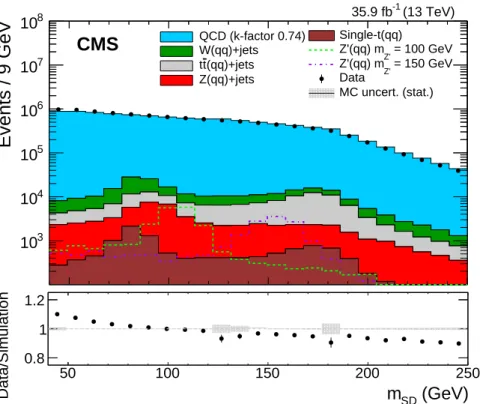
energy fraction relative to the whole jet at which jet declustering into subjet pairs is stopped. The parameter β adds additional angular requirements on the jet declustering. For β=0, these requirements are neglected, and approximately the same fraction of energy is groomed away regardless of the initial jet energy [61]. The soft-drop grooming reduces the jet mass for QCD background jets when large masses arise from soft gluon radiation. In contrast, the jet mass for merged Z0 → qq and W/Z→qq jets comes from the kinematic distributions of the decay, and is largely unchanged by grooming. Figure 1 shows the distributions of mSDfor data and
simulation, after the jet kinematic selection.
In this paper, the dimensionless scaling variable ρ [60, 62], defined as ρ= ln(m2
SD/p2T), is used
in the characterization of the correlation of jet substructure variables with the jet mass and pT. For QCD jets, the distribution of ρ is approximately invariant under a change of jet pT, in
the region where perturbative contributions dominate and scale as (mSD/pT). This property
does not hold in two regimes: in the low mass region below ρ ≈ −6, where non-perturbative effects are large and scale as (1/mSD) instead, and in the high mass region above ρ ≈ −2. The
departure from ρ invariance in the latter case arises because the cone size of the AK8 jets is insufficient to provide complete containment at high masses. Consequently, only events in the range −5.5 < ρ < −2.0 are considered. This requirement is fully efficient for the Z0 boson
signal and roughly translates to a mSDrange from 25 GeV to 185 GeV at pT =500 GeV.
In addition to the jet mass, the observable N21[63] is used to discriminate the two-prong struc-ture of the jets from the Z0 →qq decay from the hadronization products of single light quarks or gluons, which are overwhelmingly one-prong. This jet substructure variable is defined from a combination of generalized energy correlation functions ven, sensitive to correlations of v
4 3 Event simulation and selection (GeV) SD m 50 100 150 200 250
Events / 9 GeV
3 10 4 10 5 10 6 10 7 10 8 10 QCD (k-factor 0.74) W(qq)+jets (qq)+jets t t Z(qq)+jets Single-t(qq) = 100 GeV Z' Z'(qq) m = 150 GeV Z' Z'(qq) m Data MC uncert. (stat.) (13 TeV) -1 35.9 fbCMS
(GeV) SD m 50 100 150 200 250 Data/Simulation 0.8 1 1.2Figure 1: Distributions of data (points) and simulated backgrounds (histograms), of the leading pT jet soft-drop mass after the jet kinematic selection. Dashed lines illustrate the signal
contri-bution for different Z0 boson masses. The multijet processes (QCD) dominate the background component, with subdominant contributions from inclusive SM W, Z, and tt and single top quark processes. The QCD simulation is corrected by an overall factor of 0.74 to match the data yield.
pairwise angles among n-jet constituents [63]. In particular, the 2-point (1e2) and 3-point (2e3)
correlation functions are defined as:
1e2=
∑
1≤i<j≤n zizj∆Rij, (1) 2e3=∑
1≤i<j<k≤n zizjzkmin{∆Rij∆Rik,∆Rij∆Rjk,∆Rik∆Rjk}, (2)where zi represents the energy fraction of the constituent i in the jet and ∆Rij is the angular
separation between constituents i and j. For a two-prong structure, signal jets have a stronger 2-point correlation than a 3-point correlation. The discriminant variable N21is then constructed via the ratio:
N21 = 2e3 (1e2)2
. (3)
The energy correlation functions are computed from the jet constituents after the soft-drop grooming has been applied, thereby reducing their dependence on the jet mass and pT[63].
The N21observable has excellent performance in discriminating two-prong signal jets from mul-tijet QCD background jets [63]. However, N21 and similar variables are correlated with the jet mass and pT. A selection based on N21would distort the jet mass distribution, with the amount
of distortion depending on the pTof the jet. This would make the search for a resonant peak in
5
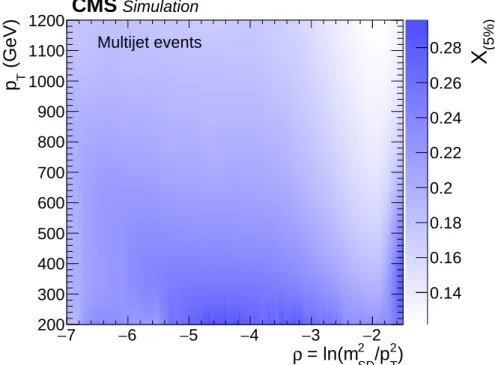
The key feature of our approach is that the application of the substructure requirement pre-serves the shape of the soft-drop jet mass distribution. Improving on the decorrelation pro-cedure proposed in Ref. [62], we apply a DDT (designed decorrelated tagger) transformation of N21 to N21,DDT. It is defined as N21,DDT(ρ, pT) ≡ N21(ρ, pT) −X(5%)(ρ, pT), where X(5%) is de-rived from the simulated N21 distribution and illustrated in Fig. 2. We require events to pass the N21,DDT(ρ, pT) <0 selection, such that we select a fixed 5% of QCD multijet events
indepen-dent of ρ and pT. The distribution of X(5%)is smoothed using a distance weighted k-nearest neighbor (kNN) approach [64]. The chosen percentile maximizes the sensitivity to the Z0boson signal.
)
2 T/p
2 SD= ln(m
ρ
7 − −6 −5 −4 −3 −2(GeV)
Tp
200 300 400 500 600 700 800 900 1000 1100 1200 (5%)X
0.14 0.16 0.18 0.2 0.22 0.24 0.26 0.28CMS
Simulation Multijet eventsFigure 2: The distribution of X(5%) used to define the N21,DDT variable, corresponding to the
5% quantile of the N21 distribution in simulated multijet events. The distribution is shown as a function of the jet ρ and pT and smoothed using a kNN approach [64]. The N21
distribu-tion is mostly insensitive to the jet ρ and pT in the kinematic phase space considered for this
analysis (−5.5 < ρ < −2.0). Residual correlations in simulation are corrected by applying a
decorrelation procedure that yields the N21,DDTvariable.
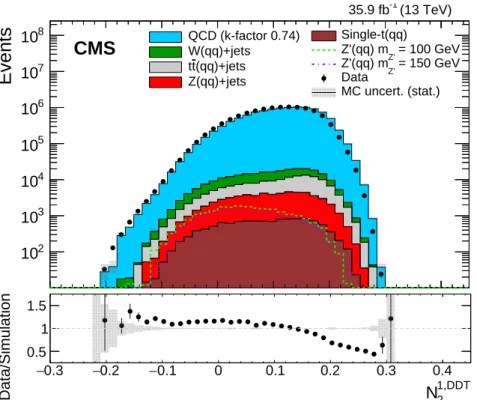
The distributions of N21,DDT for data and simulation are shown in Fig. 3 after the jet pT >
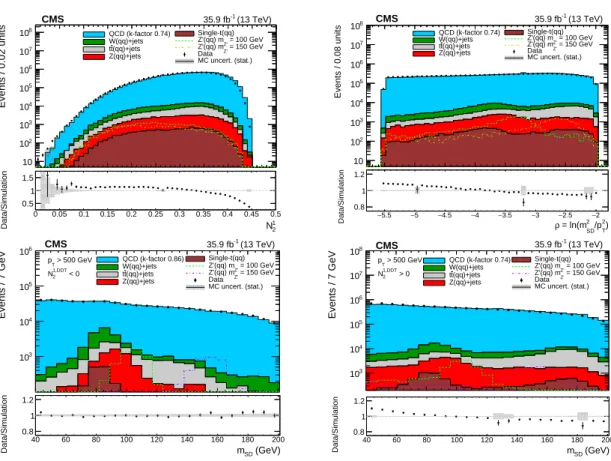
500 GeV requirement. Since there is a visible disagreement between simulation and data, the multijet background is estimated from data, as described in the next section. Additional distri-butions of kinematic observables for data and simulation are available in Appendix A.
4
Background estimate
The search is performed by looking for a resonance in the soft-drop mass distribution over background contributions dominated by QCD multijet events and smaller contributions from W(q0q)+jets, Z(qq)+jets, and top quark background processes.
To model the background contribution from pair and single top quark production we utilize simulation with data-driven corrections based on a dedicated control region. This region has
6 4 Background estimate 1,DDT 2 N 0.3 − −0.2 −0.1 0 0.1 0.2 0.3 0.4
Events
2 10 3 10 4 10 5 10 6 10 7 10 8 10 QCD (k-factor 0.74) W(qq)+jets (qq)+jets t t Z(qq)+jets Single-t(qq) = 100 GeV Z' Z'(qq) m = 150 GeV Z' Z'(qq) m Data MC uncert. (stat.) (13 TeV) -1 35.9 fbCMS
1,DDT 2 N 0.3 − −0.2 −0.1 0 0.1 0.2 0.3 0.4 Data/Simulation 0.5 1 1.5Figure 3: Distributions of data (points) and simulated backgrounds (histograms), of the N21,DDT variable for the leading pT jet after the kinematic selection. Dashed lines illustrate the signal
contribution for different Z0 boson masses. The multijet processes (QCD) dominate the back-ground component, with subdominant contributions from inclusive SM W, Z, and tt and single top quark processes. The QCD simulation is corrected by an overall factor of 0.74 to match the data yield.
the same kinematic requirements as the signal region but with the muon veto inverted. The muon is selected using dedicated muon triggers and is required to have pT > 100 GeV and
|η| <2.1 and to be in the opposite hemisphere to the selected AK8 jet. To enrich the tt
contribu-tion and reduce the multijet contaminacontribu-tion, at least one AK4 jet with pT >50 GeV is required to
pass the b-tagging medium selection based on the combined secondary vertices version-2 algo-rithm [65], which identifies AK4 jets that originate from the hadronization of b quarks. Separate scale factors correct the overall top quark background normalization and the N21,DDTefficiency for mistagging jets from top quark decays. These scale factors are SFttnorm = 0.75±0.10 and SFtmistag=0.83±0.03, respectively.
Subdominant backgrounds arising from resonant SM processes (W/Z+ jets) are estimated from simulations that include corrections to the shape and normalization from higher order NLO QCD and EW calculations. Additional data-to-simulation corrections for the jet mass shapes and N21,DDTtagging efficiencies are applied to the simulation. These corrections are evaluated from a tt control region rich in merged hadronic W bosons, as further explained below.
We estimate the main QCD multijet event background by taking advantage of the decorrelation of N21,DDTfrom ρ and pT. The fraction of events passing the N21,DDTselection is, by construction,
a constant 5% in simulated multijet events. The decorrelation ensures that the events passing and failing the selection have the same shape of the QCD jet mass distribution, and their ratio, the “pass-to-fail ratio” Rp/f, is constant for simulated multijet events. The prediction of events
7
passing the selection can then be expressed as:
nQCDpass(mSD, pT) =Rp/f(ρ(mSD, pT), pT)nQCDfail (mSD, pT), (4)
where nQCDpass and nQCDfail are the number of passing and failing events in a given mSD, pT bin.
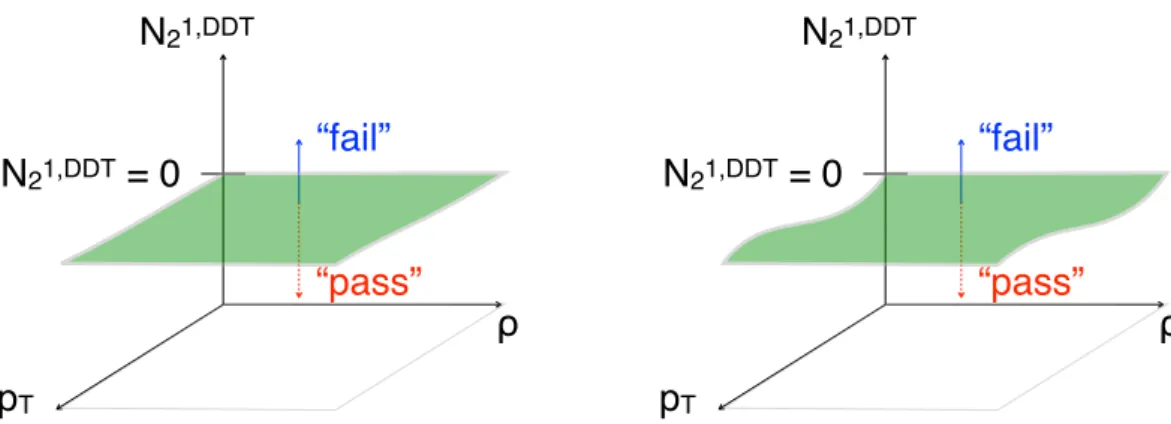
This procedure is illustrated schematically in Fig. 4. Since the distribution of ρ is expected to be invariant under a change of pT, Rp/f is parametrized as a function of ρ, which is in turn
expressed as a function of mSDand pT.
N
21,DDTp
T“fail”
“pass”
N
21,DDT= 0
ρ
N
21,DDTp
T“fail”
“pass”
N
21,DDT= 0
ρ
Figure 4: A schematic of the background estimation method. The pass-to-fail ratio, Rp/f(ρ(mSD, pT)), is defined from the events passing and failing the N21,DDTselection. The
vari-able N21,DDT is constructed so that, for simulated multijet events, Rp/f is constant (left). To
account for residual differences between data and simulation, Rp/fis extracted by performing
a two-dimensional fit to data in (ρ, pT) space (right).
Owing to residual differences between data and simulation, the correction Rp/f(ρ, pT) is
al-lowed to deviate from a constant. The deviation is modeled by expanding Rp/f(ρ, pT)into a
polynomial series in orders of ρ and pT:
Rp/f(ρ, pT) =eQCD(1+a01pT+a02p2T+ · · · (5)
+ (a10+a11pT+a12p2T+ · · · )ρ
+ (a20+a21pT+a22p2T+ · · · )ρ2+ · · · ).
The coefficients eQCD and ak` have no external constraints but are determined from a simulta-neous fit to the data events passing and failing the substructure requirement, together with the signal yield. The number of required coefficients in the fit is determined with a Fisher F-test on data [66] by iteratively adding polynomial orders. The optimum choice is found to be of fourth order in ρ and third order in pT. The fact that Rp/f varies slowly across the mSD–pT domain
is essential, since it allows one to estimate the background under a narrow signal resonance based on the events across the whole jet mass range.
5
Systematic uncertainties
Uncertainties in the multijet background arise from the fit parameter uncertainties in the pass-to-fail ratio fit described in Eq. (5). The uncertainties in the top quark background normaliza-tion (10%) and N21,DDTmistag (2%) scale factors are propagated to the signal extraction through the fit.
8 5 Systematic uncertainties
The systematic effects for the shapes and normalization of the W, Z backgrounds, and signal components are strongly correlated since they are affected by similar systematic mismeasure-ments. We constrain the jet mass scale, the jet mass resolution, and the N21,DDT selection effi-ciency using a sample of merged W boson jets in semileptonic tt events in data. In this region, events are required to have an energetic muon with pT > 100 GeV, pmissT > 80 GeV, a high-pT
AK8 jet with pT > 200 GeV, and a b-tagged AK4 jet separated from the AK8 jet by∆R > 0.8.
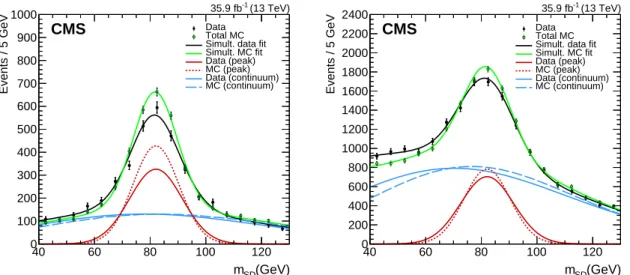
Using the same N21,DDTrequirement described above, we define samples with events that pass and fail the selection for merged W boson jets in data and simulation, shown in Fig. 5. A si-multaneous fit to the two samples is performed in order to extract the selection efficiency of a merged W jet in simulation and in data. We measure the data-to-simulation scale factor for the N21,DDT selection to be 0.88±0.10. The mass scale between data and simulation is found to be 1.10±0.05. The jet mass resolution data-to-simulation scale factor is measured to be 1.14±0.06. These scale factors determine the initial distributions of the jet mass for the W, Z boson, and signal and they are further constrained in the fit to data because of the presence of the W and Z resonances in the jet mass distribution. To account for potential deviations due to missing higher-order corrections to the simulated boson pT distributions, uncertainties are
assumed in the W and Z boson yields that are pT-dependent. An additional systematic
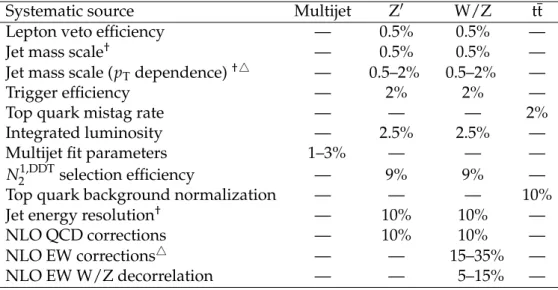
uncer-tainty is included to account for potential differences between the W and Z boson higher-order corrections. Finally, uncertainties associated to the jet energy resolution [57], trigger efficiency, lepton veto efficiency, and the integrated luminosity determination [67] are also applied to the W, Z boson, and Z0 boson signal yields. A quantitative summary of the systematic effects con-sidered is listed in Table 1.
(GeV) SD m 40 60 80 100 120 Events / 5 GeV 0 100 200 300 400 500 600 700 800 900 1000 Data Total MC Simult. data fit Simult. MC fit Data (peak) MC (peak) Data (continuum) MC (continuum) (13 TeV) -1 35.9 fb CMS (GeV) SD m 40 60 80 100 120 Events / 5 GeV 0 200 400 600 800 1000 1200 1400 1600 1800 2000 2200 2400 Data Total MC Simult. data fit Simult. MC fit Data (peak) MC (peak) Data (continuum) MC (continuum) (13 TeV) -1 35.9 fb CMS
Figure 5: Soft-drop jet mass distributions that pass (left) and fail (right) the N21,DDTselection in the semileptonic tt sample. Results of fits to data and simulation are shown.
To validate the robustness of the fit, we perform a goodness-of-fit test and bias tests using pseudo-experiments and injecting a simulated signal, for different values of Z0 boson mass. No significant bias is observed. As a further test of fit robustness, we split the region failing the N21,DDT selection into two smaller regions mimicking the passing and failing regions in the signal extraction fit. The mimicked passing-like region corresponds to a background efficiency of 60–65% and the mimicked failing-like region corresponds to an efficiency of 65–100%. We repeat our background estimation procedure on this selection as if the 60–65% efficiency region were the passing region. We find negligible biases in the fitted signal strength.
9
Table 1: Summary of the systematic uncertainties for signal and background processes and their relative size. The symbol 4 denotes uncertainties decorrelated per pT bin in the 500–
1000 GeV range. The symbol†denotes a shape uncertainty in the peaking SM W and Z boson backgrounds and Z0 boson signal shape. A long dash (—) indicates that the uncertainty does not apply.
Systematic source Multijet Z0 W/Z tt
Lepton veto efficiency — 0.5% 0.5% —
Jet mass scale† — 0.5% 0.5% —
Jet mass scale (pT dependence)†4 — 0.5–2% 0.5–2% —
Trigger efficiency — 2% 2% —
Top quark mistag rate — — — 2%
Integrated luminosity — 2.5% 2.5% —
Multijet fit parameters 1–3% — — —
N21,DDTselection efficiency — 9% 9% —
Top quark background normalization — — — 10%
Jet energy resolution† — 10% 10% —
NLO QCD corrections — 10% 10% —
NLO EW corrections4 — — 15–35% —
NLO EW W/Z decorrelation — — 5–15% —
6
Results
We combine the estimates of the various SM background processes and search for a potential signal from a Z0resonance in the mass range from 50 to 300 GeV. A binned maximum likelihood fit to the observed shape of the soft-drop jet mass distribution is performed simultaneously in the passing and failing regions of five pT ranges whose boundaries are: 500, 600, 700, 800, 900
and 1000 GeV. The number of observed events is consistent with the predicted background from SM processes. Figure 6 shows the soft-drop jet mass distribution for data and measured background contributions in the different pTranges for a Z0mass of 135 GeV; the W and Z boson
contributions are clearly visible in the data. The mSDdistribution for data in the combined pT
ranges is available in Appendix A.
The results are interpreted in terms of 95% confidence level (CL) upper limits on the produc-tion cross secproduc-tion. Upper limits are computed using the modified frequentist approach for confidence levels (CLs); taking the profile likelihood as the test statistic [68, 69] in the
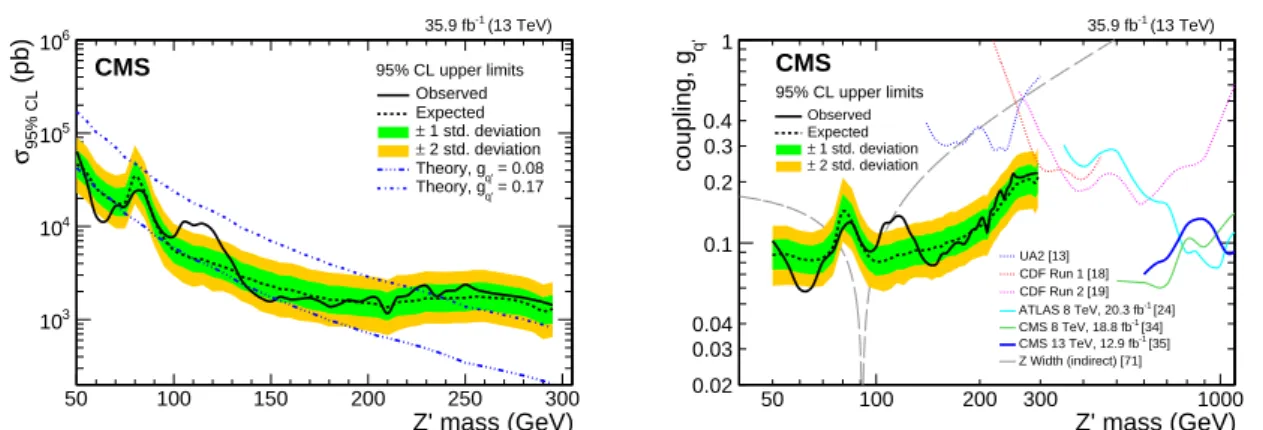
asymp-totic approximation [70]. They are shown as a function of the resonance mass in Fig. 7 (left), where they are compared to cross sections for a model of a leptophobic Z0resonance with quark coupling gq0value of either 0.17 or 0.08 that are close to our current sensitivity. Systematic
un-certainties are treated as nuisance parameters, which are modeled with log-normal priors and profiled over in the limit calculations. The maximum local observed p-value corresponds to 2.9 standard deviations from the background-only expectation at a Z0 boson mass of 115 GeV, and the global significance, calculated over the probed mass range [71], corresponds to approx-imately 2.2 standard deviations.
Upper limits on the signal cross section are translated into the coupling gq0as a function of Z0
boson mass, related to the Z0 coupling convention of Ref. [37] by gq0 = gB/6. Coupling values
above the solid curves are excluded. In Fig. 7 (right), we show previous results from UA2, CDF, ATLAS and CMS experiments. Indirect constraints from the hadronic Z boson partial width measurement and limits from the UA2 and CDF experiments are interpreted from [37].
10 6 Results (GeV) SD m 40 60 80 100 120 140 160 180 Events / 5 GeV 0 5000 10000 15000 20000
25000 DataTotal SM pred. W(qq)+jets (Z(qq)+jets (××3)3)
Multijet pred. t/tt(qq)+jets (×3) =135 GeV Z' =0.17, m q' Z'(qq), g (13 TeV) -1 35.9 fb CMS : 500-600 GeV T p (GeV) SD m 50 100 150 Data/Prediction 0.9 1 1.1 (GeV) SD m 60 80 100 120 140 160 180 200 220 Events / 5 GeV 0 1000 2000 3000 4000 5000 6000 7000 8000 Data W(qq)+jets (×3) Total SM pred. Z(qq)+jets (×3) Multijet pred. t/tt(qq)+jets (×3)
=135 GeV Z' =0.17, m q' Z'(qq), g (13 TeV) -1 35.9 fb CMS : 600-700 GeV T p (GeV) SD m 60 80 100 120 140 160 180 200 220 Data/Prediction 0.9 1 1.1 (GeV) SD m 60 80 100 120 140 160 180 200 220 240 Events / 5 GeV 0 500 1000 1500 2000 2500 Data W(qq)+jets (×3) Total SM pred. Z(qq)+jets (×3) Multijet pred. t/tt(qq)+jets (×3)
=135 GeV Z' =0.17, m q' Z'(qq), g (13 TeV) -1 35.9 fb CMS : 700-800 GeV T p (GeV) SD m 50 100 150 200 250 Data/Prediction 0.8 1 1.2 (GeV) SD m 100 150 200 250 300 Events / 5 GeV 0 100 200 300 400 500 600 700 800 900 Data W(qq)+jets (×3)
Total SM pred. Z(qq)+jets (×3) Multijet pred. t/tt(qq)+jets (×3)
=135 GeV Z' =0.17, m q' Z'(qq), g (13 TeV) -1 35.9 fb CMS : 800-900 GeV T p (GeV) SD m 100 150 200 250 300 Data/Prediction 0.8 1 1.2 (GeV) SD m 100 150 200 250 300 Events / 5 GeV 0 50 100 150 200 250 300 350 400 450 Data W(qq)+jets (×3) Total SM pred. Z(qq)+jets (×3) Multijet pred. t/tt(qq)+jets (×3)
=135 GeV Z' =0.17, m q' Z'(qq), g (13 TeV) -1 35.9 fb CMS : 900-1000 GeV T p (GeV) SD m 100 150 200 250 300 Data/Prediction 0.6 0.8 1 1.2 1.4
Figure 6: Soft-drop jet mass distribution for the different pT ranges of the fit from 500 to
1000 GeV. Data are shown as black points. The multijet background prediction, including uncertainties, is shown by the shaded bands. Contributions from the W and Z boson, and top quark background processes are shown, scaled up by a factor of 3 for clarity. A hypothetical Z0 boson signal at a mass of 135 GeV is also indicated. In the bottom panel, the ratio of the data to the background prediction, including uncertainties, is shown. The scale on the x-axis differs for each pTrange due to the kinematic selection on ρ.
11 Z' mass (GeV) 50 100 150 200 250 300 (pb) 95% CL σ 3 10 4 10 5 10 6 10 CMS (13 TeV) -1 35.9 fb 95% CL upper limits Observed Expected 1 std. deviation ± 2 std. deviation ± = 0.08 q' Theory, g = 0.17 q' Theory, g Z' mass (GeV) 50 100 200 300 1000 q' coupling, g 0.02 0.03 0.04 0.1 0.2 0.3 0.4 1 CMS (13 TeV) -1 35.9 fb 95% CL upper limits UA2 [13] CDF Run 1 [18] CDF Run 2 [19] [24] -1 ATLAS 8 TeV, 20.3 fb [34] -1 CMS 8 TeV, 18.8 fb [35] -1 CMS 13 TeV, 12.9 fb Z Width (indirect) [71] Observed Expected 1 std. deviation ± 2 std. deviation ±
Figure 7: The 95% CL upper limits on the Z0 boson production cross section compared to the-oretical cross sections (left) and on the quark coupling gq0 as a function of resonance mass for
a leptophobic Z0 resonance that only couples to quarks (right). The observed limits (solid), expected limits (dashed) and their variation at the 1 and 2 standard deviation levels (shaded bands) are shown. Limits from other relevant searches and an indirect constraint on a potential Z0signal from the SM Z boson width [72] are also shown.
The results of this analysis can be used to constrain simplified models of DM. Figure 8 shows the excluded values at 95% CL of mediator mass (mMed) as a function of the dark matter particle
mass (mDM) for vector mediators, in simplified models that assume a leptophobic mediator that
couples only to quarks and DM particles [38, 73]. Limits are shown for a choice of universal quark coupling gq =0.25 and a DM coupling gDM=1.0. The difference in limits between
axial-vector and axial-vector mediator couplings is small and thus only constraints for the latter coupling scenario are shown. The excluded range of mediator mass (red) is between 50 and 300 GeV. The upper bound decreases to 240 GeV when mMed > 2mDM, because the branching fraction
(BR) to qq decreases as the BR to DM becomes kinematically favorable. If mMed < 2mDM, the
mediator cannot decay to DM particles and the dijet cross section from the mediator model becomes identical to that in the leptophobic Z0 model, meaning that the limits on the mediator mass in Fig. 8 are identical to the limits on the Z0 mass with a coupling gq0 = gq = 0.25. For
axial-vector mediators, the excluded values of mediator mass are expected to be identical to the excluded values in Fig. 8 when mDM > mMed/2 or mDM = 0, with differences only expected
in the transition region mMed '2mDM. Additional limits (blue) in Fig. 8 come from traditional
dijet searches [35].
7
Summary
A search for a vector resonance (Z0) decaying into a quark-antiquark pair and reconstructed as a single jet has been presented, using a data set comprising proton-proton collisions at
√
s=13 TeV, corresponding to an integrated luminosity of 35.9 fb−1. Novel substructure tech-niques are employed to identify a jet containing a Z0 boson candidate over a smoothly falling soft-drop jet mass distribution in data. No significant excess above the SM prediction is ob-served, and 95% confidence level upper limits are set on the Z0 boson coupling to quarks, gq0,
as a function of the Z0boson mass. Coupling values of gq0 >0.25 are excluded over the Z0mass
range from 50 to 300 GeV, with strong constraints for masses less than 200 GeV. The results obtained for masses from 50 to 100 GeV represent the first direct limits to be published in this range. Limits are set on a simplified model of dark matter mediators that only couple to quarks and dark matter particles, excluding vector mediators with masses between 50 and 300 GeV,
12 7 Summary (GeV) Med m 50 102 2×10² 103 2×10³ (GeV) DM m 0 200 400 600 800 1000 1200 1400 (13 TeV) -1 35.9 fb
CMS
Vector mediator Dirac fermion DM = 1.0 DM g = 0.25 q g DM = 2 x m Med M 0.12 ≥ 2 h c Ω Exclusion at 95% CL Observed Expected Boosted dijet Resolved dijet [35] -1 12.9 fb (13 TeV) -1 35.9 fbCMS
Vector mediator Dirac fermion DM = 1.0 DM g = 0.25 q g 2 10 × 5×102 5×10² 5×10² 5×10² 5 2 10 × 5Figure 8: The 95% CL observed (solid red) and expected (dashed red) excluded regions in the plane of dark matter particle mass (mDM) vs. mediator mass (mMed), for vector mediators. A
branching fraction of 100% is assumed for a leptophobic vector mediator decaying to dijets. The exclusion is computed for a quark coupling choice gq = 0.25 and for a dark matter
cou-pling gDM = 1. The excluded regions from the dijet resolved analysis (blue dot dashed lines)
using early 2016 data [35] are also shown. Results are compared to constraints from the cosmo-logical relic density of DM (light gray) determined from astrophysical measurements [74, 75] and MADDM version 2.0.6 [76, 77] as described in Ref. [78].
References 13
and using a universal quark coupling gq=0.25 and a dark matter coupling gDM=1.0.
Acknowledgments
We congratulate our colleagues in the CERN accelerator departments for the excellent perfor-mance of the LHC and thank the technical and administrative staffs at CERN and at other CMS institutes for their contributions to the success of the CMS effort. In addition, we grate-fully acknowledge the computing centres and personnel of the Worldwide LHC Computing Grid for delivering so effectively the computing infrastructure essential to our analyses. Fi-nally, we acknowledge the enduring support for the construction and operation of the LHC and the CMS detector provided by the following funding agencies: BMWFW and FWF (Aus-tria); FNRS and FWO (Belgium); CNPq, CAPES, FAPERJ, and FAPESP (Brazil); MES (Bulgaria); CERN; CAS, MoST, and NSFC (China); COLCIENCIAS (Colombia); MSES and CSF (Croatia); RPF (Cyprus); SENESCYT (Ecuador); MoER, ERC IUT, and ERDF (Estonia); Academy of Fin-land, MEC, and HIP (Finland); CEA and CNRS/IN2P3 (France); BMBF, DFG, and HGF (Ger-many); GSRT (Greece); OTKA and NIH (Hungary); DAE and DST (India); IPM (Iran); SFI (Ireland); INFN (Italy); MSIP and NRF (Republic of Korea); LAS (Lithuania); MOE and UM (Malaysia); BUAP, CINVESTAV, CONACYT, LNS, SEP, and UASLP-FAI (Mexico); MBIE (New Zealand); PAEC (Pakistan); MSHE and NSC (Poland); FCT (Portugal); JINR (Dubna); MON, RosAtom, RAS, RFBR and RAEP (Russia); MESTD (Serbia); SEIDI, CPAN, PCTI and FEDER (Spain); Swiss Funding Agencies (Switzerland); MST (Taipei); ThEPCenter, IPST, STAR, and NSTDA (Thailand); TUBITAK and TAEK (Turkey); NASU and SFFR (Ukraine); STFC (United Kingdom); DOE and NSF (USA).
Individuals have received support from the Marie-Curie programme and the European Re-search Council and Horizon 2020 Grant, contract No. 675440 (European Union); the Leventis Foundation; the A. P. Sloan Foundation; the Alexander von Humboldt Foundation; the Belgian Federal Science Policy Office; the Fonds pour la Formation `a la Recherche dans l’Industrie et dans l’Agriculture (FRIA-Belgium); the Agentschap voor Innovatie door Wetenschap en Tech-nologie (IWT-Belgium); the Ministry of Education, Youth and Sports (MEYS) of the Czech Republic; the Council of Science and Industrial Research, India; the HOMING PLUS pro-gramme of the Foundation for Polish Science, cofinanced from European Union, Regional Development Fund, the Mobility Plus programme of the Ministry of Science and Higher Ed-ucation, the National Science Center (Poland), contracts Harmonia 2014/14/M/ST2/00428, Opus 2014/13/B/ST2/02543, 2014/15/B/ST2/03998, and 2015/19/B/ST2/02861, Sonata-bis 2012/07/E/ST2/01406; the National Priorities Research Program by Qatar National Research Fund; the Programa Severo Ochoa del Principado de Asturias; the Thalis and Aristeia pro-grammes cofinanced by EU-ESF and the Greek NSRF; the Rachadapisek Sompot Fund for Post-doctoral Fellowship, Chulalongkorn University and the Chulalongkorn Academic into Its 2nd Century Project Advancement Project (Thailand); the Welch Foundation, contract C-1845; and the Weston Havens Foundation (USA).
References
[1] L. A. Anchordoqui et al., “Dijet signals for low mass strings at the LHC”, Phys. Rev. Lett.
101(2008) 241803, doi:10.1103/PhysRevLett.101.241803, arXiv:0808.0497. [2] S. Cullen, M. Perelstein, and M. E. Peskin, “TeV strings and collider probes of large extra
dimensions”, Phys. Rev. D 62 (2000) 055012, doi:10.1103/PhysRevD.62.055012, arXiv:hep-ph/0001166.
14 References
[3] J. L. Hewett and T. G. Rizzo, “Low-energy phenomenology of superstring inspired E(6) models”, Phys. Rept. 183 (1989) 193, doi:10.1016/0370-1573(89)90071-9. [4] U. Baur, I. Hinchliffe, and D. Zeppenfeld, “Excited quark production at hadron
colliders”, Int. J. Mod. Phys. A 2 (1987) 1285, doi:10.1142/S0217751X87000661. [5] U. Baur, M. Spira, and P. M. Zerwas, “Excited quark and lepton production at hadron
colliders”, Phys. Rev. D 42 (1990) 815, doi:10.1103/PhysRevD.42.815.
[6] P. H. Frampton and S. L. Glashow, “Chiral color: An alternative to the Standard Model”, Phys. Lett. B 190 (1987) 157, doi:10.1016/0370-2693(87)90859-8.
[7] R. S. Chivukula, A. Farzinnia, E. H. Simmons, and R. Foadi, “Production of massive color-octet vector bosons at next-to-leading order”, Phys. Rev. D 85 (2012) 054005, doi:10.1103/PhysRevD.85.054005, arXiv:1111.7261.
[8] E. H. Simmons, “Coloron phenomenology”, Phys. Rev. D 55 (1997) 1678, doi:10.1103/PhysRevD.55.1678, arXiv:hep-ph/9608269.
[9] T. Han, I. Lewis, and Z. Liu, “Colored resonant signals at the LHC: Largest rate and simplest topology”, JHEP 12 (2010) 085, doi:10.1007/JHEP12(2010)085, arXiv:1010.4309.
[10] E. Eichten, I. Hinchliffe, K. D. Lane, and C. Quigg, “Super collider physics”, Rev. Mod. Phys. 56 (1984) 579, doi:10.1103/RevModPhys.56.579.
[11] L. Randall and R. Sundrum, “An alternative to compactification”, Phys. Rev. Lett. 83 (1999) 4690, doi:10.1103/PhysRevLett.83.4690, arXiv:hep-th/9906064. [12] UA1 Collaboration, “Two jet mass distributions at the CERN proton-anti-proton
collider”, Phys. Lett. B 209 (1988) 127, doi:10.1016/0370-2693(88)91843-6. [13] UA2 Collaboration, “A measurement of two jet decays of the W and Z bosons at the
CERN ¯pp collider”, Z. Phys. C 49 (1991) 17, doi:10.1007/BF01570793.
[14] UA2 Collaboration, “A search for new intermediate vector mesons and excited quarks decaying to two jets at the CERN ¯pp collider”, Nucl. Phys. B 400 (1993) 3,
doi:10.1016/0550-3213(93)90395-6.
[15] CDF Collaboration, “The two jet invariant mass distribution at√s= 1.8 TeV”, Phys. Rev. D 41 (1990) 1722, doi:10.1103/PhysRevD.41.1722.
[16] CDF Collaboration, “Search for quark compositeness, axigluons and heavy particles using the dijet invariant mass spectrum observed in p ¯p collisions”, Phys. Rev. Lett. 71 (1993) 2542, doi:10.1103/PhysRevLett.71.2542.
[17] CDF Collaboration, “Search for new particles decaying to dijets in p ¯p collisions at√
s =1.8 TeV”, Phys. Rev. Lett. 74 (1995) 3538, doi:10.1103/PhysRevLett.74.3538, arXiv:hep-ex/9501001.
[18] CDF Collaboration, “Search for new particles decaying to dijets at CDF”, Phys. Rev. D 55 (1997) 5263, doi:10.1103/PhysRevD.55.R5263, arXiv:hep-ex/9702004.
[19] CDF Collaboration, “Search for new particles decaying into dijets in proton-antiproton collisions at√s=1.96 TeV”, Phys. Rev. D 79 (2009) 112002,
References 15
[20] D0 Collaboration, “Search for new particles in the two jet decay channel with the D0 detector”, Phys. Rev. D 69 (2004) 111101, doi:10.1103/PhysRevD.69.111101, arXiv:hep-ex/0308033.
[21] ATLAS Collaboration, “Search for new particles in two-jet final states in 7 TeV proton-proton collisions with the ATLAS detector at the LHC”, Phys. Rev. Lett. 105 (2010) 161801, doi:10.1103/PhysRevLett.105.161801, arXiv:1008.2461. [22] ATLAS Collaboration, “Search for new physics in dijet mass and angular distributions in
pp collisions at√s =7 TeV measured with the ATLAS detector”, New J. Phys. 13 (2011) 053044, doi:10.1088/1367-2630/13/5/053044, arXiv:1103.3864.
[23] ATLAS Collaboration, “Search for new physics in the dijet mass distribution using 1 fb−1 of pp collision data at√s=7 TeV collected by the ATLAS detector”, Phys. Lett. B 708 (2012) 37, doi:10.1016/j.physletb.2012.01.035, arXiv:1108.6311.
[24] ATLAS Collaboration, “ATLAS search for new phenomena in dijet mass and angular distributions using pp collisions at√s =7 TeV”, JHEP 01 (2013) 029,
doi:10.1007/JHEP01(2013)029, arXiv:1210.1718.
[25] ATLAS Collaboration, “Search for new phenomena in the dijet mass distribution using pp collision data at√s=8 TeV with the ATLAS detector”, Phys. Rev. D 91 (2015) 052007, doi:10.1103/PhysRevD.91.052007, arXiv:1407.1376.
[26] ATLAS Collaboration, “Search for new phenomena in dijet mass and angular
distributions from pp collisions at√s=13 TeV with the ATLAS detector”, Phys. Lett. B
754(2016) 302, doi:10.1016/j.physletb.2016.01.032, arXiv:1512.01530. [27] ATLAS Collaboration, “Search for new phenomena in dijet events using 37 fb−1of pp
collision data collected at√s =13 TeV with the ATLAS detector”, (2017). arXiv:1703.09127. Submitted to Phys. Rev. D.
[28] CMS Collaboration, “Search for dijet resonances in 7 TeV pp collisions at CMS”, Phys. Rev. Lett. 105 (2010) 211801, doi:10.1103/PhysRevLett.105.211801,
arXiv:1010.0203. [Erratum: doi:10.1103/PhysRevLett.106.029902]. [29] CMS Collaboration, “Search for resonances in the dijet mass spectrum from 7 TeV pp
collisions at CMS”, Phys. Lett. B 704 (2011) 123,
doi:10.1016/j.physletb.2011.09.015, arXiv:1107.4771.
[30] CMS Collaboration, “Search for narrow resonances and quantum black holes in inclusive and b-tagged dijet mass spectra from pp collisions at√s=7 TeV”, JHEP 01 (2013) 013, doi:10.1007/JHEP01(2013)013, arXiv:1210.2387.
[31] CMS Collaboration, “Search for narrow resonances using the dijet mass spectrum in pp collisions at√s=8 TeV”, Phys. Rev. D 87 (2013) 114015,
doi:10.1103/PhysRevD.87.114015, arXiv:1302.4794.
[32] CMS Collaboration, “Search for resonances and quantum black holes using dijet mass spectra in proton-proton collisions at√s=8 TeV”, Phys. Rev. D 91 (2015) 052009, doi:10.1103/PhysRevD.91.052009, arXiv:1501.04198.
[33] CMS Collaboration, “Search for narrow resonances decaying to dijets in proton-proton collisions at√s=13 TeV”, Phys. Rev. Lett. 116 (2016) 071801,
16 References
[34] CMS Collaboration, “Search for narrow resonances in dijet final states at√s=8 TeV with the novel CMS technique of data scouting”, Phys. Rev. Lett. 117 (2016) 031802,
doi:10.1103/PhysRevLett.117.031802, arXiv:1604.08907.
[35] CMS Collaboration, “Search for dijet resonances in proton-proton collisions at√
s =13 TeV and constraints on dark matter and other models”, Phys. Lett. B 769 (2017) 520, doi:10.1016/j.physletb.2017.02.012, arXiv:1611.03568.
[36] CMS Collaboration, “Search for low mass vector resonances decaying to quark-antiquark pairs in proton-proton collisions at√s =13 TeV”, Phys. Rev. Lett. 119 (2017) 111802, doi:10.1103/PhysRevLett.119.111802, arXiv:1705.10532.
[37] B. A. Dobrescu and F. Yu, “Coupling-mass mapping of dijet peak searches”, Phys. Rev. D
88(2013) 035021, doi:10.1103/PhysRevD.88.035021, arXiv:1306.2629. [Erratum: doi:10.1103/PhysRevD.90.079901].
[38] D. Abercrombie et al., “Dark matter benchmark models for early LHC Run-2 searches: Report of the ATLAS/CMS Dark Matter Forum”, (2015). arXiv:1507.00966. [39] CMS Collaboration, “The CMS trigger system”, JINST 12 (2017) 1020,
doi:10.1088/1748-0221/12/01/P01020, arXiv:1609.02366.
[40] CMS Collaboration, “The CMS experiment at the CERN LHC”, JINST 3 (2008) S08004, doi:10.1088/1748-0221/3/08/S08004.
[41] J. Alwall et al., “The automated computation of tree-level and next-to-leading order differential cross sections, and their matching to parton shower simulations”, JHEP 07 (2014) 079, doi:10.1007/JHEP07(2014)079, arXiv:1405.0301.
[42] J. Alwall et al., “Comparative study of various algorithms for the merging of parton showers and matrix elements in hadronic collisions”, Eur. Phys. J. C 53 (2008) 473, doi:10.1140/epjc/s10052-007-0490-5, arXiv:0706.2569.
[43] S. Frixione, P. Nason, and C. Oleari, “Matching NLO QCD computations with parton shower simulations: the POWHEG method”, JHEP 11 (2007) 070,
doi:10.1088/1126-6708/2007/11/070, arXiv:0709.2092.
[44] T. Sj ¨ostrand et al., “An introduction to PYTHIA 8.2”, Comput. Phys. Commun. 191 (2015) 159, doi:10.1016/j.cpc.2015.01.024, arXiv:1410.3012.
[45] CMS Collaboration, “Event generator tunes obtained from underlying event and multiparton scattering measurements”, Eur. Phys. J. C 76 (2016) 155,
doi:10.1140/epjc/s10052-016-3988-x, arXiv:1512.00815.
[46] GEANT4 Collaboration, “GEANT4—a simulation toolkit”, Nucl. Instrum. Meth. A 506 (2003) 250, doi:10.1016/S0168-9002(03)01368-8.
[47] NNPDF Collaboration, “Parton distributions for the LHC run II”, JHEP 04 (2015) 040, doi:10.1007/JHEP04(2015)040, arXiv:1410.8849.
[48] CMS Collaboration, “Search for dark matter produced with an energetic jet or a hadronically decaying W or Z boson at√s =13 TeV”, JHEP 07 (2017) 014, doi:10.1007/JHEP07(2017)014, arXiv:1703.01651.
References 17
[49] S. Kallweit et al., “NLO electroweak automation and precise predictions for W+multijet production at the LHC”, JHEP 04 (2015) 012, doi:10.1007/JHEP04(2015)012, arXiv:1412.5157.
[50] S. Kallweit et al., “NLO QCD+EW predictions for V+jets including off-shell vector-boson decays and multijet merging”, JHEP 04 (2016) 021, doi:10.1007/JHEP04(2016)021, arXiv:1511.08692.
[51] S. Kallweit et al., “NLO QCD+EW automation and precise predictions for V+multijet production”, in Proceedings, 50th Rencontres de Moriond, QCD and high energy interactions, p. 121. 2015. arXiv:1505.05704.
[52] J. M. Lindert et al., “Precise predictions for V+jets dark matter backgrounds”, (2017). arXiv:1705.04664.
[53] CMS Collaboration, “Particle-flow reconstruction and global event description with the CMS detector”, (2017). arXiv:1706.04965. Submitted to JINST.
[54] M. Cacciari, G. P. Salam, and G. Soyez, “The anti-ktjet clustering algorithm”, JHEP 04
(2008) 063, doi:10.1088/1126-6708/2008/04/063, arXiv:0802.1189.
[55] M. Cacciari, G. P. Salam, and G. Soyez, “FastJet user manual”, Eur. Phys. J. C 72 (2012) 1896, doi:10.1140/epjc/s10052-012-1896-2, arXiv:1111.6097.
[56] D. Bertolini, P. Harris, M. Low, and N. Tran, “Pileup per particle identification”, JHEP 10 (2014) 059, doi:10.1007/JHEP10(2014)059, arXiv:1407.6013.
[57] CMS Collaboration, “Determination of jet energy calibration and transverse momentum resolution in CMS”, JINST 6 (2011) 11002, doi:10.1088/1748-0221/6/11/P11002, arXiv:1107.4277.
[58] CMS Collaboration, “Jet energy scale and resolution in the CMS experiment in pp collisions at 8 TeV”, JINST 12 (2017) 2014,
doi:10.1088/1748-0221/12/02/P02014, arXiv:1607.03663. [59] D. Krohn, J. Thaler, and L.-T. Wang, “Jet trimming”, JHEP 02 (2010) 084,
doi:10.1007/JHEP02(2010)084, arXiv:0912.1342.
[60] M. Dasgupta, A. Fregoso, S. Marzani, and G. P. Salam, “Towards an understanding of jet substructure”, JHEP 09 (2013) 029, doi:10.1007/JHEP09(2013)029,
arXiv:1307.0007.
[61] A. J. Larkoski, S. Marzani, G. Soyez, and J. Thaler, “Soft drop”, JHEP 05 (2014) 146, doi:10.1007/JHEP05(2014)146, arXiv:1402.2657.
[62] J. Dolen et al., “Thinking outside the ROCs: Designing Decorrelated Taggers (DDT) for jet substructure”, JHEP 05 (2016) 156, doi:10.1007/JHEP05(2016)156,
arXiv:1603.00027.
[63] I. Moult, L. Necib, and J. Thaler, “New angles on energy correlation functions”, JHEP 12 (2016) 153, doi:10.1007/JHEP12(2016)153, arXiv:1609.07483.
[64] S. A. Dudani, “The distance-weighted k-nearest-neighbor rule”, IEEE Transactions on Systems, Man, and Cybernetics SMC-6 (1976) 325, doi:10.1109/TSMC.1976.5408784.
18 References
[65] CMS Collaboration, “Identification of b-quark jets with the CMS experiment”, JINST 8 (2013) 4013, doi:10.1088/1748-0221/8/04/P04013, arXiv:1211.4462.
[66] R. A. Fisher, “On the interpretation of χ2from contingency tables, and the calculation of P”, Journal of the Royal Statistical Society 85 (1922) 87, doi:10.2307/2340521.
[67] CMS Collaboration, “CMS luminosity measurements for the 2016 data taking period”, CMS Physics Analysis Summary CMS-PAS-LUM-17-001, CERN, Geneva, 2017.
[68] T. Junk, “Confidence level computation for combining searches with small statistics”, Nucl. Instrum. Meth. A 434 (1999) 435, doi:10.1016/S0168-9002(99)00498-2, arXiv:hep-ex/9902006.
[69] A. L. Read, “Presentation of search results: the CLstechnique”, J. Phys. G 28 (2002) 2693,
doi:10.1088/0954-3899/28/10/313.
[70] G. Cowan, K. Cranmer, E. Gross, and O. Vitells, “Asymptotic formulae for likelihood-based tests of new physics”, Eur. Phys. J. C 71 (2011) 1554,
doi:10.1140/epjc/s10052-011-1554-0, arXiv:1007.1727. [Erratum: doi:10.1140/epjc/s10052-013-2501-z].
[71] E. Gross and O. Vitells, “Trial factors or the look elsewhere effect in high energy physics”, Eur. Phys. J. C 70 (2010) 525, doi:10.1140/epjc/s10052-010-1470-8,
arXiv:1005.1891.
[72] B. A. Dobrescu and C. Frugiuele, “Hidden GeV-scale interactions of quarks”, Phys. Rev. Lett. 113 (2014) 061801, doi:10.1103/PhysRevLett.113.061801,
arXiv:1404.3947.
[73] G. Busoni et al., “Recommendations on presenting LHC searches for missing transverse energy signals using simplified s-channel models of dark matter”, (2016).
arXiv:1603.04156.
[74] WMAP Collaboration, “Wilkinson Microwave Anisotropy Probe (WMAP) three year results: implications for cosmology”, Astrophys. J. Suppl. 170 (2007) 377,
doi:10.1086/513700, arXiv:astro-ph/0603449.
[75] Planck Collaboration, “Planck 2013 results. XVI. Cosmological parameters”, Astron. Astrophys. 571 (2014) A16, doi:10.1051/0004-6361/201321591,
arXiv:1303.5076.
[76] M. Backovic, K. Kong, and M. McCaskey, “MadDM v.1.0: Computation of dark matter relic abundance using MadGraph5”, Phys. Dark Univ. 5 (2014) 18,
doi:10.1016/j.dark.2014.04.001, arXiv:1308.4955.
[77] M. Backovic et al., “Direct detection of dark matter with MadDM v.2.0”, Phys. Dark Univ.
9(2015) 37, doi:10.1016/j.dark.2015.09.001, arXiv:1505.04190.
[78] T. du Pree, K. Hahn, P. Harris, and C. Roskas, “Cosmological constraints on dark matter models for collider searches”, (2016). arXiv:1603.08525.
19
A
Supplementary materials
1 2 N 0 0.05 0.1 0.15 0.2 0.25 0.3 0.35 0.4 0.45 0.5 Events / 0.02 units 10 2 10 3 10 4 10 5 10 6 10 7 10 8 10 QCD (k-factor 0.74) W(qq)+jets (qq)+jets t t Z(qq)+jets Single-t(qq) = 100 GeV Z' Z'(qq) m = 150 GeV Z' Z'(qq) m Data MC uncert. (stat.) (13 TeV) -1 35.9 fb CMS 1 2 N 0 0.05 0.1 0.15 0.2 0.25 0.3 0.35 0.4 0.45 0.5 Data/Simulation 0.5 1 1.5 2) T /p 2 SD = log(m ρ 5.5 − −5 −4.5 −4 −3.5 −3 −2.5 −2 Events / 0.08 units 10 2 10 3 10 4 10 5 10 6 10 7 10 8 10 QCD (k-factor 0.74) W(qq)+jets (qq)+jets t t Z(qq)+jets Single-t(qq) = 100 GeV Z' Z'(qq) m = 150 GeV Z' Z'(qq) m Data MC uncert. (stat.) (13 TeV) -1 35.9 fb CMS ) 2 T /p 2 SD = ln(m ρ 5.5 − −5 −4.5 −4 −3.5 −3 −2.5 −2 Data/Simulation 0.8 1 1.2 (GeV) SD m 40 60 80 100 120 140 160 180 200 Events / 7 GeV 3 10 4 10 5 10 6 10 QCD (k-factor 0.86) W(qq)+jets (qq)+jets t t Z(qq)+jets Single-t(qq) = 100 GeV Z' Z'(qq) m = 150 GeV Z' Z'(qq) m Data MC uncert. (stat.) (13 TeV) -1 35.9 fb CMS < 0 1,DDT 2 N > 500 GeV T p (GeV) SD m 40 60 80 100 120 140 160 180 200 Data/Simulation 0.8 1 1.2 (GeV) SD m 40 60 80 100 120 140 160 180 200 Events / 7 GeV 3 10 4 10 5 10 6 10 7 10 8 10 QCD (k-factor 0.74) W(qq)+jets (qq)+jets t t Z(qq)+jets Single-t(qq) = 100 GeV Z' Z'(qq) m = 150 GeV Z' Z'(qq) m Data MC uncert. (stat.) (13 TeV) -1 35.9 fb CMS > 0 1,DDT 2 N > 500 GeV T p (GeV) SD m 40 60 80 100 120 140 160 180 200 Data/Simulation 0.8 1 1.2Figure 9: Distributions of data (points) and simulated backgrounds (histograms) of the leading pT jet N21 (top left) and ρ (top right) observables, after the kinematic selection. The soft-drop
jet mass distributions for the passing (bottom left) and failing (bottom right) region, defined by the N21,DDTselection, are also shown. The decorrelation ensures that the shape of the mul-tijet mass distribution in both regions is unaffected by the N21,DDT selection for different pT
ranges. Dashed lines illustrate the signal contribution for different Z0 boson masses. The mul-tijet processes (QCD) dominate the background component, with subdominant contributions from inclusive SM W, Z, and tt and single top quark processes. The QCD simulation is scaled by an overall factor of 0.74 to match the data yield. Residual differences between data and sim-ulation demonstrate the need for a background estimation method based on control samples in data.
20 A Supplementary materials
(GeV)
SDm
50 100 150 200 250 300Events / 5 GeV
0 5000 10000 15000 20000 25000 30000 35000 Data W(qq)+jets (×3)Total SM pred. Z(qq)+jets (×3)
Multijet pred. t/tt(qq)+jets (×3)
=135 GeV Z' =0.17, m q' Z'(qq), g (13 TeV) -1 35.9 fb
CMS
categories T All p (GeV) SD m 50 100 150 200 250 300 Data/Prediction 0.9 1 1.1Figure 10: Soft-drop jet mass distribution for the passing region and combined pT categories.
The multijet background prediction in the passing region is obtained using the failing region and the pass–fail ratio Rp/f(mSD, pT). Data are shown as black points. The multijet background
prediction, including uncertainties, is shown by the shaded bands. Contributions from the W and Z boson, and top quark background processes are shown, scaled up by a factor of 3 for clarity. A hypothetical Z0 boson signal at a mass of 135 GeV is also indicated. The features at 45, 185, 220 and 255 GeV in the mSDdistribution are due to the kinematic selection on ρ, which
affects each pTcategory differently. In the bottom panel, the ratio of the data to the background
21
Z' mass (GeV)
50 100 150 200 250 300Local p-value
5 − 10 4 − 10 3 − 10 2 − 10 1 − 10 1CMS
(13 TeV) -1 35.9 fb ObservedFigure 11: The observed p-value, obtained from the fit to data, as a function of the Z0 boson mass. The maximum local observed p-value, at 115 GeV, is 1.72×10⁻³and corresponds to 2.9 standard deviations from the background-only expectation, and the global p-value, calculated over the probed mass range, corresponds to 0.0138 and 2.2 standard deviations.
23
B
The CMS Collaboration
Yerevan Physics Institute, Yerevan, Armenia
A.M. Sirunyan, A. Tumasyan
Institut f ¨ur Hochenergiephysik, Wien, Austria
W. Adam, F. Ambrogi, E. Asilar, T. Bergauer, J. Brandstetter, E. Brondolin, M. Dragicevic, J. Er ¨o, M. Flechl, M. Friedl, R. Fr ¨uhwirth1, V.M. Ghete, J. Grossmann, J. Hrubec, M. Jeitler1, A. K ¨onig, N. Krammer, I. Kr¨atschmer, D. Liko, T. Madlener, I. Mikulec, E. Pree, N. Rad, H. Rohringer, J. Schieck1, R. Sch ¨ofbeck, M. Spanring, D. Spitzbart, W. Waltenberger, J. Wittmann, C.-E. Wulz1, M. Zarucki
Institute for Nuclear Problems, Minsk, Belarus
V. Chekhovsky, V. Mossolov, J. Suarez Gonzalez
Universiteit Antwerpen, Antwerpen, Belgium
E.A. De Wolf, D. Di Croce, X. Janssen, J. Lauwers, M. Van De Klundert, H. Van Haevermaet, P. Van Mechelen, N. Van Remortel
Vrije Universiteit Brussel, Brussel, Belgium
S. Abu Zeid, F. Blekman, J. D’Hondt, I. De Bruyn, J. De Clercq, K. Deroover, G. Flouris, D. Lontkovskyi, S. Lowette, I. Marchesini, S. Moortgat, L. Moreels, Q. Python, K. Skovpen, S. Tavernier, W. Van Doninck, P. Van Mulders, I. Van Parijs
Universit´e Libre de Bruxelles, Bruxelles, Belgium
D. Beghin, H. Brun, B. Clerbaux, G. De Lentdecker, H. Delannoy, B. Dorney, G. Fasanella, L. Favart, R. Goldouzian, A. Grebenyuk, T. Lenzi, J. Luetic, T. Maerschalk, A. Marinov, T. Seva, E. Starling, C. Vander Velde, P. Vanlaer, D. Vannerom, R. Yonamine, F. Zenoni, F. Zhang2
Ghent University, Ghent, Belgium
A. Cimmino, T. Cornelis, D. Dobur, A. Fagot, M. Gul, I. Khvastunov3, D. Poyraz, C. Roskas, S. Salva, M. Tytgat, W. Verbeke, N. Zaganidis
Universit´e Catholique de Louvain, Louvain-la-Neuve, Belgium
H. Bakhshiansohi, O. Bondu, S. Brochet, G. Bruno, C. Caputo, A. Caudron, P. David, S. De Visscher, C. Delaere, M. Delcourt, B. Francois, A. Giammanco, M. Komm, G. Krintiras, V. Lemaitre, A. Magitteri, A. Mertens, M. Musich, K. Piotrzkowski, L. Quertenmont, A. Saggio, M. Vidal Marono, S. Wertz, J. Zobec
Centro Brasileiro de Pesquisas Fisicas, Rio de Janeiro, Brazil
W.L. Ald´a J ´unior, F.L. Alves, G.A. Alves, L. Brito, M. Correa Martins Junior, C. Hensel, A. Moraes, M.E. Pol, P. Rebello Teles
Universidade do Estado do Rio de Janeiro, Rio de Janeiro, Brazil
E. Belchior Batista Das Chagas, W. Carvalho, J. Chinellato4, E. Coelho, E.M. Da Costa, G.G. Da Silveira5, D. De Jesus Damiao, S. Fonseca De Souza, L.M. Huertas Guativa, H. Malbouisson, M. Melo De Almeida, C. Mora Herrera, L. Mundim, H. Nogima, L.J. Sanchez Rosas, A. Santoro, A. Sznajder, M. Thiel, E.J. Tonelli Manganote4, F. Torres Da Silva De Araujo, A. Vilela Pereira
Universidade Estadual Paulistaa, Universidade Federal do ABCb, S˜ao Paulo, Brazil
S. Ahujaa, C.A. Bernardesa, T.R. Fernandez Perez Tomeia, E.M. Gregoresb, P.G. Mercadanteb, S.F. Novaesa, Sandra S. Padulaa, D. Romero Abadb, J.C. Ruiz Vargasa
Institute for Nuclear Research and Nuclear Energy of Bulgaria Academy of Sciences
24 B The CMS Collaboration
University of Sofia, Sofia, Bulgaria
A. Dimitrov, L. Litov, B. Pavlov, P. Petkov
Beihang University, Beijing, China
W. Fang6, X. Gao6, L. Yuan
Institute of High Energy Physics, Beijing, China
M. Ahmad, J.G. Bian, G.M. Chen, H.S. Chen, M. Chen, Y. Chen, C.H. Jiang, D. Leggat, H. Liao, Z. Liu, F. Romeo, S.M. Shaheen, A. Spiezia, J. Tao, C. Wang, Z. Wang, E. Yazgan, H. Zhang, S. Zhang, J. Zhao
State Key Laboratory of Nuclear Physics and Technology, Peking University, Beijing, China
Y. Ban, G. Chen, J. Li, Q. Li, S. Liu, Y. Mao, S.J. Qian, D. Wang, Z. Xu
Universidad de Los Andes, Bogota, Colombia
C. Avila, A. Cabrera, L.F. Chaparro Sierra, C. Florez, C.F. Gonz´alez Hern´andez, J.D. Ruiz Alvarez, M.A. Segura Delgado
University of Split, Faculty of Electrical Engineering, Mechanical Engineering and Naval Architecture, Split, Croatia
B. Courbon, N. Godinovic, D. Lelas, I. Puljak, P.M. Ribeiro Cipriano, T. Sculac
University of Split, Faculty of Science, Split, Croatia
Z. Antunovic, M. Kovac
Institute Rudjer Boskovic, Zagreb, Croatia
V. Brigljevic, D. Ferencek, K. Kadija, B. Mesic, A. Starodumov7, T. Susa
University of Cyprus, Nicosia, Cyprus
M.W. Ather, A. Attikis, G. Mavromanolakis, J. Mousa, C. Nicolaou, F. Ptochos, P.A. Razis, H. Rykaczewski
Charles University, Prague, Czech Republic
M. Finger8, M. Finger Jr.8
Universidad San Francisco de Quito, Quito, Ecuador
E. Carrera Jarrin
Academy of Scientific Research and Technology of the Arab Republic of Egypt, Egyptian Network of High Energy Physics, Cairo, Egypt
E. El-khateeb9, S. Elgammal10, A. Ellithi Kamel11
National Institute of Chemical Physics and Biophysics, Tallinn, Estonia
R.K. Dewanjee, M. Kadastik, L. Perrini, M. Raidal, A. Tiko, C. Veelken
Department of Physics, University of Helsinki, Helsinki, Finland
P. Eerola, H. Kirschenmann, J. Pekkanen, M. Voutilainen
Helsinki Institute of Physics, Helsinki, Finland
J. Havukainen, J.K. Heikkil¨a, T. J¨arvinen, V. Karim¨aki, R. Kinnunen, T. Lamp´en, K. Lassila-Perini, S. Laurila, S. Lehti, T. Lind´en, P. Luukka, H. Siikonen, E. Tuominen, J. Tuominiemi
Lappeenranta University of Technology, Lappeenranta, Finland
T. Tuuva
IRFU, CEA, Universit´e Paris-Saclay, Gif-sur-Yvette, France
25
P. Gras, G. Hamel de Monchenault, P. Jarry, I. Kucher, C. Leloup, E. Locci, M. Machet, J. Malcles, G. Negro, J. Rander, A. Rosowsky, M. ¨O. Sahin, M. Titov
Laboratoire Leprince-Ringuet, Ecole polytechnique, CNRS/IN2P3, Universit´e Paris-Saclay, Palaiseau, France
A. Abdulsalam, C. Amendola, I. Antropov, S. Baffioni, F. Beaudette, P. Busson, L. Cadamuro, C. Charlot, R. Granier de Cassagnac, M. Jo, S. Lisniak, A. Lobanov, J. Martin Blanco, M. Nguyen, C. Ochando, G. Ortona, P. Paganini, P. Pigard, R. Salerno, J.B. Sauvan, Y. Sirois, A.G. Stahl Leiton, T. Strebler, Y. Yilmaz, A. Zabi, A. Zghiche
Universit´e de Strasbourg, CNRS, IPHC UMR 7178, F-67000 Strasbourg, France
J.-L. Agram12, J. Andrea, D. Bloch, J.-M. Brom, M. Buttignol, E.C. Chabert, N. Chanon,
C. Collard, E. Conte12, X. Coubez, J.-C. Fontaine12, D. Gel´e, U. Goerlach, M. Jansov´a, A.-C. Le Bihan, N. Tonon, P. Van Hove
Centre de Calcul de l’Institut National de Physique Nucleaire et de Physique des Particules, CNRS/IN2P3, Villeurbanne, France
S. Gadrat
Universit´e de Lyon, Universit´e Claude Bernard Lyon 1, CNRS-IN2P3, Institut de Physique Nucl´eaire de Lyon, Villeurbanne, France
S. Beauceron, C. Bernet, G. Boudoul, R. Chierici, D. Contardo, P. Depasse, H. El Mamouni, J. Fay, L. Finco, S. Gascon, M. Gouzevitch, G. Grenier, B. Ille, F. Lagarde, I.B. Laktineh, M. Lethuillier, L. Mirabito, A.L. Pequegnot, S. Perries, A. Popov13, V. Sordini, M. Vander Donckt, S. Viret
Georgian Technical University, Tbilisi, Georgia
T. Toriashvili14
Tbilisi State University, Tbilisi, Georgia
Z. Tsamalaidze8
RWTH Aachen University, I. Physikalisches Institut, Aachen, Germany
C. Autermann, L. Feld, M.K. Kiesel, K. Klein, M. Lipinski, M. Preuten, C. Schomakers, J. Schulz, V. Zhukov13
RWTH Aachen University, III. Physikalisches Institut A, Aachen, Germany
A. Albert, E. Dietz-Laursonn, D. Duchardt, M. Endres, M. Erdmann, S. Erdweg, T. Esch, R. Fischer, A. G ¨uth, M. Hamer, T. Hebbeker, C. Heidemann, K. Hoepfner, S. Knutzen, M. Merschmeyer, A. Meyer, P. Millet, S. Mukherjee, T. Pook, M. Radziej, H. Reithler, M. Rieger, F. Scheuch, D. Teyssier, S. Th ¨uer
RWTH Aachen University, III. Physikalisches Institut B, Aachen, Germany
G. Fl ¨ugge, B. Kargoll, T. Kress, A. K ¨unsken, T. M ¨uller, A. Nehrkorn, A. Nowack, C. Pistone, O. Pooth, A. Stahl15
Deutsches Elektronen-Synchrotron, Hamburg, Germany
M. Aldaya Martin, T. Arndt, C. Asawatangtrakuldee, K. Beernaert, O. Behnke, U. Behrens, A. Berm ´udez Mart´ınez, A.A. Bin Anuar, K. Borras16, V. Botta, A. Campbell, P. Connor, C. Contreras-Campana, F. Costanza, C. Diez Pardos, G. Eckerlin, D. Eckstein, T. Eichhorn, E. Eren, E. Gallo17, J. Garay Garcia, A. Geiser, J.M. Grados Luyando, A. Grohsjean,
P. Gunnellini, M. Guthoff, A. Harb, J. Hauk, M. Hempel18, H. Jung, M. Kasemann, J. Keaveney, C. Kleinwort, I. Korol, D. Kr ¨ucker, W. Lange, A. Lelek, T. Lenz, J. Leonard, K. Lipka, W. Lohmann18, R. Mankel, I.-A. Melzer-Pellmann, A.B. Meyer, G. Mittag, J. Mnich,
26 B The CMS Collaboration
A. Mussgiller, E. Ntomari, D. Pitzl, A. Raspereza, M. Savitskyi, P. Saxena, R. Shevchenko, S. Spannagel, N. Stefaniuk, G.P. Van Onsem, R. Walsh, Y. Wen, K. Wichmann, C. Wissing, O. Zenaiev
University of Hamburg, Hamburg, Germany
R. Aggleton, S. Bein, V. Blobel, M. Centis Vignali, T. Dreyer, E. Garutti, D. Gonzalez, J. Haller, A. Hinzmann, M. Hoffmann, A. Karavdina, R. Klanner, R. Kogler, N. Kovalchuk, S. Kurz, T. Lapsien, D. Marconi, M. Meyer, M. Niedziela, D. Nowatschin, F. Pantaleo15, T. Peiffer, A. Perieanu, C. Scharf, P. Schleper, A. Schmidt, S. Schumann, J. Schwandt, J. Sonneveld, H. Stadie, G. Steinbr ¨uck, F.M. Stober, M. St ¨over, H. Tholen, D. Troendle, E. Usai, A. Vanhoefer, B. Vormwald
Institut f ¨ur Experimentelle Kernphysik, Karlsruhe, Germany
M. Akbiyik, C. Barth, M. Baselga, S. Baur, E. Butz, R. Caspart, T. Chwalek, F. Colombo, W. De Boer, A. Dierlamm, N. Faltermann, B. Freund, R. Friese, M. Giffels, M.A. Harrendorf, F. Hartmann15, S.M. Heindl, U. Husemann, F. Kassel15, S. Kudella, H. Mildner, M.U. Mozer, Th. M ¨uller, M. Plagge, G. Quast, K. Rabbertz, M. Schr ¨oder, I. Shvetsov, G. Sieber, H.J. Simonis, R. Ulrich, S. Wayand, M. Weber, T. Weiler, S. Williamson, C. W ¨ohrmann, R. Wolf
Institute of Nuclear and Particle Physics (INPP), NCSR Demokritos, Aghia Paraskevi, Greece
G. Anagnostou, G. Daskalakis, T. Geralis, A. Kyriakis, D. Loukas, I. Topsis-Giotis
National and Kapodistrian University of Athens, Athens, Greece
G. Karathanasis, S. Kesisoglou, A. Panagiotou, N. Saoulidou
National Technical University of Athens, Athens, Greece
K. Kousouris
University of Io´annina, Io´annina, Greece
I. Evangelou, C. Foudas, P. Gianneios, P. Katsoulis, P. Kokkas, S. Mallios, N. Manthos, I. Papadopoulos, E. Paradas, J. Strologas, F.A. Triantis, D. Tsitsonis
MTA-ELTE Lend ¨ulet CMS Particle and Nuclear Physics Group, E ¨otv ¨os Lor´and University, Budapest, Hungary
M. Csanad, N. Filipovic, G. Pasztor, O. Sur´anyi, G.I. Veres19
Wigner Research Centre for Physics, Budapest, Hungary
G. Bencze, C. Hajdu, D. Horvath20, ´A. Hunyadi, F. Sikler, V. Veszpremi
Institute of Nuclear Research ATOMKI, Debrecen, Hungary
N. Beni, S. Czellar, J. Karancsi21, A. Makovec, J. Molnar, Z. Szillasi
Institute of Physics, University of Debrecen, Debrecen, Hungary
M. Bart ´ok19, P. Raics, Z.L. Trocsanyi, B. Ujvari
Indian Institute of Science (IISc), Bangalore, India
S. Choudhury, J.R. Komaragiri
National Institute of Science Education and Research, Bhubaneswar, India
S. Bahinipati22, S. Bhowmik, P. Mal, K. Mandal, A. Nayak23, D.K. Sahoo22, N. Sahoo, S.K. Swain
Panjab University, Chandigarh, India
S. Bansal, S.B. Beri, V. Bhatnagar, R. Chawla, N. Dhingra, A.K. Kalsi, A. Kaur, M. Kaur, S. Kaur, R. Kumar, P. Kumari, A. Mehta, J.B. Singh, G. Walia