F
ACULDADE DE
C
IÊNCIAS
D
EPARTAMENTO DE
B
IOLOGIA
V
EGETAL
S
TUDIES ON THE INVOLVEMENT OF QUORUM SENSING IN THE
REGULATION OF EXOPOLYSACCHARIDE BIOSYNTHESIS BY
BURKHOLDERIA CEPACIA COMPLEX ISOLATES
Vítor Hugo Jorge de Oliveira
M
ESTRADO EM
M
ICROBIOLOGIA
A
PLICADA
ii
U
NIVERSIDADE DE
L
ISBOA
F
ACULDADE DE
C
IÊNCIAS
D
EPARTAMENTO DE
B
IOLOGIA
V
EGETAL
S
TUDIES ON THE INVOLVEMENT OF QUORUM SENSING IN THE
REGULATION OF EXOPOLYSACCHARIDE BIOSYNTHESIS BY
BURKHOLDERIA CEPACIA COMPLEX ISOLATES
Dissertação orientada pela Profª. Doutora Leonilde Moreira (IBB-IST)
e pelo Prof. Doutor Mário Santos (FCUL)
Vítor Hugo Jorge de Oliveira
M
ESTRADO EM
M
ICROBIOLOGIA
A
PLICADA
iii
S
TUDIES ON THE INVOLVEMENT OF QUORUM SENSING IN THE
REGULATION OF EXOPOLYSACCHARIDE BIOSYNTHESIS BY
BURKHOLDERIA CEPACIA COMPLEX ISOLATES
Vítor Hugo Jorge de Oliveira
M
ASTER
T
HESIS
2012
This thesis was fully performed at the Institute for Biotechnology and
Bioengineering of the Instituto Superior Técnico under the direct
supervision of Prof. Dr. Leonilde Moreira and Dr. Ana Sofia Ferreira.
Prof. Dr. Mário Santos was the internal designated supervisor in the
scope of the Master in Applied Microbiology of the Faculty of
Sciences of the University of Lisbon.
iv
Acknowledgments
This master thesis reflects the support of many people who influenced the work in different ways and who I would like to thank.
First, I am very grateful to Prof. Leonilde Moreira from Instituto Superior Técnico, where my work was developed. I am most thankful for the careful support and guidance she gave me during the experimental work and during the writing of this thesis.
I would also like to thank Prof. Mário Santos, who was designated to be my internal supervisor in the scope of the Master in Applied Microbiology, and that from the beginning proved to be available.
I would like to address a special word to Doctor Ana Sofia Ferreira, co-supervisor of this work. Thank you for the advice and support throughout this work and for being always present to help me.
Furthermore, I would like to thank all members of BSRG group by their welcoming and a special acknowledge to PhD students Inês Silva and Mário Santos for all the support and suggestions they gave me during this work.
Finally, thanks also to all my friends and family for the patience and unconditional support.
v
Abstract
Quorum sensing (QS) is a cell-to-cell communication mechanism used by bacteria that produce and recognize signaling molecules named autoinducers. It is known to be involved in the regulation of different virulence factors including exopolysaccharide (EPS) biosynthesis in several pathogens. Bacteria belonging to Burkholderia cepacia complex (Bcc) are a group of related species that had emerged as important opportunistic pathogens mainly in cystic fibrosis (CF) patients. EPS produced by these bacteria plays an important role in the development of Bcc infections. Like in other bacteria, Bcc possess several QS-regulated phenotypes but little is known about the effect of this regulation mechanism in the Bcc EPS biosynthesis. Therefore, to evaluate the role of QS in such regulation, we tested the effects of acyl-homoserine lactones (AHLs) degradation by AiiA lactonase and the presence of a quorum sensing inhibitor (QSI) 4-nitro-pyridine-1-oxide (4NPO) in EPS biosynthesis inhibition. The results indicate that indeed QS regulates EPS biosynthesis in Bcc. However the signaling molecules involved are not dependent on the CepI/R QS system since an insertion mutant in the cepI gene did not inhibit the EPS production. Thus, bioinformatics analyses led to the identification of protein CbsI as another putative AHL synthase of Burkholderia.
Bcc bacteria are resistant to most of the conventional antibiotic treatments making its eradication a challenge. Thus, it has become essential to identify and develop alternative therapies to deal with these infections. The use of QSI seems a promising field to be explored. Since 4NPO was able to inhibit EPS production in Burkholderia, it was decided test its effect in several other Bcc QS-dependent phenotypes, such as motility, production of extracellular proteases and siderophores, and biofilm formation. Furthermore, its potential use as co-adjuvant of antibiotics in different Bcc species was also evaluated. The results confirmed that 4NPO is indeed affecting the tested phenotypes and increases the susceptibility to the antibiotics tested in both Bcc planktonic and sessile cells. The results also showed that 4NPO potentiates the activity of detergents such as Triton X100 and Tween 20. Since the clinical application of this compound is limited, its usage to clean and disinfect abiotic surfaces could be a possibility.
Keywords:
Burkholderia complex cepacia (Bcc), virulence factors, exopolysaccharide (EPS), quorum sensing (QS), quorum sensing inhibitors (QSI), 4-nitro-pyridine-1-oxide (4NPO)vi
Resumo
As bactérias pertences ao complexo Burkholderia cepacia (Bcc) estão divididas em 17 espécies e são consideradas patogénicas oportunistas infectando sobretudo doentes com fibrose quística (FQ). Apesar de representarem apenas uma pequena percentagem da totalidade das infecções em doentes com FQ, os danos causadas por estas bactérias apresentam uma grande heterogeneidade, uma vez que as infecções que causam podem ser infecções crónicas ou podem estar associadas a quadros clínicos mais graves, levando muitas vezes à falência das funções pulmonares, desenvolvimento de pneumonia e de septicémia, designada síndrome da cepacia. A severidade destas infecções é agravada pela possibilidade de transmissão cruzada entre pacientes e pela partilha de equipamentos de terapêutica inalatória. Consequentemente, a maioria dos centros de FQ em todo o mundo teve que implementar regras especiais de higiene hospitalar e medidas severas de isolamento de indivíduos colonizados e indivíduos não colonizados com Bcc. Adicionalmente, estas bactérias são intrinsecamente resistentes à maioria dos antibióticos clinicamente usados e à maioria dos desinfectantes. Os compostos antibacterianos, com acção bacteriostática ou bacteriocida, têm-se assim revelado pouco eficazes no tratamento destas infecções, sendo necessário recorrer a elevadas concentrações de antibióticos e ao uso combinado desses mesmos antibióticos. Torna-se, portanto, fundamental o desenvolvimento de novas estratégias que permitam um tratamento mais rápido e eficaz desta infecções.
Umas das estratégias que tem sido fortemente estudada e que se tem revelado promissora é a interferência dos mecanismos de quorum sensing (QS). Este mecanismo é dependente de uma densidade populacional elevada, permitindo a comunicação entre as bactérias de uma população através da libertação de sinais químicos, sendo os mais comuns em bactérias Gram-negativa as acil-homoserina lactonas (AHLs). Quando esses sinais se acumulam no meio e atingem um determinado nível, ocorre a activação de proteínas reguladoras que vão activar ou reprimir a expressão de genes regulados por QS, levando a comportamentos sincronizados dentro dessa população. Tem sido demonstrado que o QS está envolvido na regulação da expressão de diversos genes relacionados com a virulência. No caso das bactérias do complexo Bcc, o sistema mais conservado é constituído pela sintase cepI, que produz C6-HSL e C8-HSL, e pelo regulador de transcrição cepR, que está envolvido na expressão de genes codificantes para proteases e sideróforos, motilidade e formação de biofilmes, entre outros. Ao contrário do que ocorre em outras espécies, pouco se sabe sobre os efeitos do QS, e em
vii concreto do sistema CepI/R ao nível da regulação da síntese de exopolissacárido, um importante factor de virulência em Bcc. Trabalhos feitos anteriormente no nosso laboratório sugerem que a biossíntese deste polímero deverá ser regulada por QS. Assim, um dos objectivos deste trabalho foi compreender qual o papel do mecanismo de QS na regulação do exopolissacárido em diferentes espécies de Burkholderia. Para tal, estudaram-se os efeitos da degradação de AHLs pela lactonase AiiA e do inibidor de QS, 1-óxido- 4-nitro-piridina (4NPO) na síntese de exopolissacárido. Os resultados obtidos, sugerem que o QS está efectivamente a regular a produção de exopolissacárido em Bcc mas as moléculas sinalizadoras não são as dependentes do sistema CepI/R. Isto porque a construção de um mutante de inserção no gene cepI não aboliu a síntese do exopolissacárido. Assim sendo, utilizaram-se ferramentas bioinformáticas para identifcar outro possível sistema de QS em Burkholderia.
O segundo objectivo deste trabalho foi determinar os efeitos de um inibidor de QS descrito em Pseudomas aeruginosa, o 4NPO, em diferentes espécies do complexo Bcc, ao nível de diversos fenótipos regulados por QS, nomeadamente a mobilidade, produção de proteases extracelulares e de sideróforos e a formação de biofilmes. Uma vez que se confirmou que efectivamente o 4NPO inibe o QS em Burkholderia, decidiu-se estudar a potencial utilização deste composto como co-adjuvante de antibióticos. Para tal, testaram-se diferentes antibióticos e os resultados mostraram que o 4NPO aumenta a capacidade antibacteriana desses antimicrobioanos, tanto ao nível da inibição do crescimento das células planctónicas como ao nível da inibição da formação de biofilmes. Embora o uso clínico deste produto esteja limitado devido às suas propriedades mutagénicas, o uso de 4NPO em superfícies abióticas poderá ser uma potencial aplicação deste composto, uma vez que, também se verificou potenciar a actividade de detergentes como o Triton X100 e o Tween 20, ao nível do crescimento planctónico e do desenvolvimento de biofilmes. De acordo com estes resultados, os inibidores de QS, e o 4NPO em particular, poderão de facto ter aplicações a nível da desinfecção de superfícies e de material clínico, prevenindo o aparecimento de casos de contaminações hospitalares, que já levaram a graves surtos de Bcc em doentes com FQ.
Index
Acknowledgments ... iv
Abstract ... v
Resumo ... vi
1
Introduction ... 1
1.1 The Burkholderia genus ... 1
1.1.1 Burkholderia cepacia complex: a group of opportunistic CF pathogens ... 1
1.1.2 Virulence factores in Burkholderia ... 2
1.2 Insights into quorum sensing mechanism and functions ... 5
1.3 Quorum sensing inhibitors as antimicrobial compounds ... 7
1.4 Objectives ... 9
2
Material and Methods ... 11
2.1 Bacterial strains, plasmids and oligonucleotides ... 11
2.2 Bacterial growth conditions ... 13
2.3 DNA manipulation techniques ... 13
2.3.1 DNA extraction ... 13
2.3.2 DNA amplification by PCR ... 14
2.4 Construction of unmarked deletion mutants ... 15
2.5 Construction of a marked deletion mutant on cbsI gene ... 15
2.6 Burkholderia triparental mating ... 16
2.7 RNA manipulation techniques ... 16
2.7.1 RNA extraction and purification ... 16
2.7.2 Quantitative Real-Time PCR ... 17
2.8 Determination of 4NPO sub-lethal concentration ... 17
2.9 Determination of Minimal Inhibitory Concentration (MIC) ... 18
2.10 Phenotypic tests ... 18
2.10.1 EPS precipitation and quantification ... 18
2.10.2 Motility assays: Swimming and Swarming ... 19
2.10.3 Proteases and Siderophores production ... 19
2.10.4 Antibiotic and disinfectant susceptibility in the presence of 4NPO ... 19
2.10.5 Biofilm formation assays ... 20
2.11 Bioinformatic analyses ... 20
ii
3.1 Role of quorum-sensing in cepacian biosynthesis regulation ... 22
3.1.1 Role of a quorum sensing inhibitor in preventing EPS biosynthesis ... 23
3.1.2 Search of other AHL synthases that might control EPS biosynthesis ... 25
3.2 4NPO as a QSI in Bcc species ... 27
3.2.1 Evaluation of the effect of 4NPO in QS-dependent phenotypes ... 28
3.2.2 Effect of 4NPO as enhancer of Bcc susceptibility against antibiotics ... 30
3.2.3 Effect of 4NPO as co-adjuvant of detergents and disinfectants ... 36
4
Final remarks ... 39
5
Bibliography ... 40
1
1 Introduction
1.1 The Burkholderia genus
Bacteria belonging to the Burkholderia genus are motile, metabolically diverse Gram-negative β-proteobacteria that occupy a wide range of ecological niches including soil, industrial waste, water, clinical sources and many others [1, 2]. Burkholderia species have unusual large genomes, which contribute to the high plasticity, adaptability and capacity to colonize different environments and to survive under several stress conditions. These bacteria are able to use many unusual carbon and energy sources, being highly versatile from the metabolic point of view [3]. Some beneficial Burkholderia species establish symbiotic rhizospheric interactions with fungi, bring benefits to crops due to their ability to produce several antimicrobial compounds; promote plant growth by fixing atmospheric nitrogen in symbiosis with several plants; and can degrade natural and man-made pollutants (reviewed in [4]). On the other hand, some Burkholderia can be pathogens of plants, animals and humans [5, 6]. Among the pathogenic Burkholderia species are included B. mallei, which causes glanders in horses; B. pseudomallei that causes melioidosis; and the species belonging to Burkholderia cepacia complex (Bcc) which have emerged as important opportunistic human pathogens, especially in patients with chronic granulomatous disease (CGD), of immunocompromised individuals, and most importantly in cystic fibrosis (CF) patients [7]. Burkholderia cepacia complex comprises a group of related species that share a high level of similarity at 16S rRNA gene sequence (>97.5%) and of recA gene sequence (94% to 95%), and moderate levels of DNA-DNA hybridization (30% to 60%) [8-11].
1.1.1 Burkholderia cepacia complex: a group of opportunistic CF pathogens Cystic fibrosis is a genetic disease caused by mutations in a gene encoding the cystic fibrosis transmembrane conductance regulator (CFTR) that leads to the accumulation of a thick mucus in different organs including lungs, favoring bacterial colonization of several pathogens like Burkholderia [12, 13]. Even though Burkholderia infections affect less than 10% of the CF patients [14], it has become an extremely important opportunistic pathogen, which is associated with a worst clinical outcome and lower life expectancy. Furthermore, lung transplants are usually denied to these patients, due to the possibility of the development of cepacia syndrome characterized by necrotizing pneumonia and septicemia [15]. Bcc are highly transmissible from patient-to-patient and by contact with contaminated clinical devices, such as respiratory
2 therapy equipment, reusable temperature probes and catheters, being these bacteria resistant to the most commonly used disinfectants [16-19]. Burkholderia is also intrinsically resistant to antibiotics. Although poorly understood, the antibiotic resistance mechanisms in Bcc strains can be divided into three categories: enzyme modification, alteration of drug targets and limited permeability [20]. Permeability alterations at the membrane level play a key role in the Bcc defense mechanisms against antimicrobial agents, due to the existence of modified LPS, porins and efflux pumps, as well as the ability to produce EPS and/or form biofilms, which are thought to limit drugs access to the cell [20]. Bcc are able to cause enzyme drug modifications and target changes. These organisms are intrinsically resistant to aminoglycoside antibiotics and have high levels of lactam resistance due to the production of inducible chromosomal β-lactamases and altered penicillin-binding proteins [21]. Moreover, the capacity of antibiotic resistance in the Bcc can be highlighted by its capacity to use penicillin G as a sole carbon source [22]. Accordingly, the majority of Bcc strains are multidrug resistant and conventional antimicrobial therapies which includes the combination of two or sometimes three different antibiotics are often ineffective [19].
1.1.2 Virulence factores in Burkholderia
Multiple factors contribute to the pathogenicity of Bcc bacteria giving them the capacity to overwhelm the host defenses, to establish chronic infections that are rarely eradicated, to invade the epithelial cells, causing their necrosis, or to cross the epithelium paracelularly, enabling their dissemination into the blood stream [23]. These proprieties are due to the production of numerous virulence factors, the intrinsic resistance to antibiotics and the ability to form biofilms.
Among the virulence factors produced by Bcc bacteria there is the synthesis of lipopolysaccharide (LPS), which contains particular structural properties that neutralize the anionic charge of cell surface, being involved in the resistance to polymyxin, cationic antimicrobial peptides like protegin-1 [24] and in the prevention of bacterial phagocytosis by macrophages [25-28]. Other virulence factors are the expression of a cable pili and 22 kDa adhesin, which allow the binding to epithelial cells, induce cytotoxicity and initiate cellular apoptosis [29]; flagella, which are involved in bacteria dissemination, epithelial cells invasion, biofilm formation and induction of host responses [30]; and the biosynthesis and secretion of haemolysins, lipases, siderophores and extracellular proteases (eg. ZmpA and ZmpB), which were shown to be controlled by quorum sensing (QS) [31-33]. In particular, ZmpA and ZmpB are
3 metalloproteases involved in the disruption of host tissues and the enhancement of the host immune system, contributing to an increase of inflammation [32, 34].
The ability of Bcc bacteria to form biofilms has been shown in both environmental and clinical Bcc isolates grown in abiotic and biotic surfaces [35]. Biofilms are defined as a sessile community of bacterial cells in the stationary phase irreversibly attached to a surface, being embedded by a matrix of extracellular polymeric substances. The matrix of mature biofilms is composed of diverse substrates that include polysaccharides, proteins, nucleic acids and lipids. Biofilm communities exhibit gradients of nutrients and oxygen through the different layers of the biofilm, having the cells of the bottom lower availability of nutrients and therefore less metabolic activity [36]. These characteristics protect bacteria-forming biofilm from many environmental factors, including antibiotics, disinfectant chemicals and the host immune system. The reason it could be the limited drug diffusion and inactivation of compounds by the biofilm matrix [37, 38]. Biofilm formation involves several temporal phases as resumed in the Figure 1. The role of extracellular polymeric substances on biofilm matrix cohesiveness and biofilm disruption have been an interesting target to find chemical compounds that acting at that level, could promote biofilm detachment [39].
Figure 1 - Steps required for biofilm formation. [1] initial attachment, [2] irreversible attachment, [3-4]
maturation, [5] dispersion. Each stage of development in the diagram is paired with a photomicrograph of a developing P. aeruginosa biofilm. All photomicrographs are shown to same scale. The planktonic bacteria start to swim towards the substratum using flagella, to form loose attachments [1] on the surface forming microcolonies [2]. The microcolonies multiply and differentiate into mature biofilms where cells are embedded into a thick extracellular polymeric matrix. The biofilm can acquire mushroom- or tower-like structures [3-4]. Subsequently, it is observed a detachment of bacterial cells that can be spread to other places giving origin to new biofilms [5] (adapted from [40])
Besides being involved in biofilm formation, extracellular polysaccharides or exopolysaccharides (EPS) are considered to be important virulence features for several pathogens. In the case of Burkholderia the role of EPS in infection is not well
4 established, as some authors point out that it might have a virulence role and others consider EPS a persistence factor. Still the importance of EPS in Burkholderia adaptation to different environments, stress conditions, and to overcome the immune system has been demonstrated experimentally (reviewed in [41]), as summarized in Figure 2. Several Burkholderia EPSs have been identified and structurally characterized, but the EPS cepacian is the most common one, being produced by both Bcc and non-Bcc Burkholderia strains of clinical and environmental origin [42, 43]. Cepacian biosynthesis involves many genes, most of them encoded by bce-I and bce-II gene clusters [43-46]. Still, little is known about the mechanisms involved in the regulation of cepacian biosynthesis, with the exception of the BY-kinase BceF and the phosphotyrosine phosphatase BceD by exerting regulation at the post-translational level [47].
Figure 2 – Summary of the role of Burkholderia EPS in the adaptation to different niches (adapted from [41]). Cepacian was shown to interact with antimicrobial peptides [48]; to scavenge reactive oxygen
species (ROS), to interfere with neutrophil chemotaxis [49], to be required for the formation of mature biofilms structures [50] and to be involved in the resistance to desiccation and metal ion stress, contributing to Bcc capacity to thrive in adverse environments [43].
Quorum sensing (QS) mechanisms are known to control EPS production in other bacterial species, including nonpathogenic Sinorhizobium meliloti and the plant pathogens Erwinia stewartii and Pseudomonas syringae [51-53]. Recently, Soarez-Moreno and collaborators had shown that QS mechanisms also control EPS biosynthesis in non-Bcc plant-associated Burkholderia [54]. Accordingly, we had hypothesized that QS may also regulate cepacian biosynthesis in Bcc by acting at the transcriptional level, and that will be one of the aims of this work.
5
1.2 Insights into quorum sensing mechanism and functions
Cell-to-cell communication can be mediated by different chemical signals that are secreted, diffused and detected throughout the community. In response to such factors, signal transduction cascades are activated and induce alterations in gene expression which enable bacteria to survive in different stress conditions and consequently adjust to the surrounding environment [55]. These mechanisms are mediated by a cell-density-dependent regulatory mechanism designated by quorum sensing.
QS signaling is based on the intracellular production of low molecular weight molecules, known as autoinducers, that are either passively or actively released to external milieu. When these signal molecules reach a specific threshold, which is usually dependent on bacterial population density they bind to specific receptors (regulatory proteins) that trigger signal transduction cascades, resulting in the alteration of gene expression [56]. QS plays a central role in both symbiotic and pathogenic interactions. For instance, it regulates several virulence phenotypes and allows a coordinated “attack” to the host that is triggered only at high population density, increasing the bacterial ability to overwhelm host defenses and to establish an infection [57]. In symbiotic associations, QS has also crucial roles in root nodulation by legumes/Rhizobiaceae associations and the production of bioluminescence in squid/Vibrio fisheri symbiosis [58, 59].
The autoinducers chemical structure is highly diverse, being the most common structures presented by Gram-negative bacteria based on N-acylated-L-homoserine lactones (AHLs), while in Gram-positive bacteria QS is based on small peptides synthesis and detection [60].
The first QS system was described in the marine bacterium Vibrio fischeri, which establishes symbiotic associations with the squid Euprymna scolopes and is involved in the activation of the luciferase operon that enables bacterial bioluminescence [59, 61]. This system is composed by two proteins: LuxI, a N-acylhomoserine lactone synthase, and LuxR, a cytoplasmatic transcriptional regulator which recognizes the signal molecules constituting the LuxI/R QS-system [62]. This system represents the paradigm of QS systems that are usually composed by a synthase and a regulator protein. Several types of QS systems have been described in Gram-negative bacteria, each one presenting distinct class of signal molecules, such as N-acyl homoserine lactones, quinolones (AQs), long-chain fatty acids and fatty acid methyl esters as well as autoinducer-2 (AI-2), a group of furanone derivatives [63].
Due to substrate specificity of the LuxI-homologues and conformation restrictions of the LuxR-homologues, only specific AHLs can bind to the regulator
6 protein [64, 65]. Therefore, AHL autoinducers tend to be species specific, as only particular acyl-chains are recognized by the species producing them being associated to intraspecies communication [64, 65]. Interspecies communication is usually associated with another autoinducer class, known as autoinducer-2 (AI-2), which is present in both Gram-negative and Gram-positive bacteria being proposed as an “universal signal” for interspecies communication (reviewed in [66]).
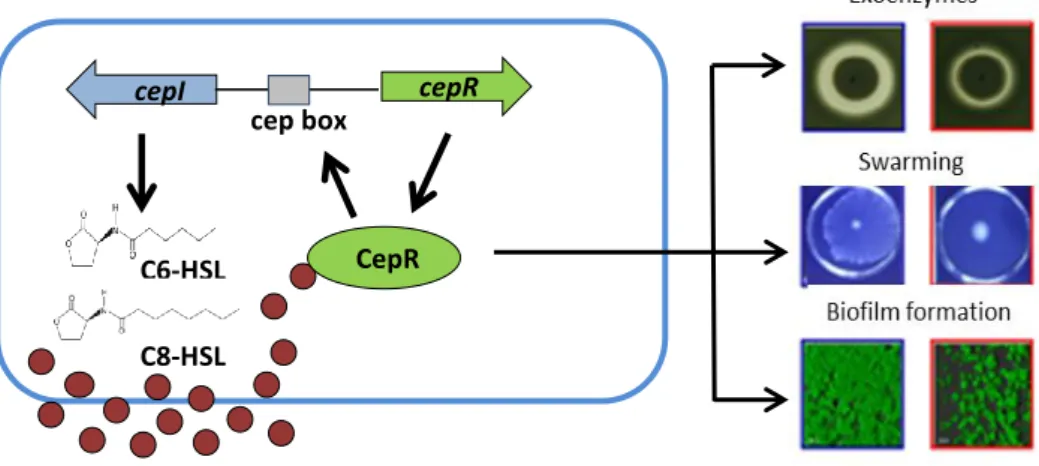
In the case of Bcc bacteria, the most well conserved QS system identified so far is based on CepI, the synthase LuxI-homologue, and CepR, the LuxR-like protein [67, 68]. The CepI protein synthesizes two AHL molecules: N-octanoyl-L-homoserine lactone (C8-HSL) and, in lower amounts, N-hexanoyl-L-homoserine lactone (C6-HSL) [69] (Figure 3). This system was shown to play a crucial role in B. cenocepacia virulence being essential for full pathogenicity in several infection models [70, 71]. CepI/R system positively regulates expression of extracellular proteases, chitinases and a polygalactunorase, as well as the swarming motility and biofilm formation; and negatively regulates the biosynthesis of the siderophore ornibactin [72-74]. Besides CepI/R homologue systems, an orphan LuxR homologue was also described in B. cenocepacia [75]. Orphan LuxR homologues are QS regulators that do not have an associated AHL synthase but respond to endogenous or exogenous synthesized AHLs [76] (Figure 3).
Figure 3 - Schematic representation of CepI/R Burkholderia QS system and some QS-regulated phenotypes (adapted from http://botserv1.uzh.ch/microbio/site/research/introduction/Burkholderia Cepacia.php).
Other AHL- based QS systems have been identified in several Burkholderia species. For instance, the B. cenocepacia CciI/R system produces and is activated by C6-HSL and C8-HSL [77]. B. vietnamiensis BviI/R system produces and responds to C10-HSL [78] and the BraI/R system from B. kururiensis synthesizes and responds to 3-oxo-C12-HSL [54]. System BraI/R was shown to control EPS biosynthesis in the
cep box
C6-HSL C8-HSL
CepR
7 plant-associated Burkholderia species [79]. Even though no BraI/R homologues can be found in the sequenced Bcc species and the Bcc EPS is slightly different from the one produced by the plant-associated Burkholderia, the results obtained by Suarez-Moreno and co-authors give a further indication that QS may control EPS production in Bcc species. Besides AHLs, other molecules have been described to be involved in QS within the Burkholderia genus such as 4-hydroxy-2-alkylquinolines (HAQ) derivative. These compounds are thought to function as iron chelators, immune modulators and antimicrobial compounds, able to inhibit bacterial growth [80]. B. cenocepacia is able to produce a diverse set of 2-alkyl-4(1H)-quinolones shown be involved in colony morphology and elastase production, and cis-2-dodecenoic acid (BDSF), a molecule structurally related to the diffusible signal factor found in Xanthomonas campestris contributing to interspecies and intraspecies communication [81-83].
1.3 Quorum sensing inhibitors as antimicrobial compounds
Considering the rapid growth of bacterial resistance against many antimicrobial compounds and the link between QS and virulence, the discovery of QS antagonists may provide a possible means to achieve new antimicrobial strategies and it has thus attracted significant attention in recent years. Many QS inhibitors (QSIs) have been described and there are a growing number of studies showing their ability to prevent and/or disrupt biofilm formation, diminish the production of virulence factors, impair the responses to oxidative stress and increase neutrophils activity against bacteria [84-88]. Accordingly, these studies point out that the use of QSIs might be the next generation of drugs against bacterial infections, as QS is directly related with the production of virulence factors that are not essential for bacterial survival. Therefore, with the selective disruption of QS, pathogens can no longer adapt to the host environment being eliminated by innate host defenses without the selective pressure associated with the conventional antibiotic treatments, which have biocide activity [86, 89].
QSI can act at several levels. For instance, the modulation of QS can occur by interfering with the synthase, with the regulator protein or with the signal itself (Figure 4) [86, 90]. Regarding QSI that act by preventing the production of autoinducers, there are studies that use small-molecule agents such as 59-methylthioadenosine (MTA) and S-adenosylmethionine (SAM) analogs to target LuxI-type synthase proteins [91]; others that use substitutes of SAM, one of the AHL’s precursors [86, 92]; and others that use autoinducer synthase blocking compounds, such as thiol derivatives and homoserine lactone derivatives [93]. Another approach used is to block the signal at the receptor level, which can be achieved by the use of antagonist compounds, capable of
8 competing or interfering with the cognate AHL signal for binding to LuxR-type receptors and both designed synthetic and natural naturally occurring substances, such as extracts from plants and food, have been tested to modulate QS at LuxR-homologues levels [94, 95]. Finally, QS inhibition can occur by manipulation of the QS signal itself. Some plants and bacteria present defense mechanisms that destroy the invading or competing bacteria autoinducers to protect themselves. For instance, some plants increase the pH at infection sites, causing hydrolysis of the lactone ring; others secrete of oxidized halogenated compounds that are capable of reacting with the 3-oxo-AHLs; some bacterial species are capable of using AHLs as a carbon and nitrogen source, others are able to breakdown AHL by secreting lactonases and acylases enzymes, others produce secondary metabolites, such as brominated furanones, that can block the action of AHLs [86, 96, 97].
Figure 4 – Different levels of quorum-sensing (QS) disrupting strategies in bacteria using quorum sensing inhibitors (QSI) (adapted from [98]).
The use of QSI as co-adjuvant of antibiotic action has been widely studied, particularly against P. aeruginosa causing CF lung infections where halogenated furanone compounds were able to inhibit biofilm formation [99] and garlic extract in combination with tobramycin enhanced the clearance of infecting bacteria in the mice pulmonary infection model [100]. Still, little is known about the potential use of QSIs against Bcc, probably due to the fact that these bacteria are able to degrade a wide variety of compounds, as some of the QSIs known to be efficient in P. aeruginosa did
9 not seem to have any effect on Bcc strains [101]. Nevertheless, Brackman and co-authors (2009, 2011) showed that same QSIs can interfere with biofilm formation and maturation in B. multivorans and B. cenocepacia [84, 102].
1.4 Objectives
Quorum sensing is known to regulate the expression of several genes that are involved in the production of virulence factors. Among the phenotypes controlled by QS, the biosynthesis of exopolysaccharides was shown to be regulated at the transcriptional level in several bacterial systems, including the plant pathogens Erwinia stewartii and Pseudomonas syringae [51, 52] and nonpathogenic species of Sinorhizobium meliloti [53]. Regarding Burkholderia species, the work of Suarez-Moreno and co-authors (2008, 2010) developed in plant-associated Burkholderia, which are non-Bcc and non-virulent species, showed that the QS system BraI/R, directing the production of oxo-C12-HSL and oxo-C14-HSL, is involved in the control of EPS biosynthesis in these species [43, 44].
Previous results from our laboratory also indicate that cepacian biosynthesis is most likely regulated by QS. In the presence of the lactonase Aiia from Bacillus subtilis which is able to hydrolyze the lactone ring of AHLs and sub-lethal concentrations of a QSI, 4-nitro-pyridine-1-oxide (4NPO), cepacian production by B. cepacia IST408 was inhibited. Therefore, one of the goals of this work was to determine if QS is indeed controlling cepacian biosynthesis in Bcc bacteria and if CepI/R system, the most well conserved QS system among Bcc species, was involved in such control or there might be another conserved system controlling this feature. To accomplish this goal we tested lactonase expression in different Bcc and non-Bcc species and evaluate whether the QSI 4NPO is also able to inhibit EPS biosynthesis. In parallel we constructed unmarked cepI and cepR genes deletion mutants to evaluate whether the AHLs produced by CepI/R QS system are the one controlling EPS expression. If these mutants still produce EPS, it is our aim to identify other QS system in a strain with the genome sequenced such as B. multivorans ATCC 17616.
The second major goal of this work is to determine if the QSI 4NPO can be used to control biofilm formation by Bcc strains, if applied as a co-adjuvant of antibiotics or detergent/disinfectants. Our previous results had shown that EPS biosynthesis by B. cepacia IST408 was inhibited by the P. aeruginosa QSI 4NPO [85] when used in sub-lethal concentrations which do not affect bacteria growth. Since 4NPO seemed to be an efficient QSI against this strain, further work was done to determine its potential as an antibiotic adjuvant. The results indicate that indeed B. cepacia IST408 susceptibility to trimethoprim, kanamycin, amikacin and piperacillin
10 was enhanced in vitro as well as in Galleria mellonella virulence model of infection, where significant survival differences were observed between the presence and absence of 4NPO supplementation with trimethoprim and kanamycin (Ferreira et. al. unpublished results). Even though the results obtained were quite promising, the application of 4NPO to humans is compromised, as previous studies in E. coli and fibroblasts showed that this compound has mutagenic activity [103, 104]. Still, 4NPO could have other biotechnological applications such as being used as disinfectant of surfaces or anti-biofouling agent, being used together with detergents or other antimicrobial compounds. The work of Vanoyan et al. (2010) showed that 4NPO has interesting physico-chemical properties that can reduce the extent of bacterial adhesion to surfaces [105]. Currently, a CF patient infected with Bcc needs to be isolated from other CF patients, requiring special treatment rooms, equipment and nursing teams, leading to an increase of costs [106]. The potential use of 4NPO or others QSI as co-adjuvant of detergents or disinfectants could prevent cross-contaminations in CF centers and hospitals. Thus, in this work, different classes of antibiotic and detergents were used to test the efficiency of 4NPO as a QSI. The chosen antibiotics are the two aminoglycosides kanamycin and amikacin (inhibitors of protein synthesis); the sulfonamide trimethoprim (folate pathway inhibitor) and the β-lactam piperacillin and ceftazidime (inhibitors of cell wall synthesis). As disinfectant agent it were used bleach solution and as detergents the anionic sodium dodeyl sulphate (SDS) and non-anionic Triton X100 (TX100) and Tween 20.
11
2 Material and Methods
2.1 Bacterial strains, plasmids and oligonucleotides
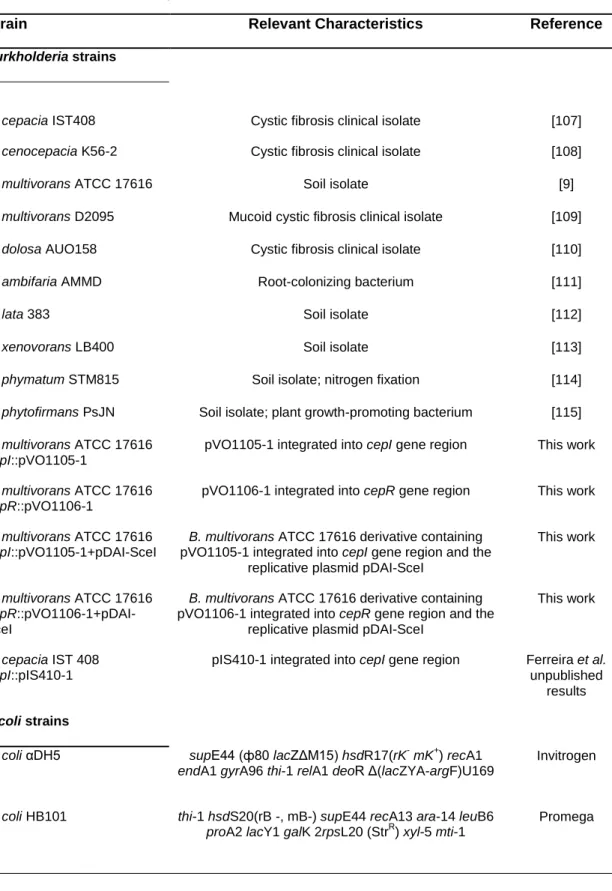
Bacterial strains and plasmid used in this work are listed on Table 1.
Table 1 – List of strains and plasmids used in this work.
Strain Relevant Characteristics Reference
Burkholderia strains
B. cepacia IST408 Cystic fibrosis clinical isolate [107]
B. cenocepacia K56-2 Cystic fibrosis clinical isolate [108]
B. multivorans ATCC 17616 Soil isolate [9]
B. multivorans D2095 Mucoid cystic fibrosis clinical isolate [109]
B. dolosa AUO158 Cystic fibrosis clinical isolate [110]
B. ambifaria AMMD Root-colonizing bacterium [111]
B. lata 383 Soil isolate [112]
B. xenovorans LB400 Soil isolate [113]
B. phymatum STM815 Soil isolate; nitrogen fixation [114]
B. phytofirmans PsJN Soil isolate; plant growth-promoting bacterium [115]
B. multivorans ATCC 17616 cepI::pVO1105-1
pVO1105-1 integrated into cepI gene region This work
B. multivorans ATCC 17616 cepR::pVO1106-1
pVO1106-1 integrated into cepR gene region This work
B. multivorans ATCC 17616 cepI::pVO1105-1+pDAI-SceI
B. multivorans ATCC 17616 derivative containing
pVO1105-1 integrated into cepI gene region and the replicative plasmid pDAI-SceI
This work
B. multivorans ATCC 17616
cepR::pVO1106-1+pDAI-SceI
B. multivorans ATCC 17616 derivative containing
pVO1106-1 integrated into cepR gene region and the replicative plasmid pDAI-SceI
This work
B. cepacia IST 408 cepI::pIS410-1
pIS410-1 integrated into cepI gene region Ferreira et al. unpublished
results
E.coli strains
E. coli αDH5 supE44 (ф80 lacZΔM15) hsdR17(rK
mK+) recA1
endA1 gyrA96 thi-1 relA1 deoR Δ(lacZYA-argF)U169
Invitrogen
E. coli HB101 thi-1 hsdS20(rB -, mB-) supE44 recA13 ara-14 leuB6 proA2 lacY1 galK 2rpsL20 (StrR) xyl-5 mti-1
12
Abbreviations: TpR trimethoprim resistance; KmR: kanamycin resistance; AmpR: ampicillin resistance; CmR, chloramphenicol resistance.
The list of oligonucleotides used in PCR and a RT-PCR amplifications is shown in Table 2. Oligonucleotides primers were designed using AmplifX 1.5.4, available at http://ifrjr.nord.univ-mrs.fr/AmplifX and synthesized by MWG Biotech AG (Germany).
Table 2 - Oligonucleotides used for PCR amplification. Abbreviations: A, Adenine; C, Cytosine; G, Guanine; T, Thymine. Primer name Sequence (5`- 3´) Primer name Sequence (5`- 3´) 1997A-fw AAGATTCAGTCTGAGATGAAGGCACGAGT RTbceH-rev CGATGTCGTCGCCTTTCC 1997A-rev AAGGTACCTCGGCAGTTCTCGCATTAG RTbceI-fw AAGTTTCGAGCGTGACCAGT TC 1997B-fw GTCTCTAGACTTCCAGACCTTCATGGCGTA RTbceI-rev AACAGCGACTTCAGCAGATA CG 1997B-rev TAGGTACCTGTTCCGACTGTCCGACATC RTbceP-fw GGACAAAGGCATACTCAAGA ACGT catKpn-up ATGGTACCTATCACGAGGCCCTTTCGTCTTC RTbceP-rev CGAAGGTCGGCAGGATCA catKpn-low CTGGTACCTGTCGTGCCAGCTGCATTA RTbceQ-fw TTCGGCGAGGACGACTATG RTbceB-fw TTCGTGAACATCCGCTTCATT RTbceQ-rev TGGAACCCGAGGAAATGC RTbceB-rev
CCGAGCACCTCGACCACTT proC-fw GTCGGCGAGATCGTATGGTT
RTbceE-fw
CCGAGACCTATCCGGTTCATT proC-rev CTGCAGCGCTTCGATGAAA
Plasmids
pMLBAD pBBR1 ori, araC-PBAD, TpR mob+ [116]
pMLBAD-aiiA
Broad-host-range vector carrying araC-PBAD-aiiA
for expression of AiiA; TpR [117]
pGPI-SceI oriR6K TPR, mob+, carries I-SceI cut site [118]
pDAI-SceI pDA17 carrying the I-SceI gene [118]
pVO1105-1 pGPI-SceI derivative containing ΔcepI gene This work
pVO1106-1 pGPI-SceI derivative containing ΔcepR gene This work
pDrive Cloning vector, AmpR KmR Qiagen
pK18mob Cloning vector, KmR [119]
pUC18 Cloning vector, Ampr [120]
pBBRIMCS Cloning vector, containing cat gene, Cmr [121]
pVO412-1
pK18mob derivative containing cbsI gene (upstream
region) This work
pVO412-2
pDrive derivative containing cbsI gene (downstream
region) This work
13 RTbceE-rev CTTTCTGCAGCTGGTCCATCA cepRa-fw TCGAATTCTGTTCCTCGGCGT GACGATTCC RTbceF-fw AAACACTCCTACGCGGATCTGT cepRa-rev ATGGATCCATCGAAGCACCC TGACGCAA RTbceF-rev CAGCCAGATGTCGTCCATGA cepRb-fw ATGGATCCTATACCGAATGG CATCGCA RtbceH-fw ACGAAAGTCCACGTCCATCTG cepRb-rev CATCTAGAGTGCCACAGCAA TTCGTCA
cepIa-fw TGAATTCTTGCGTCAGGGTGCTTCGAT cepIb-fw ATGGATCCTCGATCCGCAAA
CGTTTGCT cepIa-rev TAGGATCCTCGTGAACGAAGGTCTGCAT cepIb-rev GCGTCTAGAGTAGGGAACTG ACGAATGGGTA
2.2 Bacterial growth conditions
Burkholderia fresh cultures were obtained by inoculating a portion of the frozen material at -80oC into plates of Pseudomonas isolation agar media (PIA, Difco), followed by incubation at 37oC overnight. The cultures were then maintained at 4oC until further use. Pre-inocula required for all assays were done as followed: overnight liquid cultures were prepared by transferring one isolated bacterial colony of Burkholderia, previously grown on solid media, into LB liquid medium followed by incubating overnight at 30oC or 37oC with orbital agitation (250 rpm). Then, these cultures would be used to inoculate working cultures in the proper conditions. Burkholderia strains were cultured in S medium or MM medium (see below), at 30ºC with orbital agitation (250 rpm). E. coli strains were always grown in LB medium (Difco) and incubated at 37ºC with orbital agitation (250 rpm).
S liquid medium – 12.5 g/l Na2HPO4, 3 g/l KH2PO4, 1 g/l K2SO4, 1 g/l NaCl, 0.2 g/l MgSO4.7H2O, 0.001 g/l FeSO4.7H2O, 0.01 g/l CaCl2 2H2O, 20 g/l glucose, 1 g/l yeast extract, 1 g/l casamino acids
MM liquid medium – 2 g/l of yeast extract (Difco), 20 g/l of mannitol (Merck)
2.3 DNA manipulation techniques
2.3.1 DNA extractionPlasmid DNA was extracted from overnight cultures of E. coli host strains growing in LB medium supplemented with appropriate antibiotics, by a QIAprep Spin Miniprep kit (QIAGEN), following the manufacturer’s instructions. Total genomic DNA from Burkholderia strains was extracted according standard protocol [122]. Concentration of genomic and plasmid DNA solutions was determined on a Spectrophotometer ND-1000 (NanoDrop).
14 2.3.2 DNA amplification by PCR
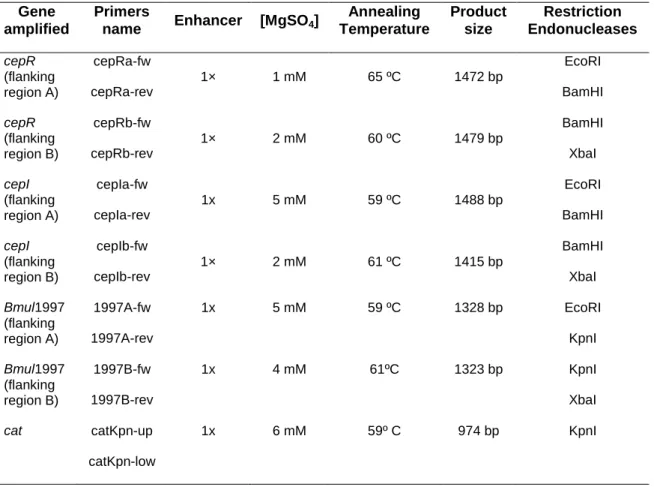
B. multivorans ATCC 17616 genomic DNA was used as template for PCR amplification of different DNA fragments required in this work. General conditions used were: 100 ng template DNA, 0.4 µM of each primer, 200 µM of deoxynucleotides and 1 U Platinum Taq DNA polymerase (Invitrogen); or 1 U TaqMed DNA polymerase in the case of cat gene amplification. Enhancer (Invitrogen) and MgSO4 concentrations were optimized for each case according to the Table 3. PCR amplification was performed on GeneAmp® PCR System 2700 (Applied Biosystems). The annealing temperature (Ta) and extension time (Te) were also optimized for each set of primers and DNA fragments as described in the Table 3. The general PCR conditions were: samples were subjected to an initial denaturation at 95ºC for 2 minutes, followed by 34 cycles of three steps: denaturation at 95ºC for 45 seconds, annealing at the optimized Ta for 30 seconds and elongation at 68ºC for text, calculated as 1 minute per kb of product expected. After the cycles, samples were submitted to a final elongation at 68ºC for 8 minutes and stored at 4ºC.
Table 3 - PCR amplification conditions and restriction endonucleases used.
Gene amplified
Primers
name Enhancer [MgSO4]
Annealing Temperature Product size Restriction Endonucleases cepR (flanking region A) cepRa-fw cepRa-rev 1× 1 mM 65 ºC 1472 bp EcoRI BamHI cepR (flanking region B) cepRb-fw cepRb-rev 1× 2 mM 60 ºC 1479 bp BamHI XbaI cepI (flanking region A) cepIa-fw cepIa-rev 1x 5 mM 59 ºC 1488 bp EcoRI BamHI cepI (flanking region B) cepIb-fw cepIb-rev 1× 2 mM 61 ºC 1415 bp BamHI XbaI Bmul1997 (flanking region A) 1997A-fw 1997A-rev 1x 5 mM 59 ºC 1328 bp EcoRI KpnI Bmul1997 (flanking region B) 1997B-fw 1997B-rev 1x 4 mM 61ºC 1323 bp KpnI XbaI cat catKpn-up catKpn-low 1x 6 mM 59º C 974 bp KpnI
15
2.4 Construction of unmarked deletion mutants
Burkholderia deletion mutations were designed according to Flannagan et al. [118]. Fragments of around 700 bp of each flanking regions of cepI and cepR genes were obtained by PCR amplification, digested with the appropriate restriction endonucleases (Table 3) and inserted into pK18mob and pUC18 cloning vectors to increase their number of copies, and selected according to white/blue selection in the respective selection marker. The digested PCR fragments were subsequently ligated into pGPI-SceI (a suicide plasmid that cannot replicate in Burkholderia and contains the I-SceI recognition site) digested with EcoRI and XbaI in a triple ligation mixture, giving rise to the plasmids pVO1105-1 (deletion of cepI) and pVO1106-1 (deletion of cepR). Selection of vectors containing the inserted regions was made on E. coli αDH5 by electrotransformation and candidates were selected based on pGPI-SceI selection marker (trimethoprim). Then, the vectors obtained were introduced into B. multivorans ATCC 17616 by triparental mating and candidates were selected based on trimethoprim resistance phenotype.
Next, pDAI-SceI, constitutively expressing the I-SceI nuclease, was introduced by triparental mating into the strains carrying the integrated mutagenic plasmid. I-SceI will causes a double strand break into the inserted plasmid sequence, stimulating the intramolecular recombination between the mutant and parental alleles. From this recombination it can be observed either the restoration of the parental allele or gene deletion. Thus, exconjungants were selected for tetracycline resistance (to select for pDAI-ISceI) and trimethoprim sensitivity (indicating the loss of the integrated pGPI-SceI plasmid). Then, the colonies were picked to LB agar in the absence to tetracycline until the loss of pDAI-SceI occurs and the mutants confirmed by PCR and Southern blot hybridization.
2.5 Construction of a marked deletion mutant on cbsI gene
Fragments of around 1400 bp of each flanking regions of cbsI gene were obtained by PCR amplification, digested with the proper restriction endonucleases (Table 3) and inserted into pK18mob and pUC18 cloning vectors to increase its number of copies and selected according to white/blue selection in the respective selection marker. Two constructions were obtained, pVO412-1 and pVO412-2. Subsequently, pVO412-2 was digested with EcoRI and KpnI, and the fragment of interest was then inserted in the digested pVO412-1, originating the pVO412-3 plasmid, carrying the flanking areas of cbsI. To insert the Cmr cassette between cbsI flanking regions, pBBRIMCS plasmid was used as template to amplify by PCR the cat gene encoding chloramphenicol acetyltransferase that was subsequently digested with KpnI. The PCR
16 fragment with around 980 bp was obtained and it was then inserted in the digested pVO412-3 plasmid. Selection of vectors containing the inserted regions and the Cmr cassette were made on E. coli αDH5 by electrotransformation and candidates were selected based on plasmid selection markers. The obtained construction was subsequently, inserted into B. multivorans ATCC 17616 by triparental mating and candidates selected by the Cmr phenotype.
2.6 Burkholderia triparental mating
Triparental conjugation was used to transfer plasmids of interest from E. coli to Burkholderia strains. The E. coli donor strain and the helper strain E. coli HB101 (pRK2013) were grown overnight at 37ºC in 30 ml of LB supplemented with appropriate antibiotics. The recipient Bcc strain was grown overnight at 30ºC in 30 ml of LB. Cells from 0.6 ml of Burkholderia culture, of donor and helper strains were harvested by centrifugation, washed with sterile 0.9% (wt/v) NaCl twice and suspended in saline solution. The three bacterial cultures were mixed together and harvested by low speed centrifugation for 5 minutes. The pellet was suspended in 80 µl of 0.9% (wt/v) NaCl and spot-inoculated on the surface of a filter Supor®-200 (13 mm diameter; 0.2 µm pore size, Pall corporation), placed onto the surface of an LB agar plate. After overnight incubation at 30ºC, the bacterial layer on the surface of the filter was suspended in 1 ml of saline solution and appropriate serial dilutions were plated on PIA supplemented with the proper antibiotic.
2.7 RNA manipulation techniques
2.7.1 RNA extraction and purificationThe time point chosen to extract RNA was the 24th hour of growth that is the time where EPS production is detected in B. multivorans ATCC 17616. Therefore, strains under study were inoculated with an initial OD640 nm 0.1 in MM medium supplemented with 1% (wt/v) of arabinose to promote the expression of Aiia lactonase, and incubated at 30ºC with orbital agitation. Similar approach was assayed with 4NPO at sub-lethal concentration. Strains carrying pMLBAD-aiiA that allows the expression of the lactonase and the addition of 4NPO to the pre-inocula were performed to evaluate their effects by comparison with the wild type strain (without lactonase/4NPO). RNA was extracted with RNeasy Mini Kit (Qiagen) following an optimized procedure. Briefly, samples of 400 µl of culture were taken and two volumes of RNA protect reagent were added, promoting mRNA stabilization. After 5 minutes of incubation at room temperature, the mixture was centrifuged and the pellet was suspended in 200 µl of TE buffer (30 mM Tris-HCl, 1 mM EDTA, pH 8.0) containing 15 mg/ml lysozyme and 15 µl
17 of proteinase K (Qiagen) were added to the suspension. After 10 min of enzymatic lysis 700 µl of RLT buffer were added, the mixture was vortexed for 10 s and 500 µl of 100% ethanol were added, mixed and transferred to a RNeasy Mini spin column. The mixture, in the columns, was then centrifuged and washed with RW1. To avoid contamination with genomic DNA, a step of DNA digestion using RNase-free DNA digestion kit (Qiagen) was introduced after wash with RW1 buffer. RNA elution was made after a second wash with RW1 buffer and a two-step RPE wash.
All steps described above were executed using RNase-free material. RNA concentration was estimated using a UV spectrophotometer (ND-1000 UV-Vis, NanoDrop Technologies, USA). RNA samples were stored at -80ºC, immediately after the extraction.
2.7.2 Quantitative Real-Time PCR
qRT-PCR was performed using a relative quantification method based on a two steps protocol. In the first step RNA was converted into cDNA and in the second step the cDNA formed was quantified. TaqManR Reverse Transcription Reagents (Applied Biosystems) were used to convert 1000 ng of total RNA to cDNA, according to the manufacturer’s instructions. The cDNA samples obtained were diluted to a proper concentration and mixtures containing 400 ng of template cDNA, 2x SYBR Green PCR Master Mix (Applied Biosystems) and 0.4 mM of reverse and forward primer for each gene under study, in a total amount of 25 µl, were prepared. Reactions were run on 7500 Instrument from Applied Biosystem. The expression ratio of the target gene was determined relative to a reference gene, proC, encoding L-proline oxidase, which did not show variation in the transcription under the conditions tested. Results were obtained from the average of three technical and three biological replicates.
2.8 Determination of 4NPO sub-lethal concentration
To determine the highest concentration of 4NPO that can be added to each Burkholderia species under study without affecting their growth, a 96-well plate microtiter dish was inoculated with the bacteria and different 4NPO concentrations and grown for 15 hours. Briefly, a stock solution of 50 mM 4NPO was prepared and 150 µl of S medium were added to each well. Two-fold serial dilutions of 4NPO were made from 500 µM to 0 µM. The wells were then inoculated with 50 µl of each bacterial species to a final OD640 nm of 0.2. Growth was followed on a Spectro star nano (BMG Labtech) at 640 nm using an appropriate kinetic program. The microtiter plate was thermostatized at 30ºC during the growth. Rows containing only S medium were used
18 as blank and negative controls to show that wells were not contaminated during the growth period.
2.9 Determination of Minimal Inhibitory Concentration (MIC)
MICs of antibiotics and disinfectant agents, in presence or absence of 4NPO, used in this study were determined in triplicate using a microdilution assay in 96-well microtiter plates. The proper amount of the disinfectant compounds, stock solutions of each antibiotic and 4NPO sub-lethal concentrations were added to the respective wells containing 300 μl of S medium and subsequently, two-fold serial dilutions of each compound were carried to test the concentrations ranging from 3300 mg/l to 6.4 mg/l, in the case of antibiotics tested, and 50% (v/v) to 0.1 % (v/v) for the disinfectants. Two rows of dilutions were made for each condition (each compound alone and in combination with 4NPO sub-lethal concentrations) being the final volume of each sample 150 μl. Wells were then inoculated with more 150 µl of the respective Burkholderia cultures to a final OD640 nm of 0.05. Rows containing only S medium or
Burkholderia culture were used as blank and positive controls, respectively. The plates were incubated for 24 h at 30oC and absorbance at 590 nm was measuring in a Spectro star nano (BMG Labtech). The results were standardized by subtraction of the negative controls absorbance from those of the corresponding inoculated wells. To each condition, the lowest concentration for which no growth was observed it was recorded as the MIC.
2.10 Phenotypic tests
Several phenotypic properties of B. multivorans ATCC 17616, B. cepacia IST408 and B. cenocepacia K56-2, in 4NPO presence and absence, were tested, as will be described.
2.10.1 EPS precipitation and quantification
To test the EPS production, strains under study were grown in S medium for 3 days, at 30ºC with orbital agitation. Samples of 2 ml were taken overtime for EPS quantification.
EPS quantification was based on the dry weight of ethanol-precipitated polysaccharide [50]. Samples were taken from Burkholderia cultures and centrifuged at 8000 rpm for 15 min to separate bacterial cells. Supernatant was then added to 2.5 volumes of cold ethanol. The EPS precipitates obtained was dried and weighted.
19 2.10.2 Motility assays: Swimming and Swarming
Several optimizations had to be performed to infer how 4NPO could affect Burkholderia motility. These included testing different media, which would allow following Bcc growth over 2 days; incubation at 30oC or 37oC; and 4NPO supplementation over the solid media surface or by incorporating the QSI into the media under test. All assays were done using 3 μl of overnight Bcc cultures standardized to an OD640 nm of 0.3 and were inoculated in swimming and swarming media with or without 4NPO supplementation. Plates were then incubated for 2 days and the halos were measured at 24 h and 48 h of incubation. The best results were obtained using the following media:
Swarming medium – 20 g/l of LB medium (Difco) supplemented with agar 0.5% (wt/v) and 5 g/l glucose
Swimming medium – 20 g/l of LB medium (Difco) supplemented with agar 0.3% (wt/v) and 5 g/l glucose
2.10.3 Proteases and Siderophores production
To test the 4NPO effect in the production of proteases and siderophores, different media were prepared. Thus, to proteases production, AL medium (12 g/l skin milk (Difco), 10 g/l peptone (Difco) and 25 g/l agar) and to siderophores production, Chrome azurol S (CAS) agar diffusion, were made. In the latter case, the modified CAS agar diffusion assay was carried out. A CAS agar diffusion assay made according to the method described by Shin et al. [123] was modified adding 20 g/l of mannitol, 2 g/l yeast extract and 15 g/l of agar (Noble, Difco) and pH adjusted to 7.0. Then, 5 µl of B. cepacia IST408 strains overnight liquid cultures standardized to an OD640 nm of 1, were inoculated into plates of AL medium or MM medium supplemented with CAS. From those plates, only half of them were supplemented with 4NPO sub-lethal concentration. During incubation 30oC for 3 days, halos were measured every 24h.
2.10.4 Antibiotic and disinfectant susceptibility in the presence of 4NPO
To evaluate whether 4NPO could be used to enhance Burkholderia susceptibility to antibiotics and disinfectant agents, growth differences with and without 4NPO were measured. The antibiotics and disinfectant/detergents tested were inoculated in 96-well plates with B. mulitovorans D2095 B. cepacia IST408 and B. cenocepacia K6-2 to a final OD640 nm of 0.2 using LB medium. Half of the inoculum was supplemented with 4NPO sub-lethal concentrations. Sequential two-fold dilutions of each compound were carried to test the concentrations ranging from 1000 mg/l to 8 mg/l, for each antibiotic tested and 10 % (v/v) to 0 % (v/v) in the case of the disinfectants. Rows containing only bacteria with and without 4NPO were used as
20 controls to guarantee that 4NPO did not affect bacteria growth within each assay; as well as rows containing only medium to account for possible contaminations. Growth was followed on a Spectro star nano (BMG Labtech) read at 640 nm using an appropriate kinetic program.
2.10.5 Biofilm formation assays
Biofilm assays were conducted to determine 4NPO possible role as anti-biofouling agent. Differences in biofilm formation upon antibiotic and disinfectant addition and in presence or absence of 4NPO sub-lethal concentrations were analyzed. The antibiotic and disinfectant concentrations tested correspond to those where different growth behaviors were observed due to 4NPO presence.
Biofilm assays were performed at least in triplicate and based on the methodology described by O’Toole and Kolter [124]. LB overnight liquid cultures of Bcc species were performed and grown at 30 or 37oC with orbital agitation until the mid-exponential phase was reached. The cultures were then diluted to a standardized culture OD640 nm of 0.1, and 20 µl of this cell suspension were used to inoculate the wells of a 96-well microtiter plate containing 180 µl of liquid medium. The compounds under study were supplemented in the medium at appropriate concentrations. Plates were incubated at 30 (disinfectants) or 37°C (antibiotics) for 48 hours without agitation. Wells containing sterile medium were used as negative controls.
For biofilm quantification, the culture medium and unattached bacterial cells were removed by washing the wells with 200 µl of distilled water, three times. Adherent bacteria were stained with 200 µl of a 1% (wt/v) crystal violet solution for 20 minutes at room temperature. After three gentle rinses with 200 µl of distilled water, the dye associated with the attached cells was solubilized in 200 µl of 95% ethanol and the biofilm was quantified by measuring the absorbance of the ethanol solution at 590 nm in a Spectro star nano (BMG Labtech) reader.
Crystal violet solution 1% was prepared as described by dissolving 0.5 g crystal violet in 10 ml of 95% (v/v) ethanol and 40 ml of water containing 0.4 g of ammonium oxalate.
2.11 Bioinformatic analyses
BLAST [125] algorithm was used to compare sequences of the deduced amino acids to database sequences available at NCBI (http://blast.ncbi.nlm.nih.gov/Blast.cgi) and Expasy (http://www.expasy.org/). Alignments were performed using the program CLUSTALW [126]. Swiss model (http://swissmodel.expasy.org/) was used to predict protein 3D-structure Protein function was predicted using Tm-align [127]. SWISSDOCK
21 prediction (http://swissdock.vital-it.ch/docking) was performed do study molecular interactions between a protein target and its ligands.
22
3 Results and Discussion
3.1 Role of quorum-sensing in cepacian biosynthesis regulation
The first step to test the hypothesis that QS may regulate EPS biosynthesis in Bcc strains was to introduce the plasmid pMLBAD-aiiA into several isolates of Bcc (B. cepacia, B. multivorans, B. dolosa, B. ambifaria and B. lata) and non-Bcc species (B. xerovorans, B. phytofirmans, B. phymatum) and verify if polymer production was inhibited. This plasmid contains the aiiA gene encoding a lactonase enzyme under the control of an arabinose inducible promoter and this enzyme is responsible for AHLs degradation. The pLMBAD
vector alone was introduced into the same strains as a negative control. The results shown in Figures 5 and 6 indicate that lactonase expression inhibited EPS production in all tested strains, which indeed confirms that QS mediated AHL molecules are involved in such regulation.
In order to confirm these results at the transcriptional level, quantitative real-time RT-PCR assays were performed. Expression of some bce genes involved in EPS biosynthesis was studied by growing B. multivorans ATCC 17616 harbouring pMLBAD
0 2 4 6 8 10 12 14 16 EPS q u an tif ic ation ( g/ l) WT pMLBAD pMLBAD-AiiA Non-Bcc species
Figure 5 – Ethanol- precipitated exopolysaccharide production by B.
multivorans ATCC 17616 in presence of
pMLBAD-aiiA (left); vector pMLBAD only (centre) and wild-type strain (right). This result is representative of
the behavior of the other strains studied. Bcc species * * * * * * B. c. IST408 B. m. ATCC 17616 B. d. AU158 B. a. AMMD B. l. sp. 383 B. x. LB 400 B. p. PsIN B. ph. STM 815
Figure 6 – EPS production by the Bcc and non-Bcc species in presence or absence of the AiiA lactonase. Error bars represent the standard error of the mean. ANOVA analysis was performed. A P
value of <0.05 was considered significant compared with the condition of pMLBAD only (*). Abbreviations:
B. c. IST408: B. cepacia IST408; B. m. ATCC 17616: B. multivorans ATCC 17616; B. d. AU158: B. dolosa
AU158; B. a. AMMD: B. ambifaria AMMD; B. lata sp 383; B. x. LB400: B. xenovorans LB400; B. p. PsIN: B.
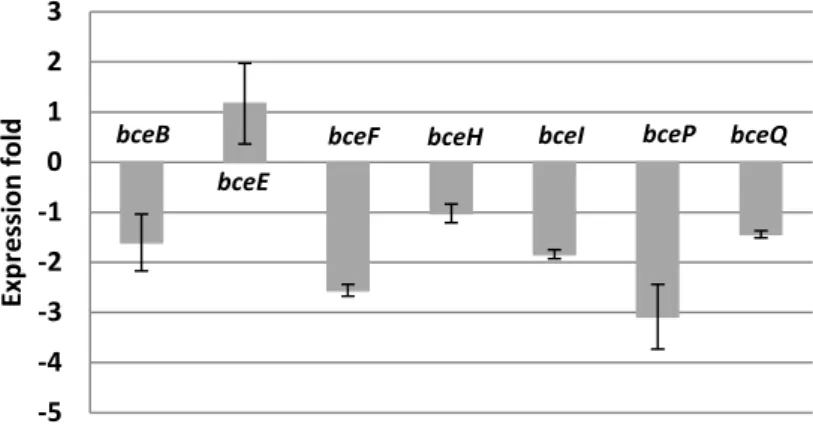
23 or pMLBAD-aiiA in MM medium supplemented with 1% (wt/v) of arabinose. Cultures were grown at 30ºC for 24 hours and total RNA was extracted. The relative expression of genes belonging to the bce-I and bce-II gene clusters under the two tested conditions indicate that lactonase production caused a repression in the expression of all genes studied, with exception for the bceE gene (Figure 7). Consequently, these results support the hypothesis of EPS biosynthesis in Burkholderia being regulated by QS at a transcriptional level.
Figure 7 - Quantitative real-time RT-PCR analysis of the relative transcript abundance of B. multivorans
ATCC 17616 containing pMLBAD-aiiA plasmid relatively to the parental strain harbouring pMLBAD growing in MM medium supplemented with 0.1% (wt/v) arabinose. Data was standardized to the internal control gene proC. The results were obtained from three independent experiments. Error bars represent the standard error of the mean.
3.1.1 Role of a quorum sensing inhibitor in preventing EPS biosynthesis
As mentioned before, Bcc species are intrinsically resistant to many toxic compounds, being able to degrade them and sometimes to use them as alternative carbon sources. Due to this feature, little is known about QSI that can efficiently interfere with Burkholderia QS. Previous work from our laboratory led to the identification of a QSI that was able to inhibit EPS production by B. cepacia IST408. Such QSI, 4-nitro-pyridine-N-oxide (4NPO), was firstly identified by random screening of pure compound libraries using QSI selector systems, based on killing/survival of reporter bacteria upon AHL presence/absence, respectively [85]. Expression studies using microarrays showed that sub-lethal concentrations of 4NPO down regulated 37% of the genes known to be dependent on QS in Pseudomonas aeruginosa [85].
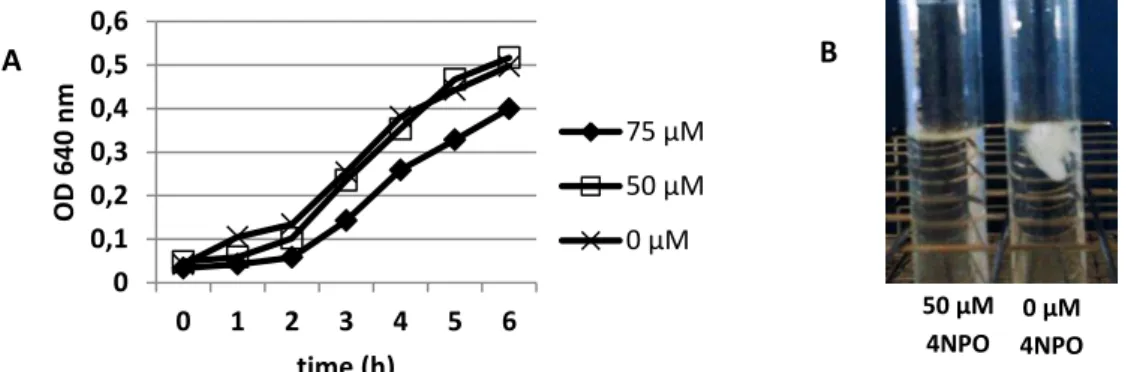
Even though 4NPO was able to inhibit EPS production in B. cepacia IST408, nothing was known for other EPS-producer Bcc species, namely for B. multivorans ATCC 17616 whose genome sequence is freely available. To test that, we had to find the highest 4NPO concentration that does not affect the growth of B. multivorans and this value was 50 μM (Figure 8A). Therefore, the supplementation of the
EPS--5 -4 -3 -2 -1 0 1 2 3 Exp re ssi o n fol d bceE bceQ bceP bceI bceH bceF bceB
![Figure 1 - Steps required for biofilm formation. [1] initial attachment, [2] irreversible attachment, [3-4]](https://thumb-eu.123doks.com/thumbv2/123dok_br/15567797.1047666/12.892.212.681.630.902/figure-required-biofilm-formation-initial-attachment-irreversible-attachment.webp)
![Figure 2 – Summary of the role of Burkholderia EPS in the adaptation to different niches (adapted from [41])](https://thumb-eu.123doks.com/thumbv2/123dok_br/15567797.1047666/13.892.136.769.480.751/figure-summary-role-burkholderia-adaptation-different-niches-adapted.webp)
![Figure 4 – Different levels of quorum-sensing (QS) disrupting strategies in bacteria using quorum sensing inhibitors (QSI) (adapted from [98]).](https://thumb-eu.123doks.com/thumbv2/123dok_br/15567797.1047666/17.892.180.714.476.865/figure-different-sensing-disrupting-strategies-bacteria-sensing-inhibitors.webp)