F
ACULDADE DE
E
NGENHARIA DA
U
NIVERSIDADE DO
P
ORTO
A Competence Management System towards
Increased Corporate Success
Ana Gabriela Teixeira Soares
A Competence Management System towards
Increased Corporate Success
Ana Gabriela Teixeira Soares
Report of Dissertation
Master in Informatics and Computing Engineering
Approved in oral examination by the committee:
Chair: Luís Paulo Reis (PhD)
____________________________________________________
External Examiner: Paulo Novais (PhD)
Abstract
In an organization, the careful management of intellectual capital is crucial for the nourishment of a sustained competitive advantage, hardly replicable by its competitors. Particularly, a Competence Management (CM) strategy transversal to the different corporate business units is of pivotal importance, as all knowledge domains are considered.
The main goal of this project – called iKnow - is to identify the requirements for the design of an effective Competence Management System (CMS) and to implement a working prototype. In particular, a study of CM concepts and key issues is intended as well as a state-of-the-art review of CMSs and main features. Additionally, the project contemplates the proposal and prototype deployment of a CMS for Critical Manufacturing (CMF), applying the acknowledged CM concepts to this corporate instance.
Created in 2009, CMF is an organization devoted to the delivery of avant-garde solutions for the high-tech manufacturing market, aiming at becoming the prime provider for that niche. In particular, its Services Unit is involved in multiple projects, whose engineers are constantly exposed to new technologies. In this scenario, the extension of skills, the growing number of projects and the associated increase in staff crave for a system capable of effectively managing the unit‘s competence pool. Although CMF possesses several platforms related to its employees‘ competences, none of them is specifically oriented towards CM nor deploys a CM strategy. To bridge this flaw, a CMS is imperative.
The project‘s objectives were successfully accomplished. Aside from the research effort on state-of-the-art CMSs, iKnow materialized in a fully documented software development cycle (requirements analysis, design engineering and prototype deployment and acceptance). Although a CM strategy has been instanced for CMF, iKnow‘s design is comprehensive and generic enough to be marketed for external corporations.
Resumo
Numa organização, a gestão cuidada do capital intelectual é crucial para a criação de uma vantagem competitiva sustentada e dificilmente replicável pelos seus concorrentes. Em particular, uma estratégia de Gestão de Competências (CM) transversal às diferentes unidades de negócio empresarial é vital, uma vez que todos os domínios de conhecimento são contemplados.
O objectivo nuclear deste projecto – denominado iKnow - consiste na identificação dos requisitos para o desenho de um Sistema de Gestão de Competências (CMS) e implementação de um protótipo funcional. Concretamente, pretende-se um estudo dos conceitos e problemas chave de CM bem como uma revisão do estado da arte de CMSs e principais funcionalidades. O projecto contempla ainda a proposta e implementação de um protótipo funcional de um CMS para a Critical Manufacturing (CMF), aplicando os conceitos de CM estudados a esta instância organizacional.
Criada em 2009, a CMF é uma organização dedicada ao desenvolvimento de soluções de vanguarda para o mercado de fabrico de tecnologia de ponta, com o objectivo de se assumir como o principal fornecedor para esse nicho. Em particular, a sua Unidade de Serviços está envolvida em vários projectos, cujos engenheiros estão constantemente expostos a novas tecnologias. Neste cenário, a ampliação de competências, o crescente número de projectos bem como o associado aumento de trabalhadores motivam a necessidade de um sistema capaz de gerir eficazmente a pool de competências da unidade. Embora a CMF possua diversas plataformas relacionadas com as competências dos seus trabalhadores, nenhuma está especificamente orientada para CM nem implementa qualquer estratégia correspondente. Deste modo, é imperativo um CMS para colmatar esta falha.
Os objectivos do projecto foram cumpridos com sucesso. Para além da pesquisa relativa ao estado da arte de CMSs, iKnow materializou-se num ciclo de desenvolvimento de software fortemente documentado (análise de requisitos, engenharia de design bem como implementação do protótipo e aceitação). Embora uma estratégia de CM tenha sido instanciada para a CMF, é relevante frisar que o sistema foi desenhado por forma a ser suficientemente abrangente e genérico visando a comercialização para empresas externas.
Acknowledgements
I can almost see it, that dream I'm dreaming. There's always going to be another mountain, I'm always going to want to make it move. Ain't about how fast I get there, ain't about what's waiting on the other side. It's the climb. – Miley Cirus, in The Climb
This project would not have been possible without the essential and gracious support of many individuals. The professionalism and dedication of my tutor at FEUP – Professor Teresa Galvão – kept me focused and motivated, providing insightful remarks towards a coherent and consistent thesis. I‘m thankful for the opportunity Critical Manufacturing has given me, allowing me to carry out this project and apply my academic training. The guidance, experience and work methodology from my supervisors at this company – Pedro Mêdas and Luis Pessoa – helped me improve my technical and soft skills, contributing to the successful completion of this project. I‘d also like to acknowledge Professors Eugénio Oliveira, Nuno Flores, António Castro and João José Pinto Ferreira for sparing time in their agendas to discuss with me implementation approaches for this project.
This work is the culmination of a two year route. I would like to thank everyone who has helped me reach this stage. FEUP‘s staff, from teachers to colleagues, for making my experience at this institution indeed unforgettable and enriching. In particular, I‘d like to thank Professors Rosaldo Rossetti, Ademar Aguiar, Nuno Flores and Hugo Ferreira for the remarkable opportunity to participate in CDVE ‘09 at Luxembourg. My colleague André Oliveira, for his support and sense of humour. I‘d also wish to acknowledge INESC Porto, particularly Eng. Luís Carneiro and Professor José Soeiro Ferreira, for letting me take FEUP‘s courses in my first year, while working full-time as their researcher.
Last, but not least, I would like to thank my family, for their unconditional support and encouragement to pursue my dreams. My parents, for enriching me with solid educational bases, for showing me the four corners of the world while filling my heart with tender moments. My sister, for listening to my complaints and frustrations, and for believing in me. Luna, for 10
Table of Contents
1 Introduction... 1 1.1 Report Scope ... 1 1.2 Motivation ... 2 1.3 Goals ... 2 1.4 Document Overview ... 2 2 Competence Management ... 42.1 Competences in the Organization: Dawn of the Knowledge Era ... 5
2.2 Why Manage Competences? ... 6
2.2.1 Impact on the Organization Structure ... 6
2.2.2 Corporate Benefits ... 7
2.2.3 Application Areas ... 7
2.3 Competence Management: Strategic Perspective ... 8
2.4 Key Challenges ... 11
2.4.1 Competence Modelling ... 11
2.4.2 Competence Profiling ... 13
2.5 Summary ... 14
3 Competence Management Systems ... 15
3.1 Competence Management Systems: Review ... 15
3.2 Key Challenges and Literature Review ... 21
3.2.1 Competence Modelling ... 21
3.2.2 Competence Profiling ... 22
3.3 Summary ... 22
4 iKnow: a General Purpose CMS... 23
4.1 Project Proposal... 23
4.2 Client Portrayal: Critical Manufacturing ... 24
4.3 Motivation ... 25 4.4 Goals ... 30 4.5 Summary ... 30 5 Requirements Analysis ... 32 5.1 Users Characteristics ... 32 5.2 Restrictions ... 33
5.3 Assumptions and Dependencies ... 33
5.4 External Interface Requirements ... 33
5.5 Functional Requirements ... 34
5.5.1 User Stories ... 34
5.5.2 Use Case Models ... 39
5.6 Supplementary Requirements ... 64
6 Solution Specification ... 65
6.1 Architectural Requirements ... 65
6.2 Main Design Decisions ... 66
6.2.1 Model-View-Controller Pattern ... 66
6.2.2 Dependency Injection Pattern... 67
6.3 Technology Platform ... 68
6.3.1 Preliminary Survey ... 69
6.3.2 Final Decisions ... 75
6.4 High Level Design ... 79
6.4.1 System Components ... 79 6.4.2 Physical Architecture ... 79 6.4.3 Logical Architecture ... 81 6.5 Data Model... 84 6.6 Summary ... 84 7 Prototype Deployment... 85 7.1 Approached Features ... 85 7.2 Implementation Details ... 87 7.3 Testing ... 97 7.4 Summary ... 99
8 Conclusions and Future Work ... 100
8.1 Goal Satisfaction ... 102
8.2 Future Work ... 102
References ... 104
Glossary ... 110
Annex A : Additional Use Case Models ... 112
A.1 Core Competence Management ... 112
A.1.1 Competence Derivation ... 114
A.1.2 Competence Derivation: Derivation Graph ... 115
A.1.3 Wishlist ... 117
A.1.4 Basic Management ... 118
A.1.5 Hierarchy ... 119
A.1.6 Competence Profile ... 121
A.1.7 Competence Grouping ... 123
A.1.8 Import/Export ... 126
A.2 Training... 127
A.2.1 Gap Analysis ... 127
A.2.2 Evaluation ... 130
A.2.3 Lookup... 132
A.3 Coaching ... 134
List of Figures
Figure 1: Process diagram for strategic working with competences [1] ...8
Figure 2: Key issues in the strategic perspective of competence management (adapted from [1]) ... 10
Figure 3: Macro-phases in Competence Management ... 11
Figure 4: Example of a competence gap analysis (adapted from [115]) ... 13
Figure 5: Example of an employee performance review on Taleo [116] ... 20
Figure 6: Critical Manufacturing logo [74] ... 24
Figure 7: Location of Critical Manufacturing within the Critical Group [74] ... 24
Figure 8: Example of an Excel sheet used for internal CM at CMF ... 26
Figure 9: Detail of Figure 8, where a sample set of competences can be identified. ... 26
Figure 10: WISE in action, showing a list of CMF‟s workers ... 27
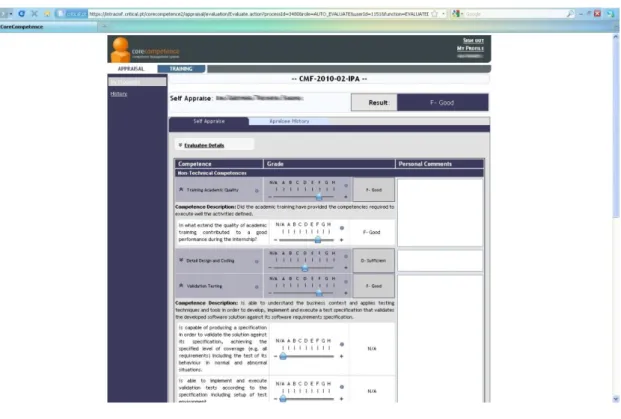
Figure 11: CoreCompetence in action, showing a list of a worker‟s self-evaluation parameters 28 Figure 12: Detail of Figure 11, where there is a list of competences to be evaluated, which the user can grade and add personal comments to ... 28
Figure 13: Learning Center, an internal CMF application focused primarily on competence development through e-learning ... 29
Figure 14: Outline of iKnow‟s use cases ... 41
Figure 15: System actors‟ overview ... 42
Figure 16: Core Competence Management use cases ... 43
Figure 17: Example of a competence derivation ... 45
Figure 18: A competence hierarchy example ... 46
Figure 19: Training use cases ... 51
Figure 20: Coaching use cases ... 54
Figure 21: Talent use cases... 55
Figure 22: Dashboard use cases ... 59
Figure 23: Gadgets use cases... 60
Figure 24: Alerts use cases ... 60
Figure 25: Social network use cases... 61
Figure 27: MVC concept, where direct and indirect associations are represented by a solid and a
dashed lines, respectively [80] ... 67
Figure 28: Explanation of DI‟s main principles [85] ... 68
Figure 29: Spring .NET framework logo [92] ... 75
Figure 30: jQuery logo [94] ... 76
Figure 31: Telerik Extensions for ASP .NET MVC logo [95] ... 76
Figure 32 – PostgreSQL logo [97] ... 77
Figure 33: Overview of the WCF framework [101] ... 78
Figure 34: iKnow‟s physical architecture... 80
Figure 35: iKnow's vertical logical architecture ... 83
Figure 36: Vernhout‟s strategic perspective on Competence Management vs. the deployed prototype features ... 86
Figure 37: The CM process described by Draganidis et al. vs. the deployed prototype features 87 Figure 38: Organization of the iKnow project, namely the iKnow.Database class library ... 88
Figure 39: Classes corresponding to the system‟s data model in iKnow.Database ... 88
Figure 40: iKnow.Database resources file ... 89
Figure 41: Interface classes deployed in iKnow.Contract ... 90
Figure 42: iKnow.GUI overview ... 90
Figure 43: User interface for competence management, where a list of existing competences is presented ... 91
Figure 44: User interface for system users‟ account management... 92
Figure 45: List of competences within a given group ... 93
Figure 46: Competence group list ... 93
Figure 47: Visualization of competences as hierarchies ... 94
Figure 48: Overview of developed scripts using the jQuery library ... 95
Figure 49: Intuitive description of the rendering of a table in a view using jQuery ... 95
List of Tables
Table 1: Competence definitions by author [24] ... 12
Table 2: List of CMSs reviewed [24] ... 16
Table 3: CM features included in the analysed LMSs [24] ... 17
Table 4: Common features of the analysed CMSs [24] ... 18
Table 5: iKnow's user stories for core competence management ... 34
Table 6: iKnow's user stories regarding training lookup and evaluation ... 35
Table 7: iKnow's user stories related to coaching ... 37
Table 8: iKnow's user stories for dashboard features ... 37
Table 9: iKnow's user stories regarding alerts ... 37
Table 10: iKnow's user stories regarding talent sniffing and scouting ... 38
Table 11: iKnow's user stories concerning social network characteristics ... 39
Table 12: iKnow's user stories regarding security/privacy ... 39
Table 13: List of system modules ... 40
Table 14: List of system actors ... 42
Table 15: Auto-evaluate a competence use case ... 44
Table 16: Add/remove competence use case ... 47
Table 17: Add/remove preferable competence use case ... 49
Table 18: Perform gap analysis on myself use case ... 52
Table 19: Search for workers for a project use case ... 56
Table 20: Generate job interviews from project competences use case ... 57
Table 21: Add gadget to dashboard use case ... 59
Table 22: Configure alerts use case ... 60
Table 23: Accept/decline/ignore friend request use case ... 62
Table 24: Delegate own role on another user use case ... 63
Table 25: iKnow's supplementary requirements list ... 64
Table 26: Clarification of the Maturity parameter ... 70
Table 27: Details of the Support Community parameter ... 70
Table 29: Final comparison matrix of web-based MVC frameworks ... 72
Table 30: Final DBMS comparison matrix ... 74
Table 31: Implemented use cases ... 85
Table 32: Unit tests performed on the Core Competence Management deployed use cases... 97
Abbreviations
ADO ActiveX Data ObjectsAJAX Asynchronous JavaScript and XML API Application Programming Interface API Application Programming Interface
C# C-sharp
CM Competence Management
CMF Critical Manufacturing COM Component Object Model CRUD Create, Read, Update and Delete DBMS Database Management System DI Dependency Injection
DOM Document Object Model DOM Document Object Model ERP Enterprise Resource Planning GUI Graphical User Interface HTML HyperText Markup Language IP Internet Protocol
IT Information Technology JSON JavaScript Object Notation
KM Knowledge Management
LDAP Lightweight Directory Access Protocol LMS Learning Management System
MVC Model-View-Controller REST Representational State Transfer
SGPS Sociedade Gestora de Participações Sociais
SOAP Simple Object Access Protocol TCP Transmission Control Protocol URI Uniform Resource Locator URL Uniform Resource Identifier
WCF Windows Communication Foundation WPF Windows Presentation Foundation WSDL Web Service Definition Language WSE Web Services Enhancements
XAML eXtensible Application Markup Language XHTML eXtensible HyperText Markup Language XML eXtensible Markup Language
XPath XML Path Language
Chapter 1
Introduction
A competent organization has the ability to structurally and systematically coordinate and commit resources for creating and distributing value to customers and stakeholders.
Arjan Vemhout [1] Competence Management (CM) is used today for a broad set of purposes: company and project staffing, competence detection and development for single persons, whole companies or virtual organizations [2]. For a corporation, the alignment of human resources to business goals dictates its strategic success [3]. Considering that each individual has a set of competences from various domains, an effective matching of competences with project needs and, subsequently, corporate goals, becomes crucial.
1.1 Report Scope
This document supports the author‘s completion of the Master degree in Informatics and Computer Engineering, held by the Faculty of Engineering at the University of Porto, Portugal. The research was carried out at Critical Manufacturing S.A. headquarters at Tecmaia (Maia, Portugal), from October 26th, 2009 to March 1st, 2010.
Introduction
1.2 Motivation
Undoubtly, part of an organization‘s knowledge resides in the people who form it. The employees‘ knowledge value depends on their potential to contribute to the achievement of an organizational competitive advantage [4]. Recent research suggests that human capital attributes (including training, experience and skills) – and in particular the executives‘ human capital – have a clear impact on organizational results [5], [6], [7], [8], [9], [10]. Indeed, it is the management of these assets that sustains the creation of a coherent and consistent competitive advantage.
Competence Management (CM) has become a leading practice in human resources management [11] and is often applied in organizations to guide selection, assessment, development and performance appraisal [12]. CM can be described as an integrated set of human resources activities aimed at optimizing the development and the use of employee competences. Hence, individual and, subsequently, organizational effectiveness are expected to increase [13].
Critical Manufacturing presents difficulties at the CM level, such as data dispersion and a lack of modern competence appraisal and reporting tools. Indeed, it craves for a flexible and coherent tool for competence mapping, evaluation, development and even monitoring transversal to all business areas – a Competence Management System.
1.3 Goals
The main objective of this project is to identify the requirements for the design of an effective Competence Management System (CMS) and to implement a working prototype. In particular, the goals are as follows:
- Study of Competence Management (CM) concepts and key issues; - State-of-the-art review of CMSs and main features;
- Proposal of a CMS suitable for a given organization (Critical Manufacturing),
applying the acknowledged CM concepts to this corporate instance. However, this system ought to be generic enough as to successfully adapt other organization.;
- Implementation of a working CMS prototype.
1.4 Document Overview
This report approaches Competence Management (CM) in a top-down fashion: it begins with a broad perspective of this area and its key issues, then restricting this research field to a given corporation. The document is divided into eight chapters as follows.
The initial section introduces the project, detailing its motivation and goals. Additionally, the document‘s scope and structure overview are stated. Apart from the conclusion, each subsequent chapter is closed by a summary subdivision, which gathers the main ideas of that section.
Chapter 2 analyses CM, focusing on its impact on the organization, its history, strategic perspective as well as key issues such as competence modelling and profiling.
The third part delivers a state-of-the-art review on Competence Management Systems and key challenges mentioned in the previous chapter.
Introduction
Section 4 details the project, mentioning its motivation and goals from a perspective that‘s closely linked to the target company: Critical Manufacturing.
Chapter 5 performs a requirements analysis, presenting the most relevant use cases.
The sixth part depicts the solution specification, namely its architecture, main design decisions and technology platform, justifying the choices for the latter.
Part 7 details the implemented prototype and acceptance tests.
Chapter 8 is dedicated to concluding remarks and future work considerations.
A glossary is also contemplated, where all relevant vocabulary used in this manuscript is clarified. Annex A provides additional use cases for the reader, while Annex B illustrates the performed technology survey. Finally, Annex C supplies code samples from the deployed prototype.
Competence Management
Chapter 2
Competence Management
Sustained competitive advantage is no longer rooted in physical assets and financial capital, but in effective channelling of intellectual capital. [14]
We are not only in a new millennium, but also in a new era: the knowledge era [15]. As the contemporary business scenario becomes increasingly mutable and heterogeneous, the corporation success is ever more rooted on its capacity to anticipate the changes and to respond to new business challenges. In particular, organizations strive to obtain competitive advantage through knowledge [16].
Businesses have long recognized the importance of managing their resources, tangible or intangible. Indeed, as stated by Prahalad and Hamel [3], the ability to develop and leverage the value of intangible assets comprises a core competence for organizations, particularly those providing financial and professional services. In such knowledge-intensive corporations, processing knowledge is central to business success. Particularly, focusing on competences allows the organization to identify the key knowledge that an employee or the organization itself should possess in order to achieve the desired targets.
Competence Management - a Knowledge Management strategy - is key to aligning human capital assets with business strategy in order to create value for organizations and drive their performance forward in a competitive talent market. Inevitably, corporate success is driven by people – human capital – through their creativity, knowledge and their relationships with customers, co-workers and professional networks. Hence, the challenge for organizations is to align their human capital assets with the strategic priorities identified in their business strategy to create value for their organization [17].
The present chapter is dedicated to the study of Competence Management and its impact on the organization1.
1
The terms competency and competence are often used interchangeably in the literature. For the purpose of this document, please consider them as synonyms from this point on.
Competence Management Systems
2.1 Competences in the Organization: Dawn of the Knowledge
Era
A critical aspect of business management is the successful creation of processes which drive the development of a continuous flow of innovation, to give a basis for competitive advantage. To reach this goal, the establishment of a Knowledge Management (KM) strategy may be considered the best way to channel the organization‘s efforts to this end [18].
In 1984, Wernerfelt proposed a resource-based view of the corporation, rooted in the heterogeneity of organizations. In particular, resources could be interpreted as strengths or weaknesses of the corporation, including tangible and intangible assets such as in-house technology knowledge, personnel skills or trade contacts, to mention a few [19]. Most importantly, those assets ought to be rare, valuable, difficult to imitate and non-substitutable. In this sense, knowledge was seen as a strategic asset with the potential to be a source of competitive advantage for an organization [15].
During the 1990s, the importance of unique and inimitable assets such as tacit knowledge and competencies [20] came to be seen as the core competencies for firms that wished to compete in the new ‗knowledge based economy‘ [21]. As the key strategic resource for organizations, knowledge needed to be efficiently managed to gain competitive advantage among a company‘s peers.
KM focuses on techniques to manage a common base of organizational knowledge that allows heterogeneous organizational groups, functions and communities to coordinate their efforts and share knowledge across time, function, discipline and task specific boundaries [22]. With the crescent interest in KM and the recognition of the value of tacit knowledge that took place at the same time, there was a renewed interest in trying to develop Knowledge Management Systems in general and Competence Management Systems (CMSs) in particular [23]. Hence, Competence Management (CM) is an important research object of the more general area of KM [24].
Developing versatile employees and leveraging their competencies in order to cope with different corporate needs is a matter of pivotal importance [25]: employees‘ competences in the form of technical and cognitive capabilities directly affect the company‘s knowledge creation abilities. Competence is a way to put into practice some knowledge, know-how, and also attitudes within a specific context. Therefore, CM has the prime objective to well define and continuously maintain a set of competences according to the goals of the corporation [26]. In particular, it provides a roadmap that helps organizations develop their talent pool [27].
In the 21st century workplace, the most important corporate resource over the next 20 years will be talent: smart, sophisticated business people who are technologically literate, globally astute and operationally agile. Yet as the demand for high performing talent grows, the supply
Competence Management Systems
2.2 Why Manage Competences?
Lately, competences have proven to be useful as an abstraction of work-relevant human behaviour in a variety of contexts and across different actor groups (individual, organizational and market). Within an organization, competences allow a more effective resource allocation (e.g. team staffing), Knowledge Management and informal learning support, as well as human resource development in general [28]. Indeed, competences make the individual skills and their relationship to corporate goals transparent. If, as stated earlier in this chapter, competences are crucial to organizational competitive advantage among peers, then they should be carefully managed towards (near) optimal corporate performance.
2.2.1 Impact on the Organization Structure
Broadly speaking, Competence Management (CM) concerns the way in which competences in a corporation, of a group or individuals of the corporation are organized and controlled [26]. Considering competence as a way to put in practice some knowledge, know-how and also attitudes in a particular context [26], its management has the prime goal to well define and continuously maintain the set of competences according to the overall organization‘s goals.
CM has long been associated to the management of people‘s qualifications and their annual assessment. Initially, these qualifications were closely linked to predefined jobs, tasks and roles within (relatively) stable job-based organizations. In such an environment, the standardization of organization practices (and processes) was the main approach to maintain or improve corporate performances [26]. However, this strong linkage between competences and standard organizational jobs gradually decoupled over time as inter-organizational competitiveness grew and businesses became swiftly mutable. Thus, corporations were forced to deal with less structured, less stable and less standardized processes [26].
Such adaptation of the organization‘s behaviour and structure originated CM approaches based on two major (complementary) concepts/axis: individual competence and core
competence. The first one focuses on the increased importance of the individual employees‘
competences for companies in the achievement of corporate goals. On the other hand, the latter has its foundations on the idea that companies rely on very specific and (ideally) unique competences – core competences – which directly sustain the company‘s competitiveness.
Given this gradual organizational structure shift, CM caused significant impact on the overall corporation. In particular, as pointed out by Harzallah et al. [26], nowadays CM is part of all three company control levels, as follows:
- Strategic Level, because it ensures that the competences required for the fulfilment of corporate goals are correctly identified. For instance, it may provide recruiting and training staff policies or even support (re)organization decisions by checking required and available competences;
- Tactical Level, as managers must guarantee the achievement of the tasks for which they are responsible by reorganizing the work, reallocating the personnel, recruiting new members, or deciding on the persons to be trained;
- Operational Level, since it can be used for day-by-day personnel reallocation - for instance, to face some unexpected situations (e.g. missing staff).
Competence Management Systems
2.2.2 Corporate Benefits
As pointed out by Draganidis and Mentzas [24], organizations can highly benefit from Competence Management approaches, namely because:
- Competence Management Systems allow the identification of the skills, knowledge, behaviours and capabilities needed to meet current and future personnel selection needs in alignment with the differentiations in strategies and organizational priorities; - Corporations can focus the individual and group development plans to eliminate the
gap between the competences requested and those available according to a project, job role or enterprise strategy.
2.2.3 Application Areas
Concerning employee management, Competence Management (CM) is crucial in the following activities [24]:
- Workforce planning: competences are used to evaluate the current and future competence needs at macro (organization wide) and micro (individual employees) levels. A competence gap analysis can reveal the chasm between the competences of a that a target object (employee, groups or the organization) has and those it should have, contributing to the workforce development plans;
- Recruitment management: competences are used to compare the capabilities of the candidate against the requirements of the offered position; once the best candidate is identified, competence gaps form the basis for a new-hire learning plan;
- Learning management: competence gap analysis can identify the needed competences, which can then be linked to the equivalent learning objects;
- Performance management: worker performance is evaluated against job competence requirements as well as objectives;
- Career development: competences are used to create the personal development plans for the employee. The latter can review the needed competences of all the positions and, through comparison with the possessed competences identify potential positions and develop career plans;
- Succession planning: organizations assess potential replacements for key positions based on competence requirements.
Competence Management Systems
2.3 Competence Management: Strategic Perspective
According to Vernhout [1], working with competences at a strategic level is a cyclic process, in which eight significant phases are distinguished, as pictured in Figure 1 and explained as follows.
Firstly, it is imperative that management determines the position of the organization on the social-economic scenario, by clearly defining its mission, goals and contribution. This is the preliminary phase called Define the role of the organization within the social-economic
environment.
Once the mission has been determined, both qualitative and quantitative organization goals must be formulated. Realizing them is of pivotal importance in order to survive in the constant changing business environment. While performing an environment and internal analyses, the role of the organization (strategic position) is refined and the most relevant opportunities and threats are identified. Additionally, the internal analysis allows the identification of the available assets and the organizational capacity to exploit them effectively and efficiently (that is, its strategic capabilities). This strategic development phase is named Determine the need for
competences of the organization.
When the goals of the organization are clear, the needed competences to realize those goals should be determined. Such action takes place at the level of organizational units (logistics, purchasing, sales, finance and communication, to mention a few). Thus, the focus is on the competences linked to the organizational units of the corporation. This phase is called
Determine the need for competences of the organization. Accordingly, competence needs must
Competence Management Systems
be determined, that is, it should be assessed if internal and/or external recruitment of competences is necessary for achieving the corporate goals.
The third phase – Inventory the present competences of the organization – answers the previous question, by determining existing and required competences by organizational unit. In particular, such inventory is performed at two levels: organizational unit and employee-wise. With this approach, the corporation is able to identify competence needs with different granularity, thus allowing a more effective approach when targeting lacked competences. Additionally, employee competences are graded in order to determine the degree in which employees apply a certain competence.
When employee (and organizational unit specific) competences have been identified, the following step is to Determine job competency profiles and individual competency profile. A job competency profile describes the most relevant competences for a job as well as the required level of competences. On the other hand, an individual competence profile refers the competences an employee currently possesses. When both profiles are clear, the next step is to determine to what extent competence discrepancy exists, that is, what is the difference between the present and the needed competences at the employee level.
Dependent of the first three phases, the fourth (Analyse the ‘fit’ between the present and
needed competences) takes place both at organizational unit and employee level. Such ‗fit‘ is
obtained through the comparison of job competency profiles to employee‘s individual competency profiles, by organizational unit. Such analysis (also called competence gap
analysis) allows the identification of competence needs as well as of new business opportunities
not previously discovered. In short, phase 4 is about the management of the competence stock. Given the competence ‗fit‘ determined in the previous phase, Competence-based training
and development focuses on the development of employee‘s competences as to increase the ‗fit‘
between present and needed competences in the various organizational units. Hence, competence needs are identified and employees are directed to learning processes for improvement.
Competence-based training and development of an employee must explicitly lead to effective work behaviour. Prior to a performance appraisal (phase 7), it should be determined to what extent an employee has shown effective work behaviour. Hence, the phase Determine
effective work behaviour based on the formulated objectives concerns the assessment how
employees performed their tasks in order to realise corporate goals (i.e., to what extent).
Based on the results of the previous phase, the stage Performance appraisal and
competence-based rewarding concerns the assessment of employee behaviour and results
relative to global corporate goals, as opposed to the organization unit analysis previously performed. Hence, the management of future performance, promotions and employee career development can be improved. Based on this performance appraisal results, organizations may reward employees for the applied competences towards corporate goals fulfilment.
Competence Management Systems
Similarly, Draganidis et al. [24] present CM as an aggregation of four macro-phases directed to the continuous enhancement and development of individual and organizational competences. As shown in Figure 3, they are the following:
- Competence mapping: aims to provide the organization with an overview of all the necessary competences in order to fulfil its targets, which are defined by the organizational business plan, the projects requirements, the group needs and the job role requirements. The required proficiency level for each job profile is defined in this phase as well;
- Competence diagnosis: meaning an instance of the current situation of the competences and equivalent proficiency level that each individual employee possesses. A competence gap analysis is also essential in this phase in order to define the breach between the number and level of competences that the employees possess compared to the number and level of the competences required by the organization, according to their job role;
- Competence development: deals with the scheduling of activities to increase the number and proficiency level of competences that the employees should have, according to the previous two phases and the skill gap analysis;
- Competence monitoring: the last phase, which is a continuous examination of the results achieved by the competence development stage.
Competence Management Systems
2.4 Key Challenges
As previously discussed, Competence Management (CM) is a process of multiple stages, each with its inherent complexity. This section narrows this problem‘s domain to two key issues, closely linked to competence mapping: competence modelling and competence profiling. Pictured hereafter, these issues are not isolated; they extend to other CM phases. For example, competence profiling may be used for ‘fit‘ analysis (6th stage in Figure 2)/competence diagnosis (first macro-phase in Figure 3).
2.4.1 Competence Modelling
According to Draganidis and Mentzas [24], over the past few years many companies and governmental organizations have addressed issues such as organizational transformation, performance improvement, employee development, succession planning, etc by the implementation of competence modelling programs, i.e., through strategic initiatives aimed at aligning employee performance with job requirements. A competence model is a list of competences which are derived from observing satisfactory or exceptional employee performance for a specific occupation [24].
Indeed, a competence model can provide identification of the competences employees need to develop in order to improve performance in their current job or to prepare for other jobs via promotions or transfer. It can also be useful in skill gap analysis where the comparison between available and needed competences of individuals or organizations can motivate the construction of individual development plans as to eliminate the gap.
Competence Management Systems
Table 1: Competence definitions by author [24]
Author Definition
Marrelli [31] Competencies are measurable human capabilities that are required for effective work performance demands.
Dubois [32]
Competencies are those characteristics (knowledge, skills, mindsets, thought patterns, and the like) that, when used either singularly or in various combinations, result in successful performance.
HR-XML [33] (www.hr-xml.org)
A specific, identifiable, definable, and measurable knowledge, skill, ability and/or other deployment-related characteristic (e.g. attitude, be-haviour, physical ability) which a human resource may possess and which is necessary for, or material to, the performance of an activity within a specific business context.
Boyatzis [34]
Boyatzis described competencies as underlying characteristics of an individual, which are causally (change in one variable cause change in another) related to effective job performance.
Selby et al. [35] Selby described it as an ability expressed in terms of behaviour. UK National Vocational
Council for Vocational Qualification [36]
The National Vocational Council for Vocational qualification described competency as performance standards, the ability to perform in work roles or jobs to the standard required in employment.
Treasury Board of Canada Secretariat [37]
“Competencies” are the knowledge, skills, abilities and behaviours that an employee applies in performing his/her work and that are the key employee-related levers for achieving results that are relevant to the organization‟s business strategies.
Perrenaud [38] A capacity to mobilize diverse cognitive resources to meet a certain type of situation.
LeBoterf [39]
LeBoterf says that competencies are not themselves resources in the sense of knowing how to act, knowing how to do, or attitudes, but they mobilize, integrate and orchestrate such resources. This mobilization is only pertinent in one situation, and each situation is unique, although it could be approached as an analogy to other situations that are already known.
Jackson and Schuler [40] Competencies are defined as “the skills, knowledge, abilities and other characteristics that someone needs to perform a job effectively”.
Intagliata et al. [41]
Most fundamentally, competencies provide organizations with a way to define in behavioural terms what their leaders need to do to produce the results the organization desires and do so in a way that is consistent with and builds its culture. They should provide the „North Star‟ by which leaders at all levels navigate in order to create synergy and produce more significant and consistent results.
PeopleSoft A set of measurable and observable knowledge, skills and behaviours that contribute to success in a job/position.
Gartner group A competency is a set of characteristics, including skills, knowledge and attributes, that causes or forecasts performance.
Competence Management Systems
2.4.2 Competence Profiling
Generally speaking, a competence profile is a set of competences obtained from the observation of the behaviours, skills, knowledge and attitudes required to excel in a task. Hence, such outlines are mainly associated to employees. Moreover, they may be linked to projects, jobs or even stand as ad hoc profiles to express competence requirements/needs. However, since competences cannot be directly measured, sensed or observed [28], the question is: how should
organizations build competence profiles? Likewise, how should they use them?
Regarding the second issue, competence profiles can be used as benchmarks for competence gap analysis. Performing a competence gap analysis allows the organization to assess breaches in performance, thus enabling the targeting of areas for training and developing. In essence, it denounces organizational competence needs through the comparison of (current vs. required) competence profiles. Figure 4 shows an example of a competence gap analysis, where gaps Gap0 and Gap1 are identified. As noted by Carbone et al. [42], the difference between the two tends to increase when the organization doesn‘t invest in the employees‘ competence development. In particular, the greater the range, the greater is the urgency to direct corporate competence development efforts to that target.
As previously stated, competence gap analysis facilitates the identification of breaches Figure 4: Example of a competence gap analysis (adapted from [115])
Time Competence value Current competences Required competences
Competence Management Systems
2.5 Summary
In the 21st century knowledge-intensive business scenario, a company‘s intellectual capital is crucial to corporate success. Hence, Competence Management (CM) approaches provide a strategic management of such resources, setting the basis for the creation of sustained competitive advantage.
This chapter focused on the review of CM main concepts and key challenges: competence modelling and profiling. Indeed, the construction of a competence model is no easy task, as there is no standard definition of the underlying concept – it is strongly dependent on the context in which it is used. Moreover, competence profiles are of pivotal importance, as they stand as viable benchmarks for competence gap analysis.
Having studied the theme of CM, the next step is to perform a bibliographic review on IT supported CM, learning how the analysed challenges are approached.
Competence Management Systems
Chapter 3
Competence Management Systems
As stated by Draganidis and Mentzas [24], Competence Management (CM) is an important research object in the more general area of Knowledge Management (KM). It has a crucial contribution at organizational and personal levels, as it identifies the key knowledge that the corporation or its employee should possess in order to achieve their goals.
Competence and skills management have been tightly linked to organizational efforts towards the creation of solid grounds for workforce empowerment. In this sense, competitive advantage is promoted, and innovation and effectiveness are expected to increase [43]. Also relevant is that CM is directly related to corporate efforts to leverage internal knowledge and initiate consistent KM initiatives [44]. It is a research field which has recently begun attracting approaches to leverage personal development [45], knowledge sharing [46], corporate e-learning efforts [47] as well as applications of semantic technologies such as ontology management [48].
As part of KM, CM plays a crucial role to sustained organizational competitive advantage. Hence, enterprises deploy Competence Management Systems (CMSs) to support CM activities. The goal of the present chapter is to review the most common and widespread CMSs and present the research directions of this field.
Competence Management Systems
Table 2: List of CMSs reviewed [24]
CMS Company Website
Skills gap management system CAPSA, Consulting
incorporated www.capsaconsulting.com
SkillBase Claymore Inc. www.skillbase.net
On track for training and ontrack
online DKSystems, Inc. www.dksystems.com
Occupational skills analysis
system (OSAS) Educational Data Systems www.edsincorporated.com
KSA online Gyrus Systems www.gyrus.com
HRScope HR Technologies www.hrscope.com
TL4 Humeng www.humeng.ca
RemoteHR Illion www.remotehr.com
Talent management system KnowledgePool Americas usa.knowledgepool.com
Learner LifeTime Media www.ltmedia.com
Meridian KSI knowledge centre Meridian Knowledge Solutions www.meridianksi.com SkillQuest People Sciences www.peoplesciences.com
PeoplePower People3 www.people3.com
ClickEM Peopleclick www.peopleclick.com
HR pulse Pilat NAI www.pilat-nai.com
PlanView software PlanView www.planview.com
Training and performance
management (TAP) Prismatics
PROTECH Proactive Technologies
CompAssess Right/Career Directions www.careerdir.com SkillView enterprise 5.0
SkillView Technologies www.skillview.com IntelliSkill and ITG databases
Competence Management Systems
Table 3: CM features included in the analysed LMSs [24]
LMS vendor Product CM features included Click2learn, Inc. Aspen Learning Management
Server 1.1
Determine gaps in the individual‟s skills. It also tracks an employee‟s progress in skills acquisition.
Docent, Inc. Docent LMS Measures competency at a company level. Skill search capabilities. It tracks gaps be-tween student competency levels and job profile specifications, produces personalized learning plans to fill individual skill gaps and matches employees to job requirements us-ing skills-mappus-ing capabilities.
Element K, LLC KnowledgeHub (Learning management system)
None
GENESYS Software Systems, Inc.
PeopleComeFirst – hosted version, client requirements 1.0
PeopleComeFirst – licensed, in-house version 1.0
PeopleComeFirst Healthcare Learning Advantage 1.0
Skills gap analysis and personalized learning paths.
Hyperwave
Informa-tion Management, Inc. eLearning Suite 1.3 None
IBM Lotus learning management system None KnowledgePlanet.com, Inc. HCM Suite 6.0 KP Learning (No CMS Features)
It performs a skill gap analysis based on which a performance review or personalised learning path can take place. Through its learning content management system, it leverages the reuse of learning objects. Fi-nally, through its application interfaces and
Competence Management Systems
Vendor of LMS Product CM features included Open Text Corporation Livelink for Learning
Management 1.2
None
Oracle Corp. Oracle iLMS It integrates with HR systems in order to update employees‟ skills inventory and skills gap analysis.
OutStart, Inc. Evolution 4.0 None Pathlore Software
Corp.
Pathlore LMS 5 Skills management
Pedagogue Solutions PedagogueTesting None Plateau Systems, Ltd Plateau 4 Learning
Management System 4.2
Skills gap analysis and customization of curriculum according to it.
Saba Software, Inc. Saba Enterprise Learning Suite 3.5
SAP GmbH SAP Learning Solution THINQ Learning
Solutions, Inc.
Learning Management System 5.x
A web based system which performs skills gap analysis.
Table 4: Common features of the analysed CMSs [24]
Feature Description
Competency categories A group that homogeneous or similar competencies belong to (e.g. people management competencies).
Competency definitions Statement (s) that explains the basic concept of a competency.
Proficiency scale
Most of the CMS use a 0-4 or 0-5 scale, in order to grade the proficiency level that an employee possesses on a particular com-petency.
Behaviours associated with specific competencies
Behaviour indicators an individual should demonstrate if the specified competency is possessed.
Job descriptions Job descriptions and definitions of employee roles. Assessment tool To identify and rate competencies.
Competency tracking by position, department and company
Most CMSs include a competencies‟ viewer which depicts the status of competencies possessed by an individual, a department or a company.
Link of skills gap analysis with a personalised learning path
The competencies that an employee should work on are linked with specific learning objects in order to facilitate their acquisi-tion.
Competence Management Systems
Microsoft implemented a CMS by defining more than 300 competences in four categories
(foundation, unique, global, and universal skills) [49]. Basic, working, leadership, and expert are the terms for different competence levels. In this approach, staff members are rated by themselves and by their superiors within an iterative process. Consequently, the company expects a better matching of employees to jobs and work teams [50].
Before introducing a CMS at Ericsson, they had individual solutions in each country, sometimes paper-based or relied on databases or spreadsheets. They extended the existing SAP R/3 Personal Management Module and implemented a competence catalogue. For the grades the corporation adopted a scale from 0 (not assessed) to 9 (excellent). The values are evaluated by using the period of time a person has used the competence [51].
Zelewsky et al. [52] describe a CMS designed to support the product development process in engineering networks made of different organizations. To support the understanding of competences and their development between organizations, an ontology is used. They match tasks that require certain competences with those of humans.
Dom and Pichlmair [53] have developed a prototype of a university CMS. The system is based on an ontology defining competences, evidence types and jobs in information systems and computer science domain. The system distinguishes competences in knowledge and an experience aspect. To decide on a competence, evidences such as passed examinations, books read by the person, trainings, assessments, project work, e-learning courses and more are stored. Each competence can be evaluated on three levels: beginner, advanced and expert and on each of these levels a finer scale exists with real values between 0 and 1. The competence of the individual is computed by the system when required and all evidences until that moment are used for the computation (historic perspective). A gap analysis algorithm determines differences between actual and desired goal profiles [54]. The computed gap is then used to recommend further courses to a student.
Taleo [55], a self-proclaimed talent management framework, sees employee competences as talent, thus supporting the entire employee lifecycle, talent management and development as well as career evolution. Figure 5 pictures an example of an employee performance review (evaluation) using this tool; please take notice of the presence of competence evaluations along with the employee‘s personal data.
Competence Management Systems
As noted by Draganidis and Mentzas [24], the majority of CMSs have been or plan to be enhanced with the use of web services in their development environments. As technology matures, the use of web services and XML is gradually allowing components of workforce management systems to read competence data from the Human Resources Management System ―master‖ repository, updating the master with new entries or revisions based on completion of business processes.
Similarly, another area which could prove to be increasingly interesting for further research is the area of employee portals with self-service technology. Most organizations (mainly financial and telecommunications companies), have adopted or intend to deploy such portals [24]. In this sense, an employee self-service portal is integrated with the enterprise portal, thus facilitating tracking of specific competences which are easily self-reported (e.g. courses, knowledge acquired outside the organization scope). Such approach would address the problem of employees‘ lack of time and commitment to update the content of a CMS.
Moreover, ontology capabilities leading to the semantic web are becoming a core future technology [24]. In particular, ontology-based competence models can present a tight integration of capabilities and information in a highly contextualized user interface. Simultaneously, different services and components may be loosely coupled through a dynamic architecture whose coherence is ensured via a common semantic model in a rich competence ontology [24].
Enhanced by IT support, CM is a practice of increasing importance in private and public organizations. It provides them the means to attract and develop talented human capital, identify the right person for a job position, performing succession planning and training analysis, among other core human resources functions.
Competence Management Systems
3.2 Key Challenges and Literature Review
Concerning the key challenges presented in the previous chapter, this section is dedicated to the literature review on existing state-of-the-art approaches to those issues.
3.2.1 Competence Modelling
There are multiple approaches to competence modelling.
The IMS Reusable Definition of Competencies or Educational Objective [56] and the later IEEE Reusable Competency Definition [57] focus on reusable competency definitions. The primary idea is to build central repositories which define competencies for certain communities. Hence, these definitions can be referenced by external data structures, encouraging interoperability and reusability. However, IEEE RCD lacks information on context and proficiency level and doesn‘t allow relationships or recursive dependencies among competencies.
On the other hand, HR-XML focuses on the modelling of a wide range of information related to human resource tasks (such as contact data or aspects of the curriculum vitae) [58]. The work performed in HR-XML Measurable Competencies [59] tries to define profiles in order to use such competency definitions. It specifies data sets like job requirement profiles (describing the competencies required for an employee) or personal competency profiles (stating the current competencies held by a person). Such profiles are composed of evidences (required or acquired), referring to competency definitions. However, the proposed model fails to clearly separate required from acquired profiles. As a consequence, an acquired competency could have mandatory and optional elements, according to the model. Moreover, it is unclear why a competency is composed of several evidences: since a competency is a reusable object, evidences should rather represent a requirement or demonstrate the acquirement of a competency [58]. Hence, the evidences should refer or contain competency definitions and not vice versa.
The Simple Reusable Competency Map [60] tries to model relationships between competencies. A map can contain information about dependencies/equivalencies among competencies, including the composition of complex competencies from simple ones. In this approach (SRCM), relationships are modelled using a directed acyclic graph. However, the semantics of the proposed model is confusing [58]. In particular, relationships among different nodes may have different meanings: composition, equivalence or order dependency. This leads to confusion when modelling tasks and when creating algorithms to use such information. Furthermore, combination and weighting of competencies is not clearly defined and external references to the maps (e.g. from profiles) must point to the root (and not to any node), therefore requiring the traversal of the graph until the appropriate node is found [58].
Competence Management Systems
3.2.2 Competence Profiling
On the organizational level, the most obvious problem is getting the competency profile. One fundamental issue is that competencies cannot be measured, sensed or observed directly [28]. What we can observe is performance [64] in various forms: assessment of learning outcomes or performance in everyday job activities, to mention a few.
In general, two approaches can be observed [65]
- Self-assessment, where employees themselves are asked to provide their competencies, possibly mediated by their superior;
- External assessment, done by superiors or through formal assessment procedures. White the latter is very expensive, cumbersome and only observable in limited areas [58], the first often fails due to missing motivation. This lack of incentive can be traced back to no immediate benefit for the employees. For instance, systems are hardly embedded into everyday work activities and have not proven their usefulness there [58]. As Becerra-Fernandez reports [66], in such scenario employees might downplay or exaggerate their competencies. Ultimately, an organization‘s competence catalogue may lack pivotal information due to the long update intervals.
Several studies address this problem by automatically extracting profile information from data the user generated in his/her daily work, such as publications [67] or documents [68]. Ley et al. [69] propose a competence performance approach that derives competencies from executed tasks. In this approach, a task competency matrix is created together with domain experts [58]. This matrix relates a set of tasks (e.g. required for a position) to a set of competencies needed to fulfil these tasks successfully. Based on this model, the system can infer a user‘s competency from his/her successful performance of a task in his/her daily work.
Another approach to employee profiles is based on community expert finding: (enterprise) social networking (e.g. LinkedIn [70] or Xing [71]). These platforms are based on the self-promotion paradigm: people can represent themselves with a profile and indicate their connections to other users. Moreover, the principle of social tagging and bookmarking is transferred to people. For instance, Xing allow the organization of contacts with tags. Within IBM‘s Fringe Contacts [58], each employee can describe their colleagues by tagging them with key words on their expertise and interests. This leverages network effects for setting up some sort of profile for the individual, tagging people with competences across the community. However, the resulting profiles lack legitimating and commitment by the organization [58], as the competence vocabulary is not directly supported.
3.3 Summary
The purpose of a Competence Management System (CMS) is to control in a logical and integrated way activities within the company or organization that will assure and further develop competent performance at work. The aim is to ensure that individuals are clear about the performance that is expected of them, that they have received appropriate training, development and assessment, and that they maintain or improve their skills over time [72].
In this section a global review of CMSs was performed, pointing out their main features and comparing them. Similarly, a link was made to the previous chapter by reviewing the work done relative to the key challenges identified on Chapter 2: competence modelling and profiling. Given this preliminary approach to CM and CMS, we proceed to describe this project‘s contribution – the application of CM principles and concepts to a corporate instance and the implementation of a CMS prototype.
Chapter 4
iKnow: a General Purpose CMS
At Critical (Manufacturing) we know our greatest asset are our employees and we understand it is the know-how, inspiration, energy and passion of our people that drives us forward. [73]
So far, this document has focused on the project‘s contextualization. It has addressed the issue of Competence Management (CM) in the corporate environment and the use of information technologies for this purpose – Competence Management Systems.
This section focuses on the instantiation of this problem (CM) to a given organization: Critical Manufacturing. In particular, the following topics are covered: a project‘s description, the presentation of the company, motivation and specific goals.
4.1 Project Proposal
In a dynamic environment in which competition is strong, companies need to evolve quickly and to base their management on performance key factors, among which human resources play a major role [29]. Taking as premise that its employees dictate decisively the company‘s success [74], Critical Manufacturing craves for an efficient management of its internal know-how. This project realizes that need by proposing the development of a Competence Management System.
More than a trivial employees‘ skills data warehouse, this assignment envisions a Competence Management transversal to the diverse aspects of human resources management,
iKnow: a General Purpose CMS
4.2 Client Portrayal: Critical Manufacturing
At Critical Manufacturing our main competitive advantage is to be able to deliver high-quality solutions in a competitive business model, addressing our customer needs and ensuring their final satisfaction. [74]
Created in 2009, Critical Manufacturing (CMF) - Figure 6 - was based on a joint business plan between the Critical Group and individual founders with large experience in semiconductor business [74]. It is devoted to the delivery of avant-garde solutions for the high-tech manufacturing market, aiming at becoming the prime solution provider for that niche.
Figure 6: Critical Manufacturing logo [74]
CMF is part of the Critical Group (Figure 7), a private set of companies founded in 1998 to provide solutions for mission and business critical information systems. It is based on an experienced services team coming from the Critical Group and established a product team of individuals with more than 10 years experience in high-tech manufacturing.
Critical SGPS (holding company for the Critical Group) integrated the formerly Critical Software‘s semiconductor manufacturing solution business unit into Critical Manufacturing, where it formed the services business division. With an annual turnover of 3 Million euros and approximately 50 employees, this unit has competed in several manufacturing areas, ranging from integration solutions to data analysis and business intelligence areas [74].
iKnow: a General Purpose CMS
The individual founders have over 10 years of experience in the area of solutions for semiconductor, and along with a group of top analysts and developers with approximately 30 persons, formerly part of a team that created solutions for semiconductor production facilities over the past 6 years, formed the product business unit of Critical Manufacturing, which creates solutions for manufacturing systems for high-tech industries, with strong focus on semiconductors, solar cells, flat panel and other electronic industries [74].
These two business units (services and product) are the core of CMF. The company comprises over 80 people at its various sites, with headquarters and main technical centre in Maia, Portugal and additional facilities in Regensburg (Germany) and Suzhou (China).
CMF‘s continuous success is built on a solid track record of on-time and on-budget projects for a growing list of satisfied customers [74]. Much patent in its slogan, CMF takes its know-how and delivers an ambitious yet sustained attitude:
Unleash the power of manufacturing2
4.3 Motivation
This project aims to improve Knowledge Management at Critical Manufacturing (CMF), namely using a Competence Management (CM) strategy.
For its dimension, CMF possesses a large set of workers and associated projects (planned, in progress or closed). If you consider that each individual has a set of skills, hence competences, the problem of managing these competences becomes exponentially complex as workforce load increases.
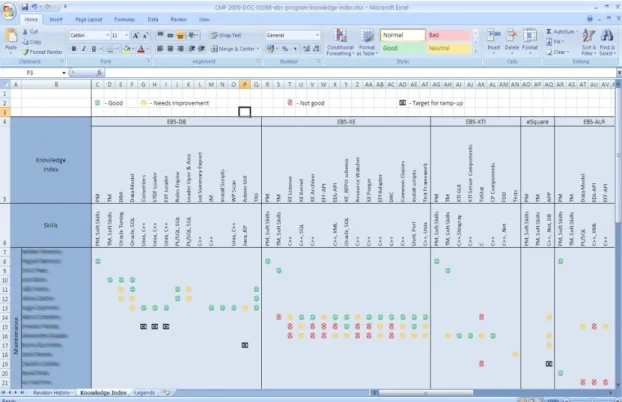
Moreover, the company lacks a centralized repository of its workers‘ competences transversal to all business relevant activities, such as project management, competence development (training) and even gap analysis. Instead, all relevant information is found throughout CMF‘s internal systems, forcing a manager to stumble upon these numerous tools, gather all relevant information and then place it in a central and unique infrastructure, for instance an Excel spreadsheet (Figure 8 and Figure 9).
iKnow: a General Purpose CMS
Figure 9: Detail of Figure 8, where a sample set of competences can be identified. Figure 8: Example of an Excel sheet used for internal CM at CMF
![Figure 1: Process diagram for strategic working with competences [1]](https://thumb-eu.123doks.com/thumbv2/123dok_br/15214615.1019764/20.892.240.685.274.733/figure-process-diagram-strategic-working-competences.webp)
![Figure 2: Key issues in the strategic perspective of competence management (adapted from [1])](https://thumb-eu.123doks.com/thumbv2/123dok_br/15214615.1019764/22.892.141.800.198.471/figure-key-issues-strategic-perspective-competence-management-adapted.webp)
![Figure 5: Example of an employee performance review on Taleo [116]](https://thumb-eu.123doks.com/thumbv2/123dok_br/15214615.1019764/32.892.125.759.114.605/figure-example-employee-performance-review-taleo.webp)
![Figure 6: Critical Manufacturing logo [74]](https://thumb-eu.123doks.com/thumbv2/123dok_br/15214615.1019764/36.892.168.766.727.1070/figure-critical-manufacturing-logo.webp)