Conjunctive Queries for Ontology based Agent
Communication in MAS
Cassia Trojahn
Universidade de Evora Rua Romao Ramalho, 59
Evora, Portugal
[email protected]
Paulo Quaresma
Universidade de Evora Rua Romao Ramalho, 59
Evora, Portugal
[email protected]
Renata Vieira
Pontificia Universidade Catolica do Rio Grande do Sul
Av. Ipiranga, 6681 Porto Alegre, Brazil
[email protected]
ABSTRACT
In order to obtain semantic interoperability in open Multi-Agent Systems, agents need to agree on the basis of differ-ent ontologies. In this paper we formally define mapping as correspondences between queries over ontologies. Indi-vidual mappings are computed by specialized agents using different mapping approaches. Next, these agents use argu-mentation to exchange their local results, in order to agree on the mappings. Based on their preferences and strength of the arguments, the agents compute their preferred mapping sets. The arguments in such preferred sets are viewed as the set of globally acceptable arguments. These arguments are then represented as conjunctive queries in OWL-DL ex-tended with DL-safe rules [9], a restriction imposed to attain decidability in such query answering system.
Categories and Subject Descriptors
I.2.11 [Artificial Artificial Intelligence]: Distributed Ar-tificial Intelligence—Multiagent systems; D.2.12 [Software Engineering]: Interoperability—data mapping
General Terms
Languages, Theory
1. INTRODUCTION
Multi-Agent Systems are by nature distributed and het-erogeneous. In these systems, ontologies play a fundamental role, formalizing the vocabulary from the agent’s perception of the world. In open Multi-Agent Systems, such as the Web, agents using different ontologies need to agree on the vocabulary they use, in order to communicate and then re-solve their tasks. Ontology mapping is a primary problem that has to be solved in order to allow agents with different backgrounds to adjust themselves before starting any form of cooperation or communication. Using a common ontology is impractical, because it would result in assuming a stan-dard communication vocabulary and it does not take into account the conceptual requirements of agents that could appear in future [13]. Moreover, a common ontology forces Cite as: Title, Author(s), Proc. of 7th Int. Conf. on Au-tonomous Agents and Multiagent Systems (AAMAS 2008), Padgham, Parkes, Müller and Parsons (eds.), May, 12-16., 2008, Estoril, Portugal, pp. XXX-XXX.
Copyright°c 2008, International Foundation for Autonomous Agents and Multiagent Systems (www.ifaamas.org). All rights reserved.
an agent to abandon its own world view and adopt one that is not specifically designed for its task [4].
In this paper we propose an OWL-DL mapping system based on argumentation and conjunctive queries. First, in-dividual mappings are computed by specialized agents using different mapping approaches (lexical, semantic and struc-tural). Next, these agents use argumentation to exchange their local results, in order to agree on the obtained map-pings. An Extended Value-based Argumentation Frame-work (E-VAF) is used to represent arguments with strength [24]. The E-VAF allows to determine which arguments are acceptable, with respect to the different audiences repre-sented by different agents. To each argument is associated a
strength, representing how confident an agent is in the
simi-larity of two ontology terms. Based on their preferences and confidence of the arguments, the agents compute their pre-ferred mapping sets. The arguments in such prepre-ferred sets are viewed as the set of globally acceptable arguments.
We follow the framework of [15] where the mappings ob-tained from argumentation are expressed as correspondences between queries over ontologies. Query answering in such a mapping system of this general form is undecidable and requires a theorem prover. To attain decidability in such query answering, we use the restrictions from [9]. These restricted, but still very expressive mappings, can be ex-pressed in OWL-DL extended with DL-safe rules. Query answering in such framework is based on a technique for re-ducing OWL-DL ontologies to disjunctive datalog programs [12][9]. Our motivation for using DL conjunctive queries is to improve the mapping expressiveness and consequently the application efficiency.
This paper is structured as follows. Section 2 presents our Extended Value Argumentation Framework (E-VAF). Section 3 presents the use of E-VAF for ontology mapping. Section 4 presents an evaluation of it against three mapping systems. Section 5 presents the proposed mapping system based on conjunctive queries for OWL-DL ontologies. Sec-tion 6 presents an illustrative example. SecSec-tion 7 comments on related work. Finally, section 8 presents the final remarks and the future work.
2. EXTENDED VALUE-BASED
ARGUMEN-TATION FRAMEWORK
Our argumentation model is based on the Value-based Argumentation Framework (VAF)[3], a development of the classical argument system of Dung [6]. The VAF is able to distinguish attacks from successful attacks, those which
de-feat the attacked argument, with respect to an ordering on the values that are associated with the arguments. It allows to accommodate different audiences with different interests and preferences. We extend the VAF in order to represent arguments with strength, which represents the confidence
de-gree that an agent has in some argument. One element has
been added to VAF: a function which maps from arguments to strength. We assumed that strength is a relevant criterion to represent the ontology mapping domain. In previous work [24] we had used only two discrete classes to express the
con-fidence degree an agent had in the mappings (certainty and uncertainty). In this paper, we use confidence as strength ∈
[0,1]. This work differs from previous ones in three issues: confidence degrees are represented as a continuous values (previously they were discrete); terms with multi-words are treated, an important issue for ontology mapping not consid-ered in previous work; representing mappings obtained from argumentation as conjunctive queries is original, in the sense of a complete framework for ontology mapping.
Definition 2.1 An Extended Value-based Argumentation Framework (E-VAF) is a 7-tuple E-VAF = (AR,
at-tacks,V,val,valS) where (AR,attacks,V,val, P) is a
value-based argumentation framework, and valS is a function which maps from elements of AR to real values from [0,1].
Definition 2.2 An argument x ∈ AR defeatsa(or
success-fully attacks) an argument y ∈ AR for audience a if
and only if attacks(x,y) ∧ ((valS(x) > valS(y)) ∨ (¬
valpref(val(y),val(x)) ∧ (¬ (valS(y) > valS(x)))).
An attack succeeds if (a) the strength of the attacking argument is greater than the strength of the argument being attacked; or if (b) the argument being attacked does not have greater preference value than attacking argument (or if both arguments relate to the same preference values) and the strength of the argument being attacked is not greater than the attacking argument.
Definition 2.3 A set S of arguments is conflict-free for au-dience a if (∀x)(∀y) ((x ∈ S ∧ y ∈ S) −→ (¬attacks(x,
y) ∨ (¬(valS(x) > valS(y)) ∧ (valpref(val(y), val(x)) (∨ (valS(y) > valS(x)))))).
3. E-VAF FOR ONTOLOGY MAPPING
In this paper we consider three values: lexical (L), seman-tic (S), and structural (E) (i.e. V = {L, S, E}, where V ∈ S-VAF). These values represent the mapping approach used by the agent and are also used to represent the audiences. Each audience has an ordering preference between the
val-ues. For instance, the lexical agent represents an audience
where the value L is preferred to the values S and E. Our idea is not to have an individual audience with preference between the agents (i.e., semantic agent is preferred to the other agents), but it is to try accommodate different audi-ences (agents) and their preferaudi-ences.
We point out that agent autonomy is not the main fo-cus of the work, the contribution relies more on the use of argumentation for solving the difficult problem of maximiz-ing correct conceptual mappmaximiz-ing on the basis of conflictmaximiz-ing individual views.
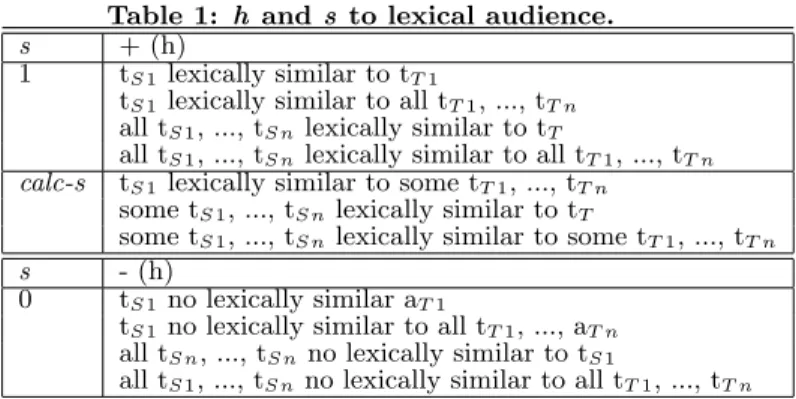
Table 1: h and s to lexical audience.
s + (h)
1 tS 1 lexically similar to tT 1
tS 1 lexically similar to all tT 1, ..., tT n all tS 1, ..., tS nlexically similar to tT
all tS 1, ..., tS nlexically similar to all tT 1, ..., tT n
calc-s tS 1 lexically similar to some tT 1, ..., tT n some tS 1, ..., tS nlexically similar to tT
some tS 1, ..., tS nlexically similar to some tT 1, ..., tT n
s - (h)
0 tS 1 no lexically similar aT 1
tS 1 no lexically similar to all tT 1, ..., aT n all tS n, ..., tS nno lexically similar to tS 1
all tS 1, ..., tS nno lexically similar to all tT 1, ..., tT n
3.1 Argumentation generation
First, the agents work in an independent manner, apply-ing the mappapply-ing approaches and generatapply-ing mappapply-ing sets. The mapping result will consist of a set of correspondences between terms of two Description Logic ontologies (OWL-DL, as commented in Section 5). For efficiency and private or proprietary reasons, the mappings can be computed only over the terms the agents need to understand each other, rather than over the whole ontology.
A mapping m can be described as a 3-tuple m = (t1,t2,h),
where t1 corresponds to a term in the ontology 1, t2
corre-sponds to a term in the ontology 2, and h is one of {+,-} depending on whether the argument is that m does or does not hold. An argument is defined as follows:
Definition 3.1 An argument ∈ AR is a 3-tuple x = (m,a,s), where m is a mapping; a ∈ V is the value of the argu-ment (lexical, semantic or structural); s is the strength of the argument.
3.1.1 Lexical agent
The lexical agent adopts a metric to compare string simi-larity. We used the lexical similarity proposed by [19]. This metric is based on the Levenshtein distance [16], which is given by the minimum number of operations (insertion, dele-tion, or substitution of a single character) needed to trans-form one string into another. The length of the compared terms is considered to compute the lexical similarity. This metric returns a value from the interval [0,1], where 1 indi-cates high similarity between two terms.
Differently from the previous work [24][25], the agents are able to deal with compound terms. The first step in this process is the tokenization, where the terms are parsed into tokens by a tokenizer. The strength of an argument is com-puted according to the lexical similarity between each token of the two compared terms. Table 1 shows the possible val-ues to s and h, where tSn correspond to some token of the source term (source ontology), and tT n correspond to some token of the target term (target ontology). Two tokens are
lexically similar if the lexical similarity is greater than a threshold r.
When all tokens are lexically similar with each other, the terms match and the strength of the argument is 1. In this case, for instance, the lexical agent generates an argument x = (m,L,1), where m = (t1,t2,+).
If some tokens of the terms are lexically similar, the strength is computed according to the number of tokens that matches, according to the calc-s formula, where TS is the term from
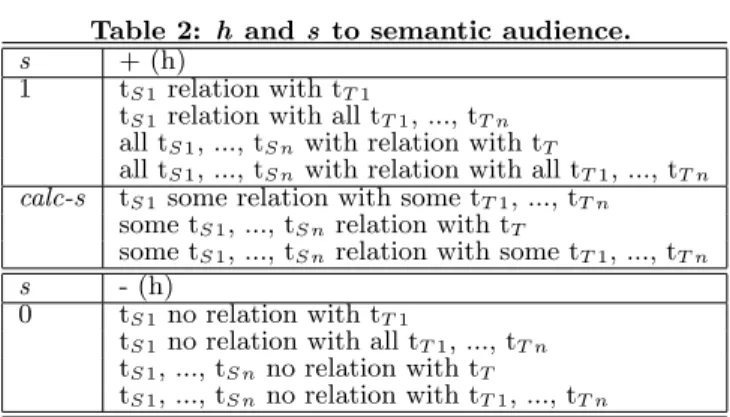
Table 2: h and s to semantic audience.
s + (h)
1 tS 1relation with tT 1
tS 1relation with all tT 1, ..., tT n all tS 1, ..., tS nwith relation with tT
all tS 1, ..., tS nwith relation with all tT 1, ..., tT n
calc-s tS 1some relation with some tT 1, ..., tT n some tS 1, ..., tS nrelation with tT
some tS 1, ..., tS nrelation with some tT 1, ..., tT n
s - (h)
0 tS 1no relation with tT 1
tS 1no relation with all tT 1, ..., tT n tS 1, ..., tS n no relation with tT
tS 1, ..., tS n no relation with tT 1, ..., tT n
the source ontology, TT is the term from the target ontol-ogy, and nM is the number of tokens that match between TSand TT: calc-s = max µ 0,max(| TS|, | TT |) − nM ) max(| TS|, | TS|) 
If there are no lexically similar tokens between the terms, the agent is not sure that the terms map (i.e., strength equals to 0), because this agent knows that other agent can resolve this mapping. In the specific case, if there is no lexical sim-ilarity between the terms, the semantic agent can resolve that mapping.
3.1.2 Semantic agent
This agent considers the semantic relations (i.e., synonym, hyponym, and hypernym) between concepts to measure the similarity between them. WordNet1database, a large
repos-itory of English semantically related items, is used to provide these relations. Table 2 shows the possible values to s and
h according to the semantic similarity.
When all tokens have semantic relation with each other, the strength of the argument is 1. The agent generates, for instance, an argument x = (m,S,1), where m= (t1,t2,
+). If some tokens have semantic relation, the strength is computed according to the number of semantically related tokens (formula presented above). Otherwise, if there are no semantic relation between the tokens, the agent is not sure that the terms map (i.e., strength equals to 0), because this agent knows that other agent can resolve the mapping. In the specific case, when the searched terms are not avail-able in WordNet, the lexical agent can decide the mapping. It is common because there is no complete lexical database for every domain (i.e., WordNet is incomplete for some do-mains).
3.1.3 Structural agent
The structural agent considers the positions of the terms in the ontology hierarchy to verify if the terms can be mapped. First, it is verified if the super-classes of the compared terms are lexically similar. If not, the semantic similarity is used. For instance, if the super-classes of the terms are not lex-ically similar, but they are synonymous, an argument x = (m,E,s), where m = (t1,t2,+), is generated, where s varies
according to the rules from Tables 1 or 2.
However, there are two main differences among the strength
1http://www.wordnet.princeton.edu
returned by the lexical, semantic, and structural agents. As Table 1 and Table 2, when the agents can not resolve the mapping, the strength of the corresponding argument is 0. However, if the structural agent does not find similarity (lex-ical or semantic) between the super-classes of the compared terms, it is because the terms can not be mapped (i.e., the terms occurs in different contexts). Then, the strength for no mapping is 1. Otherwise, if the structural agent finds simi-larity between the super-classes of the compared terms, it is because they can be mapped, but it does not mean that the terms have lexical or semantic similarity, then the strength for the mapping is 0. For instance, for the terms “Publica-tion/Topic” and “Publication/Proceedings”, the structural agent indicates that the terms can be mapped because they have the same super-class, but not with strength 1 because it is no able to indicate that the terms are similar. Other-wise, for the terms “Digital-Camera/Accessories” and “Com-puter/ Accessories”, the agent can indicate that the terms can not be mapped because they occur in different contexts (no-mapping with strength equal to 1).
3.2 Preferred extension generation
After generating their set of arguments, the agents ex-change with each other their arguments. When all agents have received the set of arguments of each other, they gener-ate their attacks set. An attack (or counter-argument) will arise when we have arguments for the mapping between the same terms, but with conflicting values of h. For instance, an argument x = (m1,L,+) has as an attack an argument y
= (m2,E,-), where m1and m2refer to the same terms in the
ontologies. The argument y also represents an attack to the argument x.
As an example, consider the mapping between the terms “Subject” and “Topic” and lexical and semantic values. The lexical agent generates an argument x = (m,L,0), where m = (subjectS,topicT,-); and the semantic agent generates an argument y = (m,S,1), where m = (subjectS,topicT,+). For both lexical and semantic audiences, the set of arguments is
AR= {x,y} and the attacks = {(x,y),(y,x)}.
When the set of arguments and attacks have been pro-duced, the agents need to define which of them must be ac-cepted. To do this, the agents compute their preferred exten-sion, according to the audience’s preferences and strength. A set of arguments is globally subjectively acceptable if each el-ement appears in the preferred extension for some agent. A set of arguments is globally objectively acceptable if each ele-ment appears in the preferred extension for every agent. The arguments which are neither objectively nor subjectively ac-ceptable are considered indefensible.
In the example above, considering the lexical(L) and se-mantic(S) audiences, where L Â S and S Â L, respectively, for the lexical audience, the argument y successfully attacks the argument x, while the argument x does not successfully attack the argument y for the semantic audience. Then, the preferred extension of both lexical and semantic agents is composed by the argument y, which can be seen as globally
objectively acceptable.
4. ARGUMENTATION EVALUATION
Let us consider that three agents need to obtain a consen-sus about mappings that link corresponding class names in
two different ontologies. We used the Test 82 data, which
corresponds to ontologies of company profiles domain. The source and target ontologies in Test 8 have 10 and 16 classes, respectively, resulting 160 possible mappings. The terms are composed from 1 to 5 tokens (for instance “Oil-and-Gas-Exploration-and-Production” or “Petroleum-Product- Dis-tribution”).
We used these ontologies because the comparative results for them, using three mapping systems commented below, are available in [8]. The three mapping systems are: Cu-pid[17], COMA[5], and S-Match[8]. Cupid algorithm is based on linguistic and structural approaches. It matches indi-vidual schema elements based on their names, data types, domains, etc. The result is a linguistic similarity, lsim, be-tween each pair of elements. Next, structural matching of schema elements is made, which depends in part on linguis-tic matches calculated initially, resulting in a structural sim-ilarity coefficient, ssim. The weighted simsim-ilarity (wsim) is a mean of lsim and ssim: wsim = wstruct ssim + (1−wstruct) lsim, where the constant wstruct is in the range 0 to 1.
COMA represents a generic system to combine match re-sults. The match result is a set of mapping elements specify-ing the matchspecify-ing schema elements together with a similarity
∈ [0,1] indicating the plausibility of their correspondence.
The matchers currently supported fall into three classes: simple, hybrid and reuse-oriented matchers. They exploit different kinds of schema information, such as names, data types, and structural properties, or auxiliary information, such as synonym tables and previous match results.
S-Match algorithm is based on two main steps. First, the synonymous terms are captured using WordNet (ele-ment level). Second, the structural schema properties are taken into account, where the path to the root is computed (structural level). Element level semantic matchers provide the input to the structural level matcher, which is applied on to produce the set of semantic relations between concepts as the matching result.
Table 3 shows the comparative results. We used a thresh-old of 0.8 to lexical agent classifies the mappings (terms with lexical similarity greater than 0.8 are considered similar) and a threshold to eliminate the terms that have strength be-low 0.75. Our model returned better precision than Cupid and COMA, and equal precision when compared to S-Match (precision equal to 1). When comparing the f–measure val-ues, our model had similar result than COMA and S-Match and better result than Cupid.
Differently from these works, our model uses argumenta-tion to combine map- ping approaches. Although our im-plementation does not provide the best solution for the on-tology mapping problem for these experimental tests as yet, we claim that our main contribution is to propose a model that can be used to combine different approaches. Using argumentation has the following advantages: the agents are independent to each other; many other agents can be easily added to our model, without having to modify the imple-mentation; there are several techniques for ontology map-pings, which can be adapted according to domain, kind of ontologies, and available resources (for instance, in the con-text of some languages, there is no lexical databases such WordNet). Moreover, although the reported experiments consider pairs of ontologies, the approach can be easily
ex-2http://dit.unitn.it/˜accord/Experimentaldesign.html
tended to deal with a larger number of ontologies. Also, the use of web-based background knowledge could be easily integrated in the framework as another mapping agent.
5. REPRESENTING MAPPINGS AS
OWL-DL CONJUNCTIVE QUERIES
The mappings obtained from argumentation are repre-sented as conjunctive queries in OWL-DL extended with DL-safe rules [9], a restriction imposed to attain decidabil-ity in such query answering system. In the following, we first introduce OWL-Description Logic (OWL-DL) and then comment on the representation of mappings as conjunctive queries.
5.1 OWL-DL
Description Logics (DLs) is the name for a family of edge representation (KR) formalisms that represent the knowl-edge of an application domain (“the world”) by defining the relevant concepts of the domain (its terminology), and using these concepts to specify properties of objects and individ-uals occurring in the domain [1].
A DL knowledge base (KB) comprises two components: TBox and ABox. The TBox contains the terminology, which specifies the vocabulary of an application domain. The ABox contains assertions about named individuals in terms of the TBox. The vocabulary consists of concepts and roles.
Con-cepts denote set of individuals while roles denote binary
re-lationship between individuals. Atomic concepts and roles can be used to build complex description of concepts and roles, using constructors. The language for building descrip-tions is a feature of different DLs, and different systems are distinguished by their description languages, i.e., the expres-siveness of the language according with the constructors that they support.
The OWL-DL ontology language is a variant of SHOIN(D) [10] Description Logic, which provides constructors for full negation, disjunction, a restricted form of existential quan-tification, and reasoning with concrete datatypes. OWL-DL is the state-of-the-art formalism to represent ontologies. Here, we propose to use OWL-DL also to represent the map-pings obtained from argumentation. The set of SHOIN(D) concepts is defined by the following syntactic rules, where
A is an atomic concept, R is a role name, d is a concrete
domain, ci are individuals, and n is a non-negative integer: C → A | ¬C | C1 u C2 | C1 t C2 | ∃R.C | ∀R.C |
n S | n S | {a1,...,an} | n T | nT |
∃T1, ..., Tn.D | ∀T1, ..., Tn.D
D → d | {c1,...,cn}
Here, we consider the semantics of a SHOIN(D) knowl-edge base KB by the mapping π proposed by [9] which trans-forms KB axioms into a first-order formula. Each atomic concept is mapped into a unary predicate and each role is mapped into a binary predicate.
5.2 Conjunctive Queries
Definition 5.1 (Conjunctive Queries) [9]. Let KB be a
SHOIN(D) knowledge base, and NP be a set of pred-icate symbols, such that all SHOIN(D) concepts and all roles are in NP. An atom has the form P(s1, ...,
Table 3: Comparative mapping results.
Arg Cupid COMA S-Match
Ontology P R F P R F P R F P R F
Company profiles (160) 1 0.63 0.77 0.50 0.60 0.54 0.80 0.70 0.74 1.0 0.65 0.78 either variables or individuals from KB. An atom is
called ground atom, if it is variable-free. An atom is called a DL-atom if P is a SHOIN(D) concept or role. Consider that x1, ..., xn and y1, ..., ynare sets of
distin-guished and non distindistin-guished variables, indicated as x and y. A conjunctive query over KB – Q(x,y) – is a conjunction of atomVPi(si), where all si together contain x and y.
A conjunctive query Q(x,y) is DL-safe if each variable occurring in a DL-atom also occurs in a non-DL-atom in Q(x,y): π(Q(x,y)) = ∃y: V π(Pi(si)). For Q1(x,y1) and
Q2(x,y2) conjunctive queries, a query containment axiom
Q1(x,y1) v Q2(x,y2) has the following semantics: π(Q2(x,y2))
v Q1(x,y1) = ∀x: π((Q1(x,y1)) ← Q2(x,y2).
The main inferences for conjunctive queries are:
• Query answering. An answer of a conjunctive query
Q(x,y) w.r.t. KB is an assignment θ of individuals to distinguished variables, such that π(KB) |= π(Q(xθ,y)).
• Checking query containment. A query Q2(x,y2) is
con-tained in a query Q1(x,y1) w.r.t. KB, if pi(KB) |=
π(Q2(x,y2)) v Q1(x,y1).
Intuitively, DL-safely restricts the applicability of a query only to individuals explicitly named in a KB [9]. To auto-matically convert a non-DL safe query into a DL-safe one, it is assumed a special non-DL predicate O such that, for each individual α occurring in KB, it contains a fact O(x). Then, a non-DL safe conjunctive query Q(x,y) can be converted into a DL-safe query by appending to it an atom of the form O(z), for each variable z occurring only in a DL-atom of Q(x,y).
5.3 OWL-DL Mapping System
Following the definitions from [15] and [9], we introduce an OWL-DL mapping system based on conjunctive queries. The components of mapping system are the source ontol-ogy, the target ontolontol-ogy, and the mapping between the two ontologies.
Definition 5.2 (OWL-DL Mapping System) An OWL-DL mapping system MS is a triple (S,T,M), where
• S is the source ontology; • T is the target ontology;
• M is the mapping between S and T, i.e, a set of
assertions qS ; qT, where qS and qT are con-junctive queries over S and T, respectively, with the same set of distinguished variables x, and ;
in {v, w, ≡}.
An assertion qSv qT is called a sound mapping, requiring that qSis contained by qTw.r.t S ∪ T; an assertion qSw qT is called a complete mapping, requiring that qT is contained by qSw.r.t S ∪ T; and an assertion qS≡ qTis called an exact
mapping, requiring it to be sound and complete. A sound
mapping qSv qTis equivalent to an axiom ∀x: qT(x,yT) ← qS(x,yS), while a complete mapping qT v qS is equivalent to an axiom ∀x: qS(x,yS) ← qT(x,yT).
Definition 5.3 (Mapping System Semantics) For a map-ping system MS = (S,T,M), let π(MS) = π(S) ∪ π(T)
π(M). the main inference for MS is computing answers
of Q(x,y) w.r.t. MS, for Q(x,y) a conjunctive query. The intuitive reading of this semantics is that an answer of a query needs to be entailed by the source ontology S, the target T and the mappings M. Query answering in such a system of this general form is undecidable and requires a theorem prover. Here we use the special kinds of mappings introduced by [9], that lead to decidable query answering and for which practical query answering algorithms exist:
• Full Implication Mappings: The first class of mappings
captures the mappings that can be directly expressed in OWL-DL. This is the case if qsand qtare DL-atoms of the form Ps(x) and Pt(x).
– Concept Mappings. If qs and qt are of the form Ps(x) and Pt(x) and Psand Ptare DL concepts, the mapping corresponds to the equivalent con-cept inclusion axiom.
– Role mappings. If qs and qt are of the form Ps(x1,y1) and Pt(x1,y2), with Ps and Pt roles,
the mapping corresponds to the equivalent role inclusion axiom.
• Restricted Implication Mappings: Query answering for
general implication mappings is undecidable due to the unrestricted use of non distinguished variables in either qs or qt. In the following, restrictions that reduce the expressivity of the mappings but provide for a decid-able query answering procedure are defined.
– DL-safe Mappings. Consider a mapping qS v qT with the assertions ∀x: qT(x,yT) ← qS(x,yS). In order to avoid introducing new objects in the in-terpretation domain, it is not allowed the use of non-distinguished variables in the query qT, i.e., restrict the assertions to the form ∀x: qT(x) ← qS(x,yS). Query answering with such mappings is still undecidable in the general case. Therefore, it is required the query qS to be DL-safe, thus limiting the applicability of the rules to known individuals.
– Mappings with Tree-like Query Parts. The re-strictions introduced by DL-safety may appear rather strong. In the following it is commented how to relax the above restrictions for a certain class of so-called tree-likes queries. Using the query roll-up technique from [11], we can elim-inate non-distinguished variables by reducing a tree-like part of a query to a concept, without loosing semantic consequences. By applying rolling up to each role term, an arbitrary query can be reduced to an equivalent one which contains only concept terms, and which can be answered using a set of satisfiability tests in DL.
5.4 Mappings as Conjunctive Queries
The mappings M are obtained using the E-VAF, as com-mented in Section 3. The set of globally (or subjectively) acceptable arguments is taken as input to the process of cre-ating the conjunctive queries. A conjunctive query, as com-mented in Section 4, has the formV (Pi(si)). Here, each Pi(si) corresponds to a mapping. For instance, in the exam-ple showed in Section 3.2, Q(x): Subject(x) ≡ Topic(x).
Using conjunctive queries in DL allows to represent very expressive mappings. When a term TSis mapped with more than one TT, the query has, for instance, the form Q(x): Thesis(x) ≡ (PhdThesis t MasterThesis)(x). According to the restrictions for decidable queries imposed by [9], x must be defined in the ABox (DL-safe rules).
Considering roles and concepts, we can define complex mapping such as Q1(x,y): Publication(x) t title(x,y) and
Q2(x,y): Entry(x) t entry-title(x,y).
Table 4 shows how to compute answers to a conjunctive query Q(x,y). Here, we adapt the algorithm proposed by [9]. Query answering in a DL KB is reduced to query answer-ing in a Disjunctive Datalog KB, which can be performed efficiently, using the techniques of (disjunctive) deductive databases [12]. The algorithm starts by eliminating non-distinguished variables from Q(x,y) and the mapping, using the query roll-up technique [11] (i.e., transforming roles into concept descriptions). After roll-up, the obtained mappings and queries are required to be DL-safe, which is needed for decidable query answering. If this condition is fulfilled, then the source ontology, target ontology and the mappings are converted into a disjunctive datalog program, and the query is answered in the obtained program.
Table 4: Algorithm for Answering Queries Require: Mappings M in a conjunctive query format, ontology source S and ontology targetT
1: Roll-up tree-like parts of Q(x,y)
2: Roll-up tree-like parts of query mapping in M
3: Stop if Q(x,y) or some mapping from M is not DL-safe 4: KB ← S ∪ T ∪ M
6: Reduce KB to a Disjunctive Datalog KB (DD) 5: Compute the answer of Q(x,y) in DD
6. AN ILLUSTRATIVE EXAMPLE
Let us consider an example where two agents, Initiator (I) and Participant(P), interact with each other to agree on the price of a product, using FIPA Contract Net Interac-tion Protocol. We had used two ontologies about product schemas3.
Figure 1 shows the organizational model of the system, and Table 5 describes the steps of the interaction between the agents.
The agent Initiator has the ontology presented in ble 6 and the Participant has the ontology presented in Ta-ble 7. Comparing the output of our argumentation model and manual mapping, it obtained precision equal to 1, recall equal to 0.75, and f–measure equal to 0.85. Table 8 shows the arguments and counter-arguments (attacks, At.), for the correct mappings returned by our model.
3http://dit.unitn.it/˜accord/Experimentaldesign.html
(Test 4)
Figure 1: Organizational model. Table 6: Initiator’s DL Ontology. Consumer-Electronics v >
Personal-Computers v Consumer-Electronics Microprocessors v Personal-Computers Accessories v Personal-Computers
Photo-and-Cameras v Consumer-Electronics
As shown in Table 8, the preferred extensions of the agents are composed by the arguments generated by the corre-sponding audience. The preferred extension of the lexical agents is {1, 5, 7}; the preferred extension of the semantic agent is {2, 5, 8}; and the preferred extension of the struc-tural agent is {3, 6, 9}). Here, we consider the “subjectively
acceptable” arguments. So, the arguments 1, 2, 3, 5, 6, 7,
and 8 can be considered as consensus (note that the argu-ment 4 is not acceptable). Note that the arguargu-ments 1, 2 and 3; 5 and 6; and 7, 8 and 9 refer to the same mappings. The corresponding queries are shown in Table 9.
Let us consider an extension of the first query in order to represent complex mappings with attributes: Q1I(x,y):
Photo-and-Camera(x) t name(x,y) t price(x,z) and Q1P(x,y):
Camera-and-Photo(x) t name-camera(x,y) t price-camera (x,z), with Q1I ≡ Q1P.
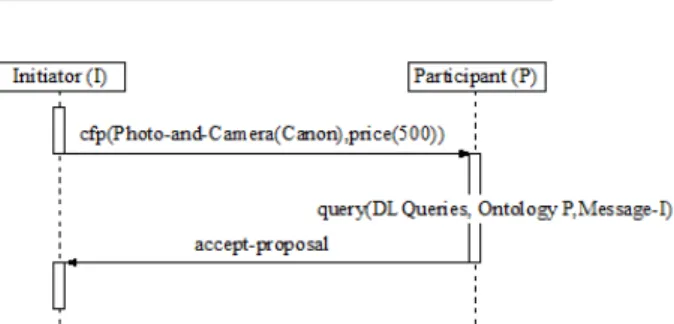
Figure 2 shows an AUML interaction diagram with the messages exchanged between the agents P and I during the negotiation of the price of one camera. The agents use the queries to search for correspondences between the messages sent from each other and the terms in the corresponding ontologies. In the example, the agent I sends a message to the agent P, using its vocabulary. The agent P, then, converts the message, using the DL queries.
7. RELATED WORK
In the field of ontology mapping, [20], [21], and [7] present a broad overview of the various approaches on automated
Table 7: Participant’s DL Ontology. Electronics v > PC v Electronics PC-board v PC Cameras-and-Photo v Electronics Accessories v Cameras-and-Photo Digital-Cameras v Cameras-and-Photo
Table 5: Interaction steps. Step Description
1 Mapper (M) agent requests the ontologies to be mapped to agents I and P 2 Ontologies are sent from M to the argumentation module
3 Agents using lexical (L), semantic (S) and structural (E) approaches apply their algorithms 4 Agents L, S and E communicate with each other to exchange their arguments
5 Preferred extensions of L, S and E are generated 6 Subjectively arguments are computed
7 Mappings are represented as conjunctive queries 8 Queries are sent to Mapper
9 Queries are sent to I and P
10 Agents I and P use the queries to communicate with each another
Table 8: Arguments and attacks.
ID Argument At. 1 (Photo-and-Camera,Camera-and-Photo,+,L,1.0) -2 (Photo-and-Camera,Camera-and-Photo,+,S,1.0) -3 (Photo-and-Camera,Camera-and-Photo,+,E,0.0) -4 (Personal-Computer,PC,-,L,0.0) 5, 6 5 (Personal-Computer,PC,+,S,1.0) 4 6 (Personal-Computer,PC,+,E,0.0) 4 7 (Consumer-Electronic,Electronic,+,L,0.5) -8 (Consumer-Electronic,Electronic,+,S,0.5) -9 (Consumer-Electronic,Electronic,+,E,0.0)
-Table 9: Conjunctive queries. Query ID Correspondences QI 1(x) i:Photo-and-Camera(x) QP 1(x) p:Camera-and-Photo(x) m1 QI 1 ≡ QP 1 QI 2(x) i:Personal-Computer(x) QP 2(x) p:PC(x) m2 QI 2 ≡ QP 2 QI 3(x) i:Consumer-Electronic(x) QP 3(x) p:Electronic(x) m3 QI 3 ≡ QP 3
ontology matching. Expressivity of the mappings is an is-sue that is not well explored in these works. [9] was the first to propose expressive mapping as DL queries. However, the mappings are not obtained by the framework proposed, only represented as queries. Our proposal is an integrated framework which combines the representation of mappings as queries, as proposed by [9], and a complete DL mapping system based on argumentation.
In the field of ontology argumentation few approaches are being proposed. Basically, the closer proposal is from [14][13], where an argument framework is used to deal with arguments that support or oppose candidate correspondences between ontologies. The candidate mappings are obtained from an Ontology Mapping Repository (OMR) – the focus is not how the mappings are computed – and argumentation is used to accommodate different agent’s preferences. In our approach mappings are computed by the specialized agents described in this paper, and argumentation is used to solve conflicts between the individual results.
We find similar proposals in the field of ontology negotia-tion. [23] presents an ontology to serve as the basis for agent negotiation, the ontology itself is not the object being nego-tiated. A similar approach is proposed by [4], where agents agree on a common ontology in a decentralized way. Rather than being the goal of each agent, the ontology mapping is
Figure 2: AUML negotiation interaction. a common goal for every agent in the system. [2] presents an ontology negotiation model which aims to arrive at a common ontology which the agents can use in their particu-lar interaction. We, on the other hand, are concerned with delivering mapping pairs found by a group of agents us-ing argumentation. [22] describes an approach for ontology mapping negotiation, where the mapping is composed by a set of semantic bridges and their inter-relations, as proposed in [18]. The agents are able to achieve a consensus about the mapping through the evaluation of a confidence value that is obtained by utility functions. According to the confidence value the mapping rule is accepted, rejected or negotiated. Differently from [22], we do not use utility functions. Our model is based on cooperation and argumentation, where the agents change their arguments and by argumentation they select the preferred mapping.
8. FINAL REMARKS AND FUTURE WORK
In this paper we proposed to represent ontology mappings as correspondences between queries. The mappings are com-puted by agents using different mapping approaches. These agents exchange their local results and use argumentation to agree on the obtained mappings. An Extended Value-based Argumentation Framework (E-VAF) was used to rep-resent arguments with strength. Based on their preferences and strength of the arguments, the agents compute their preferred mapping sets. The arguments in such preferred sets are viewed as the set of globally acceptable arguments. These arguments are then represented as conjunctive queries in OWL-DL.
Although we have not emphasized the use of mapping for agent communication, we took it for granted that ontology mapping is intrinsically related to agent communication is-sues. This is a primary problem that has to be solved in order to allow agents with different backgrounds to adjust themselves before starting any form of cooperation or com-munication.
We evaluated our argumentation model against three map-ping systems, according to the available comparative data and we presented through an example how to represent the mapping results using conjunctive queries. The motivation for using such queries is for improved efficiency. However, the improvement was not yet demonstrated, just the decid-ability (which is an important issue that must be demon-strated).
In the future, we intend to develop further tests consider-ing a benchmark of ontologies4; demonstrate the efficiency
of using conjunctive queries to search in an integrated on-tology system; and use the mapping as input to an onon-tology merge process in the question answering domain.
Acknowledgments
The first author is supported by the Programme Alban, the European Union Programme of High Level Scholarships for Latin America, scholarship no. E05D059374BR.
9. REFERENCES
[1] F. Baader, D. Calvanese, D. L. McGuinness, D. Nardi, and P. F. Patel-Schneider, editors. The Description
Logic Handbook: Theory, Implementation, and Applications. Cambridge University Press, 2003.
[2] S. Bailin and W. Truszkowski. Ontology negotiation between intelligent information agents. The Knowledge
Engineering Review, 17(1):7–19, 2002.
[3] T. Bench-Capon. Persuasion in practical argument using value-based argumentation frameworks. Journal
of Logic and Computation, 13:429–448, 2003.
[4] J. v. Diggelen, R. Beun, F. Dignum, v. R. Eijk, and J. C. Meyer. Anemone: An effective minimal ontology negotiation environment. In Proceedings of the
Fiftheen International Conference on Autonomous Agents and Multi-Agent Systems, pages 899–906, 2006.
[5] H. H. Do and E. Rahm. Coma - a system for flexible combination of schema matching approaches. In
Proceedings of the 28th Conference on Very Large Databases, 2002.
[6] P. Dung. On the acceptability of arguments and its fundamental role in nonmonotonic reasoning, logic programming and n–person games. Artificial
Intelligence, 77:321–358, 1995.
[7] J. Euzenat and P. Shvaiko. Ontology matching. Springer-Verlag, Heidelberg (DE), 2007. [8] F. Giunchiglia, P. Shvaiko, and M. Yatskevich.
S-match: An algorithm and an implementation of semantic matching. In Proceedings of the European
Semantic Web Symposium, pages 61–75, 2004.
[9] P. Haase and B. Motik. A mapping system for the integration of owl-dl ontologies. In IHIS, pages 9–16, 2005.
[10] I. Horrocks and P. Patel-Schneider. Reducing owl entailment to description logic satisfiability. In
Proceedings of the 2nd International Semantic Web Conference, 2003.
[11] I. Horrocks and S. Tessaris. A conjunctive query language for description logic aboxes. In AAAI/IAAI, pages 399–404, 2000.
4http://oaei.ontologymatching.org/
[12] U. Hustadt, B. Motik, and U. Sattler. Reducing
SHIQ−description logic to disjunctive datalog programs. In D. Dubois, C. Welty, and M.-A.
Williams, editors, Proceedings of the 9th International
Conference on Knowledge Representation and Reasoning, pages 152–162. AAAI Press, 2004.
[13] L. Laera, I. Blacoe, V. Tamma, T. Payne, J. Euzenat, and T. Bench-Capon. Argumentation over ontology correspondences in mas. In M. Durfee, E. H.; Yokoo, editor, Proceedings of the Sixth International Joint
Conference on Autonomous Agents and Multi-Agent Systems, 2007.
[14] L. Laera, V. Tamma, J. Euzenat, T. Bench-Capon, and T. R. Payne. Reaching agreement over ontology alignments. In Proceedings of 5th International
Semantic Web Conference (ISWC 2006), 2006.
[15] M. Lenzerini. Data integration: a theoretical perspective. In PODS ’02: Proceedings of the
twenty-first ACM SIGMOD-SIGACT-SIGART symposium on Principles of database systems, pages
233–246, New York, NY, USA, 2002. ACM Press. [16] I. Levenshtein. Binary codes capable of correcting
deletions, insertions an reversals. In Cybernetics and
Control Theory, 1966.
[17] J. Madhavan, P. Bernstein, , and E. Rahm. Generic schema matching with cupid. In Proceedings of the
Very Large Data Bases Conference, pages 49–58, 2001.
[18] A. Maedche, B. Motik, N. Silva, and R. Volz. Mafra - a mapping framework for distributed ontologies. In 13th
International Conference on Knowledge Engineering and Knowledge Management, pages 235–250, 2002.
[19] A. Maedche and S. Staab. Measuring similarity between ontologies. In Proceedings of the European
Conference on Knowledge Acquisition and Management, pages 251–263, 2002.
[20] E. Rahm and P. A. Bernstein. A survey of approaches to automatic schema matching. VLDB, 10:334–350, 2001.
[21] P. Shvaiko and J. Euzenat. A survey of schema-based matching approaches. Technical report, Informatica e Telecomunicazioni, University of Trento, 2004. [22] N. Silva, P. Maio, and J. Rocha. An approach to
ontology mapping negotiation. In Proceedings of the
K-CAP Workshop on Integrating Ontologies, 2005.
[23] V. Tamma, M. Wooldridge, I. Blacoe, and I. Dickinson. An ontology based approach to automated negotiation. In Proceedings of the IV
Workshop on Agent Mediated Electronic Commerce,
pages 219–237, 2002.
[24] C. Trojahn, P. Quaresma, and R. Vieira. A
cooperative approach for composite ontology mapping.
LNCS Journal of Data Semantic (to appear), 2007.
[25] C. Trojahn, P. Quaresma, and R. Vieira. An extended value-based argumentation framework for ontology mapping with confidence degrees. In Workshop of
Argumentation, International Conference on Autonomous Agents and Multiagent Systems, 2007.