ISSN: 2067-533X
INTERNATIONAL JOURNAL
OFCONSERVATION SCIENCE
Volume 8, Issue 1, January-March 2017: 25-34 www.ijcs.uaic.ro
DOCUMENTATION IN CONSERVATION FOR THE RETOUCHING
PROCESS OF A PAINTING BY AMADEO DE SOUZA-CARDOSO
Ana BAILÃO1*; Frederico HENRIQUES1,2; Madalena Costa CABRAL3; Alexandre GONÇALVES4
1Portuguese Catholic University, CITAR, Rua Diogo Botelho 1327, 4169-005 Porto, Portugal 2Laboratório HERCULES; Universidade de Évora, Palácio do Vimioso;
Largo Marquês de Marialva, 8, 7000-809 Évora 3Instituto Politécnico de Tomar (IPT), 2300-313 Tomar, Portugal
4Instituto Superior Técnico, Universidade de Lisboa / CEris; Av. Rovisco Pais 1, 1049-001 Lisboa
Abstract
In the documentation in conservation context, there is an increasing demand for precise and accurate data and also for full three dimensional records of the cultural heritage. This paper presents the study case of a painting by Amadeo de Souza-Cardoso before, during and after the retouching treatment. The work focuses on the use of open source systems, such as GIS and photogrammetry software, in order to produce accurate maps of object losses and realistic virtual 3D models enabling the study of artworks with a minimum budget and a low cost infrastructure.
Keywords: Documentation; Photogrammetry; Image-based modelling (IBM);
Amadeo de Sousa-Cardoso; Heritage conservation; Retouching.
Introduction
Tools to assist in the documentation
In the last decade, the demand for precise reports and 3D models for object documentation and visualization has drastically increased [1]. Despite the availability of new technologies and sensors [2], such recent interest is also due to the possibility of getting innovative investigations and surveys [3, 4]. For that reason, platforms like geographic information systems (GIS) and 3D modelling of close-range objects are increasingly being explored in the cultural heritage field, and especially in archaeology and conservation and restoration [5-10]. These tools can be used for diagnostic and non-invasive documentation, and in analytical and interactive visualization purposes. 3D models also represent an interesting tool to create virtual reconstructions of destroyed objects or the real environment where the object is from and when the intervention held some problems of treatment criteria [7-10].
Fabio Remondino [11] has specified some purposes where 3D documentation and modelling, with geometric and radiometric accuracy, can be applied, such as historical documentation, digital preservation and conservation, cross-comparisons, monitoring of shape and colours, simulation of aging and deterioration, virtual reality/computer graphics applications, 3D repositories and catalogues, web-based geographic systems, computer-aided restoration, multimedia museum exhibitions, visualization-supporting software, among others.
The aim of this article is to present a 3D documentation with image-based modelling (IMB) of a canvas painting, addressing the degradation phenomenon, texture description and interventions documentation. Results obtained with different open source systems are described. The text also describes the methodology and makes some recommendations on how to achieve accurate results.
Need for 3D documentation
Conservation documentation can be defined as the textual and visual records collected during the care and treatment of an object. This record can include objects condition, any treatment done to the object, any observations or conclusions made by the conservator as well
as details on the object’s past and present environment [12]. The conservation profession will
benefit from any kind of documentation that make the conservation documentation more easily accessible, cost/time efficient, and will increase consistency and accuracy of the recorded data, and reduce physical storage space requirements. The geographic information system applied in this project was a cross-platform free and open-source desktop GIS application (QGIS) that provides data viewing, editing and analysis capabilities [13]. The virtual 3D record can be a useful tool to analyse and create virtual reconstruction of degraded objects or reconstruction of lost objects. Both image-based modelling and GIS are additional contributions for the conservation documentation process in cultural heritage.
The case study present in this paper is a small painting (27,5cm × 21cm) from the Portuguese painter Amadeo de Souza-Cardoso. The georeferencing image painting and edition of polygons with GIS can provide accurate maps of the losses. The image-based modelling documentation highlights the state of conservation of the object, the texture of the painting and also the signature of the painter. To get an accurate 3D surface model of the painting the photogrammetric technique was applied, and the beta version software Memento, by Autodesk©, was used. The main advantage of Memento is that it processes a 3D model in the cloud, with a dense three-dimensional network, without using the user's computer resources. Also, with the export and preparation tools provided by the program, digitized reality can be optimized and exported for different workflows. The user can export to .OBJ, .STL, .PLY (mesh), .FBX, or save as .RCM. The .OBJ files have the option with or without texture. One of the current drawbacks of the program lies in its inability to compose multiple objects in the same scene. However, maybe for this reason the program is user-friendly with an efficiency interface. For this study, Memento was used when it was a free and open-source web-based software without restrictions. The commercial version was released on May 2016 and a student version, with restrictions, was available, newly appointed ReMake.
The Janela Azul artwork
In the present work, the case study is a painting entitled “Fenêtre Bleue”/ “Janela Azul”
(Blue Window), by Amadeo Souza-Cardoso (November 14th, 1887–October 25th, 1918), who belongs to the first generation of modernist Portuguese painters and has adopted in his paintings the innovations that took place in Europe during the years before the First World War [14].
In 1914, the year when the First World War began, Amadeo de Souza-Cardoso returned to Portugal from Paris, settling down in the North of the country. A year later, Eduardo Viana, Sonia and Robert Delaunay also moved away from Paris and settled in Northern Portugal. Inspired by the vibrant colours of popular art and local architecture, they produced several new art works, giving a new life to cubism.
Within a short time, and with the help of Almada Negreiros, the idea of creating a collective project of publications and expositions has risen among that group of painters: to the group, they have given the name of “Corporation Nouvelle” [15]. The “Janela Azul” was part of that collection, and has been sent to an exhibition in Barcelona, Spain.
Opposing the idea of reality description, this oil painting on canvas, 27,5cm × 21cm (Figure 1), shows the recreation of a popular theme, the window — in this case, with dense strokes, without hesitations, which fill the space with vitality. This painting is part of the theme "Janelas" ("Windows"), which consisted of a series of paintings created in the period of 1914– 16, during which Amadeo de Souza-Cardoso explored the theme of windows, characterized by the depiction of white and blue non symmetrical frames, surrounded by several different colours-blue, green, white, orange.
Fig. 1. Front and back views of the painting before the intervention © Frederico Henriques
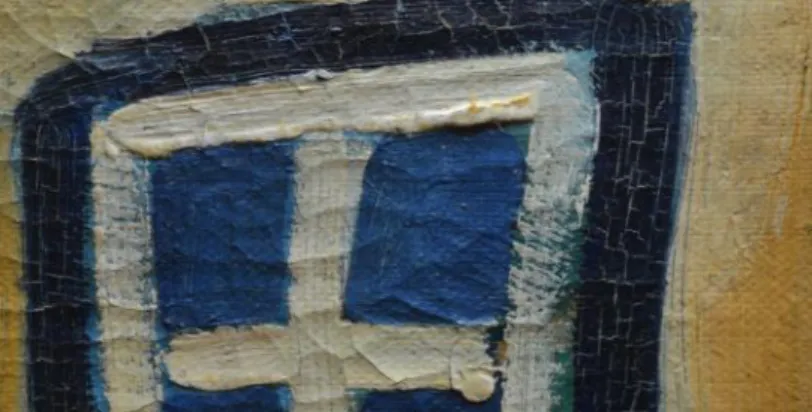
Looking for the brushstroke [16], one of the ways for observing the painting, the colour fields are built up by superimposed thick layers of saturated tones, without colour gradient, applied by brush or directly from the tube. There seems to be an equilibrium between the green, red, yellow and blue tones (Figure 2).
Fig. 2. Detail of the thick layers of saturated tones ® Ana Bailão
The artwork, owned by Maria de Sousa-Cardoso, presented small conservation problems: some small losses, yellowing varnish and a few overpaints out of hue. The intervention was held at the premises of the Calouste Gulbenkian Foundation, as part of an exhibition to be held at the Foundation's Modern Art Centre at the beginning of 2016, the
exhibition “The Delaunay Circle”. This work, also titled, since 1959, "The wall of the window,"
has a document, written by Souza-Cardoso, which refers to the work as "Fenêtre Bleue". Some conservation issues
The preliminary examination was limited to visible light, infrared (IR) and ultraviolet (UV) photography. Under UV light a yellowish fluorescence, over the pictorial layer of the
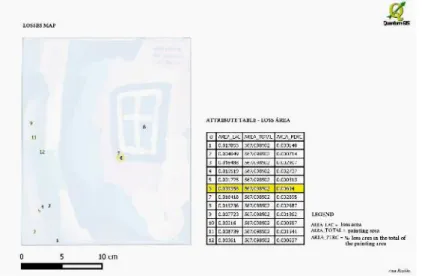
Twelve losses were recorded in datasets using QGIS, corresponding to 0.002% of the total area of the object (Figure 3).
Fig. 3. Mapping of losses done with open-source desktop geographic information system (GIS)
From the treatments that were performed, this paper focuses on the retouching task. Before this operation, 3D models of the painting were built up, both for the front and back sides. The aim of this virtual documentation was to achieve data about the texture of the painting and to help documenting the intervention.
Operational steps
To achieve the 3D model of the Souza-Cardoso painting, the following activities were performed: a photographic acquisition; an image-based modelling (cloud-based); and the visualization.
Photo acquisition
The photo was acquired with a Nikon D3200® digital camera. Camera calibration was not necessary [17]. Due to new algorithms of the software that was used in this study, the process is fully automatic. The mapping between image coordinates and directions relative to camera and the lens distortions of the digital camera is calculated by the software.
A total of 140 photographs were used for the project, 82 from the front side and 58 from the back side (Figure 4).
The photos were taken at different positions around the painting. The positions of the camera were carefully planned to achieve accuracy in the reconstruction of the object. Figure 5 shows the positions of camera maintained during the data acquisition of the painting.
Additional photos were taken from the front side to increase accuracy in the texture. For the back side less photographs were required, due to the presence of stamps and the wood painting stretcher. Although it is preferable to make the photographic records from every 5° around the painting in both sequences, thus obtaining 72 photos, it is also possible to model with reasonable quality with fewer pictures, as in this project.
The photogrammetric method is a technique for obtaining information about position, size and shape of an object by measuring images of it instead of measuring it directly. The current work uses the process of acquiring and using close range photogrammetric images. Close range is used to refer to photographs with an object-to-camera distance of less than 100m [17]. The main component necessary for a photogrammetric project is a series of overlapping
stereoscopic images. A stereo pair (or series) of images is taken from consecutive positions and overlap each other by at least 60%–70%. Through the use of photogrammetry, highly detailed three-dimensional data can be derived from the two-dimensional photographs of a stereo pair.
Fig. 4. Photos of the front side and back side taken at different positions around the painting
Fig. 5. 3D model view of Souza-Cardoso painting with the multiple close range images taken with Nikon D3200®
digital camera in different positions around the painting. These images were captured in Autodesk Memento software. There is an option to produce .avi videos with key frames and a customized camera movement can be produced
To create a 3D model of the Souza-Cardoso painting, multiple overlapping photographs, with more than 60% of the object, were taken. Photogrammetry using the position of the camera, as it moves through 3D space, can estimate X, Y and Z coordinates for each pixel of the original image. Figure 6 displays the model in a grid with information for measurement and object coordinates.
Fig. 6. 3D model view of Souza-Cardoso painting on a grid with X,Y,Z coordinates
Image processing and 3D model
The acquired photographs were uploaded into the photogrammetric modelling software Autodesk Memento, a widely used application that has made the complex algorithms necessary for processing photos into 3D models accessible through a fairly simple to use graphical interface. This software produces a dense mesh and offers much greater control of each stage of the process, and will let us produce much more accurate results. Autodesk Memento can turn photos into high quality 3D models (Figure 7).
Fig. 7. 3D model view of Souza-Cardoso painting: a) view of the front side in the textured mode;
b) view the painting in the solid mode; c) visualization of the 3D model of the signature in the textured mode; d) view of 3D model of the signature in the solid mode. The brushstrokes became
more obvious in the visualization of the surface of the painting in solid mode
It can generate meshes with up to two billion polygons. It is also possible to edit the models, smooth them out, fill in the gaps, detect any bugs and have it ready for 3D printing or 3D interaction in videos or web [18]. There are other commercial software’s that can be used like Agisoft PhotoScan, RealityCapture and free and open source software’s like 123D Catch, Visual SfM, ReconstructMe, among others.
A 3D model was generated with surfaces, textures and wireframe model. The wireframe model represents the painting as a quantity of vertices and edges. This representation is useful just to have the visualization of the general form of the painting. Figure 8 and 9 show the 3D model of the back side of the painting.
Fig. 8. 3D model view of the back side of Souza-Cardoso painting: 1) view of the back side in the textured mode;
2) view the painting in the solid mode. The brushstrokes became more obvious in the visualization of the surface of the painting in solid mode
Fig. 9. 3D model view of the back side of Souza-Cardoso painting. A 3D model of the back side of Souza-Cardoso
painting was generated in the solid mode (left image), x ray mode (centre image) and wireframe model (right image) Both in the solid and in the x-ray modes it is possible to improve the visualization of the small damage in the stretchers. Small details of the fabric are increased. The thickness of the papers glued in the stretchers is also documented. The x-ray mode allows, with a single image, be aware of the depth of an object.
It is possible to set up the coordinates X, Y, Z of the object, as shown in Figure 10. This may be important when it is necessary to export the object to another platform such as GIS or 3D computer graphics software.
After finishing the model, this can be exported in various formats for displaying or importing into other 3D analysis suites, animation software or game engines. Common formats are the 3D PDF, an interactive format that is widely accessible, as the model can be viewed, manipulated and even measured using the ubiquitous and free Adobe Reader; the Wavefront (.obj) and Collada (.dae) are the most portable 3D mesh formats. This is useful when working with other animation platforms, e.g. Blender (computer graphic software) or game engines like Unity 3D; Pointcloud (LAS, .txt, etc.). These formats are probably the most future proof for long term storage, and also offer many options for secondary analysis in other tools like Geomagic [19] or Meshlab [20].
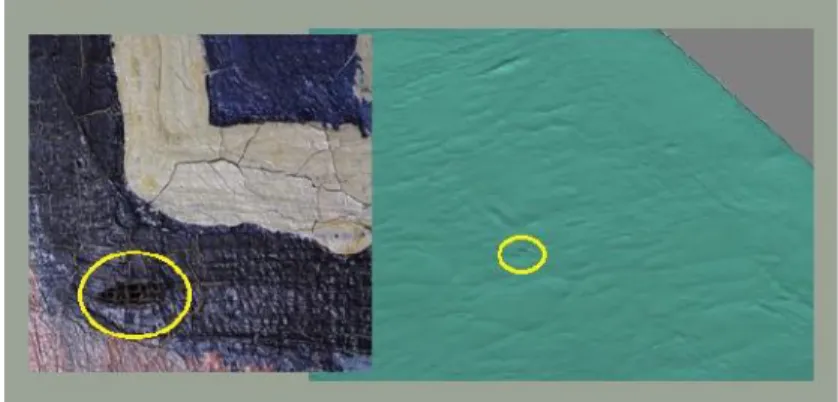
The retouching is an intervention for the reconstruction of the pictorial integrity of a artwork that over time became degraded (Figure 11). The aim is to minimize the temporal interference, the damage cause by handling, the losses, the premature cracking through their chromatic reintegration.
Fig. 11. Loss in the pictorial layer. Detail of the loss in the solid object of the 3D virtualization
In the first phase of the retouching process, water colours were used; in the second stage varnish mix with powder pigments was applied. The materials in question were Winsor & Newton Artist´s watercolours, and after applying the protective layer, the powdered pigments of Winsor & Newton were bonded in the ketonic resin. Whether with water colours or with pigments and varnish, the colour was applied in layers, bringing the tone to be reinstated to the one of the original painting. The choice of pigments was based on original artist palette. In Figure 12 it was used Ftalo Blue (PB 15) and Permanent Rose (PV19).
Results have shown that the followed flowchart of procedures (photo acquisition; image-based modelling and georeferencing, and editing of polygonal datasets with a GIS) can be a support tool in a specific phase of the conservation and restoration projects.
The accurate photographic documentation can involve very specific information about the procedures and materials used in each painting loss. This kind of documents with georeferenced images and spatial information with a comprehensive database may be essential for further studies and analyses of pictorial objects. Otherwise, without spatial information of the surface of the paintings, the conservation and restoration projects can result ambiguous in what refers to condition reporting or authentication processing.
Conclusions
The presented case study was a demonstration of the extent of photogrammetry and image-based modelling software capabilities for helping in the documentation of artworks. The precision obtained in the 3D model corresponds with the requirements of a conservator restorer and evidences that is no need for expensive equipment. Due to the availability of digital cameras at reasonable costs, low-cost photogrammetry (with could-based processing) offers one of the best alternative techniques to the professionals in the field of documentation the cultural heritage of objects.
There are projects involving the systematic acquisition of 3D information of large groups of paintings. Museums, for instance, are starting to contribute to new models of information and inventory management systems. However, the subsequent challenge will be to systematize and correlate the massive amount of data information with other works and collections by the same
painter, build an “id-based object database”.
Such advances in documentation are essential to manage research projects on heritage conservation and safeguarding of cultural heritage.
Acknowledgements
The authors would like to thank Paulo Milheiro, Maria do Carmo Sousa Cardoso and Maria da Graça Sousa Cardoso, proprietary of the painting; to the conservatorRui Xavier and to the historian and art critic Helena de Freitas from Calouste Gulbenkian Foundation. This work has been supported by Fundação para a Ciência e a Tecnologia (FCT) scholarship SFRH/BPD/99163/2013.
References
[1] F. Remondino, Reality – based 3D modeling of heritage sites and objects, I Congreso Internacional de Arquologia e Informática Gráfica, Patrimonio e Innovación, Sevillha, 2009, http://3dom.fbk.eu/sites/3dom.fbk.eu/files/pdf/remondino_sevilla09.pdf, accessed in 12.02.2016.
[2] Z. Li, J. Chen, E. Baltsavias (Ed.), Advances in Photogrammetry, Remote Sensing and Spatial Information Sciences, ISPRS Congress Book 2008, Taylor & Francis Group, London, UK, 2008.
[3] M. Levoy, K. Pulli, B. Curless, S. Rusinkiewicz, D. Koller, L. Pereira, M. Ginzton, S. Anderson, J. Davis, J. Ginsberg, J. Shade, D. Fulk, The Digital Michelangelo Project: 3D Scanning of Large Statues. Proceedings of SIGGRAPH ‟00, The 27th International Conference on Computer Graphics and Interactive Techniques Conference, New Orleans, LA, USA, 23–28 July 2000, pp. 131-144.
[4] F. Bernardini, H. Rushmeier, I.M. Martin, J. Mittleman, G. Taubin, Building a digital model
of Michelangelo’s Florentine Pieta, IEEE Computer Graphics and Applications, 22(1),
2002, pp. 59-67.
[5]
P. Spiridon, A. Ursu, I. Sandu, Touristic Revaluation of the Cultural Heritage in the Moldavian Plain, Nano, Bio and Green - Technologies for a Sustainable Future Conference Proceedings, SGEM 2016, Vol II, Book Series: International Multidisciplinary Scientific GeoConference-SGEM, 2016, pp. 381-388. DOI: 105593/sgem2016B62.[6] P. Spiridon, A. Ursu, I. Sandu, Heritage Management Using GIS, Informatics, Geoinformatics and Remont Sensing, Vol. III, Book Series: International Multidisciplinary Scientific GeoConference-SGEM 2016, 2016, pp. 262-270, DOI: 105593/sgem2016B23.
[7] M. Munteanu, I. Sandu, The implications of free 3D scanning in the conservation state assessment of old wood painted icon, IOP Conference Series: Materials Science and Engineering, 133, 2016, 012060 doi:10.1088/1757-899X/133/1/012060.
[8] M. Munteanu, I.C.A. Sandu, M.M. Lupascu, V. Vasilache, I. Sandu, The importance of a complete and modern information gathering protocol in the conservation process of a XVIII-TH Century icon, International Journal of Conservation Science, 7(3), 2017, pp. 995-1008.
[9] L. MacDonald, S. Robson, Polynomial Texture Mapping and 3D Representations, International Archives of Photogrammetry, Remote Sensing and Spatial Information Sciences, XXXVIII, Part 5, Commission V Symposium, Newcastle upon Tyne, UK, 2010. [10] T. Zaman, P. Jonker,B. Lenseigne, J. Dik, Simultaneous capture of the color and topography of paintings using finge encoded stereo vision, Heritage Science, 2(23), 2014, pp. 1-10.
[11] F. Remondino, Heritage Recording and 3D Modeling with Photogrammetry and 3D Scanning, Remote Sensing, 3, 2011, pp. 1104-1138, http://www.mdpi.com/2072-4292/3/6/1104/pdf, [accessed in 12.02.2016].
[12] M. Moore, Conservation documentation and the implications of digitisation, Journal of Conservation and Museum Studies, 7, 2001, pp. 6-10.
[13] * * *, QGIS, A Free and Open Source Geographic Information System, available online at http://www.qgis.org/en/site/, [accessed in 12.02.2016].
[14] N. Ferreira de Carvalho (coord.), Amadeo de Souza-Cardoso: um pioneiro do Modernismo em Portugal, Museu do Chiado, Lisboa, 2001.
[15] A. Vasconcelos (coord.), O Círculo Delaunay. The Delaunay Circle, Centro de Arte Moderna Fundação Calouste Gulbenkian, 2015.
[16] C. Montagner, The brushstroke and materials of Amadeo de Souza-Cardoso combined in an authentication tool, PhD Thesis, Faculdade de Ciências e Tecnologia, Universidade Nova, Lisboa, 2015.
[17] M.A.R. Cooper, S. Robson, Theory of close range photogrammetry, Close Range Photogrammetry and Machine Vision (K.B. Atkinson editor), Scotland, Whittles Publishing, 1996, p. 19.
[18] * * *, Autodesk Memento, https://memento.autodesk.com/about, [accessed in 18.04.2016].
[19] * * *, Geomagic, http://www.geomagic.com/en/, [accessed in 18.04.2016]. [20] * * *, Meshalb, http://meshlab.sourceforge.net/, [accessed in 18.04.2016].
Received: May 28, 2016 Accepted: February 10, 2017