A Work Project presented as part of the requirements for the Award of a Master Degree in International Management from the NOVA – School of Business and Economics.
Competitive Advantage in the Real Estate Development Industry- The Urban Developer in Germany’s Overheated Residential Markets
Dominic Frielinghaus (27609)
A project carried out in the Master in Management Program, under the supervision of: Prof. Alvaro da Silva
Table of Contents
Glossary………...………...i List of Figures……….…i List of Charts……….….i List of Appendices……….…ii 1. Introduction ... 6 1.4.1. Theoretical ... 10 1.4.2. Quantitative ... 11 1.4.3. Qualitative ... 11 2. Fundamentals ... 132.1.1. Real Estate Development and the Investment Environment ... 15
2.1.2. The Value of a Residential Property ... 16
2.2.1. The Value Creation Process... 20
2.2.2. The Real Estate Development Process ... 23
2.3.1. Pricing Mechanism ... 24
2.4.1. Real Estate Cycles ... 26
2.4.2. Macroeconomic Perspective ... 27
2.4.3. Microeconomic Perspective... 30
2.4.4. Management Perspective ... 31
2.5.1. Strategy and the Real Estate Development Industry ... 32
2.5.2. The Resource-based View of Competitive Advantage ... 33
2.6.1. Competitiveness in Real Estate Development ... 39
2.6.2. Measuring Competitiveness... 40
3. The German Residential Investment Market and Development Industry ... 44
3.1.1. Socio-demographic ... 45 3.1.2. Political ... 46 3.1.3. Economic ... 47 3.1.4. Legal ... 50 3.1.5. Ecologic ... 51 3.1.6. Technological ... 51
4. Methodology of Qualitative Instrument ... 64
5. Strategic Industry Analysis ... 68
5.2.1. Bargaining Power of Suppliers ... 70
5.2.2. Threat of New Entrants ... 72
5.2.3. Threat of Substitutes ... 73
5.2.4. Government (and Politics) ... 74
5.2.5. Bargaining Power of Buyers ... 77
5.2.6. Intensity of rivalry ... 78
6. Sources of Competitive Advantage in Urban RE Development ... 81
7. Conclusion ... 89
8. References ... 93 9. Appendices ... 104
Glossary
RE Real Estate
RREM Residential Real Estate Market(s)
REC Real Estate Cycles
List of Figures
Figure 1: House of Real Estate (Schulte & Schaefers, 2008) ... 8
Figure 2: Case outline, own illustration ... 13
Figure 3: Investment context adopted from (Phyrr & Cooper, 1982) ... 15
Figure 4: Value-determining parameters, adopted from (Rottke, Eibel, Krautz, 2017) ... 17
Figure 5: Value creation process of real estate development based on (Kolhepp, 2012) ... 21
Figure 6: Four-quadrant-model, adopted from (DiPasquale & Wheaton, 1992) ... 24
Figure 7: Building cycle model adopted from (Barras, 1994) ... 29
Figure 8: Generic Strategies (Porter, 2004) ... 35
Figure 9: Six Forces Model adopted from (Porter, 1989) ... 41
Figure 10: FQM with changes in variables adopted from (DiPasquale & Wheaton, 1992) 53 Figure 11: Amended six forces model adopted from (Porter, 2004) ... 79
List of Charts
Chart 1: Demographics (Eurostat, 2018; Thomson Reuters, 2017) ... 45Chart 2: GDP & Unemployment (Thomson Reuters, 2017; OECD, 2018) ... 47
Chart 3: Income and inflation indicators (Thomson Reuters, 2017) ... 48
Chart 4: Gross capital formation dwelling etc. (Thomson Reuters, 2017) ... 49
Chart 5: Residential Property Price Index (Thomson Reuters, 2017) ... 54
Chart 6: Growth cycles of GDP, RPPI and construction costs (Thomson Reuters, 2017) ... 55
Chart 7: Price-to-income/rent ratio Germany, (Thomson Reuters, 2017) ... 56
Chart 8: Big 7 price/growth trend (Thomson Reuters, 2017) ... 58
Chart 9: Average square meter price apartments and multiplier/rental growth (Numbeo, 2018; Bulwiengesa, 2017) ... 59
Chart 10: Trading development Big 7 in Million sqm (Bulwiengesa, 2017) ... 60
Chart 11: Trading developments in 2017 in Mio sqm (Bulwiengesa, 2017) ... 62 Chart 12: Top 10, Trading development share 2017 & YoY growth (Bulwiengesa, 2017) . 63
List of Appendices
Appendix 1………..104 Appendix 2………..104 Appendix 3………..114 Appendix 4………..116 Appendix 5………..1441. Introduction
Problem Outline
In the near past, Germany’s biggest seven cities (Big 7) consisting of Berlin, Hamburg, Munich, Frankfurt, Cologne, Düsseldorf and Stuttgart have been experiencing significant uptake of residents within their administrative districts, as compared to their rural counterparts. The increase has led to a reversion of Germany’s negative demographic trend, which had worsened in the post millennial decade until 2013, where Germany had lost a total of nearly 2% of its entire population in the respective period (Statistisches Bundesamt , 2017). By 2015, Germany’s population trend would sky-rocket with an increase in population of nearly one million inhabitants, due to the intensification of geopolitical crises in the middle east fueling global mobilization. On average, Germany’s two largest cities (Berlin and Hamburg) register 50,2 thousand, respectively 24,6 thousand positive population intakes hinting at the severe demand for housing (Statistisches Bundesamt , 2017).
“An obvious cause of recent price inflations is a chronic imbalance between supply and demand” (Cox, 2018)
Within the urban environment of the Big 7, the migration crisis, and ongoing trend of urbanization provoke a shortage of supply of living space fueling the positive rental price movements, and consequently, increase in property prices. In the past year, soon-to-be tenants of the Big 7 had to accept an on-average 9% increase on new rental contracts (Fuchs, 2018). From simple outfit quality to costly luxury apartments, within the centers of metropoles the demand for real estate is abundant, from the investment side, as well as user side. Within this stage of the cycle, prospective prices and rents have and continue to allure significant investment volume into residential development, and irrespective of the still unsuccessful urban rent control, the situation at hand is challenging for willing investors to achieve profit, and developers to perform efficient business going forward. The rapid jumps in prices driven by beneficial financing conditions, and generally, the overall liquidity of the market are fueling eminent fears of speculative overshooting and formation of a bubble (Fuchs, 2018).
As of February, the Bundesbank suggested that property valuations in Germany’s biggest towns and cities were overpriced by between 15-30% (Deutsche Bundesbank, 2018).
Intuitively, macroeconomic conditions appear to be beneficial for development activity, as demand spurs the creation of supply. Yet, the developer, irrespective of its capital base finds himself within the spheres of diverging interests of its upstream financiers or partners, and downstream building contractors. Thus, significant dependencies may exacerbate the value creation of the developer. Especially, small to medium-sized developers, who possess a high degree of heterogeneity depending on geographical segmentation criteria, or size and kind of operation (Manganelli, 2015), must search for ways to continue to actively engage on these overheated urban markets to secure operability. This requires them to accept and deal with novel drivers and oppositely risks that emerge, as the industry is experiencing cyclical as well as structural changes. Consequently, tightening competition in the urban development market, partly due to large-scale developers partnering with liquid and aggressive institutional investors (Bulwiengesa, 2017) ensues an increase in the overall rivalry for buildable land within the metropole submarkets so that the yields of property dispositions compress (Barras, 1994).
The competitive environment within the Big 7’s urban areas is increasingly dominated by powerful developers, and consequently, the industry is likely to experience concentration that stimulates concerns about the future of small to medium-sized developers in Germany’s biggest seven cities, and their capabilities of competing and positioning themselves competitively to remain attractive as space producers. This presupposes that the developer acknowledges the current market conditions of the industry, identifies value drivers, and lastly, knows how to utilize in-house resources, mechanisms and capabilities to create value throughout the development process. Therefore, the elaboration of a competitive advantages from internal and or external sources remains an intricate issue for the future.
Research Question, Objectives and Scope
Initially, the research question: “How can developers identify potential to attain a competitive advantage within the cyclical residential market that enables them to establish or maintain a competitive positioning?” hints at the interdisciplinary nature of the problem outlined previously. Within the development environment, a multitude of professional actors with various scientific backgrounds such as economics, engineering, finance, or management interact and exchange specific conceptions of goals and actions, when engaging in residential real estate development (Manganelli, 2015). From a superordinate perspective, property research draws from research methodologies, theories, and or techniques from diverse disciplines (Guy & Henneberry, 2002). Accordingly, the “House of Real Estate” (Schulte & Schaefers, 2008), as shown below, identifies real estate as a discipline with interferences to a multitude of other scientific disciplines specified under “Interdisciplinary Aspects”. The scope of this paper includes eyes the “Management Aspects”, which directly relate to organizational functions inherent in the traditional developer’s value creation process i.e. development process.
Nonetheless, literature that deals with suitability of mainstream economic research approaches for real estate studies highlights increasing discussion over the applicability of fundamental economic paradigms, and the utilization of economic models for the assessment of the development industry (Guy & Henneberry, 2002). This work supports the view that mainstream models may be used to assess the residential development industry. Consequently, another subordinate research question emerges: “To what extent are strategic and economic concepts i.e. analyses tools applicable for real estate development industries?”.
Referring back to the overall research question, the research objective or purpose of this paper is twofold. On the one hand, it will explore the industry structure, the drivers, and risks that fuel competitiveness on the residential development market in Germany’s Big 7, and further with detailed scope on Berlin and Hamburg. The second objective is to identify sources attaining competitive advantage within crucial functions of the development process, either through means that focus intrinsic organizational learning i.e. broadening of functions, or extrinsic vertical integration to achieve a differentiated positioning in the overall developer market, sub-markets respectively.
Relevance of Case
The intended theoretical and empirical analyses contribute to the existing knowledge of competitive strategy and real estate development. The interdisciplinary approach covers and interlinks the influence of price-related developments and demand inducing frame conditions on the Big 7 development industry seeking to highlight the model and drivers of urban development with respect to current (sub-) market settings. The case exemplifies that initial considerations for pursuing residential investment must precede the study of key qualitative factors, such as industry attractiveness and competitive advantages in development to facilitate a broader sense of understanding, when evaluating potential investment opportunities and suitable forms of development. Within the development value creation process, investors and developers must account for the dynamics of the supply side and respective pricing in advance, rather than simply chasing the favorable demand conditions. The developer faces significant changes to their business model through means of digitization
and technological innovations that will further increase the heterogeneity of developers. Yet, it can be expected that completely new ways of attaining a competitive advantage will emerge. Apart from providing valuable insights for investors that consider pursuing developments in the urban neighborhoods of the Big 7, the research in the study provides smaller and midscale developers with information about new challenges and trends that are important for choosing adequate ways of competing i.e. ways of positioning oppositely to supra-regional large-scale developers. Hence, real estate investors, developers, as well as other professionals may find this study useful, as it seeks to integrate the theoretical view of the real estate economy into the practical execution of residential development. The findings may be insightful for academics that seek to research more into the field of real estate strategy with respect to other urban development industries that exhibit a similar state of to the one in Germany and its Big 7.
Research Framework 1.4.1. Theoretical
The theoretical section serves to circumscribe the different fields of real estate science and strategic management this case gains its interdisciplinary nature from. The sections emphasize fundamental knowledge crucial for understanding the functioning of the real estate economy, the real estate investment environment within, and most importantly real estate development in Germany i.e. the role, and value creation process of the developer. For instance, with the help of the four-quadrant-model (DiPasquale & Wheaton, 1992), the reader will be knowledgeable about the conditions that stimulate development, and the way the supply and demand of real estate interplay. In addition, the theoretic section allows to explore the presence and role of cyclicality for the development industry, as well as its upstream and downstream line of industries. Lastly, the depiction of developer types and value creation strategies will enable the identification of significant value drivers, as the quantitative assessment of the investment market and developer market ensue.
1.4.2. Quantitative
To examine, which resource-based aspects, management-mechanisms, and or core competencies the small to medium-sized developers must develop, or leverage from to attain competitive advantage in competitive environment, as well as how the impact of these drivers can be identified for the developer’s value creation process, the macroeconomic as well as sub-market specific market conditions shaping the industry structure of the German development industry must be thoroughly assessed. Therefore, as part of the industry structure analysis, the residential investment as well development market will be presented for the Big 7 and in Berlin and Hamburg on a micro level. The quantitative insights seek to inform the reader about the macroeconomic, and investment-related key factors relevant for the stimulation of development activity on the RE market, its sub-markets respectively. This includes the assessment of rental and property price movements.
1.4.3. Qualitative
When an in-depth understanding of an experience, issue or process is required, qualitative instruments help to gather information that allows determining the actual nature of the issue (Bazeley, 2007). To identify and classify the sources of competitive advantage according to their relevance for the idle stages of the development process, the qualitative strategic analysis framework is set out to follow two steps. In the first part, strategic industry analyses tools will be employed to gather insights about the external and competitive environment of the industry. For the purpose of assessing the frame conditions, general drivers and risks, as well as for deriving the industry competitiveness of the development sector, the traditional PESTLE-analysis, and Porter’s five forces will be applied to the development sector of Germany accounting for the local specificities of the development markets in Berlin and Hamburg. With the insights gathered, the second step emphasizes the internal perspective of the developer. Under the premises of the resource-based view, and with support of Zhang et al’s (2011) indicator approach, crucial competitive indicators will be classified with respect to their order of succession in the development process i.e. decision-making process of the developer. The information gathered from the inquiry is expected to support identifying, which of the indicators are significant sources for competitive advantage under current
market conditions. Methodologic peculiarities of the qualitative instrument will be presented in the second part of the qualitative section.
Case Methodology and Outline
The scope resulting from the diversity and interconnectedness of topics illustrated in the research objective section requires the adoption of an interdisciplinary approach. The methodologic design must support the execution of the research framework to gather, process, and present theoretic, quantitative and qualitative information in a way it serves to explore the issue. The necessity to empirically investigate the contemporary, yet rather practical nature of the issue requires the adoption of a case methodology to ensure the issue can be studied in detail and within the real-life setting (Tietje & Scholz, 2002).
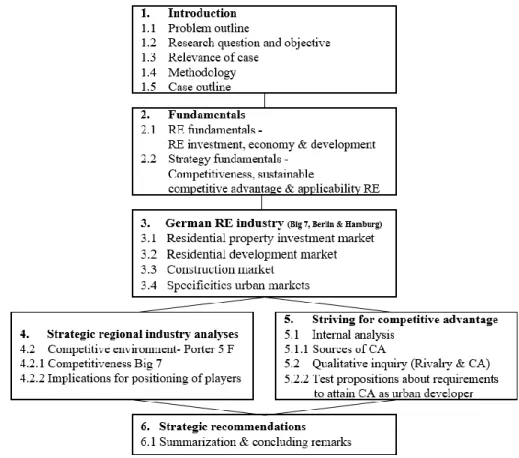
Therefore, an explorative case study approach was adopted. Yin (2003) argues an exploratory case study design should be adopted, when the purpose is to answer a “how” research question that depicts a certain issue/phenomena that presupposes the unit of analysis studied is not manipulable, and the interventions studied have no clear i.e. single set of outcomes. Additionally, such a case structure allows to present contextual information relevant for the issue under study, and enables the researcher to narrow the scope between context and issue (Yin, 2003). The case study must not intend to provide a final and conclusive solution. The objective is rather to provide an in-depth look into such a novel practical issue for the small or medium-sized German developer, in a way it inductively tests to what extent traditional real estate theory, quantitative market analysis, and qualitative strategic analyses methods help assess and test propositions about the competitive environment in the German, and in more detail the Berlin and Hamburg development industry, as well as elucidate sources for competitive advantage in the value creation process of the developer (Brown, 2006). The paper is structured as illustrated by the outline in the ensuing.
Figure 2: Case outline, own illustration
2. Fundamentals
To effectively assess the property development sector, the paper must provide an understanding of the environment, the participating institutions and businesses, the instruments and attributes that are significant for high performance (Roulac, 2002). Residential real estate, a flat, a multi-family house, or multi-housing complex not only generates cash flow for investors to attain monetary benefits but satisfies the physical necessity for secure shelter. Thus, real estate development, although economically motivated, serves the greater purpose of providing societal benefits to its users. In the context of this paper, residential real estate is viewed as a capital good or tangible asset, meaning a purchase of real estate must not exclusively occur for reasons of personal satisfaction, but may be undertaken to preserve capital and make profit (Manganelli, 2015). The overall real sector “real estate” constitutes to a large share of overall national economic performance, ranging from services to construction. In the case of Germany, the construction market and its gross added value contribution to Germany’s gross domestic product (GDP) has registered significant increases from 2013 onwards, amounting to 4,76% of total GDP in 2016, a growth
trend of 4,35% of its share to the previous year (Statistisches Bundesamt, 2017). Likewise, does the current yet stable 10.91% land and housing gross added value contribution to Germany’s GDP hint at the persistent significance of Germany’s real estate investment and development sector for the overall economic performance.
Within professional settings, the initiation of real estate development projects precedes an investment of an entity that is knowledgeable about the specific tasks that need to be fulfilled throughout the unique project, the skills required to do so in an efficient manner, and the capital requirements that arise as developments progress (Graaskamp, 1981). In view of touching upon the specificities of the development process and potentials for value creation emerging within each of the successive stages, it is significant to give an insight in to the functioning of the residential real estate economy, the pricing dynamics inherent to residential real estate markets, and the practical relevance of RE cycle theory for elaborating on macroconditions that stimulate development. Next, after a short presentation of the developer’s business model, the development process will be depicted and discussed with regard to differences in value creation, and fundamental risk sources threatening the profitability prospects of the developer. In the strategy part of the fundamentals chapter, the concept of competitiveness, and competitive advantage theory will be introduced to review the applicability to the real estate development industry. Therefore, the section introduces the basic concepts of strategic analyses utilized in the qualitative strategy analysis chapter and reviews literature that has tested to apply them to real estate industries.
Residential Real Estate Fundamentals
This thesis adopts the investor view i.e. residential real estate serves as a capital good. Thus, if an economic interest prevails, extra-economic motives such as personal are not decisive for the purchase, but rather factors such as the income a property generates, the interest rate on loans, or the level of taxation upon transfer and possession (Manganelli, 2015). Within the global economy, forms of transfer and possession have changed significantly with the development of corporate forms participating in financial markets. The housing industry comprises investors of private, institutional and public nature, which either directly or indirectly own real estate and associated property rights, in the latter converting real estate
into a financial asset as a share of a fund or stock corporation (Arnold, Rottke, & Winter, 2017). The priority for private and institutional investors holding real estate as a capital good is to realize benefits from either generating a stream of revenue from the consumption of the good by a third party or capturing a capital gain through the asset’s disposition after a certain holding period (Manganelli, 2015). Correspondingly, profit-oriented investors’ demand for a dwelling will not only depend on the level of income it produces, but majorly on the evaluation of the real estate’s capability to meet the expected profitability compared with potential performances of alternative investments, in economic terms, the opportunity cost - the loss of a potential gain from another investment.
2.1.1. Real Estate Development and the Investment Environment
As an investment is being conducted in the real estate investment environment depicted below, the real estate developer becomes an integral connector between the investor (if developer does not act as capital giver), the real estate site and its users. Depending on what risk profile the investor has, means of development will be undertaken by the space producer. For this paper, the investment environment focuses players of the real estate private equity quadrant, which includes private and public investors that pursue direct investments into real estate, also referred to as active investors (Rottke, 2005).
In regard to the illustration, active investors can be building contractors, agencies, real estate funds and privates. Most of private investors search for properties that are to be used for themselves e.g. for retirement, while the smaller fraction eyes revenue from letting or selling to consumers. Private investors with self-usage intents are known to be less professional, but intuitive on their investment appraisal, while the public or institutional investor applies valuation methods to determine return expectations in comparison to potential returns of alternative investments. Investors of public nature, which may compete for the same asset as a private investor, possess a significantly higher investment volume involving the usage of debt instruments.
Especially in times of low-interest rates, the developer, as provider of space realizes investments with funding from the upstream capital markets, although financial assets offered on the respective financial market directly compete with real estate assets (Brauer, 2013). Direct real estate investments involve a high level of risk, mainly due to operational management efforts that revolve around property management, the general illiquidity of the asset type, as well as the environmental and market-specific subjection of the property. There are a multitude of risk appetites that vary with investor type and the submarket (Manganelli, 2015). The investment strategies professional investors pursue are adapting to changing market conditions, which in turn are influenced by the macro economy. The various investment strategies can be reviewed in Appendix 2.1.
2.1.2. The Value of a Residential Property
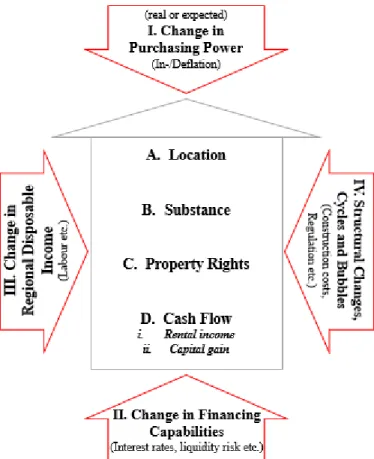
There are different, and oftentimes geographically market-dependent methods to appraise a dwelling based on financial performance indicators, such as the generated cash flow, or the substantive or real worth. Illustrating the value parameters that affect the value and respective payoff of a dwelling and explaining the influencing factors that potentially lead to an increase or decrease in value across its respective life-cycle, provides a first insight into how macroeconomic fundamentals relate to housing markets classifying the frame conditions that are decisive for developers pursuing a project. The payoff or revenue stream in this case is generated either through letting or disposing of the housing unit.
Figure 4: Value-determining parameters, adopted from (Rottke, Eibel, Krautz, 2017)
The illustration presents the endogenous and exogenous value parameters of a residential property. The revenue streams an investor realizes will partially depend on the unique location, the outfit and substance, as well as related rights of a property. In more detail, the quality of location comprises characteristics and features of the macro- and micro-environment (Grether & Mieszkowski, 1974). Nonetheless, a functioning business model that considers the interrelated characteristics aiming to place the dwelling adequately on the market will largely impact the final value (Rottke, Eibel, & Krautz, 2017). The endogenous parameters are significantly influenced by the exogenous parameters. Changes in these external influencers may ensue a positive or negative change in the intrinsic value.
Firstly, an increase in real inflation would positively affect the revenue streams of financed real estate, as rental and purchase contracts are normally inflation-adjusted, and credits are nominally defined. Vice versa would deflation increase interest costs on mortgage loans. Oftentimes, the fear of inflation drives wealthy investors of the private segment to over-invest
meaning over-proportionally pay for assets in prime locations (Rottke, Eibel, & Krautz, 2017). Therefore, stimulating the potential development of hyperbolic prices.
Secondly, a change in the availability of financing parameters may influence the profitability prospects of an investment into development. Liquidity, interest rate and currency risks could entail a loss-making investment, if changes in related-parameters increase liabilities. For example, interest payments (pledged in home currency) of unsecured foreign currency loans would increase, if the foreign currency appreciated and stabilized temporarily.
As a third influencer, changes in regional disposable incomes are likely to enhance or hamper the payoff on a dwelling. The immovable nature of a residential property implies that changes in income structures of the directly surrounding population influences the payoffs substantially. In the aftermath of the financial crisis in 2008, post-closure of major car production plants, Detroit’s mean residential market price drop, the foreclosure as well as unemployment rate increases circumstantiate the impact collapsing industrial sectors, as initial providers of labor and income have on RREM (Bai et al., 2016).
Lastly, structural changes, cycles and bubbles comprise a persistent source of value-affecting mechanisms. The happening of an exogenous shock might entail oscillations of exit values on the markets. Megatrends or speculative bubbles are developments, of which the correspondent effects on values are not always rationally explainable, but often extravert as macroeconomic fundamentals are not in line with actual price movements. Consequentially, this often leads to hyperbolic valuations. Actual examples for cyclical and structural changes will be presented in the third chapter, when industry analysis is conducted.
The Real Estate Developer
“Real estate development is required to combine the aspects of location, project concept/ idea and (use of) capital so as to achieve multiple objectives: the results need to be (micro-economically) competitive on a standalone basis, should create, and or secure employment, needs to be socially, macroeconomically and environmentally acceptable, and they need to generate a positive return over their life-cycle in the long term.” (Diederichs, 1996)
One can distinguish between three basic types of real estate developers (Wiegelmann, 2012). Each of the types follows different objectives, and thus will have a different risk-return profile. First, the trader-developer is subject to the entire span of development risk, as the land and property are held until the end of the construction phase, whereas an incipient forward deal may ensure that the developer’s liquidity necessities are covered. Throughout the development project, the developer aims to maximize the profit margin in each of the idle steps, as they contribute to the over-all project margin (Wiegelmann, 2012). Secondly, the investor-developer ensures financing through own means, eyes the ensuing holding of the object, and is solely responsible for the project throughout every single phase (assuming no partnerships with a general contractor i.e. conducting self-managed contracting). After completion, the project is added to the project portfolio of the investor-developer. This portfolio in return provides a stable financing base for following projects and makes the investors more independent from capital markets (Wiegelmann, 2012). Thirdly, the service-developer is rather risk adverse, usually focusing on the process of conception and planning of the project. The demand for service-developers is given, when the clients lack expertise in a certain phase of the process (Wiegelmann, 2012), and consequently an initial contracting agreement marks the collaboration of an investor and developer, who conducts construction as a service. Therefore, the connection to the project is only fractional, which leaves the client with an operational risk. It is noticeable that although one can differentiate between these three different types, hybrid versions are also likely to develop during, or prior to the development process.
To distinguish the smaller and mid-scale developer from the large- scale investors, the KfW (state-owned “Reconstruction Loan Corporation”) divides its respective subsidization scheme for redevelopment measures into three developer categories: Small enterprise (after EU definition) with less than 50 employees, 10 million € yearly revenue or less than 10 million € balance sheet total. Mid-sized company (after EU definition) with less than 250 employees, 50 million € yearly revenue and 43 million € balance sheet total respectively. A developer that fulfills the requirements of the latter, despite registering a yearly revenue of between 50 to 500 million € remains in the category of medium-sized businesses, as defined by the KfW (KfW, 2018). Everything above is considered a large company i.e. developer. Large-scale developers typically operate supra-regionally covering a multitude of geographical areas.
2.2.1. The Value Creation Process
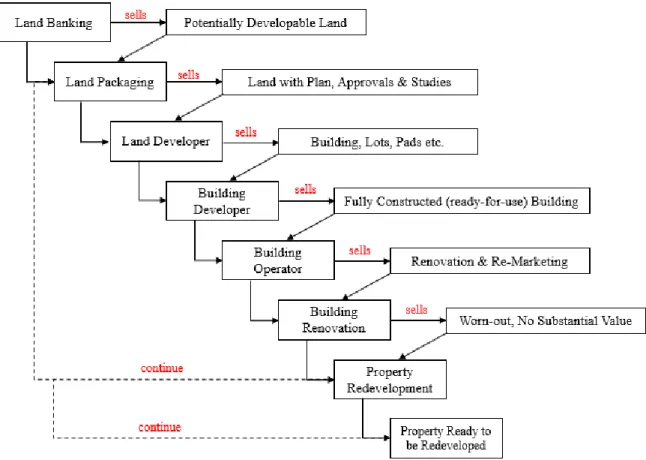
The core aspect of the process of real estate development is the creation of a micro and macroeconomic value by means of enhancement on physical spaces, and strategic decisions that are perceivable and real (Bulloch & Sullivan, 2010). To reach an ideal outcome of the project, the developer must combine a multitude of resources effectively within and between the different phases as well as sub-phases of the development process. The main challenge of a successful implementation is dependent on the interplay of a wide spectrum of relevant disciplines and subjects. As already indicated, task structure, responsibility and the required professions change during the process of development. Lawyers, physicians, local political institutions, bankers, project coordinators, investors or even non-governmental organizations represent only a fraction of the stakeholders that directly or indirectly affect the development process (Bulloch & Sullivan, 2010). The developer’s core function and responsibility are to ensure productive coordination of all team members, and to provide an optimal information flow between them. To reach a project’s fullest potential of value creation, the management of inherent risk sources, an adequate risk prediction, help to meet micro and macro investment objectives. A helpful tool to analyze the value potential and risk structure of the process, Kohlhepp (2012) circumscribes every individual stage of the real estate value creation process in his development matrix, which provides a modern view on value creation potentials in development.
Figure 5: Value creation process of real estate development based on (Kolhepp, 2012)
• The land banking developer i.e. investor usually buys, or already holds underdeveloped i.e. undeveloped land. Although it is a rather passive investment position, when market conditions and trends are favorable, the developer can become active in pursuing this opportunity to acquire land and profit from market developments (multiple arbitrage), potentially selling the land to land packagers in the ensuing. Common examples of land banking entities are public utilities and the government itself (Kohlhepp, 2012).
• The land packaging developer’s main aim, after acquiring mostly green lands, or re-developable land from the land banking entity, is to create value through various means that do not involve construction. The spectrum of possible actions focuses intangible services reaching from conceptual land planning, over financing schemes to market analyses. Once value is created, the land packaging developer potentially sells the land to the land developer (Kohlhepp, 2012).
• The land development stage involves improvements to the land that go beyond what the paper enhancements allow for. However, these improvements are limited to prepare the
land for the vertical construction. The actions are limited to e.g. the construction of connecting roads, pipe networks or horizontal adjustments to the land. Subsequently, the improved land may be disposed to the building developer (Kolhepp, 2012).
• In contrast to the previous stage, the building developer initiates vertical constructions on the land. It is relevant to distinguish between two basic types of building developers. The home-builder and the commercial developer, who can be referred to as merchant builders. The latter may try to rent out the building during the construction phase to sell it once it is completed. Otherwise, the developer may hold it until completion and sell it post-construction (Kohlhepp, 2012).
• The operating stage may include the disposition and acquisition of the object throughout its respective life-cycle, mostly among different building operators. The building operator leases and manages the property until it is sold, either to another operator or to a building renovator. Since this stage requires remarkable financial resources and securities, building operators are often institutional investors such as insurance companies or bank institutions contracting proficient asset managers (Kohlhepp, 2012).
• A pre-condition to reach the stage of renovation are considerable, yet repairable economic, and or physical shortcomings. Based on these deficits, the property renovator creates new value by means of physical corrections, as well as re-marketing to potential tenants (Kohlhepp, 2012).
• In the last stage, the economic, and or physical damages are severe, and the benefits of renovation measures do not exceed the required effort. Hence, a redevelopment of the property is most reasonable. This means that the property re-developer will initiate the demolishing of the building seeking to realize a new concept with prospective payoff. The cycle is expected to reiterate.
When evaluating the situation, the developer should be aware that it can be of great danger to attempt holding the property over multiple stages to try pursuing subsequent stages of value creation. The holder might overestimate own competences, resource equipment, or the risks incurred holding the property. In practice, there is an intense attraction to accept additional risks to increase return prospects (Kohlhepp, 2012). However, to make reasonable decisions regarding the choice of the most appropriate value creation stage, the developer
should continuously reflect upon, how capable the team is to cover all required skills, professions as well as monetary resources, yet again hinting at the heterogeneity of developers. In addition, investor trust is required, if the project requires external financing.
2.2.2. The Real Estate Development Process
For the purpose of this paper, Altona’s real estate development process is sufficient for ensuing analyses. The development process consists of five phases, namely initiation, feasibility, design and planning, construction, as well as the marketing, sales and letting phase. For additional insights about the specific tasks that are included in the process, a more detailed description has been included in Appendix 2.2. Nonetheless, Altona’s structure serves as the basis for the adapted key competitive indicator classification framework that will be used in the qualitative analyses part, as depicted in Appendix 3.
Nature of Residential Real Estate Markets
Generally, the price of a residential property will depend on how many households want to own (demand), and how many dwellings are available for purchase (supply) (DiPasquale & Wheaton, 1992). In view of explaining, how supply and demand interplay on the market, it is useful to underline that real estate markets are characterized by imperfection, due to the heterogeneity of properties stemming from differing features in location, intended usages, age and quality of substance (Manganelli, 2015). The typological as well as spatial differentiation of residences lead to asymmetric appraisals of housing (Arnold, Rottke, & Winter, 2017).
Conventional spatial segmentation into sub-markets or segments implies a relative degree of homogeneity between houses that belong to the same sub-market. These properties will compete for buyers through the pricing mechanism. Hence, houses from the same segment can be considered similar products that exhibit a substitutional relationship, in which an increase in price of House A may lead to increase in demand for House B (Triffin, 1947). Most sub-markets form with regard to value characteristics of houses mentioned previously, let it be the specific location i.e. metropolitan area, a neighborhood, or similar construction quality within an area (Manganelli, 2015).
In addition, the private and non-uniform nature of transactions, in which differing levels of information of involved parties clash to negotiate pricing, cater the non-transparency, and make the assessment of actual pricing determinants more difficult and sub-market-specific (Manganelli, 2015). Consequently, individuals taking part in transactions have the power to influence prices through behavior, whereby the ensuing temporal secrecy of price information leads to inefficient price-searching - an interval, in which transaction prices do not necessarily reflect actual market prices. Complementary to this lag characteristic, the construction process and placement of new real estate on markets will generally lag the equilibration of prices in the short-run, so that the pricing-related prediction of future supply is impracticable (Arnold, Rottke, & Winter, 2017).
2.3.1. Pricing Mechanism
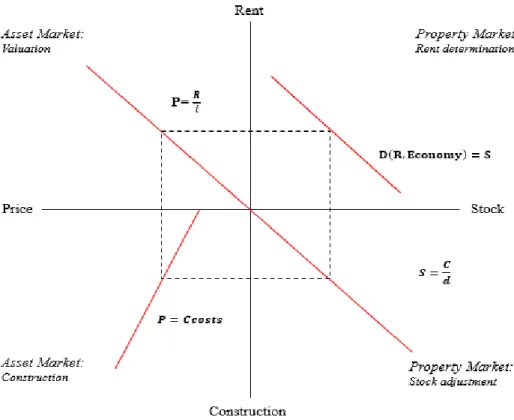
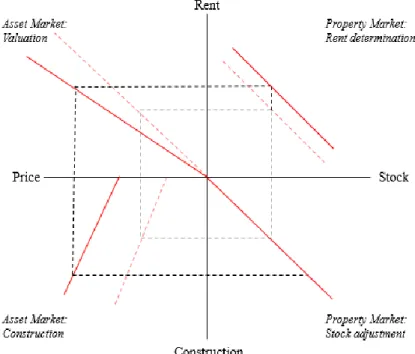
Having these imperfections in mind, the theoretical four-quadrant model (FQM) by DiPasquale and Wheaton (1992) serves to illustrate the pricing mechanism of how supply and demand interact on the connected markets for real estate asset and real estate space. In addition, the model gives an insight into how changing macroeconomic conditions impact the real estate economy and induce development.
The distinction between the two markets becomes clear, when a house is not occupied by the owner itself, but by a tenant. Starting from the north-eastern quadrant, the rent as one of the main determinants of the price will be determined with regard to the needs of the tenant and the type of quality of the building. As rents increase, due to growing market demand from consumers interested in the self-usage of the building, prices rise (all else equal). Vice versa, will an increase of supply on the property market, depress the price. If supply remains fixed, the first interconnection of the property and asset market can be highlighted, as an increase in rents ensues an immediate price increase of residential units, which in turn affects the demand for assets in the capital market.
In the capital market (north-western quadrant), the actual price for the residential asset will be determined by dividing the rent by the capitalization rate. The capitalization rate describes the ratio of rent to price and comprises investor considerations about an expected growth in rents, a multitude of risk sources that affect the rental income, tax treatments of federal tax codes, and lastly, the long-term interest rate in the respective economy (DiPasquale & Wheaton, 1992). A positive shift of price on the capital market induces development on the construction market, if the price of an asset relative to cost of constructing or replacing them are at least even (P=Ccosts).
The construction or development market (south-western quadrant) constitutes the second interconnection between both markets. In the short run, prices of assets do not equate market prices with replacement costs, due to the previously-mentioned construction lag that is inherent in the construction process. Consequently, either more development may be induced as prospects for price and demand increases hold, or less developments will be pursued, as expectations stagnate.
When new supply enters the property market, the stock adjusts to satisfy demand, and prices decrease towards cost of replacement, due to falling levels of rent. New supply can be characterized as either second-hand housing (owners and investors are mostly private), or development of new buildings (Manganelli, 2015). As market prices for residential assets move to new equilibria, induced by demand forces from the macroeconomy and its financial markets, the intermediate dynamic path prices follow cannot be traced (DiPasquale & Wheaton, 1992). In addition, governments can trigger artificial effects through for instance infrastructure developments of roads or highways that could influence the determinants of prices.
Linkages to Cycle Theory
This chapter’s intention is to depict the relationship between macroeconomic cycles and real estate cycles (REC). The insights serve to distinguish variables that are of importance for price movements i.e. fluctuations. Measurement approaches will be introduced to provide a general understanding of how to identify the positioning of a RREM within the cycle.
A cycle can be defined as a sequence of events that repeat (Miller, 1997). It may be circumscribed as the perception of a pattern of repetitive and predictable behaviors, which are present everywhere in nature, and interdependent (Phyrr, Roulac, & Born, 1999). Empirical evidence widely recognizes real estate to be cyclical, though isolating the factors that drive the cycle might be subjective to conditions of the specific market, and hence price movements are conceivably incomparable.
2.4.1. Real Estate Cycles
Business cycles impact a major portion of national wealth (Phyrr, Roulac, & Born, 1999). Real estate, as fixed reproducible tangible wealth, makes up major fractions of a nation’s wealth. Underpinned by research of Phyrr and Born (2006), as well as DiPasquale and Wheaton (1996), REC or property cycles exhibit a strong link to the general economy and the capital markets, whereas various lag and lead dynamics between the markets constitute to irregular as well as identical patterns of co-movement (Phyrr, Roulac, & Born, 1999). The
question remains, what a property cycle is, and if it is adequate to assume a single structure for demand and supply relationships for all sub-markets.
The lack of data and real estate research in general has produced different explanations of REC over the last decades, usually directly with respect to a specific sub-market. A general definition of REC by Royal Institution of Chartered Surveyors (RICS, 1999) depicts property cycles as: “[…] Recurrent but irregular fluctuations in the rate of all property returns, […] apparent in many other indicators of property activity, but with varying leads and lags against the all-property cycle”. The definition denotes the cycle phenomenon in property markets, and hints at indicators of property activity that show a differing yet related pattern to the all-property cycle. A more detailed definition by Wheaton (1999), constructed in the context of empirical testing of historic data, defined a property cycle as:
“[…] A more restrictive definition of a real estate cycle involves repeated oscillations of a market, as it continually overshoots and then undershoots its own steady state […] real estate cycles are defined as some degree of instability in the market whereby a single economic shock leads the market to oscillate around its steady state for some number of iterations”.
This definition hints at the behavioral nature of the property cycle, where the cause for oscillations in the cycle stem from single economic shocks. Nonetheless, the complex nature of a property cycle, which comprises a multitude of interacting forces (Hoyt, 1947) has induced academic definitions of REC to omit defining, what cyclical patterns attempt to describe (Baum, 2001). To systematize the forces that influence the all-property cycle, works by Phyrr et al. (1999) and Wernecke et al. (2004) discussed the all-property cycle from the macroeconomic, microeconomic and managerial perspective.
2.4.2. Macroeconomic Perspective
The macroeconomic view regards REC as part of the economic cycle. Business productivity influences construction activity and empirical evidence implies that peaks in construction activity, lag peaks in GDP (Grebler & Burns, 1982). While in expansion phase, property
demand leads supply, incentivizing construction and employment in the construction sector. If the economy contracts, the decreasing demand eventually starts overhanging supply, as the market registers an over-supply, facilitated by the construction lag (Pritchett, 1984). Subsequently, construction activity plummets and the cycles eventually reiterate going through recession characterized by price stagnation. In more detail the phases of the real estate cycle can be seen in the Appendix 2.3 about cycle measurement.
The vacancy rate serves as the main indicator of cyclicality linked to rent cycles and construction cycles (Phyrr, Roulac, & Born, 1999). In a study of apartment units, Chinloy (1996) linked production and absorption of apartments to prices and rents of secondary as well as new dwellings. His theory denotes that the behavior of vacancy rate is relevant for determining the apartment market rent, and under the influence of the construction market, rents “sluggishly” adjust to equilibrium ensuing a macroeconomic shock. Furthermore, Chinloy highlighted that when constructors under-forecast rent increases, the excess returns might trigger additional construction. Therefore, when demand on the RREM drops, the vacancy rate increases, and as a result of delayed supply entering the market, the mispriced rents must adjust to the new equilibrium. This implies that the vacancy cycle leads the rental cycle, and an inverse behavioral relationship exists (Sivitanides, Torto, & Wheaton, 2003). Thus, it can be derived that expectations for rent increases inherent in the rental cycle, and timing of initiating or continuing new construction are central for the structure of REC.
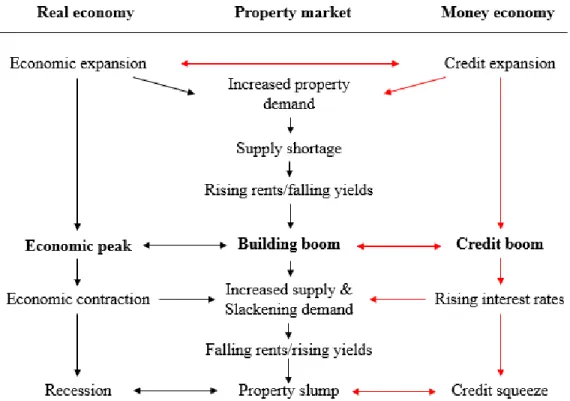
Besides economic and property-related factors, the influence of capital market forces on real estate prices gains in significance during periods of volatile market cycles and market upswings (Phyrr, Roulac, & Born, 1999). To put the business cycle into perspective with the macroeconomic property cycle, and exemplify the connection between property markets, real economies and the money economy, the following illustration adopts Barras’ (1994) building cycle model. Although this model refers to the UK economy, it possesses explanatory power for Germany, as they exhibit similar economic stability and access to capital markets.
Figure 7: Building cycle model adopted from (Barras, 1994)
The conceptual model by Barras (1994) illustrates the links between the capital market and property market in a modern market system, during the four phases of a business cycle. Credit expansion fuels building activity during the economic expansion, as low interests incentivize investors, developers, and households to pursue residential development with lower debt risk. When the economy contracts, stagnating business activity will lead to less demand, and because of the building lag, supply starts to overhang slackening demand. Rents and prices drop, and consumers of space are expected to respond to the adjustments. Amid the contraction phase, interest rates are expected to rise, which potentially leads to a credit squeeze within the recession phase. The interest rate rise leads investor to demand a higher risk premium on pursued investments, which will ultimately be comprised in a higher capitalization rate, whereas generally-speaking, it is the combination of rising interest rates and falling rents triggered by lower demand, which comprise the inducers of decreasing property prices. Thus, the financial cycle needs to be considered in distinction to the construction cycle and physical cycles of existing supply. The physical cycle has impact on rental growth, while the financial cycle as explained previously, affects property prices, which in turn determines construction activity (Mueller, 1995).
With respect to the role of the government, cyclical programs are deployed that aim to decrease volatility, by focusing on initiatives that stabilize price levels, foster low unemployment, and help to retain a healthy trade balance. Research has shown that members of G7 were able to reduce volatility in their respective business cycle (Stock & Watson, 2005), drawing on stable capital markets and cross-country capital flows as enhancers. In case of government intervention on RREM, actions might dampen investor’s profitability prospects. For example, the rental price break introduced in Berlin back in 2015 intends to preserve affordability for housing space, in theory, though considerably influencing the assessment of rental growth prospects decisive for property appraisals and transaction negotiations. A recent court ruling suggests that the reform violates the German constitution (Oltermann, 2017). Although the reform weighed and still weighs, the rental brake was not able to weaken the over proportional rental growth that Berlin experienced over the years of its implementation, and consequently, the expulsion of more low-income households from the metropolitan area to suburban areas is still ongoing (Oltermann, 2017).
To conclude the macroeconomic view on REC, the common view expressed in literature demonstrates that cash flow variables, such as vacancies, rents i.e. cash flows, and capitalization rates are cyclical, whereas real estate returns can be depicted as cyclical on a national, and regional level (Phyrr, Roulac, & Born, 1999). Hence, only considering the macro-economic perspective for investment decisions yields low explanatory power for portfolio managers that focus investments on explicit locations or metropolitan areas. To account for the individual property cycle dynamics on these markets, the micro-level perspective will be presented.
2.4.3. Microeconomic Perspective
On a microeconomic level, the assessment of vacancy, rental, and take-up rates proves to be more exhaustive to explain the relationship between cyclical economic factors and cash flow variables. However, it is inappropriate to assume that demand and supply relationships are uniform for micro-environments, as structural differences with respect to varying geography and market size lead to variable REC (Phyrr, Roulac, & Born, 1999). In addition, a multitude
of cyclical patterns, such as ownership life cycles, urban cycles, neighborhood cycles, physical life cycles or portfolio mix cycles emerge in these micro-environments, possessing explanatory power for price movements in the respective areas (Phyrr, Roulac, & Born, 1999).
In conjunction, these micro-specific cyclical patterns give insights into respective occupancy behaviors of space consumers. For example, in context of an economic recession, households residing in metropolitan areas are incentivized to rent a dwelling for a lower price in a location they could not afford during the peak phase, or to occupy a dwelling with higher building quality in the same neighborhood. Thus, it can be derived that occupancy behavior might not solely depend on the degree of economic depreciation surrounding buildings experience, but also on the degree of physical depreciation of occupied buildings, pointing at user behavior either reducing, or enhancing the amplitude of property cycles in a micro-environment (Baum, 1991). Consequently, there is no singular behavioral structure of supply and demand on these micro-markets, due to structural differences with respect to the size and geography of the area, as well behavioral differences of occupying inhabitants (Phyrr, Roulac, & Born, 1999).
2.4.4. Management Perspective
“Perhaps second in influence only to the location, location, location real estate investment selection criteria, the concept of market cycles dominates the concerns of, and is, employed as a rationalization by, real estate investment professionals. Perceptions of real estate cycles influence market participants’ strategies and transaction decisions” (Roulac, 1996)
Roulac (1996) notes that the concept of REC has been majorly used by practicing professionals, though minorly addressed by academics. The emergence of volatility in real estate performances sensitized decision-makers to choose their investment criteria with respect to the cycle. While the locational factors remain the prime criterion, the cycle can justify the timing of pursuing a specific investment strategy with regard to portfolio allocation, geographical market selection, and property type (Phyrr, Roulac, & Born, 1999).
The management perspective seeks integrate the theoretical knowledge about REC into management aspects. In practice, Rottke and Wernecke (2002) underline that REC theory has its implication for strategy-related, function-specific and phase-oriented aspects of real estate economics. For the scope of this paper, the strategy-related aspects directly refer to active investment i.e. portfolio management, while the function-specific aspects refer to functions such as finance, appraisal, and investment. The phase-oriented aspects refer to project development. More information regarding measures of cycle measurement relevant for the quantitative analysis is provided in Appendix 2.3.
Strategy Fundamentals
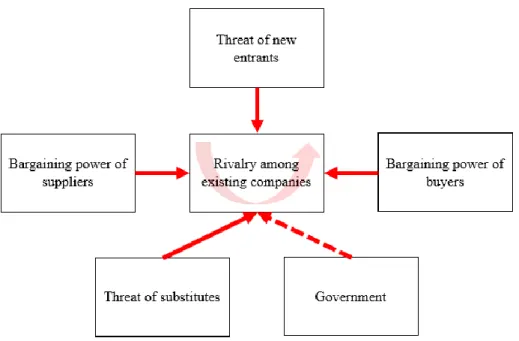
This chapter depicts the fundamentals of neoclassic strategic management and competitive theory to discuss, to what extent the concepts may be applied to the assumedly fragmented and highly local residential development industry. The insights enable the identification of peculiarities that exacerbate the application, which are summarized in the last implications section. For the general understanding, the chapter commences with basics from competitive theory and the definition of the term competitiveness to avoid confusion over the broad span of meanings. Subsequently, the chapter proceeds with the discussion of competitiveness in the real estate development industry. As introduced in the research framework, the strategic analysis tool that is being utilized in the qualitative section to study the competitive environment, namely Porter’s five forces will be literature-reviewed to discuss research that attempted to assess real estate development industries with the model. Lastly, the concept of generic strategies and competitive advantage in line with resource-based view.
2.5.1. Strategy and the Real Estate Development Industry
Porter (1989) underlines that real estate, as a real sector of an economy is subdivided into industries that compose a variety of businesses focusing on several types and business models of real estate. Each of these sub-industries has a unique economic logic, which means residential-specific know-how may not be generalized to the whole field of real estate i.e. commercial, industrial or retail real estate. The subjects of real estate development and real estate investment are disciplines that are present in, and specific to all sub-industries of the whole sector real estate that include the whole spectrum of products and services that provide
ways of dealing with development projects from idea inception to exit realization. Regarding Porter’s view (1989), developers have been under constant scrutiny to what extent strategy formulation would guide and limit investment decisions.
A business strategy can be depicted as concerning the actions and approaches formulated by management to facilitate successful performance in line with the central rationale being, how to build and improve the company’s long-term position in the market (Thompson & Strickland, 1998). Due to the opportunistic nature of deal-making, the realization of real estate development projects depends on unique frame conditions of the particular investment context. Historically-speaking, it was not uncommon that developers had no actual strategy, but rather lived by deal-to-deal. Nonetheless, as the German real estate markets develops and becomes more transparent (Schulte, Rottke & Pitschke, 2005), consumer values become more complex and shareholder requirements stricter, the developer must strategize in advance to enable the entity to attain an over average profitability level, when seeking to execute an adequate project. Hence, insights about the industry structure on a macro as well as micro level must flow into the decision-making concerning the choice of an adequate business and competitive strategy.
A developer that engages on a market needs to position within the industry (Porter, 1989). Competitive theory depicts, how exactly a company in this case developer is going to compete, and how such a firm may position itself to become a superior performer. To become a superior performer, developers and investors must understand the sources of competitiveness within the industry in light of conducting appropriate actions and strategies that enables the effective transformation of organizational resources.
2.5.2. The Resource-based View of Competitive Advantage
Resources and capabilities are considered the foundation of strategy, as they guide business and competitive strategy-making (Grant, 1991). In addition, resources and capabilities constitute the primary source of profit for a company. Termed as “the resource-based view of the firm”, the rationale depicts that the exploration of relationships between resources of the organisational resource platform (may it be between specific competencies, specialized assets
or architecture of relations (Lobo, 2017)), the nature of competition, and profitability analysis of competitive imitation, the appropriability of return to innovation, the role of information asymmetries in creating profitability differences, and the means by which the resources can be transformed to sustain as competitive advantage (Grant, 1991). Although most studies fail to provide evidence for the connection between industry structure and profitability, it is thoroughly believed that the attractiveness of the industry, and the establishment of a competitive advantage are decisive for a company’s ability to attain an over average rate of return.
In generic terms the competitive advantage is attained, by accumulating a platform of strategically valuable, rare, inimitable, as well as organized organizational resources in direct relation to competitors (Porter, 1980). In more detail, the definition of resources ranges from financial, physical, human, technological, organizational to intangible resources such as reputation and knowledge (Grant, 1991). These resources must be leveraged i.e. teamed into capabilities (guided by patterns of coordination) that the company deploys to create unique value, which in turn must be captured on the market. So-called “core competencies” are capabilities that are of central strategic importance for the success on a respective market. This implies the company must put business and competitive strategies in place that enable the company and its strategic capabilities to be optimally processed. In the last instance, isolating mechanisms need to be implemented that ensure the competitive advantage can be sustained in the medium to long term (Lobo, 2017).
One major issue in identifying and assessing capabilities is to maintain objectivity (Grant, 1991). The assessment of capablities demands constant benchmarking with the ones of the competition to disclose relative strengths. Nonetheless, transparency issues will impede constant benchmarking, and consequently knowledge gaps have to be complemented with assumptions. Accordingly, the successful formulation and execution of a business, and or competitive strategy is guided by not extending activities beyond scope of actual capabilities (Grant, 1991).
2.5.3. Generic Concept of Competitive Strategies
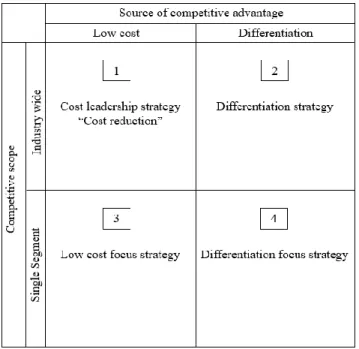
The competitive strategy focuses on improving the positioning within a specific segment, while considering the positioning and performance capabilities of its strategic competitors (Wheelen & Hunger, 1996). In addition, Porter (1989) argues that attaining the right competitive scope (geographic) is relevant for developers to pursue a competitive strategy that results in the formation of a competitive advantage. With respect to strategies that lead to a competitive advantage i.e. create and capture unique value by using unique organizational resources embedded in products or services (Lobo, 2017), traditional strategic management theory present two differing strategies, which will be depicted in the following illustration.
Figure 8: Generic Strategies (Porter, 2004)
According to theory, players that seek to develop a competitive advantage are expected to follow one of the generic strategies above, elsewise the company is considered as “stuck in the middle”. Companies pursuing cost leadership strategies are eager to design processes that allow them to produce goods or provide supplies at the lowest cost possible. Especially in industries, where consumers are price sensitive the approach is considered as prospective. For a real estate developer, this would imply that efficient scales of economy and scope can
be build up, by expansive development activities and costs reductions realized through cost minimization within development functions, also through adoption of innovative technologies such as modular construction schemes. In addition, constant rigorous cost controlling must be ensured to facilitate a lean cost structure, which enable the developer to deter new entrants and offer low service prices (Porter, 1980). Especially within the construction phase, strict contract management and efficient sequence-planing can be considered crucial. The main risk sources feature the requirement to always be on top of new innovations or improvements of technologies, the sunk costs linked to a potential renewment, and lastly, the probability to misinterpret or even lose sight of changing market demand characteristics.
The differentiation strategy expects the executor to create a differential advantage with respect to conception and performance of a service in direct comparison to competitors, by pursuing unique ways of creating sustained value for the customer (Robinson & Pearce, 1997). According to Porter (1980), uniqueness can, but must not exclusively emerge in customer service, brand image, design and technology. Yet, uniqueness does not equate or stem from being different to competitors, but from identifying and exploiting new value creation potentials, by understanding and deriving consumer insights from changing customer values, as well as market conditions.
Successful differentiation will trigger brand loyalty that enables the firm to maintain a certain competitive positioning, as well as to charge higher prices and benefit from the lower sensitivity to price changes (Porter, 1980). The range of differentiation possibilities depends on the characteristics of the product or service so that further discussion about the degree of applicability of competitive strategy to real estate development is required to answer the subordinate research question. The developer industry unites a multitude of players that seek differentiation through special standards in space configuration, building quality or operational procedures. Concerning risks, the strategy is prone to imitation, if the imitated player is successful in pursuing differentiation, which might lead to a minimization of the premium charge on the price with comparable products or services entering the market. In
addition, an increasing price difference between cost leadership and differentiation may incentivize the costumer to sacrifice the differentiated product or service to save costs.
Lastly, the focus strategies identify idle segments or geographical sub-markets that exhibit potential to build the product or service around what is particularly required by the consumers of the focus group. While cost focus seeks cost advantage in the target segment, the differentiation focus seeks to differentiate the service within the target segment. Porter (1980) states that niches can be defined by geographical uniqueness so that in the case of the urban market scope, unique characteristics of the consumer group within the respective sub-market are decisive for choosing the quality, configuration and disposition strategy of a residential building. Due to concentration of resources on location-dependent market demands, moving to new niches is difficult to conduct, and potentially linked to additional sunk costs. To respond to the subordinate research question, which scrutinizes the applicability of strategic management models for the real estate development industry, the qualitative inquiry includes related propositions that will be tested.
Competitiveness
A company that is considered “competitive” implies the firm has an ability to produce goods, or to provide services of superior quality, or lower cost compared to its competitors (Vivian & Buzzigoli, 2009). In other words, the ability to provide the right product or service with the right quality and the right price at the right time. Correspondingly, this suggests that attaining competitiveness presupposes two crucial factors, namely effectiveness, as to have the right objective, and efficiency, as to fulfil the objective at lowest cost possible.
Yet, defining competitiveness has always been a thoroughly discussed topic by strategy academics. On the one hand, the term competitiveness is not regarded as something defined universally in absolute terms, but rather as something that relates to the conditions of a firm, which in turn are dependent on customer ideals, shareholder value perceptions, and or financial stability (Chaharbaghi & Feurer, 1994). Identifying and strategically-aligning the dependencies enable the company to engage or react i.e. conduct strategic changes to account