CONSENT NOTICES AND COGNITIVE COST
AFTER THE GDPR: AN EXPERIMENTAL STUDY
Anna Pastore
Dissertation written under the supervision of Martin Seamus Quinn
Dissertation submitted in partial fulfilment of requirements for the International
MSc in Management, Major in Entrepreneurship and Innovation, at
I
Acknowledgements
I acknowledge the support from FCT – Portuguese Foundation of Science and Technology for the project FCT-PTDC/EGE-OGE/27968/2017.
Abstract
In May 2018, the European Union enforced the General Data Protection Regulation (GDPR). This regulation makes mandatory to recover user’s consent when they access a website, thus firms have to implement cookie banners that allow users to declare their privacy preferences. The aim of this paper is to study users’ interaction with four different banners that combine the opt-in/opt-out format with the presence or not of a bulk option (Accept/Reject all button). It analyzes how users react to the introduction of such bulk option that decrease cognitive cost to interact with banners. This study finds that the bulk option has an impact on user’s interaction with the banners, especially when combined with the opt-in format (p<0.001). This study also finds that without the bulk option, the format has no impact on interaction. Moreover, with the bulk option, users’ interaction is the same no matter the default option for the EU population since the presence of the “Accept/Reject all” buttons induce people to click on them even though they represent two opposed decisions over data provision. However, when comparing the EU and the US samples, the results highlight a lower interaction due to the opt-out format (p<0.001) in presence of the bulk option. This study contributes to the scientific research regarding the effects of GDPR on users’ online behavior and it participates to the debate on the regulatory environment of online personal information.
Keywords: Notice and consent, GDPR, privacy, cognitive cost, default choice, online behavior
Resumo
Em maio de 2018, a União Europeia implementou o Regulamento Geral de Proteção de Dados (GDPR). Este regulamento torna obrigatória a recuperação do consentimento do usuário ao aceder um site. Portanto, as empresas precisam implementar banners de cookies que permitam aos usuários de declarar as suas preferências relacionadas à privacidade.
O objetivo deste documento é estudar a interação do usuário com quatro tipos diferentes de banners que combinam o opt-in/opt-out format com a presença ou não de bulk option (Aceitar/Rejeitar todos os botões). O mesmo, analisa como os usuários reagem com a introdução deste bulk option que reduz o custo cognitivo para interagir com os banners, especialmente quando combinado com o formato opt-in (p<0.01).
O presente estudo também conclui que sem o bulk option, o formato não tem nenhum impacto na interação. Além disso, com o bulk option, a interação do usuário é a mesma, independente da default option para a população europeia, enquanto a presença dos botões de “Aceitar/Rejeitar tudo” induz as pessoas a clicarem neles apesar de representar duas decisões opostas sobre o fornecimento de dados.
Contudo, ao comparar as amostras da UE e dos EUA, os resultados evidenciam uma menor interação devido ao formato opt-out (p<0.001) em presença do bulk option.
Este estudo contribui para a pesquisa científica com os efeitos do GDPR no comportamento online dos usuários e participa ao debate sobre o ambiente regulatório das informações pessoais. Palavras-chave: Notificação e consenso, GDPR, privacidade, custo cognitivo, default choice, comportamento online
III
Contents
Acknowledgements ... I Abstract ... II List of Figures ... V List of Tables ... VI 1 Introduction ... 11.1 Topic and Relevance ... 1
1.2 Aim and Scientific Method ... 2
1.3 Structure and Chapter Overview ... 3
2 Literature review ... 3
2.1 Economics of Personal Information and Behavioral Economics ... 4
2.2 The impact of GDPR and behavioral implications ... 5
2.3 Hypothesis ... 6
3 Methodology and Research Objectives ... 8
3.1 Design ... 8
3.2 Data ... 10
3.3 Identification strategy ... 13
4 Descriptive Statistics and Results ... 15
4.1 Graphical Analysis ... 15
4.1.1 Interaction rates ... 15
4.1.2 Reasons for (Non-)Interaction with banners ... 18
4.1.3 Perception of complex banners ... 21
4.1.4 Use of Ad-blockers and Privacy Tools ... 23
4.1.5 Privacy sensitivity ... 24
4.2 Regression Analysis ... 25
5.1 Scientific Implications ... 44
5.2 Policy Implications ... 44
5.3 Limitations and Future Research ... 44
Bibliography ... 47
V
List of Figures
Figure 1: The 4 interface conditions ... 9
Figure 2: Overview of the Research Model ... 9
Figure 3: Graphical Overview of the average interaction per banner ... 15
Figure 4: Graphical Overview of the average interaction by EU country ... 16
Figure 5: Graphical Overview of the interactions for AMT respondents ... 18
Figure 6: Graphical Overview of the reasons to interact ... 20
Figure 7: Graphical Overview of the easiness of choice ... 22
Figure 8: Graphical Overview of the evaluation of the number of options ... 22
Figure 9: Graphical Overview of the use of Ad-blockers and Privacy Tools ... 23
Figure 10: Graphical Overview of users' privacy sensitivity ... 24
List of Tables
Table 1: Overview the frequency of banners and demographical data ... 11
Table 2: Relevant variables of this study ... 12
Table 3: Regression Model comparing banners 2 and 4 controlled by country ... 26
Table 4: Regression Model comparing banners 2 and 4 controlled by source of data ... 28
Table 5: Regression Model comparing with banners 1 and 3 controlled by country ... 30
Table 6: Regression Model comparing banners 1 and 3 controlled by source of data ... 32
Table 7: Regression Model comparing banners 1 and 2 controlled by country ... 34
Table 8: Regression Model comparing banners 1 and 2 controlled by source of data ... 36
Table 9: Regression Model comparing banners 3 and 4 controlled by country ... 38
Table 10: Regression Model comparing banners 3 and 4 controlled by source of data ... 40
1
1 Introduction
1.1 Topic and Relevance
In May 2018, the European Union (EU) started enforcing the General Data Protection Regulation (GDPR). This regulation is in fact a privacy law that defines individual privacy rights and restricts the firms’ use of personal data. Similar legislations are enforced in many other countries such as the US and Canada.
Even though this law is advantageous for users, it may hurt firms, especially the online ones. A growing literature shows the economic loss due to privacy policies. In particular, it was found a fall in revenues by about 10% for EU users after the GDPR enforcement (Goldberg et al., 2019) and a loss of about $8.58 in ad spending per American opt-out consumer (Johnson et al., 2019). This is because privacy policies increase the cost of targeted and personalized marketing, since firms may find fewer users who consent data collection. Moreover, this negative effect may also be indirect because the regulation could reduce the web analytics data that informs the business decisions. This decrease in users providing their data is due to the fact that GDPR makes mandatory to recover user’s consent when they access a website, thus firms have to implement cookie banners that allow users to declare their privacy preferences.
The GDPR clearly has the purpose to protect natural persons in relation to the processing of personal data, but what is not clear are the guidelines to build the privacy banners. The regulation only asks for 1) the provision of specific and accurate information about all the cookies and the tracking technologies, 2) to freely give users the possibility to opt-in the various types of cookies, 3) to revise their decision at any time, 4) to make sure the consent is asked prior to the setting of cookies, 5) to make sure the website works properly even when the user denies cookies, and 6) to store data securely.
These wide guidelines left open many interpretations of the same regulation and consequently allowed the flourishing of several types of banners. These lasts adopt different designs that are often meant to nudge users towards the firm’s preferred choice by exploiting cognitive biases. Furthermore, the result is that in many cases the cookie banners are borderline in their legality. Each type of banner induces a different behavior. According to Utz et al., users’ behavior depends heavily on banner design, such as preselection and banner location.
As for now, the most common banners can be divided in two main categories. The banners with the opt-in format, which are not preselected, and the banners with the opt-out format, which are pre-ticked. In both banners is then given the option to save the preferences. The latter, however,
do not follow the guidelines imposed by the GDPR in Europe. This is because it does not respect the principle of free choice that is prescript by the regulation since it influences the users’ behavior1
.
One design that have been recently widespread is the one with the bulk option, which is characterized by the presence of the “Accept all” or “Reject all” button. This master thesis attempts to find out whether the introduction of the bulk option to recover consent within cookie banners impact user’s behavior and how it influences the impact of the opt-out format.
1.2 Aim and Scientific Method
The aim of this paper is to study users’ behavior in their interaction with four different banners that combine the opt-in/opt-out format with the potential presence of a bulk option (Accept/Reject all button). We conduct an experiment that shows specific banner design and record user’s interaction when answering a survey.
This experiment allows us to gather insights about the relation between cognitive cost and bulk options in consent notices and also to see whether the opt-in format nudges towards a better user’s data protection, given that preselection might be considered as a dark pattern in nudging. This study contributes to the scientific research regarding the effects of GDPR on users’ online behavior with regard to their privacy.
Firstly, it complements studies on how the impact of default choice on banner affects user’s interaction (Goldberg et al., 2019; Johnson, E. J., 2002; Johnson, G., 2019). This work participates to the debate on the regulatory environment of online personal information by offering additional insights on the influence of banner design on user’s willingness to protect their personal information.
Secondly, it underlines how users’ interaction with banners is dependent on cognitive cost and limited attention. The bulk option, indeed, has a positive impact on the user’s interaction with the banners, especially when combined with the opt-in format. Furthermore, without the bulk option, the format has no impact on interaction. Thus, there is an impact of default option on users’ behavior because independently from the format they tend to submit the banner as it is. Finally, with the bulk option, users’ interaction is the same no matter the default option for the EU population. Thus, the opt-in/opt-out formats have no impact on users’ behavior. However, the presence of the “Accept/Reject all” buttons induces people to click on them even though
3 they represent two opposed decisions over data provision. This means that the bulk option design, and in particular the provision of an option characterized by a low cognitive effort, is relevant for users’ behavior and it has the power to nudge people. However, when comparing the EU and the US samples, the results highlight a lower interaction due to the opt-out format in presence of the bulk option. Thus, the “Accept all” option makes more respondents to click on it than the “Reject all” one.
Moreover, there is a trade-off between website performance and privacy protection, and a lower interaction cost induces people to behave following their preference. However, the bulk option in the form of “Accept all” button induces people to prefer the performance and the minimization of interaction time, but it is probably due to the effect of the financial incentive provided to respondents.
More in general, the financial incentive was found to have an influence on users’ behavior. In fact, it was found that the AMT effect is only relevant for low privacy users and it induces users to interact with the aim of assuring website performance.
Interestingly, the level of privacy concern mediates the effect of banners’ design, and it was also found a difference in the behavior of US and EU respondents, meaning that the context and the legal environment affect the management of personal privacy.
1.3 Structure and Chapter Overview
The first part of this work will review the relevant literature in the areas of economics of Internet and personal information, and behavioral economics, specifically related to cognitive biases. Moreover, identifies a research gap based on the previous literature and outlines the hypotheses to be tested.
The following chapter illustrates the design of the experiment and the methodology utilized. Subsequently, chapter four presents the results of the experiment carried out. These results are further discussed by relating findings to the existing literature previously analyzed and by developing scientific and policy implications.
Finally, the limitations of this study and pathways for future research are illustrated.
2 Literature review
In this section we provide an overview of the previous research on the economics of Internet and personal information, and previous research in the field of behavioral economics that has focused specifically on cognitive biases such as choice overload, search cost, defaults and cognitive effort.
2.1 Economics of Personal Information and Behavioral Economics
It has long been discussed in the literature whether the users could be considered perfectly rational in taking their choices related to privacy and security. However, behavioral economics research highlighted the role of biases and heuristics in affecting privacy and security decision. For instance, it was found that although individuals had sophisticated privacy attitudes, their decision-making process was affected by incomplete information, bounded rationality, and systematic psychological deviations from rationality (Acquisti & Grossklags, 2005). In addition, it is also interesting to add that human attention and processing capability have become relatively scarce resources, thus over-consumption may exhaust the users’ attention budget and hence deprive users of the ability to defend against significant risks (Böhme & Grossklags, 2011).
Another interesting cognitive bias that applies to the context of privacy and security is choice overload. It was found that users’ cognitive limitations cause failures when dealing with a large or overly complex set of alternatives, and these failures may result in users not investing the effort to understand the privacy policies or terms of service of an online store, thus, they accept the policies without reading them (Acquisti, 2017). This result is also supported by the finding that higher search cost lead to sub-optimal decisions (Johnson et al., 2012), since a less informed decision cannot be considered in the users’ interest.
Previous studies found a positive and significant impact of four factors on choice overload. In particular, 1) the difficulty of the decision task, 2) the complexity of the choice set, 3) consumers' preference uncertainty, and 4) consumers' decision goal (minimize the cognitive effort) facilitate choice overload (Cherney et al., 2015).
The difficulty of the decision task may depend on different factors, but one of them is surely the risk associated to the choice. The cognitive effort involved in choosing a guaranteed gain is considerably lower than the cognitive effort involved in selecting a risky gain (Gonzales et al., 2005). Cookie banners impose a difficult and uncertain choice over privacy but making an informed decision would lead to a gain for the user. In this situation the corresponding cognitive effort is the same of a risky gain, thus requiring a high effort. However, several studies pointed out that decision makers tend to adapt their strategy selection and to choose the option that will maintain a low level of effort expenditure (Thaler et al., 2013; Benbasat & Todd, 1996). In this context, it is also interesting to notice the effects of default options on user’s behavior. Scholars found that people encountering overly extensive choices use a choice-making heuristic
5 Lepper, 2000). Moreover, people tend to go with default settings because changing options represents a physical and cognitive costs (Johnson & Goldstein, 2003).
Default was also found to have a major role in the difference between opt-in and opt-out formats. People revealed preferences for further contact with a Web site two times more when they had to opt-out (Johnson et al., 2002). Another study evaluated the consumer opt-out mechanism and it was found to produce a loss of about $8.58 in ad spending per American opt-out consumer (Johnson et al., 2019). Thus, the design influences users’ interaction with banners and the rejection of cookies produces negative economic effects.
2.2 The impact of GDPR and behavioral implications
All those behavioral dissonances have a large impact in the context of GDPR. The regulation makes mandatory to develop a privacy policy and cookie banner format without characterizing much of such compliance. This situation gives large space for firms to develop banners’ designs that nudge users towards providing privacy consent.
The first impact studied is the economic one. In particular, Goldberg et al. (2019) found a fall in revenues by about 10% for EU users after the GDPR enforcement. This is because privacy policies increase the cost of targeted and personalized marketing, since firms may find fewer users who consent data collection. Moreover, this negative effect may also be indirect because the regulation could reduce the web analytics data that informs the business decisions.
However, there are few researches that investigate users’ behavior in the protection of their privacy online in the context of the GDPR as it is a quite new field due the beginning of its enforcement in May 2018.
One of the leading studies in this field attempted to determine how users interact with consent notices and found that bottom-left position received the most interactions, nudges and preselection had a high impact on users’ consent decisions and that mentioning of cookies has a minor influence on users’ consent behavior (Utz et al., 2019). They used several basic banners in which they highlighted one characteristic at time in order to measure its effect. Thus, it would be interesting to study the decisions users take and the cognitive biases occurring when facing realistic banners, in particular those with the bulk options, thus characterized by the Accept/Reject all button.
Another recent study adds some insights to the topic. First of all, the researchers surveyed the designs of the 5 most commonly used third-party Consent Management Platforms (CMPs), and after they investigated how interface designs affect consent actions of users by focusing on dark patterns used by websites to get users’ consent. They found that two of the most common
consent interface designs – not showing a ‘Reject all’ button on the first page; and showing bulk options before showing granular control – make it more likely for users to provide consent (Nouwens et al., 2020).
These two studies, however, are focused mainly on nudging and they left unstudied the cognitive biases affecting user’s choice. In particular, the discussion about the relation between cognitive cost and bulk options is still open. Moreover, the first study highlighted the high relevance of preselection (opt-out format) as a nudge technique in firm’s interest, however, it is not clear whether the opposite (opt-in format) nudges towards a better user’s data protection.
To gain a better understanding of the relation between cognitive effort and bulk options in banners, and also of the impact of the opt-in format on user’s privacy protection, we pose the following research questions:
Research question 1: Does introducing a bulk option to recover consent within cookie banners
impact user’s behavior?
Research question 2: How the introduction of the bulk option into consent notices change the
impact of preselected options on user’s behavior?
2.3 Hypothesis
In order to answer to the aforementioned research questions, we formulated the following hypotheses to be tested.
We design two different variations of cognitive cost, the first one related to the bulk option (Accept/Reject all button), and the second to the default option (opt-in/opt-out format). The bulk option allows user to accept or reject all cookies at once due to the presence of dedicated buttons. The open question is to what extent it reduces cognitive cost for the users. The banners with the opt-in format are not preselected and give users the possibility to activate the options they prefer. The banners with the opt-out format, which are preselected, are considered to nudge users towards the default choice, thus the acceptance of the options as they are shown.
Taking into consideration the results found in the literature review, we expect users to make decisions according to the cognitive cost to manage their privacy when interacting with banners banners. In a comparison between banners with preselected options (opt-out format), we expect
7 deactivate and then save their preferences, will face choice overload and a high cognitive effort, thus we expect them to stop the process of deactivation before having deselected all the options. This is captured by H1.
H1: In presence of the opt-out format, user’s interactions with banners is higher with the bulk
option.
Previous studies underlined the influence of default options. In particular, we know that individuals would choose the default option as changing it would require a cognitive cost. In the context of our experiment, when comparing banners in which all the options are not preselected (opt-in format), saving user’s preferences require the same cognitive effort, independently from the presence or not of the bulk option. Given this, we may expect that respondents will deactivate the same number of options. This is influenced by default as opting-in require a higher cost. This effect is captured by H2.
H2: In presence of the opt-in format, introducing a bulk option has no impact on user’s
interaction.
Different banners should imply different cognitive efforts. In particular, we expect that the banners in which users have to opt-in may require a higher cognitive effort because users do not have a clear preference. Moreover, preference uncertainty was found to be positively correlated with choice overload. On the contrary, we know that ambiguity aversion can lead to nonparticipation (Dow & Werlang, 1992). In the banners in which they have to opt-out, the users perceive more their ambiguity aversion, so they prefer to deactivate more options and not to take any risk. In this way, as the cognitive effort increase (higher in the banners in which they have to opt-in), the number of clicks decrease as they perceive a greater cognitive effort in making a decision. This is captured by H3.
H3: Without the bulk option, user’s interaction is lower with the opt-in format.
When the users face a banner with the bulk option, they are indifferent between having or not preselected options (opt-in/opt-out format). We can state this because we expect the same low cognitive effort as the bulk option enables them to reject all cookie at one time. In this context, we expect the same amount of deactivated options as users will probably decline all cookies. This is captured by H4.
To test hypothesis H1, H2, H3, and H4 our dependent variable is the number of deactivated options, and we considered how many options were deselected. For the first hypothesis if our subjects are affected by the cognitive cost and by the default choice, they would deactivate less options in the presence of Banner 2 than in Banner 4. For H2, if our subjects are affected by the same level of cognitive cost and default choice, they would deactivate the same number of options when they interact with Banner 1 or Banner 3. For the third hypothesis we considered how many options were deselected when participants interacted with banners with the opt-in and the opt-out formats, paired with no bulk option. If participants perceive a higher cognitive cost, on average they would interact less with Banner 1 than with Banner 2. Finally, in H4, if participants are not affected by cognitive cost, they would deselect the same number of options whether they interact with Banner 3 or Banner 4.
3 Methodology and Research Objectives
3.1 Design
In order to test the aforementioned hypotheses, we design a 2 (opt-in format/ opt-out format) by 2 (no bulk option/ bulk option) experiment, evaluating a total of 4 different banner’s interfaces (see Figure 1), which was paired with a survey on Amazing Mechanical Turk that contained few calibration questions to back up the results found in the experiment. We aimed at building two samples, one from the US and one from the EU, in order to measure the variation of effects in two different legal environments.
Before beginning the survey, respondents were attributed randomly to one of the 4 different type of banners contrasting default choice (opt-in and opt-out formats) and bulk options. Each banner contained the same information:
- Data type: Geolocation, Device Characteristics, and IP address
The survey (see Appendix A) was constituted of 24 questions about user’s daily activities and few calibration questions as well. The latter were intended to provide qualitative information about their interaction with the banner.
In particular, the aim of these questions was to assess:
1) The reason why respondents clicked on the consent notice and see if there is a substantial difference between the answers in the types of banners
2) If they perceived a choice overload with regard to the different banners 3) If the banner with the bulk option is making the choice easier.
The entire survey was presented as not related to consent notices. In this way we expected respondents to interact with the banner spontaneously and to provide unbiased answers.
3.2 Data
Participants were recruited through Amazon Mechanical Turk (AMT) and they were rewarded with 1$ each after the successful completion of the survey. In addition, another set of participants was recruited for free through the author’s personal network. The observational data analyzed in this study is obtained from the passive clickstream during the interaction with the banners and the answers to the survey. However, the answers gathered for free were based on the same survey without the central part about daily activities. Thus, it contained only the banners, the demographical questions, and the calibration questions. This choice was made in order to exploit at best the attention span of respondents and to reduce the mental load required by the original survey. Furthermore, the central questions were not part of this study, so they have no influence on the answers. Due to these assumptions and to the presence of the same variables, we were able to directly compare the two datasets.
The variable AMT identifies the source of the data. It is used in the analysis to see the variation of results between data gathered on the platform e data collected for free.
The answers were collected in two phases. The first one took place in April 2020 and gathered observations from the US. The other phase added to the dataset observations from EU citizens and it took place in May 2020.
Table 1 shows the number of respondents, the frequency of banners and the demographical data.
11
Table 1: Overview the frequency of banners and demographical data
US AMT EU AMT EU non-AMT Overall
Respondents 150 168 188 506 Frequency of banners Banner 1 40 48 46 134 Banner 2 31 40 52 123 Banner 3 35 40 37 112 Banner 4 43 42 52 137 Gender Male 51% 75% 46% 57% Female 49% 25% 54% 43% Age 18 – 24 2% 27% 24% 18% 25 – 34 29% 42% 23% 31% 35 – 44 34% 21% 5% 20% 45 – 54 18% 7% 19% 14% 55 – 64 11% 3% 24% 13% 65 – 74 6% 0% 5% 4% Education
High school diploma 13% 22% 18% 17%
College, no degree 30% 18% 4% 16%
Bachelor’s degree 47% 24% 33% 35%
Higher degree 10% 36% 45% 32%
Moreover, participants had diverse professional backgrounds including management, sales, services, and jobs in governmental institutions.
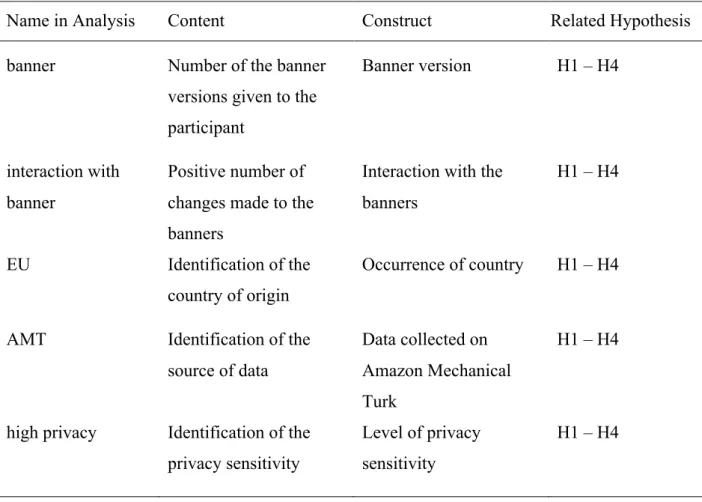
The data includes, among other variables, the number of changes that participants did while interacting with the cookie banners. This information was utilized to code an identifying dummy variable that shows whether the respondents had a positive interaction with the banner or not. This variable will be considered an operationalization of the number of changes and will be the dependent variable in the analysis of this study.
Additionally, the dataset comprises a variable that shows to the corresponding banner version given to each respondent. This information was used in the analysis in order to compare the banners and the relative interactions.
Additionally, the variable high privacy was created by considering the answers to three questions in the survey, which signaled the availability to provide personal information in order to receive different benefits. This dummy variable is used in the analysis in order to highlight the effect of the privacy concern on the interaction with the banners.
The following table provides an overview of the variables utilized in the analysis of this study and of important factors of the research model they correspond with.
Table 2: Relevant variables of this study
Overview of relevant variables and corresponding constructs from the research model
Name in Analysis Content Construct Related Hypothesis
banner Number of the banner
versions given to the participant
Banner version H1 – H4
interaction with banner
Positive number of changes made to the banners
Interaction with the banners
H1 – H4
EU Identification of the
country of origin
Occurrence of country H1 – H4
AMT Identification of the
source of data
Data collected on Amazon Mechanical Turk
H1 – H4
high privacy Identification of the privacy sensitivity
Level of privacy sensitivity
13
3.3 Identification strategy
The following paragraphs introduce the models used to analyze the data. We built a total of four models.
Model 1 is intended to test H1 by comparing the different interaction within Banner 2 and Banner 4, thus measuring the impact of the bulk option in the context of the opt-out format. Our dependent variable captures the number of changes made in the banner’s options and it distinguish a positive interaction from no interaction. On the other hand, the independent variable captures the two banner versions in comparison. Model 1 is reiterated three times in order to control data by country, source of data and privacy concern. In particular, the first iteration compares the results in the EU and US populations by only taking the dataset gathered on AMT (AMT = 1). This is necessary because the US observations are gathered only through the AMT platform, so this data have to be compared with the European data collected in the same way. The second iteration, on the other hand, compares AMT and non-AMT data, thus taking only the European answers (EU = 1) due to the fact that non-AMT data are only from the EU. Finally, this model is reiterated in order to control the results by the privacy concern and to measure the impact of the level of privacy sensitivity.
Model 1 is presented in equation (1) and equation (2).
𝑖𝑛𝑡𝑒𝑟𝑎𝑐𝑡𝑖𝑜𝑛 𝑤𝑖𝑡ℎ 𝑏𝑎𝑛𝑛𝑒𝑟| | = 𝛽 + 𝛽 𝑏𝑎𝑛𝑛𝑒𝑟4 × 𝐸𝑈 + 𝑔𝑒𝑛𝑑𝑒𝑟 (1)
+𝑎𝑔𝑒 + 𝑒𝑑𝑢𝑐𝑎𝑡𝑖𝑜𝑛 + 𝑜𝑐𝑐𝑢𝑝𝑎𝑡𝑖𝑜𝑛
𝑖𝑛𝑡𝑒𝑟𝑎𝑐𝑡𝑖𝑜𝑛 𝑤𝑖𝑡ℎ 𝑏𝑎𝑛𝑛𝑒𝑟| | = 𝛽 + 𝛽 𝑏𝑎𝑛𝑛𝑒𝑟4 × 𝐸𝑈 + 𝑔𝑒𝑛𝑑𝑒𝑟 (2)
+𝑎𝑔𝑒 + 𝑒𝑑𝑢𝑐𝑎𝑡𝑖𝑜𝑛 + 𝑜𝑐𝑐𝑢𝑝𝑎𝑡𝑖𝑜𝑛
In order to test H2 and the difference in interactions when comparing Banner 1 and Banner 3, it is used Model 2. These regressions are intended to measure the impact of the bulk option in presence of the opt-in format. The model captures the interaction with the banners in relation to the banner versions which are object of this regression. In this model it is computed, as well, the effect depending on the country and the source of data by iterating it firstly with AMT = 1 and then with EU = 1. Furthermore, the third iteration of Model 2 controls the results by the privacy sensitivity.
𝑖𝑛𝑡𝑒𝑟𝑎𝑐𝑡𝑖𝑜𝑛 𝑤𝑖𝑡ℎ 𝑏𝑎𝑛𝑛𝑒𝑟| | = 𝛽 + 𝛽 𝑏𝑎𝑛𝑛𝑒𝑟3 × 𝐸𝑈 + 𝑔𝑒𝑛𝑑𝑒𝑟 (3)
+𝑎𝑔𝑒 + 𝑒𝑑𝑢𝑐𝑎𝑡𝑖𝑜𝑛 + 𝑜𝑐𝑐𝑢𝑝𝑎𝑡𝑖𝑜𝑛
𝑖𝑛𝑡𝑒𝑟𝑎𝑐𝑡𝑖𝑜𝑛 𝑤𝑖𝑡ℎ 𝑏𝑎𝑛𝑛𝑒𝑟| | = 𝛽 + 𝛽 𝑏𝑎𝑛𝑛𝑒𝑟3 × 𝐸𝑈 + 𝑔𝑒𝑛𝑑𝑒𝑟 (4)
+𝑎𝑔𝑒 + 𝑒𝑑𝑢𝑐𝑎𝑡𝑖𝑜𝑛 + 𝑜𝑐𝑐𝑢𝑝𝑎𝑡𝑖𝑜𝑛
Model 3 is used to test H3, thus the comparison of Banner 1 and Banner 2 that opposes the opt-in and the opt-out format without the bulk option. The model is opt-intended to measure the impact of the banner version on the interaction with the two different banners. The model in its reiteration measures as well the interaction with the country of origin (AMT = 1), and the source of data (EU = 1). This model is then reiterated in order to control the results by the level of privacy.
Model 3 is presented in equation (5) and equation (6).
𝑖𝑛𝑡𝑒𝑟𝑎𝑐𝑡𝑖𝑜𝑛 𝑤𝑖𝑡ℎ 𝑏𝑎𝑛𝑛𝑒𝑟| | = 𝛽 + 𝛽 𝑏𝑎𝑛𝑛𝑒𝑟2 × 𝐸𝑈 + 𝑔𝑒𝑛𝑑𝑒𝑟 (5)
+𝑎𝑔𝑒 + 𝑒𝑑𝑢𝑐𝑎𝑡𝑖𝑜𝑛 + 𝑜𝑐𝑐𝑢𝑝𝑎𝑡𝑖𝑜𝑛
𝑖𝑛𝑡𝑒𝑟𝑎𝑐𝑡𝑖𝑜𝑛 𝑤𝑖𝑡ℎ 𝑏𝑎𝑛𝑛𝑒𝑟| | = 𝛽 + 𝛽 𝑏𝑎𝑛𝑛𝑒𝑟2 × 𝐸𝑈 + 𝑔𝑒𝑛𝑑𝑒𝑟 (6)
+𝑎𝑔𝑒 + 𝑒𝑑𝑢𝑐𝑎𝑡𝑖𝑜𝑛 + 𝑜𝑐𝑐𝑢𝑝𝑎𝑡𝑖𝑜𝑛
Finally, in order to test the interaction in presence of Banner 3 and Banner 4, we use Model 4, which is intended to measure the impact of the opt-in/opt-out formats in presence of the bulk option. The dependent variable captures the interaction with banner while the independent variable outlines the banner versions in comparison controlled by country and source of data. The three iterations are made the same way as the previous models’ reiterations. They are intended to capture the difference between US and EU populations (AMT = 1), between AMT and non-AMT respondents (EU = 1), and the influence of high privacy concern.
Model 4 is presented in equation (7) and equation (8).
𝑖𝑛𝑡𝑒𝑟𝑎𝑐𝑡𝑖𝑜𝑛 𝑤𝑖𝑡ℎ 𝑏𝑎𝑛𝑛𝑒𝑟| | = 𝛽 + 𝛽 𝑏𝑎𝑛𝑛𝑒𝑟4 × 𝐸𝑈 + 𝑔𝑒𝑛𝑑𝑒𝑟 (7)
+𝑎𝑔𝑒 + 𝑒𝑑𝑢𝑐𝑎𝑡𝑖𝑜𝑛 + 𝑜𝑐𝑐𝑢𝑝𝑎𝑡𝑖𝑜𝑛
17 not earning the final compensation. This evaluation was made spontaneously by respondents since they were not aware that the banner was part of the experiment2
.
In Banner 1 due to the opt-in format and no bulk option respondents prefer to submit the banner as it is in order to protect their privacy. By contrast, in Banner 3 participants want to have the website work and they have a fast way to achieve it due to the bulk button “Accept All”. This trade-off does not hold for Banner 2 and Banner 4, as the opt-out format makes immediate to submit the banner with all the options already activated. However, in this case the trade-off is between decreasing the time to complete the survey and protecting the personal privacy. The tendency is to submit it, but the privacy concern makes people deactivating the options twice more times from Banner 1 to Banner 2, and from this last to Banner 4 due to the bulk option. Regarding the EU sample, the interaction rates are more balanced. Banner 3 received a high positive interaction (63%), but less than the US one. Moreover, 56% of people submitted Banner 1 without providing their data, thus not changing anything in the default option. However, it is interesting to notice how many respondents decided to activate manually the options (44%), and this behavior is clearly different from the US respondents’ one.
For Banner 2 and Banner 4, respectively 63% and 67% of respondents submitted the banner without making any changes, thus providing their data.
Differently from the US sample, people who made some changes decreased from Banner 1 to Banner 2, and from this last to Banner 4. For the US respondents we hypothesized that the increase in the number of changes was due to the opt-out format of Banner 2, and to the bulk option for Banner 4. However, for the EU sample this finding does not hold since the trend is inverted. This fact might highlight a greater privacy sensitivity for EU user independently from the banner characteristics that will be investigated further.
The trade-off between minimizing the interaction time and having the website working is not very neat in the EU sample. In fact, 44% of respondents who interacted with Banner 1 activated the options one by one, which require a longer time than submitting it with the default option. However, for Banner 3 it holds the preference towards having the website working.
Concerning Banner 2 and Banner 4, the tendency is still to click on submit without personalizing the options. However, the positive interaction increased from the US sample, meaning that more people rejected some cookies, and this difference shows the greater privacy sensibility previously hypothesized for EU users.
2 The introduction to the experiment described it as related to daily activities and did not informed participants
19 Internet. These answers explain the trade-off between the protection of personal data and having the website working while minimizing the interaction time. For what concerns the EU respondents, we can notice that people who made some changes (less than 6) increased. In fact, every banner version was subject to these changes, while in the US sample only banners 3 and 4. The main reason to behave in this way is related to privacy protection, especially for Banner 2 and Banner 4, which are preselected.
The privacy concern’s effect is also evident in the reasons to reject all cookies. Respondents explained their interaction with Banner 2 and Banner 4 by selecting the answers “To protect my privacy” and “To protect me from the dangers of Internet”. Moreover, the interaction rates for these two banners in EU respondents is higher than those of US, meaning that the privacy concern might be an effect characterizing the EU population.
The trend in the reasons to make no changes is quite similar to the US one. The only difference is that in the EU sample, the percentage of respondents who had no interaction with Banner 3 is higher than in the US one, thus in the section “no changes” also this banner acquire significance in the answers given.
The most frequent reason to make no changes is “I feel protected in this way”, which is relevant for Banner 1 and Banner 3, highlighting again the privacy concern. The frequency of this response for Banner 4 was not expected. However, apart from the effect of privacy sensibility, the second most relevant effect is the payment effect, as already noted in the US sample. In fact, the second most frequent answer underline the fear of the website not working, which is relevant for all the banners, especially for Banner 2. Furthermore, it is relevant to notice the presence of some users who did not read the notice and submitted it as it was. Banner 2 is the one that received most of this answer, followed by Banner 4. This could indicate that preselected banners might present a higher cognitive cost.
It is interesting to notice the high presence of Banner 1 in the Accept all section, which is totally different from the US situation. This behavior highlights the relevance of the payment effect because EU respondents in a significant percentage decided to activate manually all the options to be sure to receive the payment after the conclusion of the survey. The reasons to interact with Banner 3 are the same as for the US sample, thus highlighting the payment effect.
21 To verify the existence of the payment effect we compared the AMT responses to the ones gathered for free.
The free data show the same interaction trend by banner as the US one with an increase of positive interactions from Banner 1 to Banner 2, and from this last to Banner 4. Surprisingly, Banner 3 still received a greater positive interaction, but the result is more balanced like in the EU sample.
Moreover, when analyzing the reasons of (non-) interaction with banners, in this second dataset the fear of a misfunctioning of the website gives path to the theme of privacy protection. In fact, the most frequent answers are “To protect my privacy” paired with the protection from the dangers of Internet. Moreover, for Banner 1 and Banner 3 (opt-in format) the most frequent answer for submitting without changes is “I feel protected in this way”, which is the one we expected. Finally, the proof of the payment effect can be also found in the comparison of the “Accept All” situation for Banner 3 in the two datasets. In fact, in the one gathered for free there is not the answer “The website might not work otherwise” anymore.
We can conclude that the payment effect exists, and, in particular, it emphasizes the respondents’ behavior by making the trend in banners’ interaction more extreme. This means that our findings are generally comparable, but specific results differ due to the payment effect. The graphs of the interaction by banner and the reasons for (non-) interaction can be found in Appendix B and Appendix C.
4.1.3 Perception of complex banners
Respondents were also asked about their perceptions of banners with which they interacted. In particular, they rated the easiness of choice and the number of options in the banner.
For both the US and EU AMT samples, participants who interacted with Banner 3 and Banner 4 found the choice easier than those who interacted with Banner 1 and Banner 2 (Figure 7). In particular, 70,5% of respondents who were shown banners 3 and 4 rated the choice “Very easy” and “Easy”, against the 58% for banners 1 and 2. Regarding the EU respondents, the percentages are smaller but respectively 56% and 52%.
Moreover, the former banners have the bulk option, so we conclude that the introduction of the bulk option makes the choice easier by decreasing the cognitive cost. This result is in line with our previous expectations.
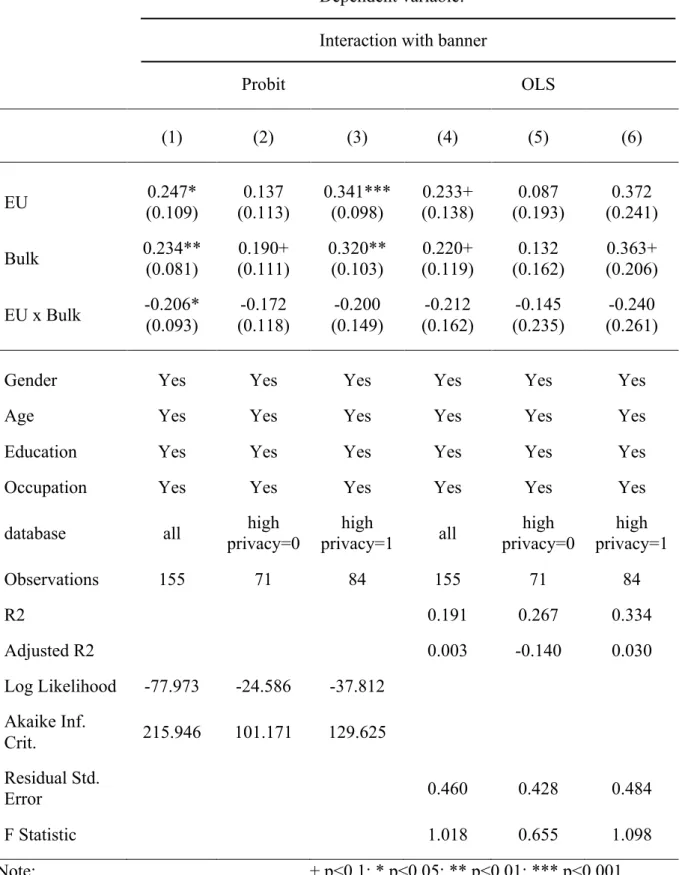
Table 3: Regression Model comparing banners 2 and 4 controlled by country
Results of Model 1 given AMT = 1
Dependent variable:
Interaction with banner Probit OLS (1) (2) (3) (4) (5) (6) EU 0.247* (0.109) 0.137 (0.113) 0.341*** (0.098) 0.233+ (0.138) 0.087 (0.193) 0.372 (0.241) Bulk 0.234** (0.081) 0.190+ (0.111) 0.320** (0.103) 0.220+ (0.119) 0.132 (0.162) 0.363+ (0.206) EU x Bulk -0.206* (0.093) -0.172 (0.118) -0.200 (0.149) -0.212 (0.162) -0.145 (0.235) -0.240 (0.261)
Gender Yes Yes Yes Yes Yes Yes
Age Yes Yes Yes Yes Yes Yes
Education Yes Yes Yes Yes Yes Yes
Occupation Yes Yes Yes Yes Yes Yes
database all high
privacy=0 high privacy=1 all high privacy=0 high privacy=1 Observations 155 71 84 155 71 84 R2 0.191 0.267 0.334 Adjusted R2 0.003 -0.140 0.030 Log Likelihood -77.973 -24.586 -37.812 Akaike Inf. Crit. 215.946 101.171 129.625 Residual Std. Error 0.460 0.428 0.484 F Statistic 1.018 0.655 1.098 Note: + p<0.1; * p<0.05; ** p<0.01; *** p<0.001
27 In Model 1 we compared Banner 2 and Banner 4, which are both preselected. However, Banner 4 has the bulk button. In H1 we expected a higher interaction as the cognitive effort decrease, thus in presence of the bulk option. The result of the regression comparing US and EU samples (AMT = 1) confirms our expectation since there is a 23.4% increase in interaction due to the effect of the bulk option (p<0.01). Moreover, EU people interact 24.7% more than US ones (p<0.05). The LPM confirms these results as it reports almost the same percentages, respectively 23.3% (p<0.1) and 22% (p<0.1), thus we conclude that Banner 4 due to the bulk option induces users to make a greater number of changes, and that this phenomenon is more marked for the EU population.
Moreover, when controlling by the EU and the bulk effects, we notice that interaction decreases by 20.6% (p<0.05). Thus, EU people who faced the banner with the bulk option interacted less than US people in the same context.
When considering the sample characterized by high privacy concern, the probit regression shows that interaction increases by 32% due to bulk option (p<0.01) and EU population interacts more than the US one by 34% (p<0.001). The LPM produces similar results but with a lower level of significance.
As we noted before, there is a trade-off between performance and privacy protection since users have different objectives while interacting with different banners. Moreover, the design influences people’s behavior and makes them pursue an objective or the other. In fact, we can notice that when the cognitive cost decreases due to the bulk option, the privacy protection acquires more importance in the trade-off, while when interacting with Banner 2 users prefer performance over privacy. Thus, the lower interaction cost induces people to behave following their preference.
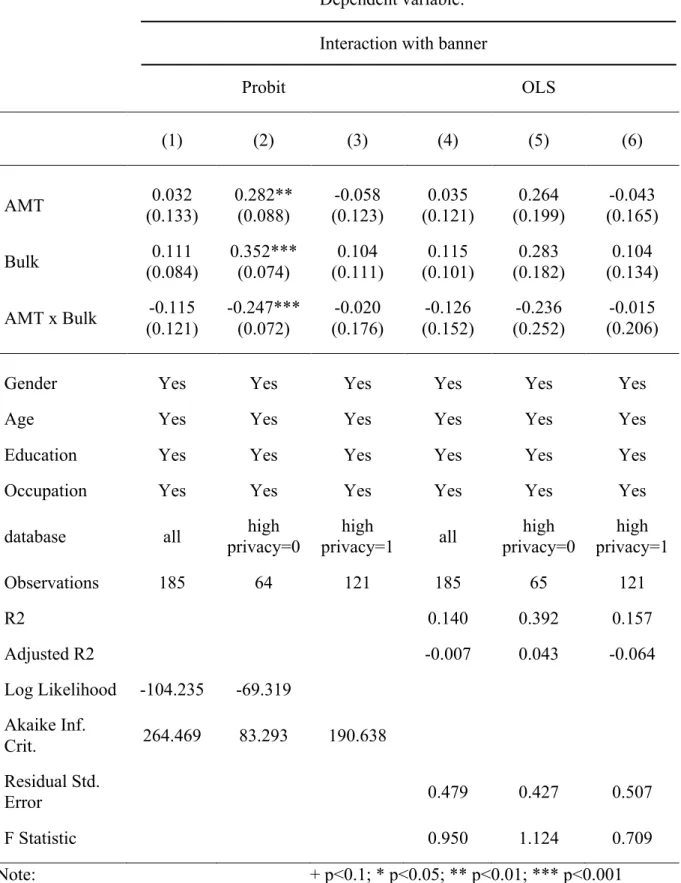
Table 4: Regression Model comparing banners 2 and 4 controlled by source of data
Results of Model 1 given EU = 1
Dependent variable:
Interaction with banner Probit OLS (1) (2) (3) (4) (5) (6) AMT 0.032 (0.133) 0.282** (0.088) -0.058 (0.123) 0.035 (0.121) 0.264 (0.199) -0.043 (0.165) Bulk 0.111 (0.084) 0.352*** (0.074) 0.104 (0.111) 0.115 (0.101) 0.283 (0.182) 0.104 (0.134) AMT x Bulk -0.115 (0.121) -0.247*** (0.072) -0.020 (0.176) -0.126 (0.152) -0.236 (0.252) -0.015 (0.206)
Gender Yes Yes Yes Yes Yes Yes
Age Yes Yes Yes Yes Yes Yes
Education Yes Yes Yes Yes Yes Yes
Occupation Yes Yes Yes Yes Yes Yes
database all high
privacy=0 high privacy=1 all high privacy=0 high privacy=1 Observations 185 64 121 185 65 121 R2 0.140 0.392 0.157 Adjusted R2 -0.007 0.043 -0.064 Log Likelihood -104.235 -69.319 Akaike Inf. Crit. 264.469 83.293 190.638 Residual Std. Error 0.479 0.427 0.507 F Statistic 0.950 1.124 0.709 Note: + p<0.1; * p<0.05; ** p<0.01; *** p<0.001
29 The second part of Model 1 investigated the difference between Banner 2 and Banner 4 within the EU sample, thus distinguishing between AMT and non-AMT respondents.
The result of the regression shows that there is not a significant difference in interaction due to the bulk option. Moreover, the EU respondents behave in the same way, no matter the financial incentive to complete the experiment.
Interestingly, the AMT effect is significant on non-privacy users, while not significant on high privacy ones. When considering the sample with a low level of privacy concern, we notice that the presence of the bulk option increases interaction by 35.2% (p<0.001). Moreover, the sample with a financial incentive (AMT) interacted more than the other by 28.2% (p<0.01). Thus, the financial incentive induces low privacy sensitive people to interact more with Banner 4, which is characterized by the bulk option. A possible explanation for this phenomenon might be that the financial incentive made people clicking on the option that enabled them to close it in the fewest time, thus the bulk option as it decreases the cognitive effort.
Finally, when controlling for AMT and bulk effects in low privacy concerned people, the interaction reduces by 24.7% (p<0.001). This means that if people are paid and in presence of the bulk option, they interact less than unpaid people.
Even though the bulk option has no significant influence over the EU sample, it is still more relevant than in the US since in the previous results it was found to have a significant effect.
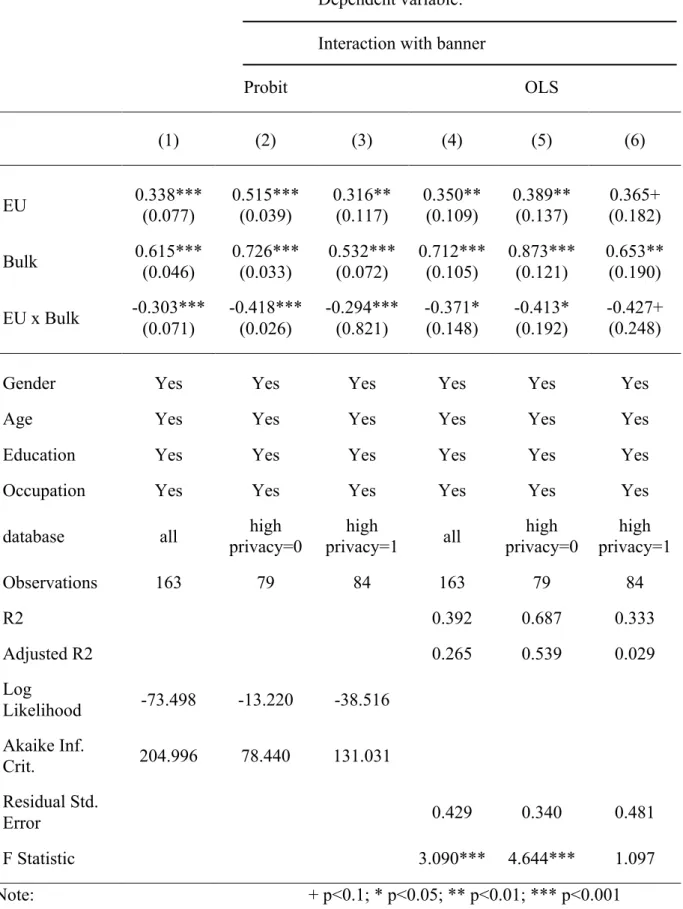
Table 5: Regression Model comparing with banners 1 and 3 controlled by country
Results of Model 2 given AMT = 1
Dependent variable:
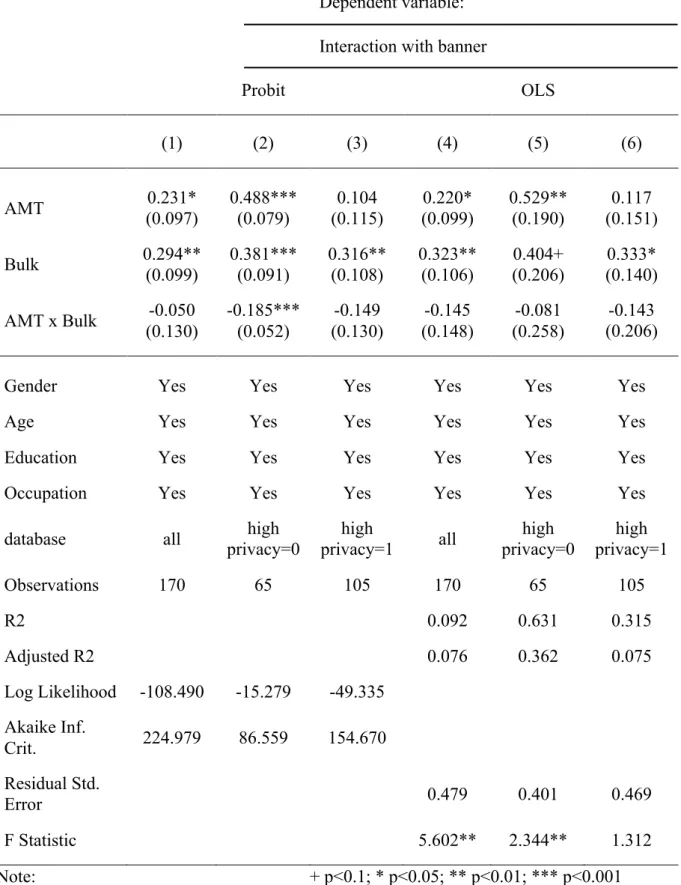
Interaction with banner Probit OLS (1) (2) (3) (4) (5) (6) EU 0.338*** (0.077) 0.515*** (0.039) 0.316** (0.117) 0.350** (0.109) 0.389** (0.137) 0.365+ (0.182) Bulk 0.615*** (0.046) 0.726*** (0.033) 0.532*** (0.072) 0.712*** (0.105) 0.873*** (0.121) 0.653** (0.190) EU x Bulk -0.303*** (0.071) -0.418*** (0.026) -0.294*** (0.821) -0.371* (0.148) -0.413* (0.192) -0.427+ (0.248)
Gender Yes Yes Yes Yes Yes Yes
Age Yes Yes Yes Yes Yes Yes
Education Yes Yes Yes Yes Yes Yes
Occupation Yes Yes Yes Yes Yes Yes
database all high
privacy=0 high privacy=1 all high privacy=0 high privacy=1 Observations 163 79 84 163 79 84 R2 0.392 0.687 0.333 Adjusted R2 0.265 0.539 0.029 Log Likelihood -73.498 -13.220 -38.516 Akaike Inf. Crit. 204.996 78.440 131.031 Residual Std. Error 0.429 0.340 0.481 F Statistic 3.090*** 4.644*** 1.097
31 As reported in H2, from Model 2 we expected no difference in the interaction with the two banners. However, the result of the regression that compares EU and US paid people says that interaction with Banner 3 is 61.5% higher than the one with Banner 1 due to the presence of the bulk option (p<0.001). Moreover, interaction increases by 33.8% from the US sample to the EU one (p<0.001). Furthermore, the LPM enables us to confirm that Banner 3 induces users to make a greater number of changes and that interaction is higher in the EU population, since the coefficients are quite similar to the ones of the probit ones.
We conclude that the bulk option has a greater impact than the opt-in format. The “Accept all” button decreases the cognitive effort in making a decision, thus people click on it as it represents the easiest choice. Thus, even though the opt-in format should convey a sense of privacy protection, the lower cognitive cost of the bulk option in this specific case makes users to prefer to provide their data and discarding the notice.
However, when controlling for the EU and the Bulk effects, the difference in interaction between Banner 3 and Banner 1 is higher in the US by 30.3% (p<0.001).
Moreover, the effect of the EU and of the bulk option is relevant both for non-privacy users and high privacy ones. In particular, the bulk option increase interaction by 72.6% for the former and by 53.2% for the latter users. This is interesting because the bulk option reduces cognitive effort, however it influences less people characterized by high levels of privacy sensitivity. Finally, the interaction is 51.5% higher for EU non-privacy users, and 31.6% higher for EU high privacy ones with respect to the US ones. However, when controlling the interaction between EU and the bulk option we notice that for both types of users the difference in interaction between Banner 3 and Banner 1 is greater.
Table 6: Regression Model comparing banners 1 and 3 controlled by source of data
Results of Model 2 given EU = 1
Dependent variable:
Interaction with banner Probit OLS (1) (2) (3) (4) (5) (6) AMT 0.231* (0.097) 0.488*** (0.079) 0.104 (0.115) 0.220* (0.099) 0.529** (0.190) 0.117 (0.151) Bulk 0.294** (0.099) 0.381*** (0.091) 0.316** (0.108) 0.323** (0.106) 0.404+ (0.206) 0.333* (0.140) AMT x Bulk -0.050 (0.130) -0.185*** (0.052) -0.149 (0.130) -0.145 (0.148) -0.081 (0.258) -0.143 (0.206)
Gender Yes Yes Yes Yes Yes Yes
Age Yes Yes Yes Yes Yes Yes
Education Yes Yes Yes Yes Yes Yes
Occupation Yes Yes Yes Yes Yes Yes
database all high
privacy=0 high privacy=1 all high privacy=0 high privacy=1 Observations 170 65 105 170 65 105 R2 0.092 0.631 0.315 Adjusted R2 0.076 0.362 0.075 Log Likelihood -108.490 -15.279 -49.335 Akaike Inf. Crit. 224.979 86.559 154.670 Residual Std. Error 0.479 0.401 0.469 F Statistic 5.602** 2.344** 1.312 Note: + p<0.1; * p<0.05; ** p<0.01; *** p<0.001
33 Table 6 shows the results of Model 2 in the EU sample, thus distinguishing between AMT and non-AMT respondents.
The bulk option also in this case increase interaction. In particular, Banner 3 received 29.4% more interaction than Banner 1 within the EU population.
Moreover, AMT respondents engage 23% more than non-paid ones (p<0.05), meaning that probably the financial incentive might have an influence in incentivizing interaction.
The LPM confirms the significance of these insights as we can notice that the coefficients are very similar to the ones just described, meaning that the model is quite accurate.
Noticeably, the bulk option increases interaction both for non-privacy and high privacy users, respectively by 38.1% (p<0.001) and 31.6% (p<0.01). As we expected, the bulk option has a lower impact on the population with high privacy concern.
However, it is interesting to notice that the AMT effect is significant only on non-privacy users. In fact, the interaction for AMT low privacy respondents is 48.8% higher than non-AMT ones. Thus, we can conclude that the financial incentive has an impact on users but only on non-privacy ones.
In both the scenarios drawn for Model 2, the majority of respondents interacted with Banner 3, thus they decided to provide their data. This means that the bulk option in the form of “Accept all” button induces people to prefer the performance and the minimization of interaction time over the privacy protection. Furthermore, we noticed that this phenomenon is more present in the AMT population and it is probably due to the effect of the financial incentive provided to respondents. In fact, in this case it is clear the preference of performance over privacy and this influences the trade-off.
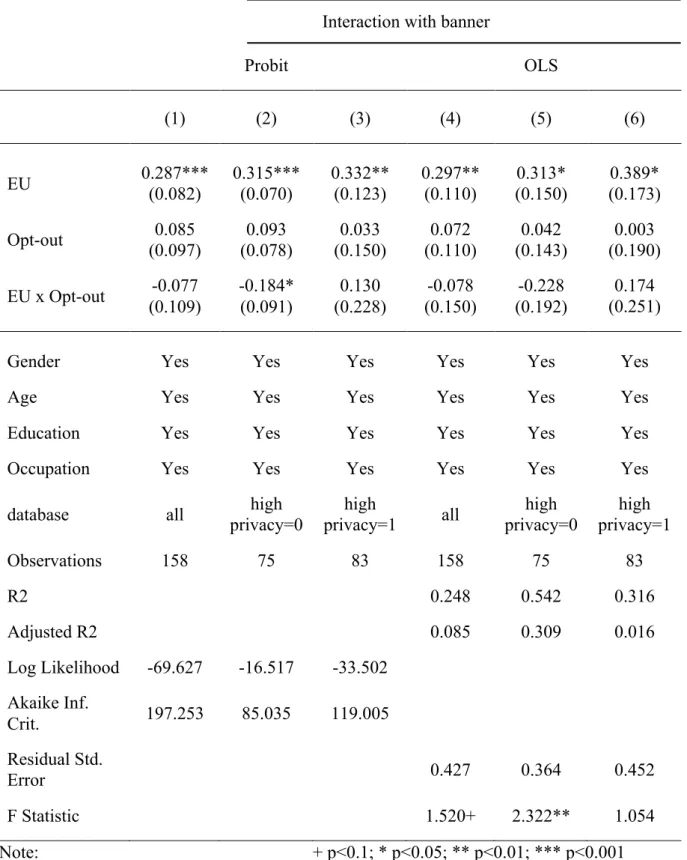
Table 7: Regression Model comparing banners 1 and 2 controlled by country
Results of Model 3 given AMT = 1
Dependent variable:
Interaction with banner Probit OLS (1) (2) (3) (4) (5) (6) EU 0.287*** (0.082) 0.315*** (0.070) 0.332** (0.123) 0.297** (0.110) 0.313* (0.150) 0.389* (0.173) Opt-out 0.085 (0.097) 0.093 (0.078) 0.033 (0.150) 0.072 (0.110) 0.042 (0.143) 0.003 (0.190) EU x Opt-out -0.077 (0.109) -0.184* (0.091) 0.130 (0.228) -0.078 (0.150) -0.228 (0.192) 0.174 (0.251)
Gender Yes Yes Yes Yes Yes Yes
Age Yes Yes Yes Yes Yes Yes
Education Yes Yes Yes Yes Yes Yes
Occupation Yes Yes Yes Yes Yes Yes
database all high
privacy=0 high privacy=1 all high privacy=0 high privacy=1 Observations 158 75 83 158 75 83 R2 0.248 0.542 0.316 Adjusted R2 0.085 0.309 0.016 Log Likelihood -69.627 -16.517 -33.502 Akaike Inf. Crit. 197.253 85.035 119.005 Residual Std. Error 0.427 0.364 0.452 F Statistic 1.520+ 2.322** 1.054 Note: + p<0.1; * p<0.05; ** p<0.01; *** p<0.001
35 In Model 3 we are interested in the comparison between the interactions with Banner 1 and Banner 2. As stated in H3 we expected respondents to interact less with the former banner due to the presence of the opt-in format. The result of the regression done on AMT respondents shows that the opt-out format does not produce a significantly different interaction between EU and US people. Moreover, the interaction with the opt-in and opt-out format is also the same for non-privacy and high privacy users. This result makes us to conclude that without the bulk option, the format has no impact on interaction. Thus, there is an impact of default option on users’ behavior because independently from the format they tend to submit the banner as it is. In fact, if the format would have an impact over default option, we would had noticed a significant difference in interaction between the two banners.
Interestingly, EU respondents engage 28.7% more when changing the banners than US ones (p<0.001). Moreover, the interaction is 33.2% higher for EU high privacy participants and this probably depends from the fact that, as we saw also in the graphical analysis, European are more privacy concerned than US people. In fact, a greater interaction with Banner 2 means deselecting more the options in order not to provide data.
Finally, non-privacy EU users has a 31.5% higher interaction when changing banners (p<0.001). However, when these users face the Banner 2 with the opt-out format have a 18.4% lower interaction than US ones in the same context (p<0.05).
The LPM regressions show the robustness of the abovementioned results due to the same coefficients reported.
In the previous results we could distinguish the effect of the trade-off between privacy protection and performance. However, in this case the default option effect affects users’ decision about data provision because the choice is biased. In fact, respondents had the same low interaction as seen in the graphical analysis, meaning that they submitted the banners in order to close them and they did not make a real choice between performance or privacy protection.
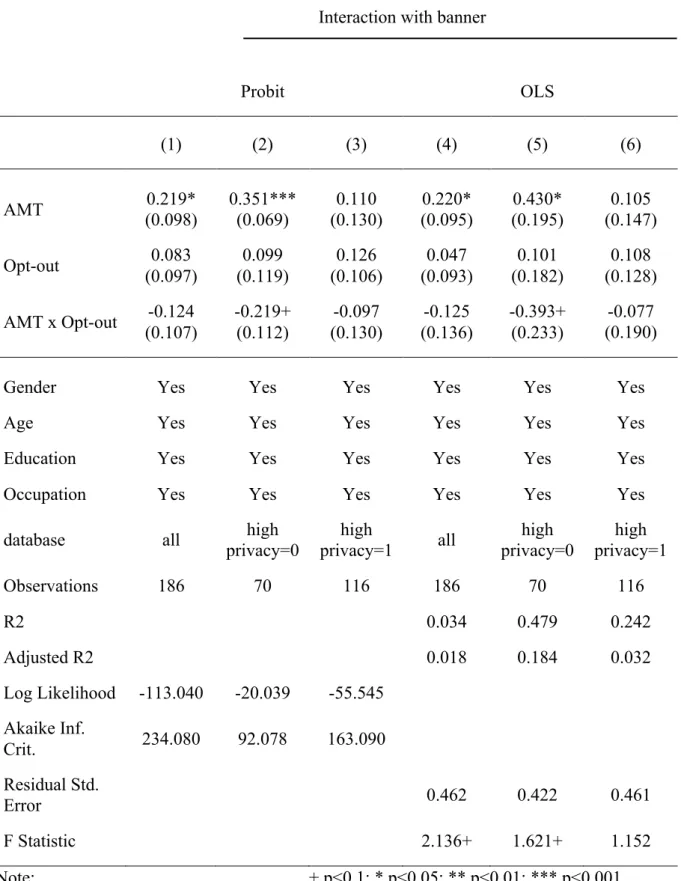
Table 8: Regression Model comparing banners 1 and 2 controlled by source of data
Results of Model 3 given EU = 1
Dependent variable:
Interaction with banner Probit OLS (1) (2) (3) (4) (5) (6) AMT 0.219* (0.098) 0.351*** (0.069) 0.110 (0.130) 0.220* (0.095) 0.430* (0.195) 0.105 (0.147) Opt-out 0.083 (0.097) 0.099 (0.119) 0.126 (0.106) 0.047 (0.093) 0.101 (0.182) 0.108 (0.128) AMT x Opt-out -0.124 (0.107) -0.219+ (0.112) -0.097 (0.130) -0.125 (0.136) -0.393+ (0.233) -0.077 (0.190)
Gender Yes Yes Yes Yes Yes Yes
Age Yes Yes Yes Yes Yes Yes
Education Yes Yes Yes Yes Yes Yes
Occupation Yes Yes Yes Yes Yes Yes
database all high
privacy=0 high privacy=1 all high privacy=0 high privacy=1 Observations 186 70 116 186 70 116 R2 0.034 0.479 0.242 Adjusted R2 0.018 0.184 0.032 Log Likelihood -113.040 -20.039 -55.545 Akaike Inf. Crit. 234.080 92.078 163.090 Residual Std. Error 0.462 0.422 0.461 F Statistic 2.136+ 1.621+ 1.152
37 The second set of regressions of Model 3 investigated the difference between Banner 1 and Banner 2 within the AMT and non-AMT respondents in the EU sample.
We can notice that there is not a significant difference in the interactions between the two banners. However, there is a 21.9% higher engagement with Banner 1 for the AMT participants (p<0.05). Moreover, the AMT effect is significant only for non-privacy users. In fact, this type of user has an increase in interaction of 35.1% with respect to non-AMT low privacy ones. However, when looking at the interaction between AMT and the opt-out format we can notice that being paid and seeing Banner 2 decrease interaction (p<0.1). While, as captured from the AMT variable, if all the options are unticked and the subject is paid, the interaction increases. This last insight is particularly interesting for the analysis of the trade-off between privacy protection and performance as it is clear that AMT respondents prefer the latter.
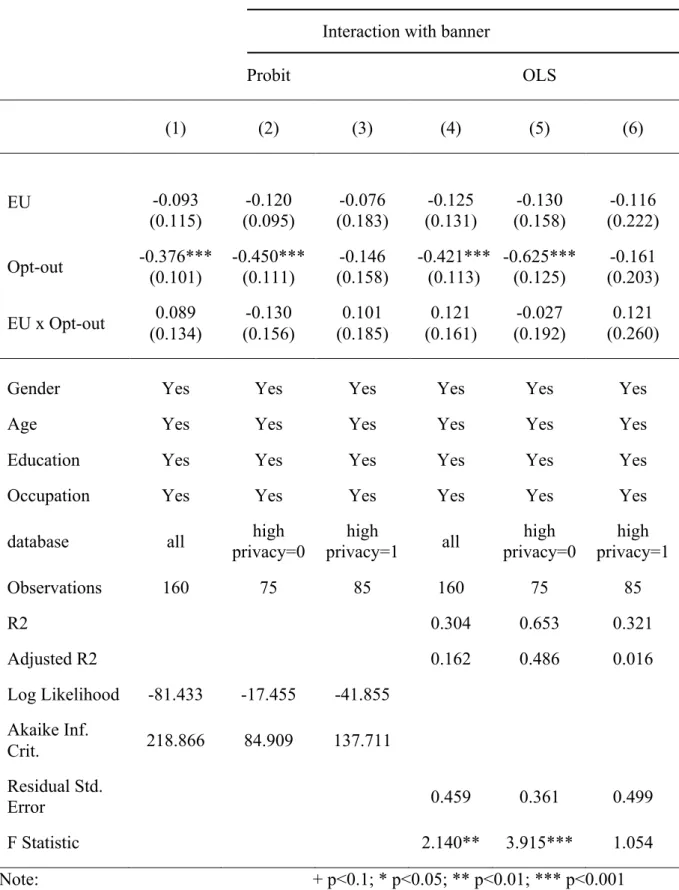
Table 9: Regression Model comparing banners 3 and 4 controlled by country
Results of Model 4 given AMT = 1
Dependent variable:
Interaction with banner Probit OLS (1) (2) (3) (4) (5) (6) EU -0.093 (0.115) -0.120 (0.095) -0.076 (0.183) -0.125 (0.131) -0.130 (0.158) -0.116 (0.222) Opt-out -0.376*** (0.101) -0.450*** (0.111) -0.146 (0.158) -0.421*** (0.113) -0.625*** (0.125) -0.161 (0.203) EU x Opt-out 0.089 (0.134) -0.130 (0.156) 0.101 (0.185) 0.121 (0.161) -0.027 (0.192) 0.121 (0.260)
Gender Yes Yes Yes Yes Yes Yes
Age Yes Yes Yes Yes Yes Yes
Education Yes Yes Yes Yes Yes Yes
Occupation Yes Yes Yes Yes Yes Yes
database all high
privacy=0 high privacy=1 all high privacy=0 high privacy=1 Observations 160 75 85 160 75 85 R2 0.304 0.653 0.321 Adjusted R2 0.162 0.486 0.016 Log Likelihood -81.433 -17.455 -41.855 Akaike Inf. Crit. 218.866 84.909 137.711 Residual Std. Error 0.459 0.361 0.499 F Statistic 2.140** 3.915*** 1.054 Note: + p<0.1; * p<0.05; ** p<0.01; *** p<0.001
39 Finally, in Model 4 we expected no difference in the changes made in Banner 3 and Banner 4 as for H4. However, the regression comparing the AMT EU and the AMT US samples shows that there is a significant difference in the interaction between the two banners. In particular, there is a 37.6% lower interaction with Banner 4 due to the opt-out format (p<0.001). Thus, Banner 3 induces users to make a greater number of changes. The “Accept all” option makes more respondents to click on it than the “Reject all” one. This phenomenon is the same for EU and for US respondents.
Interestingly, the opt-out format has an impact on non-privacy users and not on high privacy ones. In fact, respondents characterized by low privacy sensitivity interacted less with Banner 4 due to the opt-out format by 45% (p<0.001). This means that they provided more data, which is in line with their privacy preference.
The OLS regressions performs in the same way, thus confirming what stated in the previous paragraph and the reliability of the model.
When considering the trade-off between performance and privacy protection it is clear that in this situation the majority of respondents preferred the former as they accepted all cookies in order to have the website working and receiving the final payment. However, the significance of the effect of the opt-out format is driven by the low privacy users, as the effect is only relevant for them. Thus, it is clear that they do not care about providing their data and they prefer performance.
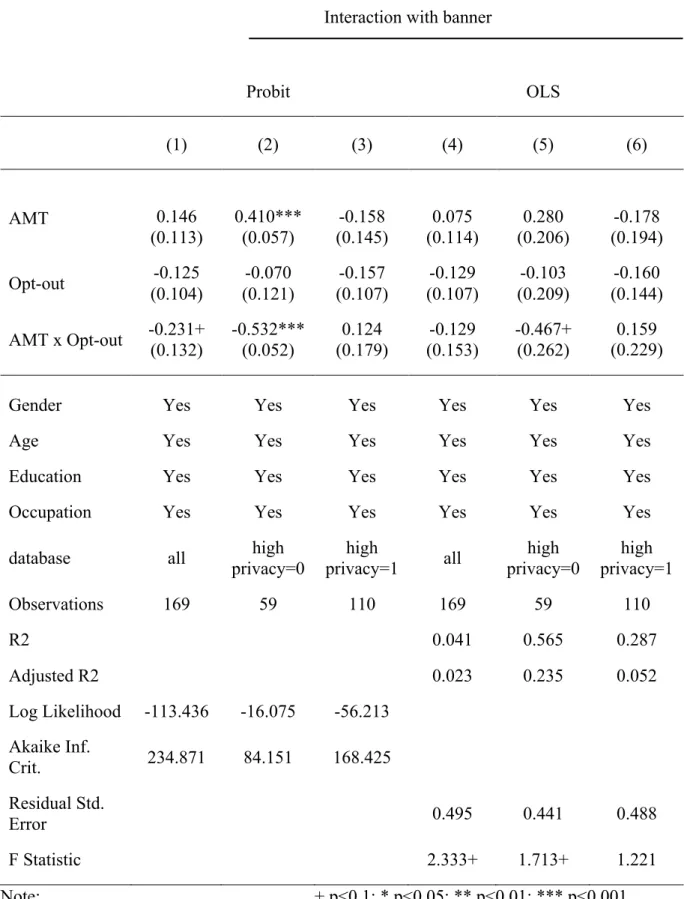
Table 10: Regression Model comparing banners 3 and 4 controlled by source of data
Results of Model 4 given EU = 1
Dependent variable:
Interaction with banner Probit OLS (1) (2) (3) (4) (5) (6) AMT 0.146 (0.113) 0.410*** (0.057) -0.158 (0.145) 0.075 (0.114) 0.280 (0.206) -0.178 (0.194) Opt-out -0.125 (0.104) -0.070 (0.121) -0.157 (0.107) -0.129 (0.107) -0.103 (0.209) -0.160 (0.144) AMT x Opt-out -0.231+ (0.132) -0.532*** (0.052) 0.124 (0.179) -0.129 (0.153) -0.467+ (0.262) 0.159 (0.229)
Gender Yes Yes Yes Yes Yes Yes
Age Yes Yes Yes Yes Yes Yes
Education Yes Yes Yes Yes Yes Yes
Occupation Yes Yes Yes Yes Yes Yes
database all high
privacy=0 high privacy=1 all high privacy=0 high privacy=1 Observations 169 59 110 169 59 110 R2 0.041 0.565 0.287 Adjusted R2 0.023 0.235 0.052 Log Likelihood -113.436 -16.075 -56.213 Akaike Inf. Crit. 234.871 84.151 168.425 Residual Std. Error 0.495 0.441 0.488 F Statistic 2.333+ 1.713+ 1.221
41 The second part of Model 4 investigated the difference between Banner 3 and Banner 4 within the EU sample, thus distinguishing between AMT and non-AMT respondents.
The result of the regression shows that there is not a significant difference in the interactions between the two banners and between the two samples. So, the opt-in/opt-out formats have the same impact within the EU population, no matter the financial incentive. The LPM confirms the significance of this insight. We can conclude that within the EU respondents with the bulk option, users’ interaction is the same no matter the default option. Thus, the opt-in/opt-out formats have no impact on users’ behavior. However, the presence of the “Accept/Reject all” buttons induces people to click on them even though they represent two opposed decisions over data provision. This means that the bulk option design, and in particular the provision of an option characterized by a low cognitive effort, is relevant for users’ behavior and it has the power to nudge people.
Finally, the AMT effect is only relevant for privacy users and, in particular, AMT non-privacy users have a 41% higher engagement than respondents who are not paid. Thus, in general the financial incentive makes respondents interacting more. At the same time, it is noticeable that being paid and interacting with Banner 4 (opt-out) decrease interaction by 53.2%. This means that they interacted more with Banner 3 by providing their data, but less with Banner 4 which means allowing cookies as well. Thus, as we noted in the relation between Banner 1 and Banner 2 for AMT and non-AMT respondents, the financial incentive induces to propend for the website performance.
Furthermore, it is also interesting to notice that the first part of results was mainly driven by the US population since the difference in interaction disappears when considering only the EU sample. Thus, we conclude that the US respondents might be more influenced by the financial incentive provided or by the nudging effect of the “Accept all” button.
In conclusion, Table 11 provides an overview of the ramifications of the results of this study for the hypotheses proposed in the research model.