PoS(Baldin ISHEPP XXI)040
New data on the differential cross section of the
dp-elastic scattering at 2.5 GeV obtained with
HADES detector
G. Agakishiev6, C. Behnke7, D. Belver16, A. Belyaev6, J.C. Berger-Chen8,
A. Blanco1, C. Blume7, M. Böhmer9, P. Cabanelas16, S. Chernenko6, C. Dritsa10, A. Dybczak2, E. Epple8, L. Fabbietti8, O. Fateev6, P. Fonte1,a, J. Friese9, I. Fröhlich7, T. Galatyuk4,b, J. A. Garzón16, K. Gill7, M. Golubeva11, D. González-Díaz4, F. Guber11, M. Gumberidze14, S. Harabasz4, T. Hennino14, R. Holzmann3, P. Huck9, C. Höhne10, A. Ierusalimov6, A. Ivashkin11, M. Jurkovic9, B. Kämpfer5,c, T. Karavicheva11,
I. Koenig3, W. Koenig3, B. W. Kolb3, G. Korcyl2, G. Kornakov16, R. Kotte5, A. Krása15, E. Krebs7, F. Krizek15, H. Kuc2,14, A. Kugler15, A. Kurepin11, A. Kurilkin6, P. Kurilkin∗6, V. Ladygin6, R. Lalik8, S. Lang3, K. Lapidus8, A. Lebedev12, L. Lopes1, M. Lorenz7, L. Maier9, A. Mangiarotti1, J. Markert7, V. Metag10, J. Michel7, C. Müntz7, R. Münzer8, L. Naumann5, M. Palka2, Y. Parpottas13,d, V. Pechenov3, O. Pechenova7,
J. Pietraszko7, W. Przygoda2, B. Ramstein14, L. Rehnisch7, A. Reshetin11, A. Rustamov7, A. Sadovsky11, P. Salabura2, T. Scheib7, H. Schuldes7, J. Siebenson8, Yu.G. Sobolev15, S. Spataroe, H. Ströbele7, J. Stroth7,3,
P. Strzempek2, C. Sturm3, O. Svoboda15, A. Tarantola7, K. Teilab7, P. Tlusty15, M. Traxler3, H. Tsertos13, T. Vasiliev6, V. Wagner15, M. Weber9, C. Wendisch5,c, J. Wüstenfeld5, S. Yurevich3and Y. Zanevsky6
(HADES Collaboration)
1LIP-Laboratório de Instrumentação e Física Experimental de Partículas, 3004-516, Coimbra,
Portugal
2Smoluchowski Institute of Physics, Jagiellonian University of Cracow, 30-059 Kraków, Poland
3GSI Helmholtzzentrum für Schwerionenforschung GmbH, 64291 Darmstadt, Germany
4Technische Universität Darmstadt, 64289 Darmstadt, Germany
5Institut für Strahlenphysik, Helmholtz-Zentrum Dresden-Rossendorf, 01314 Dresden, Germany
6Joint Institute of Nuclear Research, 141980 Dubna, Russia
7Institut für Kernphysik, Goethe-Universität, 60438 Frankfurt, Germany
8Excellence Cluster ’Origin and Structure of the Universe’ , 85748 Garching, Germany
9Physik Department E12, Technische Universität München, 85748 Garching, Germany
10II.Physikalisches Institut, Justus Liebig Universität Giessen, 35392 Giessen, Germany
11Institute for Nuclear Research, Russian Academy of Science, 117312 Moscow, Russia
12Institute of Theoretical and Experimental Physics, 117218 Moscow, Russia
c
PoS(Baldin ISHEPP XXI)040
F-91406 Orsay Cedex, France
15Nuclear Physics Institute, Academy of Sciences of Czech Republic, 25068 Rez, Czech Republic
16LabCAF. Dpto. Física de Partículas, Univ. de Santiago de Compostela, 15706 Santiago de
Compostela, Spain
aAlso at ISEC Coimbra, Coimbra, Portugal
bAlso at ExtreMe Matter Institute EMMI, 64291 Darmstadt, Germany
cAlso at Technische Universität Dresden, 01062 Dresden, Germany
dAlso at Frederick University, 1036 Nicosia, Cyprus
eAlso at Dipartimento di Fisica Generale and INFN, Università di Torino, 10125 Torino, Italy
E-mail: [email protected]
New results on the differential cross section in deuteron-proton elastic scattering are obtained at the deuteron kinetic energy of 2.5 GeV with the HADES spectrometer. The angular range of 69◦
− 125◦in the center of mass system is covered. The obtained results are compared with the relativistic multiple scattering model calculation using the CD-Bonn deuteron wave function. The data at fixed scattering angles in the c.m. are in qualitative agreement with the constituent counting rules prediction.
XXI International Baldin Seminar on High Energy Physics Problems, September 10-15, 2012
JINR, Dubna, Russia
PoS(Baldin ISHEPP XXI)040
Differential cross section of the dp-elastic scattering at 2.5 GeV obtained with HADES P. Kurilkin
1. Introduction
The reaction of nucleon-deuteron elastic scattering is considered both by theoreticians and experimentalists as one of the important tasks in few-nucleon physics. During a long period of time it has been served as a hope to obtain an information about the intermediate- and short-range
NN interaction and as a probe of the deuteron structure at small distances. A large amount of the
data on the nucleon-deuteron system has been accumulated in last few years on the cross section and also on various spin observables to study the three-nucleon forces effects. As it was shown in 1998 by Henryk Witala et al. [1], the effects of 3NF may appear in the cross section minimum region at intermediate energy scattering where the 3N interaction are comparable with the NN one. Several experimental groups have been investigated the cross section and polarization observ-ables in Nd elastic scattering at the energy range 65 − 135 MeV/nucleon [2–15]. Such activities were stimulated by the observed discrepancy of 30% between the differential cross section data and results of Faddeev calculations [16]. The discrepancy for the differential cross section at these energies are remedied by the inclusion of the 2π -exchange three-nucleon forces (3NF) such as TM-3NF [17], UrbanaIX-3NF [18] or TM99 [19] into the calculations [20]. However, the large discrepancies between the experimental data [21–24] and theoretical predictions in the differential cross section minimum are observed even after the 3NFs inclusion [20, 25] at the energy range 200 − 600 MeV/nucleon.
On the other hand the experimental data on deuteron-proton elastic scattering at the deuteron kinetic energies 195 − 600 MeV/nucleon [8, 21, 26–30] are well described by the relativistic multi-ple scattering model [31, 32].
The transition to higher energies will allow to understand the mechanism of manifestation of the fundamental degrees of freedom at distances of the order of the nucleon size. In this work we present a new data on the differential cross section of d p- elastic scattering obtained with the HADES spectrometer [36] at a deuteron beam kinetic energy of 2.5 GeV.
2. Experiment
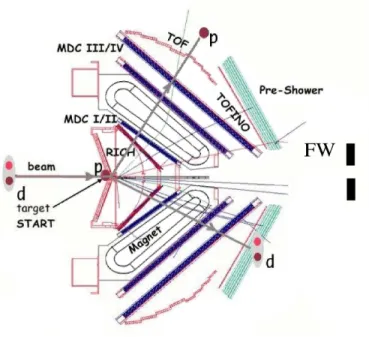
The High Acceptance Di-Electron Spectrometer (HADES) is operated at the GSI Helmholtz-zentrum für Schwerionenforschung in Darmstadt, Germany taking beams from the heavy-ion syn-chrotron SIS18. HADES is a charged-particle detector consisting of a six-coil toroidal magnet centered on the beam axis and six identical detection sections located between the coil and cover-ing polar angles between 18◦ and 85◦. Each sector is equipped with a hadron-blind ring-imaging
Cherenkov (RICH) detector followed by multivare drift chambers (MDCs), two in front and two behind the magnetic field, as well as two scintillator hodoscopes (TOF and Tofino). The lepton identification is provided mostly by the RICH and supplemented at low polar angles with preshower detectors, mounted at the back of apparatus. Hadron identification is based on the time-of-flight and on the energy-loss information from the scintillators and the MDC tracking detector. The schematic view of the HADES spectrometer is presented in Fig. 1. Technical aspects of the detec-tor are described in [36].
PoS(Baldin ISHEPP XXI)040
Figure 1: Cut through two sectors of the HADES spectrometer. The magnet coils are projected onto the cut plane to visualize the toroidal magnetic field. A schematic view of the d p elastic scattering is presented.
In experiment presented here a deuteron beam with a kinetic energy of Td = 2.5GeV and an intensity of about 107 particles/s were directed to a 5 cm long liquid-hydrogen cell with a total areal thickness of 0.35g/cm2. The main goal of this experimental run was the measuring of the
electron-positron pair production properties in np channel at the same beam energy per nucleon as in case of pp run. In order to investigate the np interaction using deuteron beam the HADES setup was upgraded with a Forward Fall(FW) scintillator hodoscope. During this run it was located 7 meters downstream from the target and cowered the angular range from 0.33◦up to 7.17◦.
The momenta of the produced particles were deduced from the hits in the four drift chamber planes (two before and two after the magnetic field zone) using a Runge-Kutta algorithm [36]. The momentum resolution was 2-3% for protons and pions and 1-2% for electrons, depending on momentum and angle [36].
The d p- elastic events were selected using the information about the angle-momentum corre-lations for two detected particles and their experimental time difference.
3. Results and discussion
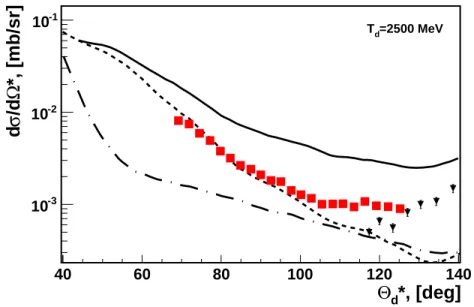
The results on the angular dependence of the d p− elastic cross section at Td= 2.5 GeV
com-pared with the relativistic multiple scattering model calculations [31, 32] using CD-Bonn deuteron wave function [37] are shown in Fig. 2. The HADES data are marked by red squares. Error bars include both the statistical and systematical uncertainties. The dashed line corresponds to the cal-culations taking into account single scattering contributions only. The solid and dash-dotted curves are the results of calculation including the single and double scattering term with and without the principal value part of the three-nucleon free propagator, respectively.
PoS(Baldin ISHEPP XXI)040
Differential cross section of the dp-elastic scattering at 2.5 GeV obtained with HADES P. Kurilkin
*, [deg]
dΘ
40 60 80 100 120 140*, [mb/sr]
Ω
/d
σ
d
-3 10 -2 10 -1 10 =2500 MeV d TFigure 2: The dp-elastic cross section data compared with the relativistic multiple scattering model calcu-lation at 2.5 GeV. The HADES results are shown by the black squares. World pd− elastic scattering data at 1.3 GeV/nucleon [38] are presented by the triangles. The curves are described in the text.
The deviations in the description of the angular dependence of the d p− elastic cross section data and theoretical calculations [31, 32] are observed. The results of the calculation taking into account only the single scattering term underestimate the cross section data, while including the double scattering leads to the experimental data overestimation. World pd− elastic scattering data at 1.3 GeV/nucleon [38] are presented by the triangles.
On the other hand, at high energies and large transverse momenta the constituent counting rules (CCR) [33, 34] are working. They predict a 1/sn−2 dependence of the differential cross section for the binary reaction, where n is the total number of the fundamental constituents involved in the reaction. In the reference [35] it is shown that in hadron interactions with participations of the lightest nuclei 2H,3H and3He the scalling behaviour given by relation above is also occurs, specifically, at a beam energy around 1 GeV if the scattering angle is large enough. A regime corresponding to CCR can occur already at Td= 500 MeV [35].
The results on the energy dependence of the differential cross section in d p- elastic scattering at fixed scattering angles of 90◦, 100◦, 110◦and 122◦in the c.m. are presented in Fig. 3 and Fig. 4.
The HADES data are depicted by the red squares. The world data [27, 38–41] are shown by the open symbols and stars. The lines are the result of the fitting of the world data by the function
∼ s−16. It can be concluded that the d p− elastic cross section data are well follows the scaling
regime ∼ s−16in the angular region 90 − 122◦in the center of mass system. 4. Conclusion
New results on the angular dependence of the differential cross section in the d p− elastic scattering are obtained whith the HADES spectrometer at 2.5 GeV. The angular region of 69 −125◦
PoS(Baldin ISHEPP XXI)040
Figure 3: Differential cross section of d p- elastic scattering at fixed scattering angle of 90◦and 100◦in c.m.s The HADES results are presented by red square. The world data are marked by open symbols. The curves are the predictions of constituent counting rules.
Figure 4: Differential cross section of d p- elastic scattering at fixed scattering angle of 110◦and 122◦in c.m.s The HADES results are presented by red square. The world data are marked by open symbols. The curves are the predictions of constituent counting rules.
in c.m. is covered. The d p− elastic scattering data are compared with the relativistic multiple scattering model calculation using CD-Bonn deuteron wave function. The deviation of the data from theoretical calculations is observed. The behavior of the cross section data at fixed scattering angles in the c.m. is in a satisfactory agreement with the constituent counting rules prediction.
Acknowledgements
We thank Dr. N.B. Ladygina for providing us the results of the relativistic multiple scattering calculations.
PoS(Baldin ISHEPP XXI)040
Differential cross section of the dp-elastic scattering at 2.5 GeV obtained with HADES P. Kurilkin
References
[1] H. Witala et al., Cross Section Minima in Elastic Nd Scattering: Possible Evidence for Three-Nucleon
Force Effects, Phys. Rev. Lett., 81 (1998) 1183.
[2] N. Sakamoto et al., Measurement of the vector and tensor analyzing powers for the d-p elastic
scattering at Ed= 270 MeV, Phys. Lett. B., 367 (1996) 60.
[3] H. Sakai et al., Precise Measurement of dp Elastic Scattering at 270 MeV and Three-Nucleon Force
Effects, Phys. Rev. Lett., 84 (2000) 5288.
[4] K. Sekiguchi et al., Complete set of precise deuteron analyzing powers at intermediate energies:
Comparison with modern nuclear force predictions, Phys. Rev. C., 65 (2002) 034003.
[5] K. Sekiguchi et al., Polarization transfer measurement for1H(~d,~p)2H elastic scattering at 135
MeVâ´L¸Tnucleon and three-nucleon force effects, Phys. Rev. C., 70 (2004) 014001.
[6] R. Bieber et al., Three-Nucleon Force and the Ay Puzzle in Intermediate Energy~p + d and ~d + p Elastic Scattering, Phys. Rev. Lett., 84 (2000) 606.
[7] K. Ermisch et al., Search for Three-Nucleon Force Effects in Analyzing Powers for~pd Elastic
Scattering, Phys. Rev. Lett., 86 (2001) 5862.
[8] K. Ermisch et al., Systematic investigation of three-nucleon force effects in elastic scattering of
polarized protons from deuterons at intermediate energies, Phys. Rev. C, 71 (2005) 064004.
[9] E. Stephan et al., Vector and tensor analyzing powers of elastic deuteron-proton scattering at 130
MeV deuteron beam energy, Phys. Rev. C, 76 (2007) 057001.
[10] H. Mardanpour et al., Precision measurement of vector and tensor analyzing powers in elastic
deuteron-proton scattering, Eur. Phys. J., A31 (2007) 383.
[11] H.R. Amir-Ahmadi et al., Three-nucleon force effects in cross section and spin observables of elastic
deuteron-proton scattering at 90−MeV/nucleon, Phys. Rev. C, 75 (2007) 041001(R)
[12] A. Ramazani-Moghaddam-Arani et al., Elastic proton-deuteron scattering at intermediate energies,
Phys.Rev. C, 78 (2008) 014006.
[13] E.J. Stephenson et al., Indications of three-nucleon force effects in the proton analyzing power for 70 − 200 MeV ~p + d elastic scattering, Phys. Rev. C, 60 (1999) 061001.
[14] R.V. Cadman et al., Evidence for a Three-Nucleon-Force Effect in Proton-Deuteron Elastic
Scattering, Phys. Rev. Lett., 86 (2001) 967.
[15] B.V. Przewoski et al., Analyzing powers and spin correlation coefficients for p+ d elastic scattering
at 135−MeV and 200−MeV, Phys. Rev. C, 74 (2006) 064003.
[16] W. Glöckle, H. Witala, D. Huber, H. Kamada, J. Golak, The three-nucleon continuum: Achievements,
challenges and applications, Phys. Rep., 274 (1996) 107.
[17] S. Coon, M. Scadron, P. McNamee, B.R. Barrett, D. Blatt, B. McKellar, The two-pion-exchange
three-nucleon potential and nuclear matter, Nucl. Phys. A, 317 (1979) 242.
[18] B.S. Pudliner, V.R. Pandharipande, J. Carlson, S.C. Pieper, R.B. Wiringa, Quantum Monte Carlo
calculations of nuclei with A< 7, Phys. Rev. C, 56 (1997) 1720.
[19] S.A. Coon, H.K. Han, Reworking the Tucson-Melbourne Three-Nucleon Potential, Few-Body Syst., 30 (2001) 131.
PoS(Baldin ISHEPP XXI)040
[20] H. Witala, W. Glöckle, J. Golak, A. Nogga, H. Kamada, R. Skibinski, J. Kuros-Zolnierczuk, Ndelastic scattering as a tool to probe properties of 3N forces, Phys. Rev. C, 63 (2001) 024007.
[21] K. Hatanaka et al., Cross section and complete set of proton spin observables in~pd elastic scattering
at 250 MeV, Phys. Rev. C, 66 (2002) 044002.
[22] Y. Maeda et al., Differential cross section and analyzing power measurements for~nd elastic
scattering at 248 MeV, Phys. Rev. C., 76 (2007) 014004.
[23] K. Ermisch et al., Systematic investigation of the elastic proton deuteron differential cross-section at
intermediate-energies, Phys. Rev. C., 68 (2003) 051001(R).
[24] K. Sekiguchi et al., Three nucleon force effects in intermediate energy deuteron analyzing powers for
dp elastic scattering, Phys. Rev. C., 83 (2011) 061001(R).
[25] A. Deltuva, K. Chmielewski, P.U. Sauer, Nucleon-deuteron scattering with∆-isobar excitation: Chebyshev expansion of two-baryon transition matrix, Phys. Rev. C., 67 (2003) 034001.
[26] R.E. Adelberger, C.N. Brown, p − d Elastic Cross Section and Polarization at 198 MeV, Phys. Rev. D, 5 (1972) 2139.
[27] N.E. Booth et al., Proton-Deuteron Elastic Scattering at 1.0 GeV/c, Phys. Rev. D., 4 (1971) 1261. [28] J.C. Alder et al., Elastic pd Scattering at 316, 364, 470, and 590 MeV in the Backward Hemisphere,
Phys. Rev. C, 6 (1972) 2010.
[29] E.T. Boschitz et al., Elastic Scattering of 600-MeV protons from H, D, He − 3, and He − 4, Phys. Rev.
C, 6 (1972) 457.
[30] P.K.Kurilkin et al., Measurement of the vector and tensor analyzing powers for d p-elastic scattering
at 880 MeV, Phys. Lett. B, 715 (2012) 61.
[31] N.B. Ladygina, Deuteron-proton elastic scattering at intermediate energies, Phys. Atom. Nucl., 71 (2008) 2039.
[32] N.B. Ladygina Differential cross section of d p-elastic scattering at intermediate energies, Eur. Phys.
J., A42 (2009) 91.
[33] S.J. Brodsky, G.R. Farrar, Scaling laws at large transverse momentum, Phys. Rev. Lett., 31 (1973) 1153.
[34] V.A. Matveev, R.M. Muradyan and A.N. Tavkhelidze, Automodellism in the large-angle elastic
scattering and structure of hadrons, Lett. Nuovo Cimento, 7 (1973) 719.
[35] Yu.N. Uzikov, Indication of asymptotic scaling in the reactions dd → p3H, dd → n3He, and pd → pd, JETP Lett., 81 (2005) 387.
[36] G.Agakishiev et al., The High-Acceptance Dielectron Spectrometer HADES, (HADES collaboration),
Eur. Phys. J., A41 (2009) 243.
[37] R. Machleidt, High-precision, charge-dependent Bonn nucleon-nucleon potential, Phys. Rev. C, 63 (2001) 024001.
[38] E. Coleman et al., Proton-deuteron elastic scattering at high momentum transfers, Phys.Rev.Lett., 16 (1966) 761.
[39] E. Winkelman et al., Proton deuteron elastic scattering at 800-MeV, Phys.Rev.C., 21 (1980) 2535. [40] G. W. Bennet et al., Proton-deuteron scattering at 1 BeV, Phys.Rev.Lett., 19 (1967) 387.
[41] E. Gulmez et al., Absolute differential cross section measurements for proton-deuteron elastic