A Work Project, presented as part of the requirements for the Award of a Master Degree in Management from the NOVA – School of Business and Economics.
T
ECHNOLOGYA
CCEPTANCE IN THE HEALTHCARE SECTOR"Q
UESTIONNAIREB
ASEDE
VALUATION OFP
ATIENTS´
A
TTITUDESA
CROSSS
CENARIOS"
Julia Ulrike Herzum 25331
A Project carried out on the International Master in Management, under the supervision of: Jose Tavares
D
ISCLAIMERWith this disclaimer, the author, Julia Herzum, declares that the work presented in this master thesis is his own and that only the mentioned references have been used in order to create this master thesis.
The copyright of the thesis resists with the author. He is responsible for the contents. The con-tent of the paper must not be made available to third parties without approval of the author.
P
REFACEThis thesis is the final piece of my Master of Science degree in Management at the Nova School of Business and Economics.
First of all, I would like to express my thanks to Jose Tavares who has supervised and sup-ported me during the project. His valuable advice and comments provided me the feedback I needed to continuously improve my work.
I would like to thank my family for the unconditional support during my studies.
Lisbon, 25.05.2017
A
BSTRACTDue to demographic changes and increasing user expectations, the European healthcare sys-tems are not able to serve the population’s future needs, so innovative technology-based solu-tions must be taken into consideration. However, the efficacy of every technical solution depends on the end-user; therefore, it is key to understand the patients’ digital preferences. For this reason, the objective of this study is to investigate the mindset determining technolo-gy acceptance. Distinctive contextual factors reflected in a range of health scenarios as well as a variety of patient characteristics were included in the analysis. The impact of perceived use-fulness and incentives in form of information and financial rewards were tested.
Keywords: Technology Acceptance within the healthcare system, Internet of Things,
Scenar-io-based analysis, Personal Tracking, Lab-on-a-chip technologies, Online Consulting, Learn-ing Healthcare System, Smart Home.
Table of Content 1 Introduction ... 1 2 Background information ... 3 2.1 Status quo of healthcare system ... 3 2.2 Transformation of the healthcare system ... 4 3 Theoretical substructure ... 5 3.1 Existing research ... 5 3.2 Modelling technology acceptance ... 7 3.3 Research hypotheses ... 8 3.4 Healthcare scenarios ... 10 4 Methodology ... 12 4.1 Empirical strategy ... 12 4.2 Sample description ... 13 5 Results ... 14 5.1 Statistical analysis ... 14 5.1.1 Influence of age as a valid parameter across scenarios ... 15 5.1.2 Scenario 1 – Personal Tracking ... 15 5.1.3 Scenario 2 – Lab-on-a-chip technologies ... 16 5.1.4 Scenario 3 – Online Consultation ... 17 5.1.5 Scenario 4 – Learning Healthcare System ... 18 5.1.6 Scenario 5 – Smart Home ... 19 5.1.7 Data sharing – Scenario 1and 2 ... 20 5.2 Overview of the patients' mindset in a digital healthcare ecosystem ... 20 6 Practical recommendations ... 21 7 Further research ... 23 8 Conclusion and Outlook ... 25 9 Bibliography ... 26 List of figures Figure 1 - Research model: visualization ... 8
Figure 2 - Scenario matrix ... 11
Figure 3 - Distribution of interest ... 15
Figure 4 - Personal Tracking: results ... 15
Figure 5 - Lab-on-a-chip technologies: results ... 16
Figure 6 - Online Consultation: results ... 17
Figure 7 - Learning Healthcare System: results ... 18
1 I
NTRODUCTION“Innovation is the only way to win” (Steve Jobs) The massive global rise of chronic diseases and an extended lifespan have caused an increase in the portion of elders in Europe and worldwide. Thus, a diminishing labour force is required to cover the healthcare costs of the increasing amount of recipients of benefit. Healthcare sys-tems are confronted with significant pressure to reduce costs while improving quality and healthcare service delivery, so that there is an urgent need for restructuring. Although gov-ernments are capable of applying a broad range of policies to control the escalation of costs, it will frequently have unintended consequences in the long term (Report, Dutta, & Lanvin, 2013). Therefore, new innovative solutions are required to win the global challenge of healthcare delivery.
Since information and communication technology (ICT), wireless networks, and sensors are combined, “things” and “data” can be connected (Yin, 2016). With the ability to tag, sense, and control things over the Internet and to make data "smart", an entirely new field of innova-tion has emerged – The Internet of Things (IoT). Considered as a sub-system of "Smart City,"1 an IoT-driven healthcare system allows the connection of all healthcare resources available in society - hospitals, doctors, insurances, and assistive devices - with the patient. Since healthcare activities such as diagnosing and monitoring are feasible with the help of the Internet the following changes are observable: firstly, healthcare services will expand from hospitals to homes. Secondly, an increasing number of residents and remote locations will be served due to the extended access to healthcare. Thirdly, this will result in efficiency gains and cost reductions (Yin, 2016). While taking the digitalization of the healthcare system into account, first of all, processes and productivity gains were focused on which is aligned with Levitt’s hypothesis ‘industrialization of services’.
1 “Smart cities are capable to improving the performance of public services and business infrastructure in the ways that real-time data can be
collected and analysed […]”, so that cities can be managed efficiently and citizens can be provided a higher level of urban mobility (Yin, 2016).
It implies that the usage of technology leads to more efficient production processes, improved quality of services and thus economic success (Ramtohul, 2015). In Germany, the overall economic benefit, generated through e-Health innovations, is estimated to be 12.2 billion Eu-ros. Worldwide, a broad range of start-ups – in absolute numbers around 7,600 – are dedicat-ed to the development of smartphone apps, wearable devices, and digital applications to better manage and measure health (Biesdorf, Deetjen, & Möller, 2016). Since data management within the healthcare sector becomes increasingly more complex, new jobs arise, and the de-mand for more technical specialists, as well as secure servers increases.
Nevertheless, the efficacy of every technical solution depends on the end-user, so that it is key to understand the patients’ digital preferences in both channel and service (Niedermans & Biesdorf, 2014). To make use of digitalized healthcare services, patients need to share their personal health information with multiple players along the healthcare value chain. Although consumers are highly used to sharing data in their daily lives, digitalized healthcare entails a broad range of privacy concerns due to the unique nature of the healthcare context: Firstly, there is the inherent risk of compromising sensitive personal information. Secondly, a high level of emotions according to the medical status is involved, and thirdly the trusted personal patient-doctor relationship seems to be crucial for the healthcare experience (Beckerman et al. 2008, Trumbo et al. 2007, Kluge, 2017). Consequently, reliance plays a significant role in the digital environment and should be considered in the service design of digital health services (Urueña, Hidalgo, & Arenas, 2016).
However, until now, it is still unclear on which technologies and features the investments should be dedicated to achieving the greatest benefits regarding perceived usefulness, user trust, and return on investment (Aue, Biesdorf, & Henke, 2016). Being considered as the centre of the healthcare ecosystem, the patients’ pain points should be examined in different scenarios. While the scenarios reflect the unique care environments, value-adding features can be aligned with future investments (Biesdorf et al., 2016). With the help of a scenario-based
analysis2, the following paper will examine the patient willingness to engage with the future
healthcare models and to disclose medical data. This paper gives background information about the European healthcare system (Chapter 2), to understand the need of altered healthcare services. In particular, it makes assumptions premised on the German healthcare system. Furthermore, the study explains the healthcare scenarios used in the empirical study. It will look into the patient’s mindset by combining various theoretical models (Chapter 3). Based on the empirical analysis (Chapter 4 and 5) managerial implications to develop a digital healthcare ecosystem, will be given (Chapter 6).
2 B
ACKGROUND INFORMATION2.1 Status quo of healthcare system
In the last 15 years, health-expenditure surpassed economic growth in almost all OECD coun-tries. An ever-increasing share of the GDP has been dedicated to the provision of healthcare: in 2013 it amounted to around 6% whereas in 2060 9.5% of the GDP will be required to cover the healthcare needs of the European population (Dutta, Geiger, & Bruno, 2015). A signifi-cant share of costs is caused by the global rise of chronic diseases as well as demographic change. Life expectancy will increase due to advancing cures and treatment possibilities3. Furthermore, by the year 2060, the share of people aged 65+ will increase by 33%, while the working population will shrink to 51%. Considering the costs of healthcare aligned with dif-ferent age groups, the category of persons aged 65 to 84 years consume three times as many healthcare services, as those persons aged between 15 and 64 and oldest group (85+) even seven times as much (Pötzsch & Rößger, 2015). Currently, around 75% of healthcare costs are dedicated to serving the population suffering chronic diseases. As early as in 2020, chron-ic diseases will cause three-quarters of all deaths worldwide (Dutta et al., 2015).
2 The cases of financial transparency tools and electronic payments are excluded from the scenario testing and the subsequent analysis, since
they do not influence the care delivery directly.
3 In Germany, life expectancy will increase from 77,9 years for men and 82,8 for women in 2010 to 86,0 and 90,5 years in 2080, respectively
Additionally, due to the increasing mobility within the European Union, patients want to ac-cess healthcare information and services anywhere and anytime (Hedberg & Morosi, 2015). However, the current European healthcare systems will not be able to cover the future de-mands due to their fragmentations (Anwar, Joshi, & Tan, 2015). The fragmentation is caused by the fact that no single caregiver is able to cover the whole range of care needs and hence various stakeholders are involved. Access to medical information and coordination between caregivers is lacking, so that health services quality, continuity, and costs are impacted on negatively.
2.2 Transformation of the healthcare system
To cover the increasing demands regarding efficiency gains, increased care quality and cost reductions, the fragmented treatment-based healthcare model needs to shift towards an inte-grated, connected, patient-centred and more prevention-based system (Tresp et al., 2016). The two paradigms of “connected” and “integrated” healthcare, which are partially overlap-ping concepts, describe the implications caused by the transformation of the healthcare sys-tem. Considered as a model of patient-centred care, integrated care focuses on the engagement of patients, the coordination of services, and the collaboration of healthcare professionals (Chouvarda, Goulis, Lambrinoudaki, & Maglaveras, 2015).
To deploy an increased level of continuous and patient-centred care, information and medical data need to be available for all stakeholders along the care continuum as well as for the pa-tients themselves. This is feasible through the tools of connected care models, which aim to access, share, and analyse health data more efficiently (Chouvarda et al., 2015). With the use of advanced health information technologies, an enormous amount of data and medical in-formation from various sources such as hospitals, rehabilitation centres, communities, and homes, is gathered and connected. As a consequence, an IoT-based healthcare system can be implemented (Yin, 2016). Since modern information and communication technologies are applied, this type of healthcare is summarized beneath the term e-Health (Albrecht, 2016). To
enhance the efficient information sharing between the stakeholders of the healthcare system, personal information is aimed to be stored in a health cloud platform (see Appendix - Figure 1). Applying data management and data analysis, the right information should be delivered to the right person at the right time (Chouvarda et al., 2015). As a consequence, excessive and unnecessary utilization of healthcare services can be eliminated. For instance, while sharing patient data, overlapping laboratory and radiology tests can be reduced by 24% (Report et al., 2013). Moreover, it is possible to complement the individual digital health with personal-monitored data, since many diseases can be prevented by adopting a healthy lifestyle or at least dammed up by early detection and intervention. To achieve better health and wellbeing, it is inevitable that the patients participate actively in the healthcare processes by self-managing their personal health (Almunawar, Anshari, & Younis, 2015). This is enabled through m-Health, which implies that healthcare services are supported by the usage of mo-bile devices. The provided service can range from smart sensors, smart apps such as fitness tracking apps, to online consultancy. The latter can also be considered as telemedicine since communication technologies are applied to bridge physical distances between caregivers and patients. Besides a reduced rate of doctors’ visits, cost reductions would result from a lower rate of medical errors, more efficient use of diagnostic testing, and drug utilization.
Consequently, a multichannel-based ecosystem will develop, where digital information and services supplement physical health experiences (Niedermans & Biesdorf, 2014). Thus ena-bling a holistic healthcare with more informed treatment decisions and a higher level of guar-anteed patient satisfaction (Anwar et al., 2015).
3
T
HEORETICAL SUBSTRUCTURE3.1 Existing research
To capture the patients’ attitude towards digital health services, multiple studies have been conducted in recent years. In the following, some of the findings which are relevant for this paper will be depicted. Bishop (2005) examined that two-thirds of respondents feel concerned
about the privacy of their electronic health records (EHR). Additionally, Bansal (2010), An-derson and Agarwal (2011) as well as Dinev (2012) verified that privacy concerns have an adverse impact on intentions to disclose health information online. Besides analyzing the pa-tients' trust in EHR, Ermakova (2014) proved that privacy concerns reduce the willingness to share medical data with healthcare professionals within a cloud-computing environment. The data sharing behaviour also depends on the type of information which should be disclosed and to that, Zulman (2011) contributed valuable insights regarding individual preferences about sharing health information. Analyzing the issue at stake from a psychological point of view, Anderson (2011) examined the involved emotions while using digital services.
Examining self-tracking and m-health, Ivanov, Sharman, Rao (2015) explore the use and the data sharing behaviour across the care continuum regarding self-tracking and m-Health. How-ever, the mentioned studies are based on respondents living in Northern America, mainly fo-cussed on the United States. It is assumable, that in Europe the results will show even a higher level of privacy concerns due to greater awareness of privacy and political discussion con-cerning data security(Anderson, 2011). Moreover, the majority of the papers focus on EHR which are only the beginning and substructure of the digital health ecosystem. For this reason, a research gap concerning the following aspects can be discerned:
1) The acceptance behaviour in a different range of scenarios with the same group of re-spondents is currently not tested extensively.
2) A broad spectrum of frameworks and qualitative studies is available; however, a quantified verification involving different health scenarios beyond the usage of EHR and self-tracking is still missing.
3) Since the economic significance of e-Health has increased in recent years, it is neces-sary to include recommendations for stakeholders as well as businesses operating in the field of healthcare.
3.2 Modelling technology acceptance
Since face-to-face interaction between doctors and patients diminishes and medical data is aimed to be stored electronically or in "the cloud," patients are required to disclose an increas-ing amount of personal information. However, sensitive data such as medical health records, augment privacy concerns which can downsize the likelihood of technology adoption.
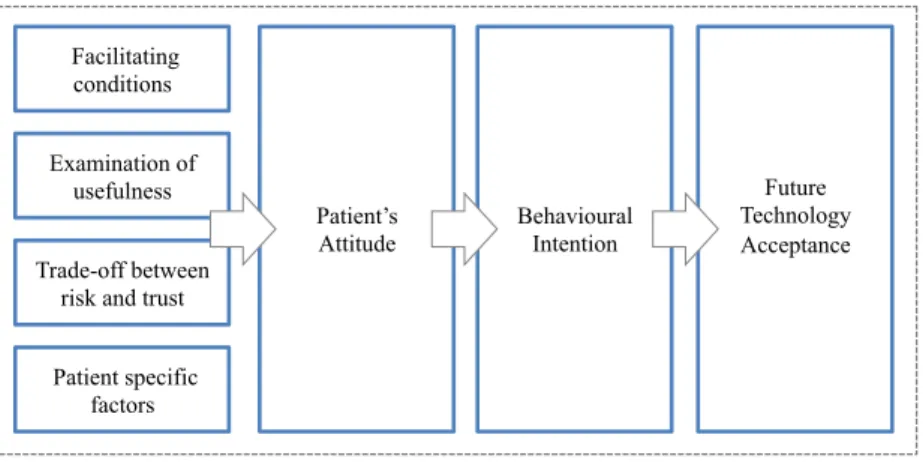
Since every individual perceives ‘privacy' differently and therefore shows distinctive user security behaviour (Anwar et al., 2015), a general framework for examining patients’ mind-sets needs to be developed. Existing models do not depict the overarching complexity of technology trust, adoption and total acceptance, so that this study combines distinctive models to consider a broader range of factors determining the adoption of e-Health services.
The ‘Technology Acceptance Model’ is used for predicting and explaining the end-user reac-tions to health IT (Hsieh, 2016). The behavioural intention to use a determined service is tak-en into consideration because it can be interpreted as a parameter of future technology acceptance. As adoption behaviour is influenced by the attitude developed towards a product or service, the determinates of user adoption need to be analyzed. Usefulness is the primary reason that consumers decide to use and accept information systems and is defined by factors such as increased satisfaction, efficiency, reduced cost, improved quality, or safety of care. Taking social-psychological and behavioural theories like the ‘Expectancy Theory' into ac-count, technology behaviour is a balanced trade-off between risk and trust (Anderson, 2011). Trust is influenced by the users’ confidence in the provider's reliability and integrity, so that the risk to compromise sensitive medical data is reduced. Furthermore, trust in the healthcare stakeholders enhances the perception that a high-quality service is delivered and thus a higher level of satisfaction can be expected (Shin, Lee, & Hwang, 2017). Consequently, trust is inev-itable under conditions of information asymmetry and disclosure of sensitive information (Anderson, 2011). Additionally, the patients’ decision process to use an e-Health service is also determined by facilitating conditions such as monetary incentives (Anderson, 2011).
Moreover, since trust and perceived usefulness, and therefore behavioural intention, are high-ly context-specific and multi-dimensional constructs (Khosrowjerdi, 2016), different healthcare scenarios, concerning users’ acceptance need to be analyzed.
Figure 1 - Research model: visualization 3.3 Research hypotheses
Based on the above theoretical background, the following hypotheses will be examined in the present study (See Appendix - Figure 2):
1. Demographics determine the technology acceptance behaviour.
Since the perception of privacy is individually distinctive, patients need to be examined in their identifying characteristics. Consequently, information about age, gender, educational background and place of residence are considered in the analysis. For instance, it is presuma-ble that senior respondents have more doubts about new technologies and therefore show a lower level of technology acceptance. Knowing the patients’ preferences in depth allows for the development of the right features for the right person group (Ivanov, Sharman, & Rao, 2015).
2. Health status and health literacy, influence the technology acceptance behaviour.
Individuals with a poor perceived health status, are more willing to share their medical data since anxiety about the medical condition and the threat of survival enhances risk seeking behaviour. Besides, health-motivated individuals possess a higher level of health literacy. The patient's knowledge, motivation, and competencies to access, and understand health
Behavioural Intention Facilitating conditions Trade-off between risk and trust Examination of usefulness Patient specific factors Patient’s Attitude Future Technology Acceptance
mation in everyday life, help to prevent diseases (Kim & Xie, 2017). For instance, they are aware of health metrics such as weight, sleep rhythm, sportive activities and the impact of an unhealthy lifestyle. This group of patients is perceived to be more willing to share personal data to maintain and to enhance their good health and well-being (Kim & Xie, 2017).
3. Patients will make use of technology when a certain level of utility is given.
Perceived usefulness of a service includes convenience, ease of use, which is determined by clarity, comprehensibility, timeliness, data security, and the possibility to personalize ser-vices. Moreover, the provided care quality, increased autonomy, improved quality of life as well as to use e-Health services anonymously plays a significant role in the decision-making process (Ramtohul, 2015).
4. Incentives of informative or monetary nature could enhance the technology acceptance. Facilitating conditions like financial incentives or information can be perceived as beneficial. Individuals would oblige themselves to make use of healthcare tools in exchange for infor-mation or monetary rewards. It can also be possible that a combination of these incentives would increase the willingness most effectively (Ward, Bridges & Chitty, 2005).
5. The patients’ data sharing behaviour depends on contextual risk factors, such as the in-tended purpose of information usage and requesting stakeholders.
Multiple players of the healthcare system need to access the medical data to provide the range of e-Health services. Nevertheless, patients predicate their use and health information disclo-sure decision “on their levels of trust, on risk and concern associated with the organization receiving their information” (Rohm & Milne, 2002). Requests from official institutions, like doctors or research institutions, are related to familiarity or high quality, which mean a greater level of trust (McKnight, Choudhury & Kacmar, 2002). Additionally, patients are more reluc-tant, when the receiving stakeholder uses the medical information for profit generating objec-tives (Willison, Schwartz & Abelson, 2007).
3.4 Healthcare scenarios
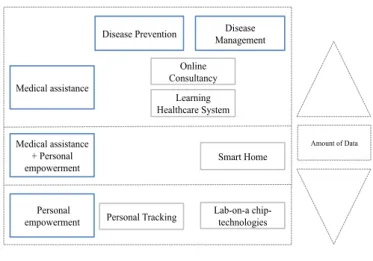
Healthcare services have moved beyond EHR. However, a higher level of smart services re-quires an increasing amount of personal health data, so that the risk of data leakage of sensi-tive data rises. The following scenarios can be categorized in a two-dimensional matrix. Medical assistance and personal empowerment, as well as disease prevention versus disease management need to be taken into consideration.
Personal tracking: The greatest healthcare savings are achievable if the range of chronic con-ditions like diabetes or cardiovascular diseases are prevented. With the help of smartphones connected to sensors, individuals can track and manage a variety of fitness and health parame-ters4. By self-tracking personal data, a healthier lifestyle is accomplished, because patients are empowered to use the physical measurements for goal setting, self-reflection, and motivation (Ivanov et al., 2015). Besides gathering the everyday activities in separate apps, it is possible to collect and to store the data securely in a health cloud. Personal tracked data can extend the doctor’s examination, so that an overall picture and "a lifelong record of our health rather than the episodic snapshots of today" (Dutta et al., 2015) can be created.
Lab-on-a-chip technologies: Besides monitoring and quantifying daily activities and parame-ters, similar tools can be used to manage chronic diseases and to collect medical data outside
Personal empowerment Medical assistance + Personal empowerment Medical assistance Online Consultancy Learning Healthcare System Personal Tracking
Disease Prevention Management Disease
Smart Home
Lab-on-a chip-technologies
Amount of Data
of the clinic5 (Tresp et al., 2016). Monitoring reduces episodes of anxiety since only in case of
an abnormality a smart alarm informs the personal caregiver. As a consequence, the patients need to return to the hospital less often (Dutta et al., 2015). All values are stored in a health cloud so that the accumulation of historical data and the use of intelligent processing will give valuable insights. The lab-on-a-chip technologies could enhance the technology enabled care because patients and caregivers are connected seamlessly and securely. Moreover, patients are empowered to control and maintain their own health (Tresp et al., 2016).
Online Consultation: Another example of digitized healthcare service is online consultancy. Appointment scheduling and prescription are highly prevalent. With the help of e-prescription medication errors are reduced: Healthcare professionals have increased access to patients’ information and past treatments, so that adverse drug reactions, allergies, or redun-dancies can be quickly checked (Report et al., 2013). Also, a photo of damaged skin can help the dermatologist in his diagnosis. As a consequence, the patients save money and time while receiving a more convenient service (Urueña et al., 2016)
Learning healthcare system: The vision of a learning healthcare system is to develop an auto-mated diagnosis system based on a large sample of patients. Since all health parameters such as daily tracking data, vital signs, symptoms, and lifestyle, as well as medical histories are stored in a health cloud, the system assesses the patient individual disease risk. Moreover, lab findings are compared to medical literature and global patients’ data, so that an exact and ho-listic diagnosis, as well as treatment recommendations, can be provided6. Consequently, it is not the doctor who does the examination of the patient’s health status and symptoms, but a learning healthcare system (Tresp et al., 2016).
Smart home: Smart homes are fully equipped with sensors so that seniors are monitored dur-ing their daily lives. A camera examines the patients’ facial expression to detect possible pain,
5
For instance, devices range from "headsets that measure brain activity, chest bands for cardiac monitoring […] remote glucose monitors for diabetes patients to smart diapers to detect urinary tract infections" (Tresp et al., 2016).
6“For a patient with properties and problems X, procedure Y is typically done, but procedure Z will probably result in a better outcome”
depressions or changes in the health status. Wearable bracelets with sensors can detect domes-tic accidents like falling or tumbling. Smart reminders could help them perform simple tasks such as taking their medicine, measuring their blood pressure or checking their heartbeat and respiration (Dutta et al., 2015). In case of an abnormal behaviour or measurement, the system sends a message to a relative, nurse, or doctor. As a consequence, IoT technologies can ame-liorate the quality of life for seniors by simultaneously decreasing social exclusion due to the enhanced possibilities of staying independent for longer (Dutta et al., 2015).
4 M
ETHODOLOGY4.1 Empirical strategy
The empirical approach of the present paper was based on a survey structured in two parts: The first part focused on the patient descriptive variables such as demographics, health status, and health literacy. The second part questioned the intentional behaviour7 presented in hypo-thetical scenarios. Moreover, information about the willingness to share the data with multiple stakeholders, the expected utility of the service as well as incentives aiming to enhance the usage was gathered. The questionnaire provided contextual information on each healthcare scenario; thus it was possible to fill out the questionnaire with a general understanding of the core features. For the first time in the literature, different healthcare scenarios are considered in a single research paper, so that it is possible to make comparisons and overarching practical recommendations to develop a digital health ecosystem.
To develop the survey in a more precise and user relevant manner, a focus group was inter-viewed. Focus groups "are used to identify key themes that will be used to develop items that are included in a survey questionnaire” (Saunders, Lewis, & Thornhill, 2009).
In the present case, the perceived usefulness for each health scenario was discussed, so that a broader range of possible benefits prompting the patient to use the e-Health service could be
listed in the survey. Apart from the focus group, the scenarios were discussed in an expert interview, where a professor for Health and Healthcare Science in Germany, who is also an expert at the Deutsches Institut für Wirtschaftsforschung (DIW) in Berlin, was invited8. To ensure validity and reliability a pilot test with a randomized sample set of 10 respondents was conducted.
4.2 Sample description
Adding to previous studies, which have developed a variety of qualitative and conceptual frameworks, it is now possible to explore technology acceptance with the help of a solid quantitative analysis. Based on the data of 252 respondents the behavioural intention to ac-cept distinctive health scenarios was examined. Therefore, younger patients between 18 and 30 years of age (group 1), and older patients ranging from 50 to 70 years of age (group 2) were asked. 141 and 111 people were distributed in group 1 and group 2, respectively. The age group division was conducted in this particular manner because the patients aged between 50 and 70 will generate spiralling costs due to the following reasons:
Named as baby boomers9 the generation is significantly bigger than the subsequent ones be-cause of the ever since decreasing birth rate. The life expectancy will increase due to advanc-ing cures and treatment possibilities. Besides, healthcare costs advance with an increasadvanc-ing age, so that an aging population will cause cost escalations10.
Furthermore, it will be interesting to compare the technology acceptance between different age groups, since the group of digital natives and the age group who is only partially digital-ized on average, will probably differ in their preferences regarding services and channels of care delivery.
Additionally, the participants were almost equally subdivided regarding gender, so that 129 males and 123 females participated in the survey. Moreover, only patients with a high school
8 As a result of the discussion, the variable “knowledge about personal health metrics” as a parameter for health literacy was added to the
survey.
9 Persons who were born between the years 1946 and 1964. 10 For further information see chapter 2.1.
14
or university degree were asked to fill out the survey, so that the young and senior age group are comparable concerning their educational background.
5 R
ESULTS5.1 Statistical analysis
To examine the different mindsets, that determine the use of the future healthcare services, regressions, conducted in Stata were applied.
The hypotheses were tested in a model, which examined the relationship between general interest (y = depended variable) and demographics (H1), health status and knowledge (H2), utility as well as incentives (H3 and H4), and the data sharing behaviour (H5) (x = independ-ent variable)11. The general interest was depicted on a three-point scale (not interest - moder-ately interest - very interested), so that an ordered probit-regression could be run.
Only 3 – 6% of the participants denied any interest. Most of the responses were concentrated in the categories moderately and very interested. Consequently, it can be stated that every respondent is interested in e-Health services on a certain level. In the case of Online Consult-ing (3) the distribution between moderate and high interest is almost equal so that the re-spondents have a notion what Online Consultation can render in terms of convenient healthcare services. Smart Homes (5) depict a very high interest, so that the drivers of interest need to be examined in depth in the following.
11 See Appendix Figure 3 for the description of the variables.
oprobit Y = α + β ∗x+ … + ɛ
Interest Scenario 1 Scenario 2 Scenario 3 Scenario 4 Scenario 5
No 16 (6.35%) 16 (6.35%) 8 (3.17%) 12 (4,76%) 11 (4.37%) Moderate 139 (55.16%) 147 (58.33%) 128 (50.79%) 173 (68.65%) 107 (42.46%) Very 97 (38.49%) 89 (35.32%) 116 (46.03%) 67 (26.59%) 134 (53.17%) oprobit Y = α + β x+ … + ɛ
5.1.1 Influence of age as a valid parameter across scenarios
Taking the demographic factor age into consideration, it can be observed that an increasing age decreases the interest in all scenarios12. However, even though in the case of Online Con-sultation, the senior respondents are less interested than the young counterpart, a lower nega-tive coefficient in comparison to the other scenarios is detectable (See Appendix - Figure 4). 5.1.2 Scenario 1 – Personal Tracking
Interest Scenario 1 Scenario 2 Scenario 3 Scenario 4 Scenario 5
No 16 (6.35%) 16 (6.35%) 8 (3.17%) 12 (4,76%) 11 (4.37%) Moderate 139 (55.16%) 147 (58.33%) 128 (50.79%) 173 (68.65%) 107 (42.46%) Very 97 (38.49%) 89 (35.32%) 116 (46.03%) 67 (26.59%) 134 (53.17%) oprobit Y = α + β x+ … + ɛ Very interested significant Moderately interested significant Very interested not significant Moderately interested not significant -0,4 -0,3 -0,2 -0,1 0 0,1 0,2 0,3 AgeGroup Gender PlaceofResidence HealthConcerns K_Weight K_SleepingHours K_Steps K_BloodPressure K_Calories No_Knowledge Activity_2 Activity_3 HealthStatus_1 HealthStatus_2 Personal Tracking
moderately interested very interested
Moderately interested significant Very interested significant 15,3 23,6 -0,4 -0,3 -0,2 -0,1 0 0,1 0,2 0,3 AgeGroup Gender PlaceofResidence U_TimeSavings U_CostSavings U_Convenience U_Personalization U_MonitoringImprovement U_SelfMotivation U_CommunityFeeling I_MedicalInformation I_InfoEncryption I_Financial I_BonusSystem Personal Tracking
moderately interested very interested
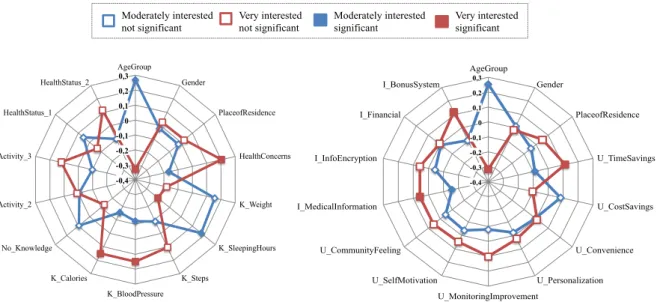
Figure 4 - Personal Tracking: results
Hypothesis 2: Being concerned about the personal well-being and knowing health metrics, such as blood pressure and calories consumed per day, increase the probability of being very interested. Knowing the sleeping hours decreases the interest and needs further research. Hypotheses 3 and 4: Patients are willing to make use of personal tracking tools when time can be saved. This is understandable since tracking tools give a broad overview over the activities pursuit during the day. Being incentivised by receiving medical information about lifestyle, insurance contracts, drugs, and diseases in form of a newsletter enhances the patients’ interest. Additionally, receiving financial benefits offered in a bonus system regarding pharmaceuti-cals and medical devices increase the technology acceptance.
12 Since the interest in a health scenario is depicted on a three-point scale of no, moderate, and high interest, the categories can be ordered in
a continuum of interest. For instance, the senior age group shows a positive coefficient in the category „moderately interested", whereas a negative coefficient is observable regarding the category „very interested". Therefore, it can be concluded that the young age group shows high interest.
5.1.3 Scenario 2 – Lab-on-a-chip technologies -0,4 -0,3 -0,2 -0,1 0 0,1 0,2 0,3 AgeGroup Gender PlaceofResidence HealthConcerns K_Weight K_SleepingHours K_Steps K_BloodPressure K_Calories No_Knowledge Activity_2 Activity_3 HealthStatus_1 HealthStatus_2 Lab-on-a chip-technologies
moderately interested very interested
-0,4 -0,3 -0,2 -0,1 0 0,1 0,2 0,3 AgeGroup Gender PlaceofResidence U_TimeSavings U_CostSavings U_Convenience U_Responsiveness U_PsychologicalStress I_MedicalInformation I_DataEncryption I_Financial I_BonusSystem Lab-on-a chip-technologies
moderately interested very interested
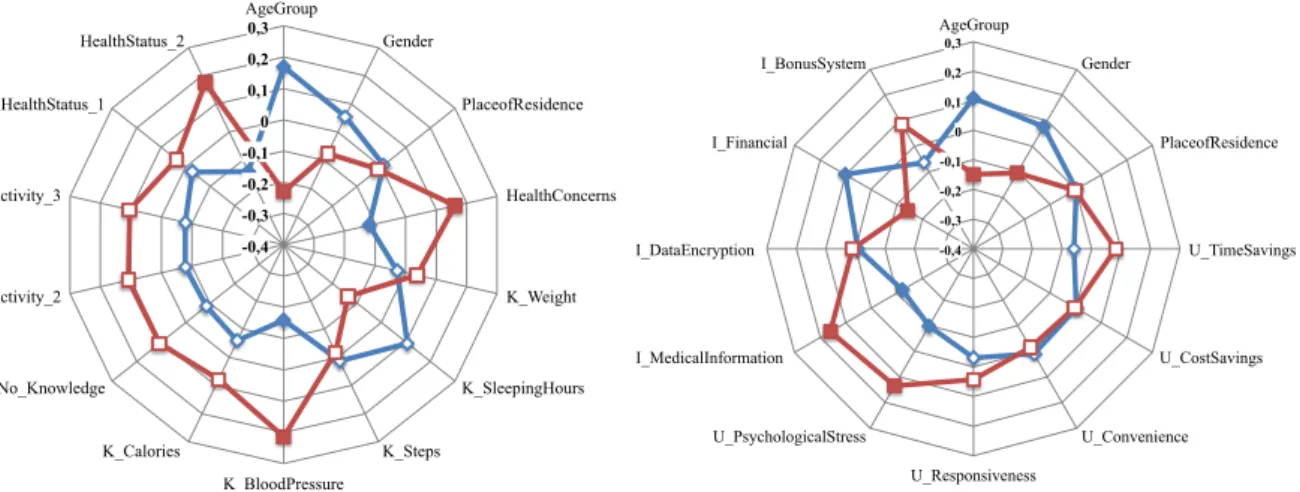
Figure 5 - Lab-on-a-chip technologies: results
Hypothesis 2: Entirely aligned with the aforementioned hypotheses, knowing the personal blood pressure and being concerned about staying healthy are associated with a positive “in-terest-coefficient”. It is possible that respondents, knowing their blood pressure, suffer some health problems. Consequently, using the lab-on-a-chip technology will reduce doctor ap-pointments where cardiac functions are checked. Related to the latter mentioned observation, persons with a poor health status have an increased interested in these technologies.
Hypotheses 1, 3 and 4: Adding the variables of utility and incentives, gender becomes signifi-cant, and male respondents are more interested.
Since, this e-Health service has been developed to monitor vital signs, patients feel attracted due to the reduction of psychological stress. Also the possibility to easily conduct medical tests at home reduces health concerns and discomfort. Receiving medical information increase the technology acceptance. Patients with a potentially decreasing health status are more aware of the importance of information. Having more information about potential cures, medication, and prevention measures empowers the patient to make better decisions. Contrary to the
en-forcing mechanism of information, financial incentives do not influence the interest-level pos-itively13.
5.1.4 Scenario 3 – Online Consultation
-0,4 -0,3 -0,2 -0,1 0 0,1 0,2 0,3 AgeGroup Gender PlaceofResidence HealthConcerns K_Weight K_SleepingHours K_Steps K_BloodPressure K_Calories No_Knowledge Activity_2 Activity_3 HealthStatus_1 HealthStatus_2 Online Consulting
moderately interested very interested
-0,4 -0,3 -0,2 -0,1 0 0,1 0,2 0,3 AgeGroup Gender PlaceofResidence U_TimeSavings U_CostSavings U_Convenience U_Availability U_Anonymity U_Coordination U_Realtionsship I_MedicalInformation I_DataEncryption I_Financial I_BonusSystem Online Consultancy
moderately interested very interested
Figure 6 - Online Consultation: results
Hypothesis 2: Moreover, persons, aware of their cardiac metrics, have a higher interest in Online Consultation. However, it cannot be observed as a relationship between interested and poor health status, so that it is not possible to conclude that the respondents are only interested in a digital consultation because they suffer a disease.
Hypotheses 3 and 4: The patients perceive timesaving as an inevitable factor of utility. Never-theless, the patient’s place of residence does not matter. Even for patients living in metropoli-tan areas, visiting the doctor implies inconvenience and effort in terms of time. Since, while accessing test results or having conference with the physician via digital channels sensitive data is transmitted, the patients are incentivized by more information about data encryption.
13 The scenario description mentioned, that the respondents receive monetary incentives from their insurance companies. Being transparent
regarding daily metrics and therefore facing the possibility of being classified a risk patient, could decrease the interest in financial incen-tives.
5.1.5 Scenario 4 – Learning Healthcare System -0,4 -0,3 -0,2 -0,1 0 0,1 0,2 0,3 AgeGroup Gender PlaceofResidence HealthConcerns K_Weight K_SleepingHours K_Steps K_BloodPressure K_Calories No_Knowledge Activity_2 Activity_3 HealthStatus_1 HealthStatus_2
Learning Healthcare system
moderately interested very interested
-0,4 -0,3 -0,2 -0,1 0 0,1 0,2 0,3 AgeGroup Gender PlaceofResidence U_TimeSavings U_CostSavings U_Convenience U_DiagnosisAccuracy U_ErrorReduction I_MedicalInfromation I_DataEncryption I_Financial I_BonusSystem
Learning Healthcare system
moderately interested very interested
Figure 7 - Learning Healthcare System: results
Hypotheses 1 and 2: Taking the independent variable gender into account, it can be stated that men have a higher interest14. Knowledge of personal blood pressure increases the probability of trusting in data-driven medicine. Furthermore, a person who cares a lot about his health and wellbeing is increasingly willing to make use of the Learning Healthcare System. The observation that the knowledge about steps per day and sleeping hours would impact the in-terest in the scenario seem unrelated and need further research15.
Hypotheses 3 and 4: Human error reduction, as one of the benefits of a learning data system, does not increase the patients’ trust. This answers the question as to whether patients place more value on the personal relationship with the doctor and human interaction than on a sci-entific, exact diagnosis. Furthermore, financial incentives would not persuade the patients to trust in a Learning Healthcare System, which is reflected by the negative coefficient. Howev-er, receiving monetary incentives in form of a bonus system enhances the patients’ willing-ness to accept data-driven diagnoses.
14 This result might be rooted in the fact that, men are stereotypically more affine to technology.
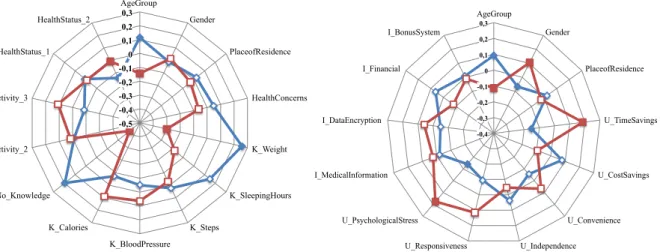
5.1.6 Scenario 5 – Smart Home -0,5 -0,4 -0,3 -0,2 -0,1 0 0,1 0,2 0,3 AgeGroup Gender PlaceofResidence HealthConcerns K_Weight K_SleepingHours K_Steps K_BloodPressure K_Calories No_Knowledge Activity_2 Activity_3 HealthStatus_1 HealthStatus_2 Smart Home
moderately interested very interested
-0,4 -0,3 -0,2 -0,1 0 0,1 0,2 0,3 AgeGroup Gender PlaceofResidence U_TimeSavings U_CostSavings U_Convenience U_Independence U_Responsiveness U_PsychologicalStress I_MedicalInformation I_DataEncryption I_Financial I_BonusSystem
Figure 8 - Smart Home: results
Hypothesis 2: As stated in the theory, ill health increases the patients’ willingness to use e-Health services. Persons with poor health can imagine being in need of assistance in the fu-ture, but living in a Smart Home will enable them to stay independent longer. Having no knowledge about personal health data decreases the probability of imagining living in a Smart Home significantly. The knowledge about weight seems unrelated to the scenario so that fur-ther research needs to be conducted.
Hypotheses 1, 3 and 4: Including the independent variables of utility and incentives, gender also becomes significant: Females show higher likeliness to live in a Smart Home16. Moreo-ver, since women have a higher life expectancy17, they will have to face the situation to live alone after the husbands have died. Smart Homes include monitoring with the help of weara-ble devices and lab-on-a-chip technologies: The patients feel less worried, because in case of an abnormal behaviour or measurement, the system sends a message to a relative, nurse, or doctor. As a consequence, less psychological stress is rated as a key aspect of usefulness. Moreover, timesaving is also one reason to live in a Smart Home, because the patients need to visit the doctor less often due to continuous monitoring.
16 This might be ascribed to the fact that women are more connected to their homes due to evolutionary circumstances as being the person
who cares for others and particularly for themselves.
5.1.7 Data sharing – Scenario 1and 2
Since a digital healthcare ecosystem aims to provide holistic healthcare, it is inevitable that patients share their medical data. Therefore, in scenario 1 and 2 the respondents were explicit-ly asked about their willingness to share their medical information. It has to be pointed out that patients are only willing to share their data with research institutions (See Appendix – Figure 6, 7). Furthermore, and ill health status also enhances the sharing behaviour. Since the respondents are concentrated in the group “moderately interested”, the anticipated benefits do not outweigh the concerns about compromising the personal data. It can be stated that the patients are willing to support the potential success of research with their personal infor-mation. Consequently, patients contribute to a data-driven medicine with the help of their medical information, but, as mentioned before, trusting in the diagnosis of a learning system seems to threaten the trusted patient-doctor-relationship.
5.2 Overview of the patients' mindset in a digital healthcare ecosystem
The empirical results do not support all aspects of the hypotheses, but the following conclu-sions can be made: In what concerns the demographical factors of the sample, age remains significant in all scenarios and senior respondents show a lower interest in the health scenari-os than their young counterparts (H1). Furthermore, it can be stated that a declining health status increases the patients' intention to accept technologies such as Lab-on-a-chip technolo-gies and Smart Homes. This is undoubtedly rooted in the fact that both scenarios are targeting mainly pain points suffered by ill persons. Health concerns, defined as actions like reading about health trends, diseases, healthy nutrition, and sports increases the probability of being very interested in Personal Tracking and Lab-on-a-chip technologies (H2). Knowledge of personal blood pressure enhances the likeliness of accepting the scenarios like Personal Tracking, Lab-on-a-chip technologies, Online Consulting and the Learning Healthcare Sys-tem (H2) (See Appendix - Figure 5). Furthermore, patients value information: information about the encryption methods is highly favoured in the case of Online Consultation. Besides
this, medical information is appreciated while using Personal Tracking and Lab-on-a-chip technologies (H3). Monetary incentives function only as an enforcing mechanism when they are provided in form of a bonus system. This is the case in the scenario of Personal Tracking and Learning Healthcare System. However, it has to be taken into account that financial re-wards are only successful in short term (Galizzi, 2014), since self-motivation to use preven-tion and disease management tools and to receive cost reducpreven-tions in return decreases over the time. It has been observed in the case of Personal Tracking and Lab-on-a-chip technologies, that patients are only willing to share their data with research institutions.
However, in further research it has to be analyzed if the patients are not aware of the benefits the smart technologies can provide or if the hesitating attitude is rooted in concerns of becom-ing increasbecom-ingly transparent. Bearbecom-ing these findbecom-ings in mind, practical recommendations and ideas for further research will be given in the following chapters.
6 P
RACTICAL RECOMMENDATIONSSince the majority of the respondents are concentrated in the interest group “moderately” and “very” interested, it can be stated that almost every patient is aware of current or future healthcare technologies. However, since the digitalization of the healthcare sector is still in its beginnings, it is still unclear on which technologies and features the investments should be dedicated to achieving the greatest benefits regarding perceived usefulness, user trust, and return on investment.
As a first step, the unmet needs of patients, which are already interested in a digital health service and therefore more likely to adapt should be covered. Implementing online consulting on a more sophisticated scale should be the first step, since the general interest is almost equally distributed between "moderately” and “very interested” respondents. Examining the technology acceptance of the senior age group, it is observable that the elderly are more likely to adapt Online Consultancy than other e-Health Scenarios. Consequently, the present study
provides valuable insights, how to deploy e-Health Services aligned with the age-depended interest.
The present analysis shows, that a decrease in health and wellbeing enhances the willingness to use digital services, since patients want to increase their chances of survival. This is espe-cially the case of Lab-on-a-chip technologies and Smart Homes. Since the vision of the future health ecosystem is driven by patient centricity, which helps the patients to manage their dis-ease independently, it is crucial to take pain points aligned with different disdis-eases and health status into account18. The patients' willingness to share data with research institutions will enable the development of new cures and services.
However, the group of moderately interested patients is dominant in the present study and therefore, it is inevitable to familiarize patients with new digital health trends as well as en-hancing credibility, perceived usefulness, and trust.
Since perceived usefulness is critical for the adoption of technological services, healthcare innovation cannot be cost but value driven. Since at the moment in time an unmanageable number of medical apps19 are available in the market, customers have no guidance as to which app is helpful to prevent diseases and to maintain a healthy lifestyle. As a consequence, measures for verification of the usefulness of Personal Tracking Apps is lacking and need to be tackled by national and international health policies. Additionally, when usefulness of cer-tain services is proven20, it is justified that insurance companies take over the costs. This also inhibits the risk that only high-income target groups can afford the costs to use personalized Apps. Consequently, inclusive growth21 and better health can be guaranteed to an entire
popu-lation at a lower cost of care (Dutta et al., 2015).
According to the present study, the patients strive for empowerment concerning information and health knowledge. The option to receive medical information about lifestyle, insurance
18 See analysis: patients with an ill health status are more willing to use e-Health services than persons with no health problems. 19 Between 80.000 and 90.000 Apps are ranked among medical Apps on a global scale (Albrecht, 2016).
contracts, drugs, and diseases in form of a newsletter incentivises the patients. This finding underpins, that the vision of a patient-centred health ecosystem also applies for information: being more informed enables to make better decisions and transmits the feeling of being in control even when facing difficult treatment decisions.
7 F
URTHER RESEARCHAlthough the present study is tackling an existing research gap and provides highly valuable insights within the field of digitized healthcare, ideas and useful directions for future research will be discussed in the following.
Firstly, to further increase the reliability of this study, it is essential to examine the technology acceptance over an extended time period. The trust in new healthcare services is evolving over time since information search processes and acquired knowledge are not static. Accord-ing to Shin, Lee, & Hwang (2017), patients are not sure of the utility of determined services at the beginning. Nevertheless, their initial doubts have transformed into trust at a later stage (Shin et al., 2017). This issue was already examined in the case of EHR and will offer a solid starting point for further research. Consequently, having divided the interest into different groups allows continuing the present study by analysing the moderately interested patients. Thereby, the potential to ‘persuade' and increase the patients’ perceptions of trust can be ex-plored in depth.
Moreover, testing the patients' satisfaction after the use of e-Health services can increase the level of valuable insights. According to the “Expectation Confirmation Theory (ECT), satis-faction is defined as “psychological effect of the cognitive appraisal of expectation-performance discrepancies” (Shin et al., 2017). Consequently, testing the distinctive scenarios in real life situation with prototypes applied in Design Thinking and adopting methods used by UX-designers, will help to create an increased level of patient-centred services.
Additionally, testing the adaptation of services over an extended period of time allows deter-mining, if the adoption behaviour is influenced by emotions caused by an in/decreasing health
status. Previous research emphasized that “even though the probability of realizing a health improvement is lower than the potential privacy risk in disclosing health information” indi-viduals having a severe disease will exploit all possibilities (Anderson, 2011).
Also external shocks like the global Cyber-Attack in May 2017 may alter the patients’ trust in digital health services and should be considered in a time-dynamic analysis.
In order to guarantee comparability between the two age groups, patients with a higher educa-tion were taken into consideraeduca-tion in this analysis. It can be assumed that the present study does not represent the whole range of the society. The young age group, mainly students, are probably well-educated, tech-orientated, as well as digital natives. As a consequence, the pre-sent model can be also applied to other societal groups e.g. handicapped people.
Besides this, the questionnaire did not aim to analyse the technology acceptance behaviour in different countries. Nonetheless, since the answers of every respondent are determined by previous experiences or knowledge made under country-specific circumstances, further re-search can apply the present framework to measure the impact of culturally diverse patient groups.
Lastly, it should be pointed out that the doctor's opinion could play a significant role in the patient's decision-making process since he or she is the trusted person while facing health problems. Due to this fact, the doctors should be studied in subsequent papers. Moreover, also for physicians, the implementation of new healthcare models will change their daily work routines22. Since the healthcare system is characterized by a complex multiplicity of stake-holders, various perspectives need to be taken into consideration in order to approach the challenge of restructuring current healthcare systems and to approach the vision of a digital healthcare ecosystem.
legitima-8 C
ONCLUSION ANDO
UTLOOK"Innovation is the only way to win" is certainly true in the case of the European healthcare system since cost and demographic pressures as well as increasing user expectancies need to be faced in the foreseeable future. The national healthcare systems are mainly perceived as static and from the top ruled constructs.
However, to enable innovation initiatives from outside the traditional health industry must be evaluated and fostered. For a sustainable economic development collaboration between the incumbent and new stakeholders is inevitable. As innovation is based on transformational actions - “doing better things” instead of transactional as “doing things better”(Britnell, 2015) a balanced trade-off between measures driven by efficiency or improvements lead by value creation need to be obtained.
One single health scenario like Online Consultation can be interpreted under two extreme and contradictory perspectives: Under aspects of efficiency it would be ideal that doctors, who speak the language of the patient can carry out the Online Consultation. The allocations and matches between doctors and patients will be executed randomly and with the aim of cost reduction. Visualizing value creation for the patient, healthcare providers would act as con-sultants to help the patients to make sense out of the gathered information. As a consequence the doctors remain the persons of trust when personal consultancy and assistance is needed.
However, the following ethical issues and questions remain and certainly disturb and concern the patients: Will it be obligatory at some point in time, that patient need to share their medi-cal information to be part of the healthcare system? Can an increased level of health and life expectancy while at the same time having lower costs, compensate the fact that humans be-come increasingly more transparent? If everyone can bebe-come healthier due to disease preven-tion tools, will employers only pick the healthiest people based on the examinapreven-tion of historical data?
9 B
IBLIOGRAPHYAlbrecht, U. (2016). Chancen und Risken von Gesundheits-Apps - charisma. Retrieved from http://www.digibib.tu-bs.de/?docid=60004.
Almunawar, M. N., Anshari, M., & Younis, M. Z. (2015). Incorporating customer empowerment in mobile health. Health Policy and Technology, 4(4), 312–319.
Anderson, C. L. (2011). The Digitization of Healthcare : Boundary Risks , Emotion , and Consumer Willingness to Disclose Personal Health Information. INFORMS: Information System Research, 22(3), 469–490.
Anwar, M., Joshi, J., & Tan, J. (2015). Anytime, anywhere access to secure, privacy-aware healthcare services: Issues, approaches and challenges. Health Policy and Technology, 4(4), 299–311.
Aue, G., Biesdorf, S., & Henke, N. (2016). How healthcare systems can become digital-health leaders. McKinsey&Company, Healthcare Systems & Services, (January 2016), 1–5. Beckerman, J. Z., J. Pritts, E. Goplerud, J. C. Leifer, P. A. Borzi, S. Rosenbaum, D. R. Ander-
son. 2008. A delicate balance: Behavioral health, patient privacy, and the need to know. California Healthcare Foundation: Issue Brief.
Biesdorf, S., Deetjen, U., & Möller, M. (2016). Eine Vision für ein digitales Gesundheits - system in Deutschland. McKinsey & Company, (April), 1–13.
Bishop, L, Holmes, B, Kelley, C. (2005). National Consumer Health Privacy Survey 2005. Forrester Research, Inc.
Britnell, M. (2015). Transforming health care takes continuity and consistancy. Harvard Business Review
Chouvarda, I. G., Goulis, D. G., Lambrinoudaki, I., & Maglaveras, N. (2015). Connected health and integrated care: Toward new models for chronic disease management. Maturitas, 82(1), 22–27.
Dinev, T., Hart, P., (2006). An extended privacy calculus model for e-commerce transactions. Inf. Syst. Res. 17 (1), 61–80. Erickson, J., 2012. The Effect of Age Difference
Dutta, S., Geiger, T., & Bruno, L. (2015). The Global Information Technology Report 2015. Ermakova, T, Fabian, B, Zarnekow, R. (2013). Security and Privacy System Requirements for
Adopting Cloud Computing in Healthcare Data Sharing Scenarios. Proceedings of the 19th Americas Conference on Information Systems;12.
Ermakova, T, Fabian, B, Zarnekow, R. (2014). Acceptance of Health Clouds – a Privacy Calculus Perspective. Proceedings of the 22nd European Conference on Information Systems.
Hedberg, A., & Morosi, M. (2015). Keeping health high on the EU agenda: Role for economic governance? EPC Policy Brief (7 May 2015).
Galizzi, M. (2014). What is really behavioural in behavioural health policy? And does it work?. Applied Economic Perspectives and Policy, 36.
Hsieh, P. J. (2016). An empirical investigation of patients’ acceptance and resistance toward the health cloud: The dual factor perspective. Computers in Human Behavior, 63, 959– 969.
Huckman, R.S., Uppaluru M. (2015). The Untapped Potential of Health Care APIs. Harvard Business Review (December 23, 2015)
Ivanov, A., Sharman, R., & Rao, H. R. (2015). Exploring factors impacting sharing health-tracking records. Health Policy and Technology, 4(3), 263–276.
Khosrowjerdi, M. (2016). A review of theory-driven models of trust in the online health context. IFLA Journal, 42(3), 189–206.
Kim, H., & Xie, B. (2017). Health Literacy in the eHealth Era: A Systematic Review of the Literature. Patient Education and Counseling.
Kluge, E.-H. W. (2017). Health Information Professionals in a Global eHealth World: Ethical and legal arguments for the international certification and accreditation of health information professionals. International Journal of Medical Informatics, 97, 261–265. McKnight, D.H., Choudhury, V., Kacmar, C., 2002. Developing and validating trust measures
for e-commerce: an integrative typology. Inf. Syst. Res. 13 (3), 334– 359.
Niedermans, F., & Biesdorf, S. (2014). Healthcare’ s digital future. McKinsey&Company, Healthcare Systems & Services, 8.
Pötzsch, O., Rößger, F., (2015 ). Population by 2060, Results of the 13th coordinated popula-tion projecpopula-tion, Federal Statistical Office, Wiesbaden
Ramtohul, I. (2015). The adoption of e-health services: Comprehensive analysis of the adoption setting from the user’s perspective. Health Policy and Technology, 4(3), 286– 293.
Report, I., Dutta, S., & Lanvin, B. (2013). The Global Information Technology Report 2013 Growth and Jobs in a Hyperconnected World.
Saunders, M., Lewis, P., & Thornhill, A. (2009). Research methods for Business Students Fifth Edition.
Shin, D.-H., Lee, S., & Hwang, Y. (2017). How do credibility and utility play in the user experience of health informatics services? Computers in Human Behavior, 67, 292–302.
Rohm, A. J., G. R. Milne. 2002. Just what the doctor ordered: The role of information sensi-tivity and trust in reducing medical information privacy concern. J. Bus. Res. 57(9) 1000–1011.
Tresp, V., Marc Overhage, J., Bundschus, M., Rabizadeh, S., Fasching, P. A., & Yu, S. (2016). Going Digital: A Survey on Digitalization and Large-Scale Data Analytics in Healthcare. Proceedings of the IEEE, 104(11), 2180–2206.
Trumbo, C.W., K. A. McComas, P. Kannaovakun. (2007). Cancer anxiety and perception of risk in alarmed communities. Risk Anal. 27(2) 337–350.
Urueña, A., Hidalgo, A., & Arenas, Á. E. (2016). Identifying capabilities in innovation projects: Evidences from eHealth. Journal of Business Research, 69(11), 4843–4848. Ward, S., K. Bridges, B. Chitty. (2005). Do incentives matter? An examination of online
priva- cy concerns and willingness to provide personal and financial information. J. Marketing Comm. 11(1) 21–40.
Willison, D. J., L. Schwartz, J. Abelson, C. Charles, M. Swinton, D. Northrup, L. Thabane. (2007). Alternatives to project-specific consent for access to personal information for health research: What is the opinion of the Canadian public? J. Amer. Medical Informat- ics Assoc. 14(6) 527–533
Yin, Y. (2016). The internet of things in healthcare: An overview. Journal of Industrial Information Integration, 1.
Zulman, D.M., Nazi, K.M., Turvey, C.L., Wagner, T.H., Woods, S.S. (2011). Patient Interest in Sharing Personal Health Record Information. Annals of Internal Medicine 2011; 155(12), 805-811.