CIÊNCIAS AGRÁRIAS, ALIMENTARES E VETERINÁRIAS AGRICULTURAL SCIENCES, FOOD AND VETERINARY
CIENCIAS AGRÍCOLAS, ALIMENTOS Y VETERINARIA
mill
e
nium
75
Millenium, 2(3), 75-82.
CARACTERIZAÇÃO FÍSICO-QUÍMICA E SENSORIAL DE DOCES DE FRUTOS DE S. TOMÉ E PRÍNCIPE
PHYSICO-CHEMICAL AND SENSORY CHARACTERIZATION OF FRUIT JAMS OF S. TOMÉ AND PRÍNCIPE
CARACTERIZACIÓN FISICOQUÍMICA Y SENSORIAL DE MERMELADAS DE FRUTAS DE S. TOMÉ Y PRÍNCIPE
Elsa Ramalhosa
1Agostinho V. Sousa
2Luana Fernandes
1,3Teresa Delgado
1,3Maria do Céu Fidalgo
1José A. Pereira
1 1Instituto Politécnico de Bragança, ESA, Centro de Investigação de Montanha (CIMO), Bragança, Portugal
2Instituto Superior Politécnico de São Tomé e Príncipe, São Tomé, São Tomé e Príncipe 3
Universidade do Porto, Faculdade de Farmácia, REQUIMTE, Serviço de Bromatologia e Hidrologia, Porto, Portuga
Elsa Ramalhosa - [email protected] | Agostinho V. Sousa - [email protected] | Luana Fernandes - [email protected] | Teresa Delgado - [email protected] | Maria do Céu Fidalgo - [email protected] | José A. Pereira - [email protected]
Autor Correspondente Elsa Ramalhosa
Instituto Politécnico de Bragança, ESA, Centro de Investigação de Montanha (CIMO), 5300-253 Bragança, Portugal
RECEBIDO: 25 de outubro de 2016 ACEITE: 17 de maio de 2016
Ramalhosa, E., Sousa, A. V., Fernandes, L., Delgado, T., Fidalgo, M. C. & José A. Pereira, J. A. (2017).
Physico-chemical and sensory characterization of fruit jams of S. Tomé and Príncipe. Millenium, 2(3),75-82.m
76
3
RESUMO
Introdução: São Tomé e Príncipe tem uma grande variedade de árvores frutíferas, sendo a maioria dos frutos consumida em fresco. Em certos períodos do ano, os frutos estão disponíveis em quantidades significativas, não sendo comum usar o excedente. Assim, o excedente de frutos pode ser usado na preparação de outros produtos (ex. doces), para aumentar a diversidade de produtos e permitir o consumo anual desses frutos sazonais.
Objetivos: Avaliar as características dos frutos de S. Tomé e Príncipe.
Métodos: Preparação de doces de banana, cajá-manga, goiaba (escura e clara) e mamão, com diferentes teores de açúcar, e posteriormente proceder à sua caracterização físico-química (cor, pH, teor de humidade e acidez) e sensorial, através de testes de preferência e aceitabilidade.
Resultados: Os doces preparados apresentaram diferentes cores e valores de acidez, humidade e cinza, demonstrando a possibilidade de elaboração de diferentes produtos pela modificação da formulação. Quanto à preferência dos doces, 60% dos consumidores preferiram os menos doces no caso da banana e goiaba (clara), enquanto mais de 67% dos participantes preferiram o doce de cajá- manga mais doce. Quanto à goiaba escura e papaia, as percentagens foram semelhantes para ambos os teores de açúcar. Para todos os atributos analisados (aparência, cor, sabor, acidez, doçura e avaliação global), a maioria dos participantes gostou ligeiramente de todos os doces.
Conclusões: A produção de doces em S. Tomé e Príncipe apresenta-se como uma atividade promissora. A qualidade dos atributos analisados deve ser monitorizada, para satisfazer os consumidores.
Palavras-chave: Doces; banana; cajá-manga; goiaba; mamão.
ABSTRACT
Introduction: São Tomé and Príncipe has a wide variety of fruit trees, being most of the fruits consumed in fresh. In certain periods of the year, fruits are available at significant amounts; however, it is not common to use the surplus of those fruits. Thus, this excess may be used in the preparation of other fruit based products (ex. jams), in order to increase product diversity and allow the annual consumption of these seasonal fruits.
Objetives: To evaluate the characteristics of the fruits of S. Tomé and Príncipe.
Methods: Preparation of jams of banana, ambarella, guava (dark and light) and papaya, with two levels of sugar, and perform their physico-chemical characterization (color, pH, moisture and acidity). Furthermore, sensory analysis was also done, through preference and acceptability tests.
Results: The jams prepared had different colours, acidity values, and moisture and ash contents, demonstrating the possibility of producing different products by changing the formulation. Regarding jams preference, 60% of the consumers preferred the less sweet in the case of banana and guava (light), whereas, over 67% of the panellists preferred the sweetest ambarella jam. Concerning dark guava and papaya, the percentages were similar for both sugar contents. For all attributes analysed (appearance, colour, taste, acidity, sweetness and global evaluation), most of the panellists liked slightly all jams.
Conclusion: The production of jams in S. Tomé and Príncipe presents itself as a promising activity. The quality of the attributes analyzed must be monitored to satisfy consumers.
Keywords: Jams; banana; ambarella; guava; papaya.
RESUMEN
Introducción: S. Tomé y Príncipe tiene una gran variedad de árboles frutales, siendo la mayoría de los frutos comidos en fresco. En ciertos períodos del año, los frutos están disponibles en cantidades significativas, no siendo común el uso de los excedentes. Por lo tanto, este excedente se puede utilizar en la preparación de otros productos y permitir el consumo anual de la fruta de temporada.
Objetivos: Evaluar las características de los frutos de Santo Tomé y Príncipe.
Métodos: Preparación de mermelada de plátano, caja-mango, guayaba (clara y oscura) y papaya con distintos contenidos de azúcar, y proceder à su caracterización físico-química (color, pH, contenido de humedad y acidez) y sensorial, a través de pruebas de preferencia y aceptabilidad.
Resultados: Las mermeladas preparadas tenían diferentes colores y valores de acidez, humedad y cenizas, lo que demuestra la posibilidad de producir diferentes productos. En relación à la preferencia de las mermeladas, 60% de los consumidores prefiere la menos dulce en el caso del plátano y guayaba (clara), mientras más del 67% de los participantes prefiere la mermelada de caja-mango más dulce. En cuanto a la guayaba oscura y papaya, los porcentajes fueron similares para ambos niveles de azúcar. Para todos los atributos analizados (aspecto, color, sabor, acidez, dulzor y evaluación global), la mayoría de los participantes les gustó un poco todas las mermeladas.
Ramalhosa, E., Sousa, A. V., Fernandes, L., Delgado, T., Fidalgo, M. C. & José A. Pereira, J. A. (2017). Physico-chemical and sensory characterization of fruit jams of S. Tomé and Príncipe. Millenium, 2(3),75-82.
m
3
77
Conclusións: La producción de mermelades en Santo Tomé y Príncipe se presenta como una actividad prometedora. La calidad de los atributos analizados debe monitorearse para satisfacer a los consumidores.
Palabras Clave: Mermeladas; plátano; caja-mango; guayaba; papaya.
INTRODUCTION
S. Tomé and Príncipe is a small country with two islands, São Tomé and Príncipe, located in Gulf of Guinea. The climate is equatorial type, favourable to the development and production of a wide variety of fruit trees. With rare exceptions, the majority of fruits is of seasonal occurrence and is consumed fresh. Thus, in certain periods of the year fruits are in significant amounts unlike others, where fruit is not available. In S. Tomé and Príncipe it is not common to use the surplus of fruits in the abundance period; however, during this period there is high availability of raw material for preparing other fruit based products (ex. jams) that may increase product diversity and allow the annual consumption of these seasonal fruits.
Among fruits with the highest distribution and importance in S. Tomé and Príncipe, banana (Musa spp.), papaya (Carica papaya), ambarella (Spondias dulcis (syn. Spondias cytherea)) and guava (Psidium guajava) must be highlighted. Ambarella and guava are seasonal fruits, whereas papaya and banana can be eaten at any time of year. So far, some studies conducted in jams and jellies of tropical fruits have already been made. Concerning banana, jellies have been prepared from banana peel (Lee, Yeom, Ha, & Bae, 2010; Borges et al. 2011), due to its richness in pectin. Regarding ambarella, Lago-Vanzela et al. (2011) observed that jelly prepared from skin showed satisfactory acceptance. Relatively to guava, two kinds are found in S. Tomé, namely, dark and light. Guava is usually consumed fresh or in the form of jam, called “goiabada”. Also common are candies, jellies and juices; however, in S. Tomé and Príncipe these forms are uncommon. Regarding guava, there are few studies published on this topic until now. López, Ramírez, & Farinas (2000) characterized guava jams of different batches of three brands sold in Venezuela, finding significant differences between batches of each brand in relation to acidity, total soluble solids, reducing sugars and colour, suggesting a lack of control in the preparation of guava jam. Fernandes et al. (2013) characterized sensorially guava jellies prepared with brown sugar and refined sugar, finding that colour and sweetness are important attributes in the choice of jellies by consumer. Regarding papaya and due to its quick ripening and ability to reduce blood cholesterol, Rajarathnam (2010) suggests the preparation of papaya based products.
Although there are already some studies made in jellies of banana, ambarella and guava, few works have been made on jams of these fruits and no study has been done so far on tropical fruits of S. Tomé and Príncipe. Thus, in the present work we intended to: (i) perform the physico-chemical characterization of four types of tropical fruits, namely, banana, ambarella, guava (dark and light) and papaya of S. Tomé and Príncipe; (ii) prepare fruit jams with different sugar contents; and (iii) characterize them in physico-chemical and organoleptic terms.
1. METHODS
1.1 SampleBanana, ambarella, guava (light and dark) and papaya were harvested at the proper state of maturity in various localities of the district of Mé-Zochi of S. Tomé and Príncipe: 30 ambarellas were collected in Trinity Chapel, 30 light guavas in Bobô Forro, and 30 dark guavas, 10 papaya and 21 bananas in Gramechele at Quinta das Palmeiras. After harvest, the fruits were transported to the laboratory under refrigeration. Upon arrival, the fruits were washed with deionized water and stored under refrigeration (24 hours max.) until analysis. 1.2 Physical characterization of fruits
The axial dimensions of fruits were measured with a calliper and ruler. In ambarella, papaya and guavas, the height and width of fruits were determined. In the case of banana the diameter at the middle of the fruit and length were measured. All fruits were weighed on an analytical balance (Kern, ACJ 220-4M, Germany). Finally, the various constituents of fruits (peel, pulp and seeds) were separated and weighted (with the exception of banana that seeds and pulp were not separated).
1.2 Preparation of the jams
For each type of fruit, two types of jams were prepared, namely: (i) 1 kg of fruit pulp + 600 g of sugar (sucrose); and (ii) 1 kg of pulp + 800 g of sugar, following the requirements of the Portuguese Law-Decree No. 230/2003. After mixing the pulp with sugar, the mixture was let to boil until obtaining a jam with the desired consistency.
1.3 Physico-chemical characterization of the jams
In all jams the following parameters were evaluated: colour, ash, pH, moisture and acidity. The colour was evaluated with a colorimeter Minolta CR-400 (Japan) in the CIELab mode (L*, a* and b* coordinates). L* (lightness) varies between 0 (completely black) to 100 (completely white), a* -60 (green) to +60 (red), and b* -60 (blue) to +60 (yellow). pH was measured directly with a
Ramalhosa, E., Sousa, A. V., Fernandes, L., Delgado, T., Fidalgo, M. C. & José A. Pereira, J. A. (2017).
Physico-chemical and sensory characterization of fruit jams of S. Tomé and Príncipe. Millenium, 2(3),75-82.m
78
3
potentiometer (Jenway, model 370 pH Meter, England). Moisture was determined by weight loss at 105 ºC to constant weight and ash by the AOAC Method 940.26 (AOAC, 1940). Acidity (% citric acid) was determined by titrimetric analysis with NaOH 0.1 M (Eq. 1):
) ( 100 ) 3 / / ) ( ( ) ( ) / ]( [ ) 100 / ( 6 8 7 3 3 g m mol g O H C MM dm v dm mol NaOH sample g g Acid Citric sample (1) 1.4 Sensory analysisIn order to evaluate the preference and acceptance of the jams prepared, a consumers’ panel was used (n=40). The sensory analysis took place in consecutive days, due to the high number of samples. In each day the jams with the two sugar contents of the same fruit were analysed. Each jam was identified with a random number with three digits, being given approximately 15 g to each panellist. The panellists were asked to indicate the preferred jam, following its evaluation in terms of acceptance. A 9-point hedonic scale was used: 1–disliked extremely, 2-disliked very much, 3–disliked moderately, 4–disliked slightly, 5–neither liked nor disliked, 6-liked slightly, 7-liked moderately, 8–liked very much, 9–liked extremely. The attributes evaluated were appearance, colour, taste, acidity, sweetness and overall evaluation.
1.5 Statistical Analysis
Statistical analysis was performed in SPSS (v.19, SPSS Inc., Chicago) software. To evaluate the effect of fruit and sugar ratio on the physico-chemical properties of jams, a two-way ANOVA was carried out to determine if there were significant differences (p < 0.05) between both samples. In the sensory analysis, the nonparametric Wilcoxon-Mann-Whitney test was applied in order to compare the sweetest and less sweet jams of each tropical fruit. In order to evaluate the role of gender on jams preference, the chi-square or Fisher's exact tests were applied.
2 RESULTS AND DISCUSSION
2.1 Physical characterization of fruitsThe axial dimensions and weights of the skin, pulp and seeds of the tropical fruits are described in Table 1. Papaya had the highest weight, followed by banana and ambarella. On contrary, guavas were the lightest fruits. Concerning seeds, ambarella and papaya were the only fruits that had seeds of considerable weight. Regarding axial dimensions, papaya was the fruit that presented the highest values of height and width. In terms of pulp yield, ambarella and dark guava were those that showed the highest values; however, it was found that all fruits showed a pulp yield higher than 70%, demonstrating to be suitable for jams’ formulation.
Table 1 - Physical characterization of the fruits
Fruit Weight [g] Height [mm] Width [mm] Skin Weight [g] Seeds Weight [g] Pulp Weight [g] Pulp yield [%] Ambarella 126.6±15.6 70.0±4.3 55.9±2.6 14.0±2.3 10.3±2.8 102.3±14.2 80.7±2.4 Banana 143.3±34.4 18.3±1.0a 36.4±6.1b 41.6±6.9 - 101.6±28.3 70.6±2.4
Dark Guava 36.7±12.4 41.9±4.6 38.1±4.1 7.5±2.4 Aprox. 3.7 29.2±10.4 79.1±3.6
Light Guava 47.0±12.7 47.0±4.6 42.2±3.9 11.9±2.4 Aprox. 5.2 35.1±10.7 74.0±3.5
Papaya 552.9±178.9 112.5±11.5 98.4±11.7 97.7±24.6 55.5±33.2 399.7±125.6 72.4±2.2
Mean ± Standard Deviation (SD). aThe value refers to fruit length. bThe value refers to fruit diameter measured at the middle.
2.2 Physico-chemical characterization of jams
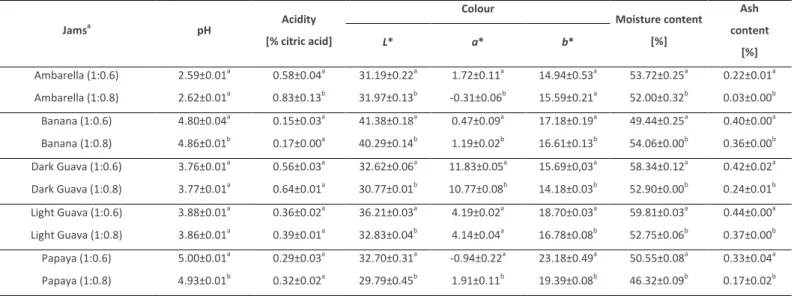
Firstly it was found that the effect of sugar on the physico-chemical parameters analysed was influenced by the fruit used on jam formulation due to the significant interactions observed between the two factors (Table 2). By analysing the different jams prepared (Table 3), ambarella jams presented the lowest pH values (2.59 and 2.62); however, no significant differences were found between jams prepared with the two sugar proportions. On contrary, among the two papaya jams (with the highest pH) significant differences were detected between them. Our pH values were similar to those determined in a dietetic ambarella jam (2.42 to 2.92) (Mamede et al. 2013) and guava jams prepared with sugar (3.80 and 4.02) (Marquina, Araujo, Ruíz, Rodríguez-Malaver, & Vit, 2008; Correa et al. 2011) and sweetener (3.75) (Correa et al. 2011). Conversely, the pH values determined in this work for guava jams were slight higher than the value reported by López et al. (2000) (3.28) when analysing three commercial guava jams. According to Mamede et al. (2013), a pH of 3.2 is a reference value for gel formation and to obtain suitable consistency, since a pH lower than 3.2 will yield a jam with high consistency, whereas a high pH will decrease it. When considering this reference value, it was found that only the ambarella jams showed mean pH values lower than 3.2, explaining
Ramalhosa, E., Sousa, A. V., Fernandes, L., Delgado, T., Fidalgo, M. C. & José A. Pereira, J. A. (2017). Physico-chemical and sensory characterization of fruit jams of S. Tomé and Príncipe. Millenium, 2(3),75-82.
m
3
79
their firmness. On contrary, the banana and papaya jams showed lower consistency due to their high pH. Regarding acidity, no significant differences were found between jams formulated with both sugar contents, with the exception of ambarella. According to Mamede et al. (2013), acidity values greater than 1% will cause syneresis. All jams prepared in our work had lower acidity values than 1%, not being observed this phenomenon. Regarding guava jams, our acidity values were identical to the mean (0.59% of citric acid) determined by López et al. (2000) for three commercial guava jams, but higher than 0.12% determined for guava jams formulated with and without sugar by Correa et al. (2011).
Table 2 – Physico-chemical characterization of the jams.
pH L* a* b* Acidity [% citric acid] Moisture content [%] Ash content [%] Jam Ambarella 2.61±0.03a 31.60±0.46a,b 0.72±1.21b 15.34±0.47ª 0.70±0.18c 52.86±1.02c 0.12±0.11a Banana 4.82±0.05e 40.90±0.64d 0.84±0.41b 16.97±0.35b 0.16±0.03a 51.75±2.67b 0.38±0.03e Dark Guava 3.76±0.02c 31.69±1.05b 11.31±0.64d 14.95±0.87a 0.60±0.05c 55.62±3.14d 0.33±0.10c Light Guava 3.88±0.02d 34.54±1.95c 4.15±0.04c 17.77±1.09c 0.38±0.01b 56.28±4.08e 0.40±0.04e Papaya 4.96±0.04b 31.42±1.60a 0.50±1.56a 21.40±2.37d 0.31±0.03b 48.44±2.44a 0.25±0.10b p-value <0.001 <0.001 <0.001 <0.001 <0.001 <0.001 <0.001 Proportion [Pulp:Sugar] 1:0.6 4.01±0.00 34.86±3.88a 3.49±4.74a 18.05±3.14a 0.39±0.16a 54.37±4.34a 0.36±0.08a 1:0.8 4.01±0.89 33.20±3.91b 3.52±4.10b 16.52±1.80b 0.47±0.25b 51.61±2.87b 0.23±0.13b p-value 0.864 <0.001 0.027 <0.001 <0.001 <0.001 <0.001
Jam × Proportion [Pulp:Sugar]
p-value <0.001 <0.001 <0.001 <0.001 0.006 <0.001 <0.001
Values followed with different letters in each column are significantly different (p < 0.05).
Table 3 – Physico-chemical parameters determined in São Tomé and Príncipe jams produced in the present work.
Jamsa pH Acidity [% citric acid] Colour Moisture content [%] Ash content [%] L* a* b* Ambarella (1:0.6) 2.59±0.01a 0.58±0.04a 31.19±0.22a 1.72±0.11a 14.94±0.53a 53.72±0.25a 0.22±0.01a Ambarella (1:0.8) 2.62±0.01a 0.83±0.13b 31.97±0.13b -0.31±0.06b 15.59±0.21a 52.00±0.32b 0.03±0.00b Banana (1:0.6) 4.80±0.04a 0.15±0.03a 41.38±0.18a 0.47±0.09a 17.18±0.19a 49.44±0.25a 0.40±0.00a Banana (1:0.8) 4.86±0.01b 0.17±0.00a 40.29±0.14b 1.19±0.02b 16.61±0.13b 54.06±0.00b 0.36±0.00b Dark Guava (1:0.6) 3.76±0.01a 0.56±0.03a 32.62±0.06a 11.83±0.05a 15.69±0,03a 58.34±0.12a 0.42±0.02a Dark Guava (1:0.8) 3.77±0.01a 0.64±0.01a 30.77±0.01b 10.77±0.08b 14.18±0.03b 52.90±0.00b 0.24±0.01b Light Guava (1:0.6) 3.88±0.01a 0.36±0.02a 36.21±0.03a 4.19±0.02a 18.70±0.03a 59.81±0.03a 0.44±0.00a Light Guava (1:0.8) 3.86±0.01a 0.39±0.01a 32.83±0.04b 4.14±0.04a 16.78±0.08b 52.75±0.06b 0.37±0.00b Papaya (1:0.6) 5.00±0.01a 0.29±0.03a 32.70±0.31a -0.94±0.22a 23.18±0.49a 50.55±0.08a 0.33±0.04a Papaya (1:0.8) 4.93±0.01b 0.32±0.02a 29.79±0.45b 1.91±0.11b 19.39±0.08b 46.32±0.09b 0.17±0.02b
Mean ±SD. For each jam values followed with different letters in each column are significantly different (p < 0.05). aValues in parentheses indicate the proportion
of pulp and sugar (w:w).
Colour is another important parameter for future acceptability of the product. Banana jams were those that showed the highest L* values (Table 3). With the exception of ambarella, the jams prepared with more sugar consistently reported lower L* values than those prepared with less sugar, due to sugar caramelization and subsequent formation of hydroxymethylfurfural that is an intermediate product, capable of undergoing polymerization and able to produce melanin, compound responsible for the darkening of the product (Mamede et al. 2013). Regarding a* parameter, the ambarella (1:0.8) and papaya (1:0.6) jams showed
Ramalhosa, E., Sousa, A. V., Fernandes, L., Delgado, T., Fidalgo, M. C. & José A. Pereira, J. A. (2017).
Physico-chemical and sensory characterization of fruit jams of S. Tomé and Príncipe. Millenium, 2(3),75-82.m
80
3
negative values, suggesting greenish colour. On contrary, the highest positive values were determined in dark guava, followed by light guava jams, due to their intense reddish colour. Moreover, the light and dark guava jams prepared with less sugar had a* values higher than jams with more sugar, as a result of the greater proportion of pulp present in the former jams. In terms of b*, this parameter was always higher than a* for all jams, indicating the importance of the yellow colour in the jams prepared. The papaya jams had the highest b* values, followed by light guava and banana. Generally, the jams with less amount of sugar (1:0.6) had significantly higher mean values of b* than those prepared with more sugar, due to the yellow colour of the fruit pulps.
The moisture contents varied between jams with different sugar contents, decreasing with sugar content (Table 3). Our values were higher than those reported by Mamede et al. (2013) for ambarella jams (26.27 to 31.98%), but lower to Correa et al. (2011) who determined mean moisture contents of 75.00 and 71.24% for guava jams prepared with and without sugar in their formulation, respectively. Marquina et al. (2008) also obtained lower mean moisture content for guava jams, 23.21%, than ours. Concerning ash content (Table 3), the mineral content decreased with sugar concentration because refined sugar was used in jam formulation, being its mineral content low. Our ash contents were similar to Mamede et al. (2013) for ambarella jams, 0.2 and 0.3%. On contrary, Correa et al. (2011) and Marquina et al. (2008) found higher ash contents of 0.60 and 0.50%, respectively, for guava jams prepared with sugar than ours.
2.3 Sensory analysis
It was observed that the choice of jam by sugar content was not dependent on gender (p > 0.05). When considering the preference of the panellists by one of the two sugar contents of each jam, it was found that for banana and light guava more than 60% of consumers preferred the jams with less sugar (65 and 75%, respectively). On contrary, over 67% of the panellists preferred the sweetest ambarella jam. In the case of dark guava and papaya, the percentages of preference were similar for both jams, with slight preference for the less sweet in the case of dark guava (52%) and for the sweetest in the case of papaya (55%). The results obtained for dark guava jam were similar to those described by Fernandes et al. (2013) for guava jellies prepared with brown sugar and refined sugar, being the less sweet jelly the preferred.
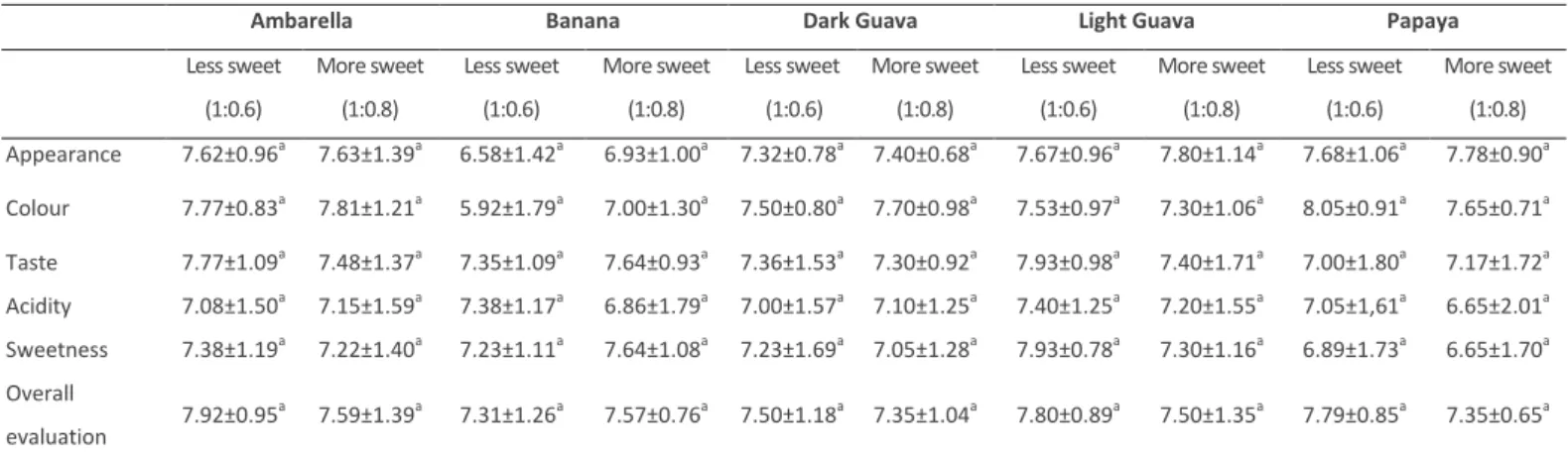
Regarding jams acceptability (Table 4 and Figure 1), no significant differences between both sugar levels for each fruit jam were observed for all parameters analysed. All jams had means greater than 6, indicating that the panellists liked slightly them. In terms of overall evaluation, the mean varied between 7.31 and 7.92, suggesting good future acceptance of these jams by consumers and indicating the potential of tropical fruit jams’ industry in S. Tomé and Príncipe.
Table 4 – Acceptability test of the jams
Mean±SD. For each jam values followed with the same letter in each row do not differ significantly (p > 0.05).
CONCLUSIONS
Our results suggest that the formulation of jams from tropical fruits of S. Tomé and Príncipe can be an excellent option to use the surplus of these fruits, allowing the introduction of jams produced in this country in national and international markets, which is not a common practice. It was found that for banana and light guava the consumers preferred the jams with less sugar, while for ambarella they preferred the sweetest jam. In the case of dark guava and papaya, both jams (with less and more sugar) were accepted almost equally, with slight preference for the less sweet in the case of dark guava and for the sweetest in the case of papaya. Nevertheless, as a suggestion for future work, food safety and product stability issues shall be addressed.
Ambarella Banana Dark Guava Light Guava Papaya
Less sweet (1:0.6) More sweet (1:0.8) Less sweet (1:0.6) More sweet (1:0.8) Less sweet (1:0.6) More sweet (1:0.8) Less sweet (1:0.6) More sweet (1:0.8) Less sweet (1:0.6) More sweet (1:0.8) Appearance 7.62±0.96a 7.63±1.39a 6.58±1.42a 6.93±1.00a 7.32±0.78a 7.40±0.68a 7.67±0.96a 7.80±1.14a 7.68±1.06a 7.78±0.90a Colour 7.77±0.83a 7.81±1.21a 5.92±1.79a 7.00±1.30a 7.50±0.80a 7.70±0.98a 7.53±0.97a 7.30±1.06a 8.05±0.91a 7.65±0.71a Taste 7.77±1.09a 7.48±1.37a 7.35±1.09a 7.64±0.93a 7.36±1.53a 7.30±0.92a 7.93±0.98a 7.40±1.71a 7.00±1.80a 7.17±1.72a Acidity 7.08±1.50a 7.15±1.59a 7.38±1.17a 6.86±1.79a 7.00±1.57a 7.10±1.25a 7.40±1.25a 7.20±1.55a 7.05±1,61a 6.65±2.01a Sweetness 7.38±1.19a 7.22±1.40a 7.23±1.11a 7.64±1.08a 7.23±1.69a 7.05±1.28a 7.93±0.78a 7.30±1.16a 6.89±1.73a 6.65±1.70a Overall evaluation 7.92±0.95 a 7.59±1.39a 7.31±1.26a 7.57±0.76a 7.50±1.18a 7.35±1.04a 7.80±0.89a 7.50±1.35a 7.79±0.85a 7.35±0.65a
Ramalhosa, E., Sousa, A. V., Fernandes, L., Delgado, T., Fidalgo, M. C. & José A. Pereira, J. A. (2017). Physico-chemical and sensory characterization of fruit jams of S. Tomé and Príncipe. Millenium, 2(3),75-82.
m
3
81
Figure 1 – Sensory characteristics of the less sweet (LS) and more sweet (MS) ambarella, banana, dark guava, light guava and papaya jams.
ACKNOWLEDGEMENTS
The authors are grateful to the Foundation for Science and Technology (FCT, Portugal) and FEDER under Programme PT2020 for financial support to CIMO (UID/AGR/00690/2013).
REFERENCES
Association of Official Analytical Chemists (1940). AOAC Official Method 940.26 Ash of Fruits and Fruit Products. Journal of AOAC International, 23, 314.
Borges, S. V., Valente, W. A., Figueiredo, L. P., Dias, M. V., Pereira, P. P., Pereira, A. G. T., & Clemente R. R. (2011). Quality evaluation of banana skin extract jellies. Food Science and Technology International, 17, 177-183.
https://doi.org/10.1177/1082013210381945
Correa, R. C. G., Sora, G. T. S., Haminiuk, C. I. W., Ambrosio-Ugri, M. C. B., Bergamasco, R., & Vieira, A. M. S. (2011).
Physico-chemical and sensorial evaluation of guava jam made without added sugar. Chemical Engineering Transactions, 24, 505-510. http://dx.doi.org/10.3303/CET1124085.
Fernandes, L. G. V., Braga, C. M. P., Kajishima, S., Spoto, M. H. F., Borges, M. T. M. R., & Verruma-Bernardi, M. R. (2013). Caracterização físico-química e sensorial de geleias de goiaba preparadas com açúcar mascavo. Revista Brasileira de Produtos Agroindustriais, 15 (2), 167-172. http://dx.doi.org/10.15871/1517-8595/rbpa.v15n2p167-172
Lago-Vanzela, E. S., Ramin, P., Umsza-Guez, M. A., Santos, G. V., Gomes, E., & Da Silva, R. (2011). Chemical and sensory characteristics of pulp and peel “cajá-manga” (Spondias cytherea Sonn.) jelly. = Caracterização química e sensorial de geléia da casca e polpa de cajá-manga (Spondias cytherea Sonn).Ciência e Tecnologia de Alimentos, 31(2), 398-405. http://dx.doi.org/10.1590/S0101-20612011000200018
Decreto-Lei nº 230/2003. (2013, Setembro 27). Transpõe para a ordem jurídica nacional a Directiva nº 2001/113/CE (EUR-Lex), do Conselho, de 20 de Dezembro, relativa aos doces e geleias de frutos, citrinadas e creme de castanha destinados à alimentação humana. [Portugal]. Diário da República, I (224). pp. 6323-6327. Available at: https://dre.pt/application/file/a/493638.
Lee, E. H., Yeom, H. J., Ha, M. S., & Bae, D. H. (2010). Development of banana peel jelly and its antioxidant and textural properties. Food Science and Biotechnology, 19 (2), 449-455. http://dx.doi.org/10.1007/s10068-010-0063-5.
López, G. R., Ramírez, A. O., & Farinas, L. G. (2000). Evaluación fisicoquimica y microbiológica de tres mermeladas comerciales de guayaba (Psidium guajava L.) = Physicochemical and microbiological evaluation of three commercial guava jams (psidium guajava L.). Archivos Latinoamericanos de Nutrición, 50(3), 291-295.
0 2 4 6 8 10
Appearance
Colour
Taste
Acidity
Sweetness
Overall evaluation
Ambarella (LS) Ambarella (MS) Banana (LS) Banana (MS)
Dark Guava (LS) Dark Guava (MS) Light Guava (LS) Light Guava (MS)
Ramalhosa, E., Sousa, A. V., Fernandes, L., Delgado, T., Fidalgo, M. C. & José A. Pereira, J. A. (2017).
Physico-chemical and sensory characterization of fruit jams of S. Tomé and Príncipe. Millenium, 2(3),75-82.m
82
3
Mamede, M. E. O., Dib de Carvalho, L., Viana, E. S., Alves de Oliveira, L., Soares, W. S. F., & Ritzinger, R. (2013). Production of dietetic jam of umbu-caja (Spondias sp.): physical, physicochemical and sensorial evaluations. Food and Nutrition Sciences, 4, 461-468. http://dx.doi.org/10.4236/fns.2013.44059.
Marquina, V., Araujo, L., Ruíz, J., Rodríguez-Malaver, A., & Vit P. (2008). Composición química y capacidade antioxidante en fruta, pulpa y mermelada de guayaba (Psidium guajava L.). Archivos Latinoamericanos de Nutricion, 58(1), 98-102. Available at: http://www.alanrevista.org/ediciones/2008/1/art-14/.
Rajarathnam, S. (2010). Perspectives of processing papaya (Carica papaya) fruit: national and international strategies. Acta Horticulturae, 851, 547-553. http://dx.doi.org/10.17660/ActaHortic.2010.851.84.