1
The Global Crisis and Intergovernmental Relations: Revisiting the
Centralisation-Decentralisation Debate Ten Years On
Luiz de Mello and João Tovar Jalles1
January 2018 Abstract
There is a growing empirical literature on the effects of the global financial and economic crisis on intergovernmental relations. This paper contributes to this literature by focusing on conventional budgetary aggregates and institutional indicators of subnational authority in policymaking and fiscalfinancial management. The empirical analysis is carried out for a large set of advanced and emergingmarket/developing economies between 1990 and 2015 and shows that the crisis has been associated with an increase in the subnational shares of general government spending and revenue. The findings for subnational authority over policy and fiscal-financial management are more nuanced and suggest that increases in government indebtedness (spending) since the crisis have been associated with greater (weaker) subnational authority. It is possible that the need to deliver debt reductions through medium-term fiscal consolidation calls for greater intergovernmental coordination, which enhances the bargaining power of the subnational jurisdictions to broaden their prerogatives in fiscal matters and influence national policymaking.
Keywords: federalism, decentralisation, intergovernmental relations JEL classification codes: H77, H72, H11,
1. Introduction
The global financial and economic crisis had a marked impact on the public finances, especially in the advanced economies. Public debt levels rose sharply as a result of the implementation of countercyclical stimulus packages, extra-budgetary and below-the-line operations, such as equity injections and troubled asset purchases, as well as the cyclical effects of the contraction in economic activity in the aftermath of the crisis. Indeed, at around 107 percent of GDP in 2016, total public debt ratios are on average still close to 30 percentage points higher than before the crisis among OECD
1 Luiz de Mello is Director at the Economics Department of the OECD, and João Tovar Jalles is a Research Economist at the Research Department of the IMF.
Paper prepared for presentation at the Third International Conference on “Decentralisation after the Great Recession: Fine-Tuning or Paradigm Change?”, Santiago de Compostela, 26-27 October 2017 organized by GEN (University of Vigo). This conference was financially supported by the Spanish Ministry of Science and Innovation (CSO2013-40723-C2-1-R and CSO2013-40723-C2-2-R), AIReF (Independent Authority for Fiscal Responsibility), the University of Vigo and ECOBAS. The authors are indebted to Oriol Roca, Andreas Kyriacou, Pablo Beramendi, Jorge Martinez-Vazquez and Santiago Lago-Peñas for their valuable comments and suggestions. We remain solely responsible for any remaining errors and/or omissions. The views expressed in this paper are the authors’ own and do not necessarily reflect those of the Organisations to which they are affiliated and their member countries.
2
countries. This ratio includes the combined debt of regional and local governments, which almost doubled in relation to GDP to about 10 percent on average over the same period. The emerging-market economies and developing countries fared somewhat better, especially those that took the high-growth years in the run-up to the crisis to reduce vulnerabilities to capital flow reversals through sound macroeconomic and structural reforms.
Importantly, the crisis also had a bearing on intergovernmental relations. In the immediate aftermath of the crisis, counter-cyclical activism included large public investment programmes that were carried out predominantly at the subnational level and financed by the centre through grants and transfers. The post-crisis surge in subnational spending was subsequently reversed as activity began to recover, stimulus was withdrawn, and fiscal consolidation programmes were put in place to restore the longerterm sustainability of the public finances. In addition to these budgetary effects, intergovernmental relations were also impacted by the crisis in several countries as a result of wide-ranging institutional reforms to fiscal-financial management. In the European Union, for example, reforms enhanced the engagement of the subnational governments in national medium-term fiscal consolidation programmes, established binding public debt and/or deficit ceilings applying to both the central government and the subnational jurisdictions, and in some cases introduced restrictions on subnational borrowing.2
Another goal of post-crisis reforms has been to improve the managerial efficiency of the subnational governments to ensure the delivery of cost-effective services to the population at the time of fiscal duress. Reforms included in some cases the consolidation of subnational jurisdictions in recognition of the potential for economies of scale in the delivery of services. Europe offers numerous examples, such the reorganisation of regional governments in Finland, France and Greece. Of course, these reforms were not triggered by the crisis, and in some cases were already under way at the onset of the crisis, but they were in different ways shaped by the need for greater efficiency in intergovernmental fiscal relations against the imperatives of medium-term fiscal consolidation and the challenges posed by secular trends, especially those related to population ageing, which are putting upward pressure on government budgets.
An additional, somewhat overlooked, legacy of the crisis has been a change in the ability of subnational governments to influence national policymaking. In some cases, the need to engage the regional and
2 For analyses of the fiscal impacts of the global financial and economic crisis on subnational governments, see for example, Ter-Minassian and Fedelino (2009) and OECD (2009a, 2009b).
3
local governments in nationwide fiscal consolidation programmes -- and to secure their political support for reform -- has actually empowered the subnational jurisdictions in the policy arena, given them a stronger voice in intergovernmental policy fora. In other words, the opportunity posed by the needed post-crisis policy reform enhanced the bargaining power of the subnational governments in national policymaking. In some cases, subnational governments used this enhanced bargaining power to enhance their autonomy in policymaking and fiscal-financial matters.
Against this background, the objective of this paper is to revisit the empirical evidence of the effects of the crisis on intergovernmental fiscal relations. Two broad classes of indicators will be used, including first a range of metrics for the composition of expenditure, including those financed by intergovernmental grants and transfers, as well as revenue across the different levels of administration. These indicators based on budgetary aggregates are conventional gauges of fiscal decentralisation and proxy for the otherwise unmeasured assignment of expenditure and revenue functions across the different layers of government. To complement the fiscal decentralisation metrics, a second batch of indicators will be used to describe the institutional underpinnings of intergovernmental relations, including the prerogatives granted to the subnational governments in policymaking and fiscal-financial management. Measures of subnational influence in national policy, including in fiscal-financial management, will also be considered.
As recognised frequently in the empirical literature, the fiscal decentralisation indicators reflect only imperfectly the autonomy enjoyed by subnational governments in policymaking. They need to be complemented by other indicators that reflect the formal authority of subnational governments in matters related to policy and management. While the fiscal decentralisation indicators are available for relatively long time series for large sets of countries from sources such as the IMF’s Government Financial Statistics, the OECD’s Regional Dataset, the Eurostat and other organisations, there is a relative dearth of quantitative indicators of authority that cover a broad range of policy and managerial aspects of intergovernmental relations and exhibit sufficient time series variation to be used meaningfully in empirical analysis. A data set that meets these criteria is that of Hooghe et al. (2010, 2016), which covers a variety of advanced and emerging-market economies, as well as developing countries, over a long time span of several decades.
The key hypothesis to be tested is whether or not the crisis has been a trigger or catalyst for reform in intergovernmental relations. The empirical analysis will be based on panel regressions of the full spectrum of decentralisation indicators described above on a range of decentralisation drivers, while controlling for country and time effects. The effects of the crisis will be assessed essentially by
4
interacting the right hand-side variables of interest with an indicator that identifies the post-crisis years. Comparison of the pre- and post-crisis parameter estimates for the variables of interest will shed light on the mechanisms through which the crisis has affected intergovernmental relations in the countries included in the panels.
The main findings of the paper can be summarized as follows. First, the crisis seems to have had a decentralising effect on the public finances, at least as far as measured by conventional budgetary aggregates. In other words, increases in general government spending and debt ratios have been associated with higher subnational shares in spending and revenue collection since the crisis. To a large extent, this effect is shaped by the role of subnational governments in the execution of stimulus programmes that were implemented in the immediate aftermath of the crisis and financed by the centre in the form of intergovernmental grants and transfers, as noted above. Subnational governments already account for about 60 percent of general government investment on average world-wide according to the OECD, and they accounted for the bulk of the public works programmes that were put in place in the aftermath of the crisis.
Second, more nuanced findings emerge from the analysis of the effects of the crisis on the institutional indicators of subnational authority in policymaking and fiscal-financial management. While increases in general government spending after the crisis appear to have reduced subnational authority across a range of self- and shared-rule prerogatives, the converse is true for increases in general government indebtedness. The exact mechanisms through which these effects take place have yet to be assessed empirically, but it can be argued that the need to deliver debt reduction through medium-term fiscal consolidation requires a concerted effort among the different spheres of government. In some cases, better intergovernmental policy coordination has been pursued to muster support for adjustment. In others, and depending on specific conditions and context, the subnational governments may have strengthened their bargaining power to negotiate amongst themselves and with the central government greater authority in matters for which they have sole responsibility, as well as their ability to influence national policymaking.
Motivation for the analysis reported in this paper comes from different sources. First, the crisis has rekindled interest in comparative federalism and the economic effects of a protracted period of economic and fiscal duress on reform of intergovernmental fiscal relations around the world. Case studies have been used to describe the institutional changes that have been brought about by the crisis, although in many cases the crisis can be argued to have catalysed reforms that had already been in course (Kincaid et al. 2010; Eccleston and Trevor, 2017). Second, and in part as a result of this
5
renewed interest, the efforts that have been put over the years to develop indicators and collect data on different aspects of intergovernmental relations now allow for a much finer analysis of the causes and consequences of institutional reform from a cross-country perspective. Given the remaining methodological limitations of this strand of empirical work, such the ability of the researcher to take account of all the relevant cross-country heterogeneity of causal mechanisms, context and institutions, as well as channels of transmission, the analysis can only complement the wealth of information that can reported in country-specific case studies.
The remainder of paper is organised as follows. The next section describes the empirical analysis, the estimating strategy, the range of decentralisation indicators used and the source of data. The baseline results are reported in Section 3 for the three categories of indicators: fiscal decentralisation, authority of subnational governments and composition of government expenditure across levels of administration. Sensitivity analysis and robustness checks are also reported. A broader discussion of the empirical results and conclusions is presented in Section 4.
2. Empirical analysis
Estimating strategy: gauging the effects of the crisis
The effects of the crisis can be gauged by regressing the full range of indicators measuring different aspects of intergovernmental relations on a set of variables capturing the key drivers of reform and interactions of these variables with an indicator that takes the value of 0 for the pre-crisis years (before 2007) and 1, otherwise. In particular, the baseline regressions, estimated by OLS, can be defined as follows:
𝐷𝐷𝑖𝑖𝑖𝑖 = 𝑎𝑎0 + 𝑎𝑎1𝑋𝑋𝑖𝑖𝑖𝑖(𝐼𝐼 + 𝜙𝜙𝑖𝑖𝑖𝑖)+𝑎𝑎2𝑅𝑅𝑖𝑖𝑖𝑖 + 𝑢𝑢𝑖𝑖𝑖𝑖 (1)
where D is an indicator capturing a given aspect of intergovernmental relations; X is a vector of relevant drivers of reform in intergovernmental relations; R is a set of controls, including country and time effects (the first are included to control for unobserved cross-country heterogeneity, while the second are included to control for global shocks); 𝜙𝜙𝑖𝑖𝑖𝑖is an indicator taking the value of 0 for the pre-crisis country-years, and 1 otherwise; I is an identity vector; and 𝑢𝑢𝑖𝑖𝑖𝑖 is an error term satisfying usual assumptions of zero mean and constant variance. Countries and years are identified by subscripts i and t, respectively.
6
The aspects of intergovernmental relations (denoted by indicator D) are of three types:3
- Composition of revenue and expenditure across the spheres of government. In this case, D is a continuous variable defined either as the inverse of the ratio of the central government share of expenditure over the share of general government expenditure (expenditure decentralisation) or the ratio of local expenditures financed with local revenues (revenue decentralisation). Data are available from Sow and Razafimahefa (2017) and cover 64 OECD and non-OECD countries over the period 1990 to 2012.4
- Functional composition of government spending and revenue. These indicators are based on the classification of the main budgetary aggregates from a functional viewpoint. They are defined as the share of subnational (middle-tier and local) governments in total general government spending and revenue by function. Emphasis is placed on total spending and revenue, tax and social security revenue, as well as outlays on economic affairs, health care, education and social protection. These revenue and spending functions account for the lion’s share of subnational budgets in most countries. Data are available from the IMF’s Government Finance Statistics database and include an updated version (up to 2015) of the work by Dziobek et al. (2011), which covered about 80 countries over a period of close to 20 years (1990-2008).5
- Subnational authority in policymaking and fiscal-financial management. These indicators are related to changes in the assignment of policymaking authority and responsibilities across the different levels of administration, the executive and law-making prerogatives of the subnational governments, as well as inter-jurisdictional coordination mechanisms. Data are available from Hooghe et al. (2016) and cover 81 countries over the period 1950-2010.
The key indicators measure two broad aspects of subnational authority: self- and shared rule. The self-rule indicators are based on the policy, fiscal-financial and representation autonomy
3 In the appendix we present for each data source the list of countries covered as well as summary statistics and correlation matrices amongst the different variables used.
4 Data were collected mostly from the IMF’s Government Finance Statistics and World Economic Outlook databases, the World Bank’s World Development Indicators, as well as Eurostat and OECD databases.
5 We thank the authors for kindly sharing their data.
7
of the subnational governments within their own jurisdictional borders. They include the institutional autonomy (depth) of regional governments (measured on a 0-3 scale with increasing level of authority), their policy scope (or range of policies under regional government authority, measured on a 0-4 scale with increasing breadth of policy areas, including economic affairs, education and welfare, etc.), their fiscal autonomy (measured on a 0-4 scale of increasing regional autonomy to set tax bases and rates), and their borrowing autonomy (measured on a 0-3 scale of decreasing central government control over subnational borrowing), and their representation independence (measure on a 0-4 scale identifying the existence of an independent executive branch and a legislature at the subnational level).
The shared-rule indicators measure the extent of joint prerogatives of subnational governments based on their capacity to influence national legislation and policy. They include the ability of the subnational governments to influence national legislation (law-making, measured on a 0-2 scale of increasing level of law-making co-determination between subnational and national governments) and co-set national policy in intergovernmental fora (executive control, measured on a 0-2 scale of increasing ability), the distribution of national tax revenue (fiscal control, measured on a 0-2 scale of increasing ability), subnational and national borrowing constraints (borrowing control, measured on a 0-2 scale of increasing ability), and constitutional change (constitution reform, measured on a 0-4 scale of increasing ability). These individual indicators are also used to construct composite indicators of self and shared rule, as well as an aggregate Regional Authority Index.
Of course, while the fiscal decentralisation indicators provide useful information on the budgetary resources that are available to the subnational governments, their spending commitments and financial obligations, they do not necessarily reflect the policymaking or managerial authority enjoyed by the subnational jurisdictions. This authority goes beyond matters related to the public finances – tax and spending powers as well as financial management – and includes the fiscal, financial, policy, representational and constitutional arrangements at the subnational level, such as the structure of their executive and legislative branches; the range of shared responsibilities among the different spheres of government and administration; and the ability of the subnational governments to influence national policy.
While alternative indicators are available to measure subnational autonomy in tax policy, essentially by weighing tax revenue ratios by some measure of subnational tax policy autonomy (Stegarescu, 2005; Blöchliger and King, 2006), a broader gauge of subnational authority, such as those available
8
from Hooghe et al. (2016) is particularly useful in the empirical assessment of the effects of the crisis, given the breadth of effects associated with policy responses and accompanying institutional reform. Indeed, a precursor to these more recent measurement efforts is Kearney (1999), whose decentralisation index include several aspects of subnational autonomy, such as government structure, executive selection and central veto power, in additional to revenue and spending authority.
Another advantage of the subnational authority indicators used in our empirical analysis is their time series and cross-sectional coverage and variation, which is far greater than that of indicators based on constitutional parameters, such as that of Elazar (1987). The indicators therefore allow for a finer analysis of incremental institutional change, rather than radical constitutional reforms. Indeed, a lack of time series variability in the indicators has posed serious obstacles to sound empirical analyses on the drivers and effects of decentralisation, which explains the emphasis that has been put in the literature on fiscal indicators based on higher-frequency budgetary data.6
All in all, these indicators describe longer-term trends that were in motion before the crisis. For example, both the fiscal decentralisation and subnational authority indicators point to a gradual process of decentralisation around the world, regardless of the countries’ level of economic development. Decentralisation started earlier in most advanced economies and gathered momentum in Latin America in the 1980s, chiefly as a result of democratisation, and later in the Asia-Pacific region. Major democratic transitions have indeed been key drivers of decentralisation.7 The literature on comparative federalism based on constitutional provisions also documents a trend towards greater decentralisation over the years leading up to the crisis (OECD and KIPF, 2016). There is indeed a shift to the right in the distributions of two selected fiscal Decentralisation indicators (one for expenditures and one for revenues) between 1990 and 2012, suggesting increased Decentralisation (Figure 1).
6 The coverage of both indicators differs in that the Hooghe et al. (2016) indicators exclude local governments, or jurisdictions with less than 150 thousand inhabitants, whereas the fiscal decentralisation indicators include both middle-tier and local governments.
7 See for example the analysis reported by Jametti and Joanis (2009) based on the IMF’s Government Finance Statistics database, OECD and KIPF (2016) based on OECD data.
9
Figure 1. Kernel Densities of selected Fiscal Decentralisation Indicators
Note: These estimates were generated with an Epanechnikov kernel and a band-width proportional to the sample size raised to the power -2.
Source: Authors’ estimations.
The right hand-side variables of interest in our empirical analysis are the conventional determinants of decentralisation, such as the country’s stage of economic development (measured by the level of real per capita GDP), the level of total public debt and expenditure (both defined in relation to GDP), as well as a host of control variables, including proxies for macroeconomic imbalances (the rate of CPI inflation, the rate of growth of real GDP and the rate of unemployment), external imbalances (the terms of trade and trade openness, defined as the ratio of imports plus exports over GDP), and a measure of long-term expenditure pressures (the age dependency ratio).
Moreover, we control for broader institutional characteristics by including in the regressions two variables from the Database of Political Institutions (which cover 180 countries between 1975 and 2015): stability, and checks and balances. These indicators proxy for the presence of well-functioning institutions and their quality, over and above those related to intergovernmental relations. More specifically, “checks and balances” measure the number of veto players in a political system, adjusting for whether or not these veto players are independent of each other, as determined by the level of electoral competitiveness in a system, their respective party affiliations and the electoral rules (the original variable is constructed on a 0-18 scale in ascending order of strength of check and balances).8
8 Countries where legislatures are not competitively elected are considered countries where only the executive wields a check.
10
The “stability” indicator measures the percentage of veto players who drop from the government in any given year.9
3. Baseline results
Fiscal decentralisation indicators: a focus on the public finances
The baseline results are reported in Table 1 for the fiscal decentralisation indicators, which capture the composition of expenditure, revenue and intergovernmental transfers among the different levels of administration. The indicators are constructed in ascending order, such that an increase in the indicator denotes a rise in the subnational shares of expenditure and revenue. All regressions are estimated by OLS and include both country and time fixed effects.
The parameter estimates show that higher-spending countries tend to be less decentralised, a feature of the public finances that has been mitigated at least in part by the crisis. The finding applies to all three decentralisation indicators: expenditure, revenue and intergovernmental transfers. In addition, more indebted countries also tend to be less decentralised, at least as far as the expenditure decentralisation indicator is concerned, a finding that does not seem to have been affected by the crisis.
The controls are signed as follows: macroeconomic imbalances are associated with less decentralisation (inflation and unemployment), economic development matters (richer countries are less decentralised),10 and countries that are more open to trade also tend to be less decentralised,11 as well as those with a higher age dependency ratio and better institutions. The baseline results are also robust to the omission of time effects and alternative combinations of the set of control variables.
Table 1. Baseline Results: Fiscal Decentralisation Indicators
Specifications (1) (2) (3) (4) (5) (6)
9 Readers should refer to the codebook available at https://publications.iadb.org/handle/11319/7408 for further details.
10 Recent evidence on the links between economic development and decentralisation include Panizza (1999) and Arzaghi and Henderson (2005). Both studies focus on expenditure centralisation and find that income (as well as land area) is negatively associated with centralisation.
11 Stegarescu (2009) uses OECD data to assess the effect of economic and political integration on decentralisation and finds that trade openness is associated with a higher degree of decentralisation.
11
Dependent Variables Subnational share of spending Subnational share of revenue Subnational share of transfers Subnational share of spending Subnational share of revenue Subnational share of transfers Inflation rate -0.220*** -0.149*** -0.094** -0.208*** -0.137** -0.088** (0.073) (0.054) (0.040) (0.074) (0.054) (0.038) Real GDP growth 0.009 -0.010 -0.059 0.023 0.005 -0.040 (0.092) (0.053) (0.061) (0.092) (0.052) (0.059) Real GDP per capita -0.138*** -0.128*** -0.136*** -0.131*** -0.121*** -0.126***
(0.027) (0.021) (0.025) (0.028) (0.022) (0.025) Total Expenditures -0.288*** -0.153*** -0.158*** -0.277*** -0.139*** -0.144*** (0.070) (0.051) (0.052) (0.071) (0.051) (0.052) Public Debt -0.040* 0.005 0.016 -0.042* 0.002 0.013 (0.021) (0.012) (0.012) (0.021) (0.012) (0.012) Inflation rate*postgfc 0.239*** 0.160** 0.125* 0.229*** 0.152** 0.121* (0.082) (0.063) (0.070) (0.083) (0.063) (0.070) Real GDP growth*postgfc -0.161 -0.041 -0.084 -0.182 -0.057 -0.098 (0.128) (0.087) (0.089) (0.127) (0.083) (0.087) Real GDP per capita*postgfc -0.002 -0.001 -0.002 -0.002 -0.001 -0.002 (0.002) (0.001) (0.001) (0.002) (0.001) (0.001) Total Expenditures*postgfc 0.254*** 0.113*** 0.073*** 0.253*** 0.112*** 0.072*** (0.080) (0.035) (0.026) (0.081) (0.035) (0.026) Public Debt*postgfc -0.026 -0.009 0.011 -0.025 -0.009 0.012 (0.017) (0.011) (0.007) (0.017) (0.010) (0.007) Trade openness -0.000** -0.000** -0.000 -0.000** -0.000** -0.000 (0.000) (0.000) (0.000) (0.000) (0.000) (0.000) Unemployment rate -0.002*** -0.001** -0.002* -0.002*** -0.001* -0.001 (0.001) (0.001) (0.001) (0.001) (0.001) (0.001) Age dependency ratio -0.002*** -0.002*** -0.003*** -0.002*** -0.002*** -0.003***
(0.000) (0.000) (0.000) (0.000) (0.000) (0.000) Checks and balances -0.002 -0.001 -0.002**
(0.001) (0.001) (0.001) Stability -0.010* -0.006 -0.002 (0.005) (0.004) (0.004) Constant -0.644** -0.703*** -0.831*** -0.585** -0.643*** -0.759*** (0.260) (0.209) (0.233) (0.267) (0.213) (0.237) Observations 898 928 972 901 933 977 R-squared 0.949 0.975 0.977 0.950 0.975 0.977
Note: Estimation of Equation (1) by OLS. Time and country fixed effects included but omitted for reasons of parsimony. Robust standard errors clustered at the country level in parenthesis. *, **, *** denote statistical significance at the 10, 5 and 1 percent levels, respectively.
Source: Authors’ estimations.
The baseline findings are not surprising. The large stimulus packages that were put in place in the aftermath of the crisis, especially in the advanced economies, were carried out to a large extent by the subnational governments and financed predominantly through central government grants and
12
transfers.12 This has led to an increase in both the subnational spending and revenue shares in the aftermath of the crisis, a trend that was subsequently reversed as the stimulus packages were withdrawn and central government grants and transfers were pared back. In this respect, the effects of the crisis on the subnational budgets reflect the role that the subnational governments played as agents of the central government in the post-crisis stabilisation efforts. This is, of course, over and above the direct effects of the crisis on the subnational finances, which took place through several different channels, including a cyclical contraction in their own revenue base, a reduction in compliance by liquidity-constrained taxpayers, increases in cyclically-sensitive spending (such as unemployment benefits and social assistance transfers, which in many countries are executed at the subnational level of government), and in some cases pressure to assist troubled state-owned or controlled enterprises, as well as (potentially large) losses in financial investments.
To be sure about the econometric specification, we tested for residual autocorrelation using the Wooldridge (2002) test and could not reject the null of no serial correlation in the residuals of the baseline specifications (with a p-value in excess of 20 percent). We also experimented with a variety of indicators of heterogeneity of the population, which is another driver of decentralisation that may not be fully captured by the fixed effects, leading to omitted variable biases. We included the
language, ethnic and religious fragmentation measures available from Alesina et al. (2003) and found them to be statistically significant at classical levels in the baseline regressions (results available upon request), but these indicators are time-invariant and were therefore omitted from the baseline specification. We also experimented with alternative indicators of institutional development, such as the WGI governance indicators (rule of law, government effectiveness, and voice and accountability) and the CPIA corruption indicator, but found them not to be robustly strong co-variates with the subnational shares of spending and revenue in the baseline specifications (results available upon request).
Subnational authority indicators: going beyond the public finances
As far as the subnational autonomy decentralisation indicators are concerned, the baseline results based on the Hooghe et al. (2016) indicators are reported in Tables 2-4. As it was the case with the
12 We experimented with adding the share of general government capital spending in GDP in the baseline regressions. The results (available upon request) confirm the increase in the subnational share of transfers and revenue after the crisis associated with the post-crisis investment drive. However, capital spending data are available only for a significantly smaller sample of country-years; the indicator was therefore omitted from the baseline specification.
13
fiscal decentralisation indicators, the subnational autonomy indicators are constructed in ascending order, with an increase in the indicator denoting an increase in subnational autonomy. The regressions are estimated by OLS and include both country and time fixed effects.
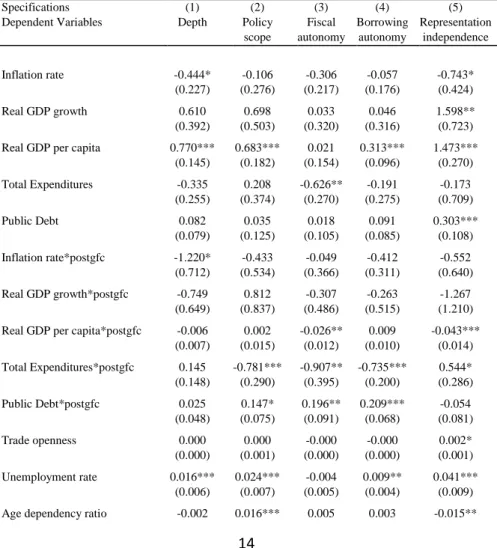
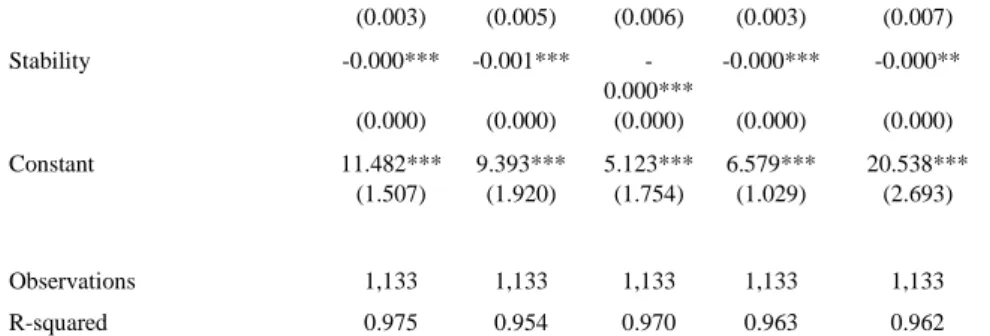
The parameter estimates show that the crisis has been associated with a reduction in subnational autonomy in the higher-spending countries across the range of self-rule prerogatives covered by the indicators, including in policy and fiscal-financial management, except for the endowment of representative institutions. The results are less clear-cut for the different components of the shared rule indicators, although on the basis of the composite indicator, it seems that the ability of the subnational governments to influence national policy and fiscal-financial management may have been curtailed too. The composite indicators of self and shared rule, as well as the overall regional autonomy indicator, also point towards a curtailment of subnational autonomy in the immediate aftermath of the crisis.
Specifications (1) (2) (3) Dependent Variables RAI Self-rule Shared rule Inflation rate -1.235 -1.656* 0.421
(1.040) (1.015) (0.293) Real GDP growth 2.297 2.984* -0.687 (1.915) (1.655) (0.809) Real GDP per capita 3.400*** 3.260*** 0.141
(0.705) (0.633) (0.212) Total Expenditures 0.100 -1.116 1.216***
(1.532) (1.438) (0.461) Public Debt 0.514 0.529 -0.014 (0.418) (0.372) (0.181) Inflation rate *postgfc -5.857** -2.665* -3.192**
(2.391) (1.600) (1.397) Real GDP growth *postgfc -1.545 -1.774 0.229
(2.926) (2.652) (0.966) Real GDP per capita *postgfc -0.032 -0.065 0.033***
(0.045) (0.041) (0.012) Total Expenditures *postgfc -2.853*** -1.733* -1.120***
(1.043) (0.968) (0.278) Public Debt *postgfc 0.446* 0.523** -0.078 (0.274) (0.240) (0.100) Trade openness 0.000 0.001 -0.001* (0.002) (0.002) (0.001) Unemployment rate 0.061** 0.085*** -0.025***
(0.025) (0.024) (0.008) Age dependency ratio 0.025 0.007 0.018***
(0.020) (0.018) (0.007) Stability -0.002*** -0.002*** 0.000***
(0.001) (0.001) (0.000) Constant 60.649*** 53.116*** 7.533***
14
Table 2. Baseline Regressions:
Composite Authority
Indicators
Note: Estimation of Equation (1) by OLS. Time and country fixed effects included but omitted for reasons of parsimony. Robust standard errors clustered at the country level in parenthesis. *, **, *** denote statistical significance at the 10, 5 and 1 percent levels, respectively.
Source: Authors’ estimations.
Table 3. Baseline: Self-Rule Indicators
Specifications (1) (2) (3) (4) (5) Dependent Variables Depth Policy
scope Fiscal autonomy Borrowing autonomy Representation independence Inflation rate -0.444* -0.106 -0.306 -0.057 -0.743* (0.227) (0.276) (0.217) (0.176) (0.424) Real GDP growth 0.610 0.698 0.033 0.046 1.598** (0.392) (0.503) (0.320) (0.316) (0.723) Real GDP per capita 0.770*** 0.683*** 0.021 0.313*** 1.473***
(0.145) (0.182) (0.154) (0.096) (0.270) Total Expenditures -0.335 0.208 -0.626** -0.191 -0.173 (0.255) (0.374) (0.270) (0.275) (0.709) Public Debt 0.082 0.035 0.018 0.091 0.303*** (0.079) (0.125) (0.105) (0.085) (0.108) Inflation rate*postgfc -1.220* -0.433 -0.049 -0.412 -0.552 (0.712) (0.534) (0.366) (0.311) (0.640) Real GDP growth*postgfc -0.749 0.812 -0.307 -0.263 -1.267 (0.649) (0.837) (0.486) (0.515) (1.210) Real GDP per capita*postgfc -0.006 0.002 -0.026** 0.009 -0.043***
(0.007) (0.015) (0.012) (0.010) (0.014) Total Expenditures*postgfc 0.145 -0.781*** -0.907** -0.735*** 0.544* (0.148) (0.290) (0.395) (0.200) (0.286) Public Debt*postgfc 0.025 0.147* 0.196** 0.209*** -0.054 (0.048) (0.075) (0.091) (0.068) (0.081) Trade openness 0.000 0.000 -0.000 -0.000 0.002* (0.000) (0.001) (0.000) (0.000) (0.001) Unemployment rate 0.016*** 0.024*** -0.004 0.009** 0.041*** (0.006) (0.007) (0.005) (0.004) (0.009) Age dependency ratio -0.002 0.016*** 0.005 0.003 -0.015**
Observations 1,133 1,133 1,133 R-squared 0.986 0.978 0.986
15 (0.003) (0.005) (0.006) (0.003) (0.007) Stability -0.000*** -0.001*** -0.000*** -0.000*** -0.000** (0.000) (0.000) (0.000) (0.000) (0.000) Constant 11.482*** 9.393*** 5.123*** 6.579*** 20.538*** (1.507) (1.920) (1.754) (1.029) (2.693) Observations 1,133 1,133 1,133 1,133 1,133 R-squared 0.975 0.954 0.970 0.963 0.962
Note: Estimation of Equation (1) by OLS. Time and country fixed effects included but omitted for reasons of parsimony. Robust standard errors clustered at the country level in parenthesis. *, **, *** denote statistical significance at the 10, 5 and 1 percent levels, respectively.
Source: Authors’ estimations.
Table 4. Baseline Results: Shared-Rule Indicators
Specifications (6) (7) (8) (9) (10) Dependent Variables Law-making Executive
control Fiscal control Borrowing Constitutional control reform Inflation rate 0.133* 0.131** 0.123*** 0.231** -0.197 (0.076) (0.052) (0.047) (0.090) (0.216) Real GDP growth -0.290* 0.202 0.043 0.315 -0.957* (0.175) (0.169) (0.128) (0.210) (0.587) Real GDP per capita 0.075 0.042 0.004 -0.074* 0.094
(0.048) (0.045) (0.045) (0.041) (0.167) Total Expenditures -0.045 0.382*** 0.488*** 0.415** -0.025 (0.084) (0.101) (0.103) (0.169) (0.317) Public Debt -0.183*** -0.027 0.026 -0.023 0.192 (0.041) (0.034) (0.038) (0.045) (0.161) Inflation rate*postgfc -0.635** -0.401 -0.498** -0.199 -1.460 (0.299) (0.252) (0.207) (0.168) (1.106) Real GDP growth*postgfc 0.314 -0.312 -0.092 -0.158 0.477 (0.263) (0.331) (0.215) (0.316) (0.653) Real GDP per capita*postgfc 0.009** 0.006 0.010* -0.003 0.012
(0.004) (0.006) (0.006) (0.002) (0.009) Total Expenditures*postgfc -0.290*** -0.382*** -0.334*** 0.016 -0.130 (0.110) (0.106) (0.090) (0.082) (0.186) Public Debt*postgfc 0.053*** -0.020 -0.083*** -0.039 0.012 (0.019) (0.020) (0.024) (0.026) (0.074) Trade openness -0.000 0.000** 0.000 -0.000 -0.001*** (0.000) (0.000) (0.000) (0.000) (0.000) Unemployment rate 0.007*** -0.003* -0.003 -0.012*** -0.014** (0.002) (0.001) (0.002) (0.003) (0.006) Age dependency ratio 0.005*** 0.004*** 0.004** 0.005*** 0.001
(0.001) (0.001) (0.002) (0.002) (0.006) Stability 0.000** 0.000*** 0.000 0.000 -0.000 (0.000) (0.000) (0.000) (0.000) (0.000) Constant 2.057*** 2.072*** -0.363 -1.240*** 5.006*** (0.494) (0.464) (0.500) (0.440) (1.879) Observations 1,133 1,133 1,133 1,133 1,133 R-squared 0.974 0.977 0.961 0.887 0.960
Note: Estimation of Equation (1) by OLS. Time and country fixed effects included but omitted for reasons of parsimony. Robust standard errors clustered at the country level
16
in parenthesis. *, **, *** denote statistical significance at the 10, 5 and 1 percent levels, respectively.
Source; Authors’ estimations.
By contrast with the findings based on general government spending, the regressions show that an increase in government indebtedness has been associated with greater self rule at the subnational level since the crisis, especially as far as their policy, taxing and borrowing autonomy is concerned. Interestingly, higher indebtedness has also been associated with an increase in subnational influence in national law-making since the crisis. The composite indicator of self rule, but not that of shared rule, and the overall regional autonomy indicator also point to an increase in subnational autonomy in the immediate aftermath of the crisis.
Some comments on the set of included controls are worthwhile. More specifically, macroeconomic imbalances have a mixed effect on decentralisation, with an increase in inflation reducing subnational self rule, but the converse is true for unemployment and economic growth. Self rule is also stronger in more developed countries, or those with higher per capita GDP. A higher age dependency ratio and greater trade openness tend to be associated with greater subnational ability to influence national policy, or a higher degree of shared rule on the basis of the subnational autonomy indicators used in the analysis.
All in all, and although the self- and shared-rule indicators only cover a short period of time in the aftermath of the crisis, it seems that the increase in government indebtedness and spending that occurred in several countries, due predominantly to a combination of cyclical developments and the implementation of counter-cyclical stimulus packages, has had an impact on intergovernmental relations and institutions. This impact appears to have curtailed certain aspects of subnational fiscalfinancial and policy self rule, and to some extent the ability of subnational governments to influence national policymaking, at least where the crisis has been associated with an increase in government spending. On the other hand, the increase in public indebtedness that also resulted from the crisis appears to have had the opposite effect, enhancing subnational self-rule in policymaking and fiscalfinancial management.
The contrast between the findings for government spending and indebtedness is not surprising. First of all, the increase in government spending that occurred in the years following the crisis reflected to a large extent the implementation of stimulus packages executed by the subnational governments but financed predominantly by the centre, at least in the advanced economies. This centre-led policy
17
response was reflected in several cases in a reduction in subnational policymaking and fiscal-financial management autonomy, as well as the ability of the subnational governments to influence national policy. By contrast, dealing with government indebtedness to address the needed post-crisis fiscal consolidation requires a longer-term policy response that depends on cooperation with the subnational governments, at least in those countries where fiscal policy is conducted in a decentralised fashion. In many cases, the subnational governments have been called upon to participate in national fiscal consolidation plans, as was the case of the adjustment pacts that were put in place in several EU countries, including Austria and Germany, where explicit targets have been agreed between the central and subnational governments. Where intergovernmental cooperation has been strengthened, the ability of the subnational governments to influence national policymaking may have been enhanced, and an increase in subnational self-rule may have been a necessary quid pro quo.
These findings are related to the political economy literature pioneered by Besley and Coate (2003), among others, which looks at policy outcomes in situations where regional politicians bargain over fiscal policy at the national level. The extent to which policymaking is decentralised depends in this case on several drivers, including shifts in the power balance within the country and uncertainty over the ability of specific regions to reflect their interests in national policy choices. In the case of fiscal consolidation in response to the crisis-induced rise in public indebtedness, there is uncertainty over whether or not centralised policymaking would result in a balanced distribution of the costs of adjustment across regions, as well as between the regions and the centre. This uncertainty creates an incentive for the regions to collude among themselves and bid for greater policymaking and managerial authority, resulting in a more decentralised governance arrangement. Further empirical work is nevertheless warranted to test this hypothesis.
Drilling down on the public finances: What programmatic areas matter the most?
A third category of decentralisation indicators used in our empirical analysis focuses on the functional composition of spending and revenue across the different layers of administration. As in the case of the decentralisation indicators based on budgetary aggregates, emphasis is still placed on the public finances as a source of quantitative information, but a finer look at the evolving subnational shares across a variety of functional areas provides complementary evidence on decentralisation trends and the effects of the crisis on intergovernmental fiscal relations. An obvious limitation of the analysis is that the assignment of spending and revenue functions across the spheres of government is hardly ever clear-cut, which results in overlapping mandates.
18
The regression results reported in Tables 5-6 include both country and time fixed effects for ease of comparison with those reported in Tables 1-4. The parameter estimates reported in Table 5 show that increases in general government spending tend to occur in tandem with decentralisation, in that they are associated with a higher subnational spending share, especially after the crisis. This finding is consistent with the prominent role played by the subnational governments in the execution of stimulus programmes financed by the centre in the aftermath of the crisis. This effect is indeed particularly true for economic affairs. By contrast, increases in general government spending seem to have taken place at the central government level since the crisis in the areas of health care, education and social protection, since spending hikes in these areas have been associated with lower subnational spending shares. This is also the case of the effect of increases in general government indebtedness on subnational spending shares, at least as far as outlays on social protection are concerned.13
Table 5. Baseline Regressions: Functional Composition of Spending
Specifications (1) (2) (3) (4) (5) Dependent Variables Subnational
total spending share Subnational share of economic affairs spending Subnational share of spending on health care Subnational share of spending on education Subnational share of spending on social protection Inflation rate -22.571*** -80.499*** -106.018** -14.191 -8.930 (5.298) (23.172) (41.295) (19.205) (26.794) Real GDP growth -3.662 19.229 0.466 18.790 30.261* (3.810) (20.082) (18.498) (17.697) (16.192) Real GDP per capita 6.207*** -23.494*** 28.537*** 22.211** -21.113* (1.996) (7.892) (8.622) (9.638) (13.041) Total Expenditures 15.827*** 26.940* 66.512*** 40.639** 61.914*** (3.900) (15.292) (23.224) (17.314) (21.268) Public Debt 0.439 -1.127 -17.948* 3.771 8.104* (0.884) (4.026) (9.406) (4.127) (4.762) Trade openness -0.001 -0.037 0.051 0.039 -0.006 (0.004) (0.032) (0.048) (0.038) (0.033) Unemployment rate 0.104* -0.993*** -0.025 0.367 -0.922*** (0.065) (0.238) (0.328) (0.262) (0.283) Age dependency ratio 0.066* -0.443** 0.516** 0.292* -0.677 (0.036) (0.185) (0.238) (0.170) (0.438) Stability 0.002*** -0.077 -2.976 -3.965** 3.945 (0.001) (1.716) (2.328) (2.013) (2.938) Inflation rate*postgfc 26.064*** 60.114** 106.449** 4.930 23.688 (5.911) (23.193) (44.449) (15.760) (25.239) Real GDP growth*postgfc 5.725 -7.049 -36.633 -32.815 -31.745 (4.580) (22.543) (23.675) (23.784) (27.908) Real GDP per capita*postgfc -0.007 0.977 1.074 -0.662 -0.549
(0.166) (0.612) (0.737) (0.483) (0.533) Total Expenditures*postgfc 3.506* 18.751** -23.805** -30.264*** -23.681**
(2.069) (9.308) (11.862) (8.117) (11.624) Public Debt*postgfc -0.476 -4.533 -1.347 -2.979 -7.896**
13 In some specifications the number of observations drops considerably due to data availability constraints, hence our discussion of the results should be taken with care.
19 (0.517) (3.282) (4.328) (2.560) (3.891) Constant 114.650*** -175.450** 323.666*** 198.959** -106.148 (18.533) (72.574) (81.464) (87.189) (114.677) Observations 926 374 374 374 360 R-squared 0.979 0.935 0.941 0.975 0.844
Note: Estimation of Equation (1) by OLS. Time and country fixed effects included but omitted for reasons of parsimony. Robust standard errors clustered at the country level in parenthesis. *, **, *** denote statistical significance at the 10, 5 and 1 percent levels, respectively.
Source: Authors’ estimations.
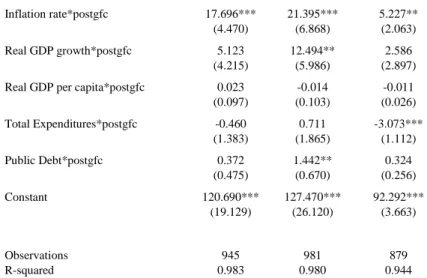
As for revenue, the results reported in Table 6 show that higher general government spending is associated with a higher share of subnational tax revenue, a feature of the public finances that has not changed since the crisis. However, in the case of social security revenue the effect of higher general government spending on subnational revenue collection seems to have weakened since the crisis. This phenomenon can be associated with protracted joblessness in the aftermath of the crisis, which takes its toll on revenue, and/or efforts to alleviate the tax burden on labour income as a means of encourage hires.14
Table 6. Baseline Results: Functional Composition of Revenue
Specifications (1) (3) (4) Dependent Variables Subnational
total revenue share Subnational share of tax revenue Subnational share of social security revenue Inflation rate -18.667*** -21.247*** -4.877** (4.103) (5.654) (2.164) Real GDP growth -5.483 -10.272* -1.043 (3.671) (5.373) (2.090) Real GDP per capita 6.563*** 7.411*** 0.005
(2.053) (2.782) (0.380) Total Expenditures 8.922** 10.724* 8.350*** (3.804) (5.751) (2.151) Public Debt -0.585 -3.443*** 0.467 (0.834) (1.179) (0.303) Trade openness 0.004 0.006* 0.003** (0.003) (0.004) (0.002) Unemployment rate 0.053 0.056 -0.034 (0.061) (0.064) (0.026) Age dependency ratio 0.033 0.018 0.058***
(0.034) (0.032) (0.018) Stability 0.000 0.000 -0.000**
(0.000) (0.000) (0.000)
14 For a recent paper on the topic of jobless recoveries see the work by Plotnikov (2014) who develops and estimates a general equilibrium rational expectations model with search and multiple equilibria where aggregate shocks have a permanent effect on the unemployment rate.
20 Inflation rate*postgfc 17.696*** 21.395*** 5.227** (4.470) (6.868) (2.063) Real GDP growth*postgfc 5.123 12.494** 2.586 (4.215) (5.986) (2.897) Real GDP per capita*postgfc 0.023 -0.014 -0.011 (0.097) (0.103) (0.026) Total Expenditures*postgfc -0.460 0.711 -3.073*** (1.383) (1.865) (1.112) Public Debt*postgfc 0.372 1.442** 0.324 (0.475) (0.670) (0.256) Constant 120.690*** 127.470*** 92.292*** (19.129) (26.120) (3.663) Observations 945 981 879 R-squared 0.983 0.980 0.944
Note: Estimation of Equation (1) by OLS. Time and country fixed effects included but omitted for reasons of parsimony. Robust standard errors clustered at the country level in parenthesis. *, **, *** denote statistical significance at the 10, 5 and 1 percent levels, respectively.
Source: Authors’ estimations.
Sensitivity analysis: Are advanced economies different?
Although the baseline regressions include both country and time fixed effects, it is possible that the effects of the crisis on intergovernmental fiscal relations and the institutional arrangements that govern decentralised policymaking differ in a more substantive manner between the advanced economies, on the one hand, and the emerging-market economies and developing countries, on the other, than captured statistically by the inclusion of country fixed effects. To be sure, we re-estimated the baseline regressions for two sub-samples on the basis of the income group definitions of advanced and emerging-market and developing economies used by the World Bank. For reasons of parsimony we limited ourselves to two sets of indicators (out of the three considered above), namely fiscal Decentralisation and subnational autonomy.
Table 7. Sensitivity Analysis: Advanced versus Emerging and Developing Economies
Specifications (1) (2) (3) (4) (5) (6) (7) (8) Sample Advanced Economies Emerging Market and Developing Dependent Variables Subnational share of spending Subnational share of revenue Subnational share of transfers RAI Subnational share of spending Subnational share of revenue Subnational share of transfers RAI Inflation rate -0.545*** -0.366*** -0.291*** -21.723*** -0.121 -0.089 -0.046 -0.031 (0.155) (0.093) (0.080) (7.237) (0.093) (0.076) (0.045) (0.949) Real GDP growth 0.061 0.096 -0.164** 10.043*** 0.011 -0.020 0.062 -1.305 (0.197) (0.088) (0.070) (3.810) (0.076) (0.065) (0.097) (1.957) Real GDP per capita -0.123*** -0.100*** -0.018 -0.429 -0.105** -0.138*** -0.295*** 2.505***
21 (0.037) (0.022) (0.019) (1.030) (0.047) (0.043) (0.045) (0.872) Total Expenditures -0.269** -0.022 -0.021 1.965 -0.159 -0.261*** -0.368*** -3.276*** (0.108) (0.062) (0.042) (2.949) (0.100) (0.083) (0.094) (1.223) Public Debt -0.095*** -0.032* -0.007 2.105*** 0.026 0.003 -0.049** -0.938* (0.034) (0.018) (0.012) (0.653) (0.021) (0.018) (0.022) (0.536) Inflation rate *postgfc 0.512** 0.554*** 0.312** 11.209 0.096 0.084 0.139* -5.937** (0.256) (0.148) (0.122) (7.921) (0.088) (0.072) (0.077) (2.522) Real GDP growth *postgfc -0.444* -0.135 0.110 -13.772** 0.112 0.160 0.206 5.180 (0.259) (0.124) (0.097) (5.652) (0.152) (0.145) (0.140) (3.393) Real GDP per capita *postgfc -0.006* -0.006*** -0.004*** -0.109 0.004 0.002 0.002 -0.011 (0.003) (0.002) (0.001) (0.089) (0.002) (0.002) (0.002) (0.048) Total Expenditures *postgfc 0.229** 0.099** 0.066** -6.645*** -0.028 -0.050 0.006 -1.486 (0.111) (0.045) (0.030) (1.908) (0.058) (0.059) (0.059) (1.342) Public Debt *postgfc -0.027 -0.007 0.015** 0.315 0.009 0.005 0.064** 0.480 (0.019) (0.010) (0.007) (0.411) (0.025) (0.027) (0.028) (0.339) Trade openness -0.001*** -0.000*** -0.000*** -0.002 0.000** 0.000 0.000 0.007 (0.000) (0.000) (0.000) (0.002) (0.000) (0.000) (0.000) (0.005) Unemployment rate -0.004*** -0.003*** -0.000 -0.075* -0.001 0.000 -0.002* 0.103*** (0.001) (0.001) (0.001) (0.042) (0.001) (0.001) (0.001) (0.029) Age dependency ratio 0.000 -0.000 -0.000 -0.092* -0.002*** -0.002*** -0.005*** 0.060** (0.001) (0.001) (0.001) (0.048) (0.001) (0.001) (0.001) (0.026) Stability -0.009 -0.006 -0.006 -0.375 -0.009 -0.005 0.005 -0.002** (0.007) (0.006) (0.004) (0.252) (0.008) (0.006) (0.007) (0.001) Constant -0.584* -0.523** 0.196 27.437** -0.625 -1.020** -2.894*** 31.204*** (0.356) (0.222) (0.186) (10.704) (0.520) (0.418) (0.502) (10.738) Observations 583 583 641 602 318 350 336 531 R-squared 0.915 0.973 0.984 0.988 0.982 0.966 0.966 0.981
Note: Estimation of Equation (1) by OLS. Sample coverage is identified in the second row. Time and country fixed effects included but omitted for reasons of parsimony. Robust standard errors clustered at the country level in parenthesis. *, **, *** denote statistical significance at the 10, 5 and 1 percent levels, respectively.
Source: Authors’ estimations.
The regressions are estimated by OLS and include both country and time fixed effects for ease of comparison with the baseline results. The parameter estimates reported in Table 7 are consistent with the baseline findings, especially for the sub-sample of advanced economies, where general government spending continues to be strongly positively associated with the fiscal decentralisation indicators and strongly negatively associated with the overall subnational autonomy composite indicator over the post-crisis period.
Among the controls, macroeconomic imbalances (proxied by inflation and unemployment) have a strong negative effect on the decentralisation indicators in the sub-sample of advanced economies, as
22
in the baseline regressions, but not in the emerging-market and developing economies. By contrast, the age dependency ratio has a strong negative effect on all the decentralisation indicators in the subsample of emerging-market and developing economies, as in the baseline regressions, but it has no effect in the sub-sample of advanced economies. Trade openness and economic development continue to be negatively associated with decentralisation, although the effects are stronger in the sub-sample of advanced economies in the case of trade openness and in the sub-sample of emergingmarket economies and developing countries in the case of economic development.
4. Discussion and conclusions
The crisis that hit the global economy ten years ago has left profound social and economic scars, especially in the advanced economies. The recovery has been slow from a historical perspective and, in some cases, (real) output has barely recovered from pre-crisis levels. Public indebtedness also rose sharply in several countries, both at the central and subnational government levels, to a large extent as a result of the cyclical downturn and the ensuing counter-cyclical responses, as well as in some cases the inclusion of extra-budgetary operations in stimulus packages. Medium-term budgetary consolidation continues to be needed in those countries that were most severely affected by the crisis to bring government debt to levels that would allow policymakers sufficient fiscal space to respond to future downturns and face the secular challenges associated with population ageing.
Against this background, this paper sought to empirically assess the effects that the global financial and economic crisis has had on intergovernmental fiscal relations. Several indicators were used to gauge the effects of the crisis, including a range of budgetary aggregates as well as metrics of subnational policy and fiscal-financial managerial authority and their ability to influence national policymaking and fiscal-financial management. These indicators allow for a finer distinction between the effects of the crisis on the public finances, on the one hand, and on the institutional underpinnings of policymaking and fiscal-financial management in decentralised settings, on the other. The indicators selected for the empirical analysis have been used extensively in the literature, which facilitates comparison.
Intergovernmental relations have been affected by the crisis in different ways, depending on the specific fiscal, financial and institutional characteristics of the public finances in different countries. The complexity of these arrangements in individual countries makes the task of identifying common trends on the basis of comprehensive, albeit imperfect, indicators particularly arduous. In this respect, it is important, as argued by Eccleston and Krever (2017), among others, to complement the
23
crosscountry empirical analysis with case studies that can add nuance to the empirical findings on the basis of country-specific considerations and context.
Bearing these caveats in mind, a key finding of the empirical analysis is that the crisis has had an immediate effect on the public finances that reflects the role of the subnational governments in the execution of counter-cyclical activism. On the basis of the budgetary aggregates used in the analysis the post-crisis period can be characterised as decentralising in that the subnational shares of spending and revenue rose in tandem with the increase in general government spending and indebtedness.
As for the policy and managerial authority indicators, a more nuanced conclusion emerges from the empirical analysis. The parameter estimates show that increases in general government spending since the crisis have been associated with a reduction in subnational authority across several aspects of policymaking and managerial self-rule. The results are less clear-cut for the shared-rule indicators, but it seems that the ability of subnational governments to influence national policymaking and fiscalfinancial management may have been curtailed too. By contrast, increases in general government indebtedness since the crisis have been associated not only with greater subnational self-rule, especially as far as their policy, taxing and borrowing autonomy is concerned, but also with greater subnational influence in national law-making.
Several hypotheses may be considered to explain why rising indebtedness at the level of the general government may have resulted in greater subnational authority since the crisis. First, efforts have been put in place in many countries to strengthen intergovernmental policy coordination, especially given the need to muster political support for debt reduction through medium-term fiscal consolidation, as well as securing agreement on specific policy packages that reflect the needs and preference of (often diverse) jurisdictions.
Second, depending on the political and institutional settings in different countries, the sharing of the costs of fiscal adjustment between the central and the subnational governments, as well as among the various subnational jurisdictions, calls for bargaining over policy alternatives that may enhance the influence of the subnational governments over national policy and their ability to “extract” concessions from the central governments in matters of policy and fiscal-financial management. Indeed, TerMinassian and de Mello (2016) present different arrangements in the world’s largest federations and note the emergence of intergovernmental policy fora to deal with debt, intergovernmental grants and transfers, as well as spending and tax matters. These institutions have become in many cases the primary fora for negotiating solutions to policy challenges, such as debt reduction, where the presence
24
of inter-jurisdictional spillovers require coordinated responses among the different layers of government.
25
References
1. Alesina, A., A. Devleeschauwer, W. Easterly, S. Kurlat and R. Wacziarg (2003), “Fractionalisation”, NBER Working Paper, No. 9411, National Bureau of Economic Research, Washington, D.C.
2. Arzaghi, M. and J. Vernon (2005), “Why Countries are Fiscally Decentralizing?”, Journal of
Public Economics, Vol. 89, pp. 1157-89.
3. Besley. T. and S. Coate (2003), “Centralised versus Decentralised Provision of Local Public Goods: A Political Economy Approach”, Journal of Public Economics, Vol. 87, pp. 2611-37.
4. Blöchliger, H. and D. King (2006), “Less Than You thought: The Fiscal Autonomy of Sub-Central Governments”, OECD Economics Studies, Vol. 43, pp. 155-88.
5. Dziobek,C., C. Mangas, and P. Kufa (2011), “Measuring Fiscal Decentralisation – Exploring the IMF's Databases”, Working Paper, No. 11/126, International Monetary Fund, Washington D.C.
6. Eccleston, R. and R. Krever (2017), The Future of Federalism: Intergovernmental Relations in an
Age of Austerity, Edward Elgar.
7. Elazar, D. (1987), Exploring Federalism, University of Alabama Press, Tuscaloosa, AL.
8. Hooghe, L., G. Marks, A.H. Schakel, S. Chapman, S. Niedzwiecki and S. Shair-Rosenfield (2016), “A Postfunctionalist Theory of Governance”, Measuring Regional Authority, Vol. I, Oxford University Press, Oxford.
9. Jametti, M. and M. Joanis (2009), “The Rise of Partial Decentralisation and Shared Responsibility Federalism”, IEB Global Report on Fiscal Federalism, Barcelona.
10. Kearney, C. (1999), “Decentralisation Index”, mimeo, Brown University.
11. Kincaid, J., G.A. Tarr and S. Walti (2010), Federalism and the Global Financial Crisis: Impacts and Responses. Introduction, L'Europe en Formation, Vol. 4, pp. 3-14.
12. OECD (2009a), “Sub-Central Fiscal Policy in Times of Economic Crisis”, Note by the Secretariat, Network on Fiscal Relations, OECD, Paris.
13. OECD (2009b), Taxonomy of Central and Sub-National Discretionary Measures to Respond to
the Crisis, OECD, Paris.
14. OECD and KIPF (2016), Fiscal Federalism 2016: Making Decentralisation Work, OECD, Paris.
15. Panizza, U. (1999), “On the Determinants of Fiscal Centralisation: Theory and Evidence”,
Journal of Public Economics, Vol. 74, pp. 97-139.
26
16. Plotnikov, D. (2014), “Hysteresis in Unemployment and Jobless Recoveries”, Working Paper, No. 14/77, International Monetary Fund, Washington D.C.
17. Rodden, J. (2004), “Comparative Federalism and Decentralisation: On Meaning and Measurement”, Comparative Politics, Vol. 36(4), pp. 481-500.
18. Sow, M. and I.F. Razafimahefa (2017), “Fiscal Decentralisation and Fiscal Policy Performance”,
Working Paper, No. 17/64, International Monetary Fund, Washington, D.C.
19. Stegarescu, D. (2005), “Public Sector Decentralisation: Measurement Concepts and Recent International Trends”, Fiscal Studies, Vol. 26, pp. 301-33.
20. Stegarescu, D. (2009), “The Effects of Economic and Political Integration on Fiscal Decentralisation: Evidence from OECD Countries”, Canadian Journal of Economics, Vol. 42, pp. 694-718.
21. Ter-Minassian, T. and A. Fedelino (2009), “The Impact of the Global Crisis on Sub-National Governments' Finances”, IEB Global Report on Fiscal Federalism, Barcelona.
22. Ter-Minassian, T. and L. de Mello (2016), “Intergovernmental Fiscal Cooperation. International Experiences and Possible Lessons for Brazil”, Inter-American Development Bank, Washington, D.C.
23. Wooldridge, J. M. (2002), “Econometric Analysis of Cross Section and Panel Data”. Cambridge, MA: MIT Press.
27
APPENDIX
Number of countries in each decentralisation dataset
-Sow and Razafimahefa (2017)
US, UK, Austria, Belgium, Denmark, France, Germany, Italy, Luxembourg, Netherlands, Norway, Sweden, Switzerland, Canada, Finland, Greece, Iceland, Ireland, Malta, Portugal, Spain, Brazil, Chile, Mexico, Peru, Uruguay, Venezuela, Cyprus, Iran, Israel, Egypt, Bhutan, India, Korea, Maldives, Pakistan, Singapore, Lesotho, Mauritius, Seychelles, Tunisia, Belarus, Georgia, Bulgaria, Czech Republic, Slovak Republic, Estonia, Latvia, Hungary, Lithuania, Croatia, Slovenia, Poland, Romania
-Dziobek et al. (2011)
US, UK, Austria, Belgium, Denmark, France, Germany, San Marino, Italy, Luxembourg, Netherlands, Norway, Sweden, Switzerland, Canada, Finland, Greece, Iceland, Ireland, Malta, Portugal, Australia, New Zealand, South Africa, Bolivia, Chile, Costa Rica, El Salvador, Honduras, Paraguay, Peru, Jamaica, Cyprus, Iran, Israel, Egypt, Bhutan, Macao, Maldives, Singapore, Thailand, Congo, Lesotho, Mauritius, Morocco, Seychelles, Armenia, Belarus, Georgia, Moldova, Russia, China, Ukraine, Czech Republic, Slovak Republic, Estonia, Latvia, Hungary, Lithuania, Croatia, Slovenia, Bosnia, Poland, Romania
-Hooghe et al. (2016)
US, UK, Austria, Belgium, Denmark, France, Germany, Italy, Luxembourg, Netherlands, Norway, Sweden, Switzerland, Canada, Japan, Finland, Greece, Iceland, Ireland, Malta, Portugal, Spain, Turkey, Australia, New Zealand, Argentina, Bolivia, Brazil, Chile, Colombia, Costa Rica, Dominican Republic, Ecuador, El Salvador, Guatemala, Haiti, Honduras, Mexico, Nicaragua, Panama, Paraguay, Peru, Uruguay, Venezuela, Bahamas, Barbados, Guyana, Belize, Jamaica, Suriname, Trinidad and Tobadg, Cyprus, Israel, Brunei, Indonesia, Korea, Malaysia, Philippines, Singapore, Thailand, Albania, Bulgaria, Czech Republic, Slovak Republic, Estonia, Latvia, Hungary, Lithuania, Croatia, Slovenia, Macedonia, Bostina, Poland, Romania
Table A1. Summary statistics of main decentralisation indicators
Obs Mean Std. Dev Min Max
Subnational share of spending 1086 0.295462 0.2130837 0 0.9844444 Subnational share of revenue 1129 0.2736883 0.1980593 0 0.7359749 Subnational share of transfers 1157 0.2720405 0.2001553 0 0.7602336
RAI 1540 9.230787 9.694887 0 36.98985
Self rule 1540 7.417439 7.173634 0 26.33583
Shared rule 1540 1.813348 3.306538 0 15.00702
Subnational total spending share 1022 87.20489 13.46005 15.2067 103.7478 Subnational share of economic affairs spending 420 76.92277 23.50839 17.51112 117.5599 Subnational share of spending on health care 421 73.49565 36.13101 1.442035 156.0339 Subnational share of spending on education 420 64.94665 35.57261 3.615229 103.5205 Subnational share of spending on social protection
406 90.25978 19.03503 2.860025 189.9373 Subnational total revenue share 1048 86.80203 13.77414 15.19276 103.0247
28
Subnational share of tax revenue 1084 85.33459 15.92151 0.4744988 100 Subnational share of social security revenue 971 98.53022 3.689191 78.57059 127.2789