CERN-PH-EP/2013-167 2013/09/27
CMS-BPH-11-026
Observation of a peaking structure in the J/ψφ mass
spectrum from B
±
→
J/ψφK
±
decays
The CMS Collaboration
∗Abstract
A peaking structure in the J/ψφ mass spectrum near threshold is observed in B± →
J/ψφK±decays, produced in pp collisions at √s = 7 TeV collected with the CMS de-tector at the LHC. The data sample, selected on the basis of the dimuon decay mode of the J/ψ, corresponds to an integrated luminosity of 5.2 fb−1. Fitting the structure to an S-wave relativistic Breit–Wigner lineshape above a three-body phase-space nonreso-nant component gives a signal statistical significance exceeding five standard devia-tions. The fitted mass and width values are m = 4148.0±2.4 (stat.)±6.3 (syst.) MeV andΓ = 28+−1511(stat.)±19 (syst.) MeV, respectively. Evidence for an additional peak-ing structure at higher J/ψφ mass is also reported.
Submitted to Physics Letters B
c
2013 CERN for the benefit of the CMS Collaboration. CC-BY-3.0 license
∗See Appendix A for the list of collaboration members
arXiv:1309.6920v1 [hep-ex] 26 Sep 2013
1
Introduction
The discovery of new charmonium-like states [1–6] over the last decade poses a challenge to the conventional quark model. Many explanations, such as charmed hybrids, tetraquarks, and molecular states, have been proposed for these new entities, but their nature remains a puz-zle [7, 8]. In 2009, the CDF Collaboration reported evidence for a narrow structure, which they calledΥ(4140), near the J/ψφ threshold in B±→J/ψφK±decays [9]. This structure, if confirmed as a new resonance, would be a candidate for an exotic meson [10–15]. The Belle Collabora-tion searched for theΥ(4140)through the same B± decay channel [16] and in the two-photon process γγ → J/ψφ [17], but did not confirm it. Using the same B± decay channel, the LHCb Collaboration recently reported finding no evidence for such a state, in disagreement with the CDF result [18].
In this Letter, a study of the J/ψφ mass spectrum from B+ →J/ψφK+decays is reported, where charge conjugate decay modes are implied throughout. The data were collected in 2011 with the Compact Muon Solenoid (CMS) detector from proton-proton collisions at the Large Hadron Collider (LHC) operating at a center-of-mass energy of 7 TeV and corresponding to an inte-grated luminosity of 5.2±0.1 fb−1[19].
A detailed description of CMS can be found elsewhere [20]. The central feature of the CMS ap-paratus is a superconducting solenoid, 13 m long with a 6 m internal diameter, which provides an axial magnetic field of 3.8 T. Within the field volume is the silicon tracker, which consists of a pixel-based detector in the inner region and layers of microstrip detectors in the outer region. Charged-particle trajectories are measured with the silicon tracker, covering 0 < φ ≤ 2π in
azimuth and|η| <2.5, where the pseudorapidity η is defined as−ln(tan[θ/2])and θ is the
po-lar angle of the trajectory of the particle with respect to the counterclockwise-beam direction. Muons are detected in the pseudorapidity range|η| <2.4 by three types of gas-ionization
de-tectors embedded in the steel flux-return yoke of the magnet: drift tubes in the barrel, cathode strip chambers in the endcaps, and resistive-plate chambers in both the barrel and endcaps. The strong magnetic field and excellent position resolution of the silicon tracker enable the transverse momentum (pT) of a muon matched to a reconstructed track to be measured with a
resolution of approximately 0.7% for pT of 1 GeV. The pixel detector, with its excellent spatial
resolution and low occupancy, enables the separation of B+-decay vertices from the primary interaction vertex.
Monte Carlo (MC) simulated data were created using PYTHIA 6 [21] for the particle
produc-tion,EVTGEN[22] for the particle decays, and GEANT4 [23] for tracing the particles through a
detailed model of the detector. These samples were created with the appropriate conditions for the data analyzed, including the effects of alignment, efficiency, and number of simultaneous pp collisions.
2
Event selection
Events are chosen using a two-level trigger system. The first level, composed of custom hard-ware processors, uses information from the muon detectors to select dimuon candidates. The high-level trigger (HLT) runs a special version of the offline software code on a processor farm to select events with nonprompt J/ψ candidates coming from the decays of B mesons.
Events containing J/ψ candidates are selected by the HLT dimuon trigger. Because of the in-creasing LHC instantaneous luminosity, there are two configurations of the HLT, corresponding to two running periods and two distinct data sets. For both data sets, the following
require-2 3 Results
ments are already applied with the HLT. The dimuon pTis required to be greater than 6.9 GeV,
the two muons must be oppositely charged and form a three-dimensional (3D) vertex with a
χ2 probability greater than 0.5–10%, depending on the running period. The resulting J/ψ
ver-tex must be displaced from the average interaction point (beamspot) in the transverse plane by at least three times its uncertainty, which is the sum in quadrature of the secondary-vertex uncertainty and the beamspot size in the transverse plane. The cosine of the angle between the transverse projections of the line joining the beamspot and dimuon vertex and the dimuon momentum direction must exceed 0.9. For the later data set, there is an additional requirement that the pT of each muon be greater than 4 GeV. In the final selection of J/ψ candidates, the
dimuon pTis required to be greater than 7 GeV, the χ2 probability of the dimuon vertex is
de-manded to be greater than 10%, and the reconstructed dimuon invariant mass must be within 150 MeV of the J/ψ mass [24].
The B+→J/ψφK+candidates are reconstructed by combining three additional charged-particle tracks that are consistent with originating from the displaced J/ψ vertex and have a total charge of ±1. These tracks are assigned the kaon mass and this mass is used in accounting for the effects of energy loss and multiple-scattering. We do not apply a mass constraint on the φ candidate because our experimental K+K−mass resolution (1.3 MeV) is less than the φ meson natural width (4.3 MeV). The pT of all kaon tracks are required to be greater than 1 GeV. Only
tracks that pass the standard CMS quality requirements [25] are used. The five tracks, with the
µ+µ−invariant mass constrained to the J/ψ mass, are required to form a good 3D vertex with a χ2probability greater than 1%. There are two K+K−combinations from the three charged kaon
tracks, and we use the lower invariant mass as the φ candidate; MC simulations of the B+decay predict that the φ signal from the other combination is negligible, which is verified in the data. The reconstructed K+K− invariant mass must satisfy 1.008 GeV < m(K+K−) < 1.035 GeV to be considered as a φ candidate. These selection requirements were designed to maintain high efficiency for B+decays and were fixed before the J/ψφ mass spectrum in data was examined.
3
Results
The invariant-mass spectrum of the selected J/ψφK+ candidates is shown in the left plot of Fig. 1 for a mass difference∆m ≡ m(µ+µ−K+K−) −m(µ+µ−) < 1.568 GeV. We only
investi-gate candidates with∆m < 1.568 GeV because of possible background from B0s → ψ(2S)φ →
J/ψπ+π−φ at higher values, as discussed below. The invariant-mass spectrum is fit with a
Gaussian signal function and a second-degree polynomial background function. The fit re-turns a B+ mass of 5.2796±0.0006 (stat.) GeV, which agrees with the nominal value [24], and a Gaussian width of 9.6±0.7 (stat.) MeV, which is consistent with the prediction from the MC simulation. The B+yield is 2480±160 (stat.) events, which is the world’s largest B+→J/ψ φK+ sample. The combined B+ yield is 2340±120 (stat.) events when each data set is fit with two Gaussian signal functions and the width of each function is fixed to the prediction from MC simulation. Approximately 5% of the selected events have more than one B+candidate within 1.5 times our mass resolution(σ)of the B+mass; all candidates are kept.
The right plot in Fig. 1 displays the J/ψ K+K−K+ invariant-mass distribution after making the following tighter requirements: the pT of the kaons must be greater than 1.5 GeV, the B+
vertex probability must be greater than 10%, the B+vertex must be displaced from the primary vertex in the transverse plane by at least seven times its uncertainty, and m(K+K−)must be within 7 MeV of the φ meson mass [24]. With these requirements, 40% of the B+candidates are retained, while the background is reduced by more than a factor of ten. This sample of cleaner signal candidates is used as a cross-check of the results obtained by employing the
background-) [GeV] + K − K + K ψ m(J/ 5.15 5.2 5.25 5.3 5.35 5.4 5.45 Candidates / 5 MeV 0 200 400 600 800 1000 1200 1400 1600 1800 2000 1 − = 7 TeV, L = 5.2 fb s CMS, ) < 1.035 GeV − K + 1.008 < m(K m < 1.568 GeV Δ Data Fit Background ) [GeV] + K − K + K ψ m(J/ 5.15 5.2 5.25 5.3 5.35 5.4 5.45 Candidates / 5 MeV 0 50 100 150 200 250 300 350 400 1 − = 7 TeV, L = 5.2 fb s CMS, ) < 1.0265 GeV − K + 1.0125 < m(K m < 1.568 GeV Δ Data Fit Background
Figure 1: The J/ψφK+mass distribution with the standard event selection (left) and the tighter requirements (right). The solid curves show the result of fitting these distributions to a Gaus-sian signal and a second-degree polynomial background while the dashed curves show the background contribution.
corrected J/ψφ mass spectrum, as described below. With the exception of this cross-check, all results are obtained with the less-restrictive criteria.
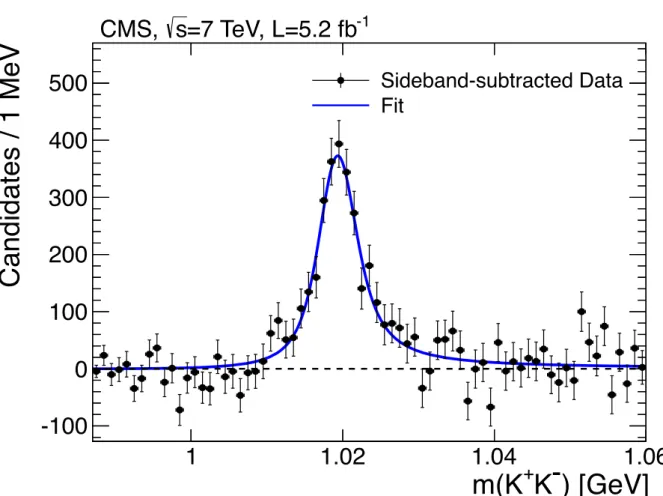
Figure 2 shows the K+K− invariant-mass distribution for J/ψ K+K−K+ candidates that have an invariant mass within ±3σ of the B+mass. We define events in the range [−12, −6]σ and [6, 12]σ of the B+ mass as sidebands. The φ mass restriction has been removed and a
side-band subtraction has been performed in Fig. 2. We fit this distribution to a P-wave relativis-tic Breit–Wigner (BW) function convolved with a Gaussian resolution function. The width of the Gaussian is fixed to 1.3 MeV, obtained from MC simulation. The fit has a χ2 probabil-ity of 23% and returns a mass of 1019.4±0.1 MeV and a width of 4.7±0.4 MeV, consistent with the φ meson [24]. The good fit to only a φ component in Fig. 2 indicates that after the J/ψ and φ mass requirements are made and the combinatorial background is subtracted, the B+→µ+µ−K+K−K+candidates are consistent with being solely J/ψφK+, with negligible
con-tribution from J/ψf0(980)K+or nonresonant J/ψK+K−K+.
As seen in Fig. 1, there are two main components to the J/ψφK+ invariant-mass spectrum: the B+ signal and a smooth background. Possible contributions from other B-hadron decays are examined using MC simulations of inclusive B+, B0, and B0s decays. Based on this study, the mass-difference region (∆m > 1.568 GeV) is excluded from the analysis to avoid potential background from B0s →ψ(2S)φ→J/ψπ+π−φdecays, where one pion is assumed to be a kaon
and the other is not reconstructed.
To investigate the J/ψφ invariant-mass distribution, rather than fitting the distribution itself with its large combinatorial background, the J/ψφK+candidates are divided into 20 MeV-wide ∆m intervals, and the J/ψφK+mass distributions for each interval are fit to extract the B+signal
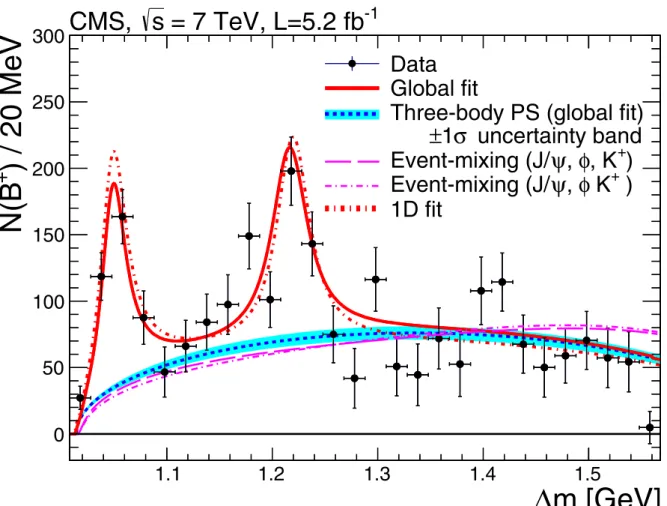
yield in that interval. We use a second-degree polynomial for the combinatorial background and two Gaussians for the B+ signal. The fit is performed separately for each data set. The mean values of the two Gaussians are fixed to the B+mass [24], and the width values of the Gaussians, as well as their relative ratio, are fixed to the values obtained from MC simulation for each specific∆m interval in each data set. The results of all the fits are good descriptions of the data distributions with an average χ2per degree of freedom (dof) close to 1. The resulting ∆m distribution for the combined data sets is shown in Fig. 3. Two peaking structures are observed above the simulated phase-space (PS) continuum distribution shown by the dotted
4 3 Results
) [GeV]
-K
+
m(K
1
1.02
1.04
1.06
Candidates / 1 MeV
-100
0
100
200
300
400
500
Sideband-subtracted Data
Fit
-1=7 TeV, L=5.2 fb
s
CMS,
Figure 2: The B+sideband-subtracted K+K−invariant-mass distribution for J/ψK+K−K+ can-didates within±3σ of the nominal B+mass. The solid curve is the result of the fit described in the text. The dashed line shows the zero-candidate baseline.
line.
Results obtained from both data sets are consistent. We have checked that events with multiple B+ candidates do not artificially enhance the two structures. The total number of B+ signal events in the∆m intervals below 1.568 GeV is 2320±110 (stat.), which is consistent with the total number of B+candidates estimated from the mass spectrum in Fig. 1.
A full study of the J/ψφ resonant pattern in the B+ → µ+µ−K+K−K+decay via an amplitude
analysis of the five-body decay would require a data sample at least an order of magnitude larger than is currently available, as well as more precise information on possible φK+or J/ψK+ resonances that may contribute to this decay. Instead, the∆m distribution is studied, since it is related to the projection of the two-dimensional (2D) J/ψφK+Dalitz plot onto the m2(J/ψφ)
axis.
Before fitting the∆m distribution, it must be corrected for the relative detection and reconstruc-tion efficiencies of the candidate events. Since no branching fracreconstruc-tions are being determined, only the relative efficiency over the Dalitz plot is required. If a possible φK+ or J/ψK+ reso-nance did exist, the density of events would depend on the quantum numbers of the resoreso-nance and on the interference of the two structures with the possible resonance. Ignoring these possi-ble interference effects, the MC simulation is used to determine the efficiency over the m2(φK+)
m [GeV]
∆
1.1
1.2
1.3
1.4
1.5
) / 20 MeV
+
N(B
0
50
100
150
200
250
300
-1= 7 TeV, L=5.2 fb
s
CMS,
Data
Three-body PS (global fit)
)
+, K
φ
,
ψ
Event-mixing (J/
)
+K
φ
,
ψ
Event-mixing (J/
Global fit
1D fit
uncertainty band
σ
1
±
Figure 3: The number of B+ → J/ψφK+ candidates as a function of∆m = m(µ+µ−K+K−) −
m(µ+µ−). The solid curve is the global unbinned maximum-likelihood fit of the data, and the
dotted curve is the background contribution assuming three-body PS. The band is the±1σ un-certainty range for the background obtained from the global fit. The dashed and dash-dotted curves are background curves obtained from two different event-mixing procedures, as de-scribed in the text, and normalized to the number of three-body PS background events. The short dashed curve is the 1D fit to the data.
The J/ψ and φ vector meson decays are simulated using their known angular distributions. The measured efficiency is fairly uniform, varying by less than 25% over the entire allowed three-body PS. Assuming a uniform PS distribution, the efficiency for each∆m bin is taken to be the average of the efficiencies over the full kinematically allowed m(φK+)range. To estimate the
systematic uncertainty in the efficiency caused by its dependence on the unknown quantum numbers of the structures, and hence on their unknown decay angular distributions, the effi-ciency is evaluated under the assumption of both a cos2θ and sin2θ dependence, where θ is
the helicity angle, defined as the angle in the J/ψφ rest frame between the direction of the boost from the laboratory frame and the J/ψ direction. Since the efficiency tends to be lower towards the edge of the Dalitz plot, the cos2θ dependence gives a lower average efficiency than the
default efficiency, while the sin2θ dependence gives a slightly higher average efficiency. This
variation (10%) is taken as the systematic uncertainty in the efficiency from our lack of knowl-edge of the quantum numbers of the structures and the effects of interference with possible two-body resonances.
6 3 Results
We investigate the possibility that the two structures in the∆m distribution are caused by re-flections from resonances in the other two-body systems, J/ψK+ and φK+. Such reflections are well known in the two-body systems from other three-body decays because of kinematic constraints. There are candidate states that decay to φK+[24], although they are not well
estab-lished. These could potentially produce reflected structures in the J/ψφ spectrum. In particular, a D-wave contribution to K−p scattering in the mass region around 1.7–1.8 GeV has been re-ported by several fixed-target experiments [26–28]. This is interpreted as two interfering broad JP = 2− resonances, labeled K2(1770) and K2(1820), with widths in the range 200–300 MeV.
These resonances at relatively low φK+ mass cannot affect the J/ψφ structure near threshold, but could contribute to the second J/ψφ structure near ∆m = 1.2 GeV. To study possible re-flections from the φK+ spectrum, we consider φK+ resonances with various masses, widths, and helicity angle distributions, but are not able to reproduce the pattern of structures seen in the J/ψφ spectrum. Moreover, we separately analyze the J/ψφ spectrum for values of the
φK+masses larger than 1.9 GeV, a region of the Dalitz plot unaffected by postulated φK+
reso-nances, and still observe the structure near∆m =1.2 GeV.
There are no candidate J/ψK+ resonances reported in the literature. Still, we have considered such resonances with various masses, widths, and helicity angle distributions. No combination produces a reflected spectrum that matches the observed J/ψφ spectrum.
The results of these studies make it improbable that the two structures seen in the J/ψφ spec-trum are solely caused by reflections from resonances in the other two-body systems. How-ever, we cannot entirely exclude the possibility of such resonances. For instance, the K+K−K+ spectrum shown in Fig. 4 displays an excess of events above the predicted PS distribution in the 1.7–1.8 GeV region, an excess that cannot be attributed to the presence of the J/ψφ struc-ture near threshold. Figure 4 is obtained by dividing the J/ψφK+candidates into 40 MeV-wide K+K−K+ mass intervals and fitting the J/ψφK+invariant-mass distributions for each interval to extract the B+ signal yield in that interval. The∆m distribution after excluding the region (1.68<m(K+K−K+) <1.88 GeV) with the excess of events is shown in the left plot of Fig. 5 and
the corresponding distribution for the excluded ∆m region in the right plot. The presence of the lower-mass structure is still apparent in the left plot, while that of the higher-mass structure is reduced though still visible. Possible interference effects over the Dalitz plot could therefore distort the shape of the observed J/ψφ structures and affect the extraction of the resonance pa-rameters. The event sample is not large enough to investigate these effects further. We assume that any interference effects can be neglected. The structures in the J/ψφ mass spectrum are de-scribed in terms of zero, one, or two noninterfering resonances and a nonresonant continuum component.
We fit the two structures with S-wave relativistic BW functions convolved with a Gaussian mass resolution function whose width varies linearly from 1 MeV at threshold to about 4 MeV at∆m = 1.25 GeV, as determined from simulation. Each structure is described by a mass, width, and yield, all determined from the fit. The continuum is assumed to follow a three-body PS shape. As an alternative, to check the sensitivity of the result to this assumption, the shape of the continuum is obtained from an event-mixing technique where the J/ψ, φ, and K+candidates are selected from different events. We use two versions of the event mixing, which differ by the φ and K+candidates being selected in the same event or not; they lead to almost identical shapes. The differences between the two event-mixing shapes and the three-body PS are used to evaluate the systematic uncertainties in the continuum modeling.
The masses and widths of the two structures are extracted by dividing the J/ψφK+candidates into 20 MeV-wide intervals of∆m from 1.008 to 1.568 GeV and performing a global unbinned
) [GeV]
+K
−K
+m(K
1.5
1.6
1.7
1.8
1.9
2
2.1
2.2
) / 40 MeV
+N(B
-50
0
50
100
150
200
250
300
350
400
1 −= 7 TeV, L = 5.2 fb
s
CMS,
Data
Phase Space simulation
Figure 4: The yield of B+ →J/ψK+K−K+candidates in the data as a function of the K+K−K+ invariant mass. The error bars represent the statistical uncertainties. The solid curve is the prediction from the PS simulation.
m [GeV] Δ 1 1.1 1.2 1.3 1.4 1.5 1.6 ) / 20 MeV + N(B 0 20 40 60 80 100 120 140 160 1 − = 7 TeV, L = 5.2 fb s CMS, ) > 1.88 GeV + K − K + ) < 1.68 or m(K + K − K + m(K Data
Phase Space simulation
m [GeV] Δ 1 1.1 1.2 1.3 1.4 1.5 1.6 ) / 20 MeV + N(B 0 20 40 60 80 100 1 − = 7 TeV, L = 5.2 fb s CMS, ) < 1.88 GeV + K − K + 1.68 < m(K Data
Phase Space simulation
Figure 5: The number of B+ → J/ψφK+ candidates as a function of ∆m requiring either m(φK+) < 1.68 GeV or m(φK+) > 1.88 GeV (left), or 1.68 < m(φK+) < 1.88 GeV (right). The
8 3 Results
maximum-likelihood (UML) fit to the J/ψφK+invariant-mass distribution in each∆m interval. The two data sets are fitted separately, with a total of 56 mass spectra fitted simultaneously. In each fit, the B+mass is fixed to its nominal value and the mass resolution δ is calculated using:
δ= a0+a1h∆mi +a2h∆mi2,
where h∆mi is the value of ∆m at the center of the bin, and a0, a1, and a2 are determined
from simulation, separately for the two data sets. The combinatorial background in each bin is modeled as a second-degree polynomial. In the global fit, the B+ yield is expressed as the product of the relative efficiency times the number of signal events from the two BWs and the nonresonant continuum events. We fit the J/ψφK+ invariant-mass distribution for each ∆m bin from the two data sets simultaneously by projecting the above product into each bin. The UML fit returns signal event yields of 310±70 (stat.) and 418±170 (stat.) for the lower-and higher-mass structures, respectively. The corresponding mass difference lower-and width values are: ∆m1 = 1051.3±2.4 (stat.) MeV,Γ1 = 28−+1511(stat.) MeV; ∆m2 = 1217.1±5.3 (stat.) MeV,
Γ2 = 38+−3015(stat.) MeV. The projection of the UML fit assuming two structures onto the J/ψφ
mass spectrum is represented as the solid line in Fig. 3.
As a check on the fitting procedure, we perform an alternative one-dimensional (1D) binned χ2 fit to the∆m spectrum shown in Fig. 3. The same signal and background functions are used in the 1D fit as in the global fit. The result of the 1D fit, assuming two structures, is shown as the dashed line in Fig. 3. The measurements of the masses, widths, and yields of the two structures from the global and 1D fits are in good agreement.
To evaluate the significance of each of the two structures, three UML and three 1D (binned χ2) fits are performed on the data shown in Fig. 3: 1) a background-only fit (null-hypothesis); 2) a background plus a single S-wave relativistic BW signal function convolved with a Gaussian resolution function having a width of 2 MeV for the lower-mass structure; and 3) a background plus two S-wave relativistic BW functions convolved with a Gaussian resolution function to model both structures. The log-likelihood ratio−2∆ lnLin the case of the UML fits or the χ2 change∆χ2for the 1D fits between 1) and 2) is then a measure of the statistical significance of the lower-mass structure, while the corresponding values between fits 2) and 3) give a measure of the statistical significance of the higher-mass structure. The resulting values for a decrease in dof of 3 are−2∆ lnL= 58 and∆χ2= 53 for the lower-mass structure, and 36 and 37 for the higher-mass structure.
Simulated samples are used to estimate the probability that background fluctuations alone could give rise to a signal as significant as that seen in the data for the lower-mass structure. Over 50 million∆m spectra were generated between 1.008 and 1.568 GeV with 2300 events for each spectrum based on a three-body PS shape. The most significant fluctuation in each spec-trum is found whose J/ψφ invariant mass is within±3 times the uncertainty in the CDF mass value of 4.140 GeV and having a width between 10 MeV (half the∆m bin width) to 80 MeV (half the separation between the two structures). We then obtain the∆χ2 distributions in the simu-lated pure background samples and compare them with the corresponding value of the signal in the data. No generated spectrum is found with a fluctuation having a∆χ2greater than or equal to the value obtained in the data (53). The resulting p-value, taken as the fraction of the simulated samples with a ∆χ2 value greater than or equal to the value obtained in the data, is less than 2×10⁻⁸, which corresponds to a significance of more than 5 standard deviations.
Because the second structure could be affected by possible φK+ resonances, it is difficult to
model the background shape in that mass range, and we do not quote a numeric significance for the higher-mass structure. However, there is clear evidence for a second structure around ∆m = 1.2 GeV even after excluding the region with possible K2 resonances. There is also a
small excess of events around∆m=1.4 GeV, but with a local significance of less than 3σ. Various checks are made to examine the robustness of the two structures. Each selection cri-terion is individually varied, and in no case is there an indication of a bias in the selection procedure. The relative efficiencies for the first five∆m bins are varied by±20% and the fit re-peated, confirming the robustness of the significance of the first structure. The∆m distribution from an sPlot [29] projection is compared to the∆m distribution shown in Fig. 3. No indication of bias is found. The sPlot algorithm is a background-subtraction technique that weights each event based on the observed signal-to-background ratio, in this case from the fit to the J/ψφK+ mass distribution shown in Fig. 1. We repeat the analysis with the tighter requirements dis-cussed earlier that lower the combinatorial background level by a factor of ten and retain 40% of the B+events, as shown in the right plot in Fig. 1. The∆m plot for these events looks similar
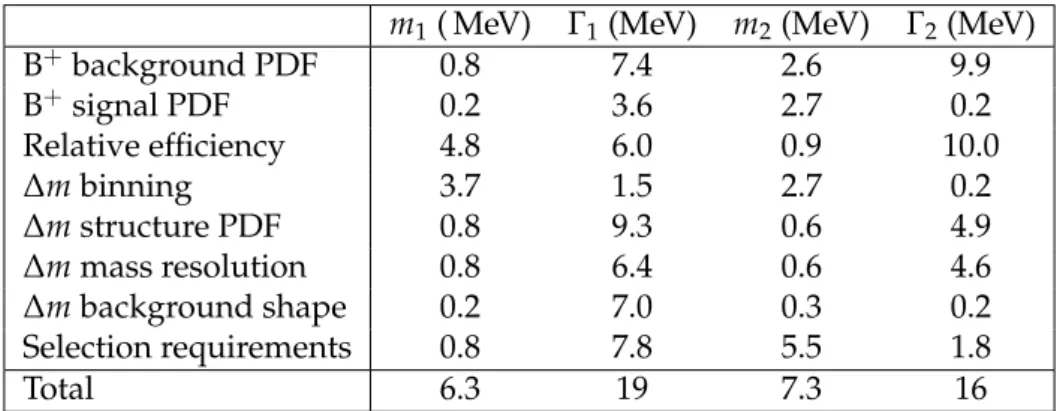
to Fig. 3, showing two peaking structures whose fitted mass and width values are consistent with the results from the nominal data sample. No indication of a possible bias is found. The estimations of the contributions to the systematic uncertainties in the mass and width mea-surements of the two structures shown in Table 1, are determined from several studies. The un-certainties owing to the probability density functions (PDFs) for the combinatorial background shape in the m(J/ψφK+)spectrum and the B+signal are studied by using different PDFs such as first- and third-degree polynomials, exponential functions, and a number of Gaussian func-tions. The uncertainties in the shape of the relative efficiency vs.∆m are evaluated by varying the relative efficiency in various bins and comparing with the 2D efficiencies for correction of m(J/ψφ)vs. m(φK+). The uncertainties caused by the binning of the∆m spectrum are studied
by using 10 MeV bins instead of 20 MeV bins. To estimate the uncertainty from the signal fitting function, we repeat the fit to the∆m distribution using either a nonrelativistic BW or a P-wave relativistic BW function for each structure. The uncertainties from the∆m mass resolution are studied by varying the mass resolution values obtained from simulation within their statistical uncertainties. To evaluate potential distortions in the∆m background shape caused by possible
φK+ resonances, we obtain the∆m background shape from data using an event-mixing
tech-nique by applying the same kinematic constraints and taking the φ and K+ candidates from the same event, but the J/ψ candidate from a different event. The uncertainties due to selection requirements are studied in the MC sample. The overall systematic uncertainties in the mea-surement of the masses and widths of the two structures are found by adding in quadrature the individual combinations summarized in Table 1.
Table 1: Systematic uncertainties in the measured masses and widths of the two peaking struc-tures from the sources listed and the total uncertainties.
m1( MeV) Γ1(MeV) m2(MeV) Γ2(MeV)
B+background PDF 0.8 7.4 2.6 9.9 B+signal PDF 0.2 3.6 2.7 0.2 Relative efficiency 4.8 6.0 0.9 10.0 ∆m binning 3.7 1.5 2.7 0.2 ∆m structure PDF 0.8 9.3 0.6 4.9 ∆m mass resolution 0.8 6.4 0.6 4.6 ∆m background shape 0.2 7.0 0.3 0.2 Selection requirements 0.8 7.8 5.5 1.8 Total 6.3 19 7.3 16
10 References
4
Summary
In summary, a peaking structure in the J/ψφ mass spectrum from B+ → J/ψφK+ decays has been observed in pp collisions at√s = 7 TeV by the CMS Collaboration at the LHC. Assum-ing an S-wave relativistic BW lineshape for this structure above a three-body PS shape for the nonresonant background, a statistical significance of greater than 5 standard deviations is found. Adding the J/ψ mass [24] to the extracted ∆m values, the mass and width are mea-sured to be m1 = 4148.0±2.4 (stat.)±6.3 (syst.) MeV and Γ1 = 28+−1511(stat.)±19 (syst.) MeV.
In addition, evidence for a second peaking structure is found in the same mass spectrum, with measured mass and width values of m2 = 4313.8±5.3 (stat.)±7.3 (syst.) MeV andΓ2 =
38+−3015(stat.)±16 (syst.) MeV. Because of possible reflections from two-body decays, the statis-tical significance of the second structure cannot be reliably determined. The two structures are well above the threshold of open charm (DD) decays and have relatively narrow widths. Con-ventional charmonium mesons with these masses would be expected to have larger widths and to decay predominantly into open charm pairs with small branching fractions into J/ψφ. An-gular analyses of the B+→J/ψφK+decays would help elucidate the nature of these structures. We congratulate our colleagues in the CERN accelerator departments for the excellent perfor-mance of the LHC and thank the technical and administrative staffs at CERN and at other CMS institutes for their contributions to the success of the CMS effort. In addition, we gratefully ac-knowledge the computing centres and personnel of the Worldwide LHC Computing Grid for delivering so effectively the computing infrastructure essential to our analyses. Finally, we ac-knowledge the enduring support for the construction and operation of the LHC and the CMS detector provided by the following funding agencies: BMWF and FWF (Austria); FNRS and FWO (Belgium); CNPq, CAPES, FAPERJ, and FAPESP (Brazil); MES (Bulgaria); CERN; CAS, MoST, and NSFC (China); COLCIENCIAS (Colombia); MSES (Croatia); RPF (Cyprus); MoER, SF0690030s09 and ERDF (Estonia); Academy of Finland, MEC, and HIP (Finland); CEA and CNRS/IN2P3 (France); BMBF, DFG, and HGF (Germany); GSRT (Greece); OTKA and NKTH (Hungary); DAE and DST (India); IPM (Iran); SFI (Ireland); INFN (Italy); NRF and WCU (Republic of Korea); LAS (Lithuania); CINVESTAV, CONACYT, SEP, and UASLP-FAI (Mex-ico); MBIE (New Zealand); PAEC (Pakistan); MSHE and NSC (Poland); FCT (Portugal); JINR (Dubna); MON, RosAtom, RAS and RFBR (Russia); MESTD (Serbia); SEIDI and CPAN (Spain); Swiss Funding Agencies (Switzerland); NSC (Taipei); ThEPCenter, IPST, STAR and NSTDA (Thailand); TUBITAK and TAEK (Turkey); NASU (Ukraine); STFC (United Kingdom); DOE and NSF (USA).
Individuals have received support from the Marie-Curie programme and the European Re-search Council and EPLANET (European Union); the Leventis Foundation; the A. P. Sloan Foundation; the Alexander von Humboldt Foundation; the Belgian Federal Science Policy Of-fice; the Fonds pour la Formation `a la Recherche dans l’Industrie et dans l’Agriculture (FRIA-Belgium); the Agentschap voor Innovatie door Wetenschap en Technologie (IWT-(FRIA-Belgium); the Ministry of Education, Youth and Sports (MEYS) of Czech Republic; the Council of Science and Industrial Research, India; the Compagnia di San Paolo (Torino); the HOMING PLUS pro-gramme of Foundation for Polish Science, cofinanced by EU, Regional Development Fund; and the Thalis and Aristeia programmes cofinanced by EU-ESF and the Greek NSRF.
References
[1] Belle Collaboration, “Observation of a new narrow charmonium state in exclusive B+→K+
doi:10.1103/PhysRevLett.91.262001, arXiv:hep-ex/0309032. [2] CDF Collaboration, “Observation of the narrow state X(3872) →J/ψπ+π−in ¯pp
collisions at√s = 1.96 TeV”, Phys. Rev. Lett. 93 (2004) 072001,
doi:10.1103/PhysRevLett.93.072001, arXiv:hep-ex/0312021.
[3] D0 Collaboration, “Observation and properties of the X(3872)decaying to J/ψπ+π−in
p ¯p collisions at√s = 1.96 TeV”, Phys. Rev. Lett. 93 (2004) 162002,
doi:10.1103/PhysRevLett.93.162002, arXiv:hep-ex/0405004.
[4] BaBar Collaboration, “Study of the B−→J/ψK−π+π−decay and measurement of the
B−→X(3872)K−branching fraction”, Phys. Rev. D 71 (2005) 071103, doi:10.1103/PhysRevD.71.071103, arXiv:hep-ex/0406022.
[5] Belle Collaboration, “Observation of a near-threshold ωJ/ψ mass enhancement in exclusive B→KωJ/ψ decays”, Phys. Rev. Lett. 94 (2005) 182002,
doi:10.1103/PhysRevLett.94.182002, arXiv:hep-ex/0408126.
[6] BaBar Collaboration, “Observation of Y(3940) →J/ψω in B→J/ψωK at BaBar”, Phys. Rev. Lett. 101 (2008) 082001, doi:10.1103/PhysRevLett.101.082001,
arXiv:0711.2047.
[7] S. L. Olsen, “Recent Results from BaBar, Belle, BESIII and CDF”, AIP Conf. Proc. 1343 (2011) 129, doi:10.1063/1.3574954, arXiv:1011.5307.
[8] N. Brambilla et al., “Heavy quarkonium: progress, puzzles, and opportunities”, Eur. Phys. J. C 71 (2011) 1534, doi:10.1140/epjc/s10052-010-1534-9,
arXiv:1010.5827.
[9] CDF Collaboration, “Evidence for a narrow near-threshold structure in the J/ψφ mass spectrum in B+→J/ψφK+decays”, Phys. Rev. Lett. 102 (2009) 242002,
doi:10.1103/PhysRevLett.102.242002, arXiv:0903.2229.
[10] X. Liu and S.-L. Zhu, “Y(4143)is probably a molecular partner of Y(3930)”, Phys. Rev. D 80(2009) 017502, doi:10.1103/PhysRevD.80.017502, arXiv:0903.2529. [11] N. Mahajan, “Y(4140): Possible options”, Phys. Lett. B 679 (2009) 228,
doi:10.1016/j.physletb.2009.07.043, arXiv:0903.3107.
[12] T. Branz, T. Gutsche, and V. E. Lyubovitskij, “Hadronic molecule structure of the Y(3940)
and Y(4140)”, Phys. Rev. D 80 (2009) 054019, doi:10.1103/PhysRevD.80.054019, arXiv:0903.5424.
[13] R. M. Albuquerque, M. E. Bracco, and M. Nielsen, “A QCD sum rule calculation for the Y(4140)narrow structure”, Phys. Lett. B 678 (2009) 186,
doi:10.1016/j.physletb.2009.06.022, arXiv:0903.5540.
[14] X. Liu, “The hidden charm decay of Y(4140)by the rescattering mechanism”, Phys. Lett. B 680 (2009) 137, doi:10.1016/j.physletb.2009.08.049, arXiv:0904.0136. [15] G.-J. Ding, “Possible molecular states of D∗sD∗s system and Y(4140)”, Eur. Phys. J. C 64
(2009) 297, doi:10.1140/epjc/s10052-009-1146-4, arXiv:0904.1782. [16] T. V. Uglov, “Recent results from Belle”, in Proceedings of 16th International Seminar on
12 References
[17] Belle Collaboration, “Evidence for a new resonance and search for the Y(4140)in
γγ→φJ/ψ”, Phys. Rev. Lett. 104 (2010) 112004,
doi:10.1103/PhysRevLett.104.112004, arXiv:0912.2383.
[18] LHCb Collaboration, “Search for the X(4140)state in B+→J/ψφK+decays”, Phys. Rev. D 85 (2012) 091103, doi:10.1103/PhysRevD.85.091103, arXiv:1202.5087. [19] CMS Collaboration, “Absolute Calibration of the Luminosity Measurement at CMS: Winter 2012 Update”, CMS Physics Analysis Summary CMS-PAS-SMP-12-008, (2012). [20] CMS Collaboration, “The CMS experiment at the CERN LHC”, JINST 3 (2008) S08004,
doi:10.1088/1748-0221/3/08/S08004.
[21] T. Sj ¨ostrand, S. Mrenna, and P. Skands, “PYTHIA 6.4 physics and manual”, JHEP 05 (2006) 026, doi:10.1088/1126-6708/2006/05/026, arXiv:hep-ph/0603175. [22] D. J. Lange, “The EvtGen particle decay simulation package”, Nucl. Instrum. Meth. A 462
(2001) 152, doi:10.1016/S0168-9002(01)00089-4.
[23] GEANT4 Collaboration, “GEANT4—a simulation toolkit”, Nucl. Instrum. Meth. A 506
(2003) 250, doi:10.1016/S0168-9002(03)01368-8.
[24] Particle Data Group, J. Beringer et al., “Review of Particle Physics”, Phys. Rev. D 86 (2012) 010001, doi:10.1103/PhysRevD.86.010001.
[25] CMS Collaboration, “CMS tracking performance results from early LHC operation”, Eur. Phys. J. C 70 (2010) 1165, doi:10.1140/epjc/s10052-010-1491-3,
arXiv:1007.1988.
[26] ACCMOR Collaboration, “Diffractive production of strange mesons at 63 GeV”, Nucl. Phys. B 187 (1981) 1, doi:10.1016/0550-3213(81)90114-0.
[27] Bari-Birmingham-CERN-Milan-Paris-Pavia Collaboration, “A partial-wave analysis of the Kφ system produced in the reaction K−p→K+K−K−p at 18.5 GeV/c”, Nucl. Phys. B 221(1983) 1, doi:10.1016/0550-3213(83)90616-8.
[28] D. Aston et al., “Evidence for two JP= 2−strange meson states in the K2(1770)region”,
Phys. Lett. B 308 (1993) 186, doi:10.1016/0370-2693(93)90620-W.
[29] M. Pivk and F. R. Le Diberder, “sPlot: A statistical tool to unfold data distributions”, Nucl. Instrum. Meth. A 555 (2005) 356, doi:10.1016/j.nima.2005.08.106, arXiv:physics/0402083.
A
The CMS Collaboration
Yerevan Physics Institute, Yerevan, Armenia
S. Chatrchyan, V. Khachatryan, A.M. Sirunyan, A. Tumasyan Institut f ¨ur Hochenergiephysik der OeAW, Wien, Austria
W. Adam, T. Bergauer, M. Dragicevic, J. Er ¨o, C. Fabjan1, M. Friedl, R. Fr ¨uhwirth1, V.M. Ghete, N. H ¨ormann, J. Hrubec, M. Jeitler1, W. Kiesenhofer, V. Kn ¨unz, M. Krammer1, I. Kr¨atschmer, D. Liko, I. Mikulec, D. Rabady2, B. Rahbaran, C. Rohringer, H. Rohringer, R. Sch ¨ofbeck,
J. Strauss, A. Taurok, W. Treberer-Treberspurg, W. Waltenberger, C.-E. Wulz1 National Centre for Particle and High Energy Physics, Minsk, Belarus V. Mossolov, N. Shumeiko, J. Suarez Gonzalez
Universiteit Antwerpen, Antwerpen, Belgium
S. Alderweireldt, M. Bansal, S. Bansal, T. Cornelis, E.A. De Wolf, X. Janssen, A. Knutsson, S. Luyckx, L. Mucibello, S. Ochesanu, B. Roland, R. Rougny, Z. Staykova, H. Van Haevermaet, P. Van Mechelen, N. Van Remortel, A. Van Spilbeeck
Vrije Universiteit Brussel, Brussel, Belgium
F. Blekman, S. Blyweert, J. D’Hondt, A. Kalogeropoulos, J. Keaveney, M. Maes, A. Olbrechts, S. Tavernier, W. Van Doninck, P. Van Mulders, G.P. Van Onsem, I. Villella
Universit´e Libre de Bruxelles, Bruxelles, Belgium
B. Clerbaux, G. De Lentdecker, L. Favart, A.P.R. Gay, T. Hreus, A. L´eonard, P.E. Marage, A. Mohammadi, L. Perni`e, T. Reis, T. Seva, L. Thomas, C. Vander Velde, P. Vanlaer, J. Wang Ghent University, Ghent, Belgium
V. Adler, K. Beernaert, L. Benucci, A. Cimmino, S. Costantini, S. Dildick, G. Garcia, B. Klein, J. Lellouch, A. Marinov, J. Mccartin, A.A. Ocampo Rios, D. Ryckbosch, M. Sigamani, N. Strobbe, F. Thyssen, M. Tytgat, S. Walsh, E. Yazgan, N. Zaganidis
Universit´e Catholique de Louvain, Louvain-la-Neuve, Belgium
S. Basegmez, C. Beluffi3, G. Bruno, R. Castello, A. Caudron, L. Ceard, C. Delaere, T. du Pree, D. Favart, L. Forthomme, A. Giammanco4, J. Hollar, P. Jez, V. Lemaitre, J. Liao, O. Militaru, C. Nuttens, D. Pagano, A. Pin, K. Piotrzkowski, A. Popov5, M. Selvaggi, J.M. Vizan Garcia Universit´e de Mons, Mons, Belgium
N. Beliy, T. Caebergs, E. Daubie, G.H. Hammad
Centro Brasileiro de Pesquisas Fisicas, Rio de Janeiro, Brazil
G.A. Alves, M. Correa Martins Junior, T. Martins, M.E. Pol, M.H.G. Souza Universidade do Estado do Rio de Janeiro, Rio de Janeiro, Brazil
W.L. Ald´a J ´unior, W. Carvalho, J. Chinellato6, A. Cust ´odio, E.M. Da Costa, D. De Jesus Damiao, C. De Oliveira Martins, S. Fonseca De Souza, H. Malbouisson, M. Malek, D. Matos Figueiredo, L. Mundim, H. Nogima, W.L. Prado Da Silva, A. Santoro, A. Sznajder, E.J. Tonelli Manganote6,
A. Vilela Pereira
Universidade Estadual Paulistaa, Universidade Federal do ABCb, S˜ao Paulo, Brazil
C.A. Bernardesb, F.A. Diasa,7, T.R. Fernandez Perez Tomeia, E.M. Gregoresb, C. Laganaa, F. Marinhoa, P.G. Mercadanteb, S.F. Novaesa, Sandra S. Padulaa
Institute for Nuclear Research and Nuclear Energy, Sofia, Bulgaria V. Genchev2, P. Iaydjiev2, S. Piperov, M. Rodozov, G. Sultanov, M. Vutova
14 A The CMS Collaboration
University of Sofia, Sofia, Bulgaria
A. Dimitrov, R. Hadjiiska, V. Kozhuharov, L. Litov, B. Pavlov, P. Petkov Institute of High Energy Physics, Beijing, China
J.G. Bian, G.M. Chen, H.S. Chen, C.H. Jiang, D. Liang, S. Liang, X. Meng, J. Tao, J. Wang, X. Wang, Z. Wang, H. Xiao, M. Xu
State Key Laboratory of Nuclear Physics and Technology, Peking University, Beijing, China C. Asawatangtrakuldee, Y. Ban, Y. Guo, W. Li, S. Liu, Y. Mao, S.J. Qian, H. Teng, D. Wang, L. Zhang, W. Zou
Universidad de Los Andes, Bogota, Colombia
C. Avila, C.A. Carrillo Montoya, L.F. Chaparro Sierra, J.P. Gomez, B. Gomez Moreno, J.C. Sanabria
Technical University of Split, Split, Croatia
N. Godinovic, D. Lelas, R. Plestina8, D. Polic, I. Puljak University of Split, Split, Croatia
Z. Antunovic, M. Kovac
Institute Rudjer Boskovic, Zagreb, Croatia
V. Brigljevic, S. Duric, K. Kadija, J. Luetic, D. Mekterovic, S. Morovic, L. Tikvica University of Cyprus, Nicosia, Cyprus
A. Attikis, G. Mavromanolakis, J. Mousa, C. Nicolaou, F. Ptochos, P.A. Razis Charles University, Prague, Czech Republic
M. Finger, M. Finger Jr.
Academy of Scientific Research and Technology of the Arab Republic of Egypt, Egyptian Network of High Energy Physics, Cairo, Egypt
A.A. Abdelalim9, Y. Assran10, S. Elgammal9, A. Ellithi Kamel11, M.A. Mahmoud12, A. Radi13,14 National Institute of Chemical Physics and Biophysics, Tallinn, Estonia
M. Kadastik, M. M ¨untel, M. Murumaa, M. Raidal, L. Rebane, A. Tiko Department of Physics, University of Helsinki, Helsinki, Finland P. Eerola, G. Fedi, M. Voutilainen
Helsinki Institute of Physics, Helsinki, Finland
J. H¨ark ¨onen, V. Karim¨aki, R. Kinnunen, M.J. Kortelainen, T. Lamp´en, K. Lassila-Perini, S. Lehti, T. Lind´en, P. Luukka, T. M¨aenp¨a¨a, T. Peltola, E. Tuominen, J. Tuominiemi, E. Tuovinen, L. Wendland
Lappeenranta University of Technology, Lappeenranta, Finland A. Korpela, T. Tuuva
DSM/IRFU, CEA/Saclay, Gif-sur-Yvette, France
M. Besancon, S. Choudhury, F. Couderc, M. Dejardin, D. Denegri, B. Fabbro, J.L. Faure, F. Ferri, S. Ganjour, A. Givernaud, P. Gras, G. Hamel de Monchenault, P. Jarry, E. Locci, J. Malcles, L. Millischer, A. Nayak, J. Rander, A. Rosowsky, M. Titov
Laboratoire Leprince-Ringuet, Ecole Polytechnique, IN2P3-CNRS, Palaiseau, France
S. Baffioni, F. Beaudette, L. Benhabib, L. Bianchini, M. Bluj15, P. Busson, C. Charlot, N. Daci, T. Dahms, M. Dalchenko, L. Dobrzynski, A. Florent, R. Granier de Cassagnac, M. Haguenauer,
P. Min´e, C. Mironov, I.N. Naranjo, M. Nguyen, C. Ochando, P. Paganini, D. Sabes, R. Salerno, Y. Sirois, C. Veelken, A. Zabi
Institut Pluridisciplinaire Hubert Curien, Universit´e de Strasbourg, Universit´e de Haute Alsace Mulhouse, CNRS/IN2P3, Strasbourg, France
J.-L. Agram16, J. Andrea, D. Bloch, D. Bodin, J.-M. Brom, E.C. Chabert, C. Collard, E. Conte16, F. Drouhin16, J.-C. Fontaine16, D. Gel´e, U. Goerlach, C. Goetzmann, P. Juillot, A.-C. Le Bihan, P. Van Hove
Centre de Calcul de l’Institut National de Physique Nucleaire et de Physique des Particules, CNRS/IN2P3, Villeurbanne, France
S. Gadrat
Universit´e de Lyon, Universit´e Claude Bernard Lyon 1, CNRS-IN2P3, Institut de Physique Nucl´eaire de Lyon, Villeurbanne, France
S. Beauceron, N. Beaupere, G. Boudoul, S. Brochet, J. Chasserat, R. Chierici, D. Contardo, P. Depasse, H. El Mamouni, J. Fay, S. Gascon, M. Gouzevitch, B. Ille, T. Kurca, M. Lethuillier, L. Mirabito, S. Perries, L. Sgandurra, V. Sordini, Y. Tschudi, M. Vander Donckt, P. Verdier, S. Viret
Institute of High Energy Physics and Informatization, Tbilisi State University, Tbilisi, Georgia
Z. Tsamalaidze17
RWTH Aachen University, I. Physikalisches Institut, Aachen, Germany
C. Autermann, S. Beranek, B. Calpas, M. Edelhoff, L. Feld, N. Heracleous, O. Hindrichs, K. Klein, A. Ostapchuk, A. Perieanu, F. Raupach, J. Sammet, S. Schael, D. Sprenger, H. Weber, B. Wittmer, V. Zhukov5
RWTH Aachen University, III. Physikalisches Institut A, Aachen, Germany
M. Ata, J. Caudron, E. Dietz-Laursonn, D. Duchardt, M. Erdmann, R. Fischer, A. G ¨uth, T. Hebbeker, C. Heidemann, K. Hoepfner, D. Klingebiel, P. Kreuzer, M. Merschmeyer, A. Meyer, M. Olschewski, K. Padeken, P. Papacz, H. Pieta, H. Reithler, S.A. Schmitz, L. Sonnenschein, J. Steggemann, D. Teyssier, S. Th ¨uer, M. Weber
RWTH Aachen University, III. Physikalisches Institut B, Aachen, Germany
V. Cherepanov, Y. Erdogan, G. Fl ¨ugge, H. Geenen, M. Geisler, W. Haj Ahmad, F. Hoehle, B. Kargoll, T. Kress, Y. Kuessel, J. Lingemann2, A. Nowack, I.M. Nugent, L. Perchalla, O. Pooth, A. Stahl
Deutsches Elektronen-Synchrotron, Hamburg, Germany
M. Aldaya Martin, I. Asin, N. Bartosik, J. Behr, W. Behrenhoff, U. Behrens, M. Bergholz18,
A. Bethani, K. Borras, A. Burgmeier, A. Cakir, L. Calligaris, A. Campbell, F. Costanza, C. Diez Pardos, S. Dooling, T. Dorland, G. Eckerlin, D. Eckstein, G. Flucke, A. Geiser, I. Glushkov, P. Gunnellini, S. Habib, J. Hauk, G. Hellwig, H. Jung, M. Kasemann, P. Katsas, C. Kleinwort, H. Kluge, M. Kr¨amer, D. Kr ¨ucker, E. Kuznetsova, W. Lange, J. Leonard, K. Lipka, W. Lohmann18, B. Lutz, R. Mankel, I. Marfin, I.-A. Melzer-Pellmann, A.B. Meyer, J. Mnich, A. Mussgiller, S. Naumann-Emme, O. Novgorodova, F. Nowak, J. Olzem, H. Perrey, A. Petrukhin, D. Pitzl, R. Placakyte, A. Raspereza, P.M. Ribeiro Cipriano, C. Riedl, E. Ron, M. ¨O. Sahin, J. Salfeld-Nebgen, R. Schmidt18, T. Schoerner-Sadenius, N. Sen, M. Stein, R. Walsh, C. Wissing
University of Hamburg, Hamburg, Germany
16 A The CMS Collaboration
R.S. H ¨oing, G. Kaussen, H. Kirschenmann, R. Klanner, R. Kogler, J. Lange, I. Marchesini, T. Peiffer, N. Pietsch, D. Rathjens, C. Sander, H. Schettler, P. Schleper, E. Schlieckau, A. Schmidt, M. Schr ¨oder, T. Schum, M. Seidel, J. Sibille19, V. Sola, H. Stadie, G. Steinbr ¨uck, J. Thomsen, D. Troendle, L. Vanelderen
Institut f ¨ur Experimentelle Kernphysik, Karlsruhe, Germany
C. Barth, C. Baus, J. Berger, C. B ¨oser, T. Chwalek, W. De Boer, A. Descroix, A. Dierlamm, M. Feindt, M. Guthoff2, F. Hartmann2, T. Hauth2, H. Held, K.H. Hoffmann, U. Husemann, I. Katkov5, J.R. Komaragiri, A. Kornmayer2, P. Lobelle Pardo, D. Martschei, Th. M ¨uller, M. Niegel, A. N ¨urnberg, O. Oberst, J. Ott, G. Quast, K. Rabbertz, F. Ratnikov, S. R ¨ocker, F.-P. Schilling, G. Schott, H.J. Simonis, F.M. Stober, R. Ulrich, J. Wagner-Kuhr, S. Wayand, T. Weiler, M. Zeise
Institute of Nuclear and Particle Physics (INPP), NCSR Demokritos, Aghia Paraskevi, Greece
G. Anagnostou, G. Daskalakis, T. Geralis, S. Kesisoglou, A. Kyriakis, D. Loukas, A. Markou, C. Markou, E. Ntomari
University of Athens, Athens, Greece
L. Gouskos, T.J. Mertzimekis, A. Panagiotou, N. Saoulidou, E. Stiliaris University of Io´annina, Io´annina, Greece
X. Aslanoglou, I. Evangelou, G. Flouris, C. Foudas, P. Kokkas, N. Manthos, I. Papadopoulos, E. Paradas
KFKI Research Institute for Particle and Nuclear Physics, Budapest, Hungary
G. Bencze, C. Hajdu, P. Hidas, D. Horvath20, B. Radics, F. Sikler, V. Veszpremi,
G. Vesztergombi21, A.J. Zsigmond
Institute of Nuclear Research ATOMKI, Debrecen, Hungary N. Beni, S. Czellar, J. Molnar, J. Palinkas, Z. Szillasi
University of Debrecen, Debrecen, Hungary J. Karancsi, P. Raics, Z.L. Trocsanyi, B. Ujvari
National Institute of Science Education and Research, Bhubaneswar, India S.K. Swain22
Panjab University, Chandigarh, India
S.B. Beri, V. Bhatnagar, N. Dhingra, R. Gupta, M. Kaur, M.Z. Mehta, M. Mittal, N. Nishu, L.K. Saini, A. Sharma, J.B. Singh
University of Delhi, Delhi, India
Ashok Kumar, Arun Kumar, S. Ahuja, A. Bhardwaj, B.C. Choudhary, S. Malhotra, M. Naimuddin, K. Ranjan, P. Saxena, V. Sharma, R.K. Shivpuri
Saha Institute of Nuclear Physics, Kolkata, India
S. Banerjee, S. Bhattacharya, K. Chatterjee, S. Dutta, B. Gomber, Sa. Jain, Sh. Jain, R. Khurana, A. Modak, S. Mukherjee, D. Roy, S. Sarkar, M. Sharan, A.P. Singh
Bhabha Atomic Research Centre, Mumbai, India
A. Abdulsalam, D. Dutta, S. Kailas, V. Kumar, A.K. Mohanty2, L.M. Pant, P. Shukla, A. Topkar Tata Institute of Fundamental Research - EHEP, Mumbai, India
S. Kumar, M. Maity25, G. Majumder, K. Mazumdar, G.B. Mohanty, B. Parida, K. Sudhakar, N. Wickramage26
Tata Institute of Fundamental Research - HECR, Mumbai, India S. Banerjee, S. Dugad
Institute for Research in Fundamental Sciences (IPM), Tehran, Iran
H. Arfaei27, H. Bakhshiansohi, S.M. Etesami28, A. Fahim27, H. Hesari, A. Jafari, M. Khakzad, M. Mohammadi Najafabadi, S. Paktinat Mehdiabadi, B. Safarzadeh29, M. Zeinali
University College Dublin, Dublin, Ireland M. Grunewald
INFN Sezione di Baria, Universit`a di Barib, Politecnico di Baric, Bari, Italy
M. Abbresciaa,b, L. Barbonea,b, C. Calabriaa,b, S.S. Chhibraa,b, A. Colaleoa, D. Creanzaa,c, N. De Filippisa,c, M. De Palmaa,b, L. Fiorea, G. Iasellia,c, G. Maggia,c, M. Maggia, B. Marangellia,b, S. Mya,c, S. Nuzzoa,b, N. Pacificoa, A. Pompilia,b, G. Pugliesea,c, G. Selvaggia,b, L. Silvestrisa, G. Singha,b, R. Vendittia,b, P. Verwilligena, G. Zitoa
INFN Sezione di Bolognaa, Universit`a di Bolognab, Bologna, Italy
G. Abbiendia, A.C. Benvenutia, D. Bonacorsia,b, S. Braibant-Giacomellia,b, L. Brigliadoria,b, R. Campaninia,b, P. Capiluppia,b, A. Castroa,b, F.R. Cavalloa, M. Cuffiania,b, G.M. Dallavallea, F. Fabbria, A. Fanfania,b, D. Fasanellaa,b, P. Giacomellia, C. Grandia, L. Guiduccia,b, S. Marcellinia, G. Masettia,2, M. Meneghellia,b, A. Montanaria, F.L. Navarriaa,b, F. Odoricia, A. Perrottaa, F. Primaveraa,b, A.M. Rossia,b, T. Rovellia,b, G.P. Sirolia,b, N. Tosia,b, R. Travaglinia,b INFN Sezione di Cataniaa, Universit`a di Cataniab, Catania, Italy
S. Albergoa,b, M. Chiorbolia,b, S. Costaa,b, F. Giordanoa,2, R. Potenzaa,b, A. Tricomia,b, C. Tuvea,b INFN Sezione di Firenzea, Universit`a di Firenzeb, Firenze, Italy
G. Barbaglia, V. Ciullia,b, C. Civininia, R. D’Alessandroa,b, E. Focardia,b, S. Frosalia,b, E. Galloa, S. Gonzia,b, V. Goria,b, P. Lenzia,b, M. Meschinia, S. Paolettia, G. Sguazzonia, A. Tropianoa,b INFN Laboratori Nazionali di Frascati, Frascati, Italy
L. Benussi, S. Bianco, F. Fabbri, D. Piccolo
INFN Sezione di Genovaa, Universit`a di Genovab, Genova, Italy P. Fabbricatorea, R. Musenicha, S. Tosia,b
INFN Sezione di Milano-Bicoccaa, Universit`a di Milano-Bicoccab, Milano, Italy
A. Benagliaa, F. De Guioa,b, L. Di Matteoa,b, S. Fiorendia,b, S. Gennaia, A. Ghezzia,b, P. Govonia,b, M.T. Lucchinia,b,2, S. Malvezzia, R.A. Manzonia,b,2, A. Martellia,b,2, D. Menascea, L. Moronia,
M. Paganonia,b, D. Pedrinia, S. Ragazzia,b, N. Redaellia, T. Tabarelli de Fatisa,b
INFN Sezione di Napoli a, Universit`a di Napoli ’Federico II’ b, Universit`a della Basilicata (Potenza)c, Universit`a G. Marconi (Roma)d, Napoli, Italy
S. Buontempoa, N. Cavalloa,c, A. De Cosaa,b, F. Fabozzia,c, A.O.M. Iorioa,b, L. Listaa, S. Meolaa,d,2, M. Merolaa, P. Paoluccia,2
INFN Sezione di Padovaa, Universit`a di Padovab, Universit`a di Trento (Trento)c, Padova, Italy
P. Azzia, N. Bacchettaa, M. Bellatoa, D. Biselloa,b, A. Brancaa,b, R. Carlina,b, P. Checchiaa, T. Dorigoa, M. Galantia,b,2, F. Gasparinia,b, U. Gasparinia,b, P. Giubilatoa,b, F. Gonellaa, A. Gozzelinoa, K. Kanishcheva,c, S. Lacapraraa, I. Lazzizzeraa,c, M. Margonia,b,
18 A The CMS Collaboration
A.T. Meneguzzoa,b, F. Montecassianoa, J. Pazzinia,b, N. Pozzobona,b, P. Ronchesea,b, F. Simonettoa,b, E. Torassaa, M. Tosia,b, S. Vaninia,b, P. Zottoa,b, A. Zucchettaa,b, G. Zumerlea,b INFN Sezione di Paviaa, Universit`a di Paviab, Pavia, Italy
M. Gabusia,b, S.P. Rattia,b, C. Riccardia,b, P. Vituloa,b
INFN Sezione di Perugiaa, Universit`a di Perugiab, Perugia, Italy
M. Biasinia,b, G.M. Bileia, L. Fan `oa,b, P. Laricciaa,b, G. Mantovania,b, M. Menichellia, A. Nappia,b†, F. Romeoa,b, A. Sahaa, A. Santocchiaa,b, A. Spieziaa,b
INFN Sezione di Pisaa, Universit`a di Pisab, Scuola Normale Superiore di Pisac, Pisa, Italy K. Androsova,30, P. Azzurria, G. Bagliesia, J. Bernardinia, T. Boccalia, G. Broccoloa,c, R. Castaldia,
R.T. D’Agnoloa,c,2, R. Dell’Orsoa, F. Fioria,c, L. Fo`aa,c, A. Giassia, M.T. Grippoa,30, A. Kraana, F. Ligabuea,c, T. Lomtadzea, L. Martinia,30, A. Messineoa,b, F. Pallaa, A. Rizzia,b, A.T. Serbana, P. Spagnoloa, P. Squillaciotia, R. Tenchinia, G. Tonellia,b, A. Venturia, P.G. Verdinia, C. Vernieria,c INFN Sezione di Romaa, Universit`a di Romab, Roma, Italy
L. Baronea,b, F. Cavallaria, D. Del Rea,b, M. Diemoza, M. Grassia,b,2, E. Longoa,b, F. Margarolia,b, P. Meridiania, F. Michelia,b, S. Nourbakhsha,b, G. Organtinia,b, R. Paramattia, S. Rahatloua,b, L. Soffia,b
INFN Sezione di Torino a, Universit`a di Torino b, Universit`a del Piemonte Orientale (No-vara)c, Torino, Italy
N. Amapanea,b, R. Arcidiaconoa,c, S. Argiroa,b, M. Arneodoa,c, C. Biinoa, N. Cartigliaa, S. Casassoa,b, M. Costaa,b, N. Demariaa, C. Mariottia, S. Masellia, E. Migliorea,b, V. Monacoa,b, M. Musicha, M.M. Obertinoa,c, G. Ortonaa,b, N. Pastronea, M. Pelliccionia,2, A. Potenzaa,b, A. Romeroa,b, M. Ruspaa,c, R. Sacchia,b, A. Solanoa,b, A. Staianoa, U. Tamponia
INFN Sezione di Triestea, Universit`a di Triesteb, Trieste, Italy
S. Belfortea, V. Candelisea,b, M. Casarsaa, F. Cossuttia,2, G. Della Riccaa,b, B. Gobboa, C. La Licataa,b, M. Maronea,b, D. Montaninoa,b, A. Penzoa, A. Schizzia,b, A. Zanettia
Kangwon National University, Chunchon, Korea S. Chang, T.Y. Kim, S.K. Nam
Kyungpook National University, Daegu, Korea
D.H. Kim, G.N. Kim, J.E. Kim, D.J. Kong, Y.D. Oh, H. Park, D.C. Son
Chonnam National University, Institute for Universe and Elementary Particles, Kwangju, Korea
J.Y. Kim, Zero J. Kim, S. Song Korea University, Seoul, Korea
S. Choi, D. Gyun, B. Hong, M. Jo, H. Kim, T.J. Kim, K.S. Lee, S.K. Park, Y. Roh University of Seoul, Seoul, Korea
M. Choi, J.H. Kim, C. Park, I.C. Park, S. Park, G. Ryu Sungkyunkwan University, Suwon, Korea
Y. Choi, Y.K. Choi, J. Goh, M.S. Kim, E. Kwon, B. Lee, J. Lee, S. Lee, H. Seo, I. Yu Vilnius University, Vilnius, Lithuania
Centro de Investigacion y de Estudios Avanzados del IPN, Mexico City, Mexico
H. Castilla-Valdez, E. De La Cruz-Burelo, I. Heredia-de La Cruz31, R. Lopez-Fernandez, J. Mart´ınez-Ortega, A. Sanchez-Hernandez, L.M. Villasenor-Cendejas
Universidad Iberoamericana, Mexico City, Mexico S. Carrillo Moreno, F. Vazquez Valencia
Benemerita Universidad Autonoma de Puebla, Puebla, Mexico H.A. Salazar Ibarguen
Universidad Aut ´onoma de San Luis Potos´ı, San Luis Potos´ı, Mexico E. Casimiro Linares, A. Morelos Pineda, M.A. Reyes-Santos
University of Auckland, Auckland, New Zealand D. Krofcheck
University of Canterbury, Christchurch, New Zealand A.J. Bell, P.H. Butler, R. Doesburg, S. Reucroft, H. Silverwood
National Centre for Physics, Quaid-I-Azam University, Islamabad, Pakistan
M. Ahmad, M.I. Asghar, J. Butt, H.R. Hoorani, S. Khalid, W.A. Khan, T. Khurshid, S. Qazi, M.A. Shah, M. Shoaib
National Centre for Nuclear Research, Swierk, Poland
H. Bialkowska, B. Boimska, T. Frueboes, M. G ´orski, M. Kazana, K. Nawrocki, K. Romanowska-Rybinska, M. Szleper, G. Wrochna, P. Zalewski
Institute of Experimental Physics, Faculty of Physics, University of Warsaw, Warsaw, Poland G. Brona, K. Bunkowski, M. Cwiok, W. Dominik, K. Doroba, A. Kalinowski, M. Konecki, J. Krolikowski, M. Misiura, W. Wolszczak
Laborat ´orio de Instrumenta¸c˜ao e F´ısica Experimental de Part´ıculas, Lisboa, Portugal
N. Almeida, P. Bargassa, A. David, P. Faccioli, P.G. Ferreira Parracho, M. Gallinaro, J. Rodrigues Antunes, J. Seixas2, J. Varela, P. Vischia
Joint Institute for Nuclear Research, Dubna, Russia
S. Afanasiev, P. Bunin, I. Golutvin, I. Gorbunov, A. Kamenev, V. Karjavin, V. Konoplyanikov, G. Kozlov, A. Lanev, A. Malakhov, V. Matveev, P. Moisenz, V. Palichik, V. Perelygin, S. Shmatov, N. Skatchkov, V. Smirnov, A. Zarubin
Petersburg Nuclear Physics Institute, Gatchina (St. Petersburg), Russia
S. Evstyukhin, V. Golovtsov, Y. Ivanov, V. Kim, P. Levchenko, V. Murzin, V. Oreshkin, I. Smirnov, V. Sulimov, L. Uvarov, S. Vavilov, A. Vorobyev, An. Vorobyev
Institute for Nuclear Research, Moscow, Russia
Yu. Andreev, A. Dermenev, S. Gninenko, N. Golubev, M. Kirsanov, N. Krasnikov, A. Pashenkov, D. Tlisov, A. Toropin
Institute for Theoretical and Experimental Physics, Moscow, Russia
V. Epshteyn, M. Erofeeva, V. Gavrilov, N. Lychkovskaya, V. Popov, G. Safronov, S. Semenov, A. Spiridonov, V. Stolin, E. Vlasov, A. Zhokin
P.N. Lebedev Physical Institute, Moscow, Russia
V. Andreev, M. Azarkin, I. Dremin, M. Kirakosyan, A. Leonidov, G. Mesyats, S.V. Rusakov, A. Vinogradov
20 A The CMS Collaboration
Skobeltsyn Institute of Nuclear Physics, Lomonosov Moscow State University, Moscow, Russia
A. Belyaev, E. Boos, M. Dubinin7, L. Dudko, A. Ershov, A. Gribushin, V. Klyukhin, O. Kodolova, I. Lokhtin, A. Markina, S. Obraztsov, S. Petrushanko, V. Savrin, A. Snigirev
State Research Center of Russian Federation, Institute for High Energy Physics, Protvino, Russia
I. Azhgirey, I. Bayshev, S. Bitioukov, V. Kachanov, A. Kalinin, D. Konstantinov, V. Krychkine, V. Petrov, R. Ryutin, A. Sobol, L. Tourtchanovitch, S. Troshin, N. Tyurin, A. Uzunian, A. Volkov University of Belgrade, Faculty of Physics and Vinca Institute of Nuclear Sciences, Belgrade, Serbia
P. Adzic32, M. Djordjevic, M. Ekmedzic, D. Krpic32, J. Milosevic
Centro de Investigaciones Energ´eticas Medioambientales y Tecnol ´ogicas (CIEMAT), Madrid, Spain
M. Aguilar-Benitez, J. Alcaraz Maestre, C. Battilana, E. Calvo, M. Cerrada, M. Chamizo Llatas2, N. Colino, B. De La Cruz, A. Delgado Peris, D. Dom´ınguez V´azquez, C. Fernandez Bedoya, J.P. Fern´andez Ramos, A. Ferrando, J. Flix, M.C. Fouz, P. Garcia-Abia, O. Gonzalez Lopez, S. Goy Lopez, J.M. Hernandez, M.I. Josa, G. Merino, E. Navarro De Martino, J. Puerta Pelayo, A. Quintario Olmeda, I. Redondo, L. Romero, J. Santaolalla, M.S. Soares, C. Willmott
Universidad Aut ´onoma de Madrid, Madrid, Spain C. Albajar, J.F. de Troc ´oniz
Universidad de Oviedo, Oviedo, Spain
H. Brun, J. Cuevas, J. Fernandez Menendez, S. Folgueras, I. Gonzalez Caballero, L. Lloret Iglesias, J. Piedra Gomez
Instituto de F´ısica de Cantabria (IFCA), CSIC-Universidad de Cantabria, Santander, Spain J.A. Brochero Cifuentes, I.J. Cabrillo, A. Calderon, S.H. Chuang, J. Duarte Campderros, M. Fernandez, G. Gomez, J. Gonzalez Sanchez, A. Graziano, C. Jorda, A. Lopez Virto, J. Marco, R. Marco, C. Martinez Rivero, F. Matorras, F.J. Munoz Sanchez, T. Rodrigo, A.Y. Rodr´ıguez-Marrero, A. Ruiz-Jimeno, L. Scodellaro, I. Vila, R. Vilar Cortabitarte
CERN, European Organization for Nuclear Research, Geneva, Switzerland
D. Abbaneo, E. Auffray, G. Auzinger, M. Bachtis, P. Baillon, A.H. Ball, D. Barney, J. Bendavid, J.F. Benitez, C. Bernet8, G. Bianchi, P. Bloch, A. Bocci, A. Bonato, O. Bondu, C. Botta, H. Breuker, T. Camporesi, G. Cerminara, T. Christiansen, J.A. Coarasa Perez, S. Colafranceschi33, D. d’Enterria, A. Dabrowski, A. De Roeck, S. De Visscher, S. Di Guida, M. Dobson, N. Dupont-Sagorin, A. Elliott-Peisert, J. Eugster, W. Funk, G. Georgiou, M. Giffels, D. Gigi, K. Gill, D. Giordano, M. Girone, M. Giunta, F. Glege, R. Gomez-Reino Garrido, S. Gowdy, R. Guida, J. Hammer, M. Hansen, P. Harris, C. Hartl, A. Hinzmann, V. Innocente, P. Janot, E. Karavakis, K. Kousouris, K. Krajczar, P. Lecoq, Y.-J. Lee, C. Lourenc¸o, N. Magini, M. Malberti, L. Malgeri, M. Mannelli, L. Masetti, F. Meijers, S. Mersi, E. Meschi, L. Moneta, R. Moser, M. Mulders, P. Musella, E. Nesvold, L. Orsini, E. Palencia Cortezon, E. Perez, L. Perrozzi, A. Petrilli, A. Pfeiffer, M. Pierini, M. Pimi¨a, D. Piparo, M. Plagge, G. Polese, L. Quertenmont, A. Racz, W. Reece, G. Rolandi34, C. Rovelli35, M. Rovere, H. Sakulin, F. Santanastasio, C. Sch¨afer, C. Schwick, I. Segoni, S. Sekmen, A. Sharma, P. Siegrist, P. Silva, M. Simon, P. Sphicas36, D. Spiga, M. Stoye, A. Tsirou, G.I. Veres21, J.R. Vlimant, H.K. W ¨ohri, S.D. Worm37, W.D. Zeuner Paul Scherrer Institut, Villigen, Switzerland
W. Bertl, K. Deiters, W. Erdmann, K. Gabathuler, R. Horisberger, Q. Ingram, H.C. Kaestli, S. K ¨onig, D. Kotlinski, U. Langenegger, D. Renker, T. Rohe
Institute for Particle Physics, ETH Zurich, Zurich, Switzerland
F. Bachmair, L. B¨ani, P. Bortignon, M.A. Buchmann, B. Casal, N. Chanon, A. Deisher, G. Dissertori, M. Dittmar, M. Doneg`a, M. D ¨unser, P. Eller, K. Freudenreich, C. Grab, D. Hits, P. Lecomte, W. Lustermann, A.C. Marini, P. Martinez Ruiz del Arbol, N. Mohr, F. Moortgat, C. N¨ageli38, P. Nef, F. Nessi-Tedaldi, F. Pandolfi, L. Pape, F. Pauss, M. Peruzzi, F.J. Ronga, M. Rossini, L. Sala, A.K. Sanchez, A. Starodumov39, B. Stieger, M. Takahashi, L. Tauscher†, A. Thea, K. Theofilatos, D. Treille, C. Urscheler, R. Wallny, H.A. Weber
Universit¨at Z ¨urich, Zurich, Switzerland
C. Amsler40, V. Chiochia, C. Favaro, M. Ivova Rikova, B. Kilminster, B. Millan Mejias, P. Otiougova, P. Robmann, H. Snoek, S. Taroni, S. Tupputi, M. Verzetti
National Central University, Chung-Li, Taiwan
M. Cardaci, K.H. Chen, C. Ferro, C.M. Kuo, S.W. Li, W. Lin, Y.J. Lu, R. Volpe, S.S. Yu National Taiwan University (NTU), Taipei, Taiwan
P. Bartalini, P. Chang, Y.H. Chang, Y.W. Chang, Y. Chao, K.F. Chen, C. Dietz, U. Grundler, W.-S. Hou, Y. Hsiung, K.Y. Kao, Y.J. Lei, R.-W.-S. Lu, D. Majumder, E. Petrakou, X. Shi, J.G. Shiu, Y.M. Tzeng, M. Wang
Chulalongkorn University, Bangkok, Thailand B. Asavapibhop, N. Suwonjandee
Cukurova University, Adana, Turkey
A. Adiguzel, M.N. Bakirci41, S. Cerci42, C. Dozen, I. Dumanoglu, E. Eskut, S. Girgis, G. Gokbulut, E. Gurpinar, I. Hos, E.E. Kangal, A. Kayis Topaksu, G. Onengut43, K. Ozdemir, S. Ozturk41, A. Polatoz, K. Sogut44, D. Sunar Cerci42, B. Tali42, H. Topakli41, M. Vergili
Middle East Technical University, Physics Department, Ankara, Turkey
I.V. Akin, T. Aliev, B. Bilin, S. Bilmis, M. Deniz, H. Gamsizkan, A.M. Guler, G. Karapinar45, K. Ocalan, A. Ozpineci, M. Serin, R. Sever, U.E. Surat, M. Yalvac, M. Zeyrek
Bogazici University, Istanbul, Turkey
E. G ¨ulmez, B. Isildak46, M. Kaya47, O. Kaya47, S. Ozkorucuklu48, N. Sonmez49 Istanbul Technical University, Istanbul, Turkey
H. Bahtiyar50, E. Barlas, K. Cankocak, Y.O. G ¨unaydin51, F.I. Vardarlı, M. Y ¨ucel
National Scientific Center, Kharkov Institute of Physics and Technology, Kharkov, Ukraine L. Levchuk, P. Sorokin
University of Bristol, Bristol, United Kingdom
J.J. Brooke, E. Clement, D. Cussans, H. Flacher, R. Frazier, J. Goldstein, M. Grimes, G.P. Heath, H.F. Heath, L. Kreczko, S. Metson, D.M. Newbold37, K. Nirunpong, A. Poll, S. Senkin, V.J. Smith, T. Williams
Rutherford Appleton Laboratory, Didcot, United Kingdom
L. Basso52, K.W. Bell, A. Belyaev52, C. Brew, R.M. Brown, D.J.A. Cockerill, J.A. Coughlan, K. Harder, S. Harper, J. Jackson, E. Olaiya, D. Petyt, B.C. Radburn-Smith, C.H. Shepherd-Themistocleous, I.R. Tomalin, W.J. Womersley
Imperial College, London, United Kingdom
22 A The CMS Collaboration
G. Davies, M. Della Negra, W. Ferguson, J. Fulcher, D. Futyan, A. Gilbert, A. Guneratne Bryer, G. Hall, Z. Hatherell, J. Hays, G. Iles, M. Jarvis, G. Karapostoli, M. Kenzie, R. Lane, R. Lucas37, L. Lyons, A.-M. Magnan, J. Marrouche, B. Mathias, R. Nandi, J. Nash, A. Nikitenko39, J. Pela, M. Pesaresi, K. Petridis, M. Pioppi53, D.M. Raymond, S. Rogerson, A. Rose, C. Seez, P. Sharp†,
A. Sparrow, A. Tapper, M. Vazquez Acosta, T. Virdee, S. Wakefield, N. Wardle, T. Whyntie Brunel University, Uxbridge, United Kingdom
M. Chadwick, J.E. Cole, P.R. Hobson, A. Khan, P. Kyberd, D. Leggat, D. Leslie, W. Martin, I.D. Reid, P. Symonds, L. Teodorescu, M. Turner
Baylor University, Waco, USA
J. Dittmann, K. Hatakeyama, A. Kasmi, H. Liu, T. Scarborough The University of Alabama, Tuscaloosa, USA
O. Charaf, S.I. Cooper, C. Henderson, P. Rumerio Boston University, Boston, USA
A. Avetisyan, T. Bose, C. Fantasia, A. Heister, P. Lawson, D. Lazic, J. Rohlf, D. Sperka, J. St. John, L. Sulak
Brown University, Providence, USA
J. Alimena, S. Bhattacharya, G. Christopher, D. Cutts, Z. Demiragli, A. Ferapontov, A. Garabedian, U. Heintz, S. Jabeen, G. Kukartsev, E. Laird, G. Landsberg, M. Luk, M. Narain, M. Segala, T. Sinthuprasith, T. Speer
University of California, Davis, Davis, USA
R. Breedon, G. Breto, M. Calderon De La Barca Sanchez, S. Chauhan, M. Chertok, J. Conway, R. Conway, P.T. Cox, R. Erbacher, M. Gardner, R. Houtz, W. Ko, A. Kopecky, R. Lander, O. Mall, T. Miceli, R. Nelson, D. Pellett, F. Ricci-Tam, B. Rutherford, M. Searle, J. Smith, M. Squires, M. Tripathi, S. Wilbur, R. Yohay
University of California, Los Angeles, USA
V. Andreev, D. Cline, R. Cousins, S. Erhan, P. Everaerts, C. Farrell, M. Felcini, J. Hauser, M. Ignatenko, C. Jarvis, G. Rakness, P. Schlein†, E. Takasugi, P. Traczyk, V. Valuev, M. Weber University of California, Riverside, Riverside, USA
J. Babb, R. Clare, M.E. Dinardo, J. Ellison, J.W. Gary, G. Hanson, H. Liu, O.R. Long, A. Luthra, H. Nguyen, S. Paramesvaran, J. Sturdy, S. Sumowidagdo, R. Wilken, S. Wimpenny
University of California, San Diego, La Jolla, USA
W. Andrews, J.G. Branson, G.B. Cerati, S. Cittolin, D. Evans, A. Holzner, R. Kelley, M. Lebourgeois, J. Letts, I. Macneill, B. Mangano, S. Padhi, C. Palmer, G. Petrucciani, M. Pieri, M. Sani, V. Sharma, S. Simon, E. Sudano, M. Tadel, Y. Tu, A. Vartak, S. Wasserbaech54,
F. W ¨urthwein, A. Yagil, J. Yoo
University of California, Santa Barbara, Santa Barbara, USA
D. Barge, R. Bellan, C. Campagnari, M. D’Alfonso, T. Danielson, K. Flowers, P. Geffert, C. George, F. Golf, J. Incandela, C. Justus, P. Kalavase, D. Kovalskyi, V. Krutelyov, S. Lowette, R. Maga ˜na Villalba, N. Mccoll, V. Pavlunin, J. Ribnik, J. Richman, R. Rossin, D. Stuart, W. To, C. West
California Institute of Technology, Pasadena, USA
A. Apresyan, A. Bornheim, J. Bunn, Y. Chen, E. Di Marco, J. Duarte, D. Kcira, Y. Ma, A. Mott, H.B. Newman, C. Rogan, M. Spiropulu, V. Timciuc, J. Veverka, R. Wilkinson, S. Xie, Y. Yang, R.Y. Zhu