PAPER REF: (to be assigned by the editors)
Determination of mode I fracture toughness of cortical human bone using
the DCB test
M.F.S.F. de Moura1*, F.G.A. Silva2, N. Dourado3 , J. Xavier2,3, F.A.M. Pereira1,3, J.J.L. Morais3, M.I.R.
Dias3, P.J. Lourenço4, F.M. Judas4
1
Faculdade de Engenharia da Universidade do Porto, Departamento de Engenharia Mecânica, Porto, Portugal 2
INEGI - - Instituto de Ciência e Inovação em Engenharia Mecânica e Engenharia Industrial, Porto, Portugal 3 Centre for the Research and Technology of Agro-Environmental and Biological Sciences, CITAB, University of Trás-os-Montes and Alto Douro, UTAD, Vila Real, Portugal
4
Faculdade de Medicina da Universidade de Coimbra,Banco de Tecidos Ósseos doCentro Hospitalar e Universitário de Coimbra -CHUC, EPE, Coimbra, Portugal
(*)Email: [email protected]
ABSTRACT
The fracture behaviour of human cortical bone was analysed considering a miniaturized version of the Double Cantilever Beam (DCB) test. A specific data reduction scheme based on crack equivalent concept was used to obtain the resistance curves. The definition of the cohesive laws mimicking the fracture process was performed measuring the crack tip opening displacement by digital image correlation during the test. The differentiation of the relation between the strain energy release rate and crack tip opening displacement allows to define the experimental cohesive law. In order to validate the procedure, trapezoidal cohesive laws with bilinear softening were adjusted to the experimental ones. The DCB tests were simulated by finite element analysis including cohesive zone modelling with the adjusted laws. The resulting numerical load-displacement and resistance curves were compared with the numerical ones. Good agreement was obtained which validates the proposed procedure.
Keywords: bone, fracture behavior, mode I, DCB test
INTRODUCTION
Bone fracture characterization is becoming a very prominent research topic mainly due to aging of population and the consequent increase of age-related diseases. The main goal is to contribute to improvement of medical prevention and treatment leading to increase of life quality of patients. Fracture toughness is the mechanical property that permits evaluating how prone a material is to initiate and propagate an already existing crack. It is known that in bone, fracture resistance is governed by several damage mechanisms like micro cracking, uncracked ligament bridging and crack bridging and deflection that influence crack growth (Vashishth et al., 1997, P. Zioupos, 1998). This means that nonlinear fracture behaviour is expected and linear elastic fracture mechanics concepts cannot be applied.
To overcome these difficulties finite element analysis using cohesive zone modelling can be applied. In addition a data reduction scheme based on crack equivalent concept was used to obtain the resistance curves. This method avoids the measurement of crack length during the test which is not easy to perform owing to damage mechanisms in the fracture process zone. The cohesive laws were obtained combining the evolution of GI as a function of crack tip
METHODS
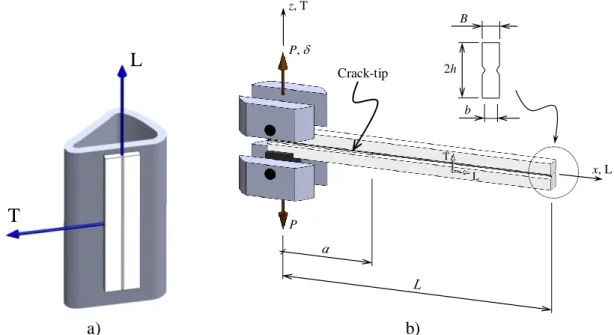
Five specimens were prepared from the diaphysis (Fig. 1a) region of the tibia of young male human donors (21-27 years old). The final specimen nominal dimensions (see Fig. 1b): L = 60; 2h = 6; B = 2.5; a0 = 20 (all dimensions in mm) were achieved after delicate milling and
cutting operations. Two longitudinal grooves were performed using a circular saw to compel crack propagation along the specimen mid-plane.
L
T
P, P T L B b 2h x, L z, T a) b)Fig. 1. a) Segment of a tibia showing the position and orientation of the specimen; b) Sketch of the DCB test with its orthotropic directions (L-longitudinal and T-
tangential).
Experimental tests were executed utilizing a servo-electrical testing system (MicroTester INSTRON 5848) considering a constant displacement rate of 0.5 mm/min (Fig. 2) with an acquisition frequency of 5 Hz, using a cell with the capacity of 2 kN. The load-displacement curves (P- curves) were registered during the test and subsequently used in the proposed data reduction scheme to evaluate the resistance curves (R-curves) in pure mode I loading.
The crack tip opening displacement (Fig. 2) was also measured during the test using digital image correlation (DIC). The relative displacement (w) perpendicular to crack plane at the crack tip is given by the difference of the corresponding values of a suitable pair of subsets selected close to the initial crack tip location.
An equivalent crack length based data reduction scheme was used to overcome the difficulties inherent to crack monitoring. The compliance versus crack length relation using Timoshenko beam theory writes
LT 3 L 3 5 12 8 BhG a Bh E a C (1) where EL is the longitudinal elastic modulus and GLT the shear modulus in the LT plane (Fig. 1). The equivalent crack length is easily obtained from previous equation and used in the Irwin-Kies relation
da dC b P G 2 2 I (2)
to obtain the the GI=f(ae) relation
LT 2 L 2 e 2 I 5 1 2 6 G h E a Bbh P G (3) This procedure avoids crack monitoring during the test since ae is a calculated parameter.
The cohesive law can be obtained through the following relation (Rice, 1968) w G w d d ) ( I
(4)Spline piecewise-function was applied to GI=f(w) to provide simple differentiation. The
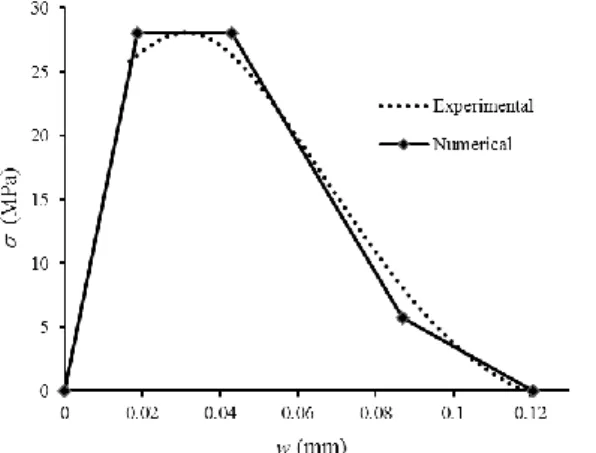
experimental cohesive laws were adjusted by trapezoidal with bilinear softening relations (Fig. 3) to be used in numerical validation.
w u w w1 w0 2 u GIc w2
RESULTS
The data issuing from experimental load-displacement curves was used to obtain the corresponding R-curves (Fig. 4) using the proposed data reduction scheme.
Fig. 4. Cohesive zone model.
Subsequently, the cohesive laws are obtained following the procedure described above. Trapezoidal with bilinear softening cohesive laws were adjusted to the experimental ones (Fig. 5).
A finite element analysis considering cohesive zone modelling is performed and the resulting load-displacement curves are compared with the experimental ones revealing good agreement (Fig. 6). Good agreement was also obtained when comparing the numerical and experimental resistance curves (Fig.4).
Fig. 6. Typical numerical and experimental load-displacement curves.
CONCLUSIONS
A miniaturized version of the double cantilever beam test was used to characterize fracture behavior of human cortical bone under pure mode I loading. A data reduction scheme based on crack equivalent concept was used to obtain the evolution of fracture energy in the course of the test. Crack opening displacement was measured by means of the digital image correlation technique and correlated with the evolution of fracture energy. The differentiation of this relation provided the cohesive law, which establishes the softening relationship between stresses and relative displacements and constitutes a fundamental tool to perform cohesive zone modelling.
The numerical load-displacement curves were compared with the experimental ones and excellent agreement was obtained. Good agreement was also obtained when comparing the numerical and experimental resistance curves. These results validate all the procedure as a valuable tool to perform systematic studies involving the assessment of the influence of several factors (e.g., age, drugs, environmental and others) on cortical human bone fracture toughness under mode I loading.
ACKNOWLEDGMENTS
The authors acknowledge the Portuguese Foundation for Science and Technology (FCT) for the conceded financial support through the research project PTDC/EME-PME/119093/2010. REFERENCES
D. Vashishth, J.C. Behiri, W. Bonfield, Crack growth resistance in cortical bone: Concept of microcrack toughening. J. of Biomech. 30 (1997) 763–769.
P. Zioupos, Recent developments in the study of failure of solid biomaterials and bone: 'fracture' and 'pre-fracture' toughness, Mater. Sci. Eng. C (1998) 33-40.
J.R. Rice, A path independent method integral and the approximate analysis of strain correlation by notches and cracks, ASME J. Appl. Mech. 35 (1968) 379–86.