Electronic Institution: an E-contracting Platform for
Virtual Organizations
Henrique Lopes Cardoso
LIACC – NIAD&R, Faculty of Engineering, University of Porto R. Dr. Roberto Frias, 4200-465 Porto, Portugal
Abstract. Automated tools that assist contract drafting are mostly focused on the representation of contract documents. Multi-agent systems have been ap-plied in the e-business domain, namely for information discovery and contract negotiation. Work on contract monitoring and enforcement is less explored. In this paper we start from these two observations to expose our efforts towards the development of tools that enable the computational representation of con-tracts and furthermore their monitoring and enforcement. We are mostly inter-ested in Virtual Organization settings, where groups of agents representing dif-ferent business entities form consortiums that must be regulated by appropriate norms. We are pursuing the concept of an Electronic Institution as a platform providing a normative environment and a set of e-contracting related services. Within this environment, contracts are represented through norms.
1 Introduction
The representation of legal contracts in computer systems has been sought by the research community [5]. However, most attempts (e.g. [10]) have focused on the con-tract document rather than the concon-tract agreement. That is, in many cases the approach is to represent, in computer systems, the structure and information of the signed docu-ment for human consumption.
Successful attempts towards a computable representation of contracts, allowing for automated tasks such as contract monitoring, are still missing. This is especially the case when considering complex contractual relationships such as those related with the formation of consortiums among different organizations.
Considering the whole e-contracting lifecycle (comprising the stages of information discovery, contract negotiation, and contract execution), automated tools have been developed for the first two stages. In fact, most currently available support to e-business is devoted to the first phase: we can find typical e-market functions such as yellow-page support, customer aggregation mechanisms and recommender systems.
Contract negotiation has been addressed in a number of research projects. In [20] an approach is presented concerning the formation of Virtual Organizations (VO): temporary consortiums of different organizations that “pool their resources to meet short-term objectives and exploit fast-changing market trends” [6]. However, the
pro-posed negotiation protocol is more concerned with the selection of the partners that will compose the VO than with the contractual agreement that is to be implemented.
The subject of virtual organizations/enterprises is gaining increasing importance in the B2B world, where players are becoming more focused on their core businesses and rely on outsourcing and dynamic consortiums. This can lead to complex relation-ships, in which partners’ compliance must be assessed.
The Multi-Agent Systems (MAS) paradigm has been applied in the domain of e-business automation, namely in the three stages of e-contracting identified above. Agents are typically used as a means of encapsulating the individual interests of dif-ferent business entities.
While agent theory describes agents as autonomous self-interested entities, prefera-bly interacting in open environments, the application of MAS in real-world scenarios has risen a concern in the MAS research community: the need to regulate agent inter-actions. Two complementary lines of research have been developed since. The field of normative multi-agent systems explores the design of environments where interacting agents can be usefully regarded as governed by norms [14]. Agents are subject to these norms, which influence their decision making. Therefore, besides their goals, agents must take into account the norms that apply to them.
Another important research concept is that of an Electronic Institution (EI): a framework providing a regulated and trustable environment by enforcing norms and providing specific services [7, 17].
In our work we are applying these two research directions to the concern identified above: the representation of contracts formalizing VO relationships in a computable fashion, and the development of automated tools for contract monitoring and en-forcement. We perceive contracts as being composed of norms that contractual agents are subject to. The EI framework provides a set of services that address the whole e-contracting life-cycle, including contract execution. The EI also provides a normative background that facilitates the establishment of contractual agreements.
The rest of the paper is organized as follows. Section 2 discusses some references in the literature regarding the computational handling of contracts. It also explores the representation of norms in contracts. Section 3 introduces the EI concept and provides information about our efforts in pursuing its development as a platform providing a normative environment and a set of e-contracting related services. Section 4 con-cludes.
2 E-contracting
Contracts are specifications for the behavior of a group of agents that jointly agree on a specific business activity. Contracts are used as a means of securing transactions between the involved parties, forming a normative structure that explicitly expresses their behaviors’ interdependencies. Electronic contracts are virtual representations of such contracts. The aim of e-contracting is to improve the efficiency of contracting processes, supporting an increasing automation of both e-contract drafting and execu-tion.
The components of a contract include the identification of participants, the specifi-cation of products and/or services included and a discrimination of actions to be per-formed by each participant. These actions are usually accompanied with time and precedence constraints. Typified business relations can recurrently use pre-formatted contract templates. In this case, contracts usually have a set of identified roles to be fulfilled by the parties involved in the relationship.
2.1 Representing E-contracts
Approaches towards a computational representation of contracts have been made. A normative conception of contracts is often used for contract representation. Formal models of norms rely on deontic logic, embracing the notions of obligation, permis-sion and prohibition. Extenpermis-sions to the original work on deontic logic have been made so as to allow its practical use, namely approaches to handle norm violations (such as the application of sanctions, also known as contrary-to-duties [13]), and considering the use of conditional and temporal aspects [8].
Languages for representing norms in contracts have been proposed. In [8] a logical formalism for describing interaction in an agent society, including social norms and contracts, is presented. Focusing on contract representation, it emphasizes on condi-tional obligations with deadlines. Other approaches to contract representation through norms include [21], considering normative statements that can comprise obligations, permissions and prohibitions. Sanctions are seen as obligations or prohibitions acti-vated by the violation of another obligation. Also, [16] proposes the inclusion of obli-gations, permissions and sanctions in a contract specification language.
A common line in these approaches is the specification of deontic operators that are dependent on certain conditions and that have associated deadlines. For instance, [21] uses the notion of normative statement formally represented as:
ϕ→ θs,b (α < ψ) where
ϕ is an activation condition
θ is a deontic operator (obligation, permission or prohibition)
s and b are, respectively, the subject and beneficiary of θ α is the action to perform or the state of affairs to bring about ψ is a deadline
An approach to contract representation based on event calculus can be found in [15]. This representation incorporates how a contract is to be fulfilled (that is, which events initiate or terminate obligations), making it a heavier structure.
In [4] the authors propose modeling contracts as processes, that is, state diagrams where transitions correspond to the execution of actions by the parties, considering also temporal elements.
Contracts can have different forms, ranging from simple contracts used to buy a product to complex contracts defining complex interactions between parties [2]. How-ever, most of the research literature devoted to e-contract automation simplifies
con-tracts to the former type, defining one time relationships between a client and a sup-plier. After the delivery and payment phase, the parties are assumed to be no longer related. Little attention has been given to contracts that result from a Virtual Enter-prise formation process. Nevertheless, as argued in [5], the construction of automated tools that deal with legal contracts is mostly helpful in complex contracting settings, such as long-term trading agreements and multi-party relationships (as is the case of a VO).
2.2 Monitoring and Enforcing Contracts
The execution of an e-contract consists on the parties following the norms they com-mitted to when signing the contract. If any deviations from the prescribed behavior should occur, sanctions can be applied as specified in the contract or in its normative system of reference. However, the parties involved will typically not voluntarily sub-mit themselves to such penalties. Therefore, appropriate mechanisms are needed to monitor and enforce norm execution. Only a trusted third party can enable the neces-sary level of confidence between the parties involved in a business relation.
The automation of contract monitoring and enforcement is challenged by the pres-ence of complex legal issues and subjective judgments on agent compliance. Never-theless, approaches have been made in some research projects.
The involvement of a third party in e-contract execution is generally claimed. In [16] a supervised interaction framework is proposed, where a trusted third party is included as part of any automated business transaction. Agents are organized in three-party relationships between two contracting individuals (a client and a supplier) and an authority that monitors the execution of contracts, verifying that errant behavior is either prevented or sanctioned. This authority enables the marketplace to evaluate participants, keeping reputation records on the basis of past business transactions.
In [21] a contract fulfillment protocol (CFP) is proposed, a collaborative protocol based on the normative statements’ lifecycle. The idea is that, since contractual rela-tionships are distributed, there is a need to synchronize the different views each agent has about the fulfillment of each contractual commitment. Agents communicate about their intentions on fulfilling contractual norms, allowing their contractual partners to know what to expect from them.
An alternative norm representation can be found in [22], where norms are defined as having explicitly associated violation conditions, means of detecting those viola-tions, and sanction and repair measures. Therefore, in this case norms have a heavy structure, making the monitoring and enforcement process dependent on each individ-ual norm.
We are unaware of an approach that considers the monitoring of contracts that rep-resent a VO activity, taking into account the cooperation efforts that each partner is supposed to practice during the VO’s lifetime. In the next section we introduce the Electronic Institution concept as a computational framework where such contracts can be created and monitored.
3 Electronic Institutions
Human societies are governed by institutions providing services or regulating the way citizens interact. The same approach has been proposed as a means to regulate the interaction among software agents. The Electronic Institution (EI) concept [7] repre-sents the virtual counterpart of real-world institutions.
The benefit of an EI resides in its potential to assure legitimacy and security to its members, through the establishment of norms [7]. An EI provides an environment that regulates the relationships between software agents. Some approaches have consid-ered such an environment as a constraining infrastructure [9], where the institution imposes the actions that agents may perform, thereby defining an interaction protocol that agents must follow. We do not follow such a restrictive scenario.
We consider that besides enforcing norms, institutional services should be provided to assist the coordination efforts between agents which, representing different real-world entities, interact with the aim of establishing business relationships. In our per-spective, an EI is thus a comprehensive framework that provides a set of institutional services covering the formation and operation of VOs, while assuring norm enforce-ment through the imposition of sanctions and reputation mechanisms.
One of the main roles of the EI is to provide trust by working as a third-party that enables partners to engage in (automated) business interactions. The provided services compose a coordination framework that assists the interaction of software agents rep-resenting different organizations or business units.
We may summarize the main goals of an EI as follows: (1) to support agent interac-tion as a coordinainterac-tion framework, making the establishment of business agreements more efficient; and (2) to provide a level of trust by offering an enforceable normative environment. Therefore, our perspective regards an EI not as an end per se, but as a means to facilitate both the creation and the enforcement of contracts between agents. 3.1 Institutional Services
A number of agent-based institutional services are provided (see figure 1, where we omitted typical e-market facilities, such as registration and white/yellow page sup-port).
Negotiation mediation services are provided to assist the formation of a VO. This includes the utilization of appropriate negotiation protocols (such as [20]) and contract templates, which are instantiated with the outcome of the negotiation process.
When addressing open environments with no centralized design, it may well be the case that agents representing different organizations use different domain ontologies. In order to enable a meaningful negotiation, ontology matching services must be put into place [19].
The mentioned services are used by different organizations, which can be seen as potential partners in a future VO. A subset of these, according to the outcome of a negotiation process, will become partners in a new VO.
Contracts resulting from successful negotiations are registered in the EI through a notary service, responsible for validating them according to institutional norms. The
execution stage is assisted by providing services that monitor the carrying out of con-tractual commitments by each VO partner. The VO contract defines cooperation ef-forts between the involved agents, and includes specific interactions during a certain time frame. Virtual Organization Partner m O rg an iz at io n n Domain ontology Agent Electronic Institution
Contract monitoring and enforcement O rg an iz at io n 1 Domain ontology Agent Contract establishment Negotiation mediation Institutional ontology Negotiation protocols templates Contract
Ontology matching Notary Contracts Contract Monitor Transactions Partner 1
Fig. 1. Services in an Electronic Institution (adapted from [17])
Every agent intending to use an institutional service must be registered as a mem-ber. Agents have, inside the EI’s boundaries, a record of reputation concerning their observance to past contractual relationships. This public information may be used by other agents, in the future, when choosing appropriate business partners. Agents’ repu-tations may also be used, if not as a ruling out factor, at least when deciding the level of detail a contract should have.
3.2 Normative Environment
As mentioned before, one of the main aims of the EI is to provide a level of trust through an enforceable normative environment. As we are concerned with the possi-bility of commitment creation at run-time through the establishment of contracts, our environment has a flexible normative structure (unlike other EI formalizations such as [9]). Contractual norms are used to represent agents’ commitments.
A norm-aware environment can operate either preventively (making unwanted be-havior impossible) or reactively (detecting violations and reacting accordingly) [22]. In order to cope with the autonomous nature of agents, our approach considers norms as regulations that agents may or may not abide to.
Norms prescribe the expected behavior of agents, specifying states of affairs that
must be brought about by an agent before a certain deadline. Therefore, we consider obligations as the means to express the prescription of behavior norms. Our basic
norm definition is therefore based on the following EBNF description: <Norm> ::= <Situation> “→” <Prescription>
<Situation> ::= {<Cond> “∧”} <Cond> {“∧” ¬<Cond>}
<Prescription> ::= {<Obligation> “∧”} <Obligation>
<Obligation> ::= obligation(<Agent>, <Fact>, <Deadline>) Norms prescribe behavior by specifying what obligations come about when a spe-cific situation is accomplished. The situation is characterized by conditions related with the state of a particular contractual relationship. The prescribed obligations indi-cate what facts an agent is supposed to bring about by a certain deadline. In the case of sanctions, the situation is characterized by the violation of another norm.
While being based on the notion of conditional obligations with deadlines, this rep-resentation shows how norms may be represented using a rule-based approach (see subsection 3.3).
Agents will not voluntarily submit themselves to associated penalties in case of de-viation. Therefore, appropriate mechanisms are needed to enforce norm compliance. It is the EI’s responsibility to maintain the normative state of the environment, taking into account the compliance or non-compliance of agents regarding their applicable norms. This is done through a contract monitoring and enforcement service. Contracts are monitored by employing rules that detect the fulfillment and violation of obliga-tions, based on the occurrence of facts and on the passage of time. When agents fail to comply with their obligations they expose themselves to punishments, either direct (e.g. sanctions) or social (e.g. reputation records). Contracts are enforced by applying predicted sanctions in case of non-compliance, by affecting the agents’ reputation and, ultimately, by preventing their access to institutional services.
A normative environment should be embodied with a set of norms applicable in the absence of further information. An important concept in contract law theory is the use of “default rules” [3], which exist with the intent of facilitating the formation of con-tracts, allowing them to be underspecified by defining default clauses or default val-ues. The most useful case for this is in defining contrary-to-duty situations [13], which typically should be not likely to occur. For this reason, such situations are normally not dealt with in each contractual agreement, and agents usually recur to legislative systems that define default procedures [4]. Default regulations provide a normative background in which agents can rely to build their contractual commitments.
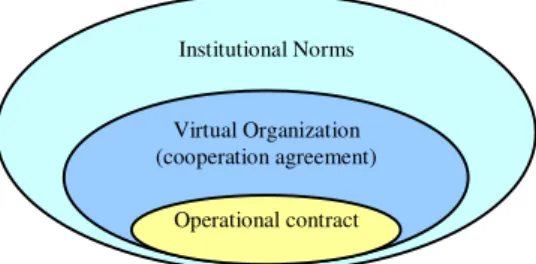
Taking into account our stated goal of providing assistance to VO formation, we developed a normative framework [18] that considers three hierarchical layers of norms: institutional, constitutional and operational (figure 2). While institutional norms may be applicable to all agents inside the EI, constitutional norms apply to agents taking part in a VO, and operational norms specify the operationalization of such organizations. Default norms may be defined for each of these layers.
Institutional Norms Virtual Organization (cooperation agreement)
Operational contract
Fig. 2. Norms in an Electronic Institution (from 18)
While we have defined our basic norm representation, a definition of contractual norms that fits each of the layers of norms identified above is still at a preliminary stage.
3.3 Implementation
We are in the process of implementing a first EI prototype integrating the different services illustrated in figure 1. Our implementation is based on the Jade platform [12]. Regarding the normative environment, our norms obviously lend themselves to a rule-based representation. The monitoring of norms is implemented by appropriate rules that detect the fulfillment and violation of obligations, also allowing for the chaining of norms within a contractual relationship.
Since the normative environment is based on the occurrence of facts, the obvious solution towards its implementation is by using a forward-chaining production system. Therefore, we are pursuing the development of the normative environment (including the norm monitoring and enforcement services) using the Jess shell [11]. Jess is a rule engine that very efficiently applies rules to data. Our knowledge base consists of rules and norms. The working memory includes the facts that describe the normative state.
Jess has a number of features that allow us to implement our normative environ-ment in an efficient and EI-integrated fashion. It includes the use of frame-based ap-proaches and the possibility to organize norms in different modules, which is appro-priate to manage the complexity of our normative framework. Jess also connects easily with Java, allowing us to define institutional procedures not amenable to a declarative representation. For instance, we may define a rule that triggers a notification proce-dure whenever a new obligation arises. The set of institutional rules and proceproce-dures implement the contract monitoring and enforcement service.
4 Conclusions
The agent technology roadmap [1], by AgentLink III, identifies as key problem areas the development of infrastructures for open agent communities, as well as the need for trust and reputation mechanisms. Electronic institutions address the needed
infrastruc-tures. Norms, electronic contracts and their enforcement are pointed out as means to achieve trust in open environments. Our work is motivated by the need to develop services that assist the coordination efforts between agents which, representing differ-ent real-world differ-entities, interact with the aim of establishing virtual organizations. In order to be trustful, a VO needs to be regulated by appropriate norms.
The work already developed concerns the design of the EI platform in order to in-tegrate different services, including ontology-based services [19], negotiation media-tion [20], and contract monitoring. We also conceptualized a framework of norms that takes into account the need to regulate VO agreements.
A basic norm representation was defined; a definition of contractual norms that al-low us to define VO agreements is still at a preliminary stage. As identified in [18], some characteristics of such complex settings that should be addressed are: the ongo-ing nature of VO relationships (as opposed to one-shot purchase operations); the exis-tence of interactions that are continuously repeated in time; the support for and regula-tion of the exit and entrance of partners during the VO lifetime; and the handling of monetary transfers, such as profit distribution.
We intend to test the applicability of our approach through illustration with case-studies. Furthermore, the contract representation to develop shall be compared with other approaches.
References
1. AgentLink III (2004). Agent Technology Roadmap: Overview and Consultation Report. http://www.agentlink.org/roadmap/index.html
2. Angelov, S. & Grefen P. (2001). B2B eContract Handling – A Survey of Projects, Papers
and Standards. University of Twente: CTIT Technical Reports.
3. Craswell, R. (2000). Contract Law: General Theories. In Bouckaert, B. & De Geest, G. (eds.), Encyclopedia of Law and Economics, Volume III: The Regulation of Contracts, Edward Elgar, Cheltenham, pp. 1-24.
4. Daskalopulu A. & Maibaum T. (2001). Towards Electronic Contract Performance. Legal
Information Systems Applications, 12th International Conference and Workshop on Data-base and Expert Systems Applications, IEEE C. S. Press, pp. 771-777.
5. Daskalopulu A. & Sergot M. J. (1997). The Representation of Legal Contracts, AI and
Society, 11 (1 & 2), pp. 6–17.
6. Davulcu, H., Kifer, M, Pokorny, L.R., Ramakrishnan, C.R., Ramakrishnan, I.V., & Daw-son, S. (1999), Modelling and Analysis of Interactions in Virtual Enterprises, Proceedings
of the 9th International Workshop on Research Issues on Data Engineering: Information
Technology for Virtual Enterprises (RIDE 1999), IEEE Computer Society, pp. 12-18.
7. Dignum, V., & Dignum, F. (2001). Modelling agent societies: co-ordination frameworks and institutions. In P. Brazdil & A. Jorge (eds.), Progress in Artificial Intelligence:
Knowl-edge Extraction, Multi-agent Systems, Logic Programming, and Constraint Solving, LNAI
2258, Springer, pp. 191-204.
8. Dignum, V., Meyer, J.-J., Dignum, F. & Weigand, H. (2003). Formal Specification of Interaction in Agent Societies. In Hinchey, M., Rash, J., Truszkowski, W., Rouff, C. & Gordon-Spears, D. (eds.), Formal Approaches to Agent-Based Systems, Springer, pp. 37-52.
9. Esteva, M., Padget, J. & Sierra, C. (2002). Formalizing a language for institutions and norms. In Meyer, J.-J. & Tambe, M. (eds.), Intelligent Agents VIII, Springer, pp. 348-366. 10. Field, S., & Hoffner, Y. (2005). Dynamic Contract Generation for Dynamic Business
Rela-tionships. In G.D. Putnik & M.M. Cunha (eds.), Virtual Enterprise Integration:
Techno-logical and Organizational Perspectives, Idea Group Inc., pp. 207-228.
11. Friedman-Hill, E. (2003). Jess in Action. Manning Publications Co. 12. Java Agent DEvelopment Framework. http://jade.tilab.com
13. Jones, A. & Carmo, J. (2001). Deontic logic and contrary-to-duties. In Gabbay, D. (ed.),
Handbook of Philosophical Logic, Kluwer, pp. 203-279.
14. Jones, A., & Sergot, M.J. (1993). On the Characterisation of Law and Computer Systems: The Normative Systems Perspective. In J.-J. Meyer & R.J. Wieringa (eds.), Deontic Logic
in Computer Science: Normative System Specification, Chichester, England: John Wiley &
Sons, pp. 275-307.
15. Knottenbelt, J., & Clark, K. (2005). Contract-related Agents. Sixth International Workshop
on Computational Logic in Multi-Agent Systems (CLIMA VI). London, England.
16. Kollingbaum, M. J., & Norman, T. J. (2002). Supervised Interaction – Creating a Web of Trust for Contracting Agents in Electronic Environments. In C. Castelfranchi & W. John-son (eds.), Proceedings of the first international joint conference on Autonomous agents
and multiagent systems, New York: ACM Press, pp. 272-279.
17. Lopes Cardoso, H., Malucelli, A., Rocha, A.P. & Oliveira, E. (2005). Institutional Services for Dynamic Virtual Organizations. In Camarinha-Matos, L. M., Afsarmanesh, H. & Ortiz, A. (eds.), Collaborative Networks and Their Breeding Environments – 6th IFIP Working
Conference on Virtual Enterprises (PRO-VE’05), Springer, pp. 521-528.
18. Lopes Cardoso, H. & Oliveira, E. (2004). Virtual Enterprise Normative Framework within Electronic Institutions. In Gleizes, M.-P., Omicini, A. & Zambonelli, F. (eds.), Engineering
Societies in the Agents World V, Springer, pp. 14-32.
19. Malucelli, A., Palzer, D. & Oliveira, E. (2005). Combining Ontologies and Agents to help in Solving the Heterogeneity Problem. In Proceedings of the International Workshop on
Data Engineering Issues in E-Commerce (DEEC2005), IEEE Computer Society, pp. 26-35.
20. Oliveira, E. & Rocha, A. P. (2000). Agents Advanced Features for Negotiation in Elec-tronic Commerce and Virtual Organisations Formation Process. In Dignum, F. & Sierra, C. (eds.), Agent Mediated Electronic Commerce: The European AgentLink Perspective, Springer, pp. 78-97.
21. Sallé, M. (2002). Electronic Contract Framework for Contractual Agents. In R. Cohen & B. Spencer (eds.), Advances in Artificial Intelligence: 15th Conference of the Canadian
Soci-ety for Computational Studies of Intelligence, Springer, pp. 349-353.
22. Vázquez-Salceda, J., Aldewereld, H. & Dignum, F. (2004). Implementing norms in multi-agent systems. In Lindemann, G., Denzinger, J., Timm, I. J. & Unland, R. (eds.),
![Fig. 1. Services in an Electronic Institution (adapted from [17])](https://thumb-eu.123doks.com/thumbv2/123dok_br/15939532.1096102/6.892.279.629.307.650/fig-services-electronic-institution-adapted.webp)