Ontology-based representation, transformation,
maintainability and staging of multiuser and multi-domain
choreographies in multiple virtual worlds
Tese de Doutoramento em Informática
Emanuel Fernando Cunha Silva
Sob orientação dos Professores Doutores
Nuno Alexandre Pinto da Silva
Leonel Caseiro Morgado
Hugo Alexandre Paredes Guedes da Silva
Tese apresentada por Emanuel Fernando Cunha Silva à
Universidade de Trás-os-Montes e Alto Douro para
cumprimento dos requisitos necessários à obtenção do grau
de Doutor em Informática, sob a orientação do Prof. Doutor
Nuno Alexandre Pinto da Silva, do Prof. Doutor Leonel
Caseiro Morgado e do Prof. Doutor Hugo Alexandre
Paredes Guedes da Silva.
Acknowledgments
I would like to thank Professor Nuno Silva, Professor Leonel Morgado and Professor Hugo Paredes for their supervision throughout my PhD. I thank them for their wise counsels, their efforts in trying to always keep me motivated, and their guidelines to always keep me focused on the right path.
I must also thank Fundação para a Ciência e Tecnologia and FEDER for the support given to my PhD through the World Search, OOBIAN – Living Knowledge and AAL4ALL projects and to the Portuguese program Quadro de Referência Estratégico Nacional for their financial support of my participation in international conferences.
I want to especially thank my family, who has always been present, sharing the joys and encouraging me in the toughest times, and to my parents for their continuous encouragement.
Resumo
No contexto de ensino e treino, a utilização de novas ferramentas tecnológicas para auxiliar a implementação das diversas estratégias de ensino/aprendizagem tem sido amplamente adotada. Os mundos virtuais têm sido vistos como um dos artefactos tecnológicos com maior potencial para uso nesta área, uma vez que proporcionam uma plataforma imersiva e colaborativa onde os seus utilizadores podem desenvolver as atividades educativas livremente ou seguindo coreografias com ações e regras bem definidas. Uma coreografia é a descrição de um conjunto de ações que podem ou devem ser executadas por um grupo de personagens, humanos ou virtuais, de acordo com regras específicas e objectivos a alcançar.
Devido à elevada quantidade de mundos virtuais existentes, com diferentes características, funcionalidades, vocabulário e API disponíveis, a criação de uma coreografia é feita muito à medida dos mundos virtuais a que se destinam apresentando, assim, fortes dependências a essas plataformas, dificultando a sua aplicação a mundos virtuais distintos.
Esta tese foca-se em fornecer um contributo no sentido de facilitar a criação, adaptação e encenação de uma coreografia em múltiplos mundos virtuais.
A primeira contribuição desta tese, a partir da qual foram desenvolvidos os esforços de pesquisa, foi identificar e descrever os principais problemas de dependências das coreografias aos mundos virtuais, bem como as limitações encontradas no estado da arte.
Para endereçar o problema em mãos, foram escolhidas ontologias como modelos de dados e o paradigma MDE (Model-Driven Engineering) como método de desenvolvimento das coreografias.
A segunda contribuição foi a proposta de uma ontologia para representar de forma abstracta e genérica uma coreografia, independente de domínios de aplicação e de mundos virtuais.
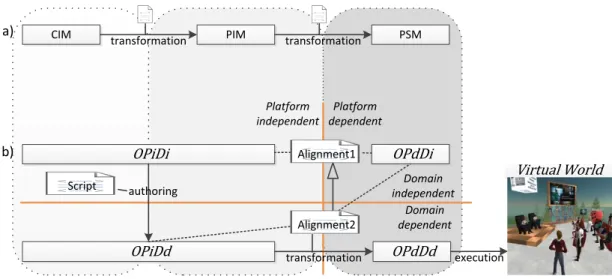
A terceira contribuição diz respeito à arquitetura de um sistema que permite representar, adaptar e encenar uma coreografia em, potencialmente, qualquer mundo virtual. Para capturar e representar uma coreografia multiutilizador e multi-domínio é adoptada uma abordagem baseada em ontologias com vários níveis de abstração. É também proposta uma abordagem orientada por modelos e um conjunto de processos que, usando mapeamentos entre as diversas ontologias permite a construção automática de uma coreografia específica para uma plataforma a partir de uma coreografia independente de plataformas, contribuindo
Resumo
assim, para a redução do tempo e esforço no desenvolvimento das coreografias. Para isso, o paradigma MDE foi adotado e adaptado, para que os modelos possam refletir duas dimensões de independência: independência em relação à plataforma (tal como no MDE) e independência em relação ao domínio de aplicação. É também apresentada a arquitetura de um componente para gerir a encenação de uma coreografia no mundo virtual explorando as vantagens proporcionadas pelas características intrínsecas às ontologias, tais como, verificação da consistência da base de conhecimento, de regras e classificação automática de instâncias.
As ideias e processos propostos no contexto desta tese foram implementados e testados usando vários cenários de diferentes domínios de aplicação e encenados em múltiplos mundos virtuais.
Abstract
In the context of education and training, the use of new technological tools to assist the implementation of various teaching/learning strategies has been widely adopted. Virtual worlds have been seen as one of the technological artifacts with greatest potential for use in this area, since they provide an immersive and collaborative platform where users can freely develop educational activities, or follow choreographies with well-defined actions and rules. A choreography is a description of a set of actions that may or must be performed by a group of characters, either human or virtual, according to specific rules and goals to be achieved.
Due to the large amount of existing virtual worlds with different features, functionalities, vocabulary and available APIs, a choreography is tailored to the target virtual worlds, thus having strong dependencies to these platforms, hindering its application to different virtual worlds platforms.
This thesis focuses on providing a contribution to facilitate the creation, adaptation and staging of a choreography in multiple virtual worlds.
The first contribution of this thesis, from which the research efforts were made, was to identify and describe the main dependency problems of the choreography to virtual worlds, as well as the limitations found in the state of the art.
To address the problem in hands, ontologies were chosen to represent data models, and the MDE (Model-Driven Engineering) paradigm was adopted as the choreography development method.
The second contribution was the proposal of an ontology to represent a choreography in an abstract and generic fashion, independent of any application domain and virtual world.
The third contribution concerns a system architecture that allows representation, adaptation and staging of a choreography in potentially any virtual world. To capture and represent a multiuser and multi-domain choreography, an approach based on ontologies with multiple levels of abstraction is adopted. It is also proposed a modelling-driven approach and a set of processes that, through mappings between ontologies, enable the automatic construction of a platform-specific choreography from a platform independent one, thus reducing the time and effort of the choreography development. In order to do this, the MDE paradigm was adopted and adapted in a way where models can reflect two dimensions of independence: platform independence (as in MDE) and application domain independence. The architecture of a
Abstract
component that manages the staging of a choreography within the virtual world is also presented, exploring the advantages provided by the intrinsic characteristics of ontologies, such as consistency checking, checking rules and dynamic classification of instances.
The proposed ideas and processes in the context of this thesis have been implemented and tested using various scenarios of different application areas and staged in multiple virtual worlds.
Palavras-chave
Keywords
Contents
Acknowledgments ... v Resumo ... vii Abstract ... ix Palavras-chave ... xi Keywords ... xii Contents ... xiiiList of Tables ... xvii
List of Figures ... xix
Acronyms ... xxiii Glossary ... xxv First Part ... xxv Chapter 1 Introduction... 3 1.1 Context ... 3 1.2 Motivation ... 4 1.3 The Problem ... 5 1.4 Research Questions ... 6 1.4.1 Research question 1 ... 6 1.4.2 Research question 2 ... 7 1.4.3 Research question 3 ... 7 1.4.4 Research question 4 ... 7 1.4.5 Research question 5 ... 8 1.5 Research Method ... 8 1.6 Research contributions ... 10 1.7 Thesis Structure ... 11
Contents
2.1 Teaching, learning and technology... 13
2.2 Virtual Worlds and choreographies ... 16
2.3 The universality of virtual worlds ... 18
2.4 Virtual worlds are not homogeneous ... 19
2.5 Choreographies ... 24
2.5.1 Models for representing choreographies ... 24
2.5.2 Applications of choreographies ... 26
2.5.3 Domains that can benefit from using choreographies ... 28
2.6 Application of choreographies to virtual environments ... 30
2.6.1 Extensions to model training procedures ... 31
2.6.2 Systems that facilitate adaptation of a choreography to multiple virtual worlds ... 32
2.6.3 Characterization of the systems ... 33
2.7 Problems in the use of choreographies in virtual worlds... 37
2.8 Summary ... 38
Chapter 3 Background knowledge ... 41
3.1 Fundamentals of ontologies ... 41
3.1.1 Ontology matching ... 44
3.1.2 Ontology transformation ... 45
3.1.3 Ontology-based data transformation ... 46
3.2 Fundamentals of Model-Driven Engineering ... 46
3.3 Summary ... 47
Second Part ... 49
Chapter 4 Ontology-Based Representation Of A Choreography And Its Staging In Virtual Worlds ... 51
4.1 The Proposal approach ... 51
4.2 Conceptual architecture ... 53
4.2.1 Representation ... 53
4.2.2 Mapping... 54
4.2.3 Staging ... 54
4.3 Choreography model based on ontologies ... 54
4.4 Model-driven generation of choreographies ... 55
4.5 Choreography representation ... 57
4.5.2 The foundational choreography ontology... 59
4.5.3 Ontologies of different choreography abstraction models... 60
4.6 Comparing the proposal model with other models ... 62
4.7 Summary ... 64
Chapter 5 Representation ... 65
5.1 The Authoring process ... 65
5.2 The definition of the application domain ... 67
5.3 The flow of the choreography ... 69
5.4 The specification of rules and constraints ... 71
5.4.1 Role-depending actions ... 72
5.4.2 Action-depending roles ... 73
5.4.3 Disjoint roles ... 74
5.5 Consistency and feasibility checking ... 74
5.5.1 Logical-semantic checking ... 75 5.5.2 Feasibility checking ... 75 5.6 Summary ... 75 Chapter 6 Mapping ... 77 6.1 Mapping1 ... 78 6.2 Mapping2 ... 79 6.3 Generating a choreography ... 81 6.4 Maintainability of choreography ... 86 6.5 Summary ... 87 Chapter 7 Staging ... 89
7.1 The execution process ... 89
7.2 Staging a Choreography ... 91
7.3 The Stage Manager Architecture ... 91
7.3.1 ChorMan ... 92 7.3.2 Knowledge Base ... 95 7.3.3 Reasoner ... 95 7.3.4 UIAGen ... 96 7.3.5 VirtMan ... 98 7.3.6 Planner ... 99
Contents 7.3.7 NpcMan ... 100 7.4 Summary ... 102 Chapter 8 Experiments ... 103 8.1 Introduction ... 103 8.2 Method ... 103 8.3 Scenarios ... 105
8.3.1 Scenario1 – The installation of the F16 aircraft engine ... 105
8.3.2 Scenario2 – The children´s story of Little Red Riding Hood ... 106
8.3.3 Scenario3 – Team handball offensive tactics ... 107
8.4 Virtual worlds ... 108
8.4.1 Platform 1 - OpenSimulator ... 109
8.4.2 Platform 2 - SmartfoxServer Pro ... 109
8.4.3 Platform 3 - Instant Messaging (IM) ... 110
8.5 Implementation ... 110 8.5.1 Planning/setup ... 111 8.5.2 VWP ontologies ... 113 8.5.3 Mapping1... 113 8.5.4 Authoring of choreographies ... 115 8.5.5 Mapping2... 122 8.5.6 Transformation ... 126 8.5.7 Execution ... 129 8.5.8 Evaluation ... 135 8.6 Summary ... 136 Third Part ... 137 Chapter 9 Conclusions... 139
9.1 Overview of the thesis ... 139
9.2 Summary of contributions ... 141
9.3 Answers to the research questions ... 143
9.4 Ongoing and future research ... 145
9.5 Final remarks ... 147
List of Tables
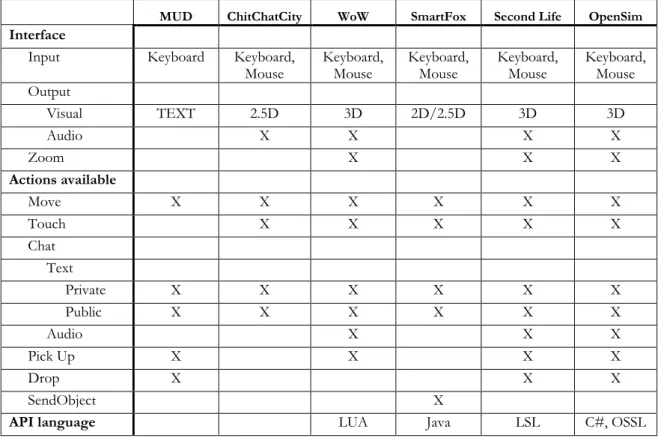
Table 1 - Characteristics of virtual platforms relating to its interface and interaction possibilities. ... 23
Table 2 - characterization of the systems reviewed ... 36
Table 3 - The characterization of the related work systems and the proposed approach ... 63
Table 4 – Test sequence: Mapping1 ... 112
Table 5 – Test sequence: Mapping2 ... 112
Table 6 – Test sequence: transformation ... 112
Table 7 – Test sequence: execution ... 112
Table 8 - The list of actions and roles for scenario1 ... 116
Table 9 – The list of actions and roles for scenario2 ... 119
List of Figures
Figure 1 – The British Legends MUD ... 19
Figure 2 – Users chatting on ChitChatCity ... 20
Figure 3 – A meeting of many users in club penguin ... 20
Figure 4 – A game taking place in World of Warcraft ... 21
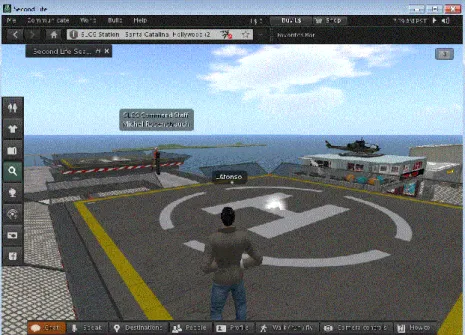
Figure 5 – A partial view of a representation of an airport in Second Life ... 22
Figure 6 – A presentation at Opensim Community Conference 2013 in OpenSim ... 22
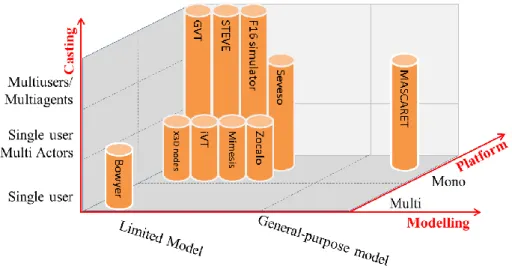
Figure 7 - The positioning of systems according to casting, platform and modelling dimensions ... 36
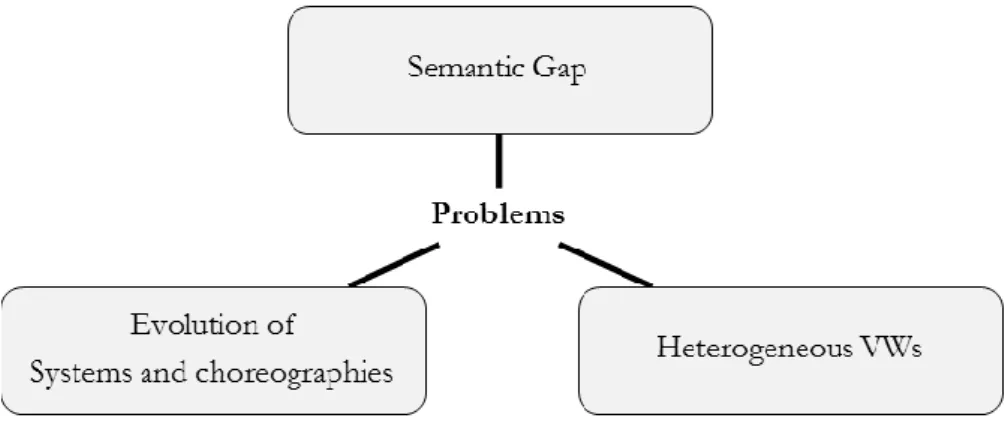
Figure 8 – Problems in the use of choreographies in VWPs ... 37
Figure 9 – Conceptual representation of MDA ... 47
Figure 10 - Conceptual representation of the proposed architecture ... 53
Figure 11 – Model-driven representation according to: a) MDA and b) proposed approach ... 56
Figure 12 - The proposed system architecture with the processes of authoring, mapping1, mapping2, transformation and execution ... 57
Figure 13 - The foundational choreography ontology (𝑂𝑃𝑖𝐷𝑖): representation of concepts, properties and relations between concepts ... 60
Figure 14 - Characterization of ontologies according to platform and domain dimensions ... 61
Figure 15 - The Choreography Ontology (𝑂𝑃𝑑𝐷𝑖) for: a) ChitChatCity and b) OpenSim ... 61
Figure 16 – The position of the related work systems and our proposal according to casting, platform and modelling dimensions ... 64
Figure 17 – An extract of the (𝑂𝑃𝑖𝐷𝑑) Ontology resulting from the authoring process... 66
Figure 18 - Example of ontologies for representing actions and roles, with two levels of granularity: a) with less detail and b) with more detail. ... 69
Figure 19 – The partial view of the alignments resulting from the Mapping1 process for: a) ChitChatCity and b) OpenSim ... 79
Figure 20 – Description of CBs, PBs and their relations in mapping1 ... 79
Figure 21 – The partial view of the alignments resulting from the mapping2 process for: a) ChitChatCity and b) OpenSim ... 80
Figure 22 - Description of CBs, PBs and its relations in mapping2 for ChitChatCity platform ... 81
Figure 23 - An excerpt of 𝑂𝑃𝑖𝐷𝑑 ontology after authoring ... 83
Figure 24 - An excerpt from the example representing the alignment2 for: a) ChitChatCity and b) OpenSim ... 84
List of Figures
Figure 25- An extract of 𝑂𝑃𝑑𝐷𝑑 ontology for: a) ChitChatCity and b) OpenSim ... 85
Figure 26- The DL representation of the 𝑂𝑃𝑑𝐷𝑑 ontology extract for: a) ChitChatCity and b) OpenSim ... 86
Figure 27 – Changes applied to a choreography ... 87
Figure 28– The components diagram of the Stage Manager ... 91
Figure 29 – The ChorMan component ... 92
Figure 30 – The sequence diagram representing the validation of a triggered action by an actor ... 94
Figure 31 – The sequence diagram representing the calculation of the plan of actions ... 95
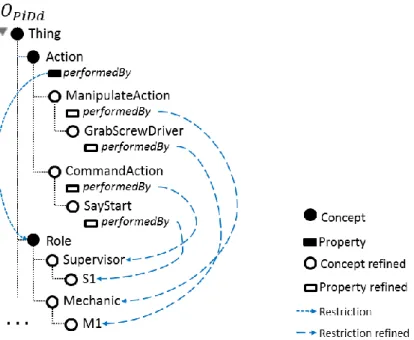
Figure 32 – A partial view of an 𝑂𝑃𝑖𝐷𝑑 ontology. ... 97
Figure 33 - A partial view of 𝑂𝑃𝑑𝐷𝑑 ontologies to be staged in: a) IM and b) OpenSim platforms ... 97
Figure 34 –list of correspondences populated by UIAGen for: a) IM and b) OpenSim platforms ... 98
Figure 35 - The sequence diagram representing the interactions to change a state of the VW ... 99
Figure 36 - The sequence diagram representing the interactions to validate the behavior of an actor .. 99
Figure 37 – The sequence diagram representing the interactions between NpcMan and other components ... 102
Figure 38 - The four iterations of the experiments ... 104
Figure 39 - Positioning of the equipment and team members for inserting the engine inside the fuselage of the F16 aircraft ... 106
Figure 40 – storyboard of the little red riding hood ... 107
Figure 41 - The tactic scheme of "attack with two pivots” ... 108
Figure 42 - 𝑂𝑃𝑑𝐷𝑖 for: a) IM, b) OpenSim and c) SmartFox platforms ... 113
Figure 43 - Concept Bridges defined in Alignment1 for: a) IM, b) OpenSim and c) SmartFox platforms ... 114
Figure 44 - Property Bridges defined in Alignment1 for: a) IM, b) OpenSim and c) SmartFox platforms ... 114
Figure 45 – Relations between Concept Bridges and Property Bridges relative to: a) IM, b) OpenSim and c) SmartFox platforms ... 115
Figure 46 – The choreography authoring tool ... 115
Figure 47 –ontologies of actions, roles and objects for scenario1 ... 117
Figure 48 – activity diagram of the installation of the F16 aircraft engine ... 118
Figure 49 - ontologies of actions, roles and zones on stage for scenario2 ... 120
Figure 50 - activity diagram of the children’s story of Little Red Riding Hood ... 120
Figure 51 - ontologies of actions, roles and zones on stage for scenario3 ... 121
Figure 52 - activity diagram of play handball attack ... 122
Figure 53 - Concept Bridges of Alignment2 for platforms: a) IM and b) OpenSim of scenario1 ... 123
Figure 54 - Property Bridges of Alignment2 for platforms: a) IM and b) OpenSim of scenario1 ... 124
Figure 55 - Relations between Concept Bridges and Property Bridges for platforms: a) IM and b) OpenSim of scenario1 ... 123
Figure 56 - Concept Bridges of Alignment2 for platforms: a) IM, b) OpenSim and c) SmartFox of
scenario2 ... 124
Figure 57 - Property Bridges of Alignment2 for platforms: a) IM, b) OpenSim and c) SmartFox of scenario2 ... 124
Figure 58 - Relations between Concept Bridges and Property Bridges for platforms: a) IM, b) OpenSim and c) SmartFox of scenario2 ... 125
Figure 59 - Concept Bridges of Alignment2 for platforms: a) IM and b) SmartFox of scenario3 ... 125
Figure 60 - Relations between Concept Bridges and Property Bridges for platforms: a) IM and b) SmartFox of scenario3... 125
Figure 61 – Transformation process for scenario1 - an excerpt of the concepts created in the target ontology for: a) IM and b) OpenSim platforms... 127
Figure 62 - Transformation process for scenario2 - an excerpt of the concepts created in the target ontology for: a) IM, b) OpenSim and c) SmartFox platforms ... 128
Figure 63 - Transformation of scenario3 - an excerpt of the concepts created in the target ontology according to alignment2 for: a) IM and b) SmartFox platforms ... 129
Figure 64 –List of correspondences generated by UIAGen for IM platform ... 130
Figure 65 –List of correspondences generated by UIAGen for OpenSim platform ... 131
Figure 66 - List of correspondences generated by UIAGen for SmartFox platform ... 131
Figure 67 – Staging of scenario1 in IM platform. 1) Actions triggered by actors and the result of its validation; 2) choreography actions available by buttons ... 132
Figure 68 - Staging of scenario1 in OpenSim platform. 1) Actions triggered by actors and the result of its validation; 2) menu of available actions for the touched object; 3) positioning sensors; 4) mechanism for verbal actions ... 132
Figure 69 - Staging of scenario2 in IM platform ... 133
Figure 70 - Staging of scenario2 in OpenSim platform ... 133
Figure 71 - Staging of scenario2 in SmartFox platform. 1) Actions triggered by actors and the result of its validation; 2) choreography actions available by buttons; 3) positioning sensors; 4) UI control for verbal actions ... 134
Figure 72 - Staging of the choreography of scenario3 in IM platform ... 134
Acronyms
AAR After Action Review
API Application Programming Interface CIM Computational Independent Model
DL Description Logics
E-Commerce Electronic Commerce E-Learning Electronic Learning
GBL Game-Based learning
LMS Learning Management Systems LSL Linden Scripting Language MDA Model-Driven Architecture MDE Model-Driven Engineering MMO Massively Multiplayer Online
MMORPG Massively Multiplayer Online Role-Playing Game
MUD Multi-User Dungeon
OMG Object Management Group
OSSL OpenSimulator Scripting Language
OWL Ontology Web Language
PIM Platform Independent Model PSM Platform Specific Model
RDF Resource Description Framework
RDFS Resource Description Framework Schema SWRL Semantic Web Rule Language
UI User Interface
URI Uniform Resource Identifier VLE Virtual Learning Environment
VR Virtual Reality
VW Virtual World
VWP Virtual World Platform
Acronyms
XML eXtensible Markup Language
cf. Latin expression: confer. It means: “compare”.
e.g. Latin expression: exempli gratia. It means: “for example”.
et al. Latin expression: et alii. It means: “and others” or “and co-workers”. i.e. Latin expression: id est. It means: “that is” or “in other words”.
Glossary
Alignment - Is a set of correspondences (semantic relations) between two or more ontologies. The alignment is the output of the mapping process.
Authoring - Is a user-driven process in which the choreographer authors a domain dependent choreography in the form of an ontology by adding or refining semantic entities and restrictions in order to constrain the ability of the actors performing actions.
Choreography – Is the description of a story to be performed. It corresponds to the representation of a set of actions that can be performed by a team of characters or roles in accordance with a plan.
Correspondence - Is the relation holding, or supposed to hold according to a particular alignment, between entities of different ontologies. These entities can be as different as classes, individuals, properties or formulas.
Execution - Is a process that coordinates the staging of a choreography in a virtual world by a computer program compatible with the platform of this virtual world. This process monitors the virtual world and the behavior of the actors, updates the knowledge base about changes on the state of the world and actions performed by actors, validates actions triggered by actors and provides feedback to them.
Mapping - Is the process that establishes relations between two ontologies, representing the necessary semantic correspondences between them.
Mapping1 - Is the process that aligns two domain-independent ontologies, a platform-independent ontology (𝑂𝑃𝑖𝐷𝑖) and a platform-dependent ontology (𝑂𝑃𝑑𝐷𝑖), giving rise to an alignment (alignment1). Mapping2 - Is the process that aligns a domain-dependent ontology yet platform-independent ontology (𝑂𝑃𝑖𝐷𝑑) with the platform-dependent but domain-independent one (𝑂𝑃𝑑𝐷𝑖), giving rise to an alignment (alignment2).
Staging - Is the implementation of a choreography in a Virtual World, i.e., the execution of actions as described in the choreography, by a set of characters in a simulation or role-playing environment.
Glossary
Transformation – Is the process that creates the choreography’s ontology for a particular virtual world platform in accordance with correspondences defined by an alignment (alignment2). It is a completely automated process that replicates and adapts the semantic entities and restrictions of an ontology that is independent on any platform to an ontology dependent on a specific platform.
Chapter 1
I
NTRODUCTION
This chapter describes the social, organizational and technological context that served as the starting point for the development of the work described in this thesis. The motivation that led to the realization of this work is explained, and the underlying problem to be solved is identified. The relevant research questions that arose, the hypothesis for their resolution and the adopted research method are also presented. Finally, the structure of this thesis is presented.
1.1 Context
We live in a dynamic society with a strong competition in which knowledge is a fundamental key point. Therefore, learning and training is a very important factor for the continuous updating of people’s knowledge, whose interests may be either at a particular or enterprise level, alone or in groups of people. At the particular level, learning and training can provide the learner with knowledge and skills that positively distinguish him/her from others. At the enterprise level, learning and training can be exploited in order to provide employees with an update of their knowledge and skills in order to allow the company to maintain a competitive advantage over its competitors. For this reason, some organizations embrace the continuous improvement of operations as one of their missions, in order to obtain service efficiency and avoid losing relevance. For some organizations it is essential that employees retain the knowledge they acquired and keep up-to-date with changes in the procedures they perform. This organizational
Introduction
perspective echoes a concern to maintain or raise effectiveness levels, looking for a continuous reduction of errors, thus directly reducing costs.
Training is therefore an important component within this context. At a basic level, it involves providing employees with knowledge about a set of operations and procedures. At a second level, it allows the practice of the acquired knowledge, promoting their consolidation.
Virtual Worlds (VWs) attracted the attention and gained particular relevance as tools used to support teaching and learning procedures [1]–[4].
In an educational context, there are some evidences [5]–[8] that the use of immersive virtual environments gains advantage compared to traditional methods (cf. section 2.5.2). Generally, these environments are more appealing [9] arising more interest and curiosity in the learner and, as a consequence, an increase in knowledge transfer and trainee’s retention capacity can be boosted. Moreover, VWs provide an environment where teaching can become more appealing, since they offer the user a dynamic, interactive, immersive and engaging environment that generally retains attention more easily. In addition, VWs can be used to perform testing procedures, perform the same simulation several times, perform actions considered wrong and check the impact of these decisions. They can also open access to possibilities that would not be possible in a real world scenario due to its hazardous nature, scarcity of resources, environmental characteristics or even for financial reasons.
1.2 Motivation
We have witnessed a significant proliferation of VWs based on the Internet, and available to the general public such as Second Life1, OpenSimulator2, ActiveWorlds3, Club Penguin4, etc. These environments
simulate social aspects of the real life of the human being (represented by avatars) and have been used for various purposes, from creating virtual communities where users use it to interact with each other establishing true social networks, to the implementation of e-commerce and recreational platforms. Due to the democratization of access to VWs, there has been a rapid growth [10] in the number of people (of all ages but especially the younger ones) who know, understand and use these tools. The availability of an environment with a relatively pleasant realism where users can communicate with others, navigate freely through the surroundings and interact with the scene’s objects captivates users and contributes to promote the adoption of VWs [11].
1 http://secondlife.com/ 2 http://opensimulator.org/ 3 http://web.activeworlds.com/ 4 http://www.clubpenguin.com/
1.3 The Problem
A choreography is a specific type of content employed in describing the story to be performed, i.e., corresponds to the representation of a set of actions that can be performed sequentially or simultaneously by a team of actors (explained in more detail in section 2.5), taking into account a desired purpose. Staging is the implementation of the choreography in the Virtual World Platform (VWP) as a VW, i.e., the execution of actions as described in the choreography, by a set of characters in a simulation or role-playing environment.
The authoring of a choreography (as explained in Chapter 5) is a task with a high degree of complexity performed by the choreographer. However, tools that allow for substantial simplification of the work of the choreographer in specific application domains have already been developed. For instance, programming by demonstration is a technique that consists in capturing the specification of a choreography while the author performs its demonstration through appropriate interfaces. It was used to represent maintenance procedures operations [12], movements of a robot [13], and handball strategies [14]. Montesanto et al. [15] used recognition of motion patterns from video to produce semantic descriptions of human actions.
A choreography is designed to be executed by a given set of actors and generally it is intended that each of them is controlled by a human user. However, it is necessary to support the possibility to perform a choreography when not all necessary human users are available. To cope with the absence, characters that are not associated with a human user should be played/controlled by the computer, thus ensuring that all the characters are represented in the VW and can carry out actions according to the planning of a choreography.
The specification of a choreography is usually authored regarding a specific platform by focusing on that platform’s characteristics. Since VWPs are very heterogeneous in terms of (e.g.) functionalities, data models, execution engines and programming/scripting languages or APIs, most approaches design content for the specific VWP where it will be staged. This creates strong dependencies with the VWPs, making it difficult or even impossible to stage the choreography in other VWs. Thus, in order to use the same choreography in different platforms, it is often necessary to rewrite the specification to suit the specific characteristics of the target platform. Moreover, once the choreography is authored, changes are often necessary, repeating similar specification efforts for all the target virtual platforms.
Designing content for VWs is a resource-intensive and time-consuming effort, so it is important that the result will not stay tied to a specific VWP but rather available to be applied on potentially any VWP. Despite the complexity of the specification of a choreography, it can be simplified using the techniques previously described. However, adaptation and implementation of this choreography to several different platforms with different characteristics and functionalities remains an open research problem.
Introduction
The work of this thesis aims to provide a contribution in order to find a solution to this problem, i.e., to provide a method that facilitates authoring and evolution of multiuser, multi-domain choreographies for different virtual platforms.
1.4 Research Questions
The research problem addressed in this thesis is stated as:
How to reduce time and effort of authoring and maintaining a multiuser and multi-domain choreography for staging in multiple and different virtual world platforms?
The approach to this main problem raised other questions that needed further response. In detail, this work sought to find answers to the following questions:
1.4.1 Research question 1
How to author and maintain a choreography avoiding particular dependencies of virtual worlds?
Actions should be represented at a high level as if they were described by and for a human being. It is desirable to allow the representation of actions with different levels of detail to allow further implementation with the degree of accuracy that best suits the requirements of the target VWP.
To address this question ontologies will be adopted as they allow a representation of knowledge in a close way to human conceptual requirements and in a formal way that allows computer processing. In fact, according to Obrst et. al., "ontologies are the best way to represent conceptual information in order to bring the intelligent systems closer to the human conceptual level" [16]. While humans typically perform the choreography authoring and maintenance processes, computers will stage the choreography. Thus, an artifact that reduces the gap between these two paradigms is potentially beneficial.
1.4.1.1 Research question 1.1
How to represent a generic high-level choreography containing a set of actions and their interdependencies?
Actions by themselves represent isolated acts. A choreography, on the other hand, is a set of interrelated actions representing a script with a specific meaning. Typically, during staging, actions do not arise all simultaneously and independently of each other, but instead experience temporal and semantic interdependencies.
The choreography representation data model must contain the representation of mechanisms that permit establishing relationships between actions in order to develop a choreography with a logical planning. The planning of the choreography consists in specifying the execution conditions (pre-conditions) of each action and the effects of its execution (post-conditions).
1.4.1.2 Research question 1.2
How to represent a generic high-level choreography that allows controlling the progress of staging?
In order to allow and control the behavior of actors but at the same time give them a certain degree of autonomy, a role-oriented choreography modelling will be adopted.
1.4.2 Research question 2
How to transform a choreography that is independent of any platform to a choreography dependent of a particular platform in order to reflect its own specificities?
To address this question the Model-Driven Engineering (MDE) paradigm will be adopted. The transformation of a generic choreography (independent of any platform) into a choreography specific to a particular platform (where it will be staged), is conducted through a set of model transformation processes based on mapping specifications. Mappings establish correspondences between the entities of two choreographies’ abstractions (models) and define the necessary data transformation.
A model in the form of ontology will represent the entities for each target VW in a way that best suits the specific characteristics of each VWP. Thus, for each VWP’s model (i.e. an ontology) a mapping between the entities of the generic ontology choreography and the VW’s choreography ontology will be defined. From the platform-independent choreography ontology (model), a transformation process will generate the platform-specific ontology (model) according to the defined mappings.
1.4.3 Research question 3
How to deal with the maintenance of the choreography to face future evolutions of the choreography or even the VWPs?
This problem is addressed automatically by the use of ontologies and the MDE paradigm. In fact, the MDE transformation process generates a VWP specific choreography ontology based on the generic ontology choreography and the mappings between them. Thus, the problem of evolution is handled automatically based on the mappings. While in some cases the mappings will need adjustments, in many cases the existing mappings will be sufficient and the maintenance/evolution of the choreographies is automatic.
1.4.4 Research question 4
How to stage a multiuser choreography in a VW and control the behavior of characters according to the rules of that choreography?
To address this question, the staging of a choreography will be based on two components: (1) the VirtMan that is dependent on the VWP, which monitors and controls what is happening in the VW, and (2) the Choreography Manager (ChorMan) that is independent of VWPs, which manages the knowledge-base of the choreography. These components operate together to exchange information with the following
Introduction
purpose: the VirtMan component informs the ChorMan about changes detected in the VW as well as actions triggered by actors. The ChorMan component provides the VirtMan with feedback related to the actions triggered in the VW, according to the specifications in the knowledge-base.
1.4.5 Research question 5
How to combine, in a multiuser choreography staging, both human and computer-controlled actors?
To address this question, two staging components are further required: the NpcMan that represents the computer-controlled actors and a Planner that generates a plan of actions based on the choreography. The NpcMan instructs the computer-controlled actors according to the resulting plan.
1.5 Research Method
One goal of this work was to design and develop a new artifact with new features for a specific domain. In this sense, the design-science research paradigm
[17]
was adopted as a research method because “it seeks tocreate innovations that define the ideas, practices, technical capabilities, and products through which the analysis, design, implementation, and use of information systems can be effectively and efficiently accomplished”
[17]
.Design-science research is fundamentally a problem-solving paradigm whose evaluation is conducted through an iterative and incremental process before the final design artifact is generated. It comprehends two complementary phases [17], [18]:
(i) The building phase that comprehends constructs (representation language), models (representation of abstractions), methods (algorithms), and instantiations (working system - prototype).
(ii) The evaluation phase that provides essential feedback allowing the identification of weaknesses in theory or in artifact for further adjustments of the detected deficiencies. The foundations of this paradigm gave rise to seven guidelines [17] to assist researchers, reviewers, editors, and readers in understanding the requirements for effective design-science research. These guidelines were addressed as follows:
1. Design as an artifact. Several artifacts that resulted from this research were as follows:
A conceptual architecture was produced (cf. Chapter 4) as well as its key components (models and methods).
The authoring component (method) was produced as well as a choreography abstraction representation (model). In Chapter 5 these are presented, as well as their authoring and instantiation.
The mapping component (method) was produced, describing mappings between different choreography abstractions (models) (cf. Chapter 6).
The algorithm that generates a choreography (model) was produced (cf. Chapter 6).
The execution component (method) was produced (cf. Chapter 7).
2. The relevance of the problem is emphasized by identifying the state-of-the-art limitations (Chapter 2); 3. Design Evaluation. To demonstrate the utility, quality and effectiveness of the produced artifacts,
experiments were performed covering different application domains. Direct observation of choreography staging in a VW was the main instrument used for data collection. Results were evaluated qualitatively, actions performed in the VW and their sequencing were compared with choreography definitions to check for evidences of discrepancies or inconsistencies (cf. Chapter 8); 4. Research Contributions. Based on the novelty and significance of the designed artifacts, a
systematized identification of the contributions is presented in section 1.6 ;
5. Research Rigor. The proposed artifacts are formally described in Chapter 4 - Chapter 7, employing description methods described in Chapter 3. Furthermore, the artifacts are evaluated based on experiments carried out in Chapter 8;
6. Design as a Search Process. By its nature, design science is an iterative process with the aim of continuously improving artefacts. To develop effective and efficient artefacts implies adding to the same formula the knowledge of the application domain and the solution domain, and combining them using the best practices for the problem domain, and finding an improved solution with innovation. In this sense, the work presented along Chapter 4 to Chapter 7 resulted from a set of iterations during the design and prototyping processes. The state of the art on the application domain is presented in Chapter 2. To clearly understand the proposed artefacts, the fundamental background knowledge of the solution domain (ontologies and model-driven engineering) is described in Chapter 3. The proposal for an innovative and effective solution to the addressed problem is described in Chapter 4 - Chapter 7;
7. Communication of Research. Most of the proposed and described artifacts were presented and published in international conferences and magazines and, therefore, evaluated by the respective research community. This reveals the importance of the proposed approach to the problem presented here. The communication of the research performed was based on the following publications:
E. Silva, N. Silva, L. Morgado, P. Martins, and H. Paredes, ‘An Ontology-Oriented Architecture for Platform-Independent Multi-User Choreographies’, Learning Technology, vol. 14, no. 2, 2012
E. Silva, N. Silva, H. Paredes, P. Martins, B. Fonseca, and L. Morgado, ‘Development of platform-independent multi-user choreographies for virtual worlds based on ontology
Introduction
combination and mapping’, in 2012 IEEE Symposium on Visual Languages and Human-Centric Computing (VL/HCC), 2012, pp. 149 –152
E. Silva, N. Silva, and L. Morgado, ‘Staging Choreographies for Team Training in Multiple Virtual Worlds Based on Ontologies and Alignments’, presented at the HCI International 2014, Heraklion, Crete, Greece, 2014
E. Silva, N. Silva, and L. Morgado, ‘Model-Driven Generation of Multi-user and Multi-domain Choreographies for Staging in Multiple Virtual World Platforms’, in Model and Data Engineering, Y. A. Ameur, L. Bellatreche, and G. A. Papadopoulos, Eds. Springer International Publishing, 2014, pp. 77–91
1.6 Research contributions
The scientific research conducted throughout the work of this thesis gave rise to several scientific contributions that can be better distinguished in the areas of (i) design artifact contributions, (ii) foundational contributions and (iii) methods contributions.
1. Design artifact contributions
Identification of problems and difficulties that limit the use of a choreography in multiple VWs, particularly those involving multiple users;
An architecture allowing authorship/maintenance of a choreography on an application domain and adapting it into a specific choreography of potentially any VW;
The description of the process that, from a choreography independent of VWPs, generates a choreography adapted to a particular VWP. The transformation algorithm that implements this process is also presented;
An architecture that allows the staging of a multiuser choreography in potentially any VW. The characters of the choreography can be performed by human users, by purely virtual actors controlled by computer or by a combination of both.
2. Foundational contributions
A foundational ontology to represent/capture choreographies independent of the application domains and VWPs. There is no pretension that this ontology is able to represent all types and needs of choreographies (all purposes). However, this ontology is good enough to be used as a starting point to represent the generality of choreographies (general purpose);
Proposal of a method that reduces and simplifies the amount of models and successive transformations between them as recommended by the MDE paradigm. The use of ontologies is
suggested to represent different models and is justified in how they can simultaneously represent, on a single model, the roles of different abstractions of models (cf. section 3.2).
3. Methods contributions
Proposal of a method for creating and transforming models whose independence is based on two dimensions. To address this, we propose an approach that adopts and adapts the MDE paradigm. Unlike in MDE, in the proposed method the model is not only independent from the platform but also independent from the (choreography’s) domain.
1.7 Thesis Structure
This thesis is composed of 9 chapters and the bibliography, grouped into three parts: 1. The first part includes Chapter 1, through Chapter 3:
Chapter 1 describes the social and technological context of the research, its first motivations, the problem to be solved and the thesis statement;
Chapter 2 presents a survey of the literature that is considered relevant to the problem of representation and staging of multiuser choreographies in multiple VWs;
Chapter 3 introduces the reader to the background knowledge required in further chapters. The background knowledge refers to two distinct research areas: (i) ontologies and (ii) Model Driven Engineering (MDE).
2. The second part includes Chapter 4, through Chapter 8:
Chapter 4 presents and describes the conceptual proposal we advocate that is able to contribute to the solution of the addressed problem;
Chapter 5 describes the process of authoring a generic choreography for a particular application domain;
Chapter 6 presents the transformation process describing the necessary mapping mechanisms between ontologies and subsequent generation of a choreography for a particular VWP;
Chapter 7 presents the execution process describing an architecture that facilitates staging a choreography in potentially any VW;
Chapter 8 describes the various experiments on the artifact developed to assess the validity of the proposals presented in this thesis.
Introduction
Chapter 9 reviews the performed research and achieved results, and describes the ongoing research efforts and the foreseen future research.
Chapter 2
T
EACHING
/
LEARNING USING VIRTUAL
WORLDS
This chapter gives an overview of the use of technological artefacts in general and VWs in particular, in the context of teaching and learning. A description of the most relevant systems in this area and a comparative analysis between them from different perspectives is presented. Some approaches that focus on content development and trying to apply them to multiple VWPs are also presented.
2.1 Teaching, learning and technology
“Learning is the lifelong process of transforming information and experience into knowledge, skills, behaviors, and
attitudes”[19].
In this quote from his blog, Cobb neatly summarizes a common perspective on learning: that it is a process of transformation of information into knowledge and skills [20] and into behaviors and attitudes [21]. However, it is far from being the only one. There is a large diversity of learning theories, focusing on other aspects, such as the process by which people learn, e.g., by looking at it as a reconstruction of concepts within one’s mind, based upon inputs and prior constructs [22]; others look at how other individuals may support or influence one’s learning, such as teachers [23] or experts/people more skilled in the practice related to one’s learning [24]. Others still take a broader view of knowledge, skills,
Teaching/Learning using Virtual Worlds
behaviors, and attitudes, focusing on aspects such as one’s relationship with society [25], or the individual’s development towards becoming an autonomous person [26]. As Hopkins said:
“The purpose of teaching therefore is not only to help students to acquire curriculum knowledge, but also to assist them in
becoming powerful learners. The most effective curricular and teaching patterns induce students to construct knowledge – to inquire into subject areas intensively. The result is to increase student capacity to learn and work smarter. The trick is to find ways of raising levels of attainment whilst at the same time helping students become more powerful learners by expanding and making articulate their repertoire of learning strategies”[27].
Given the diversity of theoretical perspectives on learning and the consequent complexity they bear upon the practice of teaching, many find technological artefacts an important ally. For instance, by allowing the implement of new strategies of interaction between teachers, students, and subject matter [28]. Or by enabling new approaches to learning itself: rendering concrete concepts that are abstract without it [29] or enabling the learner to explore his/her own concepts and test their validity [30].
Technology and teaching is a bidirectional relationship: technology may drive teachers’ practice, and change the context of classrooms; or teachers may drive the use of technology, using it beyond its original intent:
“There are times when well-designed software helps someone teach because of the built-in pedagogy steeped into the design of
the tool. There are other times when a knowledgeable person can take a technology and make it pedagogically sound ‘on the fly’. In both cases, one drives the other. We can support teachers with pedagogically sound technology; and we can learn from teachers who make technology pedagogically sound” [31].
Teaching, besides not being a simple process in itself, is practiced in different scenarios. It can be synchronous, with the student and teacher interacting directly with each other (face-to-face or remotely), or asynchronous, without simultaneous interaction between teacher and students. For instance, face-to-face teaching is typically synchronous, with teacher and student sharing the same space, time, and pedagogical content, such as: (i) lectures in which the teacher explains facts, (ii) seminars where speakers make presentations and attendants may ask questions, and (iii) hands-on sessions in which students develop activities under supervision and guidance. Technological artifacts such as video conferencing, text-based chat mechanisms or indeed VWs, which are the scope of this thesis, may assist or enable the synchronous formats, by enabling teacher and students to interact without having to share the same physical space [32], [33], or by enabling them to contact people outside the physical space of the classroom. They may also assist or enable the asynchronous formats, by enabling people to interact without having to share the same physical space and time [34].
In both cases (synchronous and asynchronous), technology can also enable teachers and students to experience hard-to-reproduce or dangerous situations [35]–[38], or adopt novel approaches to exploring knowledge and concepts, as mentioned earlier [28]–[30].
VWs are part of this technological panorama and have been used in many and varied ways in teaching and learning. They have been identified as an emerging technology likely to have a large impact on teaching and learning [39]–[42].
VWs allow the representation of virtual spaces to support social interaction [43]–[45], where teachers and students - even if geographically distant - share the same virtual space and use the visualization and communication capabilities available on the platform to interact with each other (for instance, they can participate together in an online teaching session [45]). Thus, from their homes or offices, teachers and students are represented remotely in the VW as avatars, and develop activities in the virtual space as if they were physically present there.
VWs enable the classroom to be extended, allowing groups of people from various countries and cultures to be connected and encouraged to create or participate in collaboration-based learning practices like meetings, group projects, shared exploration, and shared knowledge building [45] [46]. This has been used to perform collaborative work, forming learning communities where each participant acts both as a teacher and a learner [47], [48]. For instance, the I Dig Tanzania, I Dig Zambia and I Dig Brazil summer schools [49], allow people all over the world to use VWs to experience a scientific expedition held in places represented virtually, such as Tanzania, Zambia and Brazil, without leaving their countries. Participants perform a wide range of activities, such as digging for rocks in a particular area, collaborating in real time with international scientists and teens, learning about the local culture, and working individually or in teams.
Another opportunity to extend the classroom is the possibility of attending VW conferences. These can be seen as teaching/learning environments where participants communicate with one another, in embodied interaction, as in typical face–to-face physical events. Some conferences are already held exclusively within a VW, such as OSCC (OpenSimulator Community Conference) [50], FCVW (Federal Consortium for Virtual Worlds) [51], Mayo Clinic5 conferences [52], Virtual Worlds Best Practices in
Education [53], and SLACTIONS6 [55].
VWs enable asynchronous moments, in which students can practice autonomously sessions prepared by the teacher, prepare items or projects to be displayed inworld for other people to see and evaluate, and engage in scenarios of complex problems [42]. For instance, Second Life and OpenSim were used for virtual archeology [56] to represent historical or archaeological heritage and ancient monuments that no longer exist. Second Life was used to implement a virtual gallery, which can tailor itself to an individual visitor, following its history of interaction [57]. VWs can be used in teaching and learning of computer
5 Mayo Clinic is a hospital that has an island in Second Life where it holds courses and conferences.
6 SLACTIONS is a conference series that is usually held with a hybrid online and physical format: papers are
presented within the virtual world, but also projected in local chapters, for participants attending physically which can interact with the online participants via an avatar and microphone [54].
Teaching/Learning using Virtual Worlds
programming, providing students a place where they can store their incomplete work allowing the teacher to follow their progresses/efforts [58].
Exploratory capacity and simulation are other aspects in support of learning provided by VWs. Some situations or simulations are difficult or even impossible to implement in the classroom since they involve risks, require specific, expensive equipment that is not always available. Training scenarios for firefighting [59], [60], military operations [61], [62], flight simulation, medical surgeries [63], are just some examples. Military training applications is a field of huge investment in VWs [61], [64], [65]. They are particularly useful in training soldiers for combat situations [62], leadership [66], operating equipment or other hazardous activities [35] where they have to learn to do things and to react in a particular way. Soldiers can train the same scenario over and over again to improve skills or train in completely new scenarios without hurting themselves or have their life in danger as it happens in the real world. In the military domain, the use of VWs is seen as a way to save money, time and lives [67].
Digital games have been used for a long time in educational strategies [68], also known as game-based learning (GBL) [69]–[71], providing more captivating and creative teaching sessions. VWs can be used in a game perspective, because some are true VWs. For example, Minecraft7 (a Legos-like environment) is
used in the classroom to develop scientific literacy of the players, serving as a platform to illustrate scientific concepts in various disciplines such as biology, ecology, physics, chemistry, geology and geography [72]. Beyond the game-based learning, another perspective can be considered which is, how one can learn from the use of games, i.e., how one can learn while playing. An example of this perspective is the use of World of Warcraft8 (WoW) (Figure 4) where players communicate with each other, develop
game strategies, and learn in this context [73].
2.2 Virtual Worlds and choreographies
According to Morgado [44], a VW is a multiuser and immersive environment. Multiuser regarding the fact that it provides a social space that enables interaction between people, and immersive presence is regarding to provide its users the feeling of being present in the VW and to experience what happens there.
In literature many definitions for VWs are found, whose descriptions are more or less restrictive, given the context to which they refer to. For instance, Fox et al. [74] defined VWs as ”online, persistent, shared
environments that allow multiple users to create content and experiences, collaborate, and communicate with other users generally through the use of an avatar”.
7 https://minecraft.net/
8
An avatar is the personification of the user (or agent). It usually has the form of a textual, 2D or 3D representation, photography or cartoon, and it is through them that the user interacts with the VW and is affected by it [44].
Many authors argue that persistence is one of the attributes featuring a VW. [74]–[79]. Persistence means that “A virtual world cannot be paused. It continues to exist and function after the participant has left” [80]. But, persistence is not an essential requirement in all contexts. The need for it is strongly linked to the motivations of each author. For example, Castronova [75] used VWs to study economic processes that occur over time and, therefore, persistence is required.
However, some technological artefacts used in teaching and training do not have persistence. This is the case of virtual labs [81], which are created for students to complete assignments and, after they log off, all changes made to the system are removed and anything saved is deleted. Thus, in an educational perspective, in which the motivations for the definition of Morgado are based, persistence may not represent an essential feature. In some cases it may indeed be important but not in others.
Therefore, this thesis considers that the definition of VW should be less restrictive than the definition given by Fox et al. [74]. Persistence should not be an intrinsic characteristic of the VWs, and therefore, a broader definition was adopted as the Morgado [44], arguing that multiuser and immersive presence are the two essential aspects of a VW in a learning and training context.
Participants can be involved in activities taking place in VWs that are an integral part of other, non-VW activities, and therefore be involved in real moments of apprenticeship learning [82]. Non-virtual activities are those related to the application domain knowledge in question, related to educational issues or with the performance of trainees.
For example, consider handball training carried out in a VW. The field, the ball and the goals are virtual content that compose the virtual space. On the other hand the game tactics that define the sequences of passes and players’ movements are part of the expertise of the handball domain and therefore, is considered a non-virtual content.
In this context, it is considered that a training procedure, or a simulation involves two different types of contents: (i) virtual content that corresponds to a set of settings (topography, lighting, etc.) and visual artefacts (avatars, objects, surroundings, etc.) related to the VW and (ii) real content that is related to the logic of the application domain, i.e., aspects concerning the coordination of interactions between users, between objects and between users and objects, which can range from a simple cause-effect relationship of a single event to more complex scenarios such as theatrical performances or similar [83].
In a training session in the real world, a trainer (or more) monitors the activities of trainees and provides instructions to guide them or to correct their actions. The component that belongs to the logic of the domain is completely controlled by the trainer. The same training session can be reproduced using VWs. The trainer and trainees meet in the same virtual space and perform the activities foreseen under the
Teaching/Learning using Virtual Worlds
coordination of the trainer. In this case, the VW is only used as a support platform that facilitates the execution, not interfering with the overall planning of the activities. However, the non-virtual content can be captured and formalized in order to be interpreted by the computer. Activities can be detailed in the form of actions, following a logical structure and independent of the VWs platform. This allows exploring the possibility of reusing situations previously prepared for use in current activities. Another possibility is to record the current activities for an assessment file or to be shared in other systems, on other occasions. Regarding this, it is essential to capture the knowledge on the actions that must be performed and structure it in a kind of theatrical script, i.e., formally capture the entire activity as a choreography.
Moreover, VWs allow education with an extended temporal availability, providing an access 24 hours, 7 days a week, to educational content [48], [84], so that a student simply needs an Internet connection and he/she can be in the classroom.
2.3 The universality of virtual worlds
VWs have been perceived as a promising tool that can be used in a wide range of application domains. Meijer [85] conducted a study and concluded that the use of virtual environments can increase the effectiveness of learning of a human being and even increase it when photorealistic means are used, such as VW. There are a number of examples showing the benefits of using VWs in (i) entertainment, (ii) social networking, (iii) teleconferences, (iv) military, (v) healthcare and (vi) education domains, among others. Entertainment is one of the areas with a lot of popularity in the use of VWs. Multi-user online games captivate millions of fans around the world. The numbers are truly stunning, but let's see two examples: WoW (World of Warcraft) is one of the most popular online games, which had in the third quarter of 2014, 7.4 million active subscribers [86] and, the game League of Legends is played by 67 million people every month, 27 million every day and more than 7.5 million people play it at the same time every day [87].
There are VWs less oriented towards gaming and rather targeted towards social contact and creativity. Second Life9, OpenSimulator10, Habbo Hotel11 and Club Penguin12 are well known examples of this type
of VWs.
The field of health care has also adopted VWs as training and learning tool. Examples can be found whose purpose is to train nursing students on practical diagnosis and treatment of patients [88], [89], and to train physicians to respond to trauma situations [90]–[92] or mass accidents [93].
9 http://secondlife.com/ 10 http://opensimulator.org 11 https://www.habbo.com/ 12 http://www.clubpenguin.com/
Some universities have used VWs to replicate their university campuses [89], [94]–[96] where teachers, students and visitors can meet and develop activities such as teaching, learning, communicating with each other and performing tasks in a collaborative way.
2.4 Virtual worlds are not homogeneous
The visual aspect and the interaction paradigm that VWs provide their users can be very different. The historical evolution and their purpose contribute accordingly.
Figure 1 – The British Legends MUD13
Back in the 1979’s, the initial VWs known as MUD (Multi-User Dungeon) [97] had a text-based UI, and usually joined elements of roleplaying, fictional stories and online chat [98]–[100]. Users were aware of the evolution of history by reading or seeing the descriptions of the environment, other players and actions performed in the VW. Users interact with the VW writing commands into a kind of natural language. Figure 1 depicts an example of the visual aspect of the British Legends MUD14.
Technological progress brought higher performance and superior graphics to computers, which enabled VWs to gain a more appealing visual representation and improved interaction. The interfaces are now presented graphically with realism and interaction now has other mechanisms such as the keyboard and the mouse to navigate within the virtual space and interact and chat mechanisms to communicate with
13 Image source: http://www.british-legends.com/WizTerm/wizterm1.gif 14
Teaching/Learning using Virtual Worlds
other users [101], [102]. Figure 2 and Figure 3 depict the appearance of the VW ChitChatCity15 and Club
Penguin16 that was developed upon the SmartFox platform, respectively, which incorporate these features.
Figure 2 – Users chatting on ChitChatCity
ChitChatCity is a VW where users can interact with each other using a chat mechanism.
Figure 3 – A meeting of many users in club penguin
SmartFoxServer17 (SmartFox) is a multiuser platform that allows the creation of massive multiplayer
applications with an isometric environment 2.5D using OpenSpace18 engine. This is a client/server
multi-user platform, designed to integrate mobile technologies and the Web, such as Adobe Flash, Unity, iOS, 15 http://www.chitchatcity.com/ 16 http://www.clubpenguin.com/ 17 http://smartfoxserver.com/ 18 http://openspace-engine.com/