1 Universidade Federal da Bahia, Departamento de Medicina Veterinária Preventiva e Produção Animal, Escola de Medicina Veterinária e Zootecnia, Avenida Ademar de Barros, 500, Ondina, 40170-110, Salvador, BA, Brasil. E-mail: [email protected]
2 Universidade Federal Fluminense, Departamento de Tecnologia de Alimentos, Faculdade de Veterinária, Niterói, RJ, Brasil.
* Autor para correspondência. Recebido / Received: 19/09/2018 Aprovado / Approved: 15/01/2019
Artigo
DOI: 10.14295/2238-6416.v73i4.698DETECTION OF SORBATE POTASSIUM IN BRAZILIAN
COMMERCIAL FERMENTED MILKS
Detecção de sorbato de potássio em leites fermentados
comercializados no Brasil
Raísa Dantas Xavier Ribeiro1, Géssica Cordeiro de Araujo1, Nathália Brizack Monteiro1,
Carlos Adam Conte-Junior2, Marion Pereira da Costa1*
ABSTRACT
This study aimed to determine the sorbic acid and its salts presence in fermented milk marketed in Brazil, as well as to quantify it when the sample was positive. Twenty-six commercial samples were analyzed (n = 3), totaling 78 samples. The samples were divided into two groups: natural (5 samples) and with non-dairy ingredients (21 samples). A total of 61.53% were positive for the sorbic acid and its salts. In these, 3.85% were natural fermented milk, which is fraud, according to Codex Alimentarius and Brazilian legislation. In addition, all samples were outside the Brazilian legislation (0.3 g.kg-1) but not for Codex Alimentarius (1.0 g.kg-1). It can be concluded that the sorbic acid and its salts were detected in fermented milk both natural and with non-dairy ingredients.
Keywords: preservative; sorbic acid; yogurt; fraud. RESUMO
Este estudo teve o objetivo de determinar a presença de ácido sórbico e seus sais em leites fermentados comercializados no Brasil, bem como quantificá-lo quando a amostra foi positiva. Vinte e seis amostras comerciais foram analisadas (n = 3), totalizando 78 amostras. As amostras foram divididas em dois grupos: amostras naturais (5) e com adição de ingredientes não lácteos (21). Um total de
61,53% amostras foram positivas para ácido sórbico e seus sais. Nestes, 3,85% eram de leites fermentados naturais, o que segundo o Codex Alimentarius e a legislação brasileira é caracterizado como fraude. Além disso, todas as amostras estavam fora da concentração máxima de sorbato de potássio de acordo com a legislação brasileira (0,3 g.kg-1) vigente, no entanto, estavam dentro dos parâmetros aceitáveis pelo Codex
Alimentarius (1,0 g.kg-1). Podemos concluir que o ácido sórbico e seus sais foram detectados em leite fermentado natural e com ingredientes não lácteos.
Palavras-chave: conservante; ácido sórbico; iogurte; fraude. INTRODUCTION
Milk presents a high nutritional value that is a source of proteins, essential fatty acids, carbohydrate, vitamins, and minerals (ALBENZIO et al., 2012). Economically, the fermented milks are an essential dairy pro duct. It is considered a product with high poten tial for the development of new products. Besi des, fermented milk consumption is associated with health, which is explored by the dairy industries (COSTA; CONTE JUNIOR, 2013; COSTA et al., 2013). However, some addi tives, as preservatives, can be present in fermented milk. According to Brazilian legis lation and Codex Alimentarius, the additives presence, such as sorbic acid and its salts, is allowed in fermented milks with non-dairy ingredients, which is transferred through the optional ingredients (BRASIL, 2007; CODEX ALIMENTARIUS, 2010). These com pounds may have implications for su mer health, once these products are con-su med daily.
Several studies have evaluated the diffe rent preservative content in foods, in-cluding sorbic acid and its salts (CRESSEY; JONES, 2009; AKBARI-ADERGANI et al., 2013; ESFANDIARI et al., 2013). However, there were not found studies which evaluated these compounds presences and concentration in fermented milks. For these reasons, the present study aimed to verify the sorbic acid and its salts presence or absence in fermented
milks Brazilian marketed. In addition, in the positive samples, the potassium sorbate was quantified.
MATERIALS AND METHODS
Location of the collection and sample storage
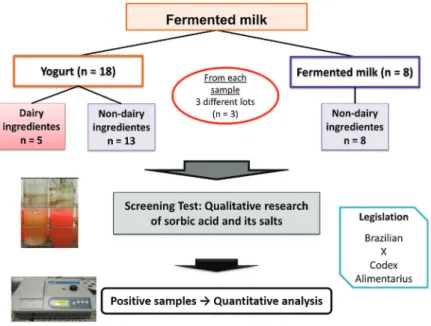
The fermented milk samples for this experiment were purchased in Rio de Janeiro and Salvador markets. Immediately afterward, they were transported in an isothermal box to the laboratory and stored at 4 ± 1 ºC until the analysis. Twenty-six fermented milks were subdivided into 18 yogurts (5 natural and 13 with non-dairy ingredients) and 8 fermented milks (all with non-dairy ingredients). From each sample, 3 different lots (n = 3) were collected, totaling 78 samples (Figure 1).
Sorbic acid and its salts
The sorbic acid and its salts qualitative analysis were used as a screening method in fermented milks. The qualitative analyzes in fermented milks were carried out according to the protocol established by Brasil (2006), with some modifications. Initially, 1 g of the samples was weighed in triplicate, then 20 mL of distilled water and 0.6 mL of sulfochromic solution were added. This mixture was taken to the fire. After boiling, 1mL of the 0.3% 2-thiobarbituric acid solution was added with further reading. Sorbic acid or its salts oxidize
to the malonic aldehyde to form a compound of red or pink coloration. In this way, the formation of red to pink color indicates these compounds presences. On the other hand, the yellowish coloration indicates the absence.
Potassium sorbate quantification
In the quantitative analysis, sixteen po-sitive samples (n = 48) were evaluated. The potassium sorbate content was estimated ba-sed on the method described by Brasil (2006). The samples were weighed (2 g), and 10 mL of 2 N sulfuric acid was added. Then, 10 g of magnesium sulfate heptahydrate was added to the distiller by steam stripping to obtain a 125 mL of distillate. Distilled water was added to complete the 250 ml volume, and 2 mL of 0.3 N sulfuric acid solution and 2 mL of 0.147% potassium dichromate solution were added to the water bath for 5 minutes. The beaker tubes were immersed in cold water, 4 mL of the 0.5% 2-thiobarbituric acid solution was added and then they stood in the water
bath for another 10 minutes before cooling down. Subsequently, the spectrophotometer (SP22 – Biospectro) was calibrated at 532 nm. The potassium sorbate results were expressed in g.kg-1 of sorbic acid.
Statistical analysis
The qualitative data were organized in a Microsoft Office Excel® spreadsheet, and descriptive statistical analysis tools were used to show the percentage values found. The quantitative results were analyzed by analysis of variance (ANOVA) and reported as means ± standard deviations. All ANOVA results were submitted to the Tukey test at P < 0.05 using the XLSTAT version 2013.2.03 (Addinsoft, Paris, France). In this experiment, three different sample batches (n = 3) were evaluated.
RESULTS AND DISCUSSION
The qualitative results demonstrated that
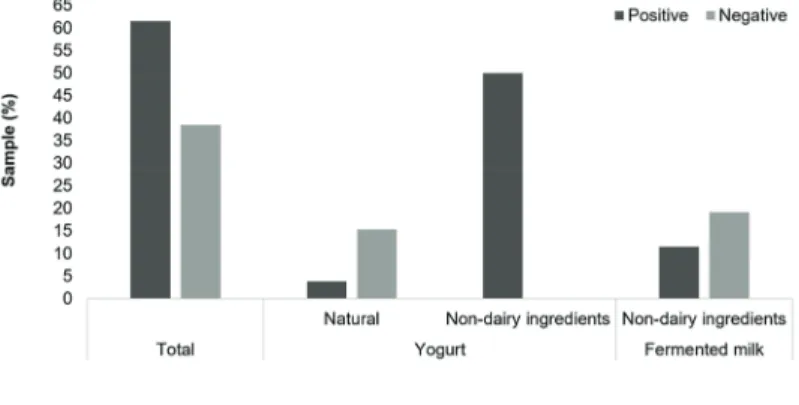
61.53% of the samples were positive for sorbic acid and its salts presence, and 38.47% of the samples were negative (Figure 2). Moreover, 3.85% of the fermented milks (yogurts) without non-dairy ingredients presented a positive result for these compounds (Figure 2). Based on Brazilian legislation (BRASIL, 2007) and Codex Alimentarius (CODEX ALIMENTARIUS, 2010), in some fermented milks it is accepted the sorbic acid and its salts presence, including fermented milk with fruit pulp aggregate (or fruit preparation for industrial use) and flavored fermented milks. In both references, the preservative presence, including sorbic acid and its salts, in fermented milks without non-dairy ingredient addition is prohibited. Thus, positive samples in natural fermented milk (Figure 2), that is without non-dairy ingredients, are characterized as fraud. Therefore, 26 fermented milks analyzed (3.85%) disagree with the legislation.
Consequently, the sorbic acid and its salts qualitative analysis is a useful screening method to analyze the fraudulent addition of this preservative in fermented milks without non-dairy ingredients. However, in fermented milks added with non-dairy ingredients, it is relevant to quantify the sorbic acid and its salts levels. Since, its presence is permitted
with a maximum concentration established (0.3 g.kg-1 and 1.0 g.kg-1, Brazilian legisla-tion and Codex Alimentarius, respectively).
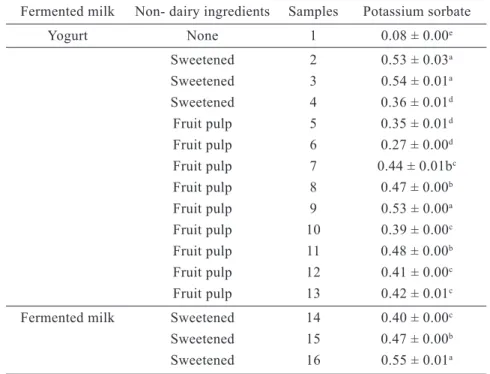
Table 1 exhibits the quantitative results (mean ± standard deviation) of potassium sorbate, expressed as g.kg-1 sorbic acid. Only natural yogurt, which should be absent from this preservative, showed a potassium sorbate concentration within the maximum per mitted limit in Brazilian legislation. Accor ding to this, only fermented milk with an aggregate of fruit pulp or fruit preparation for in dus trial use can present sorbic acid and its salts at
the maximum concentration of 300 mg.kg-1
(0.30 g.kg-1) in the final product (BRASIL, 2007). Thus, all samples were outside the standard proposed by the Brazilian legislation, characterizing fraud. On the other hand, for Co dex Alimentarius a maximum concentra-tion of 1000 mg.kg-1 (1.0 g.kg-1) as sorbic acid is accepted in flavored fermen ted milks (CODEX ALIMENTARIUS, 2010). In this case, for Codex Alimentarius, all samples were within the maximum permissible limit.
Sorbic acid and its salts are preser-vatives used to inhibit the formation of molds and yeasts in foods, including dairy products such as dairy drinks and dul ce de leche (JA-VANMARDI et al., 2015). However, regular
Figure 2 – The qualitative result (%) of the sorbic acid and its salts in fermented milk (natural
consumption of these pre ser vatives may favor allergic reactions, hi ves, toxicological and mutagenic damage, and elevated blood pres-sure. Furthermore, chil dren are the principal consumer group of these products and may develop hyperac tivity and attention deficit due to the con sump-tion of preservatives (POLÔNIO; PERES, 2009). Therefore, it is essential to control the potassium sorbate concentration, respec ting the maximum value allowed. Future studies should be carried out to evaluate the long-term effects of sorbic acid consumption on the health. In addition, it should also look for natural substances that can be used as a substitute for this pre-servative.
CONCLUSION
It was concluded that the potassium
sorbate, a preservative, was detected in fer-mented milk both natural and with non-dairy ingredients. Moreover, in several cases, the concentration exceeded the maximum per-missible by Brazilian legislation. Thus, there is a fraud by potassium sorbate addition in some fermented milks marketed in Brazil.
ACKNOWLEDGMENTS
The authors thank the Fundação de Amparo à Pesquisa do Estado do Rio de Janeiro (process no. E-26/201.185/2014, E-26/010.001.911/2015 and E-26/010.000274/ 2017, FAPERJ, Brasil) and the Conselho Nacional de Desenvolvimento Científico e Tecnológico (process no. 311361/2013-7 and 400136/2014-7, 439731/2016-0 and 150200/2017-0, CNPq, Brasil).
Table 1 – Sorbic acid (g.kg-1) in fermented milks
Fermented milk Non- dairy ingredients Samples Potassium sorbate
Yogurt None 1 0.08 ± 0.00e Sweetened 2 0.53 ± 0.03a Sweetened 3 0.54 ± 0.01a Sweetened 4 0.36 ± 0.01d Fruit pulp 5 0.35 ± 0.01d Fruit pulp 6 0.27 ± 0.00d Fruit pulp 7 0.44 ± 0.01bc Fruit pulp 8 0.47 ± 0.00b Fruit pulp 9 0.53 ± 0.00a Fruit pulp 10 0.39 ± 0.00c Fruit pulp 11 0.48 ± 0.00b Fruit pulp 12 0.41 ± 0.00c Fruit pulp 13 0.42 ± 0.01c
Fermented milk Sweetened 14 0.40 ± 0.00c
Sweetened 15 0.47 ± 0.00b
Sweetened 16 0.55 ± 0.01a
REFERENCES
AKBARI-ADERGANI, B.; ESKANDARI, S.; BAHREMAND, N. Determination of sodium benzoate and potassium sorbate in “doogh” samples in post market surveillance in Iran 2012. Journal of Chemical Health Risks, v. 3, n. 1, p. 65-71, 2013.
ALBENZIO, M. et al. Differences in pro tein fraction from goat and cow milk and their role on cytokine production in children with cow’s milk protein allergy. Small
Rumi-nant Research, v. 105, n. 1-3, p. 202-205,
2012.
BRASIL. Ministério da Agricultura, Pecuá-ria e Abastecimento (MAPA) Instrução Nor ma tiva nº 68, de 12 de dezembro de 2006. Oficia lizar os Métodos Analíticos Ofi ciais Físico-Químicos, para Controle de Lei te e Produtos Lácteos, em conformidade com o anexo desta Instrução Normativa, de terminando que sejam utilizados nos La-boratórios Nacionais Agropecuários. Diário
oficial da República Federativa do Brasil,
Brasília, 2006.
BRASIL. Ministério da Agricultura, Pe-cuária e Abastecimento (MAPA) Instrução Normativa nº 46, de 23 de outubro de 2007. Adota o Regulamento Técnico de Identidade e Qualidade de leites fermentados. Diário
oficial da República Federativa do Brasil,
Brasília, 2007.
CODEX ALIMENTARIUS. Codex standard for fermented milks. 2ª ed. Codex standard
243-2003 in Codex Alimentarius: Milk and Milk Products. Codex Alimentarius
Commission, Bruxelas, Bélgica. 2010.
COSTA, M. P.; CONTE JUNIOR, C. A. Leites Fermentados como alimentos funcionais.
Animal Business, v. 9, p. 61-65, 2013.
COSTA, M. P. et al. Leite fermentado: potencial alimento funcional. Enciclopédia
Biosfera – Centro Científico Conhecer. v.
9, n. 16, p. 1387-1408. 2013.
CRESSEY, P.; JONES, S. Levels of pre-servatives (sulfite, sorbate and benzoate) in New Zealand foods and estimated dietary exposure. Food Additives & Contaminants:
Part A, v. 26, n. 5, p. 604-613. 2009.
ESFANDIARI, Z. et al. Simultaneous determination of sodium benzoate, potassium sorbate and natamycin content in iranian yoghurt drink (Doogh) and the associated risk of their intake through doogh consumption.
Iranian Journal of Public Health, v. 42, n.
8, p. 915-920. 2013.
JAVANMARDI, F. et al. Benzoic and sorbic acid in soft drink, milk, ketchup sauce and bread by dispersive liquid–liquid microextraction coupled with HPLC. Food
Additives & Contaminants: Part B, v. 8,
n. 1, p. 32-39. 2015.
POLÔNIO, M. L. T.; PERES, F. Consumo de aditivosalimentares e efeitos à saúde: desa fios para a saúde pública brasileira. Cadernos de