Control of a
Tese Especia Speciali P Facunetwo
Luís M e de Doutora alização em (Ph.D. T ization in A Orien Professor Professor Do ldade de Ecork by a
Manuel Dion amento em m Contabilid Thesis in Bu Accounting a ntação de (S r Doutor Joã outor Rober conomia da 2012a netw
nísio Marqu Ciências Em dade e Contr usiness Scien and Manage Supervision) ão Alves Ribrt William S Universida 2
work co
ues mpresariais rolo de Gest nces ement Contr ): beiro Scapens ade do Portooordina
s tão rol) oator
Biographic note
Luís Manuel Dionísio Marques is the husband of Xana and the father of Luís Afonso. He was born in Coimbra, Portugal, in 14 December 1971 and lives in Porto with his family.
Besides being a PhD student at the Faculty of Economics, University of Porto, he is the CFO of the Aveiro Port Authority and also of the Figueira da Foz Port Authority. He also teaches management control courses at Católica Porto Business School and Católica Porto School of Economics and Management, both schools belonging to the Catholic University of Portugal. He is a Certified Public Auditor and a former colaborator of PricewaterhouseCoopers and CFA - Cravo, Fortes, Antão e Associados, SROC. He holds an MSc in Business Science at the Faculty of Economics, University of Porto and a degree course in Accounting and Auditing at ISCA, University of Aveiro, all in Portugal. He has participated in several courses of executive education, including in Harvard Business School, United States of America and in the University of Porto Business School, Portugal.
Luís is a member of the following research associations: European Network for Research in Organisational and Accounting Change (ENROAC); European Accounting Association (EAA); Management Control Association (MCA); GOVCOPP – Research Unity in Governance, Competition and Public Policy; EIASM – European Institute for Advanced Studies in Management; and Portuguese Accounting Research Network (Grudis).
He has participated and presented communications in several seminars, organized by entities like ENROAC, EAA, EIASM and MCA. He has also published opinion articles in Portuguese newspapers and a research paper in Management Accounting Research.
A former young player of Football and Taekwondo, Luís spends its part-time (‘although not lately’) voyaging with is family and reading history and romance books.
Acknowledgments
This thesis would not be possible without the support of João Ribeiro and Bob Scapens, to whom I am deeply grateful and indebted. Their remarkable work, insightful comments and guidance are the construct of this work.
Port of Aveiro’s Port Authority allowed the full consultation of all documents and archives that support the case studies. I wish to thank former and present Board Members and Managers that were always available for discussing thesis matters.
The quality of teaching at Faculty of Economics of University of Porto, Portugal, settled the outcome control that became the conclusion of the thesis. I hope that the thesis can constitute my contribution for the years of study that the school has given me.
I gratefully acknowledge the comments received on earlier versions of the first paper from the two anonymous referees at Management Accounting Research and the participants in the following colloquia: 7th Conference of the European Network for Research in Organisational & Accounting Change (ENROAC), Dundee, 2009; and 5th Conference on Performance Measurement and Management Control: Innovative Concepts and Practices, European Institute for Advanced Studies in Management (EIASM), Nice, 2009.
I also gratefully acknowledge the comments received on earlier versions of the second paper in the following colloquia: discussants Martine Cools and Paolo Quattrone and also other participants in the 5th Doctoral Summer School in Management Accounting, ENROAC – European Network for Research on Organizational and Accounting Change, Siena, 2010; from the participants in the 8th International Management Control Research Conference, Management Control Association, London, 2010; from the discussant Hernani Carqueja and other participants in the 10th Grudis Seminar, Porto, 2011; and from the participants in the 34th Annual Congress, European Accounting Association, Rome, 2011.
Finally, I also want to gratefully acknowledge the comments received on earlier versions of the third paper from the discussant João Oliveira and other participants in the 11th Grudis Seminar, Évora, 2012; and from Hernani Carqueja.
Abstract
This thesis addresses the issue of control of a network by a network coordinator that uses management control mechanisms to influence other organizations' cooperative behaviour in three different types of inter-organizational relationships: bilateral, multilateral and indirect relationships. A case study provides the basis for this thesis: the control of a network – a port – by a network coordinator – the Portuguese Port Authority in the Port of Aveiro, Portugal.
The first paper explores control in bilateral relationships and concludes that the nature and use of management control mechanisms by the network coordinator seems to be shaped by its assessment of motivations to cooperate and of the contribution to network performance of the various organizations involved in the network. Other more specific contributions are encapsulated in a ‘coordination framework’, which relates those assessments to specific features of the management control mechanisms.
The second paper explores control in multilateral relationships. In this type of relationship the network coordinator is concerned about the collective cooperative behaviour of two or more organizations. This paper contributes to understand the nature of collective management control mechanisms, to assess the consequences of the use of these mechanisms and to explore how their use is related to bilateral management control mechanisms.
The third paper explores control in indirect relationships, specifically the use of management control in networks that include third parties. This paper contributes both to systematize the understanding of the influence of the presence of third parties on the control of the network by a network coordinator, and to understand the actions and strategies conducted by the latter in order to keep the network under control in the presence of one, or several, organization(s) with whom that network coordinator does not establish a direct relationship.
Resumo
A presente tese aborda o tema do controlo de redes e de como um coordenador da rede utiliza mecanismos de controlo de gestão para influenciar o comportamento cooperativo de outras organizações em três tipos de relações: bilaterais, multilaterais e indiretas. Um caso de estudo está na base da tese: o controlo de uma rede – um porto – pelo seu coordenador – a Administração do Porto de Aveiro, em Portugal.
O primeiro ensaio explora o controlo em relações bilaterais, concluindo que a natureza e uso de mecanismos de controlo de gestão por um coordenador parecem ser influenciados pelas suas avaliações das motivações para cooperar e contribuição para o desempenho da rede das várias organizações nela envolvidas. Outras contribuições mais específicas são apresentadas num ‘quadro conceptual de coordenação’, que relaciona aquelas avaliações com características específicas dos mecanismos de controlo de gestão.
O segundo ensaio explora o controlo em relações multilaterais. Neste tipo de relacionamento o coordenador da rede está preocupado com o comportamento coletivo de duas ou mais organizações. Este ensaio contribui para compreender a natureza dos mecanismos coletivos de controlo de gestão, para avaliar as consequências do seu uso e para explorar como é que o seu uso está relacionado com o uso de mecanismos bilaterais de controlo de gestão.
O terceiro ensaio explora o controlo em relações indiretas, especificamente o uso do controlo de gestão em redes que incluem terceiros. Este ensaio contribui para sistematizar a compreensão da influência da presença desses terceiros no controlo da rede pelo coordenador e para compreender as ações e estratégias conduzidas por este último para manter a rede sob controlo, na presença de uma ou várias organizações com as quais o coordenador não estabelece relações diretas.
Table of contents
Biographic note ... i Acknowledgments ... ii Abstract ... iv Resumo ... v Table of contents ... vi Abbreviations ... ix List of tables ... x List of figures ... xi Introduction ... 1First Paper: The use of management control mechanisms by public organizations with a network coordination role: a case study in the Port Industry ... 8
Abstract ... 8
1. Introduction ... 9
2. Networks and network coordinators ... 10
3. The use of MCMs by network coordinators ... 13
4. An exploration of the factors shaping the nature and use, by network coordinators, of MCMs ... 16
5. The Case Study: Port of Aveiro, Portugal ... 23
5.1. Introduction ... 23
5.2. The port sector ... 24
5.3. Research methods ... 26
5.4. Port organizations and the Port Authority’s assessments ... 31
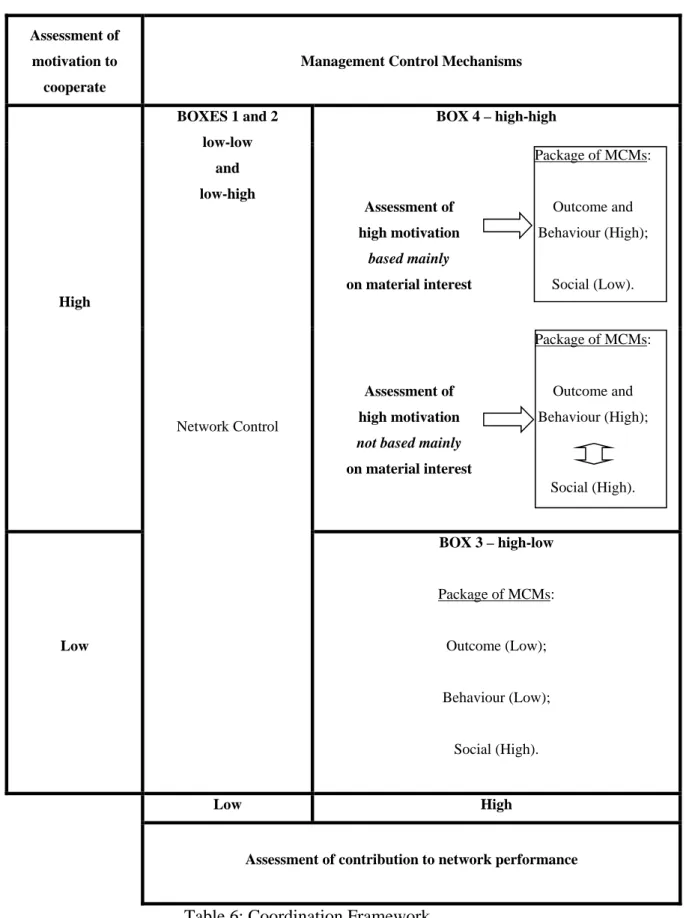
6. A Coordination Framework ... 42
6.1. Boxes 1 and 2: the nature and use of MCMs when contribution to network performance is assessed as low ... 43
6.2. Box 3: the nature and use of MCMs when contribution to network performance is assessed as high and motivation to cooperate is assessed as low ... 45
6.3. Box 4: the nature and use of MCMs when contribution to network performance is assessed as high and motivation to cooperate is assessed as high ... 46
6.5. The case of the South Terminal Concessionaire ... 51
6.6. Recapping ... 53
7. Discussion and concluding remarks ... 57
Second Paper: Collective action problems and the use of collective management control mechanisms by a network coordinator ... 66
Abstract ... 66
1. Introduction ... 67
2. Collective MCMs ... 68
3. The case study ... 77
3.1. Research methods ... 78
3.2. The Port Community Association (PCA) ... 81
3.2.1. Collective action problems in PCA ... 86
3.2.2. Nature and consequences of collective MCMs ... 90
3.3. The Port Single Window ... 97
3.3.1. Nature and consequences of collective MCMs: discussion of JUP illustration ... 102
3.3.2. How collective MCMs interact with bilateral ones ... 106
4. Final remarks ... 113
Third Paper: Third parties and the control of networks by a coordinator: the case of the dockers pool crisis in the Port of Aveiro ... 116
Abstract ... 116
1. Introduction ... 117
2. Third parties and network control ... 119
3. Methodology ... 126
4. Third parties and network control by the PAPA - the case of the dockers pool crisis ... 130
4.1. Reliance on inter-relational MCMs and the prerequisites for this reliance .... 132
4.2. Loss of reliance on inter-relational MCMs: strategies to re-establish network control ... 133
4.3. Discussion ... 141
Conclusion ... 151
1. Summary of the thesis ... 151
2. Contributions to management control literature: what have we learned? ... 159
2.1. Focus on control solutions and neglecting control problems ... 160
2.2. Structure of interests ... 169
2.3. Complexity related to the number of parties involved, the number of activities and the level of interconnection among them ... 170
2.4. Cognitional complexity ... 176
2.5. How and why public sector networks adopt particular control mechanisms . 177 2.6. Network performance measurement ... 179
2.7. Conceptualization of MCMs in function of the type of IOR ... 181
3. Limitations and opportunities for further research ... 186
4. Concluding remarks ... 188
Abbreviations
AGEPOR – Shipping Agents National Association APOA – Aveiro Port Operators’ Association EAA – European Accounting Association
EIASM – European Institute for Advanced Studies in Management
ENROAC – European Network for Research on Organizational and Accounting Change ETP – Aveiro Dockers Pool
GOVCOPP – Research Unity in Governance, Competition and Public Policy Grudis – Portuguese Accounting Research Network
IORs – Inter-organizational relationships
JUP – Port Single Window (Janela Única Portuária, in Portuguese) MCA – Management Control Association
MCM – Management Control Mechanism MCMs – Management Control Mechanisms PAPA – Port of Aveiro’s Port Authority PCA – Port Community Association
List of tables
Table 1: Behaviour patterns that inform a network coordinator’s assessments of
motivation to cooperate ... 19
Table 2: Factors shaping the nature and use of MCMs by a public organization acting as a network coordinator ... 27
Table 3: Case study illustrations - Organizations and the PAPA’s assessments ... 32
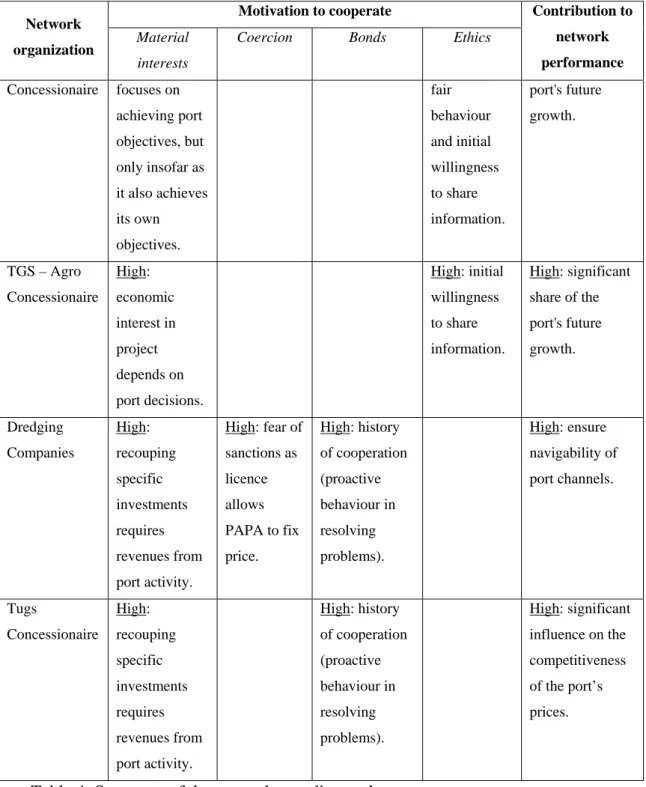
Table 4: Summary of the network coordinators’ assessments ... 42
Table 5: Nature of motivations to cooperate, contribution to network performance and the MCMs in the control package ... 55
Table 6: Coordination Framework ... 56
Table 7: Examples of collective MCMs, following Dekker’s (2004) typology ... 73
Table 8: Collective MCMs found in management control literature ... 74
Table 9: Collective MCMs identified in the case study ... 107
Table 10: Control problems and network control ... 144
Table 11: Control concepts developed ... 150
List of figures
Figure 1: Bilateral relationship ... 68
Figure 2: Multilateral relationships ... 69
Figure 3: Collective MCM ... 71
Figure 4: Collective MCMs and the consequences of their use (PCA illustration) ... 96
Figure 5: Collective MCMs and the consequences of their use (PCA and JUP illustrations) ... 104
Figure 6: Collective MCMs through the lens of the ‘Coordination framework’ ... 110
Figure 7: The paper’s problem ... 123
Figure 8: Network of relationships between the PAPA and organizations related with the dockers pool ... 131
Figure 9: Network of relationships between the PAPA and organizations related with the dockers pool (the situation in January 2011) ... 140
Figure 10: Control strategies for third parties with a relevant contribution to performance ... 145
Introduction
In recent years, practices associated with the “New Public Management” discourse have led to the gradual transfer of competences from the public to the private sector (Hood, 1995; Teisman and Klijn, 2002). New forms of partnership, such as public-private partnerships, have supported this movement. In public-public-private partnerships involving concessions, the public party assumes general functions relating to the provision of public services, leaving operational issues to private parties (Brooks and Cullinane, 2007) within a network of inter-organizational relationships (IORs). These general functions are usually related to the overall supervision of operations and the quality standards in the network. In such mixed-type networks a public organization, acting as the network coordinator, assumes a coordinating role which is aimed at stimulating cooperation within the network and ensuring that network members make adequate contributions to network performance (Torfing, 2005). As such, the network coordinator takes responsibility for key governance activities, while leaving other activities to the network members.
Network coordinators are in a position to select and use Management Control Mechanisms (MCMs) to exercise their responsibilities in coordinating the IORs in which they are involved. Network coordinators are involved in direct or dyadic and indirect relationships. The issue of management control in IORs has been extensively addressed in the past two decades (Caglio and Ditillo, 2008; Berry et al, 2009), with the unit of analysis varying from dyads to networks. However, some authors have recently pointed out that these studies focus mainly on one-to-one relationships, and only a few adopt a network perspective to analyse the deployment of MCMs in networks involving multiple interactions between organizations (Caglio and Ditillo, 2008; Berry et al, 2009). Even fewer studies have specifically tackled the use of these mechanisms in the context of mixed-type networks.
It should be noted that in a mixed-type network issues of cooperation and coordination are related to the network context. This means that the use of MCMs by a network coordinator is not restricted to securing cooperation between two organizations. Instead, the network coordinator is responsible for the performance of the network as a
whole and, consequently, the coordinator adopts a network perspective in selecting MCMs. That is, in order for the desired network outcomes to be achieved, it is not only cooperation with the network coordinator which is important, but also cooperation with and between all the other network organizations.
This thesis addresses the issue of control of a network by a network coordinator that uses MCMs to influence other organizations’ cooperative behaviour. Adopting a network perspective, the thesis studies the control of the network by a network coordinator in three different types of IORs: bilateral, multilateral and indirect relationships. The first two can also be considered as dyadic relationships. The thesis uses a case study conducted in the Portuguese Port of Aveiro. Today, most ports are mixed-type networks in which a port authority assumes a coordinating role. In this thesis case, I focused on the relationships established between the network coordinator – the Port Authority in the Port of Aveiro (PAPA) – and the various organizations operating within the port network.
In dyads we find bilateral relationships (one-to-one relationships, such as a joint-venture, a strategic alliance between two organizations or a supply-chain) or multilateral – also known as ‘multi-dyadic’ - relationships (one-to-many relationships, such as several counterparts working in one direction towards a mutual objective, or a seller and multiple customers) (Caglio and Ditillo, 2008; Lind and Thrane, 2010). Various studies have focused on the issue of control in the context of hybrid forms of organization, such as alliances, joint-ventures and supply-chains. The management control literature on dyadic relationships has adopted two different perspectives: a first one aims to identify the contingent variables that influence the use of MCMs; while the other one seeks to identify the consequences of the use of various configurations of MCMs (see Caglio and Ditillo, 2008; Berry et al, 2009).
Only a few studies, however, have adopted a network perspective with contexts characterised by multiple interactions between organizations (Caglio and Ditillo, 2008; Berry et al, 2009; Lind and Thrane, 2010). In fact, although suggestions for the adoption of a more systemic perspective when studying management control in IORs were made
almost two decades ago (Frances and Garnsey, 1996), only recently have a small number of researchers started to explore those suggestions. This gap seems to be problematic, mainly because a “…selective orientation in defining the unit of analysis has hindered the exploration of the impact that other actors and/or relationships have on the relationship(s) under analysis and on their differential influence, both on the relationship-specific cost accounting choices and on the overall cost and use of accounting controls at the network level” (Caglio and Ditillo, 2008, p. 885). Along the same lines, Berry et al (2009, p. 11) reinforce that “… only scant attention has been paid to how powerful external groups and institutions might also influence the design of hybrid control structures”. Even fewer studies have specifically tackled the use of these mechanisms in the context of mixed-type networks. These are the research gaps that the first paper aims to address. The case study allowed developing a theoretical framework which shows the linkages between the nature and use of MCMs by a network coordinator, and the assessments formed by this coordinator of other network organizations’ motivations to cooperate and contribution to network performance.
However, IORs can go beyond bilateral relationships and involve more than two participants in networks that have implications for network performance. Network coordinators are also involved in this type of IOR: multilateral relationships. These relationships are studied in the second paper which has three objectives: (i) to understand the nature of these collective MCMs; (ii) to assess the consequences of the use of these mechanisms; and (iii) to explore how their use is related to bilateral MCMs.
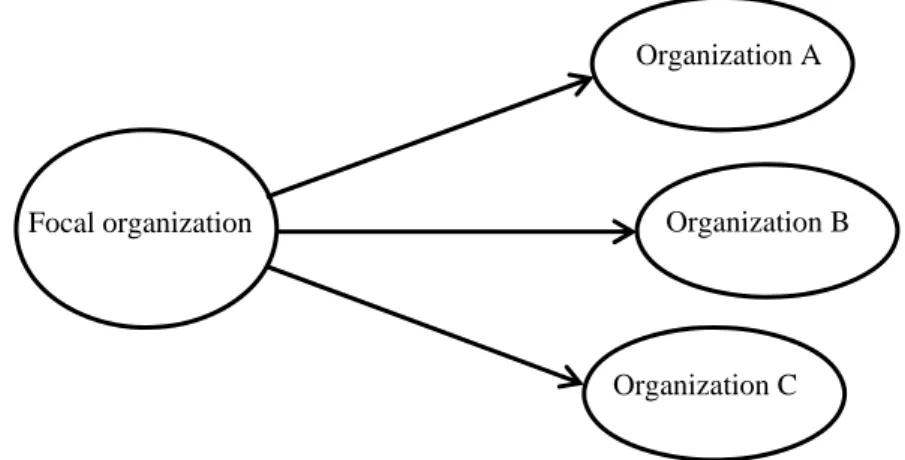
Multiple interactions between organisations can also occur in a more distant, yet still significant part of the network. For instance, there may be multiple counterparts interacting in multiple directions, as in the case where a coordinator simultaneously handles multiple suppliers and multiple customers, who, in turn, also establish dyadic relationships between themselves. At stake is the whole network, including third parties to a focal organization, i.e., organizations that do not establish a direct, dyadic, relationship with that focal organization, such as competitors, unions, regulators, customers´ other suppliers and suppliers’ other customers. The potential influence that the presence of third parties has on management control has been suggested by the
management control literature. However, such influence has, with the exception of a few recent studies, been neglected to a great extent (Caglio and Ditillo, 2008 Lind and Thrane, 2010). It is this gap in the management control literature that the third paper aims to address.
Each paper includes a detailed description of the qualitative research methodology adopted and a theoretical discussion of case study findings. I will not repeat all those contents in this introduction. Nevertheless, a brief overall description of the research methodology is of order at this point.
The case study research method was selected to focus on “how things work in a particular context” (Mason, 2002, p. 1). As Barretta and Busco (2011, 211) recently pointed out: “… there is a need to look inside management control practices, to explore what these practices are and, how and why they enable the cooperative “ideal” to become real…”.
The case study research method is also consistent with the holistic – network – perspective adopted in the research. Although the study of MCMs in networks requires an understanding of the relationships between the network coordinator and each organization, thereby involving a study of both dyadic and indirect relationships, these relationships are part of the larger network and, consequently, a network approach is adopted in this thesis. Furthermore, although I examine the IORs from the network coordinator’s viewpoint, my analysis extends beyond relationships with specific organizations. My approach combines network analysis and governance perspectives, as proposed by Provan and Kenis (2008). That is, I combine my analysis of the network as a set of actors, with a governance perspective that takes the network as my unit of analysis; in other words, I study the dyadic relationships – analytical perspective – in terms of the network coordinator’s view of the network – governance perspective.
The case study analyses the relationships between the Port Authority – which is a public organization that acts as network coordinator – and the various port organizations – both private and public – operating in the Port of Aveiro, Portugal. This
case study, which covers the period from 1999 to May 2012, was based primarily on data collected from the Port Authority. In this case study, the Port is regarded as a network (cf. van der Lugt and de Langen, 2008; de Langen, 2003) and I explore the role of the Port Authority as the network coordinator of the port organizations (see also de Langen, 2003; Olson, 1971). Port organizations are seen lato sensu, including not only organizations that provide port services, but also organizations that contribute to the overall port performance.
The preparation of the thesis followed a process that included paper presentations and submissions to international journals. This process has provided some very useful and relevant contributions from conference/seminars participants, discussants and reviewers comments.
The first paper in this thesis was presented at the 7th Conference of the European Network for Research in Organisational & Accounting Change (ENROAC, Dundee, 2009) and at the 5th Conference on Performance Measurement and Management Control: Innovative Concepts and Practices (European Institute for Advanced Studies in Management - EIASM, Nice, 2009). The paper was submitted in September 2009 for a Management Accounting Research Special Issue – Management Control Innovations in Public Sector Networks. During 2009 and 2011, three rounds of reviewers’ comments helped to improve the theoretical message and case study findings that support the proposed theoretical framework. An adapted version of this first paper was published in December 2011 in Management Accounting Research, number 22, issue 4.
The second paper was first presented at the 5th Doctoral Summer School in Management Accounting (ENROAC, Siena, 2010). Contributions from participants and discussants Martine Cools and Paolo Quattrone influenced a new version of the paper that was presented at the 8th International Management Control Research Conference (Management Control Association, London, 2010) and at the 10th Grudis Seminar (Portuguese Accounting Research Network - Grudis, Porto, 2011). Contributions from participants, from discussant Hernani Carqueja and further work on a new version of the paper allowed another presentation at the 34th Annual Congress (European Accounting
Association - EAA, Rome, 2011). Useful comments from discussants and participants lead to the development of the second paper, which was the object of some profound changes in the last months of the thesis preparation.
The third paper of the thesis was presented at the 11th Grudis Seminar (Portuguese Accounting Research Network - Grudis, Évora, 2011). Contributions from participants, from discussant João Oliveira and also from Hernani Carqueja, led to the version of the paper included in the thesis. The same version was submitted in June 2012 for publication in an ISI-indexed international accounting journal.
The three papers follow a sequence based on: (i) the extension of the scope of relationships established by a network coordinator in mixed-type networks: starting with bilateral (one-to-one) relationships, then multilateral (one-to-many) relationships and finally indirect relationships; and (ii) the evolution through time of the learning process that influenced my interpretation of the case study material and that is reflected on the discussion and conclusions which are drawn. It is this rationale that underpins the presentation of the three papers to form a coherent whole in the thesis.
A very simple presentation of the thesis structure in the form of research questions addressed in each of the three papers can be presented as:
(i) How does a network coordinator use MCMs in bilateral relationships to control the network (Paper 1)?
(ii) How does a network coordinator use MCMs in multilateral relationships to control the network in (Paper 2)?
(iii) How does a network coordinator use MCMs in indirect relationships to control the network (Paper 3)?
The main contribution of the thesis is a better understanding of the use of MCMs to the control of mixed-type networks. This includes an understanding of the factors that influence the use of MCMs by a network coordinator (Paper 1), the consequences of its use (Paper 2), and the influence of other organizations on the control of the network
(e.g. third parties in Paper 3). By expanding the scope of relationships to include both direct and indirect relationships, and by adopting a network perspective where relationships are not seen in isolation, but as part of a wider network of relationships, this thesis contributes to a more comprehensive understanding of the control of networks.
First Paper: The use of management control mechanisms by public
organizations with a network coordination role: a case study in the
Port Industry
Abstract
The first paper addresses two gaps in the literature on management control mechanisms in the context of inter-organizational relationships. Firstly, several studies have focused on one-to-one relationships, but few take a network perspective which analyses the deployment of management control mechanisms in the context of networks involving multiple interactions between organizations. Secondly, even fewer studies have specifically tackled the use of these mechanisms in the context of mixed-type networks, where a public organization acts as the network coordinator responsible for key governance activities. This is the position in Ports, which are collectives of several related organizations and in which one organization – the "port authority" – assumes the role of network coordinator. In this paper I report the results of a case study, the aims of which were: to identify the management control mechanisms deployed, or relied upon, by the Portuguese Port Authority in the Port of Aveiro in the exercise of its coordinating role; and to discern - on the basis of theoretical reasoning and empirical evidence - the factors explaining the nature and use of these mechanisms.
Several conclusions emerged from the study. A general conclusion was that my prior literature-based theorization is generally consistent with the case observations. That is, in mixed-type networks, the nature and use of management control mechanisms by the public organization acting as a network coordinator seems to be shaped by its assessment of motivations to cooperate and of the contribution to network performance of the various organizations involved in the network. Other more specific conclusions are encapsulated in a ‘coordination framework’, which relates those assessments to specific features of the management control mechanisms. Crucially, my results provide insights into the roles of public organizations acting as network coordinators in the context of mixed-type networks, and, in general, on the nature of the numerous such public organizations in today’s economy and society.
1. Introduction
In recent years, practices associated with the “New Public Management” discourse have led to the gradual transfer of competences from the public to the private sector (Hood, 1995; Teisman and Klijn, 2002). New forms of partnership, such as public-private partnerships, have supported this movement. In public-public-private partnerships involving concessions, the public party assumes general functions relating to the provision of public services, leaving operational issues to private parties (Brooks and Cullinane, 2007), within a network of inter-organizational relationships (IORs). These general functions are usually related to the overall supervision of operations and the quality standards in the network. In such mixed-type networks a public organization, acting as the network coordinator, assumes a coordinating role which is aimed at stimulating cooperation within the network and ensuring that network members make adequate contributions to network performance (Torfing, 2005). As such, the network coordinator takes responsibility for key governance activities, while leaving other activities to the network members.
The issue of management control in IORs has been extensively addressed in the literature. Various studies have focused on the issue of control in the context of hybrid forms of organization, such as alliances, joint-ventures and supply-chains. However, some authors have recently pointed out that these studies focus mainly on one-to-one relationships, and only a few adopt a network perspective to analyse the deployment of MCMs in networks involving multiple interactions between organizations (Caglio and Ditillo, 2008; Berry et al, 2009). Even fewer studies have specifically tackled the use of these mechanisms in the context of mixed-type networks. These are the research gaps that the current paper aims to address.
In this paper I report on a case study conducted in the Portuguese Port of Aveiro. Today, most ports are mixed-type networks in which a port authority assumes a coordinating role. In this case, I focused on the relationships established between the network coordinator – the Port Authority in the Port of Aveiro – and the various organizations operating within the port network. The case study allowed to develop a
theoretical framework which shows the linkages between the nature and use of MCMs by a network coordinator, and the assessments formed by this coordinator of other network organizations’ motivations to cooperate and contribution to network performance.
The paper is structured as follows: I start by briefly describing the main characteristics of mixed-type networks and, more specifically, the functions of a public organization acting as a network coordinator in such a setting. In section 3 I review the use of MCMs in IORs in mixed-type networks, and in section 4 I explore the factors which shape the use of MCMs in this context. This is followed in section 5 by the case description and theoretical discussion, leading to my proposed coordination framework in section 6. This is then elaborated in section 7, which also concludes the paper.
2. Networks and network coordinators
Networks can be seen as “modes of organizing economic activities through inter-firm coordination and cooperation” (Grandori and Soda, 1995, p. 183), in which more than two organizations are involved and, consequently, there are multiple relationships in potentially many different directions (Nooteboom, 2004). Such relationships include IORs at various levels, from the more simple – i.e., dyadic – to the more complex – where three or more organizations are involved. At the dyadic level relationships are shaped by formal structural arrangements as well as various informal (unstructured) means of ensuring that there is cooperation between all pairs of organizations within the network (Nooteboom, 2004; Van de Ven and Walker, 1984). According to Ring and Van de Ven, “cooperative IORs are socially contrived mechanisms for collective action, which are continually shaped and restructured by actions and symbolic interpretations of the parties involved” (1994, p. 96). Furthermore, cooperation implies interaction and interdependency between organizations (Dekker, 2004), and this requires some form of coordination. Malone and Crowston (1994, p. 90) define coordination as “managing dependencies between activities”. Consequently, coordination in networks is needed
when an organization’s action is connected to and dependent on the action of another network organization (Nooteboom, 2004).
Network coordination has been proposed, in both the private and public sectors, as a way of increasing performance through the more efficient use of resources, greater competitiveness and improved customer service (Child et al, 2005; Provan and Kenis, 2008). Such coordination can be achieved by means of an appropriate governance structure (Grandori, 1997). However, several factors make network governance particularly complex: there is usually no hierarchy or ownership structure (Williamson, 1985); there may be different degrees of commitment to the goals of the network (Ring and Van de Ven, 1994); and there may be issues related to the voluntary compliance with rules and procedures (Grandori, 1997).
A number of different models of network governance can be distinguished: the self-organized model whereby all network organizations interact with every other organization in governing the network; the mandated or contracted model where there is an internal or external organization that governs the network; and the mixed or mid-range model in which one organization acts as a network coordinator and is responsible for some key governance activities, leaving the more operational activities to the other organizations in the network (Provan and Kenis, 2008). This last model of network governance – the mixed-type network – has become quite common in public management in recent decades, reflecting their growing importance in the provision of public services (Hood, 1995; Provan and Kenis, 2008).
In mixed-type networks a public organization assumes the role of network coordinator, while the network services are provided mainly by private organizations. Typically, the public organization has to cope with social concerns and pressures, while the private organizations are more concerned with market pressures (Klijn, 2003). The network coordinator is generally responsible for the network’s economic development, by facilitating the activities of the network organizations (Provan and Kenis, 2008) and by using coordination mechanisms to govern the network (Grandori, 1997). The public organization can obtain its resources from the network organizations or through
governmental funding. The role of the public organization is usually mandated by the government, although mixed-type networks can also emerge in certain horizontal networks, where the public organization has sufficient resources and legitimacy to act as the network coordinator (Provan and Kenis, 2008). In recent years many public services have gradually been transferred to private organizations, although coordinators may still be needed in order to “occupy structural holes” in the network (Burt, 1992). For example, economic bottlenecks can occur where structural holes are created due to parts of the network not being sufficiently developed to operate under market conditions and, consequently, they need to be filled by the government, either directly or through public, private or non-profit organizations (Brown and Potoski, 2003).
Several studies have identified other functions and roles of network coordinators, including public ones. For instance, network coordinators may be regarded by the network organizations as mutually trusted information intermediaries, capable of bridging informational asymmetries, establishing a common set of expectations and aligning diverse goals (Ebers, 1997). Other functions of network coordinators include coordinating activities, resolving conflicts, regulating access to the network and applying sanctions. Network coordinators can also act as intermediaries between network organizations, by becoming involved in things like: arbitration or mediation; assessing the value of information before it is traded; creating mutual understandings; monitoring information flows; building trust; helping in a timely way to sort out of relationships issues; and providing reputational mechanisms (Nooteboom, 2009).
In relationships between a public organization, acting as network coordinator, and the other network organizations, there is likely to be a legal framework which defines the formal context within which the public organization has to work, but this does not necessarily mean that the network coordinator has the legal authority to impose rules or to dictate the actions to be taken by the other network organizations (Torfing, 2005). Where the legal framework mandates some or all of the roles of the public organization, the other network organizations will have to comply. However, in the absence of such legal mandates, network coordination means influencing other network organizations to take actions that enhance the performance of the network (Phillips et al, 2000). Here,
political issues may be at stake (Nutt, 2000). For example, in a political context where there is a heavy reliance on state regulation, the emphasis will be on the enforcement of state regulations. In contrast, in a more liberal, competitive, market-oriented political environment – as in New Public Management (Rethemeyer and Hatmaker, 2008) – the emphasis will be on rules and procedures which stimulate free competition (Torfing, 2005). Nevertheless, as Teisman and Klijn (2002, p. 191) argue, governments, although gradually engaged in more and more public-private partnerships, “still seem to be dedicated to their own procedures, rules and principles of control; for this reason, they try to fit partnerships into the mould of traditional policy-making procedures”.
In general, the objective of the network coordinator is to ensure that the actions of the various network organizations are consistent with the network’s goals. The achievement of such an objective clearly involves issues of control. Thus, a question emerges at this point: what are the mechanisms that can be deployed by a network coordinator (whatever its political orientation – traditional or liberal) to control the network? This topic will be tackled in the next section, where I provide a definition of MCMs and explore their use by network coordinators in IORs in mixed-type networks.
3. The use of MCMs by network coordinators
In the context of IORs, MCMs can be seen as instruments or processes deployed by an organization with the purpose of influencing another organization’s behaviour in order to achieve desirable or predetermined outcomes (Das and Teng, 1998; Dekker, 2004). Following Dekker (2004), MCMs in IORs can be one of three types: outcome, behavioural or social. Outcome controls involve the use of performance measures to assess and monitor the outputs of operations and other actions. Behavioural controls involve the specification and direct monitoring of the expected behaviour (Langfield-Smith, 2008). Taken together, outcome and behavioural controls can be classified as formal controls (Ouchi, 1979; Dekker, 2004). In contrast, the third type – social controls – are informal controls that imply a reliance on self-regulation (Ouchi, 1979) and are grounded in shared norms, values and beliefs (Langfield-Smith, 2008). In line with
Langfield-Smith (2008, p. 349) I adopt a lato sensu view of social controls that include “activities such as frequent interactions, meetings, negotiation of disputes, codes of conduct, senior management attitudes and style, and rituals”. Additional examples of the three types of controls in the context of IORs are (i) goal-setting, incentive systems and performance monitoring (outcome MCMs); (ii) rules and operational procedures (behavioural MCMs); and (iii) informal interactions, joint decision-making, and social ties and events (social MCMs). Different sets of MCMs are likely to be deployed by the network coordinator in each IOR. Here I will use the term “package of MCMs” to indicate the balanced set of MCMs (Malmi and Brown, 2008) used by the network coordinator. Balance, in this sense, is achieved by adapting the scope – i.e., higher or lower intensity of use – of each type of MCM in the MCM Package.
Two different perspectives have been adopted in the literature on management control in IORs (see Caglio and Ditillo, 2008; Berry et al, 2009). One aims to identify the contingent variables that influence the use of MCMs, while the other seeks to identify the consequences of using the various MCMs. Drawing mainly on transaction cost economics and organizational theory, the contingent variables literature has concluded that the level of interdependence and trust at various stages in the relationship life cycle influence the type of controls that are deployed (Tomkins, 2001). Furthermore, both the coordination of tasks (influenced by the degree of interdependence and task uncertainty) and appropriation concerns (influenced by asset specificity, uncertainty and frequency) influence the design and implementation of formal and social MCMs in IORs (Dekker, 2004). The consequences literature, on the other hand, suggests that MCMs can stimulate cooperation in IORs (Zajac and Olsen, 1993; Coletti et al, 2005; Mahama, 2006), increase the level of trust in cooperative IORs (Coletti et al, 2005), and, when supported by adequate information systems, tighten inter-organizational ties and reduce costs throughout the system (Frances and Garnsey, 1996).
As indicated earlier, management control studies have tended to focus on dyadic IORs, such as alliances, joint-ventures and supply-chains; very few have taken a network perspective and analysed the nature and use of the dyadic MCMs in contexts
characterised by multiple interactions between organizations (Caglio and Ditillo, 2008). Berry et al (2009, p. 9) review some notable exceptions; i.e., studies that analyse management control in “…dyadic relationships as but one element in a wider network of interconnections”. In one of those studies, Mouritsen and Thrane (2006) draw on actor-network theory to classify management controls in horizontal networks, distinguishing between self-regulation and the orchestration mechanisms which establish coherence and complementarity within the network. For them, “Self-regulating mechanisms allow interaction and exchange to occur unobtrusively, while orchestration mechanisms involve structuring these interactions” (Mouritsen and Thrane, 2006, p.
241).
Self-regulating mechanisms are, thus, network controls that require only minimal active intervention by the public organization. In another study, Håkanson and Lind (2004) explore the relationship between Ericsson and Telia Mobile, and identify the use of MCMs in three different forms of inter-organizational coordination: hierarchy, market and business relationship or cooperation. They argue that these different forms of coordination are not necessarily alternatives; they can be used in combination and further research is needed to study “how the forms of coordination can be combined” (Håkanson and Lind, 2004, p. 68). Furthermore, Berry et al (2009) observe that while there are only a few studies of MCMs from a network perspective, there are even fewer that have specifically tackled the use of MCMs by public organizations in mixed-type networks.
Arguably, in mixed-type networks, the network coordinator, as a public organization, is in a position to select and use MCMs to exercise its responsibilities in coordinating the IORs in which it is involved (which, as I pointed out above, does not necessarily imply a legally enforceable mandate). It should be noted that in a mixed-type network issues of cooperation and coordination are related to the network context. This means that the use of MCMs by a network coordinator is not restricted to securing cooperation between two organizations – as in a dyadic relationship. Instead, the network coordinator is responsible for the performance of the network as a whole and, consequently, the coordinator is likely to adopt a network perspective in selecting
MCMs. That is, in order for the desired network outcomes to be achieved, it is not only cooperation with the network coordinator which is important, but also cooperation with and between all the other network organizations. Therefore, it seems reasonable to suggest that the use of MCMs in mixed-type networks will focus on cooperation and performance in very broad terms – i.e., at the level of the network as a whole. Thus, in this paper, where I’m studying mixed-type networks in which a public organization acts as a network coordinator, I conceptualise MCMs as instruments or processes which are deployed to influence the other network organizations to cooperate in achieving the desired or predetermined network performance.
At this point, it is necessary to theorize about the nature of such MCMs, and about how and why they are used by a public organization acting as a network coordinator. From the very early stages of my research in the Port of Aveiro (see below), I noticed that different MCMs were used through time (i.e., in different periods) and across space (i.e., in relationships with different port organizations). Understanding these differences became the central issue in my research.
4. An exploration of the factors shaping the nature and use, by network coordinators, of MCMs
As we saw above, in the context of mixed-type networks, the network coordinator has several functions which together aim to achieve the desired or predetermined level of network performance. For the purpose of this paper, network performance is considered to be the network coordinators’ view of the desired or predetermined objectives of the network (cf. Child et al, 2005). However, while network performance depends on the contribution of all organizations involved in the network (Brignall and Modell, 2000), each organization is likely to make a different contribution – in its nature and reach – to that performance (Child et al, 2005). Thus, to control network performance, the network coordinator must, first of all, recognise the necessary contribution of each network organization (Nooteboom, 2009). Network coordination then comprises the actions taken by the network coordinator to ensure that each
organization realizes its expected contribution to the network. As cooperation is necessary to achieve network performance (Smith, et al, 1995; Child et al, 2005), the network coordinator will seek to influence cooperative behaviour to achieve the desired or predetermined network performance. However, “motivational factors are (…) prerequisites of cooperation” (Smith, et al, 1995, p. 8), and each organization has its own motivations to (or not to) cooperate with the network coordinator and/or with the other organizations in the network. It thus seems reasonable to expect that, in a mixed-type network, the public organization acting as network coordinator will exercise its coordinating function taking into account its assessment of each network organization’s motivation to cooperate, and the potential contribution to the network performance of each network organization. I now turn to these two concepts.
Assessment of the motivation to cooperate is the assessment, formed by the network coordinator, of each network organization’s motivation to undertake the expected level of cooperative behaviour (Smith et al, 1995). Such motivation is a prerequisite for cooperation and it determines the cooperative behaviour which is actually undertaken (Ring and Van de Ven, 1994; Smith et al, 1995). Drawing on Ring and Van de Ven’s (1994, p. 96) definition of cooperative IORs, the assessment of a higher or lower motivation to cooperate depends on the likelihood that the network organization will engage in future collective actions, i.e., joint actions involving two or more network organizations, that contribute to the network’s objectives. Therefore, the network coordinator’s assessment of each organization’s motivation to cooperate indicates the extent to which it expects the organization to cooperate with the other organizations in the network. As such, that assessment is likely to affect how the network coordinator attempts to influence the behaviour of the organization and the extent to which the network coordinator involves the organization in the various activities of the network.
As suggested by Nooteboom (1996), motivations to cooperate can derive from four types of sources: material interest, coercion or fear, bonds, and ethics. The network coordinator’s view of the importance of each of these four types of motivation will influence its assessment of the motivations to cooperate (see Williams, 1988). For the
purposes of this study, material interest to cooperate involves a network organization’s economic and/or strategic advantage (material advantage) in being cooperative (Williams, 1988). In other words, the network coordinator assesses whether the network organization believes (i) it can benefit from cooperating in a specific IOR or in the network as a whole, and (ii) that the benefits will outweigh the costs. The existence of coercion or fear means that the network organization is likely to engage in cooperative behaviour because of the sanctions or penalties which could be incurred for not doing so (Williams, 1988). In other situations, the network coordinator may form its assessment of the other organization’s motivation to cooperate based on existing bonds of friendship, kinship, or empathy (Williams, 1988; Nooteboom, 1996). Motivation due to ethics arises where cooperative behaviour is based on values and norms of proper conduct (Williams, 1988; Ring and Van de Ven, 1994; Nooteboom, 1996) and the network coordinator assessment will depend on whether it expects the network organization will behave in accordance with these values and norms.
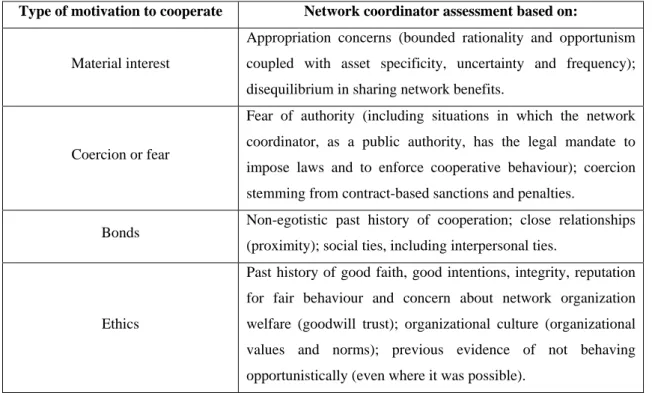
In table 1, I propose an operationalisation of Nooteboom’s four sources of motivation to cooperate. According to transaction cost economics, behavioural problems, such as bounded rationality and opportunism, coupled with transaction characteristics (asset specificity, uncertainty and frequency) may, in some circumstances, lead to contractual problems. In particular, incomplete contracts due to information asymmetries can give rise to appropriation concerns – i.e., because one of the transactional parties might engage in opportunistic behaviour (Williamson, 1985). The possibility of opportunistic behaviour by network organizations will probably influence the network coordinator’s assessment of motivations to cooperate: “appropriation concerns produce negative expectations about future behaviour” (Vosselman and van der Meer-Kooistra, 2009, p. 270). For instance, if one network organization captures excessive relational rents, at the expense of other network organizations, there will be disequilibrium in the sharing of network benefits (Dyer et al, 2008), and consequently the network coordinator’s assessment of motivations to cooperate may be negatively affected.
Type of motivation to cooperate Network coordinator assessment based on:
Material interest
Appropriation concerns (bounded rationality and opportunism coupled with asset specificity, uncertainty and frequency); disequilibrium in sharing network benefits.
Coercion or fear
Fear of authority (including situations in which the network coordinator, as a public authority, has the legal mandate to impose laws and to enforce cooperative behaviour); coercion stemming from contract-based sanctions and penalties.
Bonds Non-egotistic past history of cooperation; close relationships (proximity); social ties, including interpersonal ties.
Ethics
Past history of good faith, good intentions, integrity, reputation for fair behaviour and concern about network organization welfare (goodwill trust); organizational culture (organizational values and norms); previous evidence of not behaving opportunistically (even where it was possible).
Table 1: Behaviour patterns that inform a network coordinator’s assessments of motivation to cooperate
Every IOR will have its own combination of behavioural problems and transactional characteristics which may lead to different assessments of motivations to cooperate by the network coordinator. Without being exhaustive, some examples can be given. Investments in specific assets by a network organization – thereby giving rise to asset specificity (Williamson, 1985) – could lead to a higher assessment of motivation to cooperate. This is because the network organization would find it difficult to adapt such specific investments for other activities, and consequently it would be dependent on the network for the utilization of those assets. But the opposite can also occur. For example, in situations of monopoly (where there is only one producer of a particular good or service), asset specificity could lead to appropriation concerns and, consequently, to a lower assessment of motivation to cooperate (Brown and Potoski, 2003). In both examples, appropriation concerns contribute to the formation of the network coordinator’s assessment of material interests, which in turn lead to specific assessments of motivation to cooperate.
Although transaction cost economics helps us understand and operationalize the way a network coordinator forms its assessments of motivation to cooperate based on material interests, along with Nooteboom (1996) I argue that coercion, bonds and ethics are also important sources of motivation, which the network coordinator has to assess in numerous (probably most) situations. Coercion is, in a sense, related to the power that network organizations recognize as being encapsulated in the laws and norms, which not only define proper conduct, but also establish structures that provide for the enforcement of that proper conduct. The network coordinator’s assessment of motivations to cooperate will be based on its expectation that the other network organizations will act out of a desire not to be sanctioned. In other words, if the network organizations are aware of the legal sanctions available to the network coordinator, they may be expected, whatever their material interests, whatever their bonds with other network organizations, and whatever their ethical stance, to see cooperation as the best – if not the only – course of action. There could also be situations in which a network coordinator might expect other network organizations to fear the sanctions or penalties that would accrue, if they do not adopt cooperative behaviour, even if such behaviour is not strictly required by law. For instance, an organization with a concession contract approaching the end of its agreed term will probably tend to adopt cooperative behaviour for fear that the public authority will not renew its contract. Power is also at stake here – i.e., the network coordinator has dispositional power accruing through a set of “circuits of power” (Clegg, 1989), and other network organizations will recognize that it has the power to dispose, or not, as it chooses.
Trust is another potentially relevant concept; especially in view of the bonds and ethics involved in relations between network organizations. Das and Teng (1998) consider trust as a bond, while Nooteboom (1996) argues that trust – specifically goodwill trust – can be either a bond or an ethical motivation. While a discussion of these arguments is beyond the scope of this paper, it is relevant to note that “although research has identified many determinants of cooperation, virtually all scholars have agreed that one especially immediate antecedent is trust” (Smith, et al., 1995, p. 11). Here I will follow Das and Teng’s definition (2001, p. 14): “goodwill trust is about one’s good faith, good intentions, and integrity. It is about whether a firm has a
reputation for dealing fairly and caring about its partner firm’s welfare in alliances. With such a reputation, a focal firm feels more assured that the partner firms will cooperate in good faith, rather than behave opportunistically.” Consequently, I will treat goodwill trust as a form of ethical motivation.
The foundations for bonds are located in the behavioural routines that support a non-egotistic past history of cooperation. A shared history characterized by frequent cooperative relationships can lead to the development of social ties of friendship, kinship, and empathy. In comparison with the ethical motivation described above, bonds tend to be more personal as they are based on interpersonal familiarity and mutual understanding (Nooteboom, 1996). In IORs, bonds can also be formed between organizations as a result of the close relationships that can emerge through the frequent sharing of information and complementarity of objectives.
It is the mix of these four types of motivation that shape the network coordinator’s assessments of the other network organizations’ motivation to cooperate. As Nooteboom (1996, p. 991) notes, these assessments “…may have a strong or weak basis, ranging from assurance from objective facts and logical reason, through belief which is less firmly based on experience and argument, to unsubstantiated faith.”
Assessment of contribution to network performance is the network coordinator's assessment of the extent to which a network organization's actions will contribute to the achievement of the desired or predetermined objectives of the network (Child et al, 2005). These objectives “…may include many dimensions such as: efficiency, development capability, flexibility, adherence to specifications, network position, value as a source of learning, international presence, continuity” (Nooteboom, 1996, p. 995). Although network organizations may benefit individually, network performance is assessed at the network level by the network coordinator (Provan and Kenis, 2008). When the network coordinator is a public organization, the contribution of the various network organizations may be measured on several dimensions (Brignall and Modell, 2000). For instance, funding bodies have a financial and resource dimension, whereas service providers have a quality dimension.
The contribution to network performance will be assessed by the network coordinator as lower or higher according to the relative contribution that each network organization makes to the performance of the network as a whole. Thus, when the provision of public services is allocated to a private network organization, for instance, by means of a concession contract, the network coordinator will probably assess its contribution to network performance as higher than when that provision is performed under a public service licence (Brown and Potoski, 2003). This is because licences are usually issued on a relatively short-term basis, while concessions imply a long-term commitment and, furthermore, concessions tend to be exclusive, whereas multiple licences are often issued simultaneously. This example is based on the recognition that the concept of contribution to network performance relates to the contribution of organizations individually. When a group of organizations operate under a licence, and together have an important role in the network, their contribution to network performance as a group might be assessed as high. However, the contribution of each individual organization in that group might be assessed as low, as any one organization could be replaced by another organization in the group or by a new organization to which a licence could be granted.
To sum up, the discussion so far suggests that the exercise of the coordinating function, by a public organization acting as a network coordinator, is likely to be shaped by its assessment of the motivation to cooperate and of the contribution to network performance of the various organizations involved in the network. As I pointed out earlier, MCMs are the means deployed by the network coordinator in the exercise of its coordinating function. This leads to the specific questions which shaped my case research:
(i) Are the nature and use of MCMs by a public organization acting as a network coordinator related to its assessment of the motivation to cooperate and of the contribution to network performance of the organizations involved in the network?
(ii) How are the nature and use of MCMs by a public organization, acting as a network coordinator, shaped by these two assessments?
I attempted to find answers to these questions through a case study conducted in the Port of Aveiro in Portugal, which is described in subsequent sections of this paper.
5. The Case Study: Port of Aveiro, Portugal
5.1. Introduction
The case study research method was selected to focus on “how things work in a particular context” (Mason, 2002, p. 1). In addition, this research method is consistent with the holistic – network – perspective adopted in the research. Although my study of MCMs in mixed-type networks requires an understanding of the relationships between the network coordinator and each organization, thereby involving a study of dyadic relationships, these dyadic relationships are part of the larger network and, consequently, a network approach is adopted in this paper. Furthermore, although I examine the IORs from the network coordinator’s viewpoint, my analysis extends beyond dyadic relationships with specific organizations. My approach combines network analysis and governance perspectives, as proposed by Provan and Kenis (2008). That is, I combine my analysis of the network as a set of actors, with a governance perspective that takes the network as my unit of analysis; in other words, I study the dyadic relationships – analytical perspective – in terms of the network coordinator’s view of the network – governance perspective.
Prior to this study I had conducted earlier research in the Port of Aveiro, and so I had access to preliminary information from which I could identify the characteristics of a mixed-type network in this setting. Importantly, that earlier research also gave me virtually unlimited access to the study of the relationships between the Port Authority –
which is a public organization that acts as network coordinator – and the various port organizations – both private and public – operating in the Port of Aveiro. This case study, which covers the period from 1999 to May 2009, was based primarily on data collected from the Port Authority. In this case study, the Port is regarded as a network (cf. van der Lugt and de Langen, 2008; de Langen, 2003) and I explore the role of the Port Authority as the network coordinator of the port organizations (see also de Langen, 2003; Olson, 1971). Port organizations are seen lato sensu, including not only organizations that provide port services, but also organizations that contribute to the overall port performance. I start by presenting the port characteristics and its evolution during the period of analysis. Then some aspects of the case study research method are discussed, before I proceed to the presentation and discussion of my results
5.2. The port sector
Changes in the port industry in recent decades seem to be in line with trends in public management more generally. Many governments are no longer in the business of port operations. Instead, they are now focusing on more general functions, such as providing a level playing field for commercial activities (Brooks and Cullinane, 2007; Baltazar and Brooks, 2007). In Continental Europe, for instance, we now witness a predominance of the landlord port model (Notteboom and Winkelmans, 2001). Landlord ports have a mixed character and aim to strike a balance between public (port authority) and private (port industry) interests. Port authorities provide the port infrastructure (e.g. maritime access, intra-rail and road connections) and the private sector is responsible for the port services (e.g. transhipment, storage and warehousing), including investments in superstructure (e.g. equipments and pavements). In this landlord model the port authority is responsible for the safe, sustainable and competitive development of the port (see van der Lugt and de Langen, 2008).
Also, most port authorities have recently lost the enforcement role that had previously underpinned their authority to determine the behaviour of other port organizations. Legal changes have created a new situation in which port authorities have
to act in a more persuasive and market-oriented way – based on consensus-oriented decision making (Ansell and Gash, 2008) – and use a wide variety of mechanisms to influence the behaviour of the port organizations (van der Horst and de Langen, 2008). Nevertheless, the port authority usually retains the position of the network leader, primarily because of its central role in the management of certain key resources. Consequently, ports can be viewed as sets of IORs, in which the port authority acts as the network coordinator (Teisman and Klijn, 2002).
Port authorities play an important role in the creation of core competences and thus focus on the development of the port network (Notteboom and Winkelmans, 2001; Notteboom, 2007; van der Lugt and de Langen, 2007), including the entire logistic value chain (Robinson, 2002; Notteboom, 2007). As network coordinators, port authorities are in the best position to solve problems arising from collective action (Olson, 1971; de Langen, 2003). In ports, collective action can give rise to problems surrounding innovation, training and education, internationalisation, marketing and promotion, and hinterland access – including co-investment, between the port authority and port organizations in the port (de Langen, 2003). All port organizations both contribute to, and benefit from, a competitive port service, which comprises various services provided by many different organizations (Nijdam and de Langen, 2003). Competitive port service is one dimension of contribution to network performance. Examples of other dimensions that can support this assessment in ports include: the number of providers per type of port service which reflects the objective of internal port competition; the relative quantity of each port organization in the total cargo handled in the port; the relative price of the services provided each port organization in total price of port services; and the importance of quality of the services of each port organization in attracting customers to the port.
The Port Authority in the Port of Aveiro (henceforth, PAPA) is a public organization that was legally transformed from a public body into a state owned company in 1998. This change implied a new strategy for the Port, the implementation of which required new private investment and the award of concessions for port services to private organizations. As a result, the PAPA adopted a new role. Previously, it had
been a traditional public body and its main legal functions were to regulate the port organizations; specifically it was responsible for such issues as security, access to operations, environment and infrastructural investments. But in 1998 it was transformed into an organization responsible for all aspects of the economic development of the Port. Nevertheless, public law still applies to procedures concerning the granting of licences and the signing of contracts, and the Port Authority must reconcile its legal obligations with the commercial prerequisites that are necessary for its interactions with the port organizations. This has led to a process of change within the PAPA in an attempt to achieve a balance between complying with public law and responding to the demands of port organizations. Some of the issues which have arisen in this process will be outlined below, after a brief description of my research methods.
5.3. Research methods
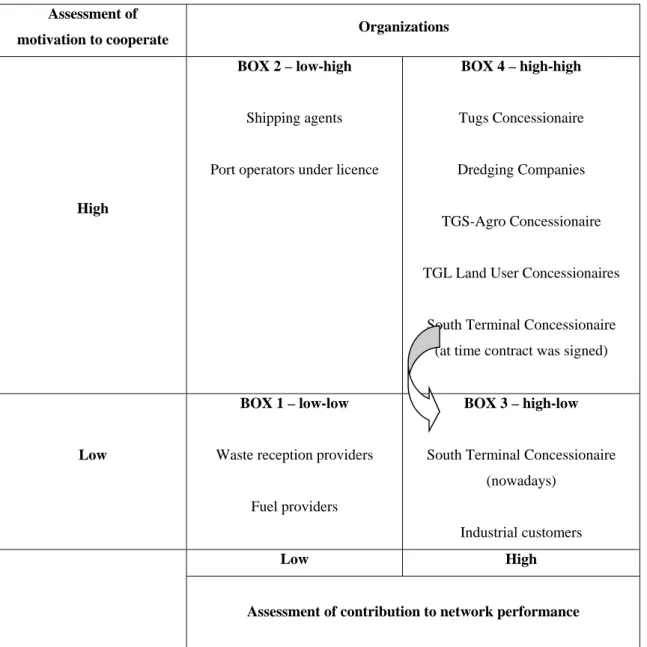
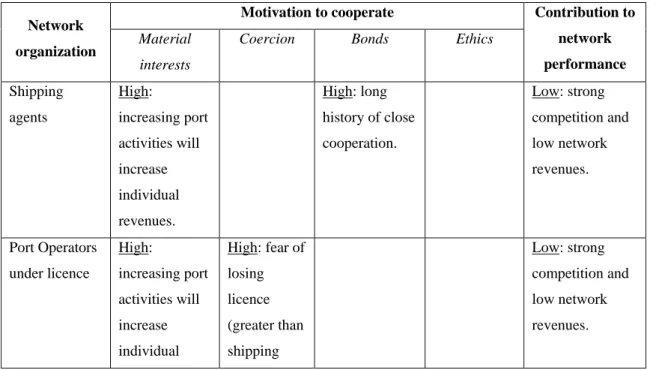
The transformation of the PAPA, which took place in 1998, was a change from a service port to a landlord port model, and this required the organization to become more actively involved in coordinating the port’s activities. This event provided an obvious time-frame for my study: 1999 to May 2009. I started with a detailed analysis of various aspects of the network governance model, including the PAPA’s legal competences, the different types of port organizations involved in the Port, and the IORs between the PAPA and other port organizations. Two objectives were pursued at this stage. The first was to understand the formal context and the consequent use of licences and contracts in certain IORs. The second was to explore the functions and the network position of each type of organization, and to try to identify the PAPA’s assessments of the motivation to cooperate and the contribution to network performance of each organization involved in the Port. The ultimate objective was to fill the boxes in table 2; i.e., turning it into table 3 (see below) by positioning each of the relevant network organizations within my theoretical framework.