Luxury Hotel Consumption
Examining the effects of personality on consumers’
valuations involving inconspicuous versus conspicuous
consumption experiences
Aihoor Kayoom Aleem
152117051
Dissertation written under the supervision of Vera Herédia-Colaço
Dissertation submitted in partial fulfilment of requirements for the MSc in Management with Specialization in Strategic Marketing, at the Universidade Católica Portuguesa, January 2019.
Title: Luxury Hotel Consumption – Examining the effects of personality on consumers’ valuations involving inconspicuous versus conspicuous consumption experiences.
Author: Aihoor Kayoom Aleem Abstract
The present dissertation aims to examine the impact of personality (introvert consumers versus extrovert consumers) on luxury hotel consumption, more specifically on inconspicuous versus conspicuous consumption. Based on a review of the academic literature, an experimental study was designed to test for the moderating impact of personality traits on the likelihood to engage in different types of consumption, willingness to pay, quality and sustainability perceptions. Results indicate that there is a positive causal effect between personality and luxury consumption, and that introvert consumers are associated more with inconspicuous consumption, whereas extrovert consumers are more associated with conspicuous consumption. Moreover, inconspicuous consumption is also perceived as being more sustainable, with introvert consumers being more preoccupied with sustainability practices. The present dissertation positively contributes to the literature on conspicuous and inconspicuous consumption and personality traits.
Keywords: luxury hotel; services; inconspicuous; conspicuous; luxury consumption; introversion; extroversion; personality; sustainability.
Resumo
A presente dissertação pretende examinar o impacto da personalidade (consumidores introvertidos versus consumidores extrovertidos) no desenvolvimento de hábitos de consumo relativamente a hotéis de luxo, mais especificamente, ao consumo inconspícuo versus conspícuo. Com base na revisão da literatura, foi desenhado um estudo experimental com o objetivo de testar os efeitos da personalidade sobre a probabilidade de os consumidores se envolverem em diferentes tipos de consumo, disponibilidade para pagar, perceção de qualidade e perceção de sustentabilidade. Os resultados demonstram que existe uma relação causal positiva entre a personalidade e o consumo de luxo, associando consumidores introvertidos ao consumo inconspícuo, enquanto os consumidores extrovertidos estão associados ao consumo conspícuo. Além disso, o consumo inconspícuo é também associado a maiores perceções de sustentabilidade, revelando que os consumidores introvertidos manifestam igualmente uma maior preocupação com práticas de sustentabilidade. Em suma, a presente dissertação contribui positivamente para a literatura sobre o consumo conspícuo e inconspícuo e a sua relação com os traços de personalidade.
Palavras-Chave: hotel de luxo; serviços; inconspícuo; conspícuo; consumo de luxo; introversão; extroversão; personalidade; sustentabilidade.
Acknowledgments
“In The Name of God, The Most Beneficent, The Most Merciful.”
I have always dreamt of the day I would write my own dissertation and complete my Master’s degree. I am truly passionate about investigation so writing this dissertation was a very enjoyable experience. I will continue to follow my heart and conquer my dreams, regardless of what I have to sacrifice.
I want to express my admiration for my supervisor Vera Herédia-Colaço, for showing me how powerful a woman can be, for her knowledge and support, continuously helping and motivating me whenever I needed. I am very thankful for her guidance through this part of my academic journey. Thank you, for inspiring me for the future.
Furthermore, I want to express my gratitude to my Father, Abdul Kayoom. Thank you, for all the sacrifices you made throughout my whole life, for all your effort, and for always supporting my choices. I am lucky to have a Father like you.
Moreover, I want to thank my Husband, Farhan Majeed. All your support, effort and motivation throughout my Masters. Without you, this would have been impossible. You have been my rock.
Also, I want to thank my Mother, Faranaze Harum, for taking such good care of me. My sisters, Anissa & Nur. My dear cousin who always helped me, Nilofar. My two incredible best-friends Mariana & Marta. Also, my colleagues during the dissertation seminar, João Figueiredo, Maria Sousa & Marta Sampaio. Without you, it would have not been the same.
Last but not least, I am very thankful to my IADE Professor, Pedro Miguel Oliveira, for helping me when I most needed advice to choose my Master’s. Thank you, for your encouragement and support.
Thank you, from the bottom of my heart. This is a dream come true.
Table Of Contents
Abstract ... II Resumo ... III Acknowledgments ... IV List of Figures ... VII List of Tables ... VIII
1. INTRODUCTION... 1
1.1. Problem Definition and Relevance ... 1
1.2. Research Objectives and Questions ... 3
2. LITERATURE REVIEW ... 5
2.1. Luxury Hotel Industry ... 5
2.1.1. Subtle Hotels versus Extravagant Hotels ... 6
2.2. The relationship between luxury and conspicuous versus inconspicuous consumption... 7
2.2.1. Luxury Consumption... 7
2.2.2. Conspicuous Consumption ... 8
2.2.3. Inconspicuous Consumption ... 9
2.3. Sustainability and Luxury Hotel Consumption ... 10
2.4. Personality Traits: extroversion versus introversion ... 11
3. CONCEPTUAL FRAMEWORK AND HYPOTHESES ... 13
3.1. Hypotheses ... 13
4. METHODOLOGY AND RESEARCH FRAMEWORK ... 16
4.1. Research Method ... 16
4.2. Sampling ... 16
4.3. Research Instruments ... 16
4.4. Design and Procedure ... 17
4.6. Variable Description ... 18
5. ANALYSIS AND RESULTS ... 20
5.1. Sample Characterization ... 20
5.2 Data Screening Multivariate Outliers ... 20
5.3. Scales Reliability ... 20 5.4. Manipulation Checks ... 22 5.5. Main Results ... 23 5.6. Discussion... 32 6. CONCLUSIONS ... 33 6.1. Theoretical Implications ... 33 6.2. Practical Implications ... 34
7. LIMITATIONS AND FUTURE RESEARCH ... 36
8. APPENDICES ... 37
Appendix 1: Stimuli ... 37
Appendix 1a: Subtle Hotel - COMO ... 37
Appendix 1b: Extravagant Hotel – Destino Pacha ... 41
Appendix 2: Common sections to all stimuli ... 45
Appendix 3: Demographics ... 50
Appendix 4: Personality ... 54
List of Figures
List of Tables
Table 1 - Item Description - The I-E Scale ... 21
Table 2 - Reliability Test for Multi-Item Scales ... 21
Table 3 - Correlation Test for 2 items ... 22
Table 4 - Results for Manipulation Checks ... 23
Table 5 - Results of the two-way interaction between Type of Hotel x Personality... 24
Table 6 - Results independent sample t-test for the impact of type of hotel on WTP and Quality Perceptions ... 24
Table 7 - Results independent sample t-test for the impact of type of hotel on Sustainability Importance ... 25
Table 8 - Results independent sample t-test for the impact of personality on WTP and Quality Perceptions ... 26
Table 9 - Results independent sample t-test for the impact of personality on Sustainability Importance ... 26
Table 10 - Results of the two-way interaction Type of Hotel x Personality on Quality Perceptions and WTP ... 27
Table 11 - Results independent sample t-test for the impact of interaction on WTP ... 27
Table 12 - Results independent sample t-test for the impact of interaction on Quality Perceptions ... 28
Table 13 - Results for independent t-test for Role of Sustainability in Attracting Consumers ... 29
Table 14 - Results for independent t-test for Sustainable Attributes and Personality... 30
Table 15 - Results for independent t-test for Likelihood to Choose the Hotel ... 31
1. INTRODUCTION
1.1. Problem Definition and Relevance
The luxury hotel industry represents a considerable segment of the worldwide hotel industry, with a 42% increase in five-star hotels in the year 2013 (Forbes, 2013). Luxury hotels are part of two great industries: the hotel industry and the luxury industry. As for the hotel industry, a Deloitte (2017) report states that the industry was projected to sustain 5 to 6% growth throughout the year 2018. According to a BCG report (2017), global luxury markets represent a significant economic force, a substantial driver of GDP and are able to promote competitive advantage. Meanwhile, the luxury market is defined as a market for non-essential expensive goods, that are bought for pleasure (Cambridge Dictionary, 2018).
Given the current reality, the luxury markets continuously suffer from diverse challenges. As a result, consumption patterns are in permanent change causing new trends to rise (e.g. experiential luxury). Former Chief Marketing Officer of Four Seasons Hotels’ Barbara Talbott (2004), claims that style, comfort, service and pampering are the four responsible factors to create a memorable luxury experience (Chu, 2014). For instance, hotels such as Anantara, COMO Hotels & Resorts, One & Only Resorts, are some of the luxury service providers that have been attracting different guests around the world due to the exclusive services offered (including: ‘a la carte’ menus, international cuisine, unique spa massages, meditation and yoga classes). As reported by an Oracle study (2012) 81% of surveyed participants demonstrate a higher willingness to pay for an improved customer experience, with 44% willing to pay premium due to the emotional arousal caused by experience-giving brands that make clients feel unique and generate unforgettable memories. Additionally, Dubois and Duquesne (1993), argue that individuals purchase luxury goods as a representation of one’s values. However, in this fast-paced world, it is important to take into account the sustainability factor, since there is still an attitude-behavior gap when it comes to consuming in a more sustainable way (Huang and Rust, 2010). Luxury consumption is frequently perceived as being non-sustainable (Kapferer and Michaut-Denizeau, 2014). Kapferer and Michaut-Denizeau (2014) claim that the criticisms tend to refer to luxury brands raw material sourcing (e.g. animal skins), human work conditions, polluting the local environment or even destruction of the environment (destroying landscapes with construction of luxury hotels near beaches). Given that there is an increasing consciousness about the importance of caring for the environment and society (Laroche, Bergeron, & Barbaro-Forleo, 2001), luxury hotels need to become more conscious
about their ethical and act accordingly to build a sustainable reputation. The Trip Barometer (2013) states sustainability practices in hotel accommodations are increasing in importance, with almost 80% of worldwide travelers wanting to reduce their environmental impact (Booking, 2018). In fact, individuals are more willing to choose hotels with a sustainable certification (Manaktola and Jauhari, 2017). Hence, the importance of sustainability practices on luxury hotels.
Luxury is often related to status and admiration, a concept that is further covered by the conspicuous consumption literature (Bainbridge, 2013). This type of consumption, leads individuals to purchase goods and services with the intention of communicating their wealth and status, portraying many times other than the actual reality of the consumer (Brun & Castelli, 2013). For instance, purchasing ostentatious goods such as expensive designer bags with visible logos, or, staying at trendy luxury hotels like One & Only Resorts, Fairmont Hotels, and Melia Hotels & Resorts. Yet, there is also a stream of individuals who enjoy purchasing and engaging in luxury for non-ostentatious reasons (Makkar & Yap, 2018). This consumption habit type is labeled inconspicuous consumption and includes consumers who tend to give higher value to more subtle luxury brands, and products with non-visible logos. Also, it is often manifested by supporting behaviors given to sustainable companies and hotels who provide customers with experiences that bring them a sense of purpose and self-worth (Eckhardt et al., 2015). In fact, the luxury industry is experiencing a transformation in their client-base type, now including a segment of consumers who can be seen as simpler, quieter and more introvert (Eckhardt et al., 2015). For this audience, luxury involves consuming luxurious products without publicly displaying wealth or social status, through spending in a more conscious way. Interestingly, from a research standpoint, introversion shows to be a personality trait that has been undermined by marketers in their attempts to communicate luxury and fantasy feelings when promoting services such as hotel experiences. To the author’s knowledge, limited research has been conducted with regards to the differential effects that personality traits have on consumption decisions that involve both conspicuous versus inconspicuous experiences, and that are considered more extravagant or subtle in nature. Concerns over ‘one size fits all’ concept should, therefore, be taken into account since consumers are not alike and different motivations, will result in contrasting consumption behaviors. For instance, personality represents a strong antecedent behind consumption motivations, persuading and influencing individuals towards certain consumption behaviors (Makkar & Yap, 2018). Despite this, luxury brands frequently neglect the important personality
moderate the relationship between hotel types that provide subtle (inconspicuous) versus extravagant (conspicuous) experiences on consumers’ quality perceptions, sustainability perceptions and willingness to pay.
1.2. Research Objectives and Questions
The topic of conspicuous consumption has been discussed by a great number of authors in the literature (Chaudhuri, Mazumdar and Ghoshal, 2011; Husic and Cicic, 2009; O’Cass and McEwen, 2004). Nevertheless, there is still a gap in the literature addressing the concept of inconspicuous consumption, specifically in the services’ industry. This is an important aspect to unveil since the hotel industry accounts for 208 billion dollars (Statista, 2018) and is still one of the most sought-after business in the world. Most often, at the time of booking a hotel stay, a customer expects to have comfort and feel at ease, even if on a business trip. This self-benefit expectation is even stronger when one is planning a vacation. Not all consumers are alike and what draws attention to a type of hotel to a customer who is seeking fun and excitement may be very dissimilar to another customer who prefers and enjoys more a relaxing experience. Hence, the author has an interest in developing an empirical study that allows her to understand the association of personality with the type of hotel consumption. More specifically, the impact that personality has on hotel valuations. Therefore, the following research questions were formulated:
RQ 1: Does personality type influence engagement in different types of luxury consumption?
In the context of personality, the aim of the author is to extend previous research considering two types of personality: introverts versus extroverts and establish their relationship with the type of service consumption that individuals tend to engage. Therefore, one of the purposes of the study is to analyze the association between different personalities and their consumption preferences, namely conspicuous versus inconspicuous consumption.
RQ 2: Are introvert people more likely to engage in subtle hotels?
Past research indicates there are segments of consumers who are more likely to engage in inconspicuous consumption. For instance, individuals who are quieter, prioritize inner experiences and choose simplicity over extravagance – are characterized as introverts. Yet, inconspicuous consumption is a fairly recent topic of research which still needs to be developed
further. Therefore, it is important to address the inherently driven factors that guide inconspicuity. In comparison, extrovert people are more likely to engage in conspicuous consumption as they are more likely to expose their wealth and signal their status than introverts. For the purpose of this dissertation and based on prior literature, inconspicuous consumption will be tested using a manipulation scenario presenting a subtle hotel, and conspicuous consumption will use an equivalent manipulation scenario but presenting an extravagant hotel. Likewise, the likelihood that introverts (extroverts) will select a subtler (extravagant) hotel.
RQ 3: Are introvert people more concerned with sustainability issues?
Despite its importance, there is a high concern for sustainability on business practices as also there are more consumers aware of the effects of sustainability on their well-being, which makes this topic relevant to be conducted in more detail. Interestingly, little research has yet established the relationship between the impact of sustainability and individual personality traits. For instance, are introvert consumers more likely to engage in sustainable behaviors than extrovert consumers? Also, what is the link between hotels that are positioned as being subtler versus extravagant and sustainability?
2. LITERATURE REVIEW
The following chapter aims to cover in more detail the aforementioned research problem. Research topics will be reviewed in order to provide a research basis to sustain the present dissertation.
2.1.Luxury Hotel Industry
The term ‘hotel’ was first addressed in the late 18th century, being defined as taverns that served
upper class clients (Sherman, 2007). According to the same author this definition will continuously be adapted as new trends emerge. Nowadays, a hotel is characterized as an establishment that provides not only accommodation, but meals and extra services for travelers and tourists (Oxford Dictionary, 2018). In this industry, hotels are classified according to a stars’ classification system, commonly between one (standard services and facilities) to five stars (including exclusive and personalized services). The existence of this ranking intends to reduce the gap between what is expected (guests) versus what is being offered (hotel) (World Tourism Organization, 2015). Martin-Fuentes (2016) claims that higher hotel classifications correspond to superior prices, and consequently to higher guests’ expectations, suggesting that rankings are also a good tool to predict price.
Amongst the literature examining the hotel industry, a budget hotel and an economy hotel can be used to define the same type of hotel (Roper and Carmouche, 1989). More specifically, an economy hotel typically offers basic accommodations at lower price when comparing to the average industry, and standard services (Roper and Carmouche, 1989). In comparison, luxury is defined as a hotel with high quality amenities, offering personalized services with the purpose of giving pleasure and comfort, although it is not essential (The American Heritage Dictionary of the English Language, 4th ed.). There are four categories that enhance the
perception of luxury regarding hotel services: (i.) Cost - guests are expected to pay more; (ii.) Time – individuals expect to be pampered; (iii.) Prestige – guests expect a high-quality experience; and (iv.) Amenities - the “extras” like a welcome massage in the hotel spa, a chocolate and a beverage in their room or offered amenities (Bernstein, 1999).
Amongst the literature on luxury, it has been suggested that it is difficult to give a single definition for a luxury hotel, for that reason it is important to first define the term luxury (Danziger, 2005). According to Danziger (2005), luxury can be categorized into four dimensions: (i.) “Luxury as a Brand”; (ii.) “Luxury as a Luxe Product Features”, which represents for instance the quality and elegance of a luxury hotel; (iii.) Luxury as Non-Essential, something besides human needs, and; (iv.) “Luxury as the Power to Pursue
Passions”, which represents individuals who purchase something to give extra comfort to their lives (e.g. yoga classes, Thai-massage, Spa). Luxury hotels fall into the category named “luxury as a brand”, which comprehends individuals who choose to consume luxury goods, as they represent quality and prestige (Chu, 2014; Danziger, 2005).
According to Curtis (2001), the luxury hotel industry established in the market represents an accommodation for individuals who desire a more ostentatious lifestyle. Luxury in this specific situation is more a representation of a high-quality experience than an expensive material good (Chu, 2014; Curtis, 2001). Given that, it is reasonable to say that consumption and hotel service are two linked concepts (Kandampully et al, 2014). For the purpose of the present dissertation, a luxury hotel is defined as an establishment that provides personalized services and benefits to their guests, offering rooms at a higher price than the average industry rate and with high quality amenities (Bernstein, 1999; Danziger, 2005; Maggi, 2017).
The competitive environment that hotel industry is facing nowadays, requires an extra effort to deliver a higher service quality (Tzschentke, 2008). Service quality can be defined as the evaluation between service expected by consumers and service performed by the hotel (Cser & Ohuchi, 2008). In addition, different consumers reveal different expectations, thus it becomes interesting to research the association between personality traits and consumption habits. In order to give the best service, it is crucial to first analyze what drives individuals to certain types of hotels. As well as in products, hotels also differ from one another in the sense that one can be more extravagant, while others may have a subtler approach despite operating in the same market category. As a matter of fact, luxury hotels provide multiple types of service, adequate to diverse needs and consumer aspirations which can be either more extravagant or more low-key (Miller et al, 2013), as it is reviewed next. After all, understanding customer expectations is the first step to be successful in the hotel business (Blank, 2008).
2.1.1. Subtle Hotels versus Extravagant Hotels
Bearden and Etzel (1982) suggest that luxury can be either public, for status purposes or, private, when triggered by personal intentions depending when the consumption occurs. By consuming luxurious goods, individuals feel successful, more pleased and have a sense of self-fulfillment, (Memushi, 2013). According to Dubois and Paternault (1995), consumption behaviors related to luxury are often more associated with certain attitudes, such as: impulsive
or more spontaneous responses; hedonic behaviors; and usage of ostentatious or extravagant signals. Furthermore, extravagance is commonly associated with conspicuous consumption (Bearden and Etzel, 1982).
In the same line of reasoning, Nelissen and Meijers (2010), suggest that extravagant luxury concerns make use and display of goods, with the purpose of signalizing wealth and status. For instance, individuals who wear brand-labeled clothes, are more likely to purchase luxury-branded cars (red Ferrari) and, choose specific luxury hotels to spend their vacations. For instance, hotels that offer an international cuisine from a well-known chef, that organize parties for guests to see and be seen by trendy social influencers and are also more likely to have a more ostentatious or extravagant décor.
In contrast, subtle luxury goods are defined as being associated with imperceptible quality. For instance, individuals who are willing to pay a premium for unpretentious quality and with the purpose of not signalizing their wealth (Eckhardt et al. 2015). In fact, these individuals engage in luxury consumption for private reasons, triggered by personal intentions (Bearden and Etzel, 1982). Commonly, this type of consumers reveals a subtler approach to luxury (less is more), choosing luxury hotels that are more focused on providing unforgettable experiences, non-labelled luxury goods, down-to-earth and health related activities.
Due to the aforementioned arguments, it is expected that different luxury hotel experiences will impact hotel valuations differently and most likely these manifestations are triggered by individual difference variables such as personality traits. Individuals who are quieter are likely to prefer more discrete or inconspicuous consumptions experiences, while more extrovert consumers are more likely to engage in more visible or conspicuous experiences.
2.2.The relationship between luxury and conspicuous versus inconspicuous consumption 2.2.1. Luxury Consumption
As suggested by Berthon et al (2009), the word luxury implies “indulgence and extravagance” and derives from two languages: Latin (luxus) and French (luxurie). According to Kapferer and Bastien (2009), individuals use luxury to distinguish themselves from others. Luxury represents more than a set of attributes, it should be defined in three dimensions: material, social and individual (Berthon et al, 2009). With the globalization of the concept, luxury brands
emerged worldwide. Nevertheless, the term luxury has always been associated with status, power, sophistication, quality and uniqueness (Truong, McColl and Kitchen, 2009).
Ko, Costello and Taylor (2017) reinforce that luxury brands are based on consumer perceptions regarding product attributes such as price or quality. The authors suggest that a luxury brand concerns a product or service, perceived as high quality, offering an authentic value, being able to create a deep connection with the consumer, with a prestigious image. Therefore, it is worth paying a premium price for a luxury good or service. The consumption of luxury brands allows the consumer to disclose their identity, as well as their values using it as a way to express how they feel. Additionally, luxury consumption symbolizes desires people have beyond necessities. Makkar and Yap (2018) reinforce that luxury consumption represents a communications’ tool that helps building identity, self-fulfillment, sense of belongingness along with taste (Bauer et al., 2011, Orr et al., 2009).
Bourdieu (1984) claims that to engage into luxury consumption one needs more than economic power, although wealth is an important driver. It is reasonable to say, individuals need to be educated in order to choose luxuries (Dubois and Paternault, 1995). In fact, culture is as important as income since culture and taste decide what people choose to purchase, whereas income decides what they can afford (Chadhuri and Majumdar, 2006). Also, one can classify luxury as having a more external dimension, where the main objective is displaying economic and social power. This dimension comprehends materialistic and ostentatious behaviors, and the values associated are quality, conspicuousness and uniqueness (Vigneron and Johnson, 1999). As a matter of fact, the term luxury and conspicuous consumption are often associated, even though the concepts have distinct definitions. Since Veblen (1899) both terms grew hand in hand.
2.2.2. Conspicuous Consumption
In spite of the large research concerning the concept, there is limited research conducted regarding the nature behind conspicuous consumption drivers. Thus, one of the research questions concerns the effect of personality on conspicuous consumption.
The concept conspicuous consumption was introduced in 1899 by Veblen (Memushi, 2013). Veblen (1899) claimed that conspicuous consumption exists since the early civilizations, where a culture of power being associated with material display (e.g. large quantities of food, women
decorated in jewelry) was already established. Accordingly, this type of consumption behavior is not a recent phenomenon. Veblen (1899) defined conspicuous consumption as the act of purchasing luxury goods and services with the purpose of displaying ones’ economic power. Veblen argued that higher classes consumed conspicuously in order to form a differentiation between themselves and lower classes, so they could match the consumption patterns of individuals above them, in social hierarchy (Truong et al, 2011). Chaudhuri, Mazumdar and Ghoshal (2011) add to the argument by reinforcing that individuals who engage in conspicuous consumption desire to communicate a unique self-image, when compared to other people. Consequently, conspicuous consumers adopt certain types of behaviors in order to express their uniqueness, through their products and services. For instance, high conspicuity consumers are willing to pay premium for luxury goods, despite of their income level, in order to enhance their status (Abreu, 2018).
As aforementioned, wealth, culture and taste are important drivers concerning luxury consumption. Conspicuous consumers aim to demonstrate their wealth, uniqueness, power and status through extravagant spending (Husic and Cicic, 2009; O’Cass and McEwen, 2004). Therefore, given the purpose of the study and based on previous literature, conspicuous consumption will be represented through extravagant hotels. Yet, an increased desire for elegance, sophistication and subtleness is rising (Eckhardt et al, 2015). In contrast to conspicuous consumption, which includes ostentatious behaviors (O’Cass and McEwen, 2004), a relatively new concept is emerging and is named inconspicuous consumption. 2.2.3. Inconspicuous Consumption
As previously pointed, different consumption patterns are emerging. One pattern specifically, is named inconspicuous consumption. Nevertheless, there is limited research regarding this concept. As previously mentioned, since Veblen (1899), luxury has been associated with conspicuous consumption. However, this reality has changed, and some individuals are not comfortable with signaling their ability to purchase luxury goods (Eckhardt et al, 2015). Luxury grows hand in hand with economic reality. Given the economic reality that people live, individuals are showing more preference in not standing out, and choose subtler behaviors. A number of definitions regarding inconspicuous consumption have been suggested by the literature. Eckhardt et al. (2015), designate inconspicuous consumption as individuals who consume luxury goods with no intention of displaying their own wealth or social status. Furthermore, Makkar and Yap (2018) describe the concept as individuals who use subtler signs
and identifies the lack of consideration to the psychological forces that drive luxury consumption. Thus, reinforcing the importance of identifying these forces. Individuals who engage in inconspicuous consumption consider they are able to signalize their social status without overly display (Makkar & Yap, 2018). In addition, they also feel responsible for more wholesomeness experiences or socially responsible forms of consumption, revealing a preference for education, health care and non-visible goods. Contrary to conspicuous consumption, strong evidence has been found that this type of consumers sees luxury in the subtleness of goods and experiences and thus, attribute more value to low-profile cars and hotels that are positioned as being more nature friendly or sustainable (Makkar & Yap, 2018). Accordingly, prior literature examining the congruency between sustainability and product/service category, suggests that simpler than sophisticated goods and services are associated with having more sustainability concerns (Herédia-Colaço & Coelho do Vale, 2016). The simplicity of an organic product, for instance, lies in the fact that is less processed and thus, more environmentally-friendly. Using the same logic, it is also expected that a simpler and subtler hotel is also perceived as being more congruent with sustainability than a more extravagant hotel.
2.3. Sustainability and Luxury Hotel Consumption
In 1987, the World Commission on Environment and Development defined the concept of sustainability as, “the ability to satisfy present needs without compromising future generations to satisfy their own needs”. The concept is also linked with socially responsible events, and it involves three major aspects – environmental, economic and social aspects, also labeled the triple bottom line (Elkington, 1998).
From an economic and social perspective, sustainability does affect consumption behaviors (Huang and Rust, 2010). Consumers are increasingly gaining more knowledge concerning sustainable consumption (Luchs and Kumar, 2017), searching for alternatives and making balanced choices regarding their consumption habits. In line with Luchs and Kumar (2017), luxury companies should be more concerned about making positive contributions regarding sustainability actions (Luchs, Brower, & Chitturi, 2012). Accordingly, since luxury consumers purchase goods for what they symbolize, representing their values, socially responsible consumers will purchase goods that express their sustainability concerns (Dubois and Duquesne, 1993). The same reasoning can be applied to the hotel industry, which grew hand
in hand with the development of the tourism industry that is now seeing an increasing consumer demand for hotels that have put into practice sustainability measures (e.g., water reduction policies, towels’ reuse) and offer healthier menus and treatments for those who care about longevity and inner well-being (Kirk, 1995). Additionally, the World Tourism Organization (WTO, 2016) states that, sustainable tourism aims to meet tourists needs, while preserving and protecting host regions and enhancing future opportunities. Moreover, eight out of ten hoteliers now consider sustainability practices to be as important as location, given that sustainability foot print is amongst the major sought-after attributes by individuals (Bohdanowicz, 2005). As the luxury market is revealing an increase in sustainability awareness, it is meaningful to analyze the consumption patterns that give higher importance to sustainable behavior, brands and practices, for instance, inconspicuous consumption (Huang and Rust, 2010). Therefore, the impact of personality traits behind consumer behaviors - willingness to pay, quality perceptions and sustainability perceptions, towards a subtle versus a more extravagant hotel is important to unveil, since different types of consumers will react to stimuli from hotel types differently, as it is reviewed next (Bearden and Etzel, 1982; Jung, 1923).
2.4. Personality Traits: extroversion versus introversion
Consumers’ purchases represent not only their wealth, but their personality, social status and self-perceptions (Belk, 1988). Yet, despite the research examining the role of personality on decision-making, less empirical evidence exists on how personality affects consumption habits. Personality is a complex concept since there is not a common definition agreed among researchers (Kassarjian, 1971). According to Warr (1999), personality refers to relatively intrinsic individual characteristics concerning general and basic behaviors, reflecting long-termed personal differences. However, besides the long-lasting characteristics, recent studies provide a new point of view, arguing that personality is susceptible to change (Gulamali, 2017). The author suggests that the same individuals are likely to give different responses to personality questionnaires on different occasions, developing a broad consensus that personality is vulnerable to modify according to situations (Costa and McCrae, 2006). Throughout several research, it is suggested that all personality characteristics can be categorized under a Five-Factor model of personality, named “Big Five” (Goldberg, 1990). Although a definition of personality is hard to obtain, there is a reasonable consensus that the Big Five taxonomy describes human personality in a comprehensive approach (Goldberg, 1993). The Big Five model includes five dimensions labelled: Extraversion, Agreeableness,
Conscientiousness, Neuroticism and Openness to Experience (Goldberg, 1990). Extraversion versus introversion, in particular, is the object of the present research and represent opposite ends within the Big Five Factor model spectrum. Despite individuals are likely to show traits from the aforementioned five dimensions, they also lean towards a more extroversion or introversion side. Extroverts, on one hand, who represent the tendency to seek others company include sociable individuals, who tend to be more active, cheerful, optimistic and oriented to the outside world (Goldberg, 1992). These individuals are usually more energic, seek excitement and outgoing activities, and impulsive than introverts (Watson and Clark, 1997). Introverts, in contrast, are more reserved, enjoy being alone, and are more introspective. Introversion versus extroversion has also been covered by Carl Jung’s Personality Theory (Jung, 1923). The author identified two opposing attitudes: introversion and extroversion. Besides being in opposite sides, the author states that they represent complementary forces. According to Jung (1923), introvert people are more aware of their inner word, whereas extrovert people are characterized as giving more importance to external surroundings. Extroverts tend to be more talkative, assertive and enthusiastic. Their pleasure come from community activities or public demonstrations. In addition, they usually feel more comfortable around people than by themselves (Jung, 1923). Yet, Helgoe (2008), suggests that introverts are more reserved and take pleasure out of being alone.
Previous findings point for a positive correlation between different personalities and different types of consumption (Watson and Clark, 1997), suggesting that extrovert individuals are more likely to engage in extravagant experiences (extravagant hotels), whereas introverts are more likely to prefer quieter activities (subtle hotels). In addition, due to introverts’ tendency to appreciate more down-to-earth and wholesomeness practices, it is also more likely that they have a higher preoccupation with sustainability practices than extroverts, as it is hypothesized next.
3. CONCEPTUAL FRAMEWORK AND HYPOTHESES
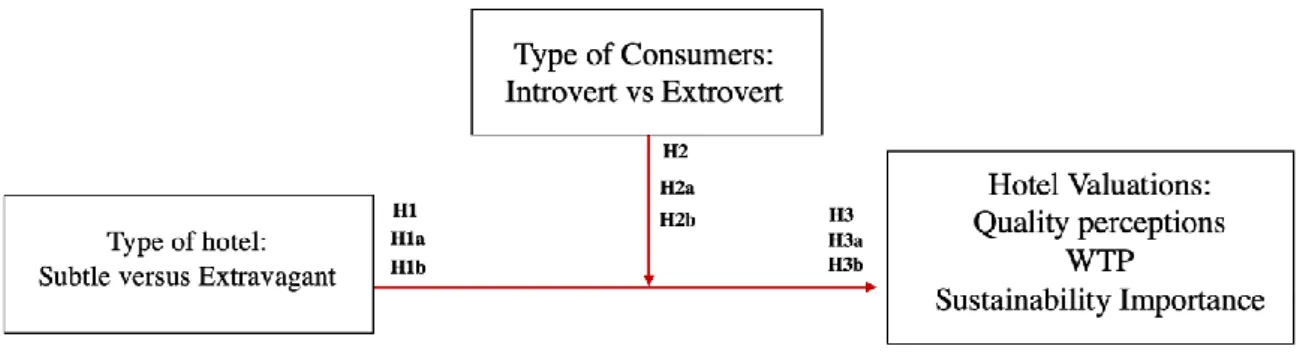
The following chapter introduces the conceptual framework as well as the hypotheses tested during the research. The conceptual model (Figure 1) is based on the academic review that revealed several gaps in the literature in line with the research purpose. The empirical study explores the impact that type of hotel (subtle versus extravagant) has on dependent variables: willingness to pay, quality perceptions and sustainability importance towards the hotel. A second independent variable is also included in the model which examines the moderating role of consumers personality (introvert versus extrovert) on the impact of type of hotel (subtle versus extravagant) on the hotel valuations represented by the dependent variables of interest.
3.1.Hypotheses
Prior research regarding luxury consumption, including conspicuous and inconspicuous consumption (Husic and Cicic, 2009; O’Cass and McEwen, 2004) associates different types of luxury consumption habits with different types of purchases (subtle purchases versus extravagant purchases). According to the aforementioned literature the author suggests that conspicuous consumption is associated with more extravagant hotels (Vigneron and Johnson, 1999), whereas inconspicuous consumption is associated with more subtle hotels (Halvena and Holbrook, 1986). Given the luxury nature of both hotel types, no differential valuations are expected to occur on the willingness to pay and quality perceptions of these hotels when evaluated in isolation. Yet, due to the nature of subtler hotels often positioned more as eco-friendly and providers of more wholesomeness experiences, these also expected to be linked more with having sustainability concerns. Therefore, it is expected that subtle hotels will Figure 1 - Conceptual Framework
increase perceptions and importance given to sustainability. Therefore, the first hypothesis is suggested as follows:
H1: Luxury hotel types will have an impact on Willingness to Pay, Quality Perceptions and Sustainability Importance Perceptions, so that:
H1a: There will be no significant differences in consumers WTP and quality perceptions for extravagant versus subtle hotels.
H1b: Sustainability importance will be greater for subtle than for extravagant hotels.
Concerning personality trait differences, previous research evaluating the differential behaviors between individuals during consumption, (Goldberg, 1990) suggest that personality has an impact on consumption behaviors, especially in sustainability concerns. It is therefore, expected that introvert consumers will give higher importance to sustainability practices in a hotel, than extrovert consumers. As for the willingness to pay and quality perceptions it is expected that both type of consumers will reveal similar hotel valuations. Therefore, the second hypothesis is suggested as follows:
H2: Different types of consumers (introverts versus extroverts) will have an impact on Willingness to Pay, Quality Perceptions and Sustainability Importance, so that:
H2a: There will be no significant differences in consumers’ WTP and quality perceptions for introvert vs extrovert consumers.
H2b: Introvert consumers are likely to give more importance to sustainability practices than extrovert consumers.
In addition, previous research concerning luxury consumption (Dubois and Duquesne, 1993) and personality traits (Goldberg, 1992), suggests that personality has an influence on different luxury consumption habits. For instance, it has been suggested by the literature that introvert consumers have different reactions towards conspicuous incitements than extroverts, which is also reflected in preferences towards inconspicuous experiences. Given that, it is expected that different personality attitudes will have an impact on hotel valuations, namely willingness to pay and quality perceptions. It is hypothesized that introvert consumers are more likely to engage in subtle hotels, whereas extrovert consumers are more likely to engage in extravagant
hotels. Consequently, introvert valuations (willingness to pay and quality perceptions) on subtle hotels will be higher than for extravagant hotels, whereas for extrovert valuations (willingness to pay and quality perceptions) on extravagant hotels will be higher than for subtle hotels. Therefore, the third hypothesis is suggested as follows:
H3: The likelihood of introvert (extrovert) consumers to engage in subtle (extravagant) hotel types is higher (lower), so that:
H3a: Introvert consumers are more likely to pay more for a subtle hotel, whereas Extrovert consumers are more likely to pay more for an extravagant hotel.
H3b: Introvert consumers are more likely to perceive subtle hotels with having higher quality, whereas Extrovert consumers are more likely to perceive extravagant hotels with having higher quality.
4. METHODOLOGY AND RESEARCH FRAMEWORK
The following chapter presents the research method used to conduct the study, the procedures for data collection and the variables used to answer the research questions.
4.1.Research Method
In line with the study main objectives, the survey software selected was Qualtrics. Qualtrics is an online platform with diverse advantages, including reaching a large number of individuals, with minor associated costs; is a time efficient method, allowing an efficient distribution to a wide population; it is convenient and flexible, as one does not have to travel to a particular place and time to answer the questionnaire. It also gives participants an equal chance to enter the survey, guarantees privacy and personal boundaries.
However, Qualtrics do present some risks: the investigator cannot control participants focus and surroundings, nor give detailed directions. In order to minimize drawbacks, the questions were clear focused precise arguments to avoid misunderstanding and survey abandon.
4.2.Sampling
Given the present research needs, the non-probability convenience sampling method was adopted. From all the sampling techniques, convenience sampling seemed the most suitable since the analysis is specific, and not yet to a more generalized population. It is also convenient, easy to measure, easily accessible to the participants and time and cost efficient (Evans and Mathur, 2005).
4.3.Research Instruments
In order to answer the research questions, two main studies were conducted using the previously mentioned online software (Qualtrics): the pilot and the main study. In both studies, subjects accessed the questionnaire through an anonymous link that was shared within different social media channels, Facebook, Twitter, Instagram and WhatsApp.
Pilot study:
Before conducting the main study, a pilot study was performed in order to test that manipulations and questions were correctly understood by participants. The pilot study was truly important to verify if the flow was taken as expected. Additionally, given the questionnaire length it was crucial to test if subjects kept focus throughout the entire survey. Also, it was helpful to understand how the questionnaire could be improved. This study gathered twenty responses.
Main study:
The main study was created in two languages, Portuguese and English. This study collected 205 responses from which 182 were fully complete. Amongst the 182 responses, 91 were exposed to the first scenario (subtle hotel) and 91 to the second scenario (extravagant hotel). The sample dimension was calculated by dividing 182 responses by the four conditions. Given that, the sample size is approximately forty-five individuals in each cell, according to the required number of responses needed for a randomized experimental design-study (Maxwell & Delaney, 2004).
4.4.Design and Procedure
All the data was gathered within the last week of October and first two weeks of November 2018. The study followed a mixed design with 2 (type of hotel: extravagant, subtle) x 2 (personality: introvert, extrovert) between-within subjects’ design. The between-within subjects’ design provides the advantage of being able to ask similar questions as well as, providing different scenarios at the same time.
The 182 participants were presented at first, with an introduction to the questionnaire, without any information regarding its purpose. Next, they were randomly assigned to a particular condition. The respondents were allocated to a condition using the Qualtrics’ randomization function and were introduced to different stimuli regarding the hotel types (COMO versus Destino Pacha). After that, the participants were asked to answer to a set of questions concerned with their personality and sustainability practices. The type of hotel was thus experimentally manipulated in the study and, the personality measure was self-assessed by participants. In the end, a set of demographic questions were presented, (see Appendix 1 and 2).
4.5.Stimuli Development
The stimuli used in the survey were fictional hotel descriptions. Type of hotel consumption was chosen due to its high importance to the current research. Two experimental conditions concerning the hotel description were presented in a ransom order: the description of an extravagant hotel was used to represent a conspicuous experience and the description of a subtle hotel was used to represent the inconspicuous experience. The personality variable (introvert versus extrovert) was chosen, in order to analyze differences and similarities between consumption habits in the different scenarios. To minimize differences between groups, the scenarios shared the same structure, however hotel names were different due to the contrasting
nature of the consumption habits, as well as the color of the manipulation. The information available was as similar as possible. No images were provided with the intention of letting respondents to have a free imagination resulting from the manipulations used and since providing images could influence their responses. The fictional descriptions were based in two real hotels, that were chosen and compared taking into account the main purpose of the study. The subtle hotel selected was COMO and the extravagant hotel selected was Destino Pacha.
4.6.Variable Description
All of the independent and dependent variables were assessed after respondents were exposed to the experimental manipulations.
4.6.1. Independent Variables
Type of hotel – Extravagant versus subtle: was measured after participants were exposed to
one of the two scenarios and, used both as an independent variable and as a manipulation check. Participants were asked to rate how extravagant they perceived the given hotel, on a seven-point Likert scale from 1 (Very Subtle) to 7 (Very Extravagant).
4.6.2. Moderators
Personality – introvert versus extrovert: personality measure was self-assessed by asking
participants how they considered themselves in terms of personality, on a seven-point Likert scale (1 = Introvert; 7 = Extrovert). It was also assessed by exposing participants to the I-E scale (Grove, 2016). Respondents were asked to give an opinion about themselves concerning eight sentences:
1. I show individuality and originality in written reports (Extrovert)
2. I dislike test questions in which the information tested is in a different form that in which was learned (Introvert)
3. I avoid exaggeration when sharing personal experiences (Introvert) 4. I lose control when I get angry (Extrovert)
5. I get excited when I argue (Extrovert)
6. I shed tears when I hear a sad story (Introvert)
7. I prefer to have theory explained than self-studying (Extrovert) 8. When people displease me, I refrain from saying anything (Introvert)
Four sentences representing the introvert personality and the other four representing the extrovert personality. According to what respondents answered, they were characterized as introverts or extroverts. A median split was then performed in order to divide the sample in two groups with the two significant items of the I-E scale (0 = Introvert consumers, 1 = Extrovert consumers), representing the construct of personality. After conducting the median split, the sample ended up with 94 introvert consumers and 118 extrovert consumers.
4.6.3. Dependent Variables
Quality perceptions towards the hotel – was measured by asking individuals how they
perceived the hotel to be in terms of quality, again on a seven-point Likert scale (1 = low quality; 7 = high quality).
Willingness to pay – willingness to pay was measured by asking participants how much they
were willing to pay (from 100 to 500 euros), for a night at the hotel.
Sustainability importance towards the hotel - was measured by asking individuals, while
choosing a hotel how important is for them that they have sustainability practices, on a seven-point Likert scale (1 = not at all important; 7 = very important).
5. ANALYSIS AND RESULTS
The aim of the chapter is presenting the results and analyze the data previously collected. 5.1. Sample Characterization
In order to check for equality among the two experimental conditions (subtle and extravagant), a descriptive statistical analysis was conducted. The sample was composed of 182 responses with a majority of women (69.6%) and aged between 25-34 years old (43.6%) and 18-24 years old (37%). Regarding the citizenship distribution the sample included subjects from 11 countries and displayed a majority of Portuguese (79%), followed by South African (5.5%) and Brazilian participants (5%). Concerning the educational level, the majority of the sample have an academic degree: 47.5% hold a Master’s degree and 19.3% hold a Bachelor degree. However, 21.5% of the participant only have the High School completed. Concerning occupation, the sample incorporated mainly employed participants (51.4%) and still studying (39.8% are university students and 2.8% are high school students). For most of the sample, the annual income is between 20,000€ and 29,999€ (29.3%). Yet, 27.6% of the subjects did not wish to share the information, followed by participants with an annual income between 10,000€ and 19,999€ (14%).
For more information, detailed tables and graphics see Appendix 3.
5.2 Data Screening Multivariate Outliers
The first step before initiating results analysis, both univariate and multivariate outlier analyses were performed to test for any inconsistencies in the data. As no unusual combinations were found, no participants were removed from the original sample.
5.3. Scales Reliability
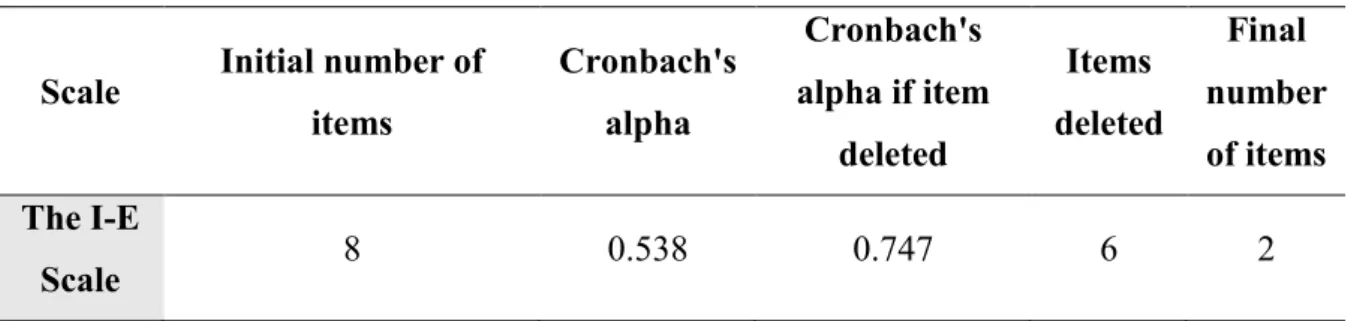
One of the scales used in the study was adapted from previous research. Yet, it is still important to test for the scale’s reliability. Cronbach’s alpha is a statistical measure of reliability used to assess the internal consistency of multi-item scales. According to DeVellis (1991), values lower than 0.60 are considered unsatisfactory, if they belong to the interval between 0.65 and 0.70 are minimally acceptable, whereas alphas between 0.70 and 0.80 are assumed to be good. Additionally, values between 0.80 and 0.90 are very good.
a very low value (0.538). However, this result could be improved with 6 items deleted (0.747), (see Table 1 and Table 2).
Table 1 - Item Description - The I-E Scale Item description
1 Extrovert I show individuality and originality in written reports
2 Introvert I dislike test questions in which the information tested is in a different form in which was learned
3 Introvert I avoid exaggeration when sharing personal experiences
4 Extrovert I lose control when I get angry 5 Extrovert I get excited when I argue
6 Introvert I shed tears when I hear a sad story
7 Extrovert I prefer to have theory explained than self-studying 8 Introvert When people displease me I refrain from saying anything
Table 2 - Reliability Test for Multi-Item Scales
Scale Initial number of items Cronbach's alpha Cronbach's alpha if item deleted Items deleted Final number of items The I-E Scale 8 0.538 0.747 6 2
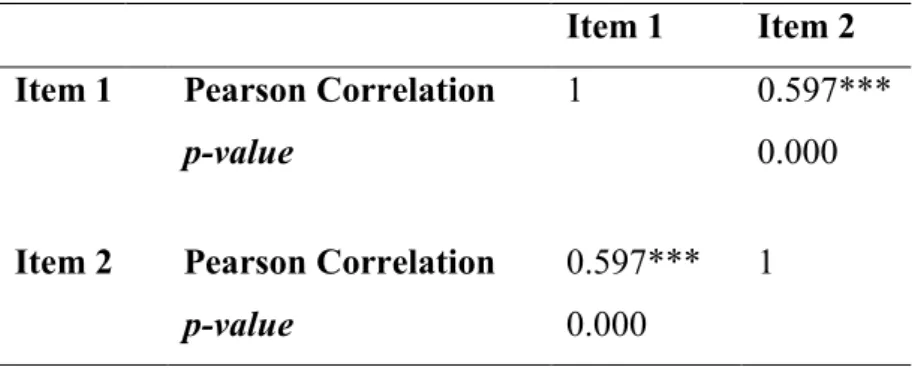
As the number of test items was too small, the alpha coefficient is likely to underestimate reliability (Tavakol & Dennick, 2011). Thus, a correlation analysis was conducted with the two items (one extrovert and one introvert), to estimate the strength and direction of the correlation between the variables.
According to Benesty, Chen and Huang (2009), the Pearson Correlation coefficients can take a range of values between +1 and -1. The stronger the association between two variables, the closer the Pearson Correlation coefficient, will be to either +1 or -1, depending whether the relationship is positive or negative. The results from Pearson Correlation demonstrated a positive correlation between the two variables (r = 0.597, N = 182, p<0.001). This correlation is statistically significant (p <0.001), (see Table 3).
Table 3 - Correlation Test for 2 items Item 1 Item 2
Item 1 Pearson Correlation 1 0.597***
p-value 0.000
Item 2 Pearson Correlation 0.597*** 1
p-value 0.000
*p < .05; **p < .01; ***p < .001
5.4. Manipulation Checks
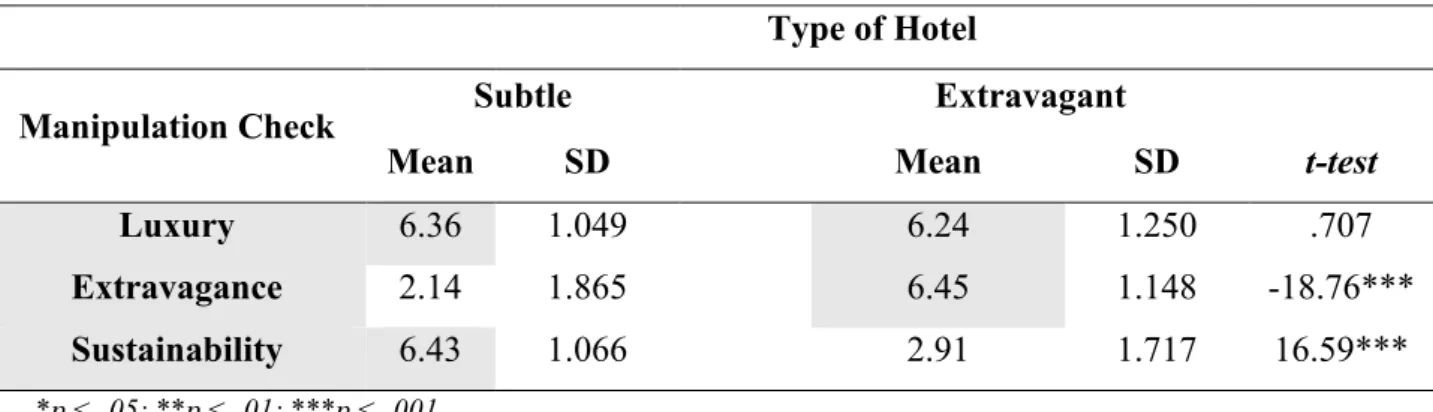
Luxury, extravagance and sustainability manipulation checks were performed by conducting an independent-samples t-test at a 95% confidence level.
The results obtained were as expected (see Table 4). In terms of luxury, participants perceived both hotels as luxury hotels (MSubtle = 6.36 vs MExtravagant = 6.24; t(182) = 0.707, p > 0.05).
Results demonstrate there were no statistically significant differences in the means. In terms of extravagance, and as expected, the extravagant hotel was perceived as being more extravagant than the subtle hotel, (MExtravagant = 6.45 vs MSubtle = 2.14; t(182) = - 18.763, p < 0.001), showing
a statistically significant difference in the means and thus, validating the type of luxury hotel manipulation check.
In terms of sustainability, the subtle hotel was perceived as being more sustainable than the extravagant hotel, (MSubtle = 6.43 vs MExtravagant = 2.91; t(182) = 16.599, p < 0.001), validating
the sustainability manipulation check.
Since both manipulation checks revealed that both hotels are perceived as luxury-extravagant versus luxury-subtle, and being the latter perceived as more sustainable, the author proceeded with the analysis, with confidence.
Table 4 - Results for Manipulation Checks
*p < .05; **p < .01; ***p < .001
5.5.Main Results
In order to test the hypotheses, a 2 (type of hotel: subtle vs extravagant) x 2 (personality: introvert vs extrovert) multivariate analysis (MANOVA) was conducted on the dependent variables WTP, Quality Perceptions and Sustainability Importance. The multivariate analysis of variance (MANOVA) is used to test the effect of one or more categorical independent variables on two or more continuous dependent variables (Seltman, 2006).
5.5.1. H1: Luxury hotel types will have an impact on Willingness to Pay, Quality Perceptions
and Sustainability Importance perceptions, so that:
H1a: There will be no significant differences in consumers WTP and quality perceptions for extravagant versus subtle hotels.
In order to test the first hypothesis, which proposes that the different types of hotel (subtle vs extravagant) have an impact on the dependent variables, a MANOVA was conducted. As expected, the MANOVA results (see Table 5) indicate there is no significant main effect on the willingness to pay dependent variable (F(1,178) = 2.76, p > 0.05). But, contrary to the author’s expectations, a significant type of hotel main effect was found on the quality perception dependent variable (F(1,178) = 22.86, p < 0.001). Independent sample t-tests were further conducted to test H1a.
Type of Hotel
Manipulation Check Subtle Extravagant
Mean SD Mean SD t-test
Luxury 6.36 1.049 6.24 1.250 .707
Extravagance 2.14 1.865 6.45 1.148 -18.76***
Table 5 - Results of the two-way interaction between Type of Hotel x Personality Type of Hotel main effect Personality main effect Type of Hotel * Personality
F test F test F test
WTP 2.76 3.08 22.50***
Quality perceptions 22.86*** 0.156 30.47***
Sustainability Importance 4.37* 26.80*** 0.097
*p < .05; **p < .01; ***p < .001
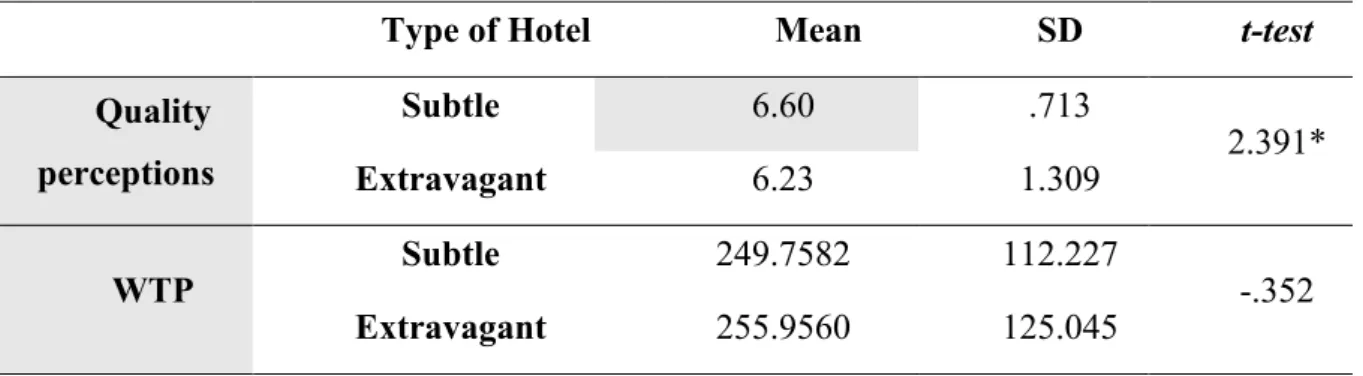
Concerning the effect of hotel type on willingness to pay, results demonstrate there is no statistically significant differences in consumers’ ratings exposed to the subtle versus extravagant hotel types (MSubtle = 249.75 vs MExtravagant = 255.95; t(182) = -0.352 p>0.05), since
participants are willing to pay approximately the same amount for both hotels.
Yet, concerning quality perceptions, t-test results indicate that the subtle hotel is perceived by participants as having more quality than the extravagant hotel (MSubtle
= 6.60 vs M
Extravagant =6.23; t(182) = 2.391, p<0.05), partially validating H1a (see Table 6).
Table 6 - Results independent sample t-test for the impact of type of hotel on WTP and Quality Perceptions
Type of Hotel Mean SD t-test
Quality perceptions Subtle 6.60 .713 2.391* Extravagant 6.23 1.309 WTP Subtle 249.7582 112.227 -.352 Extravagant 255.9560 125.045 *p < .05; **p < .01; ***p < .001
H1b: Sustainability importance perceptions will be greater for subtle than for extravagant hotels.
In order to test H1b, MANOVA results indicate a significant hotel type main effect on the importance given to sustainability (F(1,178) = 4.37, p < 0.05). An independent t-test was then
performed indicating that in the subtle hotel condition, sustainability importance is more valued by participants (MSubtle
= 5.59 vs M
Extravagant = 4.43; t(182) = 4.19 p< 0.001), confirming H1b.Indeed, results show the higher sustainability importance given to the subtle than for the extravagant hotel (see Table 7).
Table 7 - Results independent sample t-test for the impact of type of hotel on Sustainability Importance
Type of Hotel Mean SD t-test
Sustainability Importance Subtle 5.59 1.795 4.19*** Extravagant 4.43 1.956 *p < .05; **p < .01; ***p < .001
5.5.2. H2: Different types of consumers (introverts versus extroverts) will have an impact on
Willingness to Pay, Quality Perceptions and Sustainability Importance, so that:
In order to test the second hypothesis, which proposes that different types of consumers (introvert vs extrovert) will have an impact on the dependent variables, a MANOVA analysis was conducted.
H2a: There will be no significant differences in consumers’ WTP and quality perceptions for introvert vs extrovert consumers.
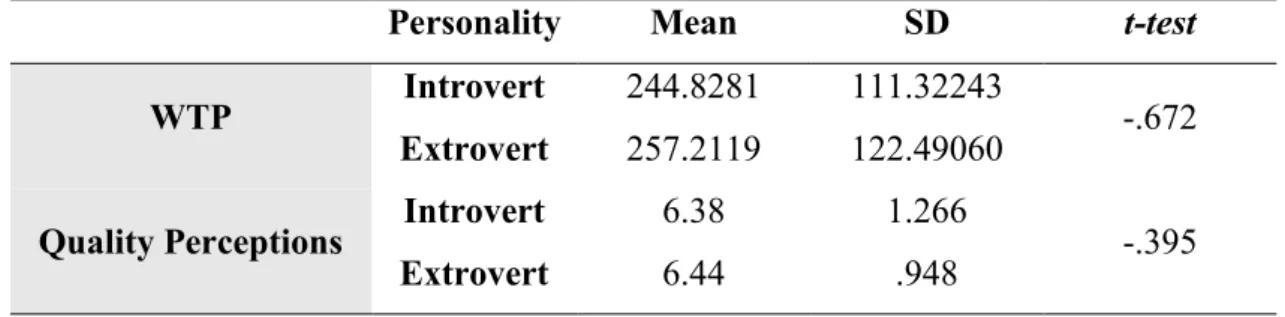
As expected, MANOVA results reveal no significant personality main effect on the willingness to pay dependent variable (F(1,178) = 3.08, p > 0.05), as well as on the quality perceptions’ dependent variable (F(1,178) = 0.156, p > 0.05) (see Table 5). To test H2a, t-test results indicate that participants are willing to pay approximately the same amount per night at a hotel (WTP:
MIntrovert = 244.83 vs MExtrovert = 257.21; t(182) = -0.672 p>0.05) . Regarding the effect of
personality on quality perceptions, a similar result was obtained, with no statistically significant difference between groups, on quality perceptions (MIntrovert = 6.38 vs MExtrovert = 6.44; t(182)
Table 8 - Results independent sample t-test for the impact of personality on WTP and Quality Perceptions
Personality Mean SD t-test
WTP Introvert 244.8281 111.32243 -.672
Extrovert 257.2119 122.49060
Quality Perceptions Introvert 6.38 1.266 -.395
Extrovert 6.44 .948
*p < .05; **p < .01; ***p < .001
H2b: Introvert consumers are likely to give more importance to sustainability practices than extrovert consumers.
MANOVA results reveal a significant personality main effect on the sustainability importance’ dependent variable (F(1,178) = 26.80, p < 0.05). Independent sample t-tests were further conducted to test H2b and indicate that introvert consumers give more importance to sustainability practices than extrovert consumers (MIntrovert= 6.16 vs MExtrovert = 4.39; t(182) =
6.414 p<0.001), fully validating H2b. Indeed, the results demonstrate a higher importance given to sustainability from introverts than extroverts (see Table 9).
Table 9 - Results independent sample t-test for the impact of personality on Sustainability Importance
Personality Mean SD t-test
Sustainability Importance Introvert 6.16 1.348 6.414*** Extrovert 4.39 1.966 *p < .05; **p < .01; ***p < .001
5.5.3. H3: The likelihood of introvert (extrovert) consumers to engage in subtle (extravagant)
hotel types is higher, so that:
In order to test the third hypothesis, which proposes that the different type of consumers engage into different type of hotels (introvert & subtle vs extrovert & extravagant), a MANOVA analysis was conducted once more. The MANOVA results indicate a significant type of hotel x personality interaction effect on the willingness to pay (F(1,178) = 22.50, p < 0.001) and
quality perception (F(1,178) = 30.47, p < 0.001) dependent variables, (see Table 10). Further analysis was conducted in order to test H3a and H3b.
Table 10 - Results of the two-way interaction Type of Hotel x Personality on Quality Perceptions and WTP Type of Hotel * Personality F test WTP 22.50*** Quality perceptions 30.47*** *p < .05; **p < .01; ***p < .001
H3a: Introvert consumers are more likely to pay more for a subtle hotel, whereas Extrovert consumers are more likely to pay more for an extravagant hotel.
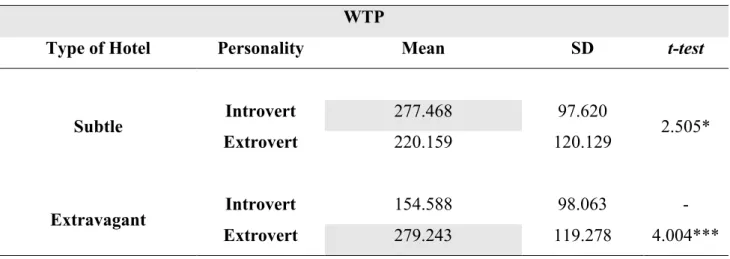
An independent t-test was conducted on participants willingness to pay. Results demonstrate that introvert consumers are willing to pay more than extrovert consumers for subtle hotels (WTP: MSubtleIntrovert= 277.468 vs MSubtleExtrovert = 220.159, t(182) = 2.505, p <0.05) and, extrovert consumers are willing to pay more for extravagant hotels than introvert consumers, (WTP: MExtravagantExtrovert= 279.243 vs MExtravagantIntrovert = 154.588 t(182) = -4.004, p<0.001), fully corroborating with H3a. Indeed, results demonstrate that introvert consumers
are likely to pay more for a subtle hotel than extrovert consumers, and extrovert consumers are likely to pay more for an extravagant hotel than introvert consumers (see Table 11).
Table 11 - Results independent sample t-test for the impact of interaction on WTP WTP
Type of Hotel Personality Mean SD t-test
Subtle Introvert 277.468 97.620 2.505* Extrovert 220.159 120.129 Extravagant Introvert 154.588 98.063 -4.004*** Extrovert 279.243 119.278 *p < .05; **p < .01; ***p < .001
H3b: Introvert consumers are more likely to perceive subtle hotels with having higher quality, whereas Extrovert consumers are more likely to perceive extravagant hotels with having higher quality.
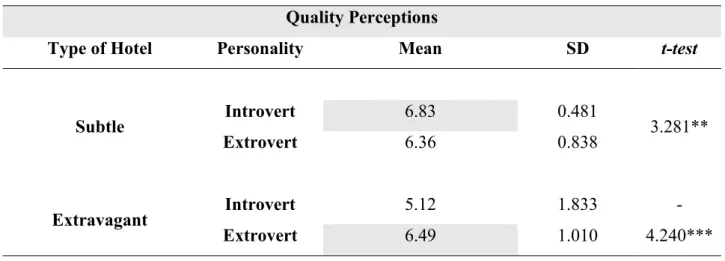
T-test results demonstrate that introvert consumers perceive subtle hotels to have more quality than extrovert consumers (quality perceptions: MSubtleIntrovert = 6.83 vs MSubtleExtrovert = 6.36, t(182) = 3.281, p <0.01) whereas, extrovert consumers perceive extravagant hotels to have higher quality than introvert consumers (quality perceptions: MExtravagantExtrovert= 6.49 vs MExtravagantIntrovert = 5.12 t(182) = -4.240, p<0.001), fully validating H3b (see Table 12).
Indeed, results demonstrate that introvert consumers associate higher quality to a subtle hotel than extrovert consumers, and extrovert consumers associate higher quality to an extravagant hotel, than introvert consumers.
Table 12 - Results independent sample t-test for the impact of interaction on Quality Perceptions Quality Perceptions
Type of Hotel Personality Mean SD t-test
Subtle Introvert 6.83 0.481 3.281** Extrovert 6.36 0.838 Extravagant Introvert 5.12 1.833 -4.240*** Extrovert 6.49 1.010 *p < .05; **p < .01; ***p < .001
Results obtained confirm that introvert consumers are more likely to engage in subtle hotels while extrovert consumers are more likely to engage in extravagant hotels.