ABSTRACT
The aim of this study was to determine the prevalence of metabolic syndrome in women with polycystic ovary syndrome, as well as its characteristics and predictors. Seventh-three women, with body mass index of 30.4 ± 7.8 kg/m2and 25.0 ± 6.0 years old, subdivided according to body mass index, were studied retrospectively. There was no significant mean age difference among body mass index groups (p = 0.228). Prevalence of metabolic syndrome was 38.4%, with a null prevalence for normal (n = 18), 23.8% for overweight (n = 17), 62.9% for obese (n = 28), and 85.5% for morbidly obese women (n = 7). Women with metabolic syndrome were older than women without metabolic syndrome (27.3 ± 5.3 vs. 24.2 ± 4.6 vs. years old; p = 0.031) and presented a higher body mass index (36.3 ± 7.7 vs. 26.9 ± 5.4; p < 0.001). There was no difference for degree of hirsutism and menstrual patterns between women with and without metabolic syndrome (p = 0.593 and p = 0.119, respectively). Regarding laboratory parameters, DHEAS was lower (1,646 ± 1,007 vs. 2,594 ± 1,563; p = 0.007) and HOMA-IR were higher (9.9 ± 9.7 vs. 4.6 ± 4.7; p = 0.004) in women with metabolic syndrome (p = 0.031 and p < 0.001, respectively). The best predictors of metabolic syndrome were waist circumference > 88 cm, HDL-cholesterol < 50 mg/dL and triglycerides ≥150 mg/dL. (Arq Bras Endocrinol Metab 2007;51/6:972-979)
Keywords: Polycystic ovary syndrome; Metabolic syndrome; Insulin resis-tance; Cardiovascular risk
RESUMO
Síndrome Metabólica em Mulheres com Síndrome dos Ovários Policísticos: Prevalência, Características e Preditores.
O objetivo deste estudo foi o de determinar a prevalência, características e preditores da síndrome metabólica em mulheres com a síndrome dos ovários policísticos. Setenta e três mulheres, com índice de massa corporal de 30,4 ± 7,8 kg/m2e 25,0 ± 6,0 anos de idade, subdivididas de acordo com o índice de massa corporal, foram estudadas retrospectivamente. Não se observou diferença significativa de idade entre os grupos (p = 0,228). A prevalência da síndrome metabólica foi de 38,4%, estando ausente nas mulheres com índice de massa corporal normal (n = 18) e presente em 23,8% das com sobrepeso (n = 17), 62,9% das obesas (n = 28) e 85,5% das obesas mórbidas (n = 7). Quando comparadas, as mulheres com síndrome metabólica apresentaram uma idade mais avançada (27,3 ± 5,3 vs. 24,2 ± 4,6 anos; p = 0,031) e um índice de massa corporal maior (36,3 ± 7,7 vs. 26,9 ± 5,4; p < 0,001) que as mulheres sem a síndrome, não havendo diferença significativa com relação ao grau de hirsutismo (p = 0,593) e padrão menstrual (p = 0,119). Com relação aos parâmetros laboratoriais, a concentração de DHEAS foi menor (1.646 ± 1.007 vs. 2.594 ± 1.563; p = 0,007) e o valor do HOMA-IR foi maior (9,9 ± 9,7 vs. 4,6 ± 4,7; p = 0,004) nas pacientes com a síndrome metabólica. Os melhores preditores para a presença da síndrome metabólica foram a circunferência abdominal > 88 cm, HDL-colesterol < 50 mg/dL e triglicérides ≥ 150 mg/dL. (Arq Bras Endocrinol Metab 2007;51/6:972-979)
Descritores: Síndrome dos ovários policísticos; Síndrome metabólica; Resistência à insulina; Risco cardiovascular
artigo original
JOSÉANTONIOM. MARCONDES SYLVIAA.Y. HAYASHIDA CRISTIANOR.G. BARCELLOS MICHELLEP. ROCHA GUSTAVOA.R. MACIEL EDMUNDC. BARACAT
Endocrine Unit (JAMM, CRGB & MPR) and Gynecological Unit (SAYH, GARM & ECB), Hospital das Clínicas de São Paulo, SP.
P
OLYCYSTIC OVARY SYNDROME (PCOS) is a hetero-geneous disorder, characterized by chronic anovu-lation and hyperandrogenism. It affects between 5 to 10% of women of reproductive age, and it is consid-ered one of the most common endocrine disorders in premenopausal women (1).Since the study by Burghen et al. (2), in 1980, which reported that women with PCOS had basal and glucose-stimulated hyperinsulinemia, suggesting the presence of insulin resistance, it has become clear that the syndrome also has a component of metabolic dis-order, beyond reproductive morbidities. In fact, Dal-ghren et al. (3), in 1992, reported that the prevalence of diabetes mellitus in menopausal women with previ-ous PCOS was higher than that observed in the gen-eral population, 15% versus 2.3%. Furthermore, insulin resistance (4), dyslipidemia (5,6), central obesity (7), and hypertension (8,9) started to be commonly described as being associated with PCOS. Nowadays, PCOS is considered a complex metabolic disorder and a risk factor for diabetes mellitus and cardiovascular disease. It is considered that insulin resistance can be a link between carbohydrate intolerance and the increase in cardiovascular risk and PCOS (10) and that insulin resistance also plays a pathogenic role in the metabolic syndrome (11). Furthermore, cardiovascu-lar and diabetes mellitus type 2 risk factors defining metabolic syndrome are prevalent in PCOS (5-9,12).
The data regarding the prevalence of metabolic syndrome in PCOS are scarce, and limited only to the USA (13-17) and Europe (18-20). In the USA popula-tion, its prevalence in adolescents was 37% (14), while in adult women it varied from 34.4% (16) to 47.9% (17). In Southern Italy its prevalence was 8.2% (20) and 8.4 to 16% in Turkey (19), while Czech women with polycys-tic ovary syndrome were rarely described, although its isolated features were relatively frequent (18).
This study aimed at analyzing the prevalence, characteristics and predictors of metabolic syndrome in women with PCOS from a single University Hospi-tal from the city of São Paulo, Brazil.
SUBJECTS AND METHODS
The study protocol, as a retrospective study, was approved by the Ethical Committee of the Hospital das Clínicas da Universidade de São Paulo.
Subjects
All women who were seen in the Outpatient Clinic (Endocrine Unit and Gynecology Unit) of Hospital das Clínicas of São Paulo from 1995 to 2004 were initially included in the study.
The women were referred to the clinic for hirsutism evaluation. All of them came from the urban area of the city of São Paulo; regarding ethnicity, most were Caucasian and Brazilian mulat-to and none of them were Black. Diagnosis of PCOS was based on the presence of hirsutism and/or hyperandrogenemia and menstrual dysfunction, after exclusion of Cushing’s syndrome, late-onset 21-hydroxylase deficiency, thyroid dysfunction, hyperprolactinemia, or androgen-secreting tumor by appropri-ated tests, according to the 1990 National Institute of Child Health and Women Development (21). None of the patients had other diseases or were taking any medication for at least 6 months prior to the study.
A modified National Cholesterol Education Program Adult Treatment Panel (NCET ATP III) criteria (22), as sug-gested by the Rotterdam ESHRE/ASRM-Sponsored PCOS Consensus Workshop Group (23), which also included glycemia at the OGTT, together with fasting glycemia as a sin-gle criteria, was used for the diagnosis of metabolic syndrome, by the presence of three or more of the following abnormali-ties: waist circumference > 88 cm; fasting glucose ≥ 110 mg/dL and/or glicemia at the 120 minutes of the oral glucose tolerance test ≥140 mg/dL; fasting serum triglycerides ≥150 mg/dL, serum HDL-C < 50 mg/dL and blood pressure ≥ 130/85 mmHg. Only women who had the complete panel of clinical and laboratory data for the classification of PCOS and metabolic syndrome were included in the final analysis.
Blood pressure (BP) was measured with a mercury sphygmomanometer with rubber sleeves of different sizes, according to the women’s arm circumference. The women stayed in supine position after a 20-minute resting period. The systolic (SBP) and diastolic (DBP) pressures were mea-sured twice on average. We considered hypertension a blood pressure level equal or higher than 130 mmHg for SBP and 85 mmHg for DBP, in accordance with the Brazilian Guide-lines in Arterial Hypertension (24).
Body mass index (BMI) was calculated with the for-mula: weight (kg)/height (m2).
Waist circumference was measured with the patient lying down, at the level of the umbilicus.
Hirsutism was defined by the presence of excessive body hair distributed in an androgen-depend pattern, using the Ferriman & Gallwey score > 8 (25).
Eumenorrhea was defined as the presence of men-strual cycles between 25 and 34 days. At least two consecu-tive cycles with low progesterone levels (< 3 ng/mL) were required for a diagnosis of anovulation. Oligomenorrhea was defined as the presence of three or more cycles of > 35 days in the previous 6 months and amenorrhea due to the lack of vaginal bleeding for 3 months. Hypermenorrhea was defined as the presence of vaginal bleeding at intervals < 21 days.
The women were subdivided in groups, according to BMI (normal: 18.5 to 24.9 kg/m2, overweight: 25.0 to
29.9 kg/m2, obese: ≥30 kg/m2,and morbidly obese: ≥40
kg/m2) and the presence of metabolic syndrome.
Oral glucose tolerance test (OGTT) was performed between 7:30 and 8:30 A.M. After an overnight fast, blood samples were obtained through an IV catheter placed in the forearm for the determination of fasting blood glucose, insulin, gonadotropins (LH and FSH), estradiol (E2), total testosterone (testo) and dehydroepiandrosterone sulphate (DHEAS), triglycerides, and total cholesterol and its frac-tions (LDL-C and HDL-C). A 75-gr of glucose load was given, and blood was collected after 30, 60, 90, and 120 minutes thereafter, for determination of glucose and insulin. Samples were considered only when progesterone concen-tration at the basal sample was less than 1.0 ng/mL.
The states of glucose tolerance were classified accord-ing to the World Health Organization (WHO) (26) — impaired fasting glucose IFG: fasting plasma glucose ≥110 mg/dL and < 126 mg/dL; impaired glucose tolerance: plas-ma glucose at 120 minutes ≥ 140 mg/dL and < 200 mg/dL; diabetes: fasting plasma glucose ≥ 126 mg/dL and/or plasma glucose at 120 minutes ≥200 mg/dL.
Methods
Plasma glucose concentration was determined by a glucose oxidase method.
All lipid determinations were measured directly in plasma samples. Plasma total cholesterol and triglycerides were determined using enzymatic methods (Roche Labora-tories). HDL-C was measured by the same method as for cholesterol and LDL-C, which were estimated by the Friede-wald formula.
For hormone assays, blood samples were processed by centrifuging, and serum was stored at -20 °C until assayed.
Progesterone and testosterone were measured by flu-oroimmunometric assay (Wallac, Finland), insulin, LH and FSH were measured by immunofluorometric assay (Wallac, Finland) and DHEAS were measured by radioimmunoassay (Cisbio International, France, and DSL, Texas, USA).
All assays were performed in duplicate and the intraassay and interassay coefficients of variation did not exceed 10% and 15%, respectively.
Statistical analysis
Descriptive statistics were calculated in order to present the results, mean and standard deviation.
Levine test was used to compare the group’s vari-ances. Mann-Whitney non-parametric test — U statistics — was used for group’s comparison of means. This statistical analysis does not assume either normal distribution or homogeneity of variances. Chi-square test was used to test categorical or nominal variables association. Fisher’s test was used in transformed variables (log) to evaluate Body Mass Index groups’ effect. Performance measures were calculated (Predictive Positive Value, Predictive Negative Value, speci-ficity, sensitivity, overall accuracy and Youden’s Index) for metabolic syndrome characteristics.
The significance level used was 5%.
RESULTS
Seventy-three women were included in the study, with BMI of 30.4 ± 7.8 kg/m2and 25.0 ± 6.0 years old.
According to BMI, 24.7% were normal, 28.8% were overweight, 37.0% were obese and 9.6% were morbid-ly obese. There was no significant mean age difference among BMI groups (p = 0.228). Except for 4 women with eumenorrhea and anovulatory cycles (5.5%), all of them presented menstrual abnormalities (5 with hypermenorrhea — 6.8%, 33 with oligomenorrhea — 45.2% and 31 with amenorrhea — 42.5%). Hirsutism was present in 83.8% of the women.
Prevalence of the metabolic syndrome
Overall, the prevalence of metabolic syndrome accord-ing to the modified NCET ATP III was 38.4%. If the original criteria were considered, the prevalence of metabolic syndrome would be 28.8%, with a null prevalence for a BMI < 24.9 kg/m2 and increasing
progressively according to the BMI (figure 1).
Prevalence of each component of the meta-bolic syndrome
The prevalence of each criteria of metabolic syndrome in the whole group as well as stratified by BMI can be seen in table 1. Considering all women, the prevalence of one or no factor was observed in 43.9% of the women, and the prevalence of 3 or more factors was seen in 38.4% of them. Except for glucose at 120 min-utes of the OGTT, there was a progressive increase in the prevalence of each criterion with the increase in BMI, with a decline for HDL-C < 50 mg/dL and triglycerides ≥150 mg/dL for a BMI > 40 kg/m2.
Comparison between women with and without the metabolic syndrome
There was no difference between the menstrual pat-tern and degree of hirsutism between women with and without metabolic syndrome (p = 0.593 and p = 0.119, respectively). As shown in table 2, women with the metabolic syndrome were older than women with-out it (p = 0.031) and presented a higher BMI (p < 0.001). Regarding the hormonal profile, only DHEAS was different between the groups, being lower in women with the metabolic syndrome (p = 0.007).
Figure 1. Prevalence of metabolic syndrome stratified by body mass index in women with polycystic ovary syndrome.
Total <24.4 25.0-29.9 30.0-39.9 >40.0 100
80
60
40
20
0
% 38.4
0
23.8
62.9
85.5
Table 1.Prevalence (%) of individual characteristics of the metabolic syndrome among 73 patients with polycystic ovary syn-drome stratified by body mass index.
Characteristics Total No MS* With MS Body mass index (Kg/m2)
(n = 73) (n = 45) (n = 28) < 25.0 25.0–29.9 30.0–39.9 ≥40 (n = 18) (n = 21) (n = 27) (n = 7)
Waist circumference > 88cm 49.3 26.7 87.5 0 33.3 81.5 100.0
HDL-Cholesterol < 50 mg/dL 67.6 50.0 92.9 38.5 61.9 85.2 71.4
Triglycerides ≥150 mg/dL 31.8 7.7 66.7 0 30.0 46.2 42.9
130 SBP ≥130mmHg or DBP ≥ 24.7 8.9 50.0 5.6 9.5 29.6 100.0
85 mmHg**
Fasting glucose ≥110 mg/dL 6.9 0 47.9 0 4.8 7.4 28.6
Glucose at 120 min 37.6 23.5 60.9 46.2 23.5 45.5 40.0
of OGTT*** ≥140 mg/dL
* MS: metabolic syndrome; ** SBP: systolic blood pressure, DBP: diastolic blood pressure, *** OGTT: oral glucose tolerance test.
Table 2.Anthropometrics and laboratory data of women with polycystic ovary syn-drome according to the presence of metabolic synsyn-drome.
Metabolic syndrome p
No Yes
Age (Years) 24.2 ± 4.6 27.3 ± 5.3 0.031
Body mass index (kg/m2) 26.9 ± 5.4 36.3 ± 7.7 < 0.001 Waist circumference (cm) 83.4 ± 12.1 102.8 ± 13.4 < 0.001
FSH (UI/L) 5.1 ± 2.1 4.7 ± 1.7 0.296
LH (UI/L) 12.4 ± 7.4 8.9 ± 3.6 0.070
Estradiol (pg/mL) 78.3 ± 60.6 57.0 ± 25.5 0.196
Testosterone (ng/dL) 119.8 ± 46.6 105.7 ± 45.5 0.301
DHEAS (ng/mL 2,594 ± 1,563 1,646 ± 1,007 0.007
Glycemia (µg/dL) 87.4 ± 9.2 100.4 ± 33.0 0.031
Insulin (mUI/mL) 19.1 ± 17.9 37.8 ± 37.4 < 0.001
HOMA-IR 4.6 ± 4.7 9.9 ± 9.7 0.004
Cholesterol (mg/dL) 177.0 ± 30.8 192.2 ± 26.7 0.010 Triglycerides (mg/dL) 97.4 ± 38.5 219.4 ± 209.6 < 0.001 LDL-Cholesterol (mg/dL) 109.7 ± 24.9 116.5 ± 25.4 0.161 HDL-Cholesterol (mg/dL) 51.8 ± 15.4 37.5 ± 6.7 < 0.001
SBP mmHg 11.8 ± 1.1 13.2 ± 1.7 < 0.001
DBP mmHg 7.4 ± 1.0 8.5 ± 1.0 < 0.001
metabolic syndrome, while LDL-C did not show any difference between the groups.
The fasting glucose, insulin and HOMA-IR were higher in women with the metabolic syndrome (p = 0.031, p < 0.001, and p = 0.004, respectively) and, as expected, as these were inclusion criteria, women with the metabolic syndrome presented high-er waist circumfhigh-erence (p < 0.001), systolic and dias-tolic blood pressures (p < 0.001 for both).
Prevalence of glucose intolerance
According to the WHO criteria, when women without the metabolic syndrome were considered, none of them presented fasting glycemia ≥110 mg/dl. At the OGTT, 15.5% had impaired glucose tolerance and 2.2% had diabetes. On the other hand, regarding the women with the metabolic syndrome, 13 (46.4%) women presented impaired glucose tolerance (3 on basal glucose and 10 at OGTT) and 6 (21.4%) had diabetes (2 on basal glucose – 140 and 147 mg/dL, and 4 at OGTT).
Performance measures for the metabolic syndrome characteristics
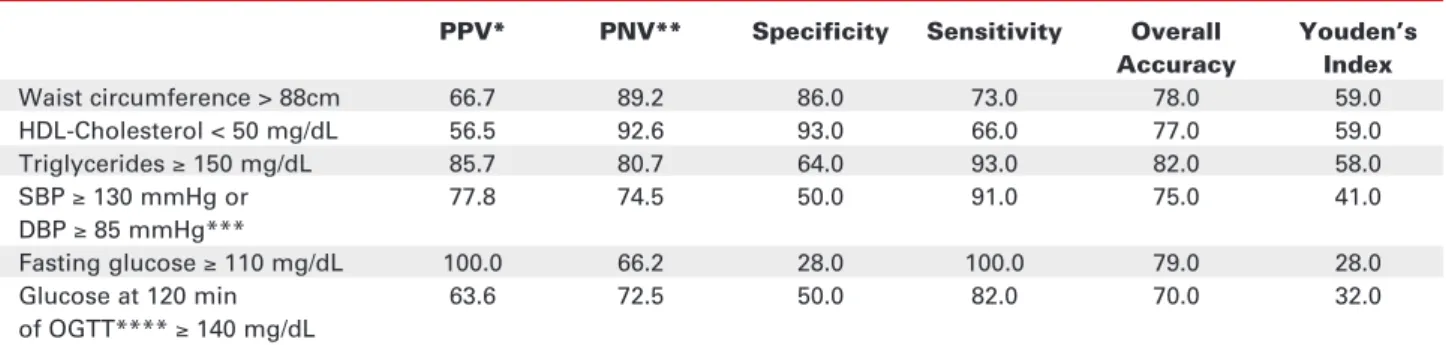
The positive (the percentage of women who have the metabolic syndrome) and negative predictive (the per-centage of women who do not have the metabolic syn-drome) values for the individual component of the metabolic syndrome, as well as the sensitivity, speci-ficity and the Youden’s Index, are shown in table 3. According to this Index, the best indicators of the metabolic syndrome were a waist circumference > 88 cm, an HDL-C < 50 mg/dL and triglycerides ≥ 150 mg/dL, with Indexes of 59, 59 and 58. For instance, while fasting glicemia ≥110 mg/dL was the best pos-itive predictive value, with a sensitivity of 100% (all women with a basal glucose ≥ 110 mg/dL presented
the metabolic syndrome), it had a low negative pre-dictive value, with a specificity of 28% (66.2% of the women with a basal glucose < 110 mg/dL did not have the metabolic syndrome), with a Younde’s Index of 28.0. On the other hand, the Younde’s Index for a HDL-C < 50 mg/dL was 59, with the lowest positive predictive value (56.5% of the women with a HDL-C < 50 mg/dL presented the metabolic syndrome), but with the highest negative predict value (93% of the women with a HDL-C > 50 mg/dL did not have the metabolic syndrome).
DISCUSSION
The metabolic syndrome and the polycystic ovary syn-drome share some characteristics, such as a high rate of impaired glucose tolerance and risk factors for cardio-vascular disease.
We employed a modification of the NCET APT III guidelines, as suggested by the Rotterdam ESHRE/ASRM-Sponsored PCOS Consensus Work-shop Group for the diagnosis of metabolic syndrome, which included glycemia at 120 minutes of the OGTT together with fasting glycemia as a single criterion (23). According to Legro et al. (27) and based on our own experience (12), these modified guidelines will identify more women with abnormal glucose toler-ance. This is particularly true for women with PCOS and normal BMI, as it has been shown that the preva-lence increases 6.7 times when the American Diabetes Association criteria (28) are employed versus the
WHO criteria for the diagnosis of glucose intolerance in women with PCOS. According to this, the preva-lence of metabolic syndrome by NCET ATP III guidelines was 28.8%, increasing to 38.8% when the modified guidelines were used.
Table 3.Performance measures for metabolic syndrome characteristics.
PPV* PNV** Specificity Sensitivity Overall Youden’s Accuracy Index
Waist circumference > 88cm 66.7 89.2 86.0 73.0 78.0 59.0
HDL-Cholesterol < 50 mg/dL 56.5 92.6 93.0 66.0 77.0 59.0
Triglycerides ≥150 mg/dL 85.7 80.7 64.0 93.0 82.0 58.0
SBP ≥130 mmHg or 77.8 74.5 50.0 91.0 75.0 41.0
DBP ≥85 mmHg***
Fasting glucose ≥110 mg/dL 100.0 66.2 28.0 100.0 79.0 28.0
Glucose at 120 min 63.6 72.5 50.0 82.0 70.0 32.0
of OGTT**** ≥140 mg/dL
It is difficult to compare our data about preva-lence of metabolic syndrome with that of metabolic syndrome in Brazil. The only data regarding its preva-lence in Brazil comes from the semi-arid rural area of the Northeast region, in a predominantly Brazilian Mulatto and Black women population with more advanced age (29). Crude prevalence was 30.0%, while the age-adjusted prevalence was 24.8%. However, when the age younger than 45 years old was consid-ered, the prevalence decreased to 18.2%. Our study population consisted of individuals who were predom-inantly Caucasian and Brazilian Mulatto, younger and that came from an urban area of the southwest region of Brazil, with different dietary habits. Nonetheless, our prevalence was higher than that observed in women younger than 45 years old.
The prevalence of metabolic syndrome found by us was similar to that found in adult or adolescent women with PCOS in the USA, i.e., 33.4% to 43%, which is 2-fold higher than the age-adjusted preva-lence rate based on the NHANES III survey (30). In the USA, the prevalence of metabolic syndrome in adolescent girls was 37% (14) compared to 5% of NHANES III girls. Among adult women, the preva-lence rates vary from 34% (17) to 47.3% (16), and these prevalence rates of metabolic syndrome under the age of 40 were comparable to the 44% rate report-ed for women agreport-ed 60–69 in the general US popula-tion. On the other hand, a lower prevalence was observed in Europe, being 1.6% in the Czech Repub-lic (18), 2.3% in Turkey (19), and 8.2% to 16% in southern Italy (20).
Different criteria for PCOS and metabolic syn-drome, as well as the characteristics of the population studied, such as age and BMI, could in part explain this discrepancy in the prevalence of MS in women with PCOS. Carmina et al. (20) subdivided their patients with PCOS into two subgroups, according to their par-ticular phenotype, hyperandrogenism and chronic anovulation, compatible with the NIH criteria (21) and hyperandrogenism and polycystic ovaries, but normal ovulatory cycles, compatible with the Rotterdam ESHRE/ASRM-Sponsored PCOS Consensus Work-shop Group criteria (23). The prevalence decreases from 8.9% to 5.0%, according to the NCEP APT III criteria for metabolic syndrome (22), and from 17.3% to 10.6%, according to the WHO criteria (30).
In this study, women with PCOS and metabol-ic syndrome were more obese and older than women with PCOS without metabolic syndrome. Similarly, we observed that the prevalence of metabolic syn-drome increased with age and BMI. An effect of age
alone could be discarded as an explanation for the dif-ferences between prevalence rates of metabolic syn-drome, as a high prevalence of metabolic synsyn-drome, of 37%, was found even in adolescent girls with PCOS. However, age could be an adjunct factor in precipitat-ing metabolic syndrome, as its prevalence, after strati-fied by BMI, increase with age in PCOS women (17). On the other hand, we observed a significant impact of BMI on the prevalence of metabolic syn-drome in our patients with PCOS, being absent in women with normal BMI, and present in 23.8% of overweigh, 62.9% of obese and 85.7% of morbidly obese women. Possibly, the prevalence of obesity and the impact of age could be the main determinant of the prevalence of metabolic syndrome in different populations. This could explain the higher prevalence in the USA (34.0% to 47.3%) (16,17) when compared to European women with PCOS (1.6 to 17.3%) (18-20). The adult USA patients with PCOS were older (from 18 to 39 years) and more obese (at least, 55% of them presented a BMI > 30 kg/m2), while in Europe,
the age range varies from 22 to 28 and obesity was much less prevalent (less them 26%). In fact, in Czech women with PCOS, aged younger than 28 years and with BMI < 27 kg/m2, the prevalence of MS was the
least observed (1.6% vs. 0 in the control group) (18). The only author that observed the presence of meta-bolic syndrome in lean women with PCOS was Carmi-na et al. (20), with a prevalence of 1.9% to 2.9%, according to the criteria for metabolic syndrome MS (NCAP ATP III and WHO, respectively).
We did not find any phenotypic differences between our patients with and without metabolic syn-drome, considering menstrual patterns and degree of hirsutism. The same occurred regarding hormonal profile, except for DHEAS, which was lower in women with metabolic syndrome. Although total testosterone was not different in the other studies either, free testosterone was always high (15,17). In the study by Erhmann et al. (17), there was an increase in the prevalence of metabolic syndrome from the low-est to the highlow-est quartile of free tlow-estosterone, which does not remain significant after adjusting for BMI. Regarding the lower level of DHEAS in women with metabolic syndrome, an inverse relationship between insulin and DHEAS in PCOS women has been previ-ously demonstrated (32,33).
while the prevalence of three or more factors was not seen in women with a BMI < 25 kg/m2, being present
in 85.8% of the morbidly obese ones. The most fre-quent found abnormality was a HDL-C < 50 mg/dL in 67.6% of the women, followed by a waist circumfer-ence > 88 cm in 49.3% and triglyceride ≥150 mg/dL in 31.8%. High blood pressure and fasting plasma glu-cose was less frequently found (24.7% and 6.9%, respectively). This prevalence was not different from that found by Erhmann et al. (17) and Apridonidze et al. (15), except for a higher HDL-C, the second more prevalent component observed by these two authors. Nevertheless, the most common aggregates of variables were indexes of adiposity (obesity or waist circumfer-ence and a HDL-C < 50 mg/dL). Even in Czech women with PCOS, in whom the prevalence of meta-bolic syndrome was low (18), their isolated features were relatively frequent. It is noteworthy that the prevalence of the components of the metabolic syn-drome increases with the BMI. The prevalence of one or no factors was seen in 94.5% of our patients with a BMI < 25 kg/m2and in none of the morbidly obese
women, while the prevalence of three or more factors was not seen in women with a BMI < 25 kg/m2,being present in 85.8% of the morbidly obese ones.
Each component was evaluated for its value to either confirm or exclude the metabolic syndrome, and an index (the Youden’s Index), based on specificity and sensitivity of each component, was calculated. The best Positive Predictive Value was basal glucose, as all women with a value > 110 mg/dL had the metabolic syndrome, but it identified only 28% of the women with MS. On the other hand, 92.6% of the women with a value of HDL-C > 50 mg/dL did not have the syn-drome (Negative Predictive Value), although a value < 50 mg/dL was presented only by 56.5% of the women (Positive Predictive Value). According to the Youden’s Index, the best predictors for metabolic syndrome was a WC > 88 cm, a HDL-C < 50 mg/dL and Triglyc-erides > 150 mg/dL, whereas the worst were basal and post-glucose concentrations. These data are in accor-dance with those from Erhmann et al. (17), as, although isolated, the best predictor for this author was a high level of triglycerides, with a PPV and a NPV of 83% and 90%, respectively.
In conclusion, we observed a high prevalence of metabolic syndrome in our patients with PCOS, which increased when glycemia at 120 minutes of the OGTT was included in the ATP III guidelines; we also observed that BMI has a significant impact on the prevalence of all individual components. In view of our results, we suggest that the assessment of metabolic
syndrome should be carried out in all overweight and obese women with PCOS. The best predictors of the metabolic syndrome were waist circumference, HDL-C, and triglycerides.
ACKNOWLEDGMENTS
We thank Ms. Sonia Strong for the English review and Mr. Antonio de Castro Bruni for the statistical analysis. This paper was presented at the 12th World
Congress of Gynecological Endocrinology, March 2–5, 2006, Florence, Italy.
REFERENCES
1. Knochenhauser ES, Key TJ, Kahsar-Miller M, Waggoner W, Boots LR, Azziz R. Prevalence of the polycystic ovary syndrome in unselected black and white women of southeastern United States: a prospective study. J Clin Endocrinol Metab 1998;83:3078-82.
2. Burghen GA, Givens JR, Kitabchi AE. Correlation of hyperandrogenism with hyperinsulinism in polycystic ovarian disease. J Clin Endocrinol Metab 1980;50:113-6. 3. Dalghren E, Johansson S, Lindstedt G, Knutsson F, Oden A,
Janson PO, et al. Women with polycystic ovary syndrome wedge resected in 1956 to 1965: a long-term follow-up focus-ing on natural history and circulatfocus-ing hormones. Fertil Ster-il 1992;57:505-13.
4. Dunaif A, Segal KR, Futterweit W, Dobrjansky A. Profound peripheral insulin resistance, independent of obesity, in poly-cystic ovary syndrome. Diabetes 1989;38:1165-74. 5. Holte J, Bergh T, Berne C, Lithell H. Serum lipoprotein lipid
profile in women with the polycystic ovary syndrome: relation to anthropometric, endocrine and metabolic variables. Clin Endocrinol (Oxf) 1994;41:463-71.
6. Barcellos CRG, Rocha MP, Bastos MSCBO, Hayashida SY, Halbe HW, et al. Prevalência de dislipidemia em pacientes portadoras da síndrome dos ovários policísticos: impacto do índice de massa corpórea e da resistência à insulina. Arq Bras Endocrinol Metab 2005;49(suppl. 1):S100.
7. Faloia E, Canibus P, Gatti C, Frezza F, Santangelo M, Garrapa GG, et al. Body composition, fat distribution and metabolic characteristics in lean and obese women with polycystic ovary syndrome. J Endocrinol Invest 2004;27:424-9. 8. Holte J, Gennarelli G, Berne C, Bergh T, Lithell H. Elevated
ambulatory day-time blood pressure in women with polycys-tic ovary syndrome: a sign of a pre-hypertensive state? Hum Reprod 1996;11:23-8.
9. Barcellos CRG, Rocha MP, Bastos MSCBO, Hayashida SY, Halbe HW, et al. Prevalência da hipertensão arterial sistêmica em pacientes portadoras da síndrome dos ovários policísticos: impacto do índice de massa corpórea e da resistência à insulina. Arq Bras Endocrinol Metab 2005;49(suppl. 1):S86.
10. Dunaif A. Insulin resistance and the polycystic ovary syn-drome: mechanism and implications for pathogenesis.
Endoc Rev 1997;18:774-800.
11. Reaven GM. Banting lecture. Role of insulin resistance in human disease. Diabetes 1988;37:1595-607.
13. Glueck CJ, Papanna R, Wang P, Goldenberg N, Sieve-Smith L. Incidence and treatment of metabolic syndrome in newly referred women with confirmed polycystic ovarian syn-drome. Metabolism 2003;52:908-15.
14. Coviello AD, Legro SL, Dunaif A. Adolescent girls with poly-cystic ovary syndrome have an increased risk of the meta-bolic syndrome associated with increasing androgen levels independent of obesity and insulin resistance. J Clin Endocrinol Metab 2006;91:492-7.
15. Apridonidze T, Essah PA, Iuorno NJ, Nestler JE. Prevalence and characteristics of the metabolic syndrome in women with polycystic ovary syndrome. J Clin Endocrinol Metab 2005;90:1929-35.
16. Dokras A, Bochner M, Hollinrake E, Markham S, VanVoorhis B, Jagasia DH. Screening women with polycystic ovary syn-drome for metabolic synsyn-drome. Obst Gynecol 2005;106:131-7.
17. Ehrmann DA, Lijenquist DR, Kasza K, Azziz R, Legro RS, Ghazzi MN. Prevalence and predictors of the metabolic syn-drome in women with polycystic ovary synsyn-drome. J Clin Endocrinol Metab 2006;91:48-53.
18. Vrbikova J, Vondra K, Cibula D, Dvorakova K, Stanicka S, Sramkova D, et al. Metabolic syndrome in young Czech
women with polycystic ovary syndrome. Hum Reprod 2005;20:3328-32.
19. Vural B, Caliskan E, Turkoz E, Kilic T, Demirei A. Evaluation of metabolic syndrome frequency and premature carotid atherosclerosis in young women with polycystic ovary syndrome. Hum Reprod 2005;9:2409-13.
20. Carmina E, Napoli N, Longo RA, Rini GB, Lobo RA. Metabolic syndrome in polycystic ovary syndrome (PCOS): lower preva-lence in southern Italy than in the USA and the influence of criteria for the diagnosis of PCOS. Eur J Endocrinol 2006;154:141-5.
21. Zawadzki JK, Dunaif A. Diagnostic criteria for polycystic ovary syndrome: towards a rational approach. In: Dunaif A, Givens JR, Haseltine FP, Merriam GR (eds). Polycystic ovary syndrome. Boston: Blackwell Scientific, 1992. pp. 377-84.
22. Third report of the National Cholesterol Education Program (NCEP) expert panel on detection, evaluation, and treatment of high blood cholesterol in adults (Adult Treatment Panel III) final report. Circulation 2002;106:3143-421.
23. The Rotterdam ESHRE/ASRM-Sponsored PCOS consensus workshop group Revised 2003 consensus on diagnostic crite-ria and long-term health risks related to polycystic ovary syn-drome (PCOS). Hum Reprod 2004;19:41-7.
24. IV Brazilian Guidelines in Arterial Hypertension. Arq Bras Cardiol 2004;82(suppl. 4):7-22.
25. Ferriman D, Galwey G. Clinical assessment of body hair growth in women. J Clin Endocrinol Metab 1961 ;21:1440-7.
26. Alberti KG, Zimmet PZ. Definition, diagnosis and classifica-tion of diabetes mellitus and its complicaclassifica-tions. Part 1: diag-nosis and classification of diabetes mellitus provisional report of a WHO consultation. Diabet Med 1998;15:539-53. 27. Legro RS, Kunselman AR, Dodson WC, Dunaif A. Prevalence and predictors of risk for type 2 diabetes mellitus and impaired glucose tolerance in polycystic ovary syndrome: a prospective, controlled study in 254 affected women. J Clin Endocrinol Metab 1999;84:165-9.
28. Genuth S, Alberti KG, Bennett P, Buse J, Defronzo R, Zimmet P, et al. The Expert Committee on the Diagnosis and Classification of Diabetes Mellitus: Follow-up report on the diagnosis of diabetes mellitus. Diabetes Care 2003;26:3160-7.
29. Oliveira EP, Souza MLA, Lima MD. Prevalência de síndrome metabólica em uma área rural do semi-árido baiano. Arq Bras Endocrinol Metab 2006;50:456-65.
30. Ford ES, Giles WH, Dietz WH. Prevalence of the metabolic syndrome among US adults: findings from the third National Health and Nutrition Examination Survey. JAMA 2002;287:356-9.
31. World Health Organization. Definition, diagnosis and classifi-cation of diabetes mellitus and its compliclassifi-cations. Part 1: Diag-nosis and Classification of Diabetes Mellitus. Geneva, Switzerland: WHO Department of Noncommunicable Disease Surveillance, 1999.
32. Schriock ED, Buffington CK, Hubert GD, Kurtz BR, Kitabchi AE, Buster JE, et al. Divergent correlations of circulating dehydroepiandrosterone sulfate and testosterone with insulin levels and insulin receptor binding. J Clin Endocrinol Metab 1988;66:1329-31.
33. Diamond MP, Grainger DA, Laudano AJ, Starick-Zych K, DeFronzo RA. Effect of acute physiological elevations of insulin on circulating androgen levels in nonobese women. J Clin Endocrinol Metab 1991;72:883-7.
Endereço para correspondência:
José Antonio Miguel Marcondes Rua Baronesa de Itu 821, apto. 112 01231-001 São Paulo, SP
Fax: (11) 3159-0582