Neuropsychiatric symptoms (NPS) in
patients with pure vascular dementia (VaD)
and mixed dementia (MD) from a memory
outpatient clinic in Southeast Brazil
José Ibiapina Siqueira-Neto1, Octávio Marques Pontes-Neto2,
Francisco de Assis Carvalho do Vale3, Júnia Vieira dos Santos4,
Paulo Marcelo Gondim Sales4, Júnia Vieira dos Santos4, Antônio Carlos Santos5
ABSTRACT. Vascular Dementia (VaD) and Vascular Cognitive Impairment (VCI) are increasingly common worldwide. Nevertheless, the clinical-neuropsychiatric profile of these patients at presentation is still poorly characterized in developing countries. Objective: We aimed to characterize the prevalence of neuropsychiatric symptoms, as well as the clinical and cognitive profile of patients with VaD and VCI in our tertiary University outpatient cognitive clinic. Methods: We reviewed data on 253 patients diagnosed with VaD or VCI at our center between January 1996 and December 2005, located in an industrial region of the state of Sao Paulo, southeast Brazil. We excluded 19 patients who did not complete the medical investigation or who did not meet the clinical or neuroimaging criteria for vascular dementia. We collected socio-demographic data, educational level, vascular risk factors, behavioral and neuropsychological symptoms and cognitive complaints at presentation. Results: Two hundred and thirty-four cases were included in this analysis. The mean age was 67.77±10.35 years; 72% were males and 82% had less than four years of education (average 2.84±2.96 years). The initial Clinical Dementia Rating score was 2 & 3 in 68%. A total of 185 patients had neuropsychiatric symptoms distributed in main categories as follows: psychosis (52.6%), hallucinations (23.5%), psychomotor agitation (22.5%), depression (17.5%) and apathy (17.5%). Hypertension and previous stroke were the most prevalent risk factors. Conclusion: We found a high prevalence of neuropsychiatric symptoms. The clinical-neuropsychiatric profile of patients presenting to cognitive clinics in developing countries may differ greatly to that of more developed nations. These characteristics may have implications for public health strategies.
Key words: vascular dementia, neuropsychiatric symptoms, vascular risk factors, developing countries.
SINTOMAS COGNITIVOS E PSICOLÓGICOS NAS DEMÊNCIAS (SCPD) EM PACIENTES COM DEMÊNCIA VASCULAR ISOLADA OU DEMÊNCIA MISTA EM AMBULATÓRIO ESPECIALIZADO NO SUDESTE DO BRASIL
RESUMO. Demência Vascular (DV) e comprometimento cognitivo vascular (CCV) são diagnósticos cada vez mais relatados em todos os continentes. Entretanto, o perfil dos sintomas comportamentais e psicológicos das demências (SCPD) nos pacientes com DV é ainda pouco descrito e caracterizado, nos países em desenvolvimento. Objetivo: Determinar a prevalência dos SCPD, o perfil de manifestações neuropsiquiátricas e cognitivas, nos pacientes com DV no ambulatório de Neurologia Cognitiva e Comportamental (ANCC), do Hospital das Clínicas da Universidade de São Paulo em Ribeirão Preto (HCRP-FMUSP). Métodos: Revisamos os prontuários de 253 pacientes diagnosticados com DV ou CCV atendidos entre janeiro de 1996 e dezembro de 2005. Excluímos 19 pacientes que não completaram a investigação diagnóstica, não preencheram os critérios clínicos do DSM-IV, e neuroimagem não disponível para análise. Coletamos dados sócio-demográficos, nível de escolaridade, fatores de risco vascular, e SCPD da consulta de admissão. Resultados: 234 pacientes foram incluídos nesta análise. A idade
1MD, PhD. Associate Professor of Neurology, Clinical Medicine Department, Faculty of Medicine, Federal University of Ceará, Brazil. 2MD, PhD. Associate Professor
of Neurology, Department of Neuroscience and Behavior Sciences, University of São Paulo, University Hospital of Ribeirao Preto, Brazil. 3MD, PhD. Adjunct
Profes-sor of Neurology, Federal University of São Carlos, Brazil. 4MD, PhD. Medical Doctor Candidate, Federal University of Ceará, Faculty of Medicine, Brazil. 5 MD, PhD.
Associate Professor of Neuroradiology in Center of Sciences of Imaging and Medical Physics of São Paulo University-Ribeirão Preto, Ribeirão Preto University Central Hospital, Brazil.
Jose Ibiapina Siqueira-Neto. Rua Professor Costa Mendes 1608 / 4º andar – 60.430-140 Fortaleza CE – Brazil. E-mail: [email protected] and [email protected].
Disclosure: The authors report no conflicts of interest.
média global foi de 67,77±10,35; com 38% de mulheres; escolaridade de 2,84±2,96 anos; MEEM inicial 13,22±7,00, e 68% de CDR 2 & 3. 79% de pacientes com SCPD foram divididos nas seguintes categorias: psicose (52,6%), alucinações (23,5%), agitação (22,2%), depressão (17,5%) e apatia (17,5%) foram às manifestações mais prevalentes. Hipertensão Arterial e AVC prévio foram os fatores de risco de maior prevalência. Conclusão: Verificou-se elevada prevalência de SCPD em DV. O perfil destas alterações neuropsiquiátricas na DV mostrou uma tendência na direção de sintomatologia psicótica, devendo ser objeto de mais pesquisas, pois os padrões em nações desenvolvidas podem ser substancialmente diferentes. Palavras-chave: demência vascular, sintomas cognitivos e psicológicos nas demências (SCPD), fatores de risco vascular, países em desenvolvimento.
INTRODUCTION
V
ascular Dementia (VaD) is increasingly common incognitive clinics worldwide. his type of Demen-tia is probably the second-most-common cause of de-mentia after Alzheimer’s disease.1-5 Prevalence rates of
post-stroke dementia (PSD), one of the most frequent subtypes of VaD, range from 12.2% to 31.8% in the irst year after stroke1 and VaD is estimated at between 20%
and 40%.2-5 Mixed dementia seems to be more prevalent
than the pure form of VaD.2-5 Some community and
hos-pital-based studies in Brazil have suggested a prevalence ranging from 9.3% to 24.9% for VaD.6-8 In the last few
years, the term Vascular Dementia has been partially substituted, now more commonly referred to as VCI (Vascular Cognitive Impairment).9 Nevertheless, in this
paper we have used VaD because the vast majority of our patients had dementia.
he most used group of criteria for diagnosing VaD
includes: ICD-10,10 DSM-IV,11 NINDS-AIREN,12 and
ADDTC (State of California Alzheimer’s Disease
Diag-nostic and Treatment Centers).13 he NINDS-AIREN
(National Institute of Neurological Disorders and Stroke and Association Internationale pour la Recherché et l’Enseignement en Neuroscience)11 criteria is used
pref-erentially in controlled assays because it is very speciic, but less sensitive. he Hachinski Score14 is easily applied,
sensitive, but less speciic for subcortical dementia and does not include imaging. At present, a better group of criteria is not available (DSM-IV, ICD-10, ADDTC and NINDS-AIREN).10-14
Neuropsychiatric symptoms are mainly classiied into mood, psychotic disorders, and frontal manifesta-tions.3,15-19 Paranoid delusions were the most common
psychotic symptom reported in Alzheimer´s dementia, particularly at late stages.15 he prevalence of
Behav-ioral and Psychological Symptoms of Dementia (BPSD) attains 90% during the course of illness in subjects with Alzheimer’s disease, but there are scant references to this proile in VaD for Brazilian patients. With the ex-ception of Psychosis and Depression in AD, there are few consensus diagnostic criteria for BPSD in dementia.20-23
he aim of this study was to determine the preva-lence of BPSD at the 1st consultation and characterize
the proile of BPSD of patients with VaD and VCI at our public tertiary university outpatient cognitive clinic lo-cated in Ribeirao Preto city, Sao Paulo, Brazil.
METHODS
Subjects. his was a retrospective study involving two-hundred ifty-three consecutive patients with a diag-nosis of either Vascular Dementia or VCI followed at the Memory Clinic at the University Hospital, Ribeirao Preto - Southeast - Brazil. his is a regional tertiary clin-ic whclin-ich is part of the Sao Paulo Health Care System. A thorough review of all medical records of the patients seen at this service from January 1996 to December 2005 was carried out. his study was approved by our Institutional review board.
Diagnosis of vascular dementia. Two hundred thirty-four patients with a diagnosis of vascular dementia according to the Diagnostic and Statistical Manual IV (American Psychiatric Association, 1994)11 criteria were included.
Patients who did not complete the medical investigation or who did not meet the clinical or neuroimaging crite-ria for vascular dementia were excluded (N=19).
diseases, hematologic diseases and cardiac tests (holter, transesophageal echocardiogram and coronarography) were also performed electively.
he cognitive screening battery included the Mini-Mental State Examination (MMSE), and CDR (Clinical Dementia Rating) was performed in all cases. he Neu-ropsychiatric Inventory (NPI), HIS (Hachinski Ischemic Score), Pfefer Functional Index, Geriatric Depression Scale were not performed routinely during the time of the study. he NINDS-AIREN and ADDTC criteria for VD were also not applied. Formal complete neuropsy-chological evaluation was carried out in only a few cases, precluding consistent analysis.
he majority of the patients were studied with Brain MRI (1.5 Tesla). After collection of all clinical and neu-roimaging data we discussed the indings in a consensus discussion with the members of our team, including 03 cognitive neurologists and an experienced neuroradiol-ogist for classiication ascertainment. he following pa-rameters were evaluated on imaging: [1] White matter changes, [2] Multiple cortical infarcts, [3] Subcortical Infarcts, [4] Strategically located Infarcts, [5] Hemor-rhagic Lesions, [6] Ventricular dilatation, [7] Cerebral Atrophy, [8] Symmetric Temporal Atrophy (not pro-portional to age). Fazekas grade was applied to measure the burden of white matter changes as a cut-of point to evaluate subcortical lesions.
Neuropsychiatric symptoms. he classiication of psychiat-ric symptoms was obtained from chart review based on the structured admission interview questionnaire of our memory clinic. he protocol includes questions about all major neuropsychiatric domains. he symptoms of psy-chotic and mood behavior were also registered.
Statistical analysis. he analyses were undertaken with the aid of the Statistical Package for the Social Sciences soft-ware package (SPSS). he data were described through frequency distributions of categorical variables, mean values and standard (mean±SD) deviations for continu-ous variables with a normal distribution. Continucontinu-ous data were compared using the Chi-square test (p<0.05) when normally distributed or with the Mann-Whitney U-test if non-normally distributed (univariate analysis), while categorical variables were compared by cross-tabulation.
RESULTS
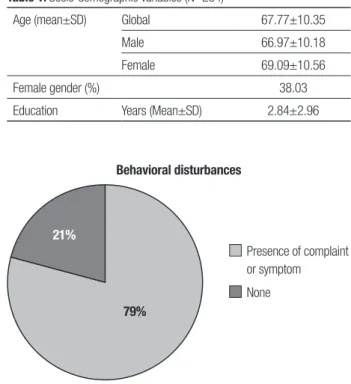
Demographic and clinical variables. he study population exhibited a Male : Female ratio of 1:0.6. All two hundred thirty-four patients had their educational proile docu-mented. A total of 34.62% of subjects were illiterate and
only 4.7% had university level education or higher. So-cio-demographic variables are given in Table 1.
Non-cognitive complaints at presentation. he prevalence of non-cognitive complaints at the admission consultation is shown in Figure 1.
Major clinical findings. At the irst inquiry, the mean time elapsed from the irst complaint to clinical attendance at our memory clinic was 2.69±2.50 years (range 0-20). Two hundred and twenty-nine individuals met the DSM Table 1. Socio-demographic variables (N=234)
Age (mean±SD) Global 67.77±10.35
Male 66.97±10.18
Female 69.09±10.56
Female gender (%) 38.03
Education Years (Mean±SD) 2.84±2.96
Behavioral disturbances
21%
79%
Presence of complaint or symptom
None
Figure 1. NPS complaints at first consultation.
Table 2. Major clinical findings observed at first interview.
Initial MMSE (Mean±SD) 13.22±7.00
CDR 0.5&1 (%) 32.05
CDR 2 & 3 (%) 67.95
Delay in attendance¹ (Mean±SD) 2.69±2.50
DSM-IV criteria for VD (%) 97.86
Vascular cognitive impairment (%) 2.14
Previous stroke (%) 23.93
Psychotropic drug Use (%) 79.91
Cholinesterase inhibitor use (%) 19.66
IV criteria for dementia while only ive patients (2.14%) presented vascular cognitive impairment (VCI). Our se-ries had a greater prevalence of isolated VaD, with 123 cases, versus 111 cases of mixed dementia. Other clini-cal indings are described in Table 2.
Overview of comorbidities and vascular risk factors. All pa-tients had comorbidities documented, where hyper-tension was present in 80.80% and previous stroke in 42.70%, with signiicance diference in gender for the latter condition. his data can be found in Table 3.
Characteristics of behavioral disturbances in dementia patients.
he most common presenting behavioral abnormal-ity was hallucination (23.50%), followed by agitation (22.20%) and depression (17.50%). Figure 2 summa-rizes the psychiatric abnormalities in patients with be-havioral complaints or detected symptoms.
DISCUSSION
he high prevalence and clinical signiicance of psychi-atric disturbances in dementia are now receiving in-creased attention. Most of the series available estimate the prevalence of neuropsychiatric signs and symptoms in dementia of the Alzheimer type, and a broad range of rates from 60% to 90% has been reported.3-5,24-28 In our
series, we observed a prevalence at irst consultation of 79%, similar to the upper limit cited. his may indicate that in our clinics, the vascular burden may contribute in the form of presentation of dementia.
Particularly noteworthy is the extremely high preva-lence of low educational level in our sample. Most se-ries in developed countse-ries have reported an average of 12 years of study or more.3,17-19,25 he review by Kalaria
NJ et al.2 on vascular dementia in developing countries,
showed similar results to those found in our series. he substantial impact of educational level on understand-Table 3. Possible risk factors (%).
Variable
Gender
Males (N=145) Females (N=89) Both (N=234)
Alcohol abuse* 28.97 1.12 18.38
Tobacco abuse* 26.90 5.62 18.80
Diabetes mellitus 22.07 29.21 24.79
Dyslipidemia 6.90 8.99 7.69
Hypertension 79.31 83.15 80.77
Stroke* 53.79 37.08 47.43
Transient ischemic attack 5.52 5.62 5.56
Atrial fibrillation 6.21 7.87 6.84
Ischemic cardiopathy 10.34 14.61 11.97
*Significant difference observed between groups on chi-square (P<0.05).
Psychosis Hallucinations / Delusions
Psychomotor Agitation Depression / Dysphoria
Apathy / Indifference
Irritability / Emotional Lability Euphoria / Disinhibition
Motor Disturbance
Anxiety Nocturnal Behaviour Disorders*
Disturbances*
52,6%
23,5%
22,2%
17,5%
17,5%
10,3%
9,0%
4,2%
2,6%
*Not evaluated.
ing the importance of preventive measures in this situ-ation probably explains the fact that the majority of pa-tients had GDS 2 and 3 at 1st consultation, because most
failed to understand at the time of our study that cogni-tive decline was a consequence of disease and not of ag-ing. However, it can also suggest that nutrition and life-style are important factors for NPS. he low diagnosis of VCI is probably the result of this low education.1,2,19
he decision to use DSM-IV as the sole criteria for diagnosing vascular dementia is owing to the period the patients were followed and the nature of the retrospec-tive analysis. he material was retrieved from the hos-pital database of records for 1996-2005 and data bank imaging, where most of the patients at the time of data collection were either unavailable or had deceased. his time interval was established because it coincides with the initial activities of the memory outpatient clinics of our hospital, and we decided to conduct analysis over a period spanning 10 years. his same reason also explains the absence of application of behavioral scales such as the NPI or Behave-AD. he patients were followed at a general dementia outpatient unit, and in the late nine-ties this scale was not routinely used. We emphasize that our questionnaire, based on the suggestions of Lyket-sos18 and Olin21 for Psychosis and Depression in AD, was
very eicient in characterizing these ancillary pictures. Another interesting point regarding this material concerns the possible risk factors. We observed the same inding as most papers, conirming hypertension as the most prevalent risk factor with no diferences between gender.1,2,19 Diabetes mellitus and dyslipidemia was also
frequent, with no diferences again between sexes. hree major risk factors for vascular dementia with signiicant diferences in gender was previous stroke, tobacco use and alcohol abuse, all of which were more prevalent in males. he correlation of these indings with BPSD was not analyzed here but constitutes an interesting issue for further discussion.
he evidence and description of BPSD in other de-mentia types is notably scarcer than for AD.3, 15-18, 24-27
his fact per se justiies the present work. Vascular de-mentia may have a somewhat lesser tendency than AD or dementia with Lewy bodies to cause hallucinations and delusional symptoms, although not all studies have veriied this.3,15-18 Psychosis was very common in our
series with vascular dementia (52.6%), and only one previous study reports a high prevalence of 46% among hospitalized patients25. We can hypothesize that this
re-sult is a consequence of the majority of our patients suf-fering from moderate-severe dementia. Nevertheless, we emphasize that schooling level in developing
coun-tries contributes substantially to this picture. Selecting a population with VCI and mild dementia remains par-ticularly diicult. herefore, this sample is still valuable because it represents the reality of our memory clinics throughout the country.
here is a dearth of information on depression in dementias other than AD. Some evidence suggests that depression may actually be more common in vascular dementia than in AD. Depression in vascular dementia has been associated with abnormal neurological signs such as extrapyramidal symptoms and grasp relexes, possibly implicating frontal-subcortical circuits. Our inding of 17.5% depressive symptoms does not corrob-orate the results veriied in reviews, but we have identi-ied some studies in which this percentage is similar.3
We may speculate that diferential diagnosis of apathy with this condition was not performed properly at the time, and so this prevalence may be greater. he new criteria for depression in dementia certainly inluence actual results.20-23
An interesting study of neuropsychiatric symptoms across 4 dementia types [Alzheimer’s disease (AD), vascular dementia (VAD), dementia with Lewy bodies (DLB), and Parkinson’s disease dementia], and 2 mixed groups (AD/VAD and AD/DLB) in a sample of 2,963 in-dividuals from the National Alzheimer’s Coordinating Center Uniform Data Set between September 2005 and June 2008, found a signiicantly higher prevalence of BPSD in VaD, and more complex indings in mixed type dementias15. Psychosis was reported in 41% of patients
with Alzheimer’s disease, including delusions in 36% and hallucinations in 18%. he incidence of psychosis increased progressively over the irst 3 years of obser-vation, after which the incidence seemed to plateau. Psychotic symptoms tended to last for several months but became less prominent after 1 year. We do not have data to compare our results with other types of demen-tia in our clinics but the prevalence of psychosis is very high when correlated with AD series and the presence of BPSD was similarly high at the 1st consultation.25-27
In conclusion, our preliminary indings on the prev-alence of BPSD in VaD indicate psychosis as the lead-ing picture. Depression is also found at a lower propor-tion. Low educational level and male gender were also observed. A high prevalence of BPSD was observed at 1st consultation. Possible risk factors found included
REFERENCES
1. Leys D, Hénon H, Mackowiak-Cordoliani MA, Pasquier F. Poststroke
dementia. Lancet Neurology 2005;4:752-759.
2. Kalaria RN, Maestre GE, Arizaga R, et al. Alzheimer’s disease and
vas-cular dementia in developing countries: prevalence, management, and risk factors. Lancet Neurol 2008;7:812-826.
3. Cerejeira J et al. Behavioral and psychological symptoms of dementia.
Front in Neurol 2012;3:1-21
4. Sahathevan R, Brodtmann A, Donnan GA. Dementia, stroke, and
vas-cular risk factors; a review. Int J Stroke 2012;7:61-73.
5. Aggarwal NT, Decarli C. Vascular dementia: emerging trends. Semin
Neurol 2007;27:66-77.
6. Herrera E Jr, Caramelli P, Silveira AS, Nitrini R. Epidemiology survey of
dementia in a community-dwelling Brazilian population. Alzheimer Dis Assoc Disord 2002;16:103-108.
7. Nitrini R. Epidemiologia da doença de Alzheimer no Brasil. Rev Psiq Clin
1999;26:262-267.
8. Vale FA, Miranda SJ. Clinical and demographic features of patients with
dementia attended in a tertiary outpatient clinic. Arq Neuropsiquiatr 2002;60:548-552.
9. Bowler JV. Modern concept of vascular cognitive impairment. Br Med
Bull 2007;83:291-305.
10. Word Health Organization (WHO). The ICD-10 classification of men-tal and behavioral disorders. Diagnostic criteria for research. Geneve, WHO; 1993.
11. American Psychiatric Association. Diagnostic and Statistical Manual of
Mental Disorders (4THed). Washington: APA; 1994.
12. Roman GC, Tatemichi TK, Erkinjuntti T, et al. Vascular dementia: diag-nostic criteria for research studies. Report of the NINDS-AIREN Interna-tional Work Group. Neurology 1993;43:250-260.
13. Chui HC et al. Criteria for diagnosis of ischemic vascular dementia pro-posed by the state of California Alzheimer’s Disease Diagnostic and Treatment Centers. Neurology 1992;42(3 Pt 1):473-80.
14. Hachinski VC, Iliff LD, Zilhka E, et al. Cerebral blood flow in dementia. Arch Neurol 1975;32:632-637.
15. Johnson DK, Watts AS, Chapin BA, Anderson RA, and Burns JM.
Neu-ropsychiatric Profiles in Dementia. Alzheimer Dis Assoc Disord 2011; 25:326-332.
16. Lyketsos CG, Carrillo MC, Ryan JM, et al. Neuropsychiatric symptoms in Alzheimer’s disease. Alzheimer Dement 2011;7:532-539.
17. Engelborghs S, Maertens K, Nagels G, et al. Neuropsychiatric symp-toms of dementia: cross-sectional analysis from a prospective, longitu-dinal Belgian study. Int J Geriatr Psychiatry 2005;20:1028-1037. 18. Lyketsos CG, Steinberg M, Tschanz JT, Norton MC, Steffens DC,
Bre-itner JC. Mental and Behavioral Disturbances in Dementia: Findings From the Cache County Study on Memory in Aging. Am J Psychiatry 2000;157:708-714.
19. Ropacki SA, Jeste DV. Epidemiology and risk factors for psychosis of Alzheimer’s disease: a review of 55 studies. published from 1990 to 2003. Am J Psychiatry 2005;162:2022-2030.
20. Jeste DV, Meeks TW, Kim DS, Zubenko GS. Research Agenda for DSM-V: Diagnostic categories and criteriafor neuropsychiatric syndromes in dementia. J Geriatr Psychiatry Neurol 2006;19:160-171.
21. Olin JT, Katz IR, Meyers BS, Schneider LS, Lebowitz BD. Provisional Diagnostic Criteria for Depression of Alzheimer’s Disease. Am J Geriatr Psychiatry 2002;10:129-141.
22. Brown EL, Raue P, Titler MG. Evidence-Based Guideline Detection of De-pression in Older Adults with Dementia. J Gerontol Nurs 2009;35:11-15. 23. Alexopoulos GS, Borson S, Cuthbert BN, et al. Assesment of Late Life
Depression. Biol Psychiatry 2002;52:164-174.
24. Miyoshi K, Morimura Y. Clinical manifestations of neuropsychiatric. In: Miyoshi K, Morimura Y, Maeda K. Neuropsychiatric Disorders 2010:1-14. 25. Bergh S, Holmen J, Saltvedt I, Tambs K, Selbæk G. Dementia and neu-ropsychiatric symptoms in nursing-home patients in Nord-Trøndelag County. Tidsskr Nor Laegeforen. 2012; 32:1956-1959.
26. Bergh S, Selbaek G. The prevalence and the course of neuropsychiatric symptoms in patients with dementia. Norsk Epidemiologi 2012;22:225-232. 27. Aalten P, de Vugt ME, Jaspers N, Jolles J, Verhey FR. The course of