Element Results in a Loss of Long-Range
Enhancer-Directed Hox Gene Expression in
Drosophila
Margaret C. W. Ho1, Benjamin J. Schiller1, Omar S. Akbari1, Esther Bae2, Robert A. Drewell1*
1Biology Department, Harvey Mudd College, Claremont, California, United States of America,2College of Osteopathic Medicine of the Pacific, Western University of Health Sciences, Pomona, California, United States of America
Abstract
There are many examples within gene complexes of transcriptional enhancers interacting with only a subset of target promoters. A number of molecular mechanisms including promoter competition, insulators and chromatin looping are thought to play a role in regulating these interactions. At the Drosophila bithorax complex (BX-C), the IAB5 enhancer specifically drives gene expression only from theAbdominal-B(Abd-B) promoter, even though the enhancer and promoter are 55 kb apart and are separated by at least three insulators. In previous studies, we discovered that a 255 bpcis-regulatory module, the promoter tethering element (PTE), located 59of theAbd-Btranscriptional start site is able to tether IAB5 to the
Abd-Bpromoter in transgenic embryo assays. In this study we examine the functional role of the PTE at the endogenous BX-C using transposon-mediated mutagenesis. Disruption of the PTE byP element insertion results in a loss of enhancer-directedAbd-Bexpression during embryonic development and a homeotic transformation of abdominal segments. A partial deletion of the PTE and neighboring upstream genomic sequences by imprecise excision of thePelement also results in a similar loss of Abd-Bexpression in embryos. These results demonstrate that the PTE is an essential component of the regulatory network at the BX-C and is requiredin vivoto mediate specific long-range enhancer-promoter interactions.
Citation:Ho MCW, Schiller BJ, Akbari OS, Bae E, Drewell RA (2011) Disruption of theAbdominal-BPromoter Tethering Element Results in a Loss of Long-Range Enhancer-Directed Hox Gene Expression inDrosophila. PLoS ONE 6(1): e16283. doi:10.1371/journal.pone.0016283
Editor:Johannes Jaeger, Centre for Genomic Regulation (CRG), Universitat Pompeu Fabra, Spain
ReceivedAugust 18, 2010;AcceptedDecember 21, 2010;PublishedJanuary 21, 2011
Copyright:ß2011 Ho et al. This is an open-access article distributed under the terms of the Creative Commons Attribution License, which permits unrestricted use, distribution, and reproduction in any medium, provided the original author and source are credited.
Funding:The research in this paper was supported by funding to R.A.D. from the National Institutes of Health (NIH-HD54977) and the National Science Foundation (IOS-0845103) and a Howard Hughes Medical Institute Undergraduate Science Education Program grant (520051213) to the Biology department at Harvey Mudd College. M.C.W.H. received support from the Merck-American Association for the Advancement of Science (AAAS) Undergraduate Science Research Program. The funders had no role in study design, data collection and analysis, decision to publish, or preparation of the manuscript.
Competing Interests:The authors have declared that no competing interests exist.
* E-mail: [email protected]
Introduction
To ensure a high fidelity of gene expression patterns in embryos a very strict functional requirement exists for the interaction ofcis -regulatory modules (CRMs) in the genome of animals during development [1,2,3,4]. Embryonic transcriptional enhancers, which direct specific spatio-temporal patterns of gene expression in the embryo, are not permitted to promiscuously activate transcription from non-target promoters. Chromatin structural organization, insulators and promoter competition are thought to play a role in regulating enhancer-promoter interactions ([5,6,7,8,9], for recent reviews see [10,11,12]). At the Drosophila
bithorax complex (BX-C), an extensive network of CRMs located in over 300 kb of infraabdominal (iab) non-genic sequence is responsible for directing embryonic expression of just three homeotic genes; Ultrabithorax (Ubx), abdominal-A (abd-A) and
Abdominal-B(Abd-B) (Fig. 1) [13,14]. These three homeotic genes are critical for establishing cellular identities in the presumptive thoracic and abdominal segments during development [2,15].
We recently identified a 255 bp promoter tethering element (PTE) located 59 of the Abd-B transcriptional start site that is responsible for specifically recruiting the IAB5 enhancer from the BX-C to theAbd-Bpromoter in competition assays on transgenes [16]. Furthermore, the PTE also demonstrates anti-insulator activity
by enabling the IAB5 enhancer to bypass an insulator from the BX-C to activate a target promoter on transgenes [17]. The ability of the PTE to facilitate specific enhancer-promoter interactions may explain how certain IAB enhancers, such as IAB5, IAB6, IAB7a and IAB7b [8,18,19], are able to bypass theFrontabdominal (Fab) insulators Fab-6, Fab-7 and Fab-8 [19,20,21,22] and direct transcription from the Abd-B morphogenetic (m) promoter at the endogenous BX-C (Fig. 1). As such, the PTE may be part of the complex regulatory network of CRMs, including the insulators, Promoter Targeting Sequences (PTSs) [23,24] and additional tethering sequences located 59of theAbd-Bgene [25,26], responsible for mediating enhancer-promoter interactions in the BX-C. In contrast to the PTSs, which are located adjacent to the Fab-7 and Fab-8 insulators, the PTE is adjacent to theAbd-Bpromoter (Fig. 1). The PTSs have been implicated in mediating insulator bypass for the IAB enhancers on transgenic constructs [23,24]. However, deletion of either of the characterized PTSs from the endogenous BX-C did not result in a significant phenotype [8,18,19], suggesting that there might be other sequences capable of mediating the long-range enhancer-promoter specificity at the BX-C.
In this study, we demonstrate the functional importance of the PTE at the endogenous BX-C. Disruption of the PTE by a P
element insertionin vivoresults in a loss of IAB enhancer-directed
when placed in hemizygosity with an Abd-B null allele. Further molecular analysis of a mutant generated by imprecise excision of the P element reveals that a partial deletion of the PTE and neighboring upstream genomic sequences results in a similar loss of enhancer-directedAbd-Bexpression. These results demonstrate the critical functional role that the PTE plays in regulating promoter-enhancer interactions at the endogenousDrosophilaBX-C.
Results
Insertions at the PTE disruptAbd-Bexpression and result in homeotic transformation
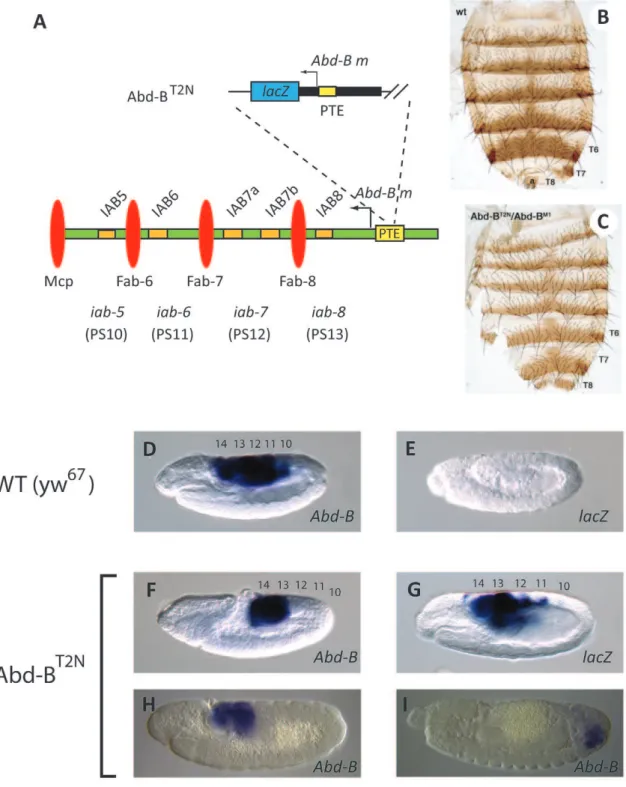
Genetic studies were carried out to determine whether the activity of the PTE is important forin vivoIAB enhancer–Abd-Binteractions in the context of the BX-C. The previously identifiedAbd-BT2Nmutation [27] is derived from aPelement insertion in the endogenous PTE sequence (2241 bp relative theAbd-Btranscription start site). The originalPelement insertion line (Abd-BLac1
) contains a 5.6 kbAbd-B
promoter region which includes 4.3 kb of 59sequence harboring the PTE sequence, fused to alacZreporter gene. This Pelement also contains theFab-8insulator element, an IAB8 enhancer element and therosygene. In contrast, the derivedAbd-BT2Nline contains only a truncatedAbd-Bpromoter-lacZreporter gene, generated by imprecise excision of the 59region of thePelement (Fig. 2a). In theAbd-BT2N
line thePelement is inserted within the endogenous 255 bp PTE sequence, while leaving the entireAbd-B morphogenetic(m) transcription unit intact [27]. TheAbd-BT2Nmutant is described as a Class IAbd-B
mutant, capable of complementing mutations in theAbd-B regulatory(r) transcript, but affecting Abd-B m transcript expression [27]. In hemizygosis with theAbd-BM1null allele, theAbd-BT2Ninsertion line shows a phenotypic transformation of abdominal segments 5–8 towards a more anterior abdominal segment identity. This is seen most clearly in the complete transformation of the seventh abdominal tergite to a more anterior identity in the Abd-BT2Ninsertion line (Fig. 2c) when compared to wild-type (WT) (Fig. 2b). The homeotic transformation is easiest to see in the cuticles of adult females due to their lighter abdominal pigmentation when compared to males (Fig. 2b and c), although it is apparent in both sexes. This phenotype is characteristic ofAbd-B mmutations [27,28], suggesting that theP
element insertion into the PTE is disrupting expression from the adjacent Abd-B m promoter and is consistent with a reduction in IAB5-7 enhancer-Abd-Binteractions.
In WTD. melanogaster embryos, the expression pattern of the
Abd-B mtranscript extends from parasegment (PS) 10–13 during the germ-band elongation stage of development, while the r
transcript is predominantly restricted to PS14 at this stage [29,30].
In situhybridization with an RNA probe that detects both them
andrtranscripts in germ-band elongation stage embryos generated from crosses of heterozygous balanced Abd-BT2N
adults (Fig. 2f) [27], demonstrates a loss of Abd-B expression in PS10–12 (presumptive abdominal segments 5–7) when compared with expression in WT embryos (Fig. 2d). These results indicate that the transposon insertion in the PTE impairs the ability of the IAB5–7 enhancers in the BX-C to drive expression from the endogenous
Abd-B mpromoter. The detectable expression ofAbd-Bin PS13 in
Abd-BT2Nembryos raises the question of why there is a homeotic transformation of the eighth abdominal segment in hemizygous
Abd-BT2N/Abd-BM1adults. While this phenotype is significant, it is only a partial transformation of A8 towards a more anterior identity (Fig. 2c), suggesting that there is not a complete loss of
Abd-Bpatterning function. It is possible that there may be subtle modulation of the level ofAbd-Bgene expression in PS13 which, while responsible for the phenotypic transformation, is not readily detectable using RNAin situ hybridization. The expression ofAbd-B
persists in PS13 and 14 at least through stage 13 of development (Fig. 2h and i). However, it is also possible that transcription of
Abd-Bin late embryonic or larval stages may be modulated from theAbd-BT2Nallele.
Knowing that expression from the endogenous Abd-B m
promoter was perturbed in Abd-BT2N mutants, we examined whether the enhancers from the BX-C were re-directed to the intact ectopicAbd-B mpromoter (containing the PTE sequence), which drives lacZ, on the P element insertion. In Abd-BT2N
embryos,lacZexpression was detected in a pattern extending from PS10 to 14 (Fig. 2g). ThelacZexpression appears strongest in PS13 (presumptive abdominal segment 8) and weaker in PS10 (Fig. 2g), presumably due to the proximity of the endogenous IAB8 regulatory sequences to the target promoter, as previously observed [27]. This pattern oflacZexpression is consistent with the Abd-B expression pattern detected in wild-type embryos (Fig. 2d) and indicates that the IAB enhancers from the endogenous BX-C are now being re-directed to the intact ectopic
Abd-Bpromoter (containing the PTE) on the Pelement to drive expression oflacZinAbd-BT2Nembryos.
Deletion of PTE and neighboring upstream sequences results in a loss of enhancer-directedAbd-Btranscription
In theAbd-BT2Nmutant endogenous PTE function is disrupted byPelement insertion. In order to address the loss-of-functional activity of the PTE more directly we generated a mutant line in which the 59 portion of the PTE and neighboring upstream genomic sequences are deleted from the endogenous BX-C locus
Figure 1. A network of interactingcis-regulatory modules control embryonic expression ofabdominal-AandAbdominal-Bin the
Drosophilabithorax complex.The abd-Aand Abd-B morphogenetic(m) and regulatory(r) transcripts are indicated by leftward arrows. The regulatory regionsiab-2,iab-3andiab-4(blue) interact withabd-A. Theiab-5,iab-6,iab-7andiab-8regions (green) interact withAbd-B m. Eachiab region is thought to contain at least one characterized enhancer (orange rectangles) capable of directing Hox gene expression in a specific embryonic parasegments (PS). The positions of the characterized Fab-6, Fab-7, Fab-8 and Mcp insulators (red ellipses), promoter targeting sequence (PTS) modules (white rectangles), promoter tethering element (PTE) (yellow rectangle) and polycomb response elements (PREs) (pink rectangles) are indicated. Numbers above line refer to kilobase positions in DNA sequence accession number: DM31961.
doi:10.1371/journal.pone.0016283.g001
Figure 2.P element insertion into the endogenous PTE results in homeotic transformation and loss ofAbd-B expression.(A) Schematic diagram of theAbd-BT2NP
element line, showing the insertion site2241 bp 59of theAbd-B mtranscription start site in the endogenous PTE sequence. The same symbols and color scheme as in Fig. 1 indicate the neighboringcis-regulatory modules. (B) Dorsal cuticles were prepared from adult females. A normal abdominal pigmentation pattern is observed in wild-type (WT) adults. (C) InAbd-BT2N
/Abd-BM1
hemizygotes the seventh abdominal tergite (T7) is fully developed, indicating a transformation toward a more anterior abdominal segment identity. The eighth abdominal tergite (T8) also shows a partial transformation toward a more anterior identity.Abd-BM1
is a Class III null allele for both theAbd-B mandrtranscripts [15,27].Abd-Bgene expression pattern in wild-type (WT) (D) andAbd-BT2N(F) germ-band elongation stage 9 embryos. The staining patterns for the Abd-BT2N
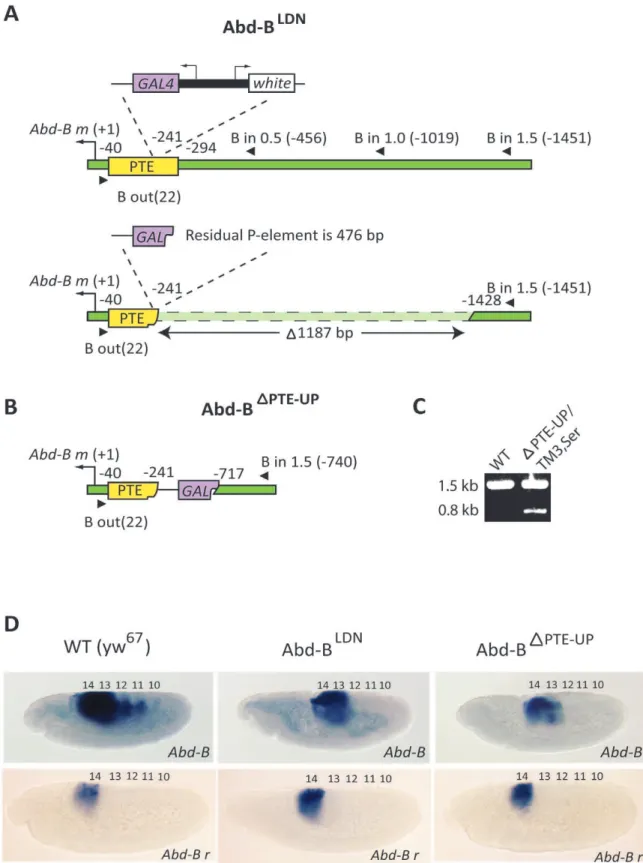
(Fig. 3). This was accomplished by performing an imprecise excision of thePelement insertion from theAbd-BLDNmutant (Fig. S1). The Abd-BLDN
mutant was generated by a P element replacement strategy and carries an insertion containing the
GAL4 and white genes in the identical location within the PTE (2241 bp relative to theAbd-Btranscription start site) as the Abd-BT2Nline, but does not contain an ectopic copy of the PTE (Fig. 3a) [31]. In theAbd-BLDNline, both thewhiteandGAL4genes are only expressed clearly in PS13 and very weakly in PS14 in embryos (data not shown), indicating that the distantly located IAB5–7 enhancers in the BX-C are not activating transcription of either reporter gene. The Abd-BLDN line was utilized to generate an imprecise excision mutant as it carries the readily detectablewhite
reporter gene (Fig. 3a). As a result, adult flies in whichPelement excision had occurred were easily identified by loss of red eye color (Fig. S1). PCR-based screening with primers from the proximal
Abd-B mpromoter region and from 0.5 kb, 1 kb and 1.5 kb 59of the Abd-B transcription start site was used to identify a 1.2 kb deletion in the Abd-BDPTE-UP allele (Fig. 3a–c). The molecular nature of the deletion was characterized by sequencing and found to have removed 53 bp of the PTE sequence 59of the originalP
element insertion site, as well as 1134 bp of endogenous genomic sequence 59 of the defined PTE. In this Abd-BDPTE-UPallele, a portion of the GAL4 gene from the originalP element remains, along with 202 bp of the 39PTE sequence (Fig. 3b).
Based on theAbd-Bexpression observed in theAbd-BT2Ninsertion line, we hypothesized that the expression pattern of the endogenous
Abd-Bgene from theAbd-BDPTE-UPallele may also be perturbed.In situhybridization with an RNA probe that can detect both themand
rtranscripts shows thatAbd-Bgene expression is lost specifically in PS10-12, but not in PS13–14 in germ-band elongation stage embryos generated from crosses of heterozygous balanced Abd-BDPTE-UPadults (Fig. 3d). Statistical analysis demonstrates that the number of embryos demonstrating this restrictedAbd-Bexpression pattern from both theAbd-BDPTE-UP
andAbd-BLDN
alleles is highly significant (p,0.01) when compared to the number of embryos with the WTAbd-Bexpression pattern. This restricted pattern ofAbd-B
expression persists at least through stage 13 of development (data not shown). One possible explanation for the loss of Abd-B
expression in PS10–12 is that the genomic region deleted in the
Abd-BDPTE-UPallele harbors a CRM capable of driving transcription in these specific parasegments. However, when tested in a transgenic reporter gene assay the 1.2 kb region does not exhibit embryonic enhancer activity (data not shown).
To confirm that mutations in the PTE only affect expression from theAbd-B mpromoter, but not theAbd-B rpromoter,in situ
hybridization with a RNA probe (BPP, [32]) that specifically detects only the Abd-B r transcript was performed on embryos collected from WT, Abd-BLDN and Abd-BDPTE-UPbalanced lines. The expression pattern of theAbd-B rtranscript was confirmed to be identical in the WT, Abd-BLDN and Abd-BDPTE-UP embryos, appearing only in PS14 of germ-band elongation stage embryos (Fig. 3d). These observations are consistent with the known pattern of expression from theAbd-B rpromoter [29] and confirm that the disruption to the PTE in these mutants only affects enhancer-mediated transcription from theAbd-B mpromoter (see discussion for more detail).
Discussion
Parasegment-specific interactions between the IAB enhancers andAbd-B promoter in the BX-C
The absence ofAbd-Bexpression in PS10–12 ofAbd-BDPTE-UP
germ-band elongation stage embryos is consistent with a loss of
IAB-enhancer directed expression from the Abd-B m promoter [29]. This suggests that deletion of theAbd-Bpromoter tethering sequence (PTE) and the neighboring 1.1 kb 59 sequence in the
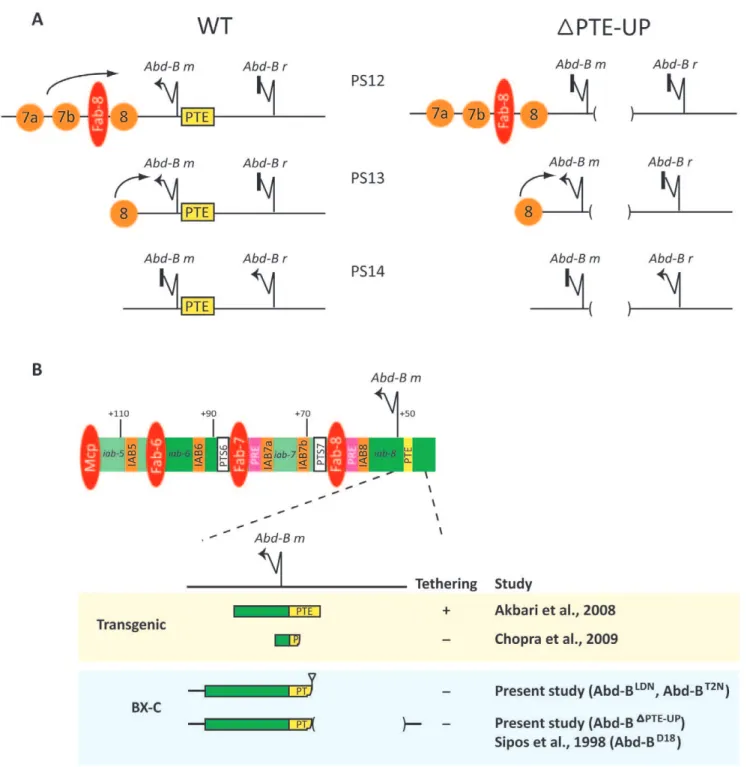
Abd-BDPTE-UP line leads to a disruption of the long-range interactions between theAbd-B m promoter and enhancers from theiab-5, iab-6andiab-7regions in PS10, 11 and 12, respectively. For example, in PS12 of WT embryos the tethering sequences upstream of theAbd-B mpromoter enable the IAB7a and IAB7b embryonic enhancers to bypass the Fab-8 chromatin insulator and drive expression from the Abd-B m promoter (Fig. 4a). In Abd-BDPTE-UP mutant embryos, removal of the tethering sequences appears to disrupt the ability of the IAB7a and IAB7b enhancers to activate theAbd-B mpromoter, resulting in an absence ofAbd-B
expression in PS12 (Fig. 4a and 3d). Similarly, the IAB6 and IAB5 enhancers are unable to bypass intervening insulators to activate
Abd-B mexpression in PS11 and PS10 inAbd-BDPTE-UPembryos. In contrast to PS10–12, the specific enhancer-promoter interac-tions at the BX-C in PS13 appear to be intact inAbd-BDPTE-UP
embryos. In WT embryos the IAB8 embryonic enhancer, located 39of theAbd-Bgene, is solely responsible for directing expression from theAbd-B mpromoter in PS13 [33]. InAbd-BDPTE-UPmutant embryos the Abd-B m transcript remains strongly expressed in PS13 (Fig. 3d). This result indicates that the interaction between the IAB8 enhancer and theAbd-B m promoter may not require tethering activity, likely due to the physical proximity of the enhancer to the promoter and lack of an intervening chromatin insulator (Fig. 4a). However, given the partial transformation phenotype observed for PS13 in flies carrying a disruption of the PTE sequences (as in the case of theAbd-BT2N allele, Fig. 2c) it remains possible that loss of PTE activity may be responsible for subtle effects on transcription ofAbd-Bin PS13. In PS14, Abd-B
expression in germ-band elongation stage embryos is not driven by the 39 IAB enhancers, as it is initiated from thertranscriptional start site located 59 of the PTE sequence (Fig. 1) [29,34]. Consequently, expression of the r transcript in PS14 is not perturbed by the loss of tethering activity inAbd-BDPTE-UPmutant embryos (Fig. 4a and 3d).
One possible outcome of the disruption of IAB enhancer interactions with theAbd-B mpromoter at theAbd-BDPTE-UPallele may be the re-direction of those enhancers to the neighboring abd-Apromoter in the BX-C. However, no change in the expression pattern of abd-A (extending from PS7 to PS13 in germ-band elongation stage embryos [35] could be detected from the Abd-BDPTE-UP
orAbd-BLDN
alleles (data not shown).
Functional dissection of critical sequences at the PTE
The functional activity of the PTE at the endogenous BX-C prompts the question of exactly what sequences associated with the PTE are necessary to confer promoter-enhancer tethering. Our earlier studies demonstrated that a 255 bp region located between
240 and 2294 bp 59 of the Abd-B m transcription start site is sufficient to tether the IAB5 enhancer to an ectopic promoter in a transgene competition assay (Fig. 4b) [16]. In contrast, an approximately 200 bp region extending from 2100 to +100 relative to theAbd-B mtranscriptional start site is not sufficient to mediate promoter-enhancer tethering when tested in similar transgenic assays [36]. In agreement with this observation, the 202 bp of sequence from the 39end of the PTE remaining at the endogenous BX-C in theAbd-BDPTE-UPallele is also not sufficient to mediate tethering of the IAB enhancers to the Abd-B m
promoter (Fig. 4b). A previous study by Sipos and colleagues, utilizing anAbd-Bmutant allele harboring a small deletion at the
Abd-B mpromoter region and a deletion at theiab-7region carried on opposite chromosomes resulted inAbd-Btranscriptional activity
Figure 3. Deletion of the PTE and upstream sequences at the endogenous BX-C disruptsAbd-Bexpression.(A) TheAbd-BLDNmutant features aPelement inserted within the PTE (yellow box) (2241 bp relative to theAbd-Btranscription start site (black arrow)). ThePelement contains GAL4(purple box) andwhite(white box) reporter genes. PCR primers (black triangles) designed against theAbd-Bpromoter region and 0.5 kb, 1 kb and 1.5 kb upstream of theAbd-B mtranscription start site were used to characterize the approximately 1.2 kb deletion (dashed box) in the Abd-BDPTE-UPmutant generated by imprecise excision of thePelement. (B) The resultingAbd-BDPTE-UPdeletion removes 53 bp of the PTE sequence 59of the original insertion site and an additional 1134 bp of endogenous sequence 59of the PTE. A 476 bp portion of theGAL4coding sequence (purple polygon) from the originalPelement remains, as well as 202 bp of the 39PTE sequence (yellow polygon). (C) Primers designed against theAbd-B promoter region and 1.5 kb upstream of theAbd-Btranscription start site were used to genotype adult flies carrying the deletion allele by amplifying the 1.5 kb wild-type (WT) band and the 0.8 kbAbd-BDPTE-UP
band in balancedAbd-BDPTE-UP
[25]. This indicates that atransinteraction can occur between the
iab-7regulatory region and the remainingAbd-Bpromoter region across chromosomes. The same genetic complementation test using the iab-7 mutant allele and the Abd-BD18 deletion allele (which removes approximately 8 kb of sequence 59of theAbd-B m
transcription start site) on opposite chromosomes showes an increase in trans-mediated Abd-B activity [25]. These results indicate that additional sequences located 59of the 255 bp PTE may also contribute to tethering activity. A functional role for the sequences in the 59 end of the PTE and neighboring upstream genomic regions is supported by the loss of enhancer-directed Abd-B mtranscript expression at theAbd-BDPTE-UPallele after deletion of the 59 53 bp region in the PTE and 1134 bp of sequence located 59 of the defined PTE (Fig. 4b). The loss of Abd-B
expression observed in theAbd-BDPTE-UP
mutant is consistent with the previously reported molecular phenotype ofAbd-B mmutants [27] and confirms the role of the PTE and associated 59sequences in mediating specific IAB enhancer-directed expression of the Abd-B mtranscript.
Promoter tethering as a general regulatory mechanism
Additional examples of genetic complexes in which long-range interactions between CRMs have been characterized include the human beta-globin locus [37], theDrosophila Antennapediacomplex [38,39] and mouse HoxDcomplex [3]. In the large genomes of vertebrates, where extensive global control regions have been identified, promoter-enhancer tethering is emerging as a critical general mechanism for regulation of gene expression [3,37]. More recently, in Drosophila, other PTE sequences have been located in theeven-skipped[40] andengrailed[41] loci that mediate enhancer-promoter communication. The long-range CRM communication in these critical developmental genes has been shown to be dynamic, changing through the course of development in some cases [40] and perhaps even capable of mediating the evolution of novel patterns of gene expression in different insect species [42].
Our current model for the molecular function of the PTE in theDrosophilaBX-C is that regulatory interactions that enable the PTE to tether the IAB enhancers to the Abd-B m promoter in specific parasegments during embryonic development may be mediated by chromatin looping [17]. A number of studies have indicated that chromatin looping may facilitate promoter-enhancer tethering through the action of different transcription factors. For example, the sea urchin GCF1 protein is able to form higher order multimeric loop structures when added to target site oligonucleotides in vitro [43]. The abundant mammalian transcription factor Sp1 has also been shown to form multimers and to strongly facilitate in vivo activation of a promoter by distantly located enhancer CRMs [44,45]. More recently, molecular studies have used high-magnification confocal imaging and 2D RNA fluorescencein situhybridization (FISH) to visualize specific physical associations between distantly located cis -regulatory sequences in the nucleus at the human beta-globin locus [37].
Direct evidence for chromatin looping at theDrosophilaBX-C comes from a study examining physical chromosomal interactions using probes designed against the IAB5 and IAB8 enhancers and a promoter-proximal region upstream of theAbd-B mtranscription
unit, containing the PTE sequence [46]. In a portion of nuclei taken from the eighth abdominal segment region of a germ-band elongation stage embryo, FISH signals from theAbd-B mpromoter region co-localize with signals from the distal IAB5 enhancer, while the more proximal IAB8 enhancer remains distantly located and disassociated [46]. This result suggests that physical associations may indeed occur between the IAB5 enhancer and the 59 upstream region of the Abd-B m promoter to facilitate expression of the Abd-B m transcript. These data support our model that tethering mediates the interaction of long-range enhancers (such as IAB5) to theAbd-B mpromoter, but that it is not required for the functional interaction of the 39proximal IAB8 enhancer to theAbd-B mpromoter.
In our current model the PTE may bind sequence-specific protein factors which interact with complementary factors bound near the IAB enhancers, allowing a molecular bridge or loop to form between theAbd-B mpromoter and the IAB enhancers [17]. This model does not exclude the possibility that additional molecular interactions between known regulatory regions in the BX-C, including insulator and PTS sequences, may also mediate enhancer-promoter communication. In future studies other techniques, such as three-dimensional chromatin conformation capture (3C) [47] andDammethylase identification [48], will be well suited to more fully elucidate the nature of such interactions and the molecular mechanisms of PTE function. In addition, molecular dissection of the functional sequences within the PTE and 59associated sequences in transgenic tethering assays and the biochemical identification of putative sequence-specific DNA-binding transfactors that may mediate the PTE activity will be essential.
Materials and Methods
Genetic insertion lines
The Abd-BT2N and Abd-BLDN P element fly lines inserted
2241 bp 59of theAbd-Bm transcription start site were provided by Ernesto Sanchez-Herrero [27,31].
Pelement imprecise excision from theAbd-BLDNline
Abd-BLDN flies were crossed with a transposase expressing line (D2–3) carrying a Stubble (Sb) dominant phenotypic marker (BL Stock 1798) in Cross 1 (Fig. S1). Cross 1 male progeny were screened for Sb (marking the presence ofD2–3 transposase) and variegated red eye color (rather than white eye color). The selected Cross 1 males were crossed with female with D, a dominant marker, and a TM3 balancer chromosome carrying Serrate (Ser), a dominant phenotypic marker (BL Stock 7198) in Cross 2 (Fig. S1). The male Cross 2 progeny were screened for Ser (marking the presence of the TM3 balancer), white eyes (indicating excision of theAbd-B-GAL4LDNPelement construct), and the absence of Sb (indicating loss of theD2–3 transposase) as well as against D. The selected Cross 2 male flies were crossed with BL Stock 7198 flies again in Cross 3 (Fig. S1). After a few days, the male parents were recovered from Cross 3 vials. PCR amplification of the Abd-B region with primers located 0.5 kb, 1 kb, and 1.5 kb upstream of theAbd-Btranscription start site on the genomic DNA prepared from approximately 100 selected Cross 2 male flies was used to detect deletions in the PTE sequence.
with an RNA probe that can detect both theAbd-B mandrtranscripts (Abd-B) shows WT expression in parasegments (PS) 10–14 in yw67embryos, while expression is found only in PS13–14 in a portion of embryos collected from crosses of balancedAbd-BDPTE-UPandAbd-BLDNlines.In situ hybridization with a probe specifically designed against theAbd-B rtranscript (Abd-B r) detects identical patterns of expression in PS14 of germ-band elongation stage embryos collected from WT, mutantAbd-BLDNandAbd-BDPTE-UPbalanced lines.
doi:10.1371/journal.pone.0016283.g003
Figure 4. PTE sequence is required for specific promoter-enhancer tethering at theAbd-Bgene. (A)Abd-Btranscription is disrupted in PTE mutants.In wild-type (WT) germ-band elongation stage embryos expression from theAbd-B mpromoter is observed in parasegments (PS) 10–13 and from theAbd-B rpromoter in PS14 [29]. The loss ofAbd-Bexpression in PS10–12 inAbd-BDPTE-UP
(DPTE-UP) embryos is consistent with a disruption of expression from theAbd-B mpromoter. In PS12 of WT embryos, the tethering sequences upstream of theAbd-B mpromoter enable the IAB7a and IAB7b enhancers (7a and 7b, orange circles) to act over the long-range of intervening sequence and bypass the Fab-8 chromatin insulator (red ellipse) and drive expression from theAbd-B mpromoter. In PS12 ofAbd-BDPTE-UP
mutants the removal of the tethering sequences disrupts the ability of the IAB7 enhancers to activate theAbd-B mpromoter across the intervening Fab-8 insulator. A similar disruption of promoter-enhancer tethering activity atAbd-BDPTE-UP
is also seen in PS11 (IAB6 enhancer) and PS10 (IAB5 enhancer). In PS13 of both WT andAbd-BDPTE-UP
embryos, IAB8 (8, orange circle) is able, due to its physical proximity and lack of intervening chromatin insulator, to drive expression from theAbd-B mpromoter. In PS14 of both WT andAbd-BDPTE-UP
embryos,Abd-B ris transcribed independently of IAB embryonic enhancer activity and represses transcription from theAbd-B mpromoter [28].(B) Functional dissection of criticalAbd-Btethering sequences.Schematic diagram of the regulatory region of the Abdominal-Bgene shows enhancers (orange boxes) in the infraabdominal regionsiab-5toiab-8(green) that are responsible for activating expression of theAbd-Bgene in abdominal PS 10–13 during embryogenesis. Color scheme for other types ofcis-regulatory modules is same as in Figure 1. Transgenic studies (highlighted in yellow box) show that a 1.4 kb of sequence from+1228 to2294, (including the 255 bp PTE sequence located 40 bp 59of theAbd-B mtranscription start site), is sufficient for promoter-enhancer tethering [16]. Additional transgenic studies have shown that an approximately 200 bp sequence spanning theAbd-B mtranscription start site (+100 to2100) is not sufficient for tethering activity [36].Pelement insertion at the endogenous BX-C (as in theAbd-BLDN
orAbd-BT2N
Primers used:
Abd-B promoter out: 59-CGA CAA CAT ATC CAC ATC GCT-39
Abd-B promoter 0.5 kb in: 59-AAG TGC GAT ACC ATC TTT-39
Abd-Bpromoter 1 kb in: 59-TGC CTT TGG AAG TGA GAC AA-39
Abd-B promoter 1.5 kb in: 59-GGA AAT AGA TTG CGG CAG TTA A-39
The PCR products were ligated into pGEM-T Easy vector (Promega) and sequenced using T3 and SP6 sequencing primers. Progeny from Cross 3 vials seeded with a male parent exhibiting a disruption of the PTE were screened against D and for Ser and self-crossed to generate a balanced mutant line.
In situanalysis ofabd-AandAbd-B expression
In situhybridization probes to detect transcription ofAbd-Band
abd-Awere PCR-amplified usingD. melanogaster yw67adult genomic DNA as a template. The previously described DNA sequences for the Bexon region (exon 8 of theD. melanogaster Abd-Bgene), BPP (specific to the r transcript) and Aexon region [32] were PCR amplified and cloned into pGEMT-Easy (Promega). PCR primer sequences were as follows:
Bexon s: 59-GAACAAGAAGAACTCACAGC-39; Bexon as: 59-TAGGCATAGGTGTAGGTGTAGG-39; BPP s: 59-TATTATTCGTCTCCAGTCGC-39; BPP as: 59-CTCAGATTGATGGTGGTGGTGG-39; Aexon s: 59- CACCAACAGCAGCAACAACAGC-39(173566); Aexon as: 59- CATTGTATTCAAGCGTTGGC-39(174756); Antisense RNA probes (relative to the direction ofAbd-Band
abd-A transcription) were prepared using a digoxigenin (DIG) RNA-labeling kit (Roche, Gipf-Oberfrick, Switzerland). Embryos from each of the wild-typeD. melanogaster,and mutant Abd-BT2N,
Abd-BLDN and Abd-BDPTE-UP lines were collected, fixed and hybridized with the appropriate probes as previously described [32]. Anti-sense Bexon RNA probes enable the detection of both themandrtranscript and anti-sense BPP RNA probes enable the specific detection of only theAbd-B rtranscript [32].
Supporting Information
Figure S1 Crosses to generate Abd-BDPTE-UPmutant.(A) Schematic diagram of the Abd-BLDN P element insertion line,
showing the insertion site2241 bp 59of theAbd-B mtranscription start site in the endogenous PTE sequence. The P element insertion in theAbd-BLDNline containsGAL4(purple box) andwhite
(white box) reporter genes. The same symbols and color scheme as shown in Fig. 1 are used to show thecis-regulatory modules. (B)
Abd-BLDNflies were crossed with a transposase expressing line (D2– 3) carrying Stubble (Sb) (BL Stock 1798) (Cross 1). Cross 1 male progeny were screened for Sb and variegated red eye color (rather than white eye color). (C) The selected Cross 1 males were crossed with a female with D, a dominant marker, and a TM3 balancer chromosome carrying Serrate (Ser), a dominant phenotypic marker (BL Stock 7198) (Cross 2). Cross 2 male progeny were screened for Ser, white eyes (indicating excision of theGAL4 LDN P element construct), and the absence of Sb and D. (D) The selected Cross 2 male flies were crossed with BL Stock 7198 flies again (Cross 3). After a few days, the male parents were recovered from the Cross 3 vials. PCR amplification of theAbd-Bpromoter region with primers (black triangles) located 0.5 kb, 1 kb, and 1.5 kb upstream of the Abd-B transcription start site on the genomic DNA prepared from these selected Cross 2 male flies was used to detect deletions in the PTE sequence. Progeny originating from Cross 3 vials seeded with a male parent exhibiting a disruption of the PTE (DPTE) were recovered and screened against D and for Ser. (E) These selected Cross 3 progeny were then self-crossed to generate theAbd-BDPTE-UP/TM3,Ser balanced line.
(TIF)
Acknowledgments
The authors would like to thank Ernesto Sanchez-Herrero for providing theAbd-BT2Nand Abd-BLDNlines. We would also like to thank Karl G. Johnson and Kathleen M. Beckingham for their helpful advice on the imprecisePelement excision.
Author Contributions
Conceived and designed the experiments: MCWH BJS RAD. Performed the experiments: MCWH BJS OSA EB RAD. Analyzed the data: MCWH BJS OAS EB RAD. Contributed reagents/materials/analysis tools: MCWH BJS RAD. Wrote the paper: MCWH BJS RAD.
References
1. Caplan AI, Ordahl CP (1978) Irreversible gene repression model for control of development. Science 201: 120–130.
2. Lewis EB (1978) A gene complex controlling segmentation in Drosophila. Nature 276: 565–570.
3. Spitz F, Gonzalez F, Duboule D (2003) A Global Control Region Defines a Chromosomal Regulatory Landscape Containing the HoxD Cluster. Cell 113: 405–417.
4. Osborne CS, Chakalova L, Brown KE, Carter D, Horton A, et al. (2004) Active genes dynamically colocalize to shared sites of ongoing transcription. Nat Genet 36: 1065–1071.
5. Dorsett D (1999) Distant liaisons: long-range enhancer-promoter interactions in Drosophila. Curr Opin Genet Dev 9: 505–514.
6. Kellum R, Elgin SC (1998) Chromatin boundaries: punctuating the genome. Curr Biol 8: R521–524.
7. Mihaly J, Hogga I, Barges S, Galloni M, Mishra RK, et al. (1998) Chromatin domain boundaries in the Bithorax complex. Cell Mol Life Sci 54: 60–70.
8. Ohtsuki S, Levine M, Cai HN (1998) Different core promoters possess distinct regulatory activities in the Drosophila embryo. Genes & Development 12: 547–556.
9. Bell AC, Felsenfeld G (2000) Methylation of a CTCF-dependent boundary controls imprinted expression of the Igf2 gene. Nature 405: 482–485. 10. Celniker S, Drewell RA (2007) Chromatin looping mediates boundary element
promoter interactions. BioEssays 29: 7–10.
11. Bushey AM, Dorman ER, Corces VG (2008) Chromatin insulators: regulatory mechanisms and epigenetic inheritance. Molecular Cell 10: 1–9.
12. Wallace JA, Felsenfeld G (2007) We gather together: insulators and genome organization. Curr Opin Genet Dev 17: 400–407.
13. Bender W, Akam M, Karch F, Beachy PA, Peifer M, et al. (1983) Molecular Genetics of the Bithorax Complex in Drosophila melanogaster. Science 221: 23–29. 14. Martin CH, Mayeda CA, Davis CA, Ericsson CL, Knafels JD, et al. (1995) Complete sequence of the bithorax complex of Drosophila. Proceedings of the National Academy of Sciences of the United States of America 92: 8398–8402.
site (from+1 to2241), including 202 bp of the identified PTE sequence, is not sufficient to tether the distally located IAB5, 6 and 7 enhancersin vivo. Deletion of an approximately 1.2 kb sequence (2241 to 21428) which include 53 bp of the 59region of the PTE and neighboring upstream sequences in theAbd-BDPTE-UP
mutant also results in a loss of tethering. The 53 bp region of the PTE may therefore be important for functional tethering. A potential tethering role at the endogenous BX-C for the sequences 59of the PTE is also suggested by earlier genetic complementation studies in theAbd-BD18allele [25].
doi:10.1371/journal.pone.0016283.g004
15. Karch F, Weiffenbach B, Peifer M, Bender W, Duncan I, et al. (1985) The abdominal region of the bithorax complex. Cell 43: 81–96.
16. Akbari OS, Bae E, Johnsen H, Villaluz A, Wong D, et al. (2008) A novel promoter-tethering element regulates enhancer-driven gene expression at the bithorax complex in the Drosophila embryo. Development 135: 123–131. 17. Akbari OS, Schiller BJ, Goetz SG, Ho MCW, Bae E, et al. (2007) The
Abdominal-B promoter tethering element mediates promoter-enhancer speci-ficity at the Drosophila bithorax complex. Fly 1: 337–339.
18. Mihaly J, Barges S, Sipos L, Maeda R, Cleard F, et al. (2006) Dissecting the regulatory landscape of the Abd-B gene of the bithorax complex. Development 133: 2983–2993.
19. Zhou J, Ashe H, Burks C, Levine M (1999) Characterization of the transvection mediating region of the abdominal-B locus in Drosophila. Development 126: 3057–3065.
20. Karch F, Galloni M, Sipos L, Gausz J, Gyurkovics H, et al. (1994) Mcp and Fab-7: molecular analysis of putative boundaries of cis-regulatory domains in the bithorax complex of Drosophila melanogaster. Nucleic Acids Research 22: 3138–3146.
21. Pe´rez-Lluch S, Cuartero S, Azorı´n F, Espina`s ML (2008) Characterization of new regulatory elements within the Drosophila bithorax complex. Nucleic Acids Res 36: 6926–6933.
22. Gyurkovics H, Gausz J, Kummer J, Karch F (1990) A new homeotic mutation in the Drosophila bithorax complex removes a boundary separating two domains of regulation. The Embo Journal 9: 2579–2585.
23. Lin Q, Wu D, Zhou J (2003) The promoter targeting sequence facilitates and restricts a distant enhancer to a single promoter in the Drosophila embryo. Development 130: 519–526.
24. Lin Q, Chen Q, Lin L, Smith S, Zhou J (2007) Promoter targeting sequence mediates enhancer interference in the Drosophila embryo. Proc Natl Acad Sci U S A 104: 3237–3242.
25. Sipos L, Mihaly J, Karch F, Schedl P, Gausz J, et al. (1998) Transvection in the Drosophila Abd-B domain: extensive upstream sequences are involved in anchoring distant cis-regulatory regions to the promoter. Genetics 149: 1031–1050.
26. Sipos L, Gyurkovics H (2005) Long-distance interactions between enhancers and promoters. The case of the Abd-B domain of the Drosophila bithorax complex. FEBS Journal 272: 3253–3259.
27. Estrada B, Casares F, Busturia A, Sanchez-Herrero E (2002) Genetic and molecular characterization of a novel iab-8 regulatory domain in the Abdominal-B gene of Drosophila melanogaster. Development 129: 5195–5204. 28. Casanova J, Sanchez-Herrero E, Morata G (1986) Identification and characterization of a parasegment specific regulatory element of the abdomi-nal-B gene of drosophila. Cell 47: 627–636.
29. Sa´nchez-Herrero E, Crosby MA (1988) The Abdominal-B gene of Drosophila melanogaster: overlapping transcripts exhibit two different spatial distributions. EMBO J 7: 2163–2173.
30. Delorenzi M, Bienz M (1990) Expression of Abdominal-B homeoproteins in Drosophila embryos. Development 108: 323–329.
31. de Navas L, Foronda D, Suzanne M, Sanchez_Herrero E (2006) A simple and efficient method to identify replacements of P-lacZ by P-Gal4 lines allows obtaining Gal4 insertions in the bithorax complex of Drosophila. Mechanisms of Development 123: 860–867.
32. Bae E, Calhoun VC, Levine M, Lewis EB, Drewell RA (2002) Characterization of the intergenic RNA profile at abdominal-A and Abdominal-B in the Drosophila bithorax complex. PNAS 99: 16847–16852.
33. Ho MC, Johnsen H, Goetz SE, Schiller BJ, Bae E, et al. (2009) Functional evolution of cis-regulatory modules at a homeotic gene in Drosophila. PLoS Genetics 5: e1000709.
34. Boulet AM, Lloyd A, Sakonju S (1991) Molecular definition of the morphogenetic and regulatory functions and the cis-regulatory elements of the Drosophila Abd-B homeotic gene. Development 111: 393–405.
35. Macias A, Casanova J, Morata G (1990) Expression and regulation of the abd-A gene of Drosophila. Development 110: 1197–1207.
36. Chopra VS, Cande J, Hong JW, Levine M (2009) Stalled Hox promoters as chromosomal boundaries. Genes and Development 23: 1505–1509. 37. Patrinos GP, de Krom M, de Boer E, Langeveld A, Imam AMA, et al. (2004)
Multiple interactions between regulatory regions are required to stabilize an active chromatin hub. Genes Dev 18: 1495–1509.
38. Calhoun VC, Stathopoulos A, Levine M (2002) Promoter-proximal tethering elements regulate enhancer-promoter specificity in the Drosophila Antennape-dia complex. Proceedings of the National Academy of Sciences of the United States of America 99: 9243–9247.
39. Calhoun VC, Levine M (2003) Long-range enhancer-promoter interactions in the Scr-Antp interval of the Drosophila Antennapedia complex. Proceedings of the National Academy of Sciences of the United States of America 100: 9878–9883.
40. Fujioka M, Wu X, Jaynes JB (2009) A chromatin insulator mediates transgene homing and very long-range enhancer-promoter communication. Development 136: 3077–3087.
41. Kwon D, Mucci D, Langlais K, Americo JL, DeVido SK, et al. (2009) Enhancer-promoter communication at the Drosophila engrailed locus. Devel-opment 136: 3067–3075.
42. Cande J, Chopra VS, Levine M (2009) Evolving enhancer-promoter interactions within the tinman complex of the flour beetle, Tribolium castaneum. Development 136: 3153–3160.
43. Zeller RW, Griffith JD, Moore JG, Kirchhamer CV, Britten RJ, et al. (1995) A multimerizing transcription factor of sea urchin embryos capable of looping DNA. PNAS 92: 2989–2993.
44. Su W, Jackson S, Tjian R, Echols H (1991) DNA looping between sites for transcriptional activation: self-association of DNA-bound Sp1. Genes & Development 5: 820–826.
45. Mastrangelo IA, Courey AJ, Wall JS, Jackson SP, Hough PV (1991) DNA looping and Sp1 multimer links: a mechanism for transcriptional synergism and enhancement. Proceedings of the National Academy of Sciences of the United States of America 88: 5670–5674.
46. Ronshaugen M, Levine M (2004) Visualization of trans-homolog enhancer-promoter interactions at the Abd-B Hox locus in the Drosophila embryo. Dev Cell 7: 925–932.
47. Hage`ge H, Klous P, Braem C, Splinter E, Dekker J, et al. (2007) Quantitative analysis of chromosome conformation capture assays (3C-qPCR). Nat Protoc 2: 1722–1733.