2255-4823/$ – see front matter © 2013 Elsevier Editora Ltda. All rights reserved.
ASSOCIAÇÃO MÉDICA BRASILEIRA
Volume 58 • Número 6 • Novembro/Dezembro 2012 • ISSN 0104-4230 • ISSN 1806-9282 (On-line)
www.ramb.org.br
ARTIGOS
ARTIGOS ORIGINAIS _____________Qualidade da informação da internet disponível para pacientes em páginas em português ___________________________________________________________645 Acesso a informações de saúde na internet: uma questão de saúde pública? ______650 Maus-tratos contra a criança e o adolescente no Estado de São Paulo, 2009_______659 Obesidade e hipertensão arterial em escolares de Santa Cruz do Sul – RS, Brasil ___666 Bone mineral density in postmenopausal women with and without breast cancer ___673 Prevalence and factors associated with thoracic alterations in infants born prematurely __________________________________________________679 Análise espacial de óbitos por acidentes de trânsito, antes e após a Lei Seca, nas microrregiões do estado de São Paulo ___________________________________685 Sobrevida e complicações em idosos com doenças neurológicas em nutrição enteral ______________________________________________________691 Infliximab reduces cardiac output in rheumatoid arthritis patients without heart failure ______________________________________________________698 Análise dos resultados maternos e fetais dos procedimentos invasivos genéticos fetais: um estudo exploratório em Hospital Universitário _______________703 Frequência dos tipos de cefaleia no centro de atendimento terciário do Hospital das Clínicas da Universidade Federal de Minas Gerais __________________709 ARTIGO DE REVISÃO ______________Influência das variáveis nutricionais e da obesidade sobre a saúde e o metabolismo __714
EDITORIAL
Conclusão: como exibir a cereja do bolo 633
PONTO DE VISTA
Os paradoxos da medicina contemporânea 634
IMAGEM EM MEDICINAObstrução duodenal maligna: tratamento endoscópico paliativo utilizando prótese metálica autoexpansível 636 Gossypiboma 638
DIRETRIZES EM FOCO
Hérnia de disco cervical no adulto: tratamento cirúrgico 639
ACREDITAÇÃOAtualização em perda auditiva: diagnóstico radiológico 644 SEÇÕES ____________________________
•
•
•
www.ramb.org.br
Revista da
ASSOCIAÇÃO MÉDICA BRASILEIRA
Original article
Cross‑cultural adaptation of the World Health Organization
Disability Assessment Schedule (WHODAS 2.0)
into Portuguese
q
Carla Silveira
a,b, Mary Angela Parpinelli
a, Rodolfo Carvalho Pacagnella
a,c,
Rodrigo Soares de Camargo
a,b, Maria Laura Costa
a,
Dulce Maria Zanardi
a,
Elton Carlos Ferreira
a, Juliana Paula Santos
a, Lesley Hanson
d,
José Guilherme Cecatti
a,*, Carla Betina Andreucci
a,caDepartment of Obstetrics & Gynecology, Medical Sciences School, Universidade Estadual de Campinas (Unicamp), Campinas, SP, Brazil bDepartment of Gynecology & Obstetrics, Faculdade de Medicina de Jundiaí, Jundiaí, SP, Brazil
cDepartment of Medicine, Universidade Federal de São Carlos (Ufscar), São Carlos, SP, Brazil
dObstetrics & Gynecology Postgraduate Program, Medical Sciences School, Unicamp, Campinas, SP, Brazil
A RT I C L E I N F O
Article history:
Received 13 September 2012 Accepted 4 November 2012
Keywords:
Disability and functioning Cross-cultural adaptation Pregnancy
Postpartum period
qStudy conducted at the Medical Sciences School, Universidade Estadual de Campinas, Campinas, SP, Brazil.
* Corresponding author at: Departamento de Tocoginecologia da FCM/Unicamp, Av. Alexander Fleming, 101, Campinas, SP, 13083-881,
Brasil.
E-mail: [email protected] (J.G. Cecatti).
A B S T R A C T
Objective: The World Health Organization Disability Assessment Schedule (WHODAS 2.0) was
designed to assess the functioning level in six life domains (cognition, mobility, self-care, getting along, life activities, and participation in community activities). There are different versions, from the simplest to the most complete, various presentations (either interviews or self-administered), comprehending the domains of the International Classification of Functioning, Disability and Health (ICF). This study aimed to make a cross-cultural adap-tation of the complete version into Portuguese.
Methods: The proceeding was developed over six stages: translation, back-translation,
seman-tic equivalence, evaluation of previous stages by experts, tool pretest, and final version.
Results: After the pretest, an adjustment to a more colloquial Portuguese was made. The
versions were shown to be similar regarding general and referential meaning.
Conclusion: WHODAS 2.0 was shown to be easily applied and understood by women in the
pregnancy-postpartum cycle.
Introduction
Understanding human functioning and disability is essential in
assessing the individual’s functioning in different areas of life.1
The term functioning regards all bodily functions, activities, and
participation, whereas disability is a comprehensive term for
“deficiency, activity limitation, or restricted participation”.2
The International Classification of Functioning, Disability and Health (ICF) constitutes the conceptual basis for defining and
measuring these conditions.2-5 It belongs to the same group of
international classifications by the World Health Organization (WHO) where health status (diseases, disorders, injuries, etc.) is classified in the International Statistic Classi fication of
Diseases and Related Health Problems (ICD).2-5
ICF components interconnect and compound a multi dimen-sional, multidirectional, and dynamic model involving multiple dimensions in the process of health and functioning/disability, in addition to the role of physical and social settings and
attitudes.2.6 A disability resulting from a health change is often
observed and, therefore, health professionals are required to assess whether a person can work and carry out daily activities
to fulfill his/her social roles.2,7-9
Over the last decades, technological progress in health care has contributed to reduced mortality rates in intensive care units, and has allowed survival even after severe morbid
and traumatic events.6,9 The follow-up of surviving patients
demonstrates that many of them sustain long-term physical
and psychological sequelae affecting their quality of life.10,11 By
assessing the functional status of individuals and their limi-tations, conditions resulting from diseases or trauma can be identified, which helps to establish interventions, evaluate their effectiveness, and define priorities to allocate resources.
Although comprehensive, the ICF is not a tool to assess
and measure disabilities in daily activities.9 Generic tools used
to assess health status cannot clearly distinguish between symptoms and disabilities through a subjective assessment. As examples of this type of tool, the London Handicap Scale (LHS), the Medical Outcomes Study 36-Item Short Form Health Survey (SF-36), the Nottingham Health Profile (NHP), the Functional Independent Measure (FIM), and Barthel’s Index of Activities of Daily Living (BAI) can be mentioned. Thus, some authors indicate the necessity of a tool to measure disability and health that is conceptually and operationally linked to ICF in order to
compare different cultures and populations.1,9
To meet that need, the WHO developed the Disability Assessment Schedule (WHODAS), a tool initially designed to assess functioning mainly in psychiatric patients and
inpatients.12 The second version, WHODAS 2.0, is quite
differ-ent from the original, and was specifically developed to reflect
the ICF.1,9 The experts elaborating the tool started from a large
multicenter study involving 19 countries across the world. This
tool is currently available in over 27 languages.1,9
In the original tool, 96 items regarding how health status is assessed in different cultures were selected and included through a process involving review of terms used in health care, interviews, and group discussions. From field test data, the tool consisted of 34 items, and two more were included, one related to sexual activity and other related to the impact
of the health condition on the family.1
The WHODAS 2.0 questionnaire assesses the functioning level in six domains (cognition, mobility, self-care, getting along, life activities, and participation in community activities), providing a profile and a summary measure of functioning and disability that are reliable and applicable to different cultures
and to all adult populations.1,9 It can be found in different
Adaptação transcultural da Escala de Avaliação de Incapacidades da Organização Mundial de Saúde (WHODAS 2.0) para o português
R E S U M O
Objetivo: A Escala de Avaliação de Incapacidades da Organização Mundial de Saúde
(WHODAS 2.0) foi desenhada para avaliar o nível de funcionalidade em seis domínios de vida (cognição, mobilidade, autocuidado, convivência social, atividades de vida e partici-pação na sociedade). Possui diferentes versões, desde as mais simplificadas até as mais completas, apresentações variadas (entrevistas ou autoadministrado) e abrange os domí-nios da Classificação Internacional de Funcionalidade (CIF). O objetivo do estudo foi realizar a adaptação transcultural da versão completa para a língua portuguesa.
Métodos: O processo foi desenvolvido em seis etapas: tradução, retrotradução, equivalência
semântica, avaliação de especialistas das etapas anteriores, pré-teste do instrumento e versão final.
Resultados: Após o pré-teste, realizou-se adequação para o português mais coloquial,
subs tituindo termos para aproximar a linguagem às expressões do dia a dia. As versões mostraram-se semelhantes em relação ao significado geral e referencial.
Conclusão: O instrumento WHODAS 2.0 mostrou-se de fácil aplicação e compreensão com
mulheres no ciclo grávido-puerperal.
© 2013 Elsevier Editora Ltda. Todos os direitos reservados.
Palavras‑chave:
Incapacidade e funcionalidade Adaptação transcultural Gestação
formats, either more simplified or complete, with 36, 12, or
12+24 questions delivered by an interview, responded to by a
caretaker/family member, or self-administered. In addition to fully comprehending the ICF domains, it applies to any disease, including physical and mental dimensions, as well as disorders
secondary to substance use.1,9
WHODAS 2.0 domains and their direct
relationship with International Classification
of Functioning, Disability and Health
WHODAS 2.0 was developed to reflect the ICF, as each domain has a direct relationship with items in that classification. The WHODAS domains and an example question per domain are as follows:
• Domain 1 ‑ Cognition: assesses communication and thin-king activities; specifically assessed areas include con-cen trating, remembering, problem solving, learning, and communication. In this domain, item 1.1 regards “concen-trating on doing something for ten minutes”, which matches the ICF items “d160 Focusing attention”; “b140 Attention functions”, and “d110-d129 “Purposeful sensory experiences”. • Domain 2 ‑ Mobility: assesses activities such as standing,
moving around inside the home, getting out of the home, and walking a long distance. Item 2.5 “walking long distan-ces, such as one kilometer [or equivalent]” matches “d4501 Walking long distances” from ICF.
• Domain 3 ‑ Self‑care: assesses bathing, dressing, eating, and staying alone. “Staying by yourself for a few days” is item 3.4, matching items “d510-d650 Combination of multiple self-care items and household tasks” of the ICF.
• Domain 4 ‑ Relationships: assesses interactions with other people and difficulties found due to a health condition. In this domain, “other people” include acquaintances, close relationships (e.g., spouse or partner, family or close friends), and unknown people (strangers). In the ICF, item “d730 Relating with strangers” matches item 4.1 “Dealing with people you do not know”.
• Domain 5 ‑ Life activities: assesses difficulties in activities of daily life, that is, those people do on most days, including those associated with household chores, leisure time, work, and school. Item 5.8 “Getting your work done as quickly as needed” matches the ICF items “d850 Remunerative employment; d830 Higher education; d820 School education; d210 Undertaking a single task; d220 Undertaking multiple tasks”.
• Domain 6, Participation: assesses social dimensions, such as community activities, barriers and hindrances in the world around the individual, and other problems, such as personal dignity maintenance. The questions do not necessarily regard only ICF and its participation components, but also include several (personal and environmental) settings and factors affected by the respondent’s health status. Question 6.4 “How much time did you spend on your health condition, or its consequences” has no matching item in the ICF, as it is a question assessing the impact resulting from the health problem.
Nevertheless, WHODAS 2.0 had not yet been translated and was not culturally adapted to the Portuguese language or the Brazilian population. Thus, this study aimed to undertake the cross-cultural adaptation of the complete version of WHODAS 2.0 into Portuguese.
Methods
Initially, an authorization to use and cross-culturally adapt the tool was requested from the WHODAS 2.0 project general coordinator. For tools developed by the WHO, a translation
and back-translation protocol13 is recommended, and was used
during this study. The protocol aims to enable the translation into languages other than English so that translated versions keep a conceptual equivalence in each country and culture. The tool should be as natural, acceptable, and applicable as in its original language. The focus is on cross-cultural and conceptual adaptation rather than on linguistics and/or literal equivalence.
The semantic equivalence of the Portuguese version was
developed from the model proposed by the WHO13 and by other
authors.14-17 The cross-cultural adaptation of the WHODAS
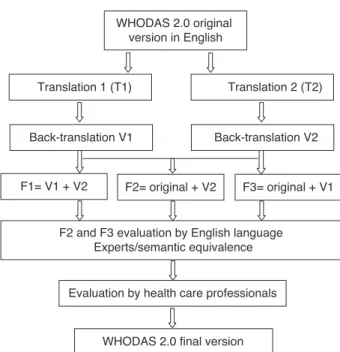
2.0 complete version (36 questions) underwent the following stages (Fig. 1).
Stage 1. Translation
From the original tool in English, a group of health professionals individually produced the first translation into Portuguese, termed (T1). At the same time, a second translation into Portu-guese was made by an English teacher (T2).
WHODAS 2.0 original version in English
Translation 1 (T1) Translation 2 (T2)
Back-translation V1
F2= original + V2 F3= original + V1 F1= V1 + V2
F2 and F3 evaluation by English language Experts/semantic equivalence
Evaluation by health care professionals
WHODAS 2.0 final version
Back-translation V2
Stage 2. Back-translation
Translations T1 and T2 were back-translated into English by two other independent translators producing versions V1 and V2, respectively.
Stage 3. Semantic equivalence
Three forms containing all the statements and the tool questions side-by-side were prepared for the semantic evalua-tion stage. Form F1 contained both versions V1 and V2 and was designed for blinded comparison. Form F2 contained V2 and the original tool in English, and form F3 contained V1 and the original tool in English.
The three forms were analyzed by a different expert in English language, who was not involved in the previous stages and did not know the original questionnaire. This professional took into account whether sentences had been rewritten using the same words and whether their original meaning had been preserved (semantic equivalence). He also considered the referential meaning equivalence (constituent terms and words) as the representation of world ideas or objects a word or group of words refers. The equivalence between pairs of assertions was evaluated according to a continuous visual analogue scale between 0% and 100% to evaluate the referential meaning. The higher the literal matching between back-translated and original terms, the higher the equivalence of the referential meaning.
However, even though there may be a literal matching, the subjective meaning may not be the same in different cultures. This matching takes into account the impact on the cultural context of the target-population and surpasses semantic and
literal matching of the terms.18 For this purpose, an evaluation
of the general meaning of every question, information, or answer option was performed, and a qualitative evaluation scale with four levels was used: unchanged (UN), barely changed (BC), much changed (MC), or completely changed (CC).
Stage 4. Evaluation by experts
Three health care professionals jointly and critically reviewed the three stages. From the identification of disagreements between back-translations, they constructed a synthetic version by selecting and incorporating items from each version. The unchanged items were preferentially selected for the synthetic version; other items were incorporated with a preference for BC over CC. The goal was to select the best way to express the same concept in each sentence simultaneously in both languages. The experts also sought to eliminate ambiguities and redundancies, in addition to evaluating the semantic equivalence. In this stage, the conceptual equivalence (keeping valid in the final version the same concept expounded in the original version), idiomatic equivalence (colloquial expressions and those pertaining to the language), cultural or experimental equivalence (whether the situations evoked in the original culture of the tool have the same reference in the
target culture), and score equivalence were evaluated in the final version compared with the original text.
Stage 5. Tool pretest
This stage aimed to test the clarity of questions and how easily they could be answered by using the minimum number of individuals necessary to elucidate the problems detected. For this stage, the investigators interviewed 14 people aged 16 to 39 years who were invited and agreed to participate after being informed about the tool content and goal. The interviewers recorded the duration of each interview and the respondent’s impression of the clarity of questions and ease of answering.
Stage 6. Final version of WHODAS 2.0
After the pretest and its results, the experts constructed the final version of the tool.
This adaptation is a part of the Severe Maternal Morbidity Cohort (Coorte de Morbidade Materna Grave – COMMAG), which was evaluated and approved by the institutional ethics committee.
Results
Overall, the versions proved similar regarding the general and the referential meaning. However, the discrepancies found were resolved by choosing a term based on the scores. As a result, the final version of WHODAS 2.0 tool adapted to Portuguese was elaborated, and is available on request. The adapted version follows the same format of the WHO original version with 11 pages and thus cannot be included as an annex.
In section 1, Title Page, the item F5 “Life condition when
the interview was conducted” received (MC) in F2 and F3, and the word “condition” replaced the word “situation”. In section 2, General Information and Demographics, one of the choices in item A4 – What is your current marital status? – was scored (CC) in F2, as the reported word was “concubine,” whereas the original word was “cohabiting”. In F3, the statement was “Live with partner,” and the general meaning in stage 3 scored (UN); a synthetic version (“Mora junto”) was chosen.
Other circumstances required minor changes in stage 5 so that both the general and the referential meaning equivalence could be considered when none of the versions achieved a good semantic evaluation. In section 2, the item A5 – “Which describes your main work status best?” (Select the single best
option) – scored (MC) in F2 and F3. the team decided for “Qual
In section 3, Introduction, the statement “The interview is about difficulties people have because of health conditions”, although being evaluated as (UN), was modified by the team to become more literally similar to the original content by including the terms “because of” upon considering the idiomatic equivalence. The same held true for the sentence “By health condition I mean diseases or illnesses, other health problems that may be short- or long-lasting, injuries, mental or emotional problems and problems with alcohol or drugs”, which was translated as “Por problemas de saúde quero dizer doenças ou enfermidades, outros problemas de saúde que podem ser de curta ou longa duração, lesões, problemas mentais ou emocionais e problemas com álcool e/ou drogas” . For this item, the team merged the statement in F2 (BC) with that in F3 (UN).
In Section 4, Domain 3 (Self‑care) for the statement “I am
now going to ask you about difficulties in taking care of yourself”, the evaluation was (UN), but the team merged the statements to be “Agora eu vou perguntar sobre as dificuldades no auto-cuidado (em cuidar de você mesmo(a))” (“Now I am going to ask you about difficulties in self-care [taking care
of yourself]”). In domain 4, Relationships, item D.4.5 “Sexual
activities” was evaluated as (UN) in both forms, but the team chose to include the verb “have” in the sentence: “Ter atividades sexuais?” (“To have sexual activities?”)
In domain 5, Life activities, the statement “Because of your
health condition, in the last 30 days, how much difficulty did you have in” was evaluated as (UN) in F2 and F3, and the word “condition” was replaced by “problem” as follows: “Because of your health problem, in the last 30 days, how much difficulty did you have in…”. Overall, throughout the tool, the word “condition” was replaced by “problem” when it meant health status, as the team understood the word “problem” is more usual in Portuguese for such a context.
In domain 6, Participation, item D.6.2 “How much of a
problem did you have because of barriers or hindrances in the world around you?” scored (BC) in both forms and the team chose the literal translation.
In the pretest tool, only one out of the 14 respondents did not answer the question regarding the tool clarity. 11 people reported the questionnaire was very easy or easy to respond to, whereas only two found it difficult to understand. The length of time needed for the interviews ranged from 12 to 16 minutes. After the pretest, the evaluation team met in order to adjust the Portuguese version, making it more colloquial by substituting terms so as to move the language closer to the usual daily expressions according to the respondents’ suggestions and the interviewers’ perception. Prepositions and pronouns were added, always adhering to the general meaning equivalence of the tool terms, and the final version kept the formatting of the original tool (the final version of the questionnaire is available on request).
Discussion
Translation and cross-cultural adaptation of tools for assessing the health status of populations are important to understand health behavior in several cultures and contribute to worldwide
public health policies. Adaptation presents advantages and disadvantages. One of the advantages is that a tool already constructed and validated in other countries is used as a starting point. A disadvantage is the bias the adaptation may undergo if standard procedures are not followed.
This concern about information validity and a possible loss of the original tool characteristics has caused several investigators deliver standard instructions in order to minimize losses resulting from language changes. A tool, to be considered valid, must be able to appropriately capture the event within the linguistic setting where it was conceived, which becomes more difficult when the tool needs to be used
in a foreign language.19
Conversely, other investigators question whether all popula tions should be asked the same questions or if cultural considerations might require a few differences in question-naires with specific questions regarding religious beliefs,
health, sexual matters, and others.14,20
The present article described the method employed in the process of cross-cultural adaptation of the WHODAS 2.0, exhibi ting the different stages from plain translation to the thorough process comprising the varying hues of cultural adaptation. In each stage of the process, veracity and quality of the tool information were ensured. In stages 3 (semantic equivalence) and 4 (evaluation by experts) of this study, clinical experience with interviews was fundamental to judge and adapt the tool terms.
WHODAS 2.0 was chosen because it assesses activity limi tations and participation restraints experienced by an individual regardless of medical diagnosis, has solid theoretical bases, excellent psychometric properties, several applications in different groups and configurations, and is easy to use. The studies conducted with WHODAS in 19 countries included healthy population and people with physical, mental, or emotional problems, alcohol-dependent individuals, and drug users from different age groups and both genders. Compared with other tools assessing functioning and disability, WHODAS 2.0 is the only tool in which the items included were selected after the nature and the practice of health status were explored in different cultures. It also presents a wide linguistic analysis
of health terminology.21
The Quality of Life tool (WHOQOL) and WHODAS 2.0 are known to be strongly related. Conceptually, the constructions of quality of life and functioning are often seen as firmly connected. Although these constructions are interconnected, WHODAS 2.0 assesses functioning measures (i.e., a performan ce goal in a given life domain), whereas WHOQOL assesses subjective measures of well-being (i.e., a feeling of fulfillment with the person’s own performance in a given life domain). Ideally,
the same life domains should be used in both tools.9 Thus,
functioning. In every question, WHODAS comparatively assesses functioning over the previous month; SF-36 compares the current health status with that found one year earlier. Both tools use answers to generate scores on a scale from 0 to 100.
A number of limitations are assigned to WHODAS, since it was constructed from activity and participation in ICF domains, while physical disabilities and environmental factors are not included. In addition, the tool is applied only to adult populations, and is not yet applicable to children and youth. In 2007, the International Classification of Functioning, Disability and Health – Children and Youth Version (ICF-CY) was published, and studies for a specific WHODAS version for
this population were initiated.1,22
Various medical specialties, such as rheumatology, psychia-try, physical therapy, and otorhinolaryngology have used WHODAS. WHODAS 2.0 can be a tool for assessing functioning/ disability in the Brazilian population, particularly in obstetrics. In women’s health care, the postpartum functional status, main ly after severe maternal morbidity and near miss, is poor ly known. Pregnancy changes alter women’s quality of life and functioning during the entire pregnancy-postpartum cycle. Reduced physical functioning over the third trimester and some adverse clinical outcomes have been significantly
registered.23
Women developing obstetric complications have a higher
risk of death and mental problems than healthy women.24
A qualitative and exploratory study based on accounts of women surviving severe complications during pregnancy showed a relationship with being critically ill, impending death,
fear, frustration, and other reported feelings.25 In pregnancy,
delive ry, and postpartum, as well as in settings of severe maternal morbidity – near miss, WHODAS can demonstrate the impact on functional ability of women experiencing these events. By understanding this impact, as health care profes-sionals, maternal health care can be improved. This is a challenging proposition that the authors intend to develop in the near future, thus enabling a real validation of the tool in real-life settings.
Funding source
This article is derived from the COMMAG) study, funded by CNPq (Process 471142/2011-5).
Conflicts of interest
The authors declare no conflicts of interest.
R E F E R E N C E S
1. Üstün TB, Chatterji S, Kostanjsek N, Rehm J, Kennedy C, Epping-Jordan J, et al.; WHO/NIH Joint Project. Developing the World Health Organization Disability Assesment Schedule 2.0. Bull World Health Organ. 2010;88(11):815-23.
2. Di Nubila HB. Uma introdução à CIF: Classificação Interna cio-nal de Funciocio-nalidade, Incapacidade e Saúde. Rev Bras Saúde Ocup. 2010;35(121):122-3.
3. Battistella LR, Brito CM. Classificação Internacional de Funcio-nalidade (CIF). Acta Fisiatrica. 2002;9(2):98-101.
4. Farias N, Buchalla CM. A Classificação Internacional de Funcio-nalidade, Incapacidade e Saúde da Organização Mundial da Saúde: conceitos, usos e perspectivas. Rev Bras Epidemiol. 2005; 8(2):187-93.
5. World Health Organization, International classification of functio ning, disability and health: ICF. Geneve: WHO; 2001 [cited 4 Jan 2012]. Available from: http://www.who.int/ classifications/icf/en/
6. Sampaio RF, Luz MT. Funcionalidade e incapacidade huma-na: explorando o escopo da classificação internacional da Organização Mundial da Saúde. Cad Saúde Pública. 2009;25(3): 475-83.
7. Diniz D, Medeiros M, Squinca F. Reflexões sobre a versão em Português da Classificação Internacional de Funcionalidade, Incapacidade e Saúde. Cad Saúde Publica. 2007;23(10):2507-510. 8. Stucki G, Reinhardt JD, Grimby G, Melvin J. O desenvolvimento da pesquisa em funcionalidade humana e reabilitação a partir de uma perspectiva abrangente. Acta Fisiatrica. 2008;15(1):63-9. 9. World Health Organization. Measuring Health and Disability:
Manual for WHO Disability Assessment Schedule (WHODAS 2.0). Geneve: WHO; 2010 [cited 4 Jan 2012]. Available from: http://whqlibdoc.who.int/publications/2010/9789241547598_ eng.pdf
10. Griffiths J, Fortune G, Barber V, Young JD. The prevalence of post-traumatic stress disorder in survivors of ICU treatment: a systematic review. Intensive Care Med. 2007;33(9):1506-18. 11. Soberg HL, Bautz-Holter E, Roise O, Finset A. Long-term
multi-di mensional functional consequences of severe multiple inju-ries two years after trauma: a prospective longitudinal cohort study. J Trauma. 2007;62(2):461-70.
12. Garin O, Ayuso-Mateos JL, Almansa J, Nieto M, Chatterji S, Vila gut G, et al.; MHADIE consortium. Validation of the “World Health Organization Disability Assessment Schedule, WHODAS-2” in patients with chronic diseases. Health Qual Life Outcomes. 2010;8:51.
13. World Health Organization. Process of translation and adapta-tion of instruments [cited 8 Aug 2011]. Available from: www. who.int/substance_abuse/research_tools/translation/en 14. Beaton DE, Bombardier C, Guillemin F, Ferraz MB. Guidelines
for the process of cross-cultural adaptation of self-report measures. Spine. 2000;25(24):3186-91.
15. Gray DB, Hendershot GE. The ICIDH-2: Developments for a new era of outcomes research. Arch Phys Med Rehabil. 2000; 81(Suppl 2):S10-S4.
16. Herdman M, Fox-Rushby J, Badia X. A model of equivalence in the cultural adaptation of HRQoL instruments: the universalist approach. Qual Life Res. 1998;7(4):323-35.
17. Reichenheim ME, Moraes CL. Operacionalização de adaptação transcultural de instrumentos de aferição usados em epide-miologia. Rev Saúde Pública. 2007;41(4):665-73.
18. Jorge MR. Adaptação transcultural de instrumentos de pesqui-sa em pesqui-saúde mental. Rev Psiquiatr Clín (São Paulo). 1998;25(2): 233-9.
19. Reichenheim ME, Moraes CL, Hasselmann MH. Equivalência semântica do instrumento Abuse Assessment Screening. Rev Saúde Pública. 2000;34(6):610-6.
22. Organização Mundial da Saúde. Classificação Internacional da Funcionalidade, Incapacidade e Saúde: Versão para crianças e jovens. Genebra: WHO; 2007. Tradução ao português [cited 14 Oct 2012]. Available from: http://www.fsp.usp.br/cbcd/CIF/manual.pdf 23. Jomeen J. The importance of assessing psychological status
during pregnancy, childbirth and the postnatal period as a multi dimensional construct: a literature review. Clin Effect Nurs. 2004;8(3-4):143-55.
24. Filippi V, Ganaba R, Baggaley RF, Marshall T, Storeng KT, Sombié I, et al. Health of women after severe obstetric com plications in Burkina Faso: a longitudinal study. Lancet. 2007;370(9595): 1329-37.