NHESSD
3, 4555–4583, 2015Teaching disaster preparedness via a mobile device
O. Kulemeka
Title Page Abstract Introduction Conclusions References
Tables Figures
◭ ◮
◭ ◮
Back Close
Full Screen / Esc
Printer-friendly Version Interactive Discussion
Discussion
P
a
per
|
Discussion
P
a
per
|
Discussion
P
a
per
|
Discussion
P
a
per
|
Nat. Hazards Earth Syst. Sci. Discuss., 3, 4555–4583, 2015 www.nat-hazards-earth-syst-sci-discuss.net/3/4555/2015/ doi:10.5194/nhessd-3-4555-2015
© Author(s) 2015. CC Attribution 3.0 License.
This discussion paper is/has been under review for the journal Natural Hazards and Earth System Sciences (NHESS). Please refer to the corresponding final paper in NHESS if available.
Teaching disaster preparedness via
a mobile device: a study of Auckland Civil
Defence’s Smartphone Application
O. Kulemeka1,† 1
University of Oklahoma, College of Journalism and Mass Communication, Norman, OK, USA
†
deceased
Received: 17 May 2015 – Accepted: 21 June 2015 – Published: 3 August 2015
Correspondence to: O. Kulemeka ([email protected])
NHESSD
3, 4555–4583, 2015Teaching disaster preparedness via a mobile device
O. Kulemeka
Title Page Abstract Introduction Conclusions References
Tables Figures
◭ ◮
◭ ◮
Back Close
Full Screen / Esc
Printer-friendly Version Interactive Discussion
Discussion
P
a
per
|
Discussion
P
a
per
|
Discussion
P
a
per
|
Discussion
P
a
per
Abstract
This content analysis study examined whether a disaster preparedness education smartphone application created by a New Zealand city matches what experts say are effective ways of teaching disaster preparedness and teaching via an app. The app was assessed to ascertain if it excelled as a platform for learning, communicated
5
effectively, addressed factors that can hinder people from preparing, and provided information for special needs populations. Results show that the app addressed most factors that hinder preparedness, provided information for some special needs populations, excelled as a platform for learning, and communicated effectively. The app’s weaknesses include the fact that it lacked targeted information for low-income
10
residents. The findings provide insight on how organizations can effectively use apps to teach disaster preparedness.
The author passed away before the publication of this discussion paper. Therefore, a final revised paper is not foreseen.
15
1 Introduction
Following a 2011 earthquake that killed 185 people and cost over USD 25 billion, disaster preparedness is a key concern in New Zealand. Auckland Civil Defence, the disaster agency of the country’s largest city, has warned that only one in 10 Aucklanders is ready for disasters (Day, 2014). To address this, the agency has created
20
a smartphone application (app) to teach residents disaster preparedness. The agency is not alone in using an app for disaster preparedness education: the U.S. Federal Emergency Management Agency and Emergency Management Australia also have apps for this purpose.
When this researcher examined the Auckland Civil Defence app in February 2015, it
25
NHESSD
3, 4555–4583, 2015Teaching disaster preparedness via a mobile device
O. Kulemeka
Title Page Abstract Introduction Conclusions References
Tables Figures
◭ ◮
◭ ◮
Back Close
Full Screen / Esc
Printer-friendly Version Interactive Discussion
Discussion
P
a
per
|
Discussion
P
a
per
|
Discussion
P
a
per
|
Discussion
P
a
per
|
the app’s purpose. After these screens, a user could log in using an email address or a Facebook username. Once logged in, the user faced four pages: home, plan, people, and info. The home page showed critical information about pending or occurring disasters as well as preparedness events such as evacuation drills.
The plan page allowed a user to create a preparedness plan in six steps that
5
included reading about disasters that can affect Auckland, entering emergency contact information, listing emergency supplies, and indicating an emergency meeting point. On the people page, a user could connect with friends and family members via email, SMS or Facebook. With these connections, a user could see the progress peers were making in crafting disaster plans.
10
The info page described disasters Auckland is at risk of, showed disaster related events occurring in Auckland, explained how special needs groups should prepare for disasters, and outlined special disaster information (e.g., insurance). In addition, how to contact emergency officials, what radio stations to listen to, how to receive SMS alerts, how to volunteer, and how to access disaster help were explained. Figures 1–4 show
15
images of the app.
This study examined the Auckland Civil Defence’s app to understand two things. First, whether the app taught in a way that matched what experts say are effective ways of teaching people to prepare for disasters. Second, whether it taught in ways matching what experts say are effective ways of teaching via a mobile app. Answering these
20
questions can help others considering using apps to teach disasters preparedness. The paper opens by describing what is known regarding effectively teaching people how to prepare for disasters and effectively teaching people via mobile devices. The research questions are outlined, the methodology is explained, findings are revealed, and implications as well limitations are discussed.
NHESSD
3, 4555–4583, 2015Teaching disaster preparedness via a mobile device
O. Kulemeka
Title Page Abstract Introduction Conclusions References
Tables Figures
◭ ◮
◭ ◮
Back Close
Full Screen / Esc
Printer-friendly Version Interactive Discussion
Discussion
P
a
per
|
Discussion
P
a
per
|
Discussion
P
a
per
|
Discussion
P
a
per
2 Literature review
2.1 Effectively teaching people disaster preparedness
Researchers have shown that a variety of factors can help or hinder efforts to teach people disaster preparedness. These factors include environmental cues, social context, source credibility, warning channels, warning content, past experience, lack of
5
resources, and residency barriers (Lundgren and McMakin, 2013). When people see or hear cues in the environment that show that a hazard exists, some are more likely to prepare (Sattler et al., 2000). Social context, the relationships people are part of, also influence disaster preparedness. Some people are more likely to prepare when they see friends preparing (Patterson et al., 2010). How people perceive the credibility
10
of a source can influence preparedness actions. Because people vary significantly in regards to whom they find credible, researchers recommend using multiple sources to encourage preparedness (Sorensen and Sorensen, 2006). Preparedness messages are also distributed through conversations, television, websites, newspapers and other channels. Because people vary in regards to which channels they pay attention to and
15
find trustworthy, researchers recommend distributing preparedness messages through diverse channels (Lindell and Perry, 2004).
In regards to message content, researchers recommend that preparedness messages should counter arguments or myths that people have regarding disasters preparedness. Messages should be repeated so that people pay attention but not
20
excessively to avoid annoying people (Lindell and Perry, 2004). Past experience with disasters can also influence preparedness actions. Drabek (1999) noted that depending on circumstances, individuals who have experienced a disaster in the past are more likely or less likely to follow preparedness advice. Preparedness messages should therefore factor past experience.
25
NHESSD
3, 4555–4583, 2015Teaching disaster preparedness via a mobile device
O. Kulemeka
Title Page Abstract Introduction Conclusions References
Tables Figures
◭ ◮
◭ ◮
Back Close
Full Screen / Esc
Printer-friendly Version Interactive Discussion
Discussion
P
a
per
|
Discussion
P
a
per
|
Discussion
P
a
per
|
Discussion
P
a
per
|
purchase extra food and supplies which can be difficult for the poor. Some communities with large immigrant populations not fluent in the local language do not provide translated disaster preparedness education material or provide poorly translated items (James et al., 2007). Undocumented migrants sometimes do not access government provided disaster services because they fear arrest. For example, during Hurricane Ike
5
in Texas, some undocumented individuals did not seek help from government agencies because officials refused to ease immigration policing during the early part of the disaster (Wilson and Tiefenbacher, 2012). Many communities also do not adequately address challenges people with disabilities face when preparing for disasters. The result is that many with disabilities are hurt or die in disasters (Rooney and White,
10
2007).
This literature revealed to this researcher that one way to assess the Auckland Civil Defence app could be to examine how well it addressed factors that can hinder disaster preparedness. For example, whether the app showed users cues in the environment illustrating the likelihood of a disaster occurring or how well the app addressed myths
15
people may have about preparing for a disaster. From this literature, the first question that guided this study was therefore developed:
RQ1: Does the Auckland Civil Defence app address these factors that can hinder people from preparing for disasters: environmental cues, social context, source credibility, warning channels, warning content, past experience, lack of resources, and
20
residency barriers?
Across the world, there is increased realization that disaster preparedness efforts should factor in people who are marginalized and vulnerable (e.g., racial-ethnic minorities, individuals with disabilities) (Blaikie et al., 2014). In the US, the lessons learned after Hurricane Katrina have spurred efforts to ensure that disaster
25
NHESSD
3, 4555–4583, 2015Teaching disaster preparedness via a mobile device
O. Kulemeka
Title Page Abstract Introduction Conclusions References
Tables Figures
◭ ◮
◭ ◮
Back Close
Full Screen / Esc
Printer-friendly Version Interactive Discussion
Discussion
P
a
per
|
Discussion
P
a
per
|
Discussion
P
a
per
|
Discussion
P
a
per
individuals with reduced or no ability to hear, see, or speak; those with limited or no ability to speak, read, or understand the local language; and those with limited ability to understand or learn. Preparedness educators should also provide information for those with medical needs (e.g., chronic conditions), those who utilize animals or devices to maintain independence (e.g., wheelchairs, hearing aids), and those
5
requiring transportation assistance (e.g., those who cannot afford a vehicle and those legally restricted from driving). In addition, information should be provided for care providers of individuals requiring supervision (e.g., nurses for individuals with dementia) (Kailes and Enders, 2007).
These works revealed that a second way to assess the Auckland app could be to
10
examine how well it addressed the challenges marginalized and vulnerable individuals face when preparing for a disaster. Specifically, how well the app provided information on how people with unique communication, medical, independence, supervision, and transportation needs can prepare for a disaster. From this literature, the second question that guided this study was crafted:
15
RQ2: Does the Auckland Civil Defence app provide preparedness information for people with communication, medical, independence, supervision, and transportation needs?
Another issue experts say preparedness education should cover is animals. In past disasters, some people have refused to evacuate due to fear regarding what will
20
happen to their pets or livestock. Many shelters do not accept pets while livestock pose unique evacuation challenges. Experts emphasize that preparedness education should address animal owner needs (Heath, 2001; Thompson, 2013). This literature revealed that a third way to assess the New Zealand app could be to ascertain how well it addressed issues faced by pet and livestock owners. Therefore, this third research
25
question was drafted:
NHESSD
3, 4555–4583, 2015Teaching disaster preparedness via a mobile device
O. Kulemeka
Title Page Abstract Introduction Conclusions References
Tables Figures
◭ ◮
◭ ◮
Back Close
Full Screen / Esc
Printer-friendly Version Interactive Discussion
Discussion
P
a
per
|
Discussion
P
a
per
|
Discussion
P
a
per
|
Discussion
P
a
per
|
The next section examines research on how to effectively teach and communicate information using apps.
2.2 Effectively teaching people via apps
Apps, as teaching tools, are advantageous in various ways. Removed from the confines of classrooms, app users can learn from anywhere they have mobile devices
(El-5
Hussein and Cronje, 2010). Apps also allow material to be learned and put to use immediately. For example, residents can browse a grocery store and use an app to learn what items to buy for an emergency. Learning on apps is often cheaper and brings lessons to those who find attending classrooms difficult (Gu et al., 2011).
Despite their positives, apps have limitations. Learning on an app can be fragmented
10
because without supervision, learners on apps can stop or digress anytime. This loss of continuity can hinder learners from grasping concepts that require uninterrupted, supervised focus. Apps also often lack instructor feedback leaving learners without answers to their questions (Park, 2011). Creating apps is also a complicated process requiring knowledge in programming, mobile learning, and specialized subject matter
15
(e.g., disasters). In addition, app designers have to make sure apps work on diverse hardware and software. Many organizations cannot meet these requirements and create apps ill suited for learning (Harrison et al., 2013).
The realization that poorly designed apps can fail drives research on how to design effective apps. Numerous organizations that have invested millions in apps want to
20
know if their apps meet the needs of users and are achieving desired goals. Various experts on mobile learning have developed guidelines on how to design mobile learning platforms such as apps that are usable and excel as platforms for learning. These experts (e.g., Dillard, 2012; Elias, 2011; Kukulska-Hulme and Traxler, 2013; Wang and Shen, 2012) have argued that mobile learning platforms such as apps, in order
25
NHESSD
3, 4555–4583, 2015Teaching disaster preparedness via a mobile device
O. Kulemeka
Title Page Abstract Introduction Conclusions References
Tables Figures
◭ ◮
◭ ◮
Back Close
Full Screen / Esc
Printer-friendly Version Interactive Discussion
Discussion
P
a
per
|
Discussion
P
a
per
|
Discussion
P
a
per
|
Discussion
P
a
per
term memory is limited, (d) be engaging and entertaining, (e) provide content that is relevant to learners, (f) deliver information fitting users’ immediate needs and contexts, and (g) provide access to information even when not connected to wireless networks. From this review, it was evident that a fourth way to assess the Auckland app could be to ascertain if the app possessed characteristics that scholars argue are present
5
in apps that excel as platforms for learning. Hence, this fourth research question was drafted:
RQ4: Does the Auckland Civil Defence app exhibit principles of an app that excels as a platform for learning: (a) simple and intuitive interface; (b) incorporates multimedia; (c) information that is contextual and relevant to the learner; (d) just-in time delivery;
10
and (e) offline access?
Additional guidelines on designing apps that excel as learning platforms have emerged from health research. As health related apps have grown in numbers, scholars worried about the accuracy of the information in these apps have developed principles on how to design apps that communicate effectively. An example is the
15
principles developed by Huckvale et al. (2012, 2015) in their research on how to design asthma apps that communicate effectively. These researchers have argued that an app that communicates effectively should have information attributed to an author whose qualifications are mentioned (when information was written and modified should also be indicated), claims supported by evidence, and a privacy policy regarding how app
20
user information is used. In addition, who paid to create the app should be identified, external influences that could affect the objectivity of app content should be revealed, and a way to contact app creators should be provided. The purpose of the app as well as the intended audience should be clearly explained and a disclaimer should be presented that the app is not meant to replace advice from human professionals
25
NHESSD
3, 4555–4583, 2015Teaching disaster preparedness via a mobile device
O. Kulemeka
Title Page Abstract Introduction Conclusions References
Tables Figures
◭ ◮
◭ ◮
Back Close
Full Screen / Esc
Printer-friendly Version Interactive Discussion
Discussion
P
a
per
|
Discussion
P
a
per
|
Discussion
P
a
per
|
Discussion
P
a
per
|
RQ5: Does the Auckland Civil Defence app exhibit principles of an app that communicates effectively: (a) information attributed to qualified author, (b) app purpose explained, audience identified, creator identified, and disclaimer present, (c) privacy policy present, (d) content creation and modification date present, (e) claims supported by evidence, (g) who paid for app identified, (h) external influence that could affect
5
objectivity of content identified, and (i) contact information of app creators provided?
3 Method
Researchers seeking to evaluate apps have a variety of methods at their disposal. These include conducting experiments, watching people using an app in the real world, and surveying users to get their input (Nayebi et al., 2012). In this study,
10
this researcher decided that an appropriate method for evaluating the Auckland Civil Defence app would be one in which two individuals of similar educational and professional backgrounds would utilize the Auckland Defence app and afterwards, use a checklist to assess whether the app met the characteristics outlined in the research questions. This checklist approach mirrors the app assessment method utilized in
15
past studies that have evaluated apps such as Reynoldson et al. (2014), Bender et al. (2013), and Huckvale et al. (2012, 2015).
This checklist method has several limitations that were highlighted by Alshehri and Freeman (2012) who explained that apps have several characteristics that make it difficult to assess them. In everyday life, apps are used in various scenarios (e.g.,
20
while running, driving) by numerous people (e.g., technology experts, novices) using numerous devices (e.g., expensive devices with newest software, older devices) on different wireless networks (e.g. Wi-Fi, 4G, 3G,). These differences make it hard to assess apps because in some cases, it is not clear if the problem is with the app, the hardware of the mobile device, the software running the mobile device, the wireless
25
NHESSD
3, 4555–4583, 2015Teaching disaster preparedness via a mobile device
O. Kulemeka
Title Page Abstract Introduction Conclusions References
Tables Figures
◭ ◮
◭ ◮
Back Close
Full Screen / Esc
Printer-friendly Version Interactive Discussion
Discussion
P
a
per
|
Discussion
P
a
per
|
Discussion
P
a
per
|
Discussion
P
a
per
similar educational and professional background, would assess the app on identical devices using a common wireless network while carrying out uniform tasks.
The first step in crafting the app analysis method was to develop a checklist for ascertaining whether the app: (a) had a simple and intuitive interface, (b) incorporated multimedia, (c) had information that was relevant to the learner, (d) offered just-in time
5
delivery, and (e) offered offline access to data. In order to craft such a checklist, this researcher had to figure out how to measure whether the app was simple and intuitive. To find such measures, studies of simplicity and intuitiveness in other digital media were examined. What emerged was that an influential way of determining simplicity and intuitiveness is Taylor and Kent’s (2014) dialogic framework. These scholars argued
10
that simple and intuitive digital media have a guide or map that tells users where to go in the media, a search box that can be used to find out what is in the media, a navigation indicator showing the part of the media the user is on, and a button or link that easily takes a user back to the homepage of media. In addition, the media should lack animation that can strain processing power and pages should load in less
15
than 0.1 s (Kim et al., 2014; Lee, 2014). These items were adopted as measures for assessing whether the app was simple and intuitive. They were added to the other items (incorporates multimedia; has information relevant to the learner; offers just-in time delivery; offline access to information) to create a checklist for assessing the app. A second checklist this researcher created was one for determining whether the
20
app matched the principles of an app that communicates effectively. The principles utilized by Huckvale et al. (2012, 2015) to assess asthma education apps were used to develop this checklist. A third checklist was drafted to determine whether the app addressed factors that can hinder people from taking steps to prepare for disasters. Lindell and Perry’s (2012) Protective Action Decision Model, which details what factors
25
Function-NHESSD
3, 4555–4583, 2015Teaching disaster preparedness via a mobile device
O. Kulemeka
Title Page Abstract Introduction Conclusions References
Tables Figures
◭ ◮
◭ ◮
Back Close
Full Screen / Esc
Printer-friendly Version Interactive Discussion
Discussion
P
a
per
|
Discussion
P
a
per
|
Discussion
P
a
per
|
Discussion
P
a
per
|
Based Framework for Emergency Management and Planning which describes how to best prepare individuals with special needs for disasters was utilized to draft this checklist. These checklists can be seen in Tables 1–4. Data collection occurred 1– 10 February 2015. The app was downloaded to two identical smartphones running the latest version of the Apple iOS operating system. The smartphones did not contain any
5
additional apps except those installed at the factory. Two independent coders (both PhDs in mass communication and employed as college professors at universities in the United States) randomly selected four sections of the app and analysed them using the above-mentioned checklists. This analysis was conducted while the smartphones were connected to the same WIFI network in the same room at a uniform time. After
10
this initial analysis, the coders met to discuss their findings. Initial inter-rater agreement was 95 %. Discrepancies were resolved and the coders reviewed remaining sections of the app. After completing the analysis, ratings were compared and final ratings reached by consensus.
4 Results
15
RQ1: Does the Auckland Civil Defence app address these factors that can hinder people from preparing for disasters: environmental cues, social context, source credibility, warning channels, warning content, past experience, lack of resources, and residency barriers?
Disaster preparedness messages are more likely to be effective if people are shown
20
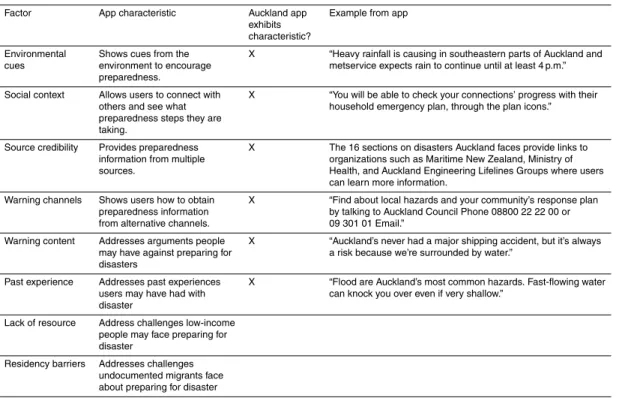
cues in the environment illustrating the likelihood of disasters occurring (Lindell and Perry, 2012). The app addressed this factor with an activity section that showed the prevalence of storms and floods in the Auckland area. This illustration of risks Auckland faces can be viewed as an example of pointing to environmental cues. Research has also shown that some people are likely to prepare if they see peers preparing (Dash
25
NHESSD
3, 4555–4583, 2015Teaching disaster preparedness via a mobile device
O. Kulemeka
Title Page Abstract Introduction Conclusions References
Tables Figures
◭ ◮
◭ ◮
Back Close
Full Screen / Esc
Printer-friendly Version Interactive Discussion
Discussion
P
a
per
|
Discussion
P
a
per
|
Discussion
P
a
per
|
Discussion
P
a
per
friends via Facebook, SMS, or email. Through the app, users could see preparedness steps their peers were taking and thus be encouraged to also prepare.
Because people vary in regards to whom they find credible and what communication channel they utilize frequently, experts recommend that preparedness messages be distributed by multiple sources on various channels (Guion et al., 2007). The app
5
provided a multiplicity of sources from where to obtain preparedness information. For example, the section on fire provided a link to the New Zealand Fire Service and the section on pandemics provided a link to the Ministry of Health. In addition, the app provided links on how to obtain information through radio, SMS, email, phone, and other channels.
10
Preparedness messages should address arguments people may have against preparing as well as past experience individuals have had with disasters (Sharma and Patt, 2012). The app addressed these factors by presenting statistics. Parts of the app went into detail describing past disasters that have affected Auckland and the likelihood of these disasters occurring in the future. For example, the section on aviation disasters
15
explained that between 1996–1999, there were 40 aircraft accidents in the Auckland area. The section on cyclones noted that every year, a cyclone comes within 500 km of Auckland. These statistics served to counter Aucklander’s preconceptions as well as past experience.
The app did not address how low-income individuals can obtain assistance in
20
preparing for disaster. For example, information was not provided on how the poor can obtain help purchasing items for emergency kits. The app also did not address any concerns that undocumented individuals may have about accessing disaster preparedness help. Experts recommend that disaster managers make it clear what disaster resources are available to the undocumented so that these individuals are not
25
NHESSD
3, 4555–4583, 2015Teaching disaster preparedness via a mobile device
O. Kulemeka
Title Page Abstract Introduction Conclusions References
Tables Figures
◭ ◮
◭ ◮
Back Close
Full Screen / Esc
Printer-friendly Version Interactive Discussion
Discussion
P
a
per
|
Discussion
P
a
per
|
Discussion
P
a
per
|
Discussion
P
a
per
|
RQ2: Does the Auckland Civil Defence app provide preparedness information for people with communication, medical, independence, supervision, and transportation needs?
Kailes and Enders (2007) recommended that in order to avoid marginalizing vulnerable individuals, disaster preparedness education efforts should meet communication,
5
medical, independence, supervision, and transportation needs. The app’s section on “people with disabilities or special requirements” provided information for people with hearing impairment, asthma/respiratory problems, sight impairment, and physical disability/mobility impairment. The advice it provided included organizing a support network of people who can assist with evacuation, preparing a seven-day supply of
10
essential medication, and knowing where to access life sustaining equipment.
Where the app was lacking was in providing information for those with limited or no ability to speak, read or understand English. New Zealand is a multilingual country. Tan (2009) explained that New Zealand’s government, recognizing that English fluency is a problem for many, provides a Language Line service that provides translators fluent in
15
44 languages to assist people seeking help from hospitals, police, charities, and other vital services. The app did not indicate how those not proficient in English could obtain information. See Table 2 for complete findings in regards to this research question.
RQ3: Does the Auckland Civil Defence app provide preparedness information for animal owners?
20
For disaster preparedness efforts to be successful, the needs of animal owners should be included in planning (Thompson, 2013). The app fulfilled these criteria in its special section on pets and livestock. For pets, the app advised users to microchip pets, prepare emergency food, and identify pet-friendly hotels. For livestock, the app instructed owners to work with local authorities on developing measures to secure
25
NHESSD
3, 4555–4583, 2015Teaching disaster preparedness via a mobile device
O. Kulemeka
Title Page Abstract Introduction Conclusions References
Tables Figures
◭ ◮
◭ ◮
Back Close
Full Screen / Esc
Printer-friendly Version Interactive Discussion
Discussion
P
a
per
|
Discussion
P
a
per
|
Discussion
P
a
per
|
Discussion
P
a
per
RQ4: Does the Auckland Civil Defence app exhibit principles of an app that excels as a platform for learning: (a) simple and intuitive interface, (b) incorporate multimedia, (c) information that is contextual and relevant to the learner, (d) just-in time delivery, and (e) offline access to data?
Taylor and Kent (2014) argued that digital platforms that excel as platforms for learning
5
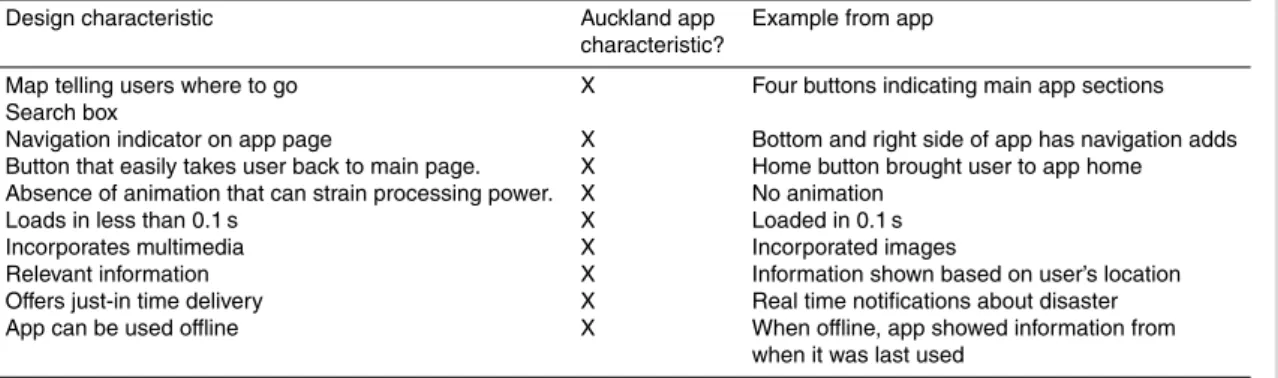
are characterized by a simple and intuitive interface. Aspects of the Auckland app that exemplified this characteristic include the presence of a navigation bar telling users where to go on the app and absence of animation that can strain processor power. The app also met other criteria outlined by Taylor and Kent such as incorporating images, providing contextual information by allowing users to receive customized disaster
10
alerts, and providing just-in-time delivery of information by allowing the delivery of notifications when a disaster was occurring. When offline, the app did show information from the previous time it was used. The app was lacking only in one area: it lacked a search box where a user could enter text to search to find specific items. See Table 3 for complete findings in regards to this research question.
15
RQ5: Does the app exhibit principles of an app that communicates effectively: (a) information attributed to qualified author; (b) app purpose explained, audience identified, creator identified, and disclaimer present; (c) privacy policy present; (d) content creation and modification date present; (e) claims supported by evidence; (g) who paid for app identified; (h) external influence that could affect objectivity of
20
content identified; and (i) contact information of app creators provided?
According to Huckvale et al. (2012, 2015), an app that communicates effectively must provide full contact information of the app’s creators. The Auckland app met these criteria by providing the email and phone contact information of the Auckland Defence Council. Additional criteria that the app met include describing the full purpose of the
25
NHESSD
3, 4555–4583, 2015Teaching disaster preparedness via a mobile device
O. Kulemeka
Title Page Abstract Introduction Conclusions References
Tables Figures
◭ ◮
◭ ◮
Back Close
Full Screen / Esc
Printer-friendly Version Interactive Discussion
Discussion
P
a
per
|
Discussion
P
a
per
|
Discussion
P
a
per
|
Discussion
P
a
per
|
a company called Ogilvy and Mather designed the app interface. The app also justified claims by providing statistics, was transparent in revealing that it was funded by the Auckland government and it contained a privacy policy regarding user data. Pages of the app with detailed information also had notes indicating when they were last updated.
5
Where the app did not meet Huckvale et al.’s (2012, 2015) criteria was in two areas. First, the information was not authoritative. At the bottom of each update, the name, title, and contact information of the person who wrote it were not provided. People, in many cases, find information more credible if an actual author is listed (Cheever and Rokkum, 2015). A second weakness was the lack of a disclaimer that the app was not
10
supposed to replace human advice. Apps, like most technology, are prone to errors and especially in disaster settings, can malfunction. Some apps include a disclaimer they are not supposed to substitute advice from human experts (Boulos et al., 2014). See Table 4 for complete findings in regards to this research question.
5 Discussion
15
The findings contain valuable lessons for organizations around the world seeking to use apps for disaster preparedness education. The first lesson is that it is possible to create an app that addresses factors that can hinder people from taking steps to address disaster. Organizations can accomplish this by creating apps that show disaster cues from the environment, allow users to connect with friends or family who
20
are preparing for disaster, provide information from multiple sources, show users how to obtain information from alternative channels, address arguments people may have against preparing for disasters, and address past experiences users may have had with disasters. Additional lessons from the Auckland app is that it is possible to create an app that excels as a platform for learning, communicates effectively, and provides
25
NHESSD
3, 4555–4583, 2015Teaching disaster preparedness via a mobile device
O. Kulemeka
Title Page Abstract Introduction Conclusions References
Tables Figures
◭ ◮
◭ ◮
Back Close
Full Screen / Esc
Printer-friendly Version Interactive Discussion
Discussion
P
a
per
|
Discussion
P
a
per
|
Discussion
P
a
per
|
Discussion
P
a
per
The findings from this app analysis, however, also reveal several things the Auckland app failed to achieve that other app creators worldwide should be cognizant about. First, app creators should recognize the need to provide information on how low-income people can address challenges to preparing for disaster. Telling people to prepare but not providing them information on how they can address lack of resources
5
(e.g., where to get help in stockpiling food if you lack money) is problematic. In Auckland, an estimated 70 food banks serve the underprivileged (Jackson, 2013). These statistics mirror other cities in emerging and developed countries where poverty is a part of urban life for many. Disaster preparedness app creators can make their apps stronger by including information on how the underprivileged can get help with
10
disaster preparedness.
Second, app creators should also be aware of the need to provide information to people who do not speak, read, or understand the local language. In Auckland, police, hospital and other emergency services utilize a Language Line service to provide assistance to the 44 different nationalities in New Zealand that are not fluent in English
15
(Tan, 2009). The Auckland app could have been stronger if it had contained information on how individuals not fluent in English could access this service. In other regions, app designers should factor how they will address the linguistic diversity among users.
App creators should also address challenges undocumented migrants face preparing for disasters. New Zealand, like many nations, has a growing population of migrants.
20
Glass (2013) noted that some of these individuals in New Zealand, documented and undocumented, live in fear of deportation and are often exploited by employers who pay them below the minimum wage knowing that they are afraid of going to government authorities to complain. App designers can make their apps stronger if they include information clarifying to undocumented individuals what preparedness services they
25
NHESSD
3, 4555–4583, 2015Teaching disaster preparedness via a mobile device
O. Kulemeka
Title Page Abstract Introduction Conclusions References
Tables Figures
◭ ◮
◭ ◮
Back Close
Full Screen / Esc
Printer-friendly Version Interactive Discussion
Discussion
P
a
per
|
Discussion
P
a
per
|
Discussion
P
a
per
|
Discussion
P
a
per
|
This study has several limitations that future scholars need to address in order to enhance the existing body of knowledge regarding the use of apps as tools for teaching disaster preparedness. First, this study lacks insight from users regarding what they think about the app. Surveying and interviewing people who used the Auckland app could have provided significant insight into whether the app is succeeding in preparing
5
Aucklanders for future disasters. In addition, querying users could have shed light on whether Auckland Civil Defence is using the app not simply to talk at people but to give them a voice in shaping how disasters are managed. A second limitation of the study is that it did not explore whether the app is entertaining or engaging. This is something that can also be ascertained by interviewing or surveying users.
10
Smartphone users have a multiplicity of apps to choose from and if an app is not engaging or entertaining, it is likely they will not use it. Whether the Auckland app is entertaining and engaging should be understood before other organizations imitate the app’s approach to preparedness education. A third limitation of the study is that it did not explore whether the app delivered information in short chunks appropriate
15
for mobile learning. The Auckland app has lots of information but is it too much or just the right size for users? Surveys and interviews can also shed light on this and give valuable details on exactly how much text and images developers should put in preparedness apps.
References
20
Alshehri, F. and Freeman, M.: Methods for usability evaluations of mobile devices, in: 23rd Australian Conference on Information Systems, edited by: Lamp, J. W., Deakin University, Geelong, 1–10, 2012.
Baker, L. and Cromier, L.: Disasters and Vulnerable Populations: Evidence-Based Practice for the Helping Professions, Springer, New York, 2014.
25
NHESSD
3, 4555–4583, 2015Teaching disaster preparedness via a mobile device
O. Kulemeka
Title Page Abstract Introduction Conclusions References
Tables Figures
◭ ◮
◭ ◮
Back Close
Full Screen / Esc
Printer-friendly Version Interactive Discussion
Discussion
P
a
per
|
Discussion
P
a
per
|
Discussion
P
a
per
|
Discussion
P
a
per
Bender, J. L., Yue, R. Y. K., To, M. J., Deacken, L., and Jadad, A. R.: A lot of action, but not in the right direction: systematic review and content analysis of smartphone applications for the prevention, detection, and management of cancer, J. Med. Internet Res., 15, e287, doi:10.2196/jmir.2661, 2013.
Bolin, B.: Race, class, ethnicity, and disaster vulnerability, in: Handbook of Disaster Research,
5
Springer, New York, 113–118, 2006.
Boulos, M. N. K., Brewer, A. C., Karimkhani, C., Buller, D. B., and Dellavalle, R. P.: Mobile medical and health apps: state of the art, concerns, regulatory control and certification, Online J. Public Health Informatics, 5, 229, doi:10.5210/ojphi.v5i3.4814, 2014.
Cheever, N. A. and Rokkum, J.: Media literacy, in: The Wiley Blackwell Handbook of
10
Psychology, Technology and Society, Wiley-Blackwell, 56–73, 2015.
Dash, N., and Gladwin, H.: Evacuation decision making and behavioral responses: individual and household, Nat. Hazards Review, 8, 69–77, doi:10.1061/(ASCE)1527-6988(2007)8:3(69), 2007.
Day, S.: Auckland the most unprepared for disaster, Stuff.co.nz, available at: http://www.stuff.
15
co.nz/national/9219092/Auckland-the-most-unprepared-for-disaster, 2013.
Dillard, A.: Mobile instructional design principles for adult learners, available at: https:// scholarsbank.uoregon.edu/xmlui/handle/1794/12253, 2012.
Drabek, T. E.: Understanding disaster-warning responses, Soc. Sci J., 36, 515–523, 1999. El-Hussein, M. and Cronje, J.: Defining mobile learning in the higher education landscape,
20
Educational Technology & Society, 13, 12–21, 2010.
Elias, T.: Universal instructional design principles for mobile learning, International Review of Research in Open and Distance Learning (IRRODL), 12, 143–156, 2011.
Glass, L.: Concern for migrant workers in NZ, available at: http://tvnz.co.nz/national-news/ concern-migrant-workers-in-nz-5434608, 2013.
25
Gu, X., Gu, F., and Laffey, J.: Designing a mobile system for lifelong learning on the move, J. Comput. Assist. Lear., 27, 204–215, doi:10.1111/j.1365-2729.2010.00391.x, 2011. Guion, D. T., Scammon, D. L., and Borders, A.: Weathering the storm: a social marketing
perspective on disaster preparedness and response with lessons from Hurricane Katrina, J. Public Policy Mark., 26, 20–32, doi:10.1509/jppm.26.1.20, 2007.
30
NHESSD
3, 4555–4583, 2015Teaching disaster preparedness via a mobile device
O. Kulemeka
Title Page Abstract Introduction Conclusions References
Tables Figures
◭ ◮
◭ ◮
Back Close
Full Screen / Esc
Printer-friendly Version Interactive Discussion
Discussion
P
a
per
|
Discussion
P
a
per
|
Discussion
P
a
per
|
Discussion
P
a
per
|
Heath, S. E.: Human and pet-related risk factors for household evacuation failure during a natural disaster, Am. J. Epidemiol., 153, 659–665, doi:10.1111/j.1365-2729.2010.00391.x., 2001.
Huckvale, K., Car, M., Morrison, C., and Car, J.: Apps for asthma self-management: a systematic assessment of content and tools, BMC Med., 10, 144,
doi:10.1186/1741-7015-5
10-144, 2012.
Huckvale, K., Morrison, C., Ouyang, J., Ghaghda, A., and Car, J.: The evolution of mobile apps for asthma: an updated systematic assessment of content and tools, BMC Med., 13, 58, doi:10.1186/s12916-015-0303-x, 2015.
Jackson, W.: Food bank partners, Stuff.co.nz, available at: http://www.stuff.co.nz/auckland/
10
local-news/local-blogs/willie-jackson/9481025/Food-bank-partners, 2013.
James, X., Hawkins, A., and Rowel, R.: An assessment of the cultural appropriateness of emergency preparedness communication for low income minorities, J. Homel. Secur. Emerg., 4, 144, doi:10.2202/1547-7355.1266, 2007.
Kailes, J. I. and Enders, A.: Moving beyond “special needs”: a function-based framework for
15
emergency management and planning, Journal of Disability Policy Studies, 17, 230–237, doi:10.1177/10442073070170040601, 2007.
Kim, D., Chun, H., Kwak, Y., and Nam, Y.: The employment of dialogic principles in website, facebook, and twitter platforms of environmental nonprofit organizations, Soc. Sci. Comput. Rev., 31, 590–605, doi:10.1177/0894439314525752, 2014.
20
Kukulska-Hume, A. and Traxler, J.: Design principles for mobile learning, in: Rethinking Pedagogy for a Digital Age: Designing for 21st Century Learning, Routledge, London, 244– 257, 2013.
Lee, S. T.: A user approach to dialogic theory in a Facebook campaign on love and marriage, Media Cult. Soc., 36, 437–455, doi:10.1177/0163443714523809, 2014.
25
Lindell, M. K. and Perry, R. W.: Communicating Environmental Risk in Multi-Ethnic Communities, Sage, Thousand Oaks, California, 2004.
Lindell, M. K. and Perry, R. W.: The protective action decision model: theoretical modifications and additional evidence, Risk Anal., 3, 616–632, doi:10.1111/j.1539-6924.2011.01647.x, 2012.
30
NHESSD
3, 4555–4583, 2015Teaching disaster preparedness via a mobile device
O. Kulemeka
Title Page Abstract Introduction Conclusions References
Tables Figures
◭ ◮
◭ ◮
Back Close
Full Screen / Esc
Printer-friendly Version Interactive Discussion
Discussion
P
a
per
|
Discussion
P
a
per
|
Discussion
P
a
per
|
Discussion
P
a
per
Nayebi, F., Desharnais, J., and Abran, A.: The state of the art of mobile application usability evaluation, in: Electrical & Computer Engineering (CCECE), 2012 25th IEEE Canadian Conference on, 29 April–2 May 2012, Montreal, QC, IEEE, 1–4, doi:10.1109/CCECE.2012.6334930, 2012.
Park, Y.: A pedagogical framework for mobile learning: categorizing educational applications of
5
mobile technologies into four types, International Review of Research in Open and Distance Learning (IRRODL), 12, 78–102, 2011.
Patterson, O., Weil, F., and Patel, K.: The role of community in disaster response: conceptual models, Popul. Res. Policy Rev.., 29, 127–141, doi:10.1007/s11113-009-9133-x, 2010. Reynoldson, C., Stones, C., Allsop, M., Gardner, P., Bennett, M. I., Closs, S. J., and Knapp, P.:
10
Assessing the quality and usability of smartphone apps for pain self-management, Pain Med., 15, 898–909, doi:10.1111/pme.12327, 2014.
Rooney, C. and White, G. W.: Consumer perspective: narrative analysis of a disaster preparedness and emergency response survey from persons with mobility impairments, Journal of Disability Policy Studies, 17, 206–215, 2007.
15
Santos-Hernandez, J. M.: “Losing Everything:” Undocumented Latino Workers and Hurricane Katrina, Boulder, Institute of Behavioral Science, University of Colorado at Boulder, CO, 2006.
Sattler, D. N., Kaiser, C. F., and Hittner, J. B.: Disaster preparedness: relationships among prior experience, personal characteristics, and distress, J. Appl Soc. Psychol., 30, 1396–1420,
20
doi:10.1111/j.1559-1816.2000.tb02527.x, 2000.
Sharma, U. and Patt, A.: Disaster warning response: the effects of different types of personal experience, Nat. Hazards, 60, 409–423, doi:10.1007/s11069-011-0023-2, 2012.
Sorensen, J. and Sorensen, B.: Community processes: warning and evacuation, in: Handbook of Disaster Research, Springer, New York, 183–199, 2006.
25
Tan, L.: Police say welcome in 14 languages, available at: http://www.nzherald.co.nz/nz/news/ article.cfm?c_id=1&objectid=10608392, 2009.
Taylor, M. and Kent, M. L.: Dialogic engagement: clarifying foundational concepts, J. Public Relat. Res., 26, 384–398, doi:10.1080/1062726X.2014.956106, 2014.
Thompson, K.: Save me, save my dog: increasing natural disaster preparedness and survival
30
NHESSD
3, 4555–4583, 2015Teaching disaster preparedness via a mobile device
O. Kulemeka
Title Page Abstract Introduction Conclusions References
Tables Figures
◭ ◮
◭ ◮
Back Close
Full Screen / Esc
Printer-friendly Version Interactive Discussion
Discussion
P
a
per
|
Discussion
P
a
per
|
Discussion
P
a
per
|
Discussion
P
a
per
|
Wang, M. and Shen, R.: Message design for mobile learning: learning theories, human cognition and design principles, Brit. J. Educ. Technol., 43, 561–575, 2012.
Wang, R., Wiesemes, R., and Gibbons, C.: Developing digital fluency through ubiquitous mobile devices: findings from a small-scale study, Comput. Educ., 58, 570–578, doi:10.1016/j.compedu.2011.04.013, 2012.
5
NHESSD
3, 4555–4583, 2015Teaching disaster preparedness via a mobile device
O. Kulemeka
Title Page Abstract Introduction Conclusions References
Tables Figures
◭ ◮
◭ ◮
Back Close
Full Screen / Esc
Printer-friendly Version Interactive Discussion
Discussion
P
a
per
|
Discussion
P
a
per
|
Discussion
P
a
per
|
Discussion
P
a
per
Table 1.Does app address factors that can hinder preparedness?
Factor App characteristic Auckland app
exhibits characteristic?
Example from app
Environmental cues
Shows cues from the environment to encourage preparedness.
X “Heavy rainfall is causing in southeastern parts of Auckland and
metservice expects rain to continue until at least 4 p.m.”
Social context Allows users to connect with
others and see what preparedness steps they are taking.
X “You will be able to check your connections’ progress with their
household emergency plan, through the plan icons.”
Source credibility Provides preparedness
information from multiple sources.
X The 16 sections on disasters Auckland faces provide links to
organizations such as Maritime New Zealand, Ministry of Health, and Auckland Engineering Lifelines Groups where users can learn more information.
Warning channels Shows users how to obtain
preparedness information from alternative channels.
X “Find about local hazards and your community’s response plan
by talking to Auckland Council Phone 08800 22 22 00 or 09 301 01 Email.”
Warning content Addresses arguments people
may have against preparing for disasters
X “Auckland’s never had a major shipping accident, but it’s always
a risk because we’re surrounded by water.”
Past experience Addresses past experiences
users may have had with disaster
X “Flood are Auckland’s most common hazards. Fast-flowing water
can knock you over even if very shallow.”
Lack of resource Address challenges low-income
people may face preparing for disaster
Residency barriers Addresses challenges
NHESSD
3, 4555–4583, 2015Teaching disaster preparedness via a mobile device
O. Kulemeka
Title Page Abstract Introduction Conclusions References
Tables Figures
◭ ◮
◭ ◮
Back Close
Full Screen / Esc
Printer-friendly Version Interactive Discussion
Discussion
P
a
per
|
Discussion
P
a
per
|
Discussion
P
a
per
|
Discussion
P
a
per
|
Table 2.Does app provide preparedness information for people with communication, medical,
independence, supervision, transportation, and pet-livestock needs?
Function App characteristic Auckland app
exhibits characteristic?
Example from app
Communication Provides information for those
with limited or no ability to speak, read or understand English.
Provides information for those with reduced or no ability to hear, see, or speak.
X “Ensure your gateway kit contains a writing pad, pencils, and
a torch, so you can communicate with others.”
Medical Provides information for those
with chronic conditions, on special medications, on dialysis, oxygen etc.
X “Make sure you have dusts masks in your survival kit and gateway
kit and sufficient medicines for at least seven days.”
Independence Provides information for those
who utilize, wheelchairs, canes, hearing aids, service animals etc.
X “Keep extra canes and in the workplace even if you use a guide
dog.”
Supervision Provides information for those
with dementia, Alzheimer’s etc.
X “Plan now if you or a family member has a disability or special
need. Consider having at least 7 days supply of your essential medications and a way to store those that need refrigeration.”
Transportation Provides information for those
with limited transportation options due to age poverty, legal restrictions against driving etc.
X “If you or a family member has a physical disability that affects
movement, ensure your gateway kit contains what you need.”
Animal needs Provides information for pet and
livestock owner.
NHESSD
3, 4555–4583, 2015Teaching disaster preparedness via a mobile device
O. Kulemeka
Title Page Abstract Introduction Conclusions References
Tables Figures
◭ ◮
◭ ◮
Back Close
Full Screen / Esc
Printer-friendly Version Interactive Discussion
Discussion
P
a
per
|
Discussion
P
a
per
|
Discussion
P
a
per
|
Discussion
P
a
per
Table 3.Does app excel as platform for learning?
Design characteristic Auckland app Example from app
characteristic?
Map telling users where to go X Four buttons indicating main app sections Search box
Navigation indicator on app page X Bottom and right side of app has navigation adds Button that easily takes user back to main page. X Home button brought user to app home Absence of animation that can strain processing power. X No animation
Loads in less than 0.1 s X Loaded in 0.1 s
Incorporates multimedia X Incorporated images
Relevant information X Information shown based on user’s location
Offers just-in time delivery X Real time notifications about disaster App can be used offline X When offline, app showed information from
NHESSD
3, 4555–4583, 2015Teaching disaster preparedness via a mobile device
O. Kulemeka
Title Page Abstract Introduction Conclusions References
Tables Figures
◭ ◮
◭ ◮
Back Close
Full Screen / Esc
Printer-friendly Version Interactive Discussion
Discussion
P
a
per
|
Discussion
P
a
per
|
Discussion
P
a
per
|
Discussion
P
a
per
|
Table 4.Does app communicate effectively?
Design characteristic Auckland app
exhibits characteristic?
Example from app
Information is attributed to author whose qualifications are mentioned.
Explaining purpose, intended audience, and organization that created it.
X “This app is brought to you by Auckland Civil
Defence to help you prepare for emergencies.”
Disclaimer that app that it is not meant to replace human professional advice.
Privacy policy regarding user information. X “We also may collect personally identifiable
information that you provide use, such as your name, address, phone number, or email address.”
Content creation and last modification date. X Pages with detailed information had notes indicating
when they were last updated.
Claims on app supported by evidence. X “In the average year, one Tropical cyclone comes
within 500 km of New Zealand.”
Who paid for app identified. X Auckland Civil Defence logo on each page.
External influences that could affect the objectivity of content
revealed.
X Auckland Civil Defence logo on each page.
NHESSD
3, 4555–4583, 2015Teaching disaster preparedness via a mobile device
O. Kulemeka
Title Page Abstract Introduction Conclusions References
Tables Figures
◭ ◮
◭ ◮
Back Close
Full Screen / Esc
Printer-friendly Version Interactive Discussion
Discussion
P
a
per
|
Discussion
P
a
per
|
Discussion
P
a
per
|
Discussion
P
a
per
NHESSD
3, 4555–4583, 2015Teaching disaster preparedness via a mobile device
O. Kulemeka
Title Page Abstract Introduction Conclusions References
Tables Figures
◭ ◮
◭ ◮
Back Close
Full Screen / Esc
Printer-friendly Version Interactive Discussion
Discussion
P
a
per
|
Discussion
P
a
per
|
Discussion
P
a
per
|
Discussion
P
a
per
|
NHESSD
3, 4555–4583, 2015Teaching disaster preparedness via a mobile device
O. Kulemeka
Title Page Abstract Introduction Conclusions References
Tables Figures
◭ ◮
◭ ◮
Back Close
Full Screen / Esc
Printer-friendly Version Interactive Discussion
Discussion
P
a
per
|
Discussion
P
a
per
|
Discussion
P
a
per
|
Discussion
P
a
per
NHESSD
3, 4555–4583, 2015Teaching disaster preparedness via a mobile device
O. Kulemeka
Title Page Abstract Introduction Conclusions References
Tables Figures
◭ ◮
◭ ◮
Back Close
Full Screen / Esc
Printer-friendly Version Interactive Discussion
Discussion
P
a
per
|
Discussion
P
a
per
|
Discussion
P
a
per
|
Discussion
P
a
per
|