Solitary ibrous tumor of the larynx:
report of two new cases
Tumor fibroso solitário de laringe: relato de dois novos casos
Fábio Muradás Girardi1; Marinez Bizarro Barra2; Adriana Muradás Girardi3
First submission on 21/08/13; last submission on 22/08/13; accepted for publication on 25/03/14; published on 20/06/14 1. Head and Neck Surgeon at Santa Rita Hospital, Porto Alegre, RS.
2. Pathologist at Santa Rita Hospital, Porto Alegre, RS.
3. Medical student from Universidade Federal do Rio Grande do Sul (UFRGS).
ABSTRACT
Solitary ibrous tumor is a rare neoplasm. Few cases have been described in the head and neck area, and less than 11 were located in the larynx. We described two new cases of solitary ibrous tumor of the larynx. A man, 64-year-old, and a woman, 77-year-old, both with submucosal and nodular supraglottic lesions, were submitted to surgical treatment and both showed CD-34 and bcl-2 immunoreactivity and S-100 and smooth-muscle actin negativity. After 24 and 22 months of postoperative follow-up, respectively, they did not show signs of active disease.
Key words: ibrous tissue tumor; laryngeal cancer.
INTRODUCTION
Mesenchymal tumors of the head and neck, primarily those originating in the larynx, are rare and include several histological types. One of these neoplasms is the solitary ibrous tumor (SFT). SFT is a neoplasm considered part of the solitary ibrous tumor − hemangiopericytoma spectrum. This tumor was irst described in the pleura. Approximately 50% of SFT cases are described in the thorax, while only 6% of the cases develop in the head and neck(5). At that location, the oral cavity is the most frequent subsite affected, although other cases have been reported in orbits, nose, paranasal sinuses, nasopharynx, parapharynx, larynx, major salivary glands, and thyroid(4). No more than 11 cases have been reported in the
larynx until this moment. We present two new cases that were surgically treated and a literature review of the larynx SFT reports.
CASE REPORT
Case report 1
A man, 64-year-old, with history of foreign body sensation in the pharynx for 6 months and progression to aspiration and
hoarseness in the last e 3 months, was attended at our clinic with upper airway obstruction, which required an emergency tracheotomy. He denied smoking and alcohol intake and he was not taking any medications. A iberoptic nasolaryngoscopy examination revealed a well-deined submucosal nodular lesion, which was about 3 cm in its greatest diameter, covered by intact mucosa, placed in the left aryepiglottic fold. It caused an almost complete obstruction of the laryngeal lumen and the left pyriform sinus. Cervical computed tomography (CT) scans showed a well-deined lesion, with no signs of associated local iniltration or lymphadenopathy, measuring 3.1 × 2.0 cm, extending to the upper margin of the false left vocal fold (Figure 1).
The microscopic evaluation of the larynx biopsy suggested solitary ibrous tumor. The lesion was completely excised by partial supraglottic laryngectomy (Figure 2). There were no
postoperative complications. The pathological examination revealed a greyish and opaque, encapsulated lesion, measuring 2.5 cm in its greatest diameter. At microscopy the tumor was composed by spindle cells elements in a uniform and solid pattern, with some areas of abundant collagen deposits, without signs of malignancy. The immunohistochemical panel showed a
FIGURE 1 – Computed tomography without contrast, showing a single, well-defined nodular lesion, that is hypodense in relation to muscle and left false fold space-occupying
strong and diffuse immunoreactivity for CD34 and bcl-2; isolated cells were positive for CD99 and Ki-67, this one meaning low proliferative index. There was negativity for CD31 and smooth muscle actin (Table 1). The tumor resection was complete and
surgical margins were free of disease. After 22 months the patient had no signs of active disease.
FIGURE 2 – Surgical specimen (case 1)
Supraglottic partial laryngectomy product. A single and submucosal lesion placed on the left side of supraglottis is individualized.
TABLE 1 – Immunohistochemical panel for both
solitary ibrous tumors of the larynx cases
Markers Case 1 Case 2
CD 34 (QBEnd-10) Positive Positive
CD 99 (12-E7) Positive Positive
Bcl2 (124) Positive Positive
CD 31 (JC70A) Negative NT
S100 (policlonal) Negative Negative Actin ML (1A4) Negative Negative Ki-67 (MIB-1) Proliferative index: 5% NT
Vimentin (V9) NT Positive
CK M (AE1/AE3) NT Positive (focal)
Calponin (CALP) NT Positive
CK 7 (OV-TL 12/30) NT Negative
CK 14 (LL002) NT Negative
CK 20 (Ks 20.8) NT Negative
CK 5/6 (D5/16B4) NT Negative
RCC (SPM 314) NT Negative
TSH (0042) NT Negative
TGB (DAK – Tg6) NT Negative
HMB45 (HMB 45) NT Negative
Melan-A (A 103) NT Negative
Desmin (D 33) NT Negative
Actin ME (HHF 35) NT Negative
GFAP (6F2) NT Negative
NT: Non-tested.
Case report 2
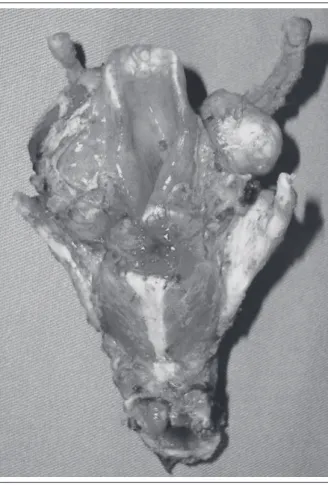
with partial obstruction of the pyriform sinus, especially on the right. CT scan showed a lesion with diffuse uptake of contrast, occupying the paraglottic and supraglottic space, crossing the midline, and greatly reducing the column of air in this region. Due to the lesion extension, previously radiotherapy treatment, patient’s age and clinical condition, the patient underwent to a total laryngectomy as the treatment of choice (Figure 3). There were no postoperative complications. The pathological investigation revealed a brown encapsulated tumor, measuring
FIGURE 3 – Surgical specimen (case 2)
Total laryngectomy product. Two well-delimited tumors, both occupying the supraglottis and the paraglottis space bilaterally are individualized.
FIGURE 4 – Microscopic appearance
On the left, hematoxylin-eosin stain, showing mesenchymal proliferation with spindle cells associated to collagen deposition. On the right and in the middle, immunohistochemistry for CD34 and bcl-2, respectively, showing strong and diffuse reactivity. Original magnification 100×.
4.8 × 3.6 × 2.4 cm, composed of two well-deined portions, the major lesion located on the left side. Macroscopy showed two grayish slightly lobulated tumors, measuring 3.6 and 1.8 cm in its major diameter, respectively. Both lesions compressed but they did not iniltrate adjacent structures. It was performed a complete resection with free and wide surgical margins. In microscopy,
supported by immunohistochemical results (Figure 4 e
Table 1), the indings were consistent with the diagnosis of solitary ibrous tumor of the larynx.
DISCUSSION
SFT is a rare entity, most often found in the thorax. It has a mesenchymal origin and it is recognized by proliferation of thin-walled blood vessels and cells that produce collagen. It is classiied within the solitary ibrous tumor-hemangiopericytoma spectrum. It was irst described in the pleura by Klemperer and Rabin in 1931(6), and subsequently in many extrapleural locations. SFT
must be included in the differential diagnosis of lesions with ibrous component, including ibromatosis, ibrous histocytoma, ibrosarcoma, synovial sarcoma, and metastatic scirrhous carcinoma. All these entities exhibit a dense ibrous collagen matrix that can reveal low T2 signal intensity in Magnetic Resonance Imaging. At CT, the tumors were highly vascularized, polypoid- to spherical-shaped, arising from the submucosa. Usually they show isoattenuation relative to the adjacent muscles. Low-attenuation areas inside the tumor may be related to cystic or myxoid degeneration or stroma areas with low contrast uptake(3).
Its clinical behavior is variable, although most of them are slow-growing, with benign course. It is dificult to differentiate them from other slow-growing mesenchymal diseases, since the diagnosis depends on architectural, cytomorphological, and immunohistochemical aspects(4). The histopathological
TABLE 2 – Summary of literature review of
larynx solitary ibrous tumor cases*
Variable n = 12 (100%)
Gender
Male 8 (66.6)
Female 4 (33.3)
Symptoms
Dyspnea 6 (50.0)
Dysphagia 2 (16.6)
Foreign body sensation 7 (58.3) AW obstruction 2 (16.6)
Dysphonia 7 (58.3)
Location
Supraglottis 11 (91.6)
Subglottis 1 (8.3)
Treatment
Partial laryngectomy 4 (33.3) CO2 laser resection 3 (25.0) Total laryngectomy 1 (8.3) Enucleation by pharyngotomy 4 (33.3)
Min-max
Age 13-77
Diameter 1.0-5.1
Average (SD)
Age 52.08 (19.96)
Diameter 2.99 (1.19)
*1 case not included (data not available) and included cases described in this paper.
n (%): relative and absolute frequency, respectively; AW: airway; min-max: minimum and maximum values; SD: standard deviation; age in years; diameter in centimeters.
cellularity, with areas of stromal hyalinization, and often associated to a hemangiopericytoma-like vascular pattern. These tumors show immunoreactivity for CD34, CD99, bcl-2, and vimentin; and are negative for cytokeratin, S-100, and smooth muscle actin(1).
When tumors develop in larynx, it usually affect middle-aged adults, like other extrapleural disease cases. Perhaps due to early presentation, most of lesions are < 5 cm in diameter(2).
It generally presents with progressive dysphonia, foreign body sensation, voice quality change, dyspnea or cough, with slow evolution of symptoms, depending on which part of the larynx is involved (Table 2).
Pedicled form is the most common presentation(3). They
do not usually destroy or invade adjacent tissues, although they may cause a mass effect that can lead to obstruction of the larynx lumen. The most affected laryngeal subsites
are epiglottis, aryepiglottic folds, ventricular folds, and commissures, areas of glottis and subglottis which have the greatest amount of submucosal soft tissue. Although the knowledge about this entity is limited, the SFT of head and neck are mostly benign and can be successfully treated by conservative surgery(2). Although not being described for SFT
patients, total laryngectomy remains as a viable treatment option, even in cases of benign tumors, especially for those with lung-related contraindications to partial laryngectomy, when we can predict dificulties with adherence by patients to follow-up routines, when dealing with recurrent tumors, or when in situations technically impeditive for conservative surgeries(9). Follow-up data of those cases are scarce. However,
recurrence is a rare event, especially in the head and neck, being observed only in extreme situations, associated with incomplete excision, and in cases with atypical or malignant microscopic features. In those cases, adjuvant radiotherapy may play a role, although the experience with this treatment modality in the management of these patients is limited to small case series(1).
Initially, the second case was thought to be a myoepithelial carcinoma of the larynx. Myoepithelial carcinoma is characterized by multilobulated architecture with polymorphic cellular structure, and may appear in spindle cells clusters, on solid and trabecular layers or reticular pattern. The immunohistochemical analysis shows expression of epithelial markers, such as keratin, epithelial membrane antigen (EMA) S100, smooth muscle markers as smooth muscle actin and calponin. Likewise, complete excision of lesion is the treatment of choice, although radiotherapy and chemotherapy may also join the therapeutic arsenal(8). The diagnosis of SFT based on
a small biopsy specimen is dificult due to wide intratumoral morphologic variation and similarities with other mesenchymal tumors(7). Diagnostic failures have already been described(10). In
theses cases, morphological and immunohistochemical features are essential in differentiating it from other entities.
CONCLUSION
RESUMO
O tumor fibroso solitário é uma neoplasia rara. Foram descritos poucos casos em cabeça e pescoço, sendo não mais de 11 na laringe. Descrevemos dois novos casos de tumor fibroso solitário da laringe, um em um homem de 64 anos e outro em uma mulher de 77 anos, ambos com lesões supraglóticas submucosas e nodulares. Os casos foram submetidos a tratamento cirúrgico e ambos apresentaram imunorreatividade a CD-34 e bcl-2, e negatividade para S-100 e actina de músculo liso. Após 24 e 22 meses de seguimento pós-operatório, respectivamente, não apresentam sinais de doença em atividade.
Unitermos: neoplasias de tecido fibroso; neoplasias laríngeas.
REFERENCES
1. ALAWI, F. et al. Solitary fibrous tumor of the oral soft tissues: a clinicopathologic and immunohistochemical study of 16 cases. USA, v. 25, n. 7, 2001.
2. ALOBID, I. et al. Laryngeal solitary ibrous tumor treated with CO2 laser excision: case report. Eur Arch Otorhinolaryngol, Spain, v. 262, n. 4, 2005. 3. CHANG, S.K. et al. CT, MR, and angiography indings of a solitary ibrous tumor of the larynx: a case report. Korean, v. 9, n. 6, 2008. 4. GANLY, I. et al. Solitary ibrous Tumors of the head and neck: a clinicopathologic and radiologic review. Arch Otolaryngol Head Neck Surg, USA, v. 132, n. 5, 2006.
5. GOLD, J. S. et al. Clinicopathologic correlates of solitary ibrous tumors.
Cancer, USA, v. 94, 2002.
6. KLEMPERER, P. et al. Primary neoplasms of the pleura: a report of ive cases. Am J Ind Med, v. 22, n. 1, 1992.
7. LO MUZIO, L. et al. Solitary ibrous tumor of the oral cavity: the need for an extensive sampling for a correct diagnosis. J Oral Pathol Med, Italy,
v. 36, n. 9, 2007.
8. REN, J. et al. Primary myoepithelial carcinoma of palate. World J Surg, China, v. 104, n. 9. 2011.
9. WENIG, B. M. et al. Inlammatory myoibroblastic tumor of the larynx. A clinicopathologic study of eight cases simulating a malignant spindle cell neoplasm. Cancer, USA, v. 76, n. 11. 1995.
10. YAMADA, H. et al. Solitary ibrous tumor of the buccal space resected
in combination with coronoidectomy. Oral Surg Oral Med Oral Pathol Oral Radiol Endod, Japan, v. 114, 2012.
MAILING ADDRESS
Adriana Muradás Girardi