Nursing consultation for the elderly: instruments of communication
and nursing roles according to Peplau
Consulta de enfermagem a idosos: instrumentos da comunicação e papéis da enfermagem
segundo Peplau
Consulta de enfermería para la tercera edad: instrumentos de comunicación y los papeles de la
enfermería según Peplau
Juliana Paiva Góes da Silva1 Káia Nêyla de Freitas Macêdo Costa2
Grazielle Roberta Freitas da Silva3
Simone Helena dos Santos Oliveira2
Paulo César de Almeida4
Maria das Graças Melo Fernandes2
1. Internaional School of
Paraíba/Laureate Internaional Universiies. João Pessoa - PB, Brazil.
2. Federal University of Paraíba.
João Pessoa - PB, Brazil.
3. Federal University of Piauí.
Teresina - PI, Brazil.
4. State University of Ceará.
Fortaleza - CE, Brazil.
Corresponding author:
Juliana Paiva Góes da Silva. E-mail: [email protected]
Submited on 10/06/2013. Accepted on 11/25/2014.
DOI: 10.5935/1414-8145.20150021
A
bstrActObjective: The main objective of this study was to identify the tools of communication and roles developed by nurses in
interaction with seniors, according to the Peplau's theory. Methods: This is a descriptive research with a quantitative approach,
performed by the footage of nursing consultations between May and September 2011 in basic health units in João Pessoa - PB.
Results: It was proven that Nurses were using the instruments highlighted by Peplau, especially listening to other. Concerning
the roles described by the theoretical model, the most identiied were the roles of substitute and leader. Conclusion: The data
relect the formation of links between professionals and the community. However, we need to ind an efective communication during nursing care, making it possible for the patient to conceptualize their problems and, based on the understanding of their health status, use appropriate interventions, seeking to quality of care.
Keywords: Nursing; Communication; Aged; Primary Health Care; Nursing Theory.
r
esumoObjetivo: Este estudo teve como objetivo identiicar os instrumentos da comunicação e papéis desenvolvidos pelos enfermeiros
na interação com idosos, de acordo com a Teoria Peplau. Métodos: Trata-se de uma pesquisa descritiva com abordagem
quantitativa, realizada por meio de ilmagens das consultas de enfermagem realizadas entre maio e setembro de 2011, em unidades básicas de saúde, em João Pessoa - PB. Resultados: Constatou-se que os instrumentos enfocados por Peplau
são utilizados pelos enfermeiros, destacando-se a escuta. Em relação aos papéis descritos pela teórica, os mais identiicados foram os de substituto e de líder. Conclusão: Os dados reletem a formação de vínculos entre proissionais e a comunidade.
Porém, é preciso buscar uma comunicação efetiva durante o cuidar em enfermagem, possibilitando ao paciente conceituar seus problemas e, a partir do entendimento do seu estado de saúde, empregar as intervenções adequadas, buscando-se a qualidade da assistência.
Palavras-chave: Enfermagem; Comunicação; Idoso; Atenção Primária à Saúde; Teoria de Enfermagem.
r
esumenObjetivo: Identiicar los instrumentos de comunicación y papeles desarrollados por enfermeros en la interacción con ancianos,
según la Teoría de Peplau. Métodos: Investigación descriptiva con enfoque cuantitativo, llevado a cabo a través de la ilmación de
las consultas de enfermería realizadas entre mayo y septiembre de 2011, en unidades básicas de salud en João Pessoa, Paraíba.
Resultados: Se observó que los instrumentos dirigidos por Peplau son utilizados por los enfermeros, destacándose la escucha.
En relación con los papeles descritos por la teoría, los más identiicados fueron los de sustituto y de líder. Conclusión: Los datos
relejan la formación de enlaces entre los profesionales y la comunidad. Sin embargo, es necesario buscar una comunicación efectiva durante el cuidado de enfermería que permite a los pacientes conceptualizar sus problemas y, a partir de la comprensión de su estado de salud, emplear intervenciones apropiadas, buscando la calidad de la atención.
INTRODUCTION
Communication is the process of transmitting and recei
-ving information on the relationships that occur during diferent phases and situations in life. The quality of relations signii
-cantly inluences thoughts and actions, as well as leads to the understanding of concepts, principles and skills that compose human existence1.
It is observed that it is by means of communication es
-tablished in nurse/patient relationship that is possible to fully understand the patient, seeking to understand his worldview and his attitudes. Therefore, it is necessary to pursuit of knowledge about the subject to direct the use of communication in various situations of care.
Restricting to the elderly, it is known that professionals should use appropriate resources to the care of this audience, as well as perform actions according to the population proile, aiming thus to implement an efective assistance. This requires training for professionals who have a diferent point of view of the elderly, aiming not only to promote the longevity of the human being, but providing this population a healthy aging, with a service aimed at the maintenance and adaptation of their routine2.
According to the Ministry of Health, for 2050, it is expected that, in Brazil, there will be more elderly than children under 15 years old, a phenomenon never observed before. This increase in the number of elderly raises the need for health services organized with the purpose of supporting the demand mainly to procedures and consultations with various professionals, since it must ensure health care for the entire population, including the elderly3.
Regarding the assistance in health primary care the nur
-sing consultation is highlighted. This is a modality of assistance needed, inserted in the context of primary care that allows a systematic and continuous monitoring of the user, favoring the link with the community, multidisciplinary work and interpersonal relationship of the professional with the client and family2.
The relevance to investigate the topic of communication is evident and health professionals, especially nurses, need to be prepared to deal with the elderly and perform a multidimen
-sional assessment. This would view the various aspects that inluence their well-being, with regard to the development of their autonomy, their capacity for social interaction, their level of independence to carry out daily activities, as well as their self-realization4.
One of the ways to develop the professional knowledge and skills in communication is deepening in nursing theories, since those would provide the nursing scientiic character, for making rational and systematic practice, which promote the formation of a moral/ethical framework to guide actions, providing an organi
-zed structure to the knowledge that, initially, it was just intuitive5. Among the theories of nursing, in this context, the geriatric interpersonal relationship of Hildegard E. Peplau is highlighted,
covering nursing as an interpersonal process, consisting of four phases, and describing the diferent roles exercised by professionals during the implementation of assistance. In this theory, the focus is the interpersonal relationship between nurse and patient, whose purpose is to seek the answer to the need to help them, aiming at the identiication and resolution of health problems.
The theory emphasizes that the nurse should use the to
-ols of communication: listening clariication and acceptance, and that nursing has six key roles: strange, resource provider, teacher, substitute leader and advisor. These functions per
-formed by nursing emphasize practices that the nurse must exercise when relating to people. This occurs according to the needs highlighted in interpersonal relationship established in the nursing care6,7.
Based on what has been exposed, the interest in dee
-pening the knowledge about communication emerged, more speciically, the communication on nurses' interaction with elders, which occurs in the basic health units. In this sense, it is observed the relevance in conduct studies geared to this clients in order to deepen and disseminate knowledge targe
-ted to this population, as well as, contributing to improving the quality of care to individuals with 60 years old or more, in the health sectors. Given the above, this research aimed to identify the instruments of communication and roles developed by the nurses in the interaction with the elderly, according to Peplau.
METHOD
It is a descriptive research with quantitative approach, focu
-sed on the interactions established between nurses and elderly, during the consultations held in basic health units located in the municipality of João Pessoa.
Basic health units of this municipality are territorially dis
-tributed in ive Sanitary Districts, which cut the entire length of the city. In Sanitary District I, there are ifty units; in the District II there are forty; in the III, 52; in the IV, 22, and the District V has 18 units. These data result in 182 family health units, with a team of health each one.
For the realization of the study, the Sanitary District III was selected, because it constitutes the ield of practical implemen
-tation of the activities of the University, with which this research is linked.
The inclusion criteria in the sample for nurses were: to be part of the basic care assistance; to be present at the time of collection and accept to participate by signing the consent term and the term of Granting of Images. For the users, the inclusion criteria were: to be part of the community assisted by the basic unit; to be less than 60 years old; to be waiting for a consultation of Hiperdia or spontaneous demand with the nurse, and, at the time of data collection, to accept to participate by signing the consent term.
the research, not being present at the time of data collection. For users, the exclusion criteria were: being less than 60 years old, not being agree to participate in the research, present any limitation that prevents communication and interaction with the nurse.
The contact with the nurses of the institution was made in advance, in order to invite them to participate in the study and to obtain the oicial accepted, through the signing of the consent terms and of granting of image and sound. Of 52 nurses from the District III, seventeen denied the participation; two were on leave, and enjoyed holidays in time of collection, so that only 32 met the inclusion criteria and participated in this study. Thirty-two elderly people who were assisted by these Nurses, also participated during the period of ieldwork.
The data collection of this study was carried out from May to September 2011, through footage of nursing consultations with elderly, enabling the registration and storage of data by image and sound. This method ofers some advantages for the researchers: to review the material collected as many times as it takes and, also, to obtain a certain degree of accuracy, since it is possible to analyze everything that was collected, without losing the details of the registered material8.
The instrument used for the analysis of the footage was built based on the theory of interpersonal relationship of Peplau, containing questions directed at nurses, referring to the interac
-tional process, verifying the implementation of the instruments of communication: a) listening; b) clariication; c) acceptance, and the performance of the six roles exercised by the nursing: a) strange; b) provider of resources; c) professor; d) leader; e) substitute; f) advisor. In view of the prerequisites and having gone through the process of validation of the content required by the study, the footage made with the nurse becomes legitimate to the analysis. For each item of the instrument, there were ive possi
-bilities for classiication of nurses' interaction and users during the research: it does not apply at the time; bad; regular; good and excellent. The validation was made, subjecting the instrument to the evaluation of three experts in the ield of communication. The number of specialists is justiied to avoid dubious questions in the circumstance of a tie9.
For the analysis of the footage, three nurses were invited and trained by the researchers to be judges. The training of judges was conducted according to the following steps: a) project of research exposition and of the theory of Peplau interpersonal relationship; b) presentation of the instrument to subsidize the production observed in the footage; c) use of footage-tests for the instrument illing exercise.
The analysis was performed by illing up an instrument every minute, from observation of each consultation performed by nurses participating in the research. The data were processed in Statistical Package for Social Sciences (SPSS) 18.0; analyzed through descriptive statistics, through relative frequency tables and percentages, and validated by the Chi-square tests of reason of verisimilitude and Cronbach's alpha.
For the completion of the research, the ethical observances were considered, included in guidelines and regulatory norms for research involving human beings, Resolution 196/96 of the Natio
-nal Health Council, especially as regards the free and informed consent of participants, secrecy and conidentiality of the data.
All research participants signed an informed consent term, as well as the term of granting of image and sound, in two copies, guaranteeing them using the material and data collected in the research, exclusively for the intended purpose. The images were used only for data analysis relating to the research.
It is worth mentioning that the research project was transferred to the Research Ethics Committee of the Hospital Universitário Lauro Wanderley (HULW), having been approved in April 5, 2011, under Protocol Number 091/2011, being also requested authori
-zation from the Director/responsible for the municipal basic units selected for the research.
RESULTS
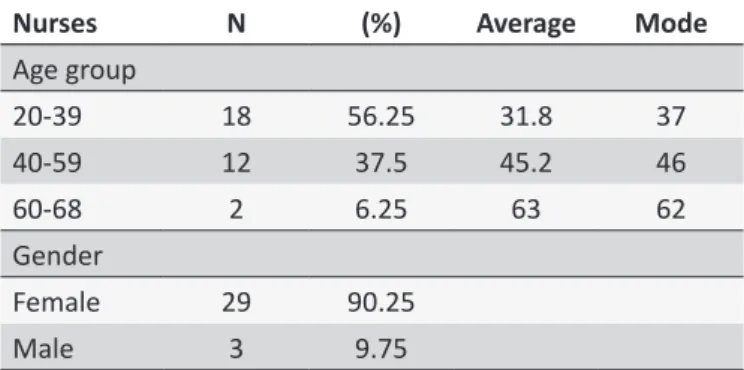
There were 468 minutes of footage, which corresponded to an average of 14.6 minutes per consultation. Below, there are the tables that correspond to the characterization of the participants. In table 1, there are data related to gender and age group of nurses participating in the study.
Table 1.
Proile of nurses paricipaing in the research, 2012
Nurses
N
(%)
Average
Mode
Age group
20-39
18
56.25
31.8
37
40-59
12
37.5
45.2
46
60-68
2
6.25
63
62
Gender
Female
29
90.25
Male
3
9.75
In relation to age, 12 (15.62%) were between 20 and 39 years old; 18 (56.25%) between 40 and 59, and 2 (6.25%) between 60 and 68 years old. As regards the gender, 29 (90.25%) were female, and 3 (9.75%) male.
In table 2, the proile data of the elderly participants in the study. As for the age group of the elderly, 21 (65.63%) were be
-tween 60 and 69; 8 (25%), be-tween 70 and 79, and 3 (9.37%) between 80 and 83 years. As regards the gender, 65.63% (21) of the sample were composed of women, and 34.37% (11), of men. Below, there are data regarding communication tools used by the nurses and the roles exercised by the nursing during the consul
Table 2.
Proile of the elderly paricipants in the research,
2012
Elderly
N
(%)
Average
Mode
Age group
60-69
21
65.63
65.1
64
70-79
8
25.00
73.6
75
80-83
3
9.37
81.3
82
Gender
Female
21
65.63
Male
11
34.37
Table 3.
Classiicaion of communicaion according to the communicaion instruments used by the nurse: listening,
Clariicaion and Acceptance. João Pessoa - PB, 2012
Classiicaion
Bad
Regular
Good
Excellent
Total
Alpha de Cronbach*
Instruments
N
(%)
N
(%)
N
(%)
N
(%)
N
(%)
Listening
24
2.03
257
21.69
745
62.87
159
13.42
1185
100.00
0.786
Clariicaion
44
4.39
200
19.96
473
47.21
285
28.44
1002
100.00
0.785
Acceptance
4
0.41
131
13.45
757
77.72
82
8.42
974
100.00
0.789
* p < 0.0001.
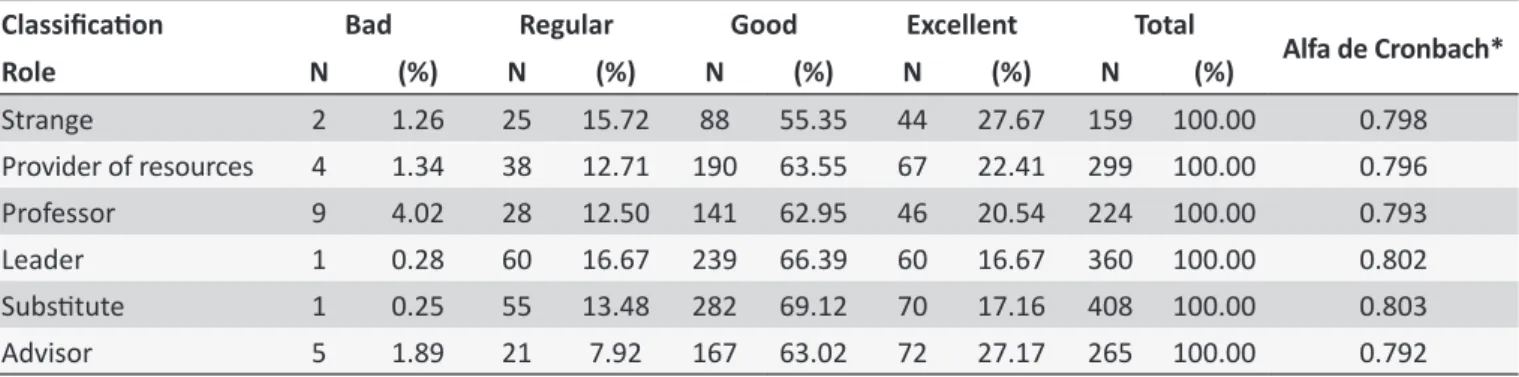
Table 4.
Classiicaion of communicaion according with the roles developed by the nurse. João Pessoa - PB, 2012
Classiicaion
Bad
Regular
Good
Excellent
Total
Alfa de Cronbach*
Role
N
(%)
N
(%)
N
(%)
N
(%)
N
(%)
Strange
2
1.26
25
15.72
88
55.35
44
27.67
159
100.00
0.798
Provider of resources
4
1.34
38
12.71
190
63.55
67
22.41
299
100.00
0.796
Professor
9
4.02
28
12.50
141
62.95
46
20.54
224
100.00
0.793
Leader
1
0.28
60
16.67
239
66.39
60
16.67
360
100.00
0.802
Subsitute
1
0.25
55
13.48
282
69.12
70
17.16
408
100.00
0.803
Advisor
5
1.89
21
7.92
167
63.02
72
27.17
265
100.00
0.792
* p < 0.0001.
In table 4, the most identiied role, during the research, was the substitute, carried out in 408 interactions, in which 69.12% were classiied as good and 17.16% as excellent. The strange role was the less present, registering 159 times, and classiied as good at 55, 35%, and excellent at 27.67%. It is worth mentioning that this role had the excellent topic with the greatest percentage of classiication.
The role with higher percentage of classiication as bad, compared to the others, was the professor (4.02%). The role of leader had the regular item with highest percentage of clas
-siication (16.67%), being the second most performed, which resulted in a total of 360 interactions and, also, was the second classiication as good (66.39%). The roles provider of resources and advisor were mostly classiied as good, corresponding, respectively, to 63.55% and 63.02%.
DISCUSSION
The proile of nurses inserted in the research still is a relec
-tion of the historical events of the profession, commonly found in Brazil, involving the female gender. Although they have obser
-ved increase in the number of men, over the past 10 years10. In relation to the demand for health care by the elderly, according to the proile of the participants entered in the sample, there is still a predominance of females.
Considering the assumptions of the theory of interpersonal relationships, used for the analysis of this study, the instruments of communication highlighted were: listening, clariication and acceptance. It should be noted that, in all the communication instruments, there was high reliability between the judges nurses, according to Cronbach's alpha, above 0.7 (Table 3).
The realization of listening by the nurses participants, has been classiied by judges as good and excellent in its majority (76.29%) However, it was possible to identify, as well, during analysis of the footage, times when the nurse has not achieved this communication instrument properly, due to the need to carry out technical and administrative procedures. In this way, listening was also classiied as bad and regular, with percentages of 2.03%, and 21.69%, respectively.
user completes his exhibition, consisting of values that are close, but with valuable information for the professional11.
In this understanding, it was observed the emphasis given to this instrument of communication, which allows the user to express their perceptions, feeling valued in interpersonal relationship with the nurse. Through listening, it is possible to recognize the needs of others, understand their world and their reality within the context in which they live12.
On assistance to the elderly, in addition to the therapy focu
-sed on exams and procedures that act on physical aspects, the professional should consider emotional aspects such as afective deprivation that surround him. Thus, the importance of apprecia
-ting how to interact and communicate, especially with regard to listening, because the elderly have peculiarities and their need for emotional security is a reality13.
For the clariication, identiied in many interactions (Table 3), it allowed explaining the information provided during the assis
-tance, to broaden the understanding of the elderly. A technique that can be used by professionals to assist in this instrument is called as clariication, which aims at the use of comparisons and deinition of terms to broaden the understanding of information14. It was noted, in the course of the research, that the clarii
-cation was present in the consultations, mostly being classiied (47.21%) as good by the judges. However, it was possible to detect, also, that some nurses did not use this instrument of com
-munication efectively, which can greatly hinder the understanding of the elderly about their state of health and care that must be performed to their well-being.
Two factors, identiied during the analysis, which may have hampered the efectiveness of clariication as an instrument of communication, were: the induction of responses, that is, the way the nurse asks the elderly interferes with the response, and the assumption of the understanding of the message, that is, to not verify that the elderly understand what was said14.
It was also highlighted, due to the aging process, that the el
-derly may have psychological and physical declines that interfere in the cognitive process and, when added to undue actions of professionals, compromise the ability of understanding. Thus, the need to use strategies to enhance communication with the clients, such as, use short sentences and objective; use appropriate lan
-guage; ask if they understood well the explanation; not to interrupt their speech and repeating the information, when necessary3,11. With regard to acceptance, communication instrument less present in this study (Table 3), it is deined as the ability of nurses to accommodate the patient without the use of pre-designed trials, during the establishment of the interpersonal relationship. The attitude of acceptance of the nurse on the patient is inluenced by their worldview, by culture, religion and race, by educational background and expectations6.
The nurses participants showed to accept the elderly, not using previous insights about users to direct the interpersonal relationship in the consultation, being the highest percentage classiied as good (77.72%). In this way, the elderly felt conident
to interact with nurses, and professionals could act, ofering elements for the care of their health.
For the efectuation of the hosting of the elderly person, the nurses should understand the speciics of this population, consi
-dering their life story, since, with the experiences, people become generally wiser, developing greater sense of dignity and prudence and expect to be recognized for that. The host strengthens the bond between people, values the individual health care, as well as provides a relective action and ethical and solidarity-based development to listen and engage in dialogue, generating pro
-fessional satisfaction and users15.
As regards the roles (Table 4) which may be exercised by the nursing, focused by Peplau in his theory, these occur according to the dynamics of interpersonal relationship, and the nurse takes one of these roles in seeking to meet the needs of the pa
-tient, exerting therapeutic posturing. With that, the professional skills are being targeted as the interaction develops during the consultation.
It should be noted that occurred high reliability of the answers of the judges nurses when evaluating the images on this aspect, shown by Cronbach alpha value (Table 4).
Concerning the role of the stranger, the nurse, when perfor
-ming it, he develops the irst contact with the user, without judging their behavior, respecting their distance needs and viewing the report as a person emotionally able. This role requires the nurse that he set aside any stereotypical image he has about the elderly and develop a therapeutic relationship free from prejudgments. In this way, the professional should explore all potential demons
-trated by the user in order to use them in favor of the relationship established between nurses and elderly and treatment planned for the balance of their health.
In the consultations, the role of stranger, when performed by the nurses, was rated as good and excellent at 83.02% of them, mainly the classiication in good (55.35%). It is highlighted that by comparing it with others, this role was the least registered, since most elderly already knew the nurses and were accompanied by the professionals of the unit. This is because the basic health care aims at continuity of care and to bond with the team that is, the efective guarantee of care over time, especially in assisting the elderly person.
In this way, it is up to the professional to prioritize a thera
-peutic relationship since the irst contact with the elderly, once the irst interaction is fundamental for the development of the other, because, if the elderly stay with a negative impression of the nurse, the next interactions may be compromised, afecting also their monitoring by the health team.
In the elderly care, when the professional assists user's requests, developing a feeling of conidence in the health servi
-ce, and also going more to the unit, strengthening the link with the health service, involving the whole family in order to use the service, in addition to becomes socially end of the socio-political process. This relects one of the pillars of the basic care, since the assistance is made continuously by the health team and search the eicaciousness of the problems identiied in the community. Studies show that the use of health services by the elderly, in basic care, depends on the resolution presented by professionals and that the health needs of this population are comprehensive, including home care, actions geared toward chronic diseases, interventions for psychological aspects, etc. It is understood, therefore, that the care of the elderly person must be based on a general assessment2.
As regards the role of professor, Peplau believes that the nurse, in exercising this function transmits information to the user, always advancing from their prior knowledge and thus helping the learning process about the aspects related to health, as promoting their active participation in their experiences. Thus, the theory deines the professor, as an educator, in which the focus of their activities is the user's learning.
Concerning this, the nurse, in the execution of their duties, performs mainly the function of educator. Health education se
-eks not only the construction of a health consciousness able to reverse the population health framework, but intensifying popular participation in health care16.
It became evident during consultations, that nurses helped the elderly in learning new behaviors concerning their health and that they played that role positively, 62.95% classiied as being good and 20.54% as excellent. However, in comparison with the others, it was the highest percentage of bad (4.02%) showing that there are still gaps mean interaction with elderly.
The elderly person may present diiculties for learning new knowledge, since limitations arising from the aging may com
-promise its ability to assimilate or habits that he performs with regard to health are so ingrained that prevent change of manners. This reinforces the need to apply professional knowledge from the information that the elderly have, so he can assimilate and accept more easily new habits.
The role of leader occurs when the nurse is able to ob
-serve and to understand the situation that afects the patient, understand what happens and appreciate the development of interpersonal relationship, targeting goals. It should be noted that the nurse, by exercising leadership role, must be in a democratic process, in which professional and user be participating, even if nurses are leaders. This role was the second most played by research nurses, having the highest percentage classiied as good (66.39%).
The leadership transcends formal positions, or positions be
-cause it is due to a spontaneous and informal tuning established between people. The fundamental in the process of leadership
is the appreciation of other people's action, in this case, the elderly17. In exercising the leader role, the nurses motivated the autonomy of the elderly, encouraging them to develop health actions previously planned during the nursing consultation, in order to continue the treatment efectively.
The nurse must preserve the active participation of the elderly person in the relationship, considering their beliefs and desires and bringing him to the planning of assistance. Health professionals play an important role in maintaining the autonomy of these clients since they can stimulate the elderly to perform certain daily activities, considering, of course, the limit imposed by the aging process.
Some strategies cooperate in the promotion, maintenance or maximization of autonomy and independence of the elderly population, such as allow and encourage the elderly to perform personal care tasks; to discover their strengths and thus incre
-asing their chance of participation in assistance; to respect their personal space and territorial cohesion; to provide time for their speech and display of feelings and concerns13.
The role of substitute, according to Peplau, occurs when the nurse is viewed as someone close to the user and is located in the place of another signiicant person, since he associates the characteristics of nurses at other people, feeling, then, supported by the professional.
In this sense, it is reairmed the commitment of the nurse as caregiver, to value the relationship with the user, making signii
-cant and therapeutic interaction, which highlight the modiication of nursing care in a more humane and welcoming practice1.
The role of substitute was the most played, since it is very common to occur the nurse's association with people that the elderly already have related or with someone who is represen
-tative for them. When performing it, the nurses had the good rating in 69.12%, and excellent in 17.16% of cases. In some consultations, the elderly have shown enough conidence in the nurses, associating them to the people closest to the point of reporting information deemed sensitive and showing their love through afectionate and accolades gestures. In this way, to play the role of substitute can contribute to strengthen the professional relationship with the elderly.
In relation to the role of advisor, it occurs when the pro
-fessional offers nursing care to meet their needs, using tech
-nical skills. Among the interventions performed by nurses, to provide assistance to the elderly, there are in the research, guidelines on nutrition; recommendation for physical activity; instructions on the use of medicines; planning to return in the consultation; request of examinations; checking blood pressure and capillary blood glucose. The interactions in that role was identified in the study, 90.19% were rated positively, between good and excellent.
turn are biological, psychological, social dimensions and thus, cultural health actions should not only focus on the pathology, but prioritize the promotion, maintenance and restoration of health. To respect the independence and encourage the participation of the elderly subject in the process of care, can also encourage qualiied assistance4.
The nursing profession has a fundamental role in assisting in the context of basic care, since he uses tools to promote health and to seek new perspectives more humanized care with people, especially with the elderly, who often are not valued by society due to their stereotypes18.
In this sense, the nurse has to be prepared to interact with the elderly, and facilitate their access to health services, as well as guide them in order to develop their autonomy and self-care. To do this, they must establish a therapeutic relationship, using the instruments of communication and performing their diferent roles in the care of the elderly.
With respect to the limitations of the research, there are interferences in the interaction between nurse and elderly due to the use of camcorders, the limitation of the researchers in the use of footage equipment and restricted the time to organize and assemble the equipment.
CONCLUSION
This study allowed us to identify the roles played by the nurses and the communication instruments used for them in the interaction with the elderly from the analysis, based on the assumptions of the theory of Peplau nursing consultations, recorded, conirming the scope of the objective proposed by this research.
It was possible to observe that the judges, generally as good, ranked the communication between nurses and elderly, with regard to the instruments of communication and roles exercised by the nursing. However, they are still checked gaps, since the results are classiied as regular and bad attitudes, which must be avoided in order to reach the excellence of interactions on nursing care to the elderly.
Thus, as the professionals seek to improve the quality of interactions, communication between nurses and elderly, in basic care, it becomes more eicient, making it possible to meet the needs of this population. Among the instruments featured in this investigation, nurses have identiied the listening as the most widely used therapeutic action.
The roles performed by the nurse were exercised in accor
-dance with the needs of the elderly, given the dynamics of inter
-personal relationships. One of the functions that can be exercised by the nursing, the research participants assumed, most of the time, the substitute and leader role, followed by the provider of resource, advisor, professor and strange, respectively.
There were some diiculties related to the use of footage, requiring a larger preparation of researchers with regard to the use of equipment, but also agility for pre-assembly in the data
collection environment in order to ensure the record. It is no
-teworthy that this method enabled the detailed observation of the phenomenon investigated, enriching it with pertinent information to the subject under study, in addition to enabling further research and/or use of archived images as educational material, conside
-ring all the bioethical principles.
In this way, the study about this issue contributed to the knowledge of the importance of communication in the context of care for the elderly, emerging from their perception of the need to inform to society and, above all, encouraging the training of health professionals in this area to the conscious use of communication skills, so that the professionals interact better with the elderly. It is highlighted therefore, the need of development of future research in the area, applying the assumptions of Peplau's theory in other scenarios of care, as well as the deepening of the context of communication with elderly people in basic health care.
REFERENCES
1. Razera APR, Braga EM. A importância da comunicação durante o período de recuperação pós-operatória. Rev. Esc. Enferm. USP. 2011 jun;45(3):632-7.
2. Oliveira JCA, Tavares DMS. Atenção ao idoso na estratégia de saúde da família: atuação do enfermeiro. Rev. Esc. Enferm. USP. 2010 set;44(3):774-81.
3. Brasil. Ministério da Saúde. Secretaria de Atenção à Saúde. Departamento de Atenção Básica. Envelhecimento e saúde da pessoa idosa/Ministério da Saúde, Secretaria de Atenção à Saúde, Departamento de Atenção Básica. Brasília (DF): Ministério da Saúde; 2006.
4. Saccomann ICR, Cintra FA, Gallani MCBJ. Qualidade de vida relacionada à saúde em idosos com insuiciência cardíaca: avaliação com instrumento especíico. Acta paul. enferm. [periódico na internet]. 2011 jun; [citado 2013 jun 06]; 24(2): [aprox.7 telas]. Disponível em: http://dx.doi.org/10.1590/S0103-21002011000200004.
5. Mcewen M, Wills EM, organizadoras. Bases teóricas para enfermagem. Tradução Ana Maria Thorell. 2ª ed. Porto Alegre (RS): Artmed; 2009. 6. Peplau HE. Interpessoal relations in nursing: a conceptual frame of
reference for psychodynamic nursing. [S.l.]: Houndmills, Basingstoke, Hampshire Macmillan; 1988.
7. Gurgel PKF, Tourinho FSV, Monteiro AI. Consulta coletiva de crescimen -to e desenvolvimen-to da criança à luz da teoria de Peplau. Esc Anna Nery. 2014 set;[citado 2014 out 14];18(3): [aprox.8 telas]. Disponível em: http://www.scielo.br/scielo.php?script=sci_arttext&pid=S1414 --81452014000300539&lng=en. http://dx.doi.org/10.5935/1414-8145.20140077.
8. Garcez A, Duarte R, Eisenberg Z. Produção e análise de vídeo -gravações em pesquisas qualitativas. Educ. Pesqui. [on line]. 2011 ago;[citado 2014 out 14];37(2): [aprox.7 telas]. Disponível em: http://www.scielo.br/scielo.php?script=sci_arttext&pid=S1517 --97022011000200003&lng=en&nrm=iso.
9. Hino P, Ciosak, SI, Fonseca RMGS, Egry EY. Necessidades em saúde e atenção básica: validação de instrumentos de captação. Rev. Esc. Enferm. USP. 2009 dez; 43(n. spe 2):1156-67.
10. Moreira DS, Magnago RF, Sakae TM, Magajewski FRL. Prevalência da síndrome de burnout em trabalhadores de enfermagem de um hospital de grande porte da Região Sul do Brasil. Cad. Saude Publica. 2009 jul;25(7);1559-68.
12. Braga EM, Silva MJP. How Communication experts express communi -cative competence. Interface: Comunicacao, Saude, Educacao. 2010 sep. 14(34):529-38.
13. Prochet TC, Silva MJP, Ferreira DM, Evangelista VC. Afetividade no processo de cuidar do idoso na compreensão da enfermeira. Rev. Esc. Enferm. USP. [on line]. 2012 fev;[citado 2013 set 17];46(1):[aprox.8 telas]. Disponível em: http://www.scielo.br/scielo.php?script=sci_artt ext&pid=S0080-62342012000100013
14. Stefanelli MC, Carvalho EC, organizadoras. A comunicação nos diferentes contextos da enfermagem. 2ª ed. Barueri (SP): Manole; 2012.
15. Santos IMV, Santos AM. Acolhimento no Programa Saúde da Família: revisão das abordagens em periódicos brasileiros. Rev. saude publica. 2011 ago;13(4):703-16.
16. Gomes LB, Merhy EE. Compreendendo a educação popular em saúde: um estudo na literatura brasileira. Cad. Saude Publica. 2011 jan; 27(1); 7-18.
17. Silva VLS, Camelo SHH. A competência da liderança em enfermagem: conceitos, atributos essenciais e o papel do enfermeiro líder. Rev. enferm. UERJ. 2013 out/dez; 21(4):533-9.