How Are Web Characteristics Evolving?
João Miranda
Foundation for National Scientific Computing 1708-001 Lisboa
Portugal
[email protected]
Daniel Gomes
Foundation for National Scientific Computing 1708-001 Lisboa
Portugal
[email protected]
ABSTRACT
The Web is a hypertextual environment in permanent evo-lution. There are new technologies and Web publishing be-haviors emerging everyday. This study presents trends on the evolution of the Web, derived from the comparison of two characterizations of a web portion performed within a 5 year interval. The Portuguese Web was used as a case study. Several metrics regarding content and site character-istics were analyzed.
Categories and Subject Descriptors
H.3.5 [Information Storage and Retrieval]: Online In-formation Services—Web-based services; H.3.7 [ Informa-tion Storage and Retrieval]: Digital Libraries— Collec-tion; C.2.5 [Computer-communication Networks]: Lo-cal and Wide-Area Networks—Internet
General Terms
Experimentation, Measurement
Keywords
Web trends, Web characterization, Web measurements
1.
INTRODUCTION
The Web is prone to suffer significant changes on its char-acteristics with a short notice, affecting, for instance, the media types most commonly used for publication. It is im-portant to keep track of trends on the evolution of the Web to develop efficient tools for processing its data. However, it is impossible to gather an instant snapshot of the whole Web. Therefore, Web characterization studies are limited to the analysis of selected Web portions.
This study presents a new characterization of a Web por-tion derived in 2008, presenting measurements for metrics that were not studied in previous works and that can be used as baseline for future trend analysis. It also compares the obtained results with previous studies to derive evolu-tion trends. The Web porevolu-tion used as a case study was the Portuguese Web. Although a national Web may present pe-culiar characteristics, such as language dominance, there are prevalent characteristics across Web portions. According to Baeza-Yates et al., there are characteristics shared across
Copyright is held by the author/owner(s).
HT’09,June 29–July 1, 2009, Torino, Italy. ACM 978-1-60558-486-7/09/06.
countries and valid for the global Web, such as URL length or HTTP responses distributions [1]. Thus, we believe that the measurements obtained for the Portuguese Web reflect the trends of the global Web.
2.
METHODOLOGY
The new Web characterization results presented in this study were extracted from a crawl performed in 2008 by the Portuguese Web Archive [4], including all media types. We named this crawl allmedia08 and used two previous studies as baseline to derive trends. The first study pre-sented a thorough characterization of the Portuguese Web derived from a crawl of 3.2 million textual contents per-formed in 2003 to feed a search engine [5], which we named
textual03. The second study presented the most prevalent media types on the Portuguese Web, based on a crawl from 2005 [3], which we named allmedia05. When comparing results from allmedia08 with textual03, we considered only the subset of textual media types harvested in both crawls. We named as textual08 this subset of contents from all-media08. The characteristics obtained from allmedia05 and allmedia08 were compared directly.
3.
CONTENTS
The number of contents downloaded was 48 718 404 in a total amount of 2.5 TB of data. The URL length of con-tents is a feature used in search engine ranking algorithms to identify relevant results [2]. After 5 years, the median URL length increased from 54 to 60 characters and the average from 62 to 72.9.
Analyzing trends on content sizes is useful to estimate the resources required to create Web data repositories. Size distribution for textual contents is similar between textual03 and textual08. After 5 years, the average size for text/html
pages grew from 21 KB to 30 KB and except forpowerpoint,
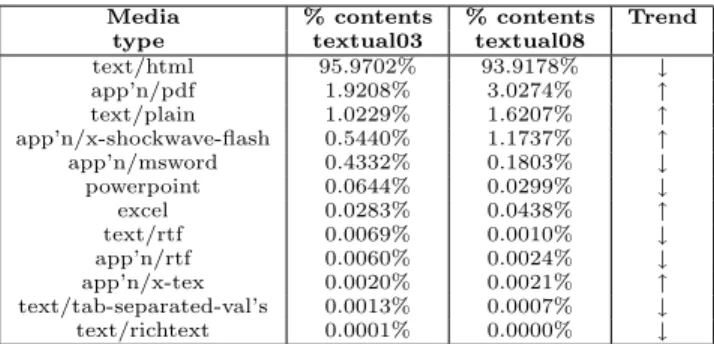
text/rtf and text/tab-separated-values, the content size for all media types tends to grow.
Media % contents % contents Trend
type textual03 textual08
text/html 95.9702% 93.9178% ↓
app’n/pdf 1.9208% 3.0274% ↑
text/plain 1.0229% 1.6207% ↑
app’n/x-shockwave-flash 0.5440% 1.1737% ↑
app’n/msword 0.4332% 0.1803% ↓
powerpoint 0.0644% 0.0299% ↓
excel 0.0283% 0.0438% ↑
text/rtf 0.0069% 0.0010% ↓
app’n/rtf 0.0060% 0.0024% ↓
app’n/x-tex 0.0020% 0.0021% ↑
text/tab-separated-val’s 0.0013% 0.0007% ↓
text/richtext 0.0001% 0.0000% ↓
Table 1: Prevalence of media types and trend in textual03 and textual08.
0% 10% 20% 30% 40% 50%
1
]1-1
0]
]1
0-100]
]100
-100
0]
>100
0
Number of contents
Pe
rc
e
n
ta
g
e
o
f
s
it
e
s
textual03
textual08
allmedia08
Figure 1: Distribution of the number of contents per site for textual03, textual08 and allmedia08.
same trend stands when comparing textual03 and textual08, as can be seen in Table 1.
Measuring the duplication of contents influences the choice of storage systems according to their duplicates elimination features. During the crawl of allmedia08, a SHA1 digest was generated for each content. Approximately 48.7 million contents were crawled for 40 million distinct digests. This means that 17.7% of the contents were duplicates, repre-senting 15.2% of the total amount of data downloaded. The obtained results show that most contents are unique (92.8%) and that most duplicated contents occur twice (5.1%). The
text/html type is responsible for 38.1% of the duplicates. The CSS and JavaScript contents are commonly duplicated instead of being reused, presenting 57.9% and 38.1% of du-plicates caused by duplication within the same site, which in-hibits the advantages of sharing files from these media types across pages [6].
4.
SITES
A site was considered valid if it returned a 200 response code to at least one request. In allmedia08, the total number of sites visited was 484 398 and 74.6% of them were valid.
Figure 1 presents the distribution of contents per site for textual03, textual08 and allmedia08. A site has on average 134.9 contents, with a median of 5 contents. Sites are typ-ically small, 87% presented less than 100 contents. After 5 years, the average size increased from 70 to 95.8 contents.
The percentage of successful responses returned by a site is an indicator of its quality. A site that presents a large percentage of broken links mines the trust of its users. On
average, in allmedia08 each site returned OK responses (200 status code) to 75% of the requests. If every Successful (200 to 206) and Redirection (300 to 307) response codes are also considered as successful responses, this number increases to 82.4%. One may argue that larger sites are harder to main-tain and should present a higher rate of broken links. How-ever, the correlation factor found between site size and OK responses was 0.06, and 0.04 between site size and Successful and Redirection responses. This shows that there is no re-lation between site size and successful response percentage. Measuring the distribution of sites across IP addresses is useful to define politeness policies for crawling: a crawler may be set to respect a courtesy pause between requests to the same IP address to avoid server overload. Regarding the distribution of sites hosted per IP address, the obtained results show that, on average, each IP address hosts 4 sites (median of 1). Only 2% of the IP addresses host more than 10 sites. The distributions for textual03 and allmedia08 are similar. However, there is a slight increase in the number of IP addresses that host only 1 site. The obtained results show that, in general, crawling courtesy pauses based on site name are adequate because most servers host a single site.
5.
CONCLUSIONS
Content characteristics tend to evolve at different paces. After 5 years, the URL length increased slightly but the average content size presented significant differences. Most prevalent media types tend to determine the general trends but each type presents peculiar characteristics. For instance, the general trend is that content size tends to increase. How-ever, the obtained results showed that size for some media contents is decreasing. A surprising result was that dupli-cation is prevalent among certain types, such as CSS and JavaScript, which contradicts Web design best practices.
The number of contents hosted per site tends to increase but sites provide a large number of unsuccessful responses.
The crawl log of allmedia08 and the extended version of this study are available athttp://arquivo.pt/resources.
6.
REFERENCES
[1] R. Baeza-Yates, C. Castillo, and E. Efthimiadis. Characterization of national Web domains.ACM Transactions on Internet Technology, 7(2), 2007. [2] R. Fagin, R. Kumar, K. Mccurley, J. Novak,
D. Sivakumar, J. Tomlin, and D. Williamson. Searching the workplace Web, 2003.
[3] D. Gomes, S. Freitas, and M. J. Silva. Design and selection criteria for a national Web archive. InECDL 2006 - 10th European Conference on Research and Advanced Technology for Digital Libraries, number 4172/2006 in LNCS, pages 196–207. Springer-Verlag, September 2006.
[4] D. Gomes, A. Nogueira, J. Miranda, and M. Costa. Introducing the Portuguese Web Archive initiative. In
8th International Web Archiving Workshop (IWAW08), Aarhus, Denmark, September 2008.
[5] D. Gomes and M. J. Silva. Characterizing a national community Web.ACM Transactions on Internet Technology, 5(3):508–531, 2005.