Rebeca Di Nicoló(a)
Maria Amelia Maximo de Araujo(b) Levy Anderson César Alves(c) Rodrigo Othavio de Assunção e Souza(d)
Daniel Maranha da Rocha(d)
(a) Associate Professor; (c)Graduate Student – Department of Orthodontics and Pediatric Dentistry, Faculdade de Odontologia de São José dos Campos, Unesp - Univ Estadual Paulista, São José dos Campos, SP, Brazil.
(b) Associate Professor, Department of Restorative Dentistry, Faculdade de Odontologia de São José dos Campos, Unesp - Univ Estadual Paulista, São José dos Campos, SP, Brazil.
(d) MSc, Graduate Student, Department of Prosthesis, Faculdade de Odontologia de São José dos Campos, Unesp - Univ Estadual Paulista, São José dos Campos, SP, Brazil.
Corresponding author:
Rebeca Di Nicoló
Rua Profa. Lúcia Pereira Rodrigues, 129, Esplanada do Sol
São José dos Campos - SP - Brazil CEP: 12244-760
E-mail: [email protected]
Received for publication on Nov 18, 2008 Accepted for publication on Jun 24, 2009
Shear bond strength of orthodontic
brackets bonded using halogen light and
light-emitting diode at different debond
times
Abstract: The aim of this in vitro study was to compare the photoactiva-tion effects of QTH (Quartz-Tungsten-Halogen) and LED (Light-Emit-ting Diode) on the SBS (Shear Bond Strength) of orthodontic brackets at different debond times. Seventy-two bovine lower incisors were random-ly divided into two groups according to the photoactivation system used (QTH or LED). The enamel surfaces were conditioned with Transbond self-etching primer, and APC (Adhesive Pre-Coated) brackets were used in all specimens. Group I was cured with QTH for 20 s and Group II with LED for 10 s. Both groups were subdivided according to the differ-ent experimdiffer-ental times after bonding (immediately, 24 h and 7 days). The specimens were tested for SBS and the enamel surfaces were analyzed ac-cording to the Adhesive Remnant Index (ARI). The statistical analysis included the Tukey’s test to evaluate the main effects of photoactivation and debond time on SBS. The Chi-square test was used to compare the ARI values found for each group, and no statistically signiicant differ-ence was observed. The debond time of 7 days for QTH photoactivation showed statistically greater values of SBS when compared to the immedi-ate and 24 h periods. There was no statistically signiicant difference be-tween the QTH and LED groups immediately and after the 24 h period. In conclusion, bonding orthodontic brackets with LED photoactivation for 10 s is suggested because it requires a reduced clinical chair time.
Descriptors: Orthodontic brackets; Curing lights, dental; Dental debonding; Dental etching.
Introduction
Since 1955, when Buonocore1 introduced the acid-etching bonding
technique, the concept of bonding resin-based materials to enamel has favored the development of its application in preventive and restorative procedures in dentistry, including the bonding of orthodontic brackets.2
Therefore, several materials have been developed in order to achieve an adequate clinical SBS (Shear Bond Strength) in bonding procedures, and also to prevent permanent enamel injury after debonding.
the functions of primer and adhesive in one clinical step, with no need of etching and rising. The com-bination of conditioning and priming into a single step reduces the bonding time and increases the cost-effectiveness of the procedure for the clinician, and consequently for the patient.3-8
A variety of curing lights are available to photoac-tivate dental materials. However, the most common-ly used method is the one that uses QTH (Quartz-Tungsten-Halogen) light. QTH-based lights degrade over time, and the power output can drop to levels which might not be suficient to perform an adequate photoactivation of the material. Portable radiometers can easily measure the power density of most LCUs (Light-Curing Units), but most dentists are unaware of their LCU’s power output until the light fails to operate.8 These lights generate high heat, which
de-grades the bulb’s components over time, and are also very sensitive to shock and vibration.9
In 1995, Mills10 proposed a solid-state LED
(Light-Emitting Diode) technology to photoactivate dental materials. Its main advantage is a minimal generation of heat. Reduced temperatures lead to a lifetime of over 10,000 hours, with no signiicant degradation in light output. LED units generate high-energy photons in the blue region (470 nm) of the visible light spectrum, ideally matched to the ab-sorption wavelength of the camphoroquinone. Some units are cordless, are reliable in their power and spectral output, do not need a cooling fan, operate silently and are more resistant to shock and vibra-tion.9,11,12
Some factors such as the intensity of the irra-diation, wavelength, time of exposure and distance between the source and the specimen may affect the photoactivation process in composite resins. In-creasing the time of exposure with standard QTH light directly increases the cure of composite resins, although in a nonlinear relationship. The higher the duration of the exposure, the greater the photoacti-vation.
LED and QTH units have shown higher mean values of SBS when the cure time was increased (10, 20 or 40 s). However, only a small increase in SBS values occurred after an exposure time of more than 40 s.13 Although the period of 24 hours does
not correspond to clinical orthodontic practice, in which archwire is usually placed after bracket bond-ing, most studies evaluating the SBS of orthodontic brackets have reported this period as a suggested time and have used it to compare their results to those of other studies.3,7,14 The aim of the present
study was to assess the effect of LED photoactiva-tion on the SBS of orthodontic brackets at different debond times when compared to that of a tradition-al QTH system.
Material and Methods
A total of seventy-two freshly extracted bovine incisors, without any visible enamel defects were cleaned and disinfected with 0.5% chloramine-T solution. The crown specimens were mounted in ep-oxy cylinders, with the labial surface exposed and parallel to the basis of the cylinder, and randomly assigned to one of the six experimental groups.
The samples were prepared according to the fol-lowing steps before bonding:
Sanded with n. 200, 400, and 600-grit silicon car-bide paper (3M, São Paulo, SP, Brazil) in order to produce a lat surface without exposing dentin; polished for 10 s with a rubber prophylaxis cup and luoride-free pumice and water;
rinsed for 15 s with distilled water; air dried for 5 s;
enamel conditioned with Transbond Plus SEP (Self-Etching Primer - 3M Unitek, Miami, FL, USA) for 5 s according to the manufacturer’s in-structions;
gently air dried.
APC (Adhesive Pre-Coated), stainless steel, max-illary incisor brackets of the Gemini Series (3M Unitek, Monrovia, CA, USA) were placed on the bonding surface. Excess adhesive was removed with a sharp explorer, and the samples were light-cured following the conditions assigned to each group.
Group I was cured with QTH for 20 s, 10 s on the mesial surface and 10 s on the distal surface of the bracket, using an Optilux VCL 403 (Demetron Research Corp., Danbury, CT, USA) and light in-tensity of 550 mW/cm². Group II was cured with LED for 10 s, 5 s on the mesial surface and 5 s on the distal surface of the bracket, using a LED-Ra-1.
2. 3. 4. 5.
dii (SDI Limited, Victoria, Australia) and light in-tensity of 1000 mW/cm². The Light inin-tensity of both systems was measured using a radiometer (Curing Radiometer Model 100 Demetron Research Corp., Danbury, CT, USA) before bonding. Both groups were subdivided into three groups (n = 12) accord-ing to the debond times: immediately (a), 24 hours (b) and 7 days (c).
A mounting jig was used to align the labial sur-face of the tooth perpendicularly to the bottom of the base. Each tooth was oriented with the testing device as a guide such that its labial surface was parallel to the force during the shear strength test. A steel rod with one lattened end was attached to the cross-head of a universal testing machine EMIC DL2000 (EMIC Equip. Sist. Ensaio Ltda., São José dos Pinhais, PR, Brazil). An occlusogingival load was applied to the bracket, producing a shearing force at the bracket-tooth interface. A computer con-nected to the testing machine recorded the results of each test. SBS values were measured at a crosshead speed of 1 mm/min and a 50-kg load cell. The force was directly recorded in N (Newtons) and converted into MPa (megapascal).
All groups debonded after 24 h and 7 days were stored in distilled water at 37°C, until the SBS test was performed. After debonding, teeth and brack-ets were examined by a blinded investigator under a light microscope (20 X) to determine the mode
of bond failure based on an assessment of the ARI (Adhesive Remnant Index).15 ARI ranged from 0 to
3, following the scores deined as follows: 0 = no adhesive left on the tooth;
1 = less than half of the adhesive left on the tooth;
2 = more than half of the adhesive left on the tooth;
3 = adhesive totally left on the tooth with a dis-tinct impression of the bracket mesh.
Descriptive statistics, including the mean and standard deviation, were calculated for each of the groups tested. Tukey’s test was used to classify the groups in a homogeneous subset, and the ARI scores were compared by using the Chi-square test. Signii-cance for all statistical tests was pre-determined at
p < .05.
Results
The descriptive statistics on shear bond strength for the experimental groups are presented in Table 1.
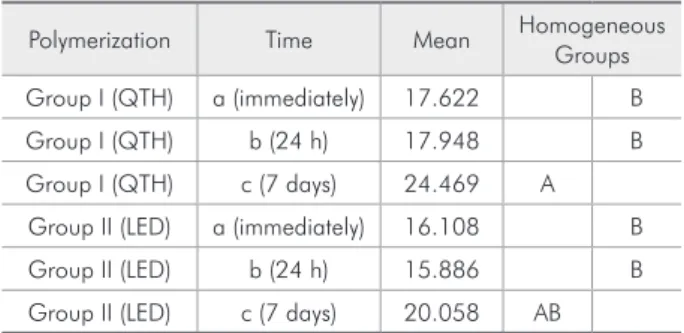
Tukey’s Test (5%) was performed in order to compare the six experimental conditions and the re-sults are shown in Table 2.
The distribution of ARI frequencies are pre-sented in Table 3. The Chi-square test revealed no statistically signiicant difference among the groups:
p-value = .098 > .05. •
• • •
Group I (QHT) Group II (LED)
a b c a b c
17.62 ± 4.54 17.95 ± 2.84 24.47 ± 5.12 16.11 ± 3.82 15.89 ± 5.49 20.06 ± 5.01 Table 1 - Descriptive statistics
in MPa – Mean values and standard deviation.
Table 2 - Statistical comparison between all QTH and LED Groups by means of the Tukey’s Test (5%).
Polymerization Time Mean Homogeneous Groups
Group I (QTH) a (immediately) 17.622 B
Group I (QTH) b (24 h) 17.948 B
Group I (QTH) c (7 days) 24.469 A
Group II (LED) a (immediately) 16.108 B
Group II (LED) b (24 h) 15.886 B
Group II (LED) c (7 days) 20.058 AB
Table 3 - ARI (Adhesive Remnant Index) for the QTH and LED Groups.
Groups / Index 0 1 2 3
Group I a 1 8 0 3
Group I b 0 7 0 5
Group I c 0 7 0 5
Group II a 1 7 0 4
Group II b 0 4 0 8
Discussion
During function, orthodontic brackets are sub-jected to either shear, tensile or torsion forces, or even a combination of these factors. According to Reyn-olds16 (1975), clinically adequate bond strengths to
enamel for metal orthodontic brackets should range between 8 and 9 MPa, values that are suficient to withstand normal orthodontic forces. In our study, the bond strength values observed were 20.01 ± 5.24 MPa for Group I and 17.35 ± 5.07 MPa for Group II, therefore greater than those clinically accepted (Table 1).
As regards the different types of enamel condi-tioning – using the traditional system or a Self-Etch-ing Primer (SEP) – SBS values may vary accordSelf-Etch-ing to different studies. However, similar mean values of SBS, with no statistical difference between the methods mentioned previously, were observed in some studies.17,18 In contrast, several authors3,6,14,19,20
have reported greater values of SBS for orthodon-tic brackets with phosphoric acid conditioning as compared to conditioning with a SEP. On the other hand, examination of the enamel-adhesive interface by scanning electron microscopy has revealed differ-ent patterns. Enamel conditioning with Transbond SEP has resulted in a more conservative enamel sur-face, comparable to that produced by traditional phosphoric acid conditioning.21-22 However, the SEP
system may be considered for clinical use because its use may entail a decrease in undesirable enamel effects during bonding procedures, and also because it reduces clinical chair time. In addition, it is a less sensitive technique, which can be justiied by its one-step procedure.
The use of APC brackets in the present study showed some advantages, such as standard quan-tity of adhesive, easy removal of excesses, better asepsis and reduction of occasional loss of material. Although the related literature has revealed greater mean values of SBS when using traditional orth-odontic brackets,19,23,24 APC brackets were used
in-stead because they involve the use of a less sensitive technique.
With regard to relationship between debond-ing time and SBS values, several studies have used a 24 h period after the bonding process.
3,5,14,17,19,20,25-27 However, previous research has shown that
orth-odontic adhesives demonstrate greater SBS values after longer debonding periods of time. Nonethe-less, the clinical practice of orthodontics requires that archwires be installed immediately after the bonding procedures.
Hence, many studies have been performed to evaluate the correlation between adhesive bond strength and post-bonding time. Hajrassie, Khier28
(2007) concluded that SBS values using orthodon-tic adhesives to metallic brackets increase with the debond time. Those authors28 evaluated periods
of 10 min, 24 h, 7 days, 1 week and 4 weeks after bonding, but no statistically signiicant difference was reported for both the in vivo and in vitro data. The results also indicated that, in vivo, the mean value (5.61 MPa) was signiicantly lower than in vitro (13.98 MPa), thus contradicting the hypoth-esis about the similarity between the shear bond strengths values obtained in vivo and in vitro. The authors28 concluded that initial archwires could be
placed 10 minutes after bonding.
The present study evaluated three different debond times. The results demonstrated that there were slight differences in debond time, and that the greatest values were observed in subgroup c (7 days), regardless of the type of photoactivation used (Table 1). The results also showed that the mean values were superior to 8 MPa. It should be borne in mind, however, that in vitro results are generally 40% higher than the results observed in vivo.28
With regard to the type of photoactivation, QTH units are traditionally preferred for bonding metal-lic orthodontic brackets, and have been used in most studies.3,5,6,14,17,18,20-22,24 Light-curing units (LCUs)
must be able to bring enough energy to achieve the wavelength of the resin’s photoinitiator to photo-activate. This physical-chemical process can be af-fected by light intensity, the material’s composition and time of exposure. An effective photoactivation sometimes may be dificult to be achieved due to the depth of the prepared cavities, and also due to the thickness of the material, which sometimes ex-ceeds 2 mm.29 These aspects, however, are not
2 mm, and because of the easier access to the mate-rial, in that the distance between the active point of the LCU and the bracket basis is small.
The Tukey’s Test (5%) indicated that two out of six experimental groups had the same performance (Table 2). From these indings it can be inferred that:
Group Ic differed from both Groups, Ia and Ib; Group IIc did not differ from Groups IIa and IIb; the four conditions established for subgroups a and b presented similar mean values, with no statistical difference.
The condition stated for Group IIc led to a per-formance which proved intermediate between the other groups, but statistically signiicant differences were observed only when considering Group Ic.
Based on the results obtained, it can be stated that 10 s of LED photoactivation provides enough adhesion for orthodontic accessories. Moreover, lit-erature reports that SBS might be reduced when us-ing shorter times of photoactivation (< 10 s).8,26,27
It is important to point out that clinicians should be aware of which photoinitiator is present in the orthodontic adhesive when using LED units due to its speciic blue light range (470 nm), and also be-cause other photoinitiators than camphoroquinone 1.
2. 3.
(e.g. propanodiona) may not photoactivate ade-quately.
The ARI frequencies (Table 3) and Chi-square test did not reveal statistically signiicant differences between Groups I and II (p-value = 0.098 > .05), which is supported by the literature.20,24,26 These
indings probably occurred due to the use of APC brackets in all groups. Therefore, the same amount and the same type of adhesive were used as standard conditions for all the experiments.
Conclusions
There were no statistically signiicant differences between the SBS values produced with the use of QTH and LED photoactivation immediately and 24 h after bonding.
Bonding orthodontic brackets for 10 s using LED is suggested because it requires a reduced clinical chair time, without compromising the SBS of the bonding interface.
Acknowledgments
The authors would like to express their apprecia-tion to 3M UNITEK for providing the APC brack-ets for this study.
•
•
References
1. Buonocore MG. A simple method of increasing the adhesion of acrylic filling materials to enamel surfaces. J Dent Res. 1955 Feb;34(6):849-53.
2. Newman GV. Epoxy adhesives for orthodontic attachments: progress report. Am J Orthod. 1965 Dec;51(12):901-12. 3. Buyukyilmaz T, Usumez S, Karaman AI. Effect of self-etching
primers on bond strength – are they reliable? Angle Orthod. 2003 Feb;73(1):64-70.
4. Bishara SE, Oonsombat C, Ajlouni R, Laffoon JF. Com-parison of the shear bond strength of 2 self-etch primer/ adhesive systems. Am J Orthod Dentofacial Orthop. 2004 Mar;125(3):348-50.
5. Rajagopal R, Padmanabhan S, Gnanamani J. A comparison of shear bond strength and debonding characteristics of con-ventional, moisture-insensitive, and self-etching primers in
vitro. Angle Orthod. 2004 Apr;74(2):264-8.
6. Bishara SE, Ostby AW, Ajlouni R, Laffoon JF, Warren JJ. Early shear bond strength of a one-step self-adhesive on orthodontic brackets. Angle Orthod. 2006 Jul;76(4):689-93.
7. Yamamoto A, Yoshida T, Tsubota K, Takamizawa T, Kuro-kawa H, Miyazaki M. Orthodontic bracket bonding: enamel bond strength vs. time. Am J Orthod. Dentofacial Orthop. 2006 Oct;130(4):435.e1-6.
8. Silta YT, Dunn WJ, Peters CB. Effect of shorter polymerization times when using the latest generation of light-emitting diodes. Am J Orthod Dentofacial Orthop. 2005 Dec;128(6):744-8. 9. Jandt KD, Mills RW, Blackwell GB, Ashworth SH. Depth
of cure and compressive strength of dental composites cured with blue light emitting diodes (LEDs). Dent Mater. 2000 Jan;16(1):41-7.
10. Mills RW. Blue light emitting diodes – another method of light curing? Br Dent J. 1995 Mar;178(5):169.
11. Mills RW, Jandt KD, Ashworth SH. Dental composite depth of cure with halogen and blue light emitting diode technology. Br Dent J. 1999 Apr;186(8):388-91.
13. Oesterle LJ, Shellhart WC, Belanger GK. The use of bovine enamel in bonding studies. Am J Orthod Dentofacial Orthop. 1998 Nov;114(5):514-9.
14. Bishara SE, Laffoon JF, VonWald L, Warren JJ. Evaluation of nonrinse conditioning solution and a compomer as an alterna-tive method of bonding orthodontic bracket. Angle Orthod. 2001 Dec;71(6):461-5.
15. Artun J, Bergland S. Clinical trials with crystal growth con-ditioning as an alternative to acid-etch enamel pretreatment. Am J Orthod. 1984 Apr;85(4):333-40.
16. Reynolds IR. A review of direct orthodontic bonding. Br Dent J. 1975 Feb;138(2):171-8.
17. Amra I, Samsodien G, Shaikh A, Lallo R. Xeno III self-etching adhesive in orthodontic bonding: The next generation. Am J Orthod Dentofacial Orthop. 2007 Feb;131(2):160.e11-5. 18. Turk T, Elekdag-Turk S, Isci D. Effects of self-etching primer
on shear bond strength of orthodontic brackets at different debond times. Angle Orthod. 2007 Jan;77(1):108-12. 19. Bishara SE, Oonsombat C, Aijlouni R, Denehy G. The effect
of saliva contamination on shear bond strength of orthodontic brackets when using a self-etch primer. Angle Orthod. 2002 Nov;72(6):554-7.
20. Davari AR, Yassaei S, Daneshkazemi AR, Yosefi MH. Ef-fect of different types of enamel conditioners on the bond strength of orthodontic brackets. J Contemp Dent Pract. 2007 Jan;8(1):1-7.
21. Fjeld M, Ogaard B. Scanning electron microscopic evaluation of enamel surfaces exposed to 3 orthodontic bonding systems. Am J Orthod Dentofacial Orthop. 2006 Nov;130(5):575-81.
22. Vilchis RJ, Hotta Y, Yamamoto K. Examination of enamel-adhesive interface with focused ion beam and scanning elec-tron microscopy. Am J Orthod Dentofacial Orthop. 2007 Nov;131(5):646-50.
23. Bishara SE, Ajlouni R, Oonsombat C. Evaluation of a new cur-ing light on the shear bond strength of orthodontic brackets. Angle Orthod. 2003 Aug;73(4):431-5.
24. Cal-Neto JP, Miguel AJ, Zanella E. Effect of a self-etching primer on shear bond strength of adhesive precoated brackets
in vivo. Angle Orthod. 2006 Jan;76(1):127-31.
25. Usümez S, Büyükyilmaz T, Karaman AI. Effect of light-emit-ting diode on bond strength of orthodontic brackets. Angle Orthod. 2004 Apr;74(2):259-63.
26. Mavropoulos A, Staud CB, Kiliaridis S, Krejci I. Light cur-ing time reduction: in vitro evaluation of new intensive light-emitting diode curing units. European J Orthod. 2005 Aug;27(4):408-12.
27. Gronberg K, Rossouw PE, Miller BH, Buschang P. Distance and time effect on shear bond strength of brackets cured with a second-generation Light-emitting Diode Unit. Angle Orthod. 2006 Jul;76(4):682-8.
28. Hajrassie MKA, Khier SE. In-vivo and in-vitro comparison of bond strengths of orthodontic brackets bonded to enamel and debonded at various times. Am J Orthod Dentofacial Orthop. 2007 Mar;131(3):384-90.