Oral Health
Sônia Cristina Lima Chaves
Institute of Collective Health, School of Dentistry, Univ Federal da Bahia, Salvador, Bahia, Brazil.
Corresponding Author: Sônia Cristina Lima Chaves E-mail: [email protected]
Oral health in Brazil: the challenges
for dental health care models
*Abstract: This paper discusses adult oral health in Brazil according to three perspectives: 1) the available epidemiological evidence about the population’s oral-health-related epidemiological situation, especially adults and the elderly population, in relation to two high prevalence oral injuries (dental caries and tooth loss), 2) the main health care models for dealing with this situation, by analyzing the related historical processes in order to reveal the likely social, political and epidemiological impli-cations of the different models, and 3) lastly, the possible challenges to Brazilian dentistry or collective oral health in overcoming these obsta-cles. The main results of the study indicate that, from an epidemiological point of view, Brazil is undergoing a transition in dental caries and tooth loss, which is not yet relected in the proile of the elderly, but which is tentatively evidenced in young adults. Tooth loss remains high. Certain aspects of society’s economic and political superstructure have an im-portant impact on oral health indicators and existing inequalities. Oral health care models have a relative importance and must not be neglected. Vestiges of ideological movements, like preventive medicine, may explain the current impasse in collective oral health practices, such as the pre-eminence of Finalized Treatment (FT) in clinics and of preventive care in schools fostered by community-based programs. It is therefore important to develop conceptual, theoretical relections and to increase the objects of intervention, their purposes and their modus operandi. The practice of dentistry according to these alternative models is still being constructed. New studies related to the different formats of these new practices are recommended.
Descriptors: Dental Care; Health Policy; Tooth Loss; Adult; Comprehensive Dental Care.
Introduction
The social scourge represented by tooth loss among Brazilian adults is a topic explored in society beyond the natural interest of dentists. In Bahia, artist Bel Borba, known as the artist who most often portrays the relationship between the reality of his city and its people, recently exhib-ited a work of art with many “before and after” photographs of pros-thetics in a number of edentulous adults; the catalogue’s symbolic phrase was, “life took the teeth and the smile restored the soul.”1
Although this assertion may lead to a great many relections and con-clusions, current discussions about adult oral health in the national and
Declaration of Interests: The author certifies that she has no commercial or associative interest that represents a conflict of interest in connection with the manuscript.
Submitted: Aug 11, 2012
Accepted for publication: Sep 21, 2012 Last revision: Oct 19, 2012
* Paper presented at the “Oral Health Under an Integrality Perspective” International Symposium, held at the 17th Congress of
international2-4 literature may indicate greater
con-cern in relation to this age group, considering that a large portion of the scientiic community working on health policies and the prevention of oral prob-lems in the 20th century focused on children and
ad-olescents, and has had relative success.4,5 In the case
of Brazil, efforts by the government and research-ers to monitor this data constantly have yielded optimistic albeit cautious results, insofar as studies reveal that the strategies implemented in the young population did not automatically beneit adults.5,6
The undoubted success of these efforts has al-ready been evidenced in a large number of studies and from consultations with experts about the con-tribution of water luoridation and the use of luo-ride toothpaste in different oral contexts, together with mass access to toothbrushes and wide-scale coverage for families. The upshot has been a reduc-tion in dental caries and some success in preventing the early signs of periodontal disease.5,7
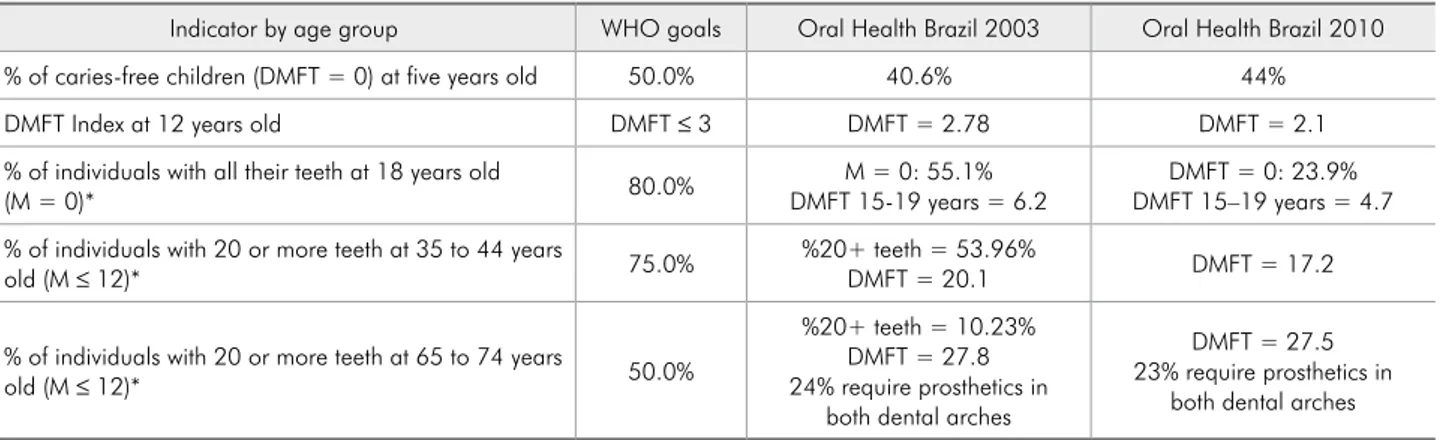
In Brazil’s most recent national survey, the av-erage DMFT index (number of decayed, missing or illed teeth) for 12-year-olds was 2.1, 25% less than the 2.8 igure recorded in 2003. It is worth noting that the irst national survey of the DMFT in 12-year-olds in Brazil was conducted in 1986, when the index was 6.7. In the component relating to dental caries, the average fell from 1.7 to 1.2. The percentage of caries-free children (DMFT = 0) rose from 31% in 2003 to 44% in 20107 (Table 1).
It is also worth noting that the caries-free pro-portion of ive-year-old children rose from 40.6% to 44%. This shows a trend toward stability in the prevalence of dental caries in this group, although short of the WHO target for the year 2000, which was 50% caries-free.5 Furthermore, the proportion
of the DMFT decayed component remains very high, suggesting limited or no access to curative dental treatment in primary health care.7
The targets for dental caries in the adult popu-lation are still far from being attained (Table 1). One of the probable explanations is that the strat-egies implemented for the Brazilian population in the 1990s, through luoride toothpaste, expansion of water luoridation and community-based preven-tion activities in the public health system for oral diseases,7,8 had little effect on the adult population,
which did not receive the beneits that population aged about 20 years old received in the 1990s. Cury
et al.9 called this process in Brazil the “90 factor”
(from the 1990s), related to the organizational and political changes of the re-democratization process that occurred in the country during this period.
However, in recent decades, the WHO indica-tors for the adult population in Brazil have shown little progress. The DMFT for the 65–74 age range was 27.5 in 2010, whereas it was 27.9 in 2003.7 The
greatest improvement was found in the 35–44 age group, which had a DMFT of 20.1 in 2003 and of 17.2 in 2010. There is no information available in
Table 1 - Comparison between the goals proposed by the World Health Organization / International Dental Federation (FDI) for the year 2000 in relation to dental caries, and the results of the Oral Health Brazil Project (Projeto SB Brasil), Brazil, 2003 and 2010.
Indicator by age group WHO goals Oral Health Brazil 2003 Oral Health Brazil 2010
% of caries-free children (DMFT = 0) at five years old 50.0% 40.6% 44%
DMFT Index at 12 years old DMFT ≤ 3 DMFT = 2.78 DMFT = 2.1
% of individuals with all their teeth at 18 years old
(M = 0)* 80.0% DMFT 15-19 years = 6.2M = 0: 55.1% DMFT 15–19 years = 4.7DMFT = 0: 23.9% % of individuals with 20 or more teeth at 35 to 44 years
old (M ≤ 12)* 75.0% %20+ teeth = 53.96%DMFT = 20.1 DMFT = 17.2
% of individuals with 20 or more teeth at 65 to 74 years
old (M ≤ 12)* 50.0%
%20+ teeth = 10.23% DMFT = 27.8 24% require prosthetics in
both dental arches
DMFT = 27.5 23% require prosthetics in
both dental arches
the inal SB 2010 report for some goals (Table 1). One could posit that the improvements reported in the epidemiological surveys of 1986, 2003 and 2010 are the result of improvements at school age, given that the 1986 school population has now reached young adulthood, and that we can, there-fore, expect such improvements to be relected in lower DMFT values, for example.
Studies reveal that the situation is different in other parts of the world, particularly in European countries, which have had DMFTs between 13.4 and 20.8 for the 35–44 year-olds, ever since the end of the last century (the 20th century). There is a
trend toward a fall in tooth loss.2,10,11 However,
in-formation in most countries about current national estimates for dental caries or tooth loss in adults is limited, due to problems related to the frequency of studies, the indicators and methodologies used for diagnostic criteria, sample size and data presenta-tion.2,10 Furthermore, it is known that edentulism is
in decline, and this has also been investigated by the dental market, given the likely implications for spe-cialties such as implantology.2,12 We should
remem-ber that demographic trends suggest a rise in the aging population, due to a reduction in birth rates and an increase in life expectancy, related to better management of chronic non-communicable diseases (NCDs). The United Nations estimates that the pro-portion of the world population over 60 years old will rise from 10% in 2000 to 30% in 2150.2
It is noteworthy that, despite the great scientif-ic production of epidemiology-based studies about the relationship between the social determinants of health and oral health,13-16 this area has been little
explored from the perspective of reasons or theories able to explain oral health inequalities.17,18
Further-more, there is a signiicant gap in evidence regarding the implementation of oral-health related interven-tions incorporating the principle of equity, in other words, the notion that it is necessary to intervene unequally where inequalities exist.
A review study about the effect of public health interventions on principal health issues indicates that oral health is one area which has produced the least results.19
Brazilian studies addressing or mapping
inter-ventions or models for oral health care20-23 have not
included the construction of a theoretical-conceptu-al framework for the socitheoretical-conceptu-al or socitheoretical-conceptu-al-dentistry ield in dental practice.
Accordingly, and in light of the work by Paim and Teixeira,24 this study aims to describe and
ana-lyze different care models as interventions to con-front both the aforementioned needs and oral health issues, by analyzing work processesin health25 and
considering the implications of this perspective in organizing dental services.
With this in mind, it is important to make a criti-cal review of national and international scientiic productions related to oral health care interventions and models from the perspective of work processes in health.25
Health care models, care models
and needs
In our context, care models are understood as combinations of technology (both structured and non-structured, such as knowledge) to solve prob-lems and meet individual and collective demands. They include ways of arranging the technical-sci-entiic means to intervene in determinants, risks and health-related injuries. According to Paim and Teixeira,24 it is the “contents” of health systems, the
practices, in other words, the working processes, that produce different types of care.
In other words, working processes in health refer to the way in which health activities are produced, the care, per se. The principal components of this analysis are the object of the work, the instruments, the resources and products or results of this work, as well as the producing agents. It also worth not-ing that these elements need to be examined jointly, since they may shape speciic work processes, but only through reciprocal relationships.25
The object of the work is the target of change, represented by what Mendes-Gonçalves25 calls
health “gaps,” understood as health needs. It is not enough to simply talk of “needs,” since there is a difference between essential needs and those aspects which are perceived as needs.
and social conditions that ensure the physiological minimum required for survival (means of life) in the sense of addressing the work force’s existence and reproduction. The term “health service needs” tends to express the population’s demand for health, or more accurately, for health services. But “the needs of health professionals” also exist; they refer to den-tists’ perceptions of the population’s dental health demands. In other words, depending on the train-ing, policy and form of remuneration by the dental service (public or private) where the professional works, the agent of this service may or may not trig-ger certain needs, such as the need for “extraction” rather than “prosthetics,” for “restoration” rather than “preservation”; this is an important issue for research, as shown in a study regarding the British health system.26
Agents are those individuals who act on knowl-edge in order to attain an object of work. Knowl-edge is the work tool, that is to say, the tool that serves to mediate human activity over objects of work, according to the social and historical process that includes social reproduction. Thus, the work-ing environment is the assemblage of thwork-ings that the worker puts between himself/herself and the object of his/her work, and that serves to direct his/her
ac-tivity in relation to that same object.25
There is a difference between material and non-material instruments. The former include equip-ment, instruments and materials, whereas the latter is the knowledge that coordinates material instru-ments within certain arrangeinstru-ments. These consti-tute the main intellectual working tools. The author emphasizes that this knowledge is also that which enables the object of his work to be attained,25 what
Schraiber et al. calls “know-how.”27
The work agent himself may be interpreted as a work instrument, and the immediate subject of the activity, to the extent that he/she brings to the working process both his/her previous project and its purpose, and other projects of a collective and personal nature.25
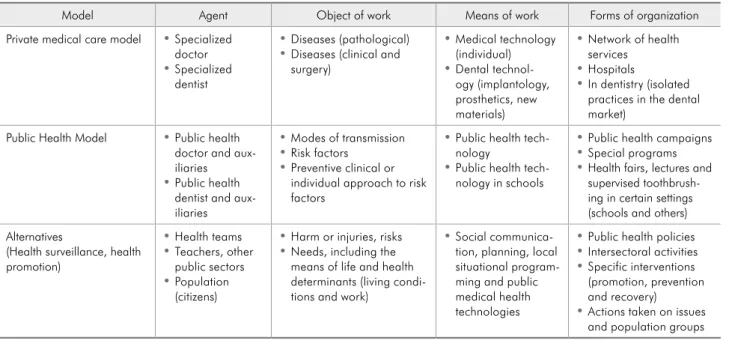
Table 2 summarizes the various objects of work, instruments and agents of work,25 taking into
ac-count the different health care models from Paim and Teixeira’s24 perspective, but focusing on
den-tistry. The models are described only briely; further in-depth examination in this area is required.
The principal care models
The hegemonic model has been called “privately paid medical care.” Despite the ideological nature of
Table 2 - Models of health care and oral health care, agents and working processes.
Model Agent Object of work Means of work Forms of organization
Private medical care model • Specialized doctor
• Specialized dentist
• Diseases (pathological)
• Diseases (clinical and surgery)
• Medical technology (individual)
• Dental technol-ogy (implantoltechnol-ogy, prosthetics, new materials)
• Network of health services
• Hospitals
• In dentistry (isolated practices in the dental market)
Public Health Model • Public health doctor and aux-iliaries
• Public health dentist and aux-iliaries
• Modes of transmission
• Risk factors
• Preventive clinical or individual approach to risk factors
• Public health tech-nology
• Public health tech-nology in schools
• Public health campaigns
• Special programs
• Health fairs, lectures and supervised toothbrush-ing in certain setttoothbrush-ings (schools and others) Alternatives
(Health surveillance, health promotion)
• Health teams
• Teachers, other public sectors
• Population (citizens)
• Harm or injuries, risks
• Needs, including the means of life and health determinants (living condi-tions and work)
• Social communica-tion, planning, local situational program-ming and public medical health technologies
• Public health policies
• Intersectoral activities
• Specific interventions (promotion, prevention and recovery)
its name, it is the best known and most practiced model, and is not exclusive to the private sector. Studies suggest that this model is also reproduced in the public dental sector.20,21,28 It is based on the
production of procedures and broken up into spe-cialties, involving the uncritical consumption of technology and a focus on surgical procedures in hospitals, in the case of medical practice, and on isolated practices, in the case of dentistry. It focuses on the curative aspect, and is aimed at the individu-al and at the biologicindividu-al aspects of disease; its organi-zation is based on “free demand.” This mode of or-ganizing services reinforces the idea that only those who already have health problems will seek services, and does not include those who do not feel ill, that is to say, who do not feel the need. This compro-mises the comprehensiveness of care and the impact that these services will eventually have on the popu-lation’s health.
In oral health, this model has been called Market Dentistry or Private Dentistry,29 although it is not
restricted to the private market. As an example, one could say that traditional clinical dental practice has the objective of recovering diseased teeth through “deinitive” restorations. In the case of market den-tistry, caries disease is the object of work, where-as the means or instruments are the dental clinic’s knowledge, and its materials are aimed at “treating” the disease. The main agent continues to be the den-tist (Table 2). One of the principal criticisms here relates to an inability to regulate the individual’s health needs in the private market, because capi-talism reinforces inequalities to the extent that the most socially deprived individuals remain without access to dental care. This criticism was also made by Leake and Birch2 in relation to the Canadian oral
health system, and there is evidence that these dis-parities exist in other countries.26,29
On the other hand, the public health model that initially (second half of the 19th century) aimed at
combating endemics and epidemics is character-ized by the use of speciic vertical campaigns and programs and is generally of an individual nature, with centralized administration and little or no co-ordination with other health activities. Activities are planned in order to combat epidemics, control
certain diseases or explain a speciic disease to the population. In an analysis of public dental health practices, we can see that many preventive prac-tices have characteristics that can be linked to this model, featuring one-off and temporary activities, which are centrally deined. An example would be a “community-supervised tooth brushing activity.” In this sense, it is possible to say that preventive care programs in schools, and the preventive practices carried out primarily by the Family Health Program (Programa de Saúde da Família) in Brazil, can now be very closely aligned with this proposition and are strongly inluenced by Social and Preventive Den-tistry, due to the inluence of Preventive Medicine in the ield of dentistry, as will be discussed briely below.21-23
The object of intervention in this case extends to the health of individuals. The instruments in-clude preventive clinics, an individual approach to risk factors or common risk factors, with work in-struments that include new knowledge about the prevention of oral diseases and new materials (the use of luoride according to the “risk” classiication, techniques to control bacterial plaque, glass iono-mers to improve both the oral environment and oc-clusal sealants, periodontal risk therapy, etc.). This practice has demonstrated important advances, but its critics point out that it has produced care exclu-sively for groups considered to be a priority (schools and pregnant women, for example) and is unable to tackle structural issues, such as social inequalities, maintaining the focus on biological components, albeit more broadly (risk groups, common risk fac-tors, etc.).21,22
model practices are supported beyond clinical and epidemiological determinants to include social de-terminants on the basis of different social groups and their living conditions. From this point on, the health surveillance model is based on interventions according to a territorial framework, working on health issues (injuries, risks and/or determinants) to offer program activities and services, including intersectoral action.24 One of the characteristics of
this model is coordination between curative, promo-tion and prevenpromo-tion activities, organized on a range of care levels and working intersectorally, thus rep-resenting a great challenge. An oral health practice that includes an alternative model perspective must take into account the fact that its activities cannot be isolated from other health activities, despite its speciicities. Moreover, the incorporation of health planning and programming into daily practice, as well as political-strategic analysis for the implemen-tation of interventions and communicative action skills, are all indispensable tools for the oral health team.
It is important to clarify that it is possible to carry out collective-preventive practices of a “pre-ventivist” nature in alternative models. What char-acterizes these new approaches is the expansion of the objects of work, the ways of working and the goals. These factors do not act on a group through a
single mode alone. The practice of dentistry in these alternative models is still being constructed.
A brief historical analysis: the
origin of the movements
Obviously, care models are produced histori-cally, in relation to people, through social groups in conlict and in society. The discussions about the best care models to tackle the main oral health is-sues originate in and are closely related to the medi-cal ield. In other words, we can see that there is a clear mirroring, whereby conlicts that occur in the medical ield are relected very similarly in the den-tal arena.
Table 3 summarizes a series of political-ideolog-ical movements that have occurred in the medpolitical-ideolog-ical ield, their relationship with the ield of dentistry and the likely impact of this “world of ideas” on professional practice, which is understood as the model.
It is worth noting that the concept of ield used in this study is that offered by Bourdieu30 as an
au-tonomous social space in which different interested agents occupy relative positions within the arena of relationships that may or may not be in conlict regarding the legitimate deinition of the objects of intervention, investigation, prioritization, etc. and
Table 3 - Summary of the ideological movements and proposed care models in the medical and dental field* in the 20th century
and at the beginning of the 21st century.
Medical field Dental field
Movements Proposed models “Movements” Proposed models
Flexnerian medicine Private medical care model Flexnerian dentistry Market dentistry or private dentistry Traditional/government
public health Public health model Public dental health • • Water fluoridationIncremental system
Preventive medicine • Preventive and social dentistry
• Simplified dentistry • Fluoride mouth rinse programs and use of fluoride gel trays
• PROESA (ABOPREV)
• Early dental care (Baby clinics)
• Simplified modular clinics Social medicine • Alternative models
• Health surveillance
• Welcoming approach
• Health promotion
• Healthy citizens
Comprehensive dentistry • Dental education
• Care inversion program Collective oral health • Family health strategy
speciic interests. In this scenario, the dominant deinition of what is legitimate and universal is ex-ercised through the power relationship between the agents or institutions engaged in the struggle. In modern societies, the social cosmos is made up of a series of these relatively autonomous social micro-cosms which are ields, the settings of objective re-lationships. These are the arenas for the logic and speciic needs of the social game, known as illusio, in other words, the agent’s sense of belonging to the game for which he ights.30
In the particular case of the ield of medicine, a series of ideological movements have emerged since the 1950s and 60s, which have sought to tackle the crisis identiied through rising medical care costs. Traditional Public Health is not considered a move-ment contrary to traditional medicine, in that it emerged as an arena for government operation in cities, starting with the industrial revolution; it falls outside the free market and is considered hegemon-ic, although it is an arena where Flexnerian medi-cine prevails.31
The Public Dental Health approach has been similar to traditional public health, in which pub-lic health dentistry formulated and performed col-lective oral health interventions. Furthermore, this movement was the great motivator for water luori-dation systems across the world, originating in the United States and introduced in Brazil by the Foun-dation for Special Public Health Services (Serviços Especiais de Saúde Pública).20,21 The movement is
considered a precursor to dental programming prac-tices in Brazil.21,27 In fact, the movement reproduced
practices from the surgical-restoration paradigm. Programming practices have developed through the “incremental” model, a word which incorporates the notion of gradual increments, maintaining the already-treated group and treating the group of re-cent arrivals, for example, at a school. It is worth noting that the focus in this case was “dental car-ies.” It is also worth relecting on the real contri-bution that programming made to this movement, where the centrality of the Finalized Treatment (FT) has remained and has been uncritically maintained in public oral health services to date. It is also worth noting that this type of care may limit access and
emergency treatment in public health services, since it rejects individuals who do not have scheduled appointments. The assumption is that this clini-cal model is a private or market dental model and, therefore, prejudicial to greater access to dental treatment in public services. Accordingly, it must be both rethought and considered in relation to other perspectives.
The Preventive Medicine movement was specii-cally examined by Sergio Arouca, cited by Paim,32
in a book currently considered one of the found-ing works of the collective health arena in Brazil. Arouca32 points out a “preventive dilemma,” in that
this movement’s intention was to change medical attitudes toward medical practice, so that practice could become more “preventive” through changes to medical education. The great dilemma is that changes in attitude, without respective structural changes—such as changes to ways of paying for pro-cedures and changes to enhance propro-cedures carried out in hospitals—did not bring about the desired re-structuring, which, in fact, did not take place.
Dentistry was also strongly inluenced by this movement, as can be seen by the names of the new-ly created disciplines in the dental schools and the creation of Preventive Medicine Departments and Preventive and Social Dentistry Departments in the Schools of Medicine. It is curious to see this combi-nation of the term “social” with that of “preventive” in dentistry, considering that preventive and social medicine perspectives are in opposite camps in the medical ield.
as is that of early dental care (the Baby Clinic) with specialties. However, this is not structurally differ-ent from Prevdiffer-entive Medicine, since it does not seek to change the forms of remuneration, nor did it fo-cus on incorporating any knowledge beyond clinical knowledge (Table 3).
The Comprehensive Dentistry “movement” is much more frequently seen in the arena of propos-als than in structured models, and is centered on attempts to change dental education. Mendes33
in-dicates in his article in 1986 (the same year as the historic 8th National Health Conference) that
Com-prehensive Dentistry is closer to the doctrinal prin-ciples of Health Reform. It criticizes scientiic or Flexnerian dentistry and simpliied dentistry, since it stresses the importance of prevention, but priori-tizes cure.33 The Care Inversion Program (Programa de Inversão da Atenção) was a product of this pro-posal, but did not expand beyond the borders of Brazil’s Southeast. This historical process regarding the different forms of dentistry has been discussed by Narvai.28
Discussion
In the case of the preventive medicine movement originating in the United States, what was at stake was the reduction of the inluence wielded by social medicine, which was contrary to capitalism and had a strong Marxist inluence. In terms of Preventive Medicine, the main result in Latin America was the maintenance of traditional public health, which was hegemonic, like the private medical model, but dominated by it (Table 3). In some countries, such as Brazil and Argentina, the existence of settings such as the Departments of Preventive Medicine led to the formation of a critical mass capable of giving rise to “the collective health arena” which prevails today, that is, a sphere of knowledge and practices that are not linked to the government alone.31
In this mirroring of the medical ield by the den-tal ield, one may state that the proposals and ini-tiatives connected to the Brazilian collective health arena are frameworks that came from the European Social Medicine movements. These consider health production as an arena for the struggle for society’s modes of production, and were revisited by the
criti-cal health movements of Latin America.
Thus, in the arena of the oral health struggle, a movement known as Collective Oral Health,28—
a preliminary concept proposed in 1988 by mili-tant agents from the Brazilian Health Reform and concomitantly by members from the ield of Den-tistry—has developed a series of relections. These represented an attempt to break from Preventive and Social Dentistry, and other forms of dentistry, and to extend the objects of practice known as oral health care, in which the oral health care model is expected to contribute to the development of its own arena of struggle, targeting Brazilian collective health.
Paraphrasing Paim34 in analyzing the Brazilian
Health Reform as an idea, movement, proposal, project and process, collective health in Brazil was established as a movement of ideas (an ideological movement) and turned into a social movement that has had the potential to produce ongoing proposals, projects and processes.31,34 It is worthwhile asking
what has occurred in the process of putting forth the ideology of dental agents involved in oral health and struggling with research and policy implemen-tation versus the ideology of agents engaged in the collective health movement in Brazil.
The oral health care models adopted in a num-ber of countries, including those that have universal public health systems,26 favor either the private
med-ical care or the surgmed-ical-restoration model for adult care, for two reasons.2,26,35,36 The irst is because, in
oral health, there is a predominance of inancing through private funding, direct reimbursement, pri-vate health insurance plans and even government social security.26 Consequently, free market
mod-els are not concerned a priori when acting on risks, even though this perspective may reduce injuries and increase proit margins.35,36 Secondly, studies reveal
that changes in the population’s oral health proile are brought about much more frequently as the re-sult of structural changes, such as more schooling, national wealth and socioeconomic position, than as the result of the dental practice model itself.13,37,38 In
and non-material conditions required to reproduce the social structure are deemed as having a more im-portant impact on oral health indicators and existing inequalities than the form of dental service organiza-tion. Introducing poverty reduction or direct income transfer policies, such as the Family Grant program (Bolsa Família),39 into the agenda has been crucial in
reducing both social and oral health inequalities. The great challenge is for public oral health ser-vices not to duplicate the Flexnerian model, but to broaden the perspective beyond the clinical model and oral lesions, because the way in which (clini-cal) dental practice is structured restricts progress in objects of intervention, thereby restricting its means and purposes.25 Moreover, since these purposes are
restricted, the work instruments are also restricted, and the objects of intervention remain solely the teeth and oral diseases, in detriment to individuals, families, social groups and their ways of life.
Conclusion
The greater coverage of the public oral health service in Brazil is undeniable and is the result of a series of efforts by social movements and the
Brazil-ian Health Reform.6,28,40 It is estimated that 30% of
dentists in the country currently work in the Family Health Program.6 However, as Narvai stresses,41 the
different groups of political ideological perspectives known as “collective oral health” and “market den-tistry” seek to inluence the course of the National Oral Health Policy, to uphold their respective in-terests. One could posit that these struggles go be-yond the two poles suggested, considering that even within the ield of collective oral health, there are currents that are strongly connected to traditional preventive medicine practices, and that no real prog-ress is being made regarding the collective health is-sue.41 In other words, the names of the disciplines
and programs may have changed, but the old prac-tices have not.
Thus, although the effect of oral health care models is of only relative importance in inluencing oral health indicators, these models should not be neglected. They are arenas for an important strug-gle, and future scenarios will result from the several different strategies put forth by social agents inter-ested in different political ideological movements.
References
1. Governo do Estado da Bahia. Secretaria de Cultura do Es-tado. Instituto do Patrimônio Artístico e Cultural. Aqui em sete elementos, por Bel Borba. Palacete das Artes Rodin Bahia. Salvador: Governo do Estado da Bahia; 2012. 53 p. Catálogo de exposição.
2. Leake JL, Birch S. Public policy and the market for dental ser-vices. Community Dent Oral Epidemiol. 2008 Aug;36(4):287-95.
3. Müller F, Naharro M, Carlsson GE. What are the prevalence and incidence of tooth loss in the adult and elderly population in Europe?. Clin Oral Implants Res. 2007 Jun;18(3):2-14. 4. Ribeiro MT, Rosa MA, Lima RM, Vargas AM, Haddad JP,
Ferreira-e-Ferreira E. Edentulism and shortened dental arch in the Brazilian elderly from the National Survey of Oral Health 2003. Rev Saude Publica. 2011 Oct;45(5):817-23.
5. Roncalli AG. National oral health survey in 2010 shows a major decrease in dental caries in Brazil. Cad Saude Publica. 2011 Jan;27(1):4-5.
6. Pucca Jr GA, Costa JFR, Chagas LD, Silvestre RM. Oral Health Policies in Brazil. Braz Oral Res. 2009 Jun; 23 Suppl 1:9-16. 7. Brasil. Ministério da Saúde. Secretaria de Atenção à Saúde.
Projeto SB Brasil 2010: resultados principais. [cited 2012 jul
02]. Available from: http://dab.saude.gov.br/cnsb/sbbrasil/index. html.
8. Narvai PC, Frazão P, Roncalli AG, Antunes JL. [Dental caries in Brazil: decline, polarization, inequity and social exclu-sion]. Rev Panam Salud Publica. 2006 Jun;19(6):385-93. Por-tuguese.
9. Cury JA, Tenuta LMA, Ribeiro CCC, Leme AFP. The im-portance of fluoride dentifrices to the current dental caries prevalence in Brazil. Braz Dent J. 2004 Sept-Dec;15(3):167-74. 10. Koniq J, Holtfreter B, Kocher T. Periodontal health in Europe:
future trends based on treatment needs and the provision of periodontal services - position paper 1. Eur J Dent Educ. 2010 May;14 Suppl 1:4-24.
11. Hugoson A, Norderyd O. Has the prevalence of periodontitis changed during the last 30 years?. J Clin Periodontol. 2008 Sep;35(8 Suppl):338-45.
12. Carlsson GE, Omar R. The future of complete dentures in oral rehabilitation. A critical review. J Oral Rehabil. 2010 Feb;37(2):143-56.
14. Tada A, Matsukobo T. Relationship between oral health behaviors and general health behaviors in a Japanese adult population. J Public Health Dent 2003 Fall;63(4):250-4. 15. Henriksen BM, Axéll T, Laake K. Geographic differences in
tooth loss and denture-wearing among the elderly in Norway. Community Dent Oral Epidemiol. 2003 Dec;31(6):403-11. 16. Barbato PR, Nagano HCM, Zanche FN, Boing AF, Peres MA.
Perdas dentárias e fatores sociais, demográficos e de serviços associados em adultos brasileiros: uma análise dos dados do estudo epidemiológico nacional (Projeto SB Brasil 2002-2003). Cad Saude Publica. 2007 Ago;23(8):1803-14.
17. Nicolau B, Thomson WM, Steele JG, Allison PJ. Life-course epidemiology: concepts and theoretical models and its rel-evance to chronic oral conditions. Community Dent Oral Epidemiol. 2007 Aug;35(4):241-9.
18. Sisson Kl. Theoretical explanations for social inequalities in oral health. Community Dent Oral Epidemiol. 2007 Apr;35(2):81-8.
19. Tirilis D, Husson H, DeCorby K, Dobbins M. Missing and accounted for: gaps and areas of wealth in the public health re-view literature. BMC Public Health. 2011 Oct;11:757. 20. Oliveira AGRC, Arcieri RM, Unfer B, Costa ICC, Moraes E,
Saliba NA. Modelos assistenciais em saúde bucal no Brasil: tendências e perspectivas. Ação Colet. 1999 Jan-Mar;2:9-13. 21. Nickel DA, Lima FG, Silva BB. Modelos assistenciais em saúde
bucal no Brasil. Cad Saude Publica. 2008 Fev; 24(2):241-6. 22. Chaves SCL, Vieira-da-Silva LM. As práticas
profission-ais no campo público de atenção à saúde bucal: o caso de dois municípios da Bahia. Cien Saude Colet. 2007 Nov-Dez;12(6):1697-710.
23. Martelli PJL, Júnior JLACA, Pimentel FC. Modelos munici-pais em saúde bucal: tendências atuais. Int J Dent. 2009 Jul-Set;8(3):146-5.
24. Paim JS, Teixeira CF. Política, planejamento e gestão: balanço do estado da arte. Rev Saude Publica. 2006 Ago; 40(nº esp):73-8. 25. Schraiber LB. Ciência, trabalho e trabalhador em saúde: contri-buições de Ricardo Bruno M. Gonçalves para a compreensão da articulação entre saber, práticas e recursos humanos. Divulgação Saúde Debate. 1996;14:6-17.
26. Tickle M, McDonald R, Franklin J, Aggarwal VR, Milsom K, Reeves D. Paying for the wrong kind of performance? Fi-nancial incentives and behaviour changes in National Health Service dentistry 1992-2009. Community Dent Oral Epide-miol. 2011 Oct;39(5):465-73.
27. Schraiber LB, Peduzzi M, Sala A, Nemes MIB, Castanhera ERL, Kon R. Planejamento, gestão e avaliação em saúde: identifican-do problemas. Cienc Saude Colet. 1999;4(2):221-61. 28. Narvai PC. Saúde bucal coletiva: caminhos da odontologia
sanitária à bucalidade. Rev Saude Publica. 2006 Ago;40(nº esp):141-7.
29. Drugan CS, Downer MC. [Dental health in the United Kingdom and influencing variables]. Bundesgesundheitsblatt gesundheits-forschung gesundheitsschutz. 2011 Sep;54(9):1027-34. German. 30. Bourdieu P. Le champ économique. Actes Rech Sci Soc. 1997
Sep;119:48-66.
31. Paim JS, Almeida-Filho N. Saúde coletiva: uma “nova saúde pública” ou campo aberto a novos paradigmas? Rev Saude Publica. 1998 Ago;32(4):299-316.
32. Paim JS. Medicina comunitaria: introducción a un análisis crí-tico. Salud Colect. 2009 Ene-Abr;5(1):121-6.
33. Mendes EV. A reforma sanitária e a educação odontológica. Cad Saude Publica. 1986 Out/Dez;2(4):533-52.
34. Paim JS. A reforma sanitária brasileira e o Sistema Único de Saúde: dialogando com hipóteses concorrentes. Physis. 2008 Nov;18(4):625-44.
35. Wallace B, MacEntee M. I Access to dental care for low-income adults: perceptions of affordability, availability and acceptability. J Community Health. 2012 Feb;37(1):32-9. 36. Davis EE, Deinard AS, Maiga EWH. Doctor, my tooth hurts:
the costs of incomplete dental care in the emergency room. J Public Health Dent. 2010 Summer;70(3):205-10.
37. Aida J, Kondo K, Kondo N, Watt RG, Sheiham A, Tsakos G. Income inequality, social capital and self-rated health and dental status in older Japanese. Soc Sci Med. 2011 Nov;73(10):1561-8.
38. Pinilla J, Gonzalez B. Exploring changes in dental workforce, dental care utilization and dental caries levels in Europe, 1990–2004. Int Dent J. 2009 Apr;59(2):87-95.
39. Brasil. Ministério da Saúde. Comissão Nacional sobre Deter-minantes Sociais da Saúde. As causas sociais das iniqüidades em saúde no Brasil. Rio de Janeiro: Fiocruz; 2008. [cited 2012 jul 02] Available from: http://www.cndss.fiocruz.br/pdf/home/ relatorio.pdf.
40. Paim J, Travassos C, Almeida C, Bahia L, Macinko J. The Brazilian health system: history, advances, and challenges. Lancet. 2011 May;377(9779):1778-97.