AUTISM AND MÖBIUS SEQUENCE
An exploratory study of children in northeastern Brazil
José Marcelino Bandim
1, Liana O. Ventura
2, Marilyn T. Miller
3,
Henderson C. Almeida
4, Ana Elizabeth Santos Costa
5ABSTRACT - The psychiatric examination was performed with diagnostic instruments for autism (DSM-IV and Childhood Autism Rating Scale-CARS) in 23 children with Möbius sequence. From the 23 patients studied with Möbius sequence, five (26.1%) met the diagnostic criteria for infantile autism according DSM-IV and two (8.6%), under two years old, showed autistic-like behavior. The scores for six children were compatible to severe autism symptoms according CARS and one child met the criteria for moderate autism symptoms. Among five children with autism, three (60%) had positive history of misoprostol exposure during the first trimester of pregnancy and from two cases autistic-like, one (50%) had positive history of misoprostol exposure during pregnancy.According to our data, this is the first report of Möbius sequence with autism and positive history of misoprostol use during pregnancy.
KEY WORDS: autism, Möbius sequence.
Autismo e sequência de Autismo e sequência de Autismo e sequência de Autismo e sequência de
Autismo e sequência de MöbiusMöbiusMöbiusMöbiusMöbius: um estudo exploratório em crianças do nordeste do Brasil: um estudo exploratório em crianças do nordeste do Brasil: um estudo exploratório em crianças do nordeste do Brasil: um estudo exploratório em crianças do nordeste do Brasil: um estudo exploratório em crianças do nordeste do Brasil
RESUMO - Foi realizada uma avaliação psiquiátrica com instrumentos de diagnóstico para o autismo (DSM-IV e Escala de Pontuação para Autismo na Infância-CARS) em 23 crianças com seqüência de Möbius. Dos 23 pacientes estudados, cinco (26.1%) preencheram os critérios diagnósticos do DSM-IV para transtorno autista e dois pacientes (8.6%) com idades abaixo dos dois anos mostraram comportamento autista-like. Entre as cinco crianças com transtorno autista, três (60%) tinham história positiva para exposição ao misoprostol durante o primeiro trimestre da gravidez; das duas crianças com comportamento autista-like, uma (50%) tinha uma história positiva para exposição ao misoprostol durante o primeiro trimestre da gravidez. Este estudo é o primeiro a investigar a associação entre sequência de Möbius com autismo e uso de misoprostol durante a gravidez.
PALAVRAS-CHAVE: autismo, sequência de Möbius.
1Professor Adjunto do Departamento de Neuropsiquiatria da Universidade Federal de Pernambuco (UFPE) e Psiquiatra da
Infância/Adoles-cência do Instituto Materno Infantil de Pernambuco (IMIP), Recife PE, Brasil; 2Departamento de Oftalmologia Pediátrica da Fundação Altino
Ventura e Hospital de Olhos de Pernambuco (HOPE), Recife PE-Brasil; 3Departamento de Oftalmologia, Universidade de Illinois, Chicago,
Illinois-EUA; 4Departamento de Oftalmologia, Universidade Federal de Minas Gerais, Belo Horizonte MG, Brasil; 5Psicóloga Clínica da
Asso-ciação de Assistência à Criança Deficiente (AACD), Recife PE, Brasil, com Especialização em Psicologia Hospitalar. Received 29 July 2002, received in final form 10 October 2002. Accepted 1 November 2002.
Dr. José Marcelino Bandim - Rua Coronel Valdemar Basgal 170 - 54310-610 Jaboatão Guararapes PE - Brasil. E-mail: [email protected]
Autistic disorder is a neuropsychiatry disturbance characterized by significant delays and abnormalities in the development of cognitive, social and communi-cation skills1,2. Autism begins during the first years of
life severely compromising the developmental process and, in most cases, there is an important association to mental retardation3. Autistic children are incapable
of interpreting emotional states in others, can fail to recognize feelings such as anger, sadness or even some specific intentions. Their language skills are frequently compromised; 50% of autistic children are functionally mute4,5. They also show restricted repetitive and
stereotyped behavior in their interests and activities1.
Efforts have been made in the specialized literatu-re to find out the genetic and biological aspects of this syndrome. The fact that some patients with au-tism also suffer from other associated medical condi-tions (such as tuberous sclerosis, prematurity, in-utero exposure to rubella, etc.) has brought out some evi-dence of possible abnormalities in the early develop-ment of these children6. However, the casual
Coleman7 have reported an association standards
between autism and medical conditions around 25% whereas Rutter et al.8 reported that this association
would be better represented by figures around 10%. Miller et al.6 in a study involving 86 Swedish
pa-tients suffering from embryopathy caused by thali-domide found four patients that met diagnostics cri-teria for autism; they all showed mental retardation and compromised cerebral involvement of VI and VII cranial nerves. All with autism affected by tha-lidomide were limited in their horizontal eye move-ments (VI cranial nerve envolvment), and have facial nerve paresis. Although the investigation did not set out to identify associated cases of autism, the authors found that the prevalence of autism in this popula-tion was 40 to 100 times higher than that found in the general population. Miller and Stromland9
inves-tigated 25 patients with Möbius sequence, from the-se, six patients met the criteria for autism and one for autistic like condition, noting that specific diag-nostic tools and instruments were used to evaluate autism symptoms.
Johanson et al.10 studying this patients under a
neuropsychiatric protocol including standardized autism diagnostic interviews, diagnosed ten cases with an autism spectrum disorder and six out of these met all diagnostic criteria for autism. A few other studies have shown an association between Möbius sequence and autism11,12. However, this interesting
association is poorly dealt with in the literature thus failing to offer more evidence on the etiology of infantile autism.
Möbius sequence is a clinical condition charac-terized by uni or bilateral eye-face palsy associated to muscle or bone malformations in the upper or lower limbs; most accepted clinical criteria to cha-racterize the sequence is the involvement of the VI and VII cranial nerves. It is defined as a sequence because it represents a cascade of events that occur after an embryo trauma from varied etiologies. Among the etiological factors responsible for Möbius sequence there are genetic factors, environmental injuries (including failed abortion attempts by use of misoprostol), prolonged membrane ruptures and chorion vilum sampling10,13.
Exposure to misoprostol during the first two months of pregnancy could cause ischemic events in the development of the brain thus resulting in Möbius sequence, since the neurons are usually very sensitive to environmental trauma such as anoxia14.
Misoprostol is a methyl ester from prostaglandin E1, used in the treatment of gastric ulcers; it is consi-dered a better protector of anti-secretion activities
than natural prostaglandin but, beyond these phar-macological activities, it can also cause uterine con-tractions which can lead to vaginal bleeding and abortion14,15. Misoprostol is a low-cost, easily
acces-sible drug that is stable at room temperature. These qualities make it a very popular abortion drug in several countries14. In some cases, abortion is not
completed when induced in the first trimester and the pregnancy is carried to conclusion16. Abortion is
illegal in Brazil except for cases of rape or incest or when the mother’s life is at risk. In our country, as in other countries in South and Central America, miso-prostol has been widely used to induce abortions15,17.
Between 1994 and 1998, a retrospective study was carried out in the State of Pernambuco, Brazil, involving 10 patients diagnosed with Möbius sequen-ce. These patients were being treated at the Pediatric Ophthalmology Department of the Altino Ventura Foundation and Pernambuco Eye Hospital. A positive history of abortion attempt occurred in 8 of the 10 cases. In 6 of the 8 cases, the mother had used misoprostol during the first trimester of the preg-nancy to induce an abortion18.
It is thought that the embryo is more vulnerable to misoprostol when used early in the pregnancy, five to six weeks after fertilization (seven to eight weeks of the menstrual period) than later in the preg-nancy19. There are no records in Brazil of Möbius
se-quence birth defects, so there is little information on whether there has been an increase in the last few years14.
To our knowledge, there were no literature re-porting the association between autism and Möbius sequence caused by the use of misoprostol in pregnancy. Therefore, a prospective study was deve-loped with a multi-disciplinary team to study as many individuals that could be identified with the charac-teristic findings of Möbius sequence. The aims were to: 1. Investigate the association between autism and Möbius sequence in children living in Northeastern Brazil, characterized by use or non-use of misoprostol by the mothers during pregnancy. 2. Investigate the main clinical aspects of psychiatric symptoms of au-tistic children diagnosed with Möbius sequence. 3. Attempt to characterize the frequency of this asso-ciation, comparing it to studies of prevalence of au-tism in the general population.
METHOD
Foundation and an association that provides assistence for handicapped children (AACD). The following diagnostic criteria were used for Möbius sequence: (1) congenital facial nerve paresis or paralysis, either unilateral or bilate-ral, and (2) congenital paresis or palsy of abducent cranial nerve, uni or bilateral. Others cranial facial or limbs ano-malies were commonly seen among the patients but were not included in the entry criteria.
A specific protocol was elaborated for the psychiatric evaluation. A psychiatric examination for the diagnosis of autism was performed. It was completed in 23 of the 28 patients. Five patients were either too young or the mother didn’t attend to the psychiatric examination. The evaluation was performed in a specialized psychiatric clinic at the “Instituto Materno Infantil de Pernambuco”(IMIP), Brazil, and complemented by interviews with family members. Assessment included family and a pregnancy history, with emphasis on exposure to known teratogens and abortive substances including misoprostol, delivery, collect data on the child’s behavioral habits, heredity; as well as psychomotor development and language skills.
In order to diagnose autism and evaluate the presence and severity of autism symptoms, the following instru-ments were used: (a) Diagnostic and Statistical Manual of Mental Disorder - DSM-IV20. (b) Childhood Autism Rating
Scale – CARS21 – CARS is an evaluation instrument
com-posed of 15 behavioral items that can be directly observed in the child or collected through interviews with the pa-rents. The child’s behavior and reactions in 15 areas and seven different levels of behavior are observed during the evaluation and then measured. Scores for each area vary from one (behavior within normal limits) to four (severe abnormal behavior for the age). The final score rates the child according to severity of symptoms (normal, light/ moderate autism, severe autism).
Intellectual coefficient in all patients was based on clini-cal observations and data collected from interviews with family members, since many of the patients were younger than four years. For children at four years old or older the Wisc was used.
Trying to avoid errors in the identification of some autism symptoms (since the instruments used in this study were not meant to evaluate autism in Möbius sequence patients) CARS items for the evaluation of facial expression and visual contact were eliminated. Möbius sequence patients had variable motility patterns and reduced facial expressions.
In order to compare average relative ages in months and CARS scores in the group of children with Möbius but not autism and the group of children with both Möbius and autism, the U. of Mann-Whitney statistical treatment was used.
RESULTS
A psychiatric examination for the diagnosis of autism was performed. It was completed in 23 of the 28 patients. Age range was 1 to 11 years (mean
4,65 ± 3.0 years), 10 boys (43.5%) and 13 girls (56.5%). Fourteen patients (60.8%) had a positive history of misoprostol use during the first trimester of pregnancy.
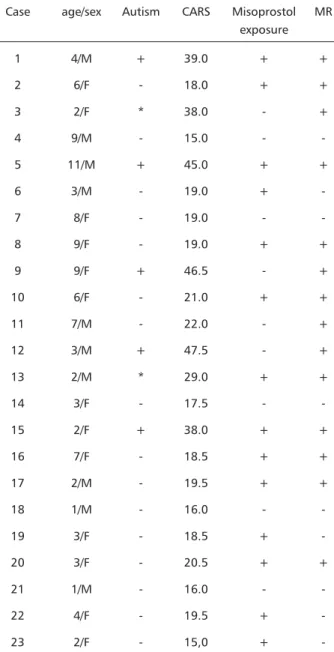
Among the 23 patients studied, five patients (26.1%) met the DSM-IV diagnostic criteria for in-fantile autism and two (8.6%), under two years old showed autistic-like behavior. The scores for six chil-dren were compatible to severe autism symptoms according CARS and one child met the criteria for moderate autism symptoms21. Even with the
elimina-tion of the CARS items (related to facial expression
Table 1. Distribution of the patients with Möbius sequence exposed or not exposed to misoprostol according to psychiatric evaluation.
Case age/sex Autism CARS Misoprostol MR exposure
1 4/M + 39.0 + +
2 6/F - 18.0 + +
3 2/F * 38.0 - +
4 9/M - 15.0 -
-5 11/M + 45.0 + +
6 3/M - 19.0 +
-7 8/F - 19.0 -
-8 9/F - 19.0 + +
9 9/F + 46.5 - +
10 6/F - 21.0 + +
11 7/M - 22.0 - +
12 3/M + 47.5 - +
13 2/M * 29.0 + +
14 3/F - 17.5 -
-15 2/F + 38.0 + +
16 7/F - 18.5 + +
17 2/M - 19.5 + +
18 1/M - 16.0 -
-19 3/F - 18.5 +
-20 3/F - 20.5 + +
21 1/M - 16.0 -
-22 4/F - 19.5 +
-23 2/F - 15,0 +
and eye motility), patients with a diagnostic of autism continued to have high scores on the evaluation ins-truments. Table 1 gives us a panoramic view of all investigated patients.
It is noteworthy that CARS average score for the group of Möbius sequence without autism was 18.4 (standard deviation = 2.1) whereas for the group of patients with both Möbius and autism disturbances and autism-like symptoms, CARS average scores were 40.4 (standard deviation = 6.5), showing thus a statistically significant difference (U Mann-Whitney = 140.0; p=0.0001).
Among patients with autism diagnostics and au-tism-like symptoms, 100% (n=7) showed, according to DSM-IV criteria, significant impairment of mutual social interactions, compromised language skills and presence of stereotypical behavior. In relation to IQ, all patients showed severe mental retardation, according to the mentioned criteria (Table 1).
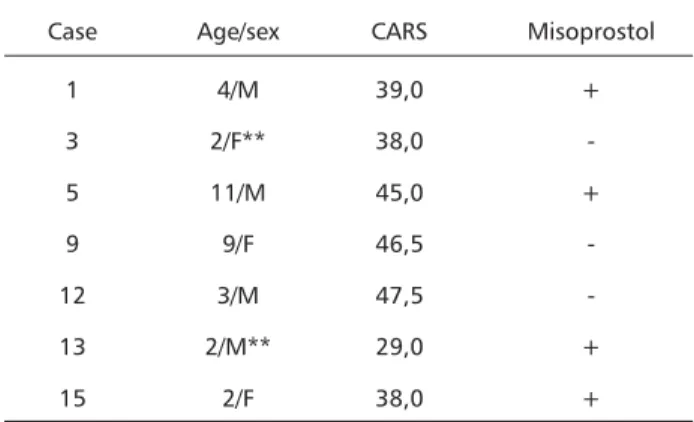
Of the five patients found carrying autism distur-bances, three had a positive history of misoprostol exposure during the first trimester of pregnancy. In one young patient ( two years old), with autism-like symptoms there was a positive history of misoprostol during pregnancy. Of the seven patients with autism spectrum disturbances, four children (57.1%) had a positive history of misoprostol use during the first trimester of pregnancy (Table 2).
DISCUSSION
With these results we can raise questions regar-ding the association between Möbius sequence and autism. Five children in the sample with Möbius se-quence met diagnostic criteria according to DSM-IV for autism, while two children showed compatibility with autism-like symptoms. All autistic patients
sho-wed significant impairment in mutual social interac-tions, compromised language skills and a repertoire of repetitive and stereotypical behaviors, according to DSM-IV criteria and the observations on symptoms seen in CARS, thus strongly characterizing the pre-sence of the disturbance.
There are few studies in the literature on the asso-ciation linking Möbius sequence and autism11,12. In
pioneering studies by Gillberg and Steffenburg12,
they investigated a population of 17 patients who had been diagnosed as having Möbius sequence and found that the frequency of patients with typical autism symptoms according to DSM-III-R criteria was approximately 40%. In another study, Miller et al.10
studied a more representative sample of 25 patients diagnosed as having Möbius sequence and where six subjects (15% of the sample) were diagnosed with autism (it was noted that, for this study, the following instruments were used as specific instruments to characterize autism symptoms and diagnostic: DSM-III-R and CID-10, as well as CARS, ADI-R and Autism Behavior Checklist. A recent paper summarizes in more detail the psychiatric and developmental characteristics10.
Recent studies estimate that the prevalence of autism in the general population is around 5.2/10000 cases, and the ratio of boys to girls around 4:122.
Prevalence of autism found in patients with Möbius sequence was 100 times higher than that found in the general population9. According to our results, it
was found a frequency of autism disorders around 26.1% of the population studied with Möbius sequen-ce and this frequency is more than 100 times above than that found in the general population for autism. The frequency of autism patients with Möbius sequence in this study is lower than that found by Gillberg and Steffenburg12 and just a little above than
that found by Miller et al.6. However, it coincides
with mentioned studies as far as the prevalence found in Möbius patients is highier than that found in gene-ral population, and the amount is far from one association resulting from pure chance, thus sugges-ting a strong association linking the two pathologies. According to our data, among five children with autism and Möbius sequence and two children with autism-like symptoms, four (almost 60%) had a posi-tive history of exposure to misoprostol some time during the first trimester of pregnancy.
In the Möbius sequence, exact time of injury is still unknown but studies show a critical period during the first trimester, possibly between the 4th
Table 2. Subjects diagnosed as having both autism and “autistic -like condition” and Möbius sequence.
Case Age/sex CARS Misoprostol
1 4/M 39,0 +
3 2/F** 38,0
-5 11/M 45,0 +
9 9/F 46,5
-12 3/M 47,5
-13 2/M** 29,0 +
15 2/F 38,0 +
and 6th week of pregnancy18,23-25. Knowing the exact
period of injury we would raise the theory that, in our group, most autism patients with Möbius se-quence, could be associated to an early injury bet-ween the 4th and 6th week of pregnancy, related to
misoprostol exposure during gestation.
It is noteworthy that, in the Möbius sequence, the occurrence of simultaneous abnormalities in mul-tiple organic systems suggests a morphogenesis impairment during a critical period in the early deve-lopment of embryonic structures; for some authors, this mechanism could be the result of transient hypoxia or ischemia due to the induced uterine con-tractions24-26.
Some etiological models investigated in animals and humans have shown evidence of the presence of an early injury in the first trimester related to the brain stem. Rodier et al.27 showed that rats exposed
to 350 mg/kg of valproic acid in the 11th, 12th or 21th
days of fertilization (in the period where neural tubes close) showed a reduce number of motor neurons, raising the perspective of a probable trauma for au-tism in the period of neural tube closure.
Leong and Ashell28 suggest that a few areas of
the brain stem are extremely vulnerable to hipoxia during a certain critical period of time in the em-bryonic development. For Miller et al.6, a few causes
of autism could have been the result of an early trau-ma to the cells responsible for the fortrau-mation of the brain stem. In the Swedish Möbius study there were a few adverse pregnancy events that might have cau-sed damage to the embryo9.
Although autism’s neurobiology is associated to multiple factors among them are the genetic factors1.
This investigation gives support to the theory that some subgroups could be directly linked to a non-specific transient hypoxia in the developing embryo from an unsuccessful attempt at abortion with mi-soprostol, but also an unknown similar event in the patients where no known etiology is obvious.
Autism studies using neuroimage techniques are not conclusive (since they use heterogeneous popu-lations and do not use specific diagnostic tools), ex-cept for increase in the brain size, which was independently replicated29. Future investigations will
be necessary using neuroimage techniques in more homogeneous groups and more representative po-pulations. Another issue that seems to be of great importance is the long term follow up of patients with Möbius sequence and autism so the groups’ inherent clinical aspects and possible factors linked
to prognosis can become better known. This com-parative study gives more insight into developmental insults that may be responsible for the constellation of malformations designed as Möbius sequence.
REFERENCES
1. Gillberg C. Neurodevelopmental process psychological functioning in autism. Dev Psychopathol 1999;11:567-587.
2. AACAP. Practice parameters for the assessment and treatment of children, adolescents, and adults with autism and other pervasive developmental disorders. J Am Acad Child Adolesc Psychiatry 1999; 38 (12 S):32S-54S.
3. Volkmar FR, Klin A, Siegel B. Field trial for autistic disorder in DSM-IV. Am J Psychiatry 1994; 151: 1361-1367.
4. Wing L. The autism spectrum. London: Constable, 1996.
5. Rapin I, Dunn M. Language disorders in children with autism. Sem Pediatr Neurol 1997;4:86-92.
6. Miller M, Stromland K, Gilberg C, Johansson M, Nilsson EW. The puzzle of autism: an ophthalmologic contribution. Trans Am Ophthalmol Soc 1998;XCVI:369-387.
7. Gillberg C, Coleman, M. Autism and medical disorders: a review of the literature. Dev Med Child Neurol 1996; 38:191-202.
8. Rutter M, Bailey A, Bolton P, Le Couter A. Autism and known medical conditions: myth and substance. J Child Psychol Psychiatry 1994;35:311-322. 9. Miller M, Strömland K. The Möbius sequence: a relook. J AAPOS1999;
3:199-208.
10. Johansson M, Wentz NE, Fernell E, et al. Autism spectrum disorders in Möbius sequence: a comprehensive study of 25 cases. Dev Med Child Neurol 2001;43:38-45.
11. Ornitz EM. The early development of autistic children. J Autism Dev Disord 1977;7:207-229.
12. Gillberg C, Steffenburg S. Autistic behavior in Moebius syndrome. Acta Paediatr 1989;79:314-326.
13. Gillberg, C. Subgroups in autism: are there behavioral phenotypes typical of underlying medical conditions? J Intellect Disabil Res 1992;36:201-214.
14. Pottie K. Is misoprostol teratogenic? Misoprostol use during early pregnancy and its association with Möbius syndrome. Can Fam Physician 1999;45:315-326.
15. Coelho HL, Teixeira AC, Cruz MF, et al.. Misoprostol: The experience of women in Fortaleza, Brasil. Contraception 1994;49:101-110. 16. Norman JE, Thong KJ, Baird DT. Uterine contractility and induction of
abortion in early pregnancy by misoprostol and mifepristone. Lancet 1991; 338:1233-1236.
17. Gonzalez CH, Marques-Dias MJ, Kim CA, et al. Congenital abnorma-lities in Brazilian children associated with misoprostol misuse in first trimester of pregnancy. Lancet 1998; 351:1624-1627.
18. Boudoux DD, Matos MAG, Gonçalves ED, et al. Síndrome de Möbius rela-cionada à ameaça de abortamento. Rev Bras Oftalmol2000;59:173-177. 19. Genest DR, Di Salvo D, Rosemblatt MJ, Holmes LB. Terminal transverse
limb defects with tethering and omphacele in a 17 week fetus following first trimester misoprostol exposure. Clin Dysmorphol 1999;8:35-38. 20. American Psychiatric Association. Diagnostic and statistical manual of mental
disorders. 4.Ed. Washington, DC: American Psychiatric Association, 1994. 21. Schopler E, Reichler RJ. Diagnosis and assessment in autism. New York:
Plenum, 1988.
22. Fombonne E. The epidemiology of autism: a review. Psychol Med 1999;
29:769-786.
23. Bavinck JNB, Weaver DD. Subclavian artery supply disruption sequence: hypothesis of a vascular etiology for Poland, Kippel-Feil, and Möbius anomalies. Am J Med Genet. 1986;23:903-919.
24. Webster WS, Lipson AH, Brown-Woodman PDC. Uterine trauma and limb defects. Teratology1987;35:253-260.
25. Graf WD, Shepard TH. Uterine contraction in the development of Möbius syndrome. J Child Neurol 1997;12:225-227.
26. Fontenelle L, Araújo APQC, Fontana RS. Síndrome de Moebius: relato de caso. Arq Neuropsiquiatr 2001;59:812-814.
27. Rodier PM, Ingram JL, Tisdale B, Nelson S, Romano J. Embriology origin for autism: developmental anomalies of cranial nerve motor nuclei. J Comp Neurol 1996; 370:247-261.
28. Leong S, Ashwell KW. Is there a zone of vascular vulnerability in the fetal, brain stem?Neurotoxicol Teratol 1997;19:265-275.