Blind identification of MISO-FIR channels
$
Carlos Esteˆva˜o R. Fernandes
a,1, Pierre Comon
b, Ge´rard Favier
b,aFederal University of Ceara´, Computer Engineering Department, Campus UFC, Sobral-CE, Brazil
bI3S Laboratory, University of Nice Sophia Antipolis, CNRS, 2000 route des Lucioles, 06903 Sophia Antipolis, France
a r t i c l e
i n f o
Article history:
Received 7 October 2008 Received in revised form 16 April 2009
Accepted 16 July 2009 Available online 30 July 2009
Keywords:
Blind channel parameter estimation Channel order detection
Chi-square test High-order statistics MISO channels
a b s t r a c t
In this paper, we address the problem of determining the order of MISO channels by means of a series of hypothesis tests based on scalar statistics. Using estimated 4th-order output cumulants, we exploit the sensitiveness of a Chi-square test statistic to the non-Gaussianity of a stochastic process. This property enables us to detect the order of a linear finite impulse response (FIR) channel. Our approach leads to a new channel order detection method and we provide a performance analysis along with a criterion to establish a decision threshold, according to a desired level of tolerance to false alarm. Afterwards, we introduce the concept of MISO channel nested detectors based on a deflation-type procedure using the 4th-order output cumulants. The nested detector is combined with an estimation algorithm to select the order and estimate the parameters associated with different transmitters composing the MISO channel. By treating successively shorter and shorter channels, it is also possible to determine the number of sources.
&2009 Elsevier B.V. All rights reserved.
1. Introduction
Convolutive propagation channels are typical in wire-less, satellite and radiocommunication systems. The channel memory is known to be closely related to the delay spread profile produced by the multipath propaga-tion scenario and it indicates the length of the channel impulse response. Long delay spread profiles characterize highly frequency-selective channels and introduce inter-symbol interference (ISI) in the sampling process. The order of the radio mobile channel relates the length of the channel impulse response with the symbol period by indicating the number of past symbols being convolved
with the impulse response. In practice, the channel order is given by the number of symbol periods fitting the (truncated) channel delay spread profile. Most of channel parameter estimation algorithms require the knowledge of the channel order or, at least an upper bound of it[31]. Channel order mismatches may have very costly con-sequences, including bit error rate (BER) floors, signal-to-noise ratio (SNR) penalties and numerical instabilities [28,29,18,11].
In this paper, we address the problem of determining the order of finite impulse response (FIR) channels in the context of a multiple-input single-output (MISO) commu-nication system, using only the 4th-order cumulants of the received signal. Channel order estimation is a classic model selection problem strongly related to determining the number of signals embedded in noisy observations in narrowband array processing. This has been often referred to as the signal (or source) detection problem [4,11,10]. Classical procedures for model order determination are based on multiple hypothesis testing and make use of the eigenvalues of a sample correlation matrix. This is the case of the well-known sphericity test[32,30], which estimates
Contents lists available atScienceDirect
journal homepage:www.elsevier.com/locate/sigpro
Signal Processing
0165-1684/$ - see front matter&2009 Elsevier B.V. All rights reserved. doi:10.1016/j.sigpro.2009.07.023
$
Funded by BZG.
Corresponding author. Tel.: +33 492 942 736; fax: +33 492 942 896. E-mail addresses:[email protected] (C.E.R. Fernandes),
the number of model parameters by testing on adjacent groups of eigenvalues, in the case of a Gaussian process [37]. This approach has been widely used for solving the signal detection problem in the context of passive arrays [50,51]. Other traditional techniques are based on in-formation theoretic criteria that minimize the inin-formation lost due to the model approximation [44,47]. Akaike’s information criterion (AIC) [1]as well as the Rissanen’s minimum description length (MDL)[42], also known as the Schwarz Bayesian criterion (SBC) [43], can both be used to test the equality of the smallest eigenvalues of the sample correlation matrix. Since AIC is not consistent[43], it tends to overestimate the model order, even for high SNR values[25]. In general, MDL performs better than AIC, but it tends to an underestimation at low and medium
SNR[26]. Similar results have also been demonstrated in
the context of source detection in passive arrays[48,49]. Unlike previous works, the order detection method proposed in this paper is based on a scalar Chi-square test statistic that is sensitive to the non-Gaussianity of a stochastic process, since it is derived from the multi-variate estimator of the 4th-order output cumulants. Exploiting this property enables us to detect the order of a single-input single-output (SISO) communication chan-nel. Making use of existing results on the asymptotic variance of the test variable, we present a performance analysis of the proposed detector. In addition, we establish a criterion for fixing the decision threshold based on a given level of tolerance to false alarm. Some implementations of the proposed method are provided in the context of radiocommunication channels demon-strating very good fit between the empirical and the theoretical results.
In the case of MISO communication channels, the propagation scenario can be viewed as a highly under-determined convolutive mixture (more sources than sensors). Overdetermined mixtures have been exhaus-tively studied in the literature, including instantaneous
[7,8,12]as well as convolutive mixtures (cf.[33–36,45,46]
and references therein). The case of underdetermined mixtures, on the other hand, has only recently been treated[3,16,17,21,52], and systems with one single output sensor have received considerably less attention. In this work, we introduce a deflation-type approach to solve the MISO channel order detection and identification problem. The proposed method is based on the use of a combined procedure that jointly selects the order, detects the number of sources and estimates the parameters of the MISO channel. The so-called HOS-based nested detector searches for the longest channel, determines its order and estimates its coefficients. Then, based on the deflation principle, it successively tests and detects the presence of shorter and shorter channels. Our detector makes use of a Chi-square test for the channel order selection and of blind identification techniques for estimating the MISO channel coefficients using 4th-order cumulants. A pre-liminary version of this deflation approach was intro-duced in[20], where only the case of 21 MISO systems has been considered and the order detection test statistics were based on the eigenvalues of 4th-order output cumulant matrices.
The main contributions of this work can be summar-ized as follows: (i) determination of a Chi-square test statistic based on 4th-order output cumulants; (ii) introduction of a blind method for determining the order of a SISO channel; (iii) proposition of a blind channel identification method based on a rank-one approximation of a 4th-order cumulant matrix; (iv) development of a combined blind procedure for order detection and channel identification in the context of MISO channels.
The rest of this paper is organized as follows: in Section 2, we derive a Chi-square test statistic based on 4th-order output cumulant information; the principles underlying our SISO channel order detector are introduced and an asymptotic performance analysis is carried out. Then, in Section 3, we introduce the concept of nested detectors for combined order detection and blind identi-fication in the context of convolutive MISO communica-tion channels; this idea exploits the residual 4th-order information remaining after subtraction of the recon-structed cumulants of previously estimated sources. In Section 4, computer simulation results are provided to illustrate the performance obtained in terms of channel order detection and identification. We finally draw our conclusions in Section 5 along with some perspectives for future works.
2. HOS-based Chi-square test for SISO channel order detection
In order to introduce the main ideas behind our channel order detector, we first consider the case of a single source and a single receive antenna. In Section 2.1, we present the SISO channel model and the associated assumptions. Then, we define the 4th-order output cumulants and give the expressions for the (circular and noncircular) covariance matrices of the cumulant estima-tors, which are important for the calculation of the Chi-square test variable, introduced in Section 2.2. The SISO channel order detection algorithm is presented in Section 2.3, under the form of a hypothesis test. A performance analysis of the test is provided and the determination of the decision threshold is addressed making use of the probability distribution function of the test variable.
2.1. Channel model and 4th-order output cumulants
Let us consider the baseband representation of a radiocommunication channel in which the output signal
yðnÞ, after sampling at the symbol rate, is written as follows:
xðnÞ ¼X
L
‘¼0
hð‘Þsðn‘Þ,
yðnÞ ¼xðnÞ þ
u
ðnÞ, (1)complex-conjugate, matrix transpose and matrix conju-gate-transpose (Hermitian), respectively. The following assumptions hold:
A1: The nonobservable discrete input sequence sðnÞ is complex-valued, ergodic, stationary, independent and identically distributed (i.i.d.) with symmetric distri-bution, zero mean, unit varianceð
E
fjsðnÞj2g ¼1Þ and nonzero Kurtosis given byg
4;s¼E
fjsðnÞj4g jE
fsðnÞ2gj22, (2)where
E
fgdenotes the expectation operator. A2: The additive noise sequenceu
ðnÞ is normallydis-tributed with zero mean and unknown autocorrela-tion funcautocorrela-tion. It is assumed to be independent from
sðnÞ.
A3: The FIR filter representing the channel is assumed to be causal with memory Lþ1, i.e.hð‘Þ ¼0,8‘e½0;L, andhð‘Þa0 for‘¼Land‘¼0.
A4: The channel order is bounded by a known valueK, i.e.
K4L.
The 4th-order output cumulants are defined as follows (see[5]for a definition of cumulant):
c4;yði;j;kÞ9cum½yðnÞ;yðnþiÞ;yðnþjÞ;yðnþkÞ. (3)
Using the channel model (1), taking assumptions A1 and A2 into account and making use of the multilinearity property of cumulants, we get[6,5]
c4;yði;j;kÞ ¼
g
4;sXL
‘¼0
hð‘Þhð‘þiÞhð‘þjÞhð‘þkÞ, (4)
where
g
4;s, defined in A1, is nothing else butc4;sð0;0;0Þ. Letus define the 4th-order output cumulant vectors ck2
C
P1, fork2 ½1;K, with elements given by½ckp¼Cð pÞ
k ; p2 ½1;P, (5)
where
CðkpÞ9c4;yðip1;jp1;k1Þ; ðip;jpÞ 2
J
, (6)and each pairðip;jpÞis formed of strictly positive integer
numbers, withip;jpK, belonging to the index set
J
¼ fði1;j1Þ; . . . ;ðiP;jPÞg, (7)with cardinality P. The choice of the index set
J
is postponed to Section 3.1, in the context of the blind identification of MISO channels. Due to (4) and assump-tion A3, we haveCðpÞ
k ¼0; 8ip;jp;k4Lþ1. (8)
Hence, the 4th-order output cumulants are zero whenever eitherip,jp, orkis larger than the channel memoryLþ1.
Furthermore, from the above definitions, we also note that ckcan include some purely real-valued components. More
precisely, we have
CðkpÞ¼CðkpÞ
ifk¼1 andjp¼ip; or;
ifip¼1 andjp¼k; or:
8 <
: (9)
In most of the real-life situations, the true values of the output cumulants are not available and have to be estimated from the output signal samples yðnÞ, n¼
0;. . .;N1. Due to the ergodicity assumption, the
2nd-and 4th-order moments can be estimated by means of time averages. The cumulant estimators obtained using the ergodic moment estimates are asymptotically un-biased[5,27]. The cumulant estimators are also consistent, since their variance is asymptotically zero.
We define the complex-valued estimatorc^kas
^ ck¼ ½C^
ð1Þ
k C^
ðPÞ
k T. (10)
Let Vk and Wk be the PP complex-valued
positive-definite Hermitian and complex symmetric covariance matrices of the estimator c^k, defined as the so-called
circularandnoncircular2nd-order moments, respectively,
as follows:
Vk9
E
fðc^kckÞðc^kckÞHg, (11)Wk9
E
fðc^kckÞðc^kckÞTg. (12)Exact expressions for computingVkandWkin the case of
input signals with discrete probability distributions and spatially uncorrelated Gaussian noise have been given in [41]. Other expressions for the computation of these covariance matrices are available in the literature for symmetrically distributed sources and also in the general case (cf.[2]for the former and[14]for the latter). These expressions are very important for the theoretical analysis of the estimator when the model parameters are assumed known, but they have also found application in the context of Gaussianity tests[15]. On the other hand, they can be useful for algorithmic purposes when only output measurements are available. In this case, moments and cumulants can be estimated from time averages, assuming ergodicity.
Let us now define the following real-valued vector:
zk¼ ½ReðckÞT ImðckÞTT2
R
2P1, (13)where the operators ReðÞand ImðÞreturn the real and imaginary parts of the vector argument, respectively. Consider the estimator z^k with covariance matrix
R
k2R
2P2P, defined asR
k9E
fðz^kzkÞðz^kzkÞTg, (14)which can be readily deduced from (11) and (12), as follows:
R
k¼1 2
ReðVkþWkÞ ImðVkþWkÞT
ImðVkþWkÞ ReðVkWkÞ
!
. (15)
We can now define the following scalar multivariate function:
r
k¼ ðz^kzkÞTR
k1ðz^kzkÞ, (16)tends to the minimum variance estimate [40]. This approach requires the calculation of the covariance matrix
R
k, which depends onhand involves knowledge of exactoutput cumulants of order up to eight. Due to the huge computational complexity involved in calculating
R
k, asimpler solution has been proposed in[22] based on an estimated covariance matrix.
Finally, note that zk may have some zero elements
corresponding to the entries½zkPþpfor whichpandkare
such that the conditions stated in (9) are satisfied. Each zero element inzkinduces a zero row and a zero column
in
R
k. To avoid singularity of the covariance matrix, weneed to eliminate the element in position Pþp of the vectorzkfor each tripletðip;jp;kÞsatisfying (9). This yields
a reduced vectorzk2
R
2Pmk, wheremkis the number ofpurely real-valued elements in ck, which gives a ð2P mkÞ ð2PmkÞ covariance matrix. This is an important
step in order to ensure the nonsingularity of
R
k.Throughout the rest of this paper, we denote by zk and
R
kthe reduced versions of these variables, thus assumingthat the covariance matrix is nonsingular.
2.2. A Chi-square statistic for channel order detection
Given a sample output data sequence yðnÞ, n¼
0;. . .;N1, it can be shown that, asN goes to infinity,
the estimatorc^ktends to a complex multivariate random
variable that follows an approximate Gaussian distribu-tion with meanck[5]. As a consequence, we have
^
zk
N
ðzk;R
kÞ asN! 1. (17)Hence,z^kcan be viewed as a realization of an
asympto-tically Gaussian random vector, which can be standar-dized as follows:
x
k¼R
1=2k ðz^kzkÞ (18)
so that
x
k2R
2Pmk is asymptotically normal with zero mean and an identity covariance matrix, i.e.x
kN
ð0;IÞ. The scalar random variabler
kdefined in (16), can now berewritten as
r
k¼x
Tkx
k. (19)The above results enable us to conclude that
r
kasympto-tically follows a Chi-square distribution withdk¼2Pmk
degrees of freedom[37], i.e.
r
kw
2ðdkÞ. (20)Therefore, its probability density function (pdf) is given by
frð
r
kÞ ¼1 2dk=2
G
ðdk=2Þ
r
ðdk=2Þ1k erk=2 for
r
k40;0 for
r
k0;8 > < > :
(21)
where
G
ðÞ denotes the well-known Gamma function, defined asG
ðzÞ ¼Z 1
0
tz1etdt. (22)
This yields
m
rk¼E
fr
kg ¼dk (23)
and
s
2rk¼
E
fðr
k
m
rkÞ2
g ¼2dk. (24)
2.3. Order detection algorithm
Contrary to the approach based on an exhaustive search for the minimum variance, our proposition exploits the fact that zk¼0 if k4Lþ1. Thus, replacing the covariance matrix
R
kby its estimate, Eq. (18) becomes^
x
k¼R
^1=2
k z^k fork4Lþ1, (25)
and we define
^
r
k¼x
^Tkx
^k¼z^TkR
^1
k z^k; k4Lþ1. (26)
The above defined variable can be viewed as a measure of the energy in the space of representation of the 4th-order cumulants. It means that, sincez^kis a consistent estimator
with asymptotically zero bias,
r
^kcan be used to detect thepresence of source signals with nonzero 4th-order cumulants whenkLþ1.
In the sequel, we formulate the problem of detecting the channel order as a series of successive hypothesis tests on the estimated variables
r
^k; k2 ½1;K; K4L, aiming to determine whetherk4Lþ1 or not. From definition (26), we conclude that, as the output data sequence length goes to infinity,r
^ktends to beX
2ðdkÞ, ifk4Lþ1. In this case, the pdf of
r
^kis given by (21). However, forkLþ1, the truecumulant vectorzkis unknown and we cannot center the
random vector
x
k, hencer
^khas anoncentral Chi-square
distribution, denoted by nC
w
2ðdkÞðl
kÞ, with dk degrees of freedom andl
k¼zTkR
1
k zk, related to the mean of the test
variable as follows:
E
fr
^kg ¼
l
kþdk. (27)From (26), we have
^
r
knCw
2ðdkÞðl
kÞ withl
k¼0; k4Lþ1;l
ka0; kLþ1:(
(28)
Remark on the number dk of degrees of freedom:
Situations may arise where the estimated covariance matrix
R
^kis ill-conditioned due, for instance, to negligible
values of the cross-correlation between the real and imaginary parts of some of the 4th-order cumulants composing the test statistic
r
^k. Such situations aredifficult to predict and the literature lacks guidelines on how to proceed in order to skip them. In spite of that, numerical instabilities can be avoided by controlling the condition number of
R
^k, i.e. the ratio between its largest
and smallest eigenvalues. In practice, when the condition number is high, we discard the smallest eigenvalues and the associated eigenvectors, until the condition number becomes smaller than a certain threshold. Thus, we get the following reduced eigenvalue decomposition (EVD) of
^
R
k2R
ð2PmkÞð2PmkÞ:^
R
k¼UkDkUTk, (29)where Dk¼Diagð
d
1;. . .;d
2PmkmkÞ and Uk2R
ð2PmkÞð2PmkmkÞis the matrix formed with the eigenvec-tors ofR
^eigenvalues,
m
k corresponding to the number of smallesteigenvalues discarded in order to attain a moderate condition number. Therefore, the numberdkof degrees of
freedom of the test statistic
r
^k¼x
^Tkx
^kis reduced bym
k, i.e.dk¼2Pmk
m
k. (30)In order to show this, note from (29) that we have
^
R
k1=2¼D1=2
k U
T
k2
R
dkð2PmkÞ. (31)Replacing the above equation in (25), we get
^
x
k¼D1=2k UTkz^k2
R
dk1, (32)and (30) follows from (26). The definition (30) will be used throughout the rest of this paper.
2.3.1. Hypothesis test and performance analysis
Let us build our channel order test by defining the null hypothesisH0ðkÞ and the alternative hypothesisH1ðkÞas follows:
H0ðkÞ:k4Lþ1 )
r
^k
X
2ðdkÞ,H1ðkÞ:k¼Lþ1 )
r
^knCw
2ðdkÞðl
kÞ. Under H0ðkÞ, we haveE
fr
^kg ¼dk and hence we should
expect that
r
^koZ
k, whereZ
k is a decision thresholdassociated with the numberdkof degrees of freedom of
the test statistic
r
^k. UnderH1ðkÞ,
E
fr
^kg ¼l
kþdk, and weshould get
r
^kZ
k. The test is successively performed fork¼K;K1;. . .;1. Our goal is to find the largest value ofk
so that the null hypothesisH0ðkÞis rejected, i.e.
r
^kZ
k,which implies ^L¼k1. The nonrejection ofH0ðkÞfor a givenkinduces a new test on
r
^k1. If the null hypothesis is rejected only whenk¼1, then L^¼0 and the channel is said to be memoryless. The rejection ofH0ðkÞfor allk2 ½1;K indicates that no source signal is present (only Gaussian noise is observed at the antenna output).Let us denote bypkandqkthe probabilities of the event
^
r
kZ
kunder hypothesesH0ðkÞandH1ðkÞ, respectively. Inother words, for each k2 ½1;K, pk and qk are the
probabilities of false alarm and detection of the associated test, and are given by
pk9P½
r
^kZ
kjH0ðkÞ; k2 ½1;K, (33)qk9P½
r
^kZ
kjH1ðkÞ; k2 ½1;K. (34)In addition, we denote byPðkÞthe probability of getting ^
L¼k1; k2 ½1;K, which is defined as the joint prob-ability of the events
r
^Ko
Z
K;r
^K1oZ
K1;. . .;
r
^kþ1oZ
kþ1 andr
^kZ
k, i.e.PðkÞ ¼
P½
r
^KZ
K fork¼K;P½
r
^KoZ
K; ^r
K1oZ
K1; . . . ; ^r
kþ1oZ
kþ1; ^
r
kZ
k for 1koK:8 > < > :
(35)
For each k2 ½1;K, we have one of the two following situations:
(i)
r
^koZ
k)L^ok1. The test continues. This happenswith probability 1pk (under hypothesis H0). The next step is to test
r
^k1. In this case, ifL k1, we underestimate the channel order (missed detection) with unknown probability 1qk.
(ii)
r
^kZ
k)^L¼k1. The test stops. This happens withprobability qk if L¼k1. In this case, the channel
order is correctly detected. Otherwise, ifLok1, we
overestimate the channel order with probabilitypk.
Theorem 1. The total probability of false alarm (
over-estimation of the channel order)is given by
PF¼pKþ
X
K1
k¼Lþ2
ð1pKÞ. . .ð1pkþ1Þpk. (36)
Proof. Overestimation happens when we getL^¼k1 for
anyk4Lþ1. Hence, the total probability of channel order overestimation is given by
PF¼
XK
k¼Lþ2
P½L^¼k1 ¼ X
KL1
q¼1
PðKþ1qÞ. (37)
Assuming that the events
r
^k4Z
k, for all k2 ½1;K, aremutually independent, the joint probability given in (35) can be written as a product of the marginal probabilities of the involved events. Hence, (35) yields
PðkÞ ¼ pð1K;p k¼K;
KÞ. . .ð1pkþ1Þpk; k¼K1;. . .;Lþ2:
(
(38)
Replacing (38) into (37), Eq. (36) follows straightfor-wardly. &
Theorem 2. The probability of detection of the channel
order is given by
pD¼ ð1pKÞð1pK1Þ. . .ð1pLþ2ÞqLþ1. (39)
Proof. In order to correctly detect the channel order, we
need
^
r
KoZ
K;
r
^K1oZ
K1;. . . andr
^Lþ2oZ
Lþ2 underH0ðkÞ and^
r
Lþ1Z
Lþ1 underH1ðkÞ:The marginal probability of each of these events can be deduced from (33) fork¼Lþ2;. . .;K1;Kand from (34) fork¼Lþ1. The joint probability of these events is the product of their marginal probabilities, which yields (39). &
Theorem 3. The probability of missing the channel order
detection(underestimation)is given as follows:
PM¼ ð1pKÞð1pK1Þ ð1pLþ2Þð1qLþ1Þ. (40)
Proof. If the hypothesisH0ðkÞis not rejected fork¼Lþ1, then the channel order is underestimated. This means that
PM¼P½
r
^KoZ
K; ^r
K1o
Z
K1; . . . ; ^
r
Lþ2oZ
Lþ2; ^
r
Lþ1oZ
Lþ1,
which yields (40). &
The total probability of error in the order detection is given byPE¼PFþPM.
2.3.2. Decision threshold
According to the Neyman–Pearson criterion[47,38], a decision rule can be established in order to maximize the probability of detection PD while not allowing the
probability of false alarm PF to exceed a certain value.
explicitly as in (36) and (39), respectively, because we do not know the channel orderL. We can nevertheless limit the tolerance of each
r
^k-test, by establishing a bound
a
foran acceptable level of the probabilitypk, defined in (33), so
that a decision threshold
Z
kcan be established in order toensure that P½
r
^k
Z
ka
; k2 ½Lþ2;K.Considering definition (26), with dk defined in (30),
and under the null-hypothesisðk4Lþ1Þ, the test variable
^
r
k is asymptotically Chi-square distributed with dkdegrees of freedom, since zk is theoretically zero for all k4Lþ1. Otherwise,
r
^k follows a noncentral Chi-square
distribution, also with dk degrees of freedom, but with
mean equal todkþ
l
k, wherel
k¼zTkR
1
k zkis an unknown
parameter, the value of which depends on the true real-valued vector zk. In other words, the distribution of the
test variable
r
^kunder the null hypothesis is given by (21),
for a given choice of the index set
J
. Thus, Eq. (33) becomespk¼
Z þ1
Zk
frð^
r
^kÞdr
^k; k2 ½1;K¼ 1
2dk=2
G
ðdk=2Þ
Z þ1
Zk
^
r
ðdk=2Þ1k e
^
rk=2d
r
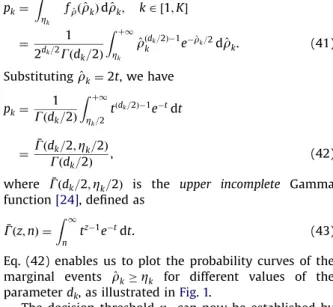
^k. (41)Substituting
r
^k¼2t, we havepk¼
1
G
ðdk=2ÞZ þ1
Zk=2
tðdk=2Þ1etdt
¼
G
¯ðdG
k=2;Z
k=2Þ ðdk=2Þ, (42)
where
G
¯ðdk=2;Z
k=2Þ is the upper incomplete Gammafunction[24], defined as
¯
G
ðz;nÞ ¼Z 1
n
tz1etdt. (43)
Eq. (42) enables us to plot the probability curves of the marginal events
r
^k
Z
k for different values of theparameterdk, as illustrated inFig. 1.
The decision threshold
Z
kcan now be established byfixing an acceptable level of tolerance
a
for the probability of false alarmpkat eachk4Lþ1, while allowing P½r
^Lþ1Z
Lþ1to be as high as possible, depending on the value ofzk. In other words, we needpk
a
fork4Lþ1. Using (42)we conclude that
Z
kcan be chosen so that¯
G
ðdk=2;Z
k=2Þa
G
ðdk=2Þ. (44)InFig. 1, we plot the probabilitypkas a function of
Z
k=2using (42), for different values of the numberdkof degrees
of freedom of the test variable
r
^k. In this example, thetolerance level
a
has been fixed at two values:a
¼1% and 0:5%. The decision threshold can be determined for a givendk by taking the value of
Z
k at the point where thecorresponding curve crosses a given tolerance level. Values of the decision threshold for the considered values ofdkand
a
are given inTable 1.Notice from (37) that the probability of false alarm still depends on
a
and KL so that a bad choice of Kmay reduce the power of the test (increasedPFis expected for KbL). Possible solutions to this drawback include the useof the Benjamini–Hochberg procedure for controlling the global level of false alarm (cf. [9–11] and references therein). This approach will not be discussed here. The proposed channel order detection algorithm is summar-ized inTable 2.
2.3.3. Simulation example
Let us consider a channel withL¼2 constant random coefficients drawn from a complex Gaussian distribution. UsingNnoiseless output data samples, we estimate the 4th-order output cumulants to form the vectorc^k, defined
in (10), forðip;jpÞ 2
J
andk¼1;. . .;K. In this example, wetake
J
¼ fð1;1Þ;ð1;2Þ; . . . ;ð1;PÞgandP¼K¼4. After that, we compose the vector z^k by taking the real andimaginary parts ofc^k, as in (13), and then we discard the
zero components corresponding to the imaginary part of the purely real-valued cumulants. Any triplet ðip;jp;kÞ
satisfying the conditions given in (9) yields a purely real-valued cumulant, and we denote by mk the number of
such components in the vectorc^k. Fork¼4 and 3, due to our choice of
J
, we havem4¼m3¼1 (sinceCð33ÞandCð4Þ
4 are purely real-valued) and henced4¼d3¼7 (m3¼
m
4¼ 0 in this example).In order to validate the test variable, we repeated the above described experiment by performing 3000 Monte Carlo simulations, varying the input data sequence sðnÞ from one simulation to another, but keeping the same channel parameters over all the simulations ( time-invar-iantchannel scenario). In this case, we usedN¼10 000
and Fig. 2 shows the histogram curves for the test
variables
r
^4 andr
^3 (solid lines). The figure on the right consists of a zoom on the area of ther
^4pdf curve on the4 5 6 7 8 9 10 11 12 13
0 0.005 0.01 0.015 0.02
ηk / 2
P [
ρk
≥η
k
]
α = 1%
α = 0.5% dk =3 dk =4 dk =5 dk =6 dk =7 dk =8
Fig. 1. Probability P½r^k Zkas a function of the decision thresholdZkfor different degrees of freedom.
Table 1
Decision thresholds for two tolerance levelsa.
a¼1% a¼0:5%
dk¼3 Zk¼11:35 Zk¼12:86
dk¼4 Zk¼13:28 Zk¼14:87
dk¼5 Zk¼15:09 Zk¼16:75
dk¼6 Zk¼16:81 Zk¼18:55
dk¼7 Zk¼18:47 Zk¼20:29
left. Decision thresholds for
a
¼1% and 5% are depicted. The dotted lines correspond to the theoretical pdf curves of the associated variables. The curves forko3 have beenomitted fromFig. 2because fork¼1 andk¼2 we have
l
kbZ
k(none underestimation cases occurred).3. Blind MISO channel order detection and parameter estimation
In this section, we consider several source signals sharing the same carrier frequency at the neighborhood of the receive antenna. We are interested in estimating the number of sources and the respective channel parameters. In this context, the radiocommunication channel can be modeled as a MISO system. First, we reformulate the cumulant vector definitions for the MISO case, and then we show that the SISO channel detection order method introduced in the last section can be used to determine the order of the longest channel in the MISO model. After that, we introduce two channel parameter estimation algorithms that allow us to reconstruct the output cumulants. Using a deflation-based approach, the procedure iterates by restarting the order
detection method on the second longest channel in the MISO model.
We assume that an unknown numberQof co-channel users are located far apart from each other, hence utilizing physically different channels. The signal measured at time instantnat the receive antenna, is written as
xqðnÞ ¼
XLq
‘¼0
hqð‘Þsqðn‘Þ,
yðnÞ ¼X
Q
q¼1
xqðnÞ þ
u
ðnÞ, (45)where
hqð0Þ¼1 (46)
and each channelq2 ½1;Qhas memoryLqþ1.
Assump-tions A1–A4 from Section 2 still hold for each sourcesqðnÞ
and their respective channel coefficients hqð‘Þ. Here, we
further assume that
A5: The input signals sqðnÞ are mutually (spatially and
temporally) independent with nonzero Kurtoses. A6: The channel orders are not equal and all bounded by a
knownK; without loss of generality, we consider that
K4L14 4LQ, so thatL1¼max1qQðLqÞ.
The case where some channels have the same length will be briefly discussed in Section 3.3.
Taking the above assumptions into account and using the multilinearity property of cumulants, the 4th-order cumulant of the output signalyðnÞ, defined in (3), can be expressed as the sum of the marginal cumulant contribu-tions of each source, as follows:
c4;yði;j;kÞ ¼
XQ
q¼1
Cqði;j;kÞ (47)
in which Cqði;j;kÞ depends on the unknown channel
parametershqð‘Þand can be written as in (4):
Cqði;j;kÞ ¼
g
4;sqXLq
‘¼0
hqð‘Þhqð‘þiÞhqð‘þjÞhqð‘þkÞ,
q2 ½1;Q, (48)
Table 2
HOS-based channel order detection algorithm.
DefineJandaand initialize the algorithm withk¼K: 1. Estimate the8th-, 6th-, 4th-,and2nd-order output cumulants
corresponding to the indicesðip;jp;kÞ,withðip;jpÞ 2J;
2.Formc^k2CP1as in(10)using the4th-order cumulant estimates
obtained in step1;
2.Determinemkas the number of real-valued cumulants inc^k;compose the
real-valued vectorz^k2Rð2PmkÞ1
3.Using all the cumulant estimates obtained in step1,compute the approximate circular and noncircular covariance matrices defined in(11)
and(12),respectively; 4.DeduceR^
kfrom(15),take its EVD and test its condition
number;determinemkas the number of discarded eigenvalues; 5.Determine the number of degrees of freedomdk¼2Pmkmkand
computex^kusing(32);
6.Computer^k¼x^Tkx^kand deriveZkfrom(44)using the value ofdk
determined in step5; 7. Test the hypotheses:
ifr^koZk,repeat the procedure from step1withk k1.
ifr^k Zk,thenL^¼k1and the algorithm is stopped.
0 50 100 150 200 250 300
0 0.05 0.1 0.14
ρ k fρ
(
ρ
k )
fρ
(
ρ k
)
0 5 10 15 20 25
0 0.05 0.1 0.14
ρ k
α
= 0.05
α
= 0.01
k = 3 ⇒ ρ
3∼nCχ( d3)(λ3)
2
k = 4 ⇒ ρ4∼ χ(d
4) 2
where
g
4;sq ¼c4;sqð0;0;0Þ. Since we assume thathqð‘Þ ¼0; 8‘e½0;Lq, we have
Cqði;j;kÞ ¼0; 8jij;jjj;jkj4Lq. (49)
Using (47), we can define the 4th-order output cumulant vector, as follows:
ck9
XQ
q¼1 ck;q2
C
P1 for eachk
2 ½1;K, (50)
where
½ck;qp9Cqðip1;jp1;k1Þ
withq2 ½1;Q;p2 ½1;P; andðip;jpÞ 2
J
, (51)the index set
J
¼ fði1;j1Þ; . . . ;ðiP;jPÞg being formed ofstrictly positive integer numbers ip;jpK. Note from
(49) that
ck;q¼0P; 8k4Lqþ1. (52)
Hence, since we have assumedL14 4LQ, we have
ck¼
0P ifk4L1þ1;
ck;1 ifL2þ1okL1þ1;
ck;1þck;2 ifL3þ1okL2þ1; cr... ..
.
ck;1þ þck;Q ifkLQþ1:
8 > > > > > > < > > > > > > :
(53)
In the sequel, we describe a deflation-type approach based on the use of nested channel order detectors, in which the test statistics are formed from the residual 4th-order output cumulants, after subtracting the contribution of the previously estimated channels. We remark that, in the context of 21 MISO systems, this deflation-based technique was proposed in [20], using a different order detection method, with test statistics obtained from the eigenvalue decomposition of a cumulant matrix.
3.1. Nested MISO order-detectors and blind channel identification
Eq. (53) shows that, for an appropriate range ofk, the output cumulant vector contains information on the longest channel exclusively. More precisely, ifk¼L1þ1, ckcan be written only in terms of the coefficientsh1ð‘Þ. As
a result, if we can determine the orderL1of the longest channel, then c^L
1þ1;1¼c^L1þ1 and we can estimate the channel coefficients associated with the source q¼1. After that, using the estimated channel coefficients, the marginal cumulants associated with the detected source can be reconstructed approximately for all k2 ½1;L1þ1. To this end, Kurtosis estimation is also needed. Then, by subtracting the contribution c^k;1 from c^k, we get an identical situation with Q1 sources and the same processing can be repeated until the Q channels are identified. The algorithm is stopped when no significant residual information remains in the estimated output cumulant vector.
The above suggested procedure summarizes the idea behind the proposed nested MISO detectors. The three
following main steps are repeated for each user
q2 ½1;Q:
1. Channel order detection: determineLq.
2. Blind channel identification: estimate channel coeffi-cientsh^
qð‘Þ,‘2 ½0;Lq.
3. Estimation of marginal cumulants: reconstructc^k;qfor all k2 ½1;Lqþ1 using the estimated channel
coeffi-cients.
Before proceeding to userqþ1, the marginal contribution of user q is subtracted from the estimated output cumulant vector c^k. Using the channel-order detection method proposed in Section 2, we can solve the problem of determining the channel order Lq by formulating a
multiple hypothesis test based on the variables
r
^kthat arecomputed from the estimated MISO channel output cumulant vectors, c^k. Details about these test variables
(step 1) are postponed to Section 3.2. In the sequel, we discuss the estimation of the channel coefficients h^qð‘Þ
(step 2). Afterwards, we will show that the reconstruction of the marginal cumulant vectorsc^k;qfor allk2 ½1;Lqþ1
(step 3) is straightforward.
3.1.1. MISO channel parameter estimation
In this section, we assume that the channel orderLqas
well as the marginal 4th-order cumulants Cqðip1;jp
1;LqÞ are known, ðip;jpÞ 2
J
; q2 ½1;Q. In the following,we present two methods for estimating the marginal channel parameters h^qð‘Þ associated with the source q,
‘2 ½0;Lq.
3.1.1.1. Rank-1 approximation-based method. From (48),
takingðip;jpÞ 2
J
andk¼Lq, we getCqðip1;jp1;LqÞ ¼
g
4;sqhqðip1Þh
qðjp1ÞhqðLqÞ,
q2 ½1;Q, (54)
where we have used (49) and the constraint (46). Hence,
cLqþ1;q9
g
4;sqhqðLqÞgðqÞ2
C
P1, (55)where
½gðqÞ
p9hqðip1Þhqðjp1Þ; p2 ½1;P. (56)
In order to recover the channel parameters, we need to impose some minimal conditions on the index set
J
of the cumulants utilized by the algorithm. Simple condi-tions ensuring correct parameter estimation are as fol-lows:ip¼p; 8p2 ½1;P; P¼K; jp¼1; 8p2 ½1;P; P¼K:
(
(57)
Satisfying the above conditions leads to
½gðqÞ
p¼hqðp1Þ, (58)
and, forp2 ½1;P, (55) becomes
cLqþ1;q¼
g
4;sqhqðLqÞhwith
hðqÞ¼ ½1;h
qð1Þ;. . .;hqðLqÞ;0;. . .;0T2
C
K1. (60)Thus we can construct the matrixCq2
C
KK, as follows:Cq9cLqþ1;qcHLqþ1;q¼
g
24;sqjhqðLqÞj2hðqÞhðqÞH
, (61)
which is clearly a rank-1 matrix. Assuming that we know the channel order Lq, we can estimate the vector
hðqÞ2
C
K1, up to a complex scaling factor, by computing the eigenvector associated with the sole nonzero eigen-value ofCq. The constrainthqð0Þ ¼1 imposed in (46)al-lows us to avoid the trivial solution and eliminate the intrinsic scaling ambiguity. In practice, we only need to use the firstLqþ1 elements ofc^Lqþ1;q to composeC^q in
order to avoid the zero-padding at the estimated channel tail.
By allowing for an increased set of 4th-order cumu-lants, we can improve the quality of the channel parameter estimates. It can be particularly interesting to expand the index set
J
to the following:J
¼ fð1;1Þ. . .ðK;1Þ . . . ð1;KÞ. . .ðK;KÞg (62)so that P¼K2. Using the above index set, we get the following equation from (55):
Bq9unvecðcLqþ1;q;KÞ ¼
g
4;sqhqðLqÞGðqÞ, (63)
with GðqÞ¼unvecðgðqÞ;KÞ ¼hðqÞhðqÞH
, where the notation
unvecðx;nÞstands for theunvectorizationoperator, which builds a matrix X2
C
mn from the vector argument x2C
mn1. As a result, we can still use the rank-1 approximation solution to estimate the channel vector hðqÞ by taking the singular vector associated with the largest singular value ofBq.3.1.1.2. Optimal solution in the total least squares sense.
Recalling (54), we notice that
½cLqþ1;qp¼Cqðip1;jp1;LqÞ. (64) Thus, another way to recover the channel coefficients consists of solving the following linear system of equa-tions, obtained from (54):
Cqðv1;u1;LqÞhqðw1Þ
Cqðw1;u1;LqÞhqðv1Þ ¼0, (65)
with 1vowLqþ1 and 1uLqþ1. (66)
From (65) we can build a set of up toLqðLqþ1Þ2=2
equa-tions with Lq unknowns, which can be rewritten in a
matrix form as follows:
Tqhq¼0, (67)
where0is an all-zero vector,hq¼ ½1;hqð1Þ;. . .;hqðLqÞTand
matrixTqis composed of the output cumulants withLqþ
1 columns and up toLqðLqþ1Þ2=2 rows, each row having
only two nonzero elements given by
½Tqrv¼ Cqðw1;u1;LqÞ;
½Tqrw¼Cqðv1;u1;LqÞ;
(
(68)
wherer¼ ðLqþ1Þðvþw3Þ þuis the row number with v,wandusatisfying (66).
Eq. (67) can be solved by computing the right singular vector of Tq associated with its smallest singular value.
Forming the index set
J
from (57), we have 1vow Lqþ1 and u¼1, and we may get up to LqðLqþ1Þ=2equations. The expanded index set given in (62) can also be used to improve the estimation quality. This solution has been originally proposed in[13]and is shown to be optimal in the total least squares (TLS) sense.
In terms of computation burden, both MISO channel parameter estimation methods presented in this section have the cost of performing one SVD for each channel
q2 ½1;Q. For comparison purposes, consider in both cases the index set
J
formed from (57). The Rank-1 approxima-tion-based method performs the SVD of a Hermitian matrix of dimensions ðLqþ1Þ ðLqþ1Þ, while the TLSapproach computes the SVD of a complex-valued matrix of dimensionsðLqðLqþ1Þ=2Þ ðLqþ1Þ. Due to the larger
number of equations used, the TLS method may theore-tically give better results at the cost of an increased complexity (except for the casesLq¼1;2). Results shown
in Section 4 indicate that, for those particular cases, the performance gap between these two methods may be negligible.
3.1.2. Composition of marginal cumulants from estimated channel coefficients
Rewriting (53) fork¼Lqþ1,q2 ½1;Q, we have
ck¼
cL1þ1;1 fork¼L1þ1;
cL2þ1;1þcL2þ1;2 fork¼L2þ1; ..
.
.. .
cLQþ1;1þ þcLQþ1;Q fork¼LQþ1 8
> > > > > < > > > > > :
(69)
so that we can estimate the marginal cumulant contribu-tion of sourceqas follows:
^
cLqþ1;q¼c^Lqþ1 X
q1
i¼1
¯
cLqþ1;i, (70)
where c¯Lqþ1;i are the reconstructed cumulant vectors
obtained from (48) using the previously estimated coefficient vectors h^i, i2 ½1;q1. To achieve this step,
we need to know the Kurtosis of source q. Note that ½c^^
Lqþ1;qp¼
^
Cqðip1;jp1;^LqÞ. From (54), using the index
set defined in (57) and imposing the constraint (46), we get
½c^L^qþ1;qp¼
^
g
4;sq^
hqðp1Þh^qðL^qÞ. (71)
Thus, an estimate of the source Kurtosis
g
4;sq is given by the least squares solution:^
g
4;sq¼P
ph^
qðp1Þ½c^^L
qþ1;qp
^
hqðL^qÞPpjh^qðp1Þj2
; q2 ½1;Q. (72)
3.2. Test statistics for MISO order-detection
user channel, since all the subsequent steps depend on this parameter. Here, we treat this problem as an FIR channel order selection problem and show that we can use the method proposed in Section 2 by computing the test variables from the estimated cumulants obtained at the output of the MISO channel.
Recalling definition (26), we can compute the test variable
r
^k from the real-valued vector z^k, which isdefined in (13) and consists of the real and imaginary parts of the vector c^k of the estimated 4th-order
cumulants of the MISO channel output, defined in (50). Hence, we can write
^ zk9
XQ
q¼1 ^
zk;q (73)
and
^
zk;q9½Reðc^k;qÞT Imðc^k;qÞTT; q2 ½1;Q. (74)
Thus, from (53), we deduce that
^
zk¼z^k;1 fork¼L1þ1. (75)
In addition, sincezk¼0dkfork4L1þ1, we can use (26) to construct our test variable from the vectorz^k, so that, for k4L1þ1,
r
^k follows a Chi-square distribution with dk
degrees of freedom, withdkgiven by (30).
On the other hand, as long as zk is nonzero for k¼L1þ1, the variable
r
^L1þ1has anoncentralChi-square distribution withl
L1þ1¼zTL1þ1;1R
L11þ1zL1þ1;1, related to the mean of the test variable as follows:E
fr
^L1þ1g ¼
l
L1þ1þdL1þ1. We can hence denote
^
r
k¼z^TkR
^1
k z^k
w
2ðdkÞ; k
4L1þ1; N! 1;
nC
w
2ðdkÞðl
kÞ; kL1þ1; N! 1: 8<
: (76)
Using (15), we can deduce
R
^k for k L1þ1 from the estimated circular and noncircular covariance matrices, given in (11) and (12), respectively.
Eq. (76) shows that the test statistic
r
^kenables us to
correctly detect the order of the longest channel asso-ciated with the MISO mixture. After determining the order
L1, we can use one of the techniques described in Section 3.1 to estimate the channel coefficients h^1ð‘Þ. Then, by replacing the estimated coefficients in (48), we recon-struct the vectorsc¯k;1for allk2 ½1;L1þ1. Subtractingc¯k;1 fromc^kallows for the computation of new test statistics
leading to the detection of the next longest channel. This deflation principle, discussed in Section 3.1, allows us to successively extract the sources from the MISO mixture. The algorithm continues until no significant residual information is detected in the remaining cumulant vector. The nested MISO channel detection method is summar-ized inTable 3.
3.3. MISO channels with identical lengths
In the case where at least two channels,q1andq2, have the same order,Lq1¼Lq2¼L, the proposed MISO channel detection method does not fully apply because the residual cumulant c^k for k¼Lþ1 contains information
from both channels, i.e.
^
cLþ1¼c^Lþ1;q1þc^Lþ1;q2. (77)
As long as the marginal cumulants are not separable, the deflation technique is no longer suitable to estimate the channel parameters. Hence, the hypothesis test for q1 should lead to the same result as that ofq2, i.e.^L
q1¼ ^
Lq2. In this case, the estimated parameters should be disregarded and the nested detection procedure termi-nated. Therefore, the proposed approach can detect the order and estimate the parameters of the channels having order higher thanLþ1. The procedure is not able to identify the number of channels with the same length
Lþ1, but can indicate that at least two sources are present in the MISO mixture.
Nevertheless, cumulants are also sensitive to the nonlinearity of a stochastic process, in the sense defined
in[23]. Yet, the process obtained by MISO linear filtering
of several i.i.d. sequences cannot be obtained by linear filtering of a single i.i.d. sequence. This property will be used in a future paper to detect the number of sources when channels may have the same length.
4. Simulation results
In this section, we illustrate the performance of the nested detectors described inTable 3 by means of some simulation results. In order to evaluate the proposed detection/identification method, we make use of the two following criteria, which are defined for each signal source
q2 ½1;Q:
(i) The empirical probability of detection: it corresponds to the ratio between the number of Monte Carlo simulations in which the detector results are consis-tentðL^q¼LqÞand the total numberRof realizations of
the experiment.
(ii) The normalized mean squared error (NMSE) of the consistent results: this metric is computed for each Table 3
Nested MISO channel detection procedure.
1. Estimate the 4th-order MISO channel output cumulants; compose the real-valued vectorsz^k, and computeS^
k,k2 ½1;K;
2. Initializeq¼1 andk¼K;
3. Compute the test variablesr^k, defined in (26) usingz^kandR^k; determine the decision threshold using the procedure described in Section 2
4. Run the order-detection algorithm by testing the hypotheses: ifr^koZkthen takek k1 and start over from step 3. ifr^k Zkthen^Lq¼k1. Go to step 5.
ifL^
q¼0, stop the procedure; 5. Computeh^
qð‘Þ,‘2 ½0;Lq, fromc^Lqþ1;qusing one of the two blind channel identification techniques described in Section 3.1; 6. From (48), compute the entries ofc¯k;q, for allk2 ½1;Lqþ1, usingh^qð‘Þ
andg^4;sq, the latter being obtained from (72); 7. Update the output cumulant vector asc^k c^kc¯k;q;
channelqas follows:
NMSEðqÞ ¼ 1 Rq
XRq
r¼1
khbhqrihqk2
khqk2
, (78)
whereRqis the number of consistent results obtained
for source q over R realizations and hbhqri is the
estimated channel vector associated with source q, obtained for the (consistent) realizationr.
Both blind channel identification algorithms described in Section 3.1 have been implemented (rank-1 approxima-tion and TLS) using the index set defined in (62), assuming the input signal constellation is known (none Kurtosis estimation needed). However, since the results are very close, we omitted here the curves obtained with the rank-1 approximation solution.
Nested algorithm for blind order detection and parameter
estimation of MISO channels: Let us consider a
frequency-selective MISO communication channel withQ¼2 users
and one single receive antenna. A static multipath propagation scenario is assumed, which induces a delay spread of the order of 3 symbol periods on the channel of source 1ðL1¼2Þand of the order of 2 symbol periods on the channel of source 2ðL2¼1Þ. Channel coefficients have been randomly generated with a continuous complex Gaussian distribution. The figures in the sequel have been obtained with the following coefficient vectors (where
j¼p1):
h1¼ ½1:0;1:350:57|;0:72þ1:49|T,
h2¼ ½1:0;1:14þ0:23|T. (79)
A known upper bound of K¼5 is assumed for both channel orders. The source signals have been QPSK modulated and 200 input data blocks have been indepen-dently generated, withNsamples per block. The results shown below have been averaged over the simulations for all received data blocks, using the nested detection–esti-mation procedure presented inTable 3.
0 2000 4000 6000 8000 10000
0 20 40 60 80 100
Sample data length
Empirical probability (%)
0 2000 4000 6000 8000 10000
−25 −20 −15 −10 −5 0
Sample Data Length
MMSE (dB)
source 1
source 2
source 1
source 2
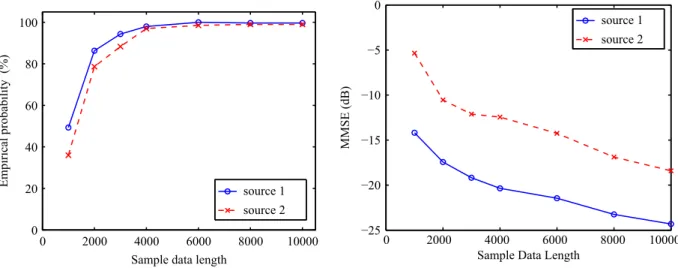
Fig. 3.Empirical probability of detection (left) and NMSE (right) versus the sample data length, with SNR¼40 dB (L1¼2,L2¼1 andK¼5).
0 2000 4000 6000 8000 10000
0 20 40 60 80 100 0 20 40 60 80
Sample Data Length
Empirical Probability (%)
1000 2000 3000 4000 5000 6000 7000 8000 9000 10000 −25
−20 −15 −10 −5 0
Sample Data Length
MMSE (dB)
source 1 source 2 source 3 source 1
source 2 source 3
First, we fixed the SNR value at 40 dB and considered an output sample data length (N) varying from 103to 104. At the left-hand side ofFig. 3, we notice a poor detection performance for both sources when the sample data length is smaller than N¼2000. The overall channel identification performance is improved as the number of output data samples increases. This is an expected result due to the fact that the cumulant estimators are biased, but the bias is asymptotically zero. Increased cumulant estimation variance implies worse channel parameter estimation, specially for short data lengths. In addition, in Fig. 3, we observe a performance loss between sources 1 and 2, suggesting that the proposed algorithm suffers from error propagation, harming the identification of shorter channels.
Afterwards, we considered a channel scenario with
Q¼3 sources, where L1¼3, L2¼2 and L3¼1. Repre-senting the randomly generated channel coefficient vectors byg1,g2andg3, we used:
g1¼ ½1:0;0:5783þ0:7291|;1:38200:99|,
0:6140þ1:3799|T, (80)
g2¼h1, andg3¼h2. Again, the SNR value was fixed at 40 dB and the output sample data length (N) varied from 103to 104.Fig. 4(left) shows the empirical probability of detection for each source, highlighting the fact that a too small data length entails performance degradations. We also verified an improvement of channel identification performance as the sample data length increases, as it can be seen at the right-hand side ofFig. 4. Here again, we can observe the effects of error propagation on the estimation of the shorter channel parameters. This behavior can be explained from the fact that shorter channels are estimated from the residual 4th-order cumulants, i.e. the information remaining after the subtraction of the reconstructed cumulants of longer channels, which are themselves estimated and hence susceptible to errors.
In another simulation, we used channels h1 and h2 with a sample data length of N¼104 for SNR values ranging from 5 to 40 dB. As we can see inFig. 5, the nested detectors are quite robust with respect to additive Gaussian noise, at moderate and high SNR levels. For low SNR levels the channel estimation performance is significantly degraded. Notice that, although the proposed order detection technique is based on the 4th-order output cumulants, the computation of
r
^k involves theestimation of the covariance matrix
R
^k, which requires
computing 2nd-order moments estimates. The overall detection performance is therefore expected to suffer with increasing levels of Gaussian noise, as illustrated inFig. 5. We notice that error propagation also affects the perfor-mance of the proposed method in a varying range of SNR. Finally, we studied the case of two sources transmit-ting data over channels that share one common zero, with
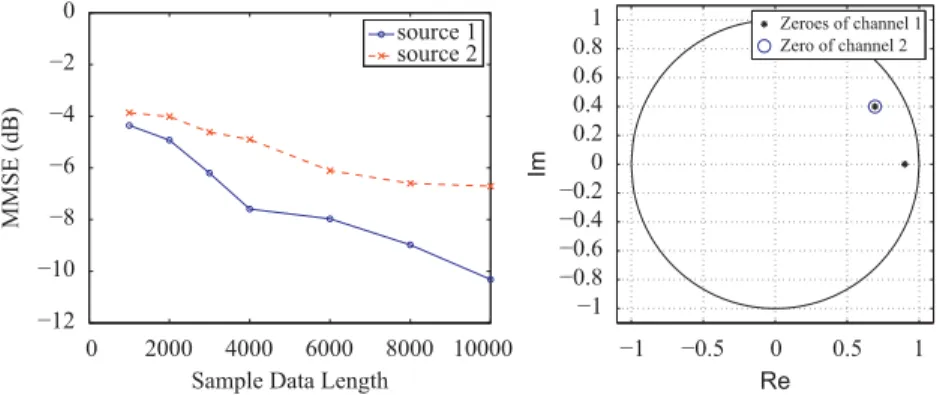
L1¼2, L2¼1 andK¼5. In this case, the user channels have been generated by randomly choosing a point within a unit-sided square centered at the origin of the Real Imaginary plane, following a bidimensional uniform distribution. The zero-pole plot of the channels used in this simulation is shown in the right-hand side ofFig. 6. The left-hand side ofFig. 6shows NMSE versus the sample data length for SNR¼40dB. Looking at these results, we notice a performance degradation with respect to the case shown in Fig. 3. This observation suggests that the proposed method performs better with channels that do not share common zeroes.
5 10 15 20 25 30 35 40
−25 −20 −15 −10 −5 0
SNR (dB)
NMSE (dB)
source 1 source 2
Fig. 5.SNRNMSE withN¼104symbols (L
1¼2,L2¼1 andK¼5).
0 2000 4000 6000 8000 10000
−12 −10 −8 −6 −4 −2 0
MMSE (dB)
Sample Data Length source 1 source 2
−1 −0.5 0 0.5 1
−1 −0.8 −0.6 −0.4 −0.2 0 0.2 0.4 0.6 0.8 1
Re
Im
Zeroes of channel 1 Zero of channel 2
5. Conclusion
In this paper, a new solution has been proposed to jointly solve the problems of order detection and para-meter estimation of FIR channels in the context of a frequency-selective MISO communication system. We have proposed a channel order detection algorithm based on HOS hypothesis testing. A Chi-square test variable has been introduced along with a discussion about the choice of the decision threshold. The proposed detection algo-rithm relies on some properties of the 4th-order output cumulants. Exploiting the proposed order selection meth-od, a combined detection–estimation procedure has been introduced. The new algorithm successively detects the source signals, determines the order of their individual transmission channel and estimates the associated chan-nel coefficients. The nested detectors are based on a deflation approach, extracting from the output cumulants the marginal contributions of the previously identified channels and testing for the presence of shorter and shorter channels. Using the residual cumulant vector, the order-detection problem is treated separately for each user. Computer simulations have shown the good perfor-mance obtained for channel order detection and identifi-cation.
One main drawback of the proposed technique is the fact that it is based on a deflation technique, which entails a high sensitiveness to cumulant estimation errors, leading to cumulative parameter estimation errors. We currently workout a possible solution to mitigate or suppress the error propagation issue based on an adapted deflation approach for referenced contrast optimization [19].
The case of channels with the same order still needs further investigation. Future works on this subject include an implementation of the nested MISO detectors for the case of a multiple-input multiple-output (MIMO) com-munication channel. In such a MIMO approach more information is available, which should allow us to treat the case of same length channels, including the over-determined as well as the underover-determined mixtures.
References
[1] H. Akaike, A new look at the statistical model identification, IEEE Transactions on Automatic Control 19 (6) (1974) 716–723. [2] L. Albera, P. Comon, Asymptotic performance of contrast-based
blind source separation algorithms, in: 2nd IEEE Sensor Array and Multichannel Signal Processing Workshop, Rosslyn, USA, August 2002.
[3] L. Albera, A. Ferre´ol, P. Comon, P. Chevalier, Blind identification of overcomplete mixtures of sources (BIOME), Linear Algebra Applica-tions 391C (November 2004) 3–30.
[4] J.F. Bo¨hme, Statistical array signal processing of measured sonar and seismic data, in: Proceedings of the SPIE Advanced Signal Processing Algorithms, San Diego, USA, July 1995.
[5] D.R. Brillinger, Time Series: Data Analysis and Theory, Holden-Day, San Francisco, 1981.
[6] D.R. Brillinger, M. Rosenblatt, Computation and interpretation of
kth-order spectra, in: B. Harris (Ed.), Spectral Analysis of Time Series, Wiley, New York, USA, 1967, pp. 189–232.
[7] J.-F. Cardoso, Source separation using higher order moments, in Proceedings of IEEE ICASSP, Glasgow, Scotland, May 1989, pp. 2109–2112.
[8] J.-F. Cardoso, A. Souloumiac, Blind beamforming for non Gaussian signals, IEE Proceedings-F 140 (6) (December 1993) 362–370. [9] P.-J. Chung, J.F. Bo¨hme, C.F. Mecklenbra¨uker, A.O. Hero, On signal
detection using the Benjamini–Hochberg procedure, in: Proceed-ings of the IEEE Workshop on Statistical Signal Processing, Bordeaux, France, July 2005, pp. 615–618.
[10] P.-J. Chung, J.F. Bo¨hme, C.F. Mecklenbra¨uker, A.O. Hero, Detection of the number of signals using the Benjamini–Hochberg procedure, IEEE Transactions on Signal Processing 55 (6) (June 2007) 2497–2508.
[11] P.-J. Chung, N. Czink, C.F. Mecklenbra¨uker, Model order selection for multipath MIMO channels using the Benjamini–Hochberg proce-dure, in: ITG/IEEE-Workshop on Smart Antennas, Ulm, Germany, March 2006.
[12] P. Comon, Independent component analysis, in: Proceedings of the International Signal Processing Workshop on Higher-order Statis-tics, Chamrousse, France, July 1991, pp. 111–120.
[13] P. Comon, MA identification using fourth order cumulants, Signal Processing 26 (3) (March 1992) 381–388.
[14] P. Comon, P. Chevalier, V. Capdevielle, Performance of contrast-based blind source separation, in: Proceedings of the SPAWC, Paris, 1997, pp. 345–348.
[15] P. Comon, L. Deruaz, Normality tests for coloured samples, in: Proceedings of the IEEE-ATHOS Workshop on HOS, Begur, Spain, June 1995, pp. 217–221.
[16] P. Comon, M. Rajih, Blind identification of under-determined mixtures based on the characteristic function, Signal Processing 86 (9) (September 2006) 2271–2281.
[17] L. De Lathauwer, B. De Moor, J. Vandewalle, J.-F. Cardoso, Independent component analysis of largely underdetermined mixtures, in: Proceedings of the 4th International Symposium on Independent Component Analysis and Blind Signal Separation (ICA 2003), Nara, Japan, April 2003, pp. 29–34.
[18] J.-P. Delmas, H. Gazzah, A.P. Liavas, P.A. Regalia, Statistical analysis of some second-order methods for blind channel identification/ equalization with respect to channel undermodeling, IEEE Transac-tions on Signal Processing 48 (7) (July 2000) 1984–1998. [19] R. Dubroca, C. de Luigi, E. Moreau, Adapted deflation approach for
referenced contrast optimization in blind MIMO convolutive source separation, in: T. Adali et al. (Eds.), Proceedings of ICA 2009, Paraty-RJ, Brazil, Lecture Notes in Computer Science, vol. 5441, Springer, Berlin, Heidelberg, 2009, pp. 243–250.
[20] C.E.R. Fernandes, P. Comon, G. Favier, Order detection and blind identification of 21 MISO channels, in: Proceedings of IEEE ICASSP, vol. 3, Honolulu, USA, April 2007, pp. 753–756.
[21] C.E.R. Fernandes, G. Favier, J.C.M. Mota, Blind channel identification algorithms based on the Parafac decomposition of cumulant tensors: the single and multiuser cases, Signal Processing 88 (6) (2008) 1382–1401.
[22] B. Friedlander, B. Porat, Asymptotically optimal estimation of MA and ARMA parameters of non-Gaussian processes from higher-order moments, IEEE Transactions on Automatic Control 35 (1) (1990) 27–35.
[23] M. Hinich, Testing for Gaussianity and linearity of a stationary time series, Journal of Time Series Analysis 3 (3) (1982) 169–176. [24] N.L. Johnson, S. Kotz, N. Balakrishnan, Continuous Univariate
Distributions, vol. 1, Wiley, New York, 1970.
[25] R.L. Kashyap, Inconsistency of the AIC rule for estimating the order of autoregressive models, IEEE Transactions on Automatic Control AC-25 (5) (October 1980) 996–998.
[26] M. Kaveh, H. Wang, H. Hung, On the theoretical performance of a class of estimators of the number of narrow-band sources, IEEE Transactions on Acoustics, Speech and Signal Processing 35 (9) (1987) 1350–1352.
[27] J.-L. Lacoume, P.-O. Amblard, P. Comon, Statistiques d’ordre supe´r-ieur pour le traitement du signal, Masson, Paris, 1997 (in French). [28] A.P. Liavas, P.A. Regalia, J.-P. Delmas, Blind channel approximation:
effective channel order determination, IEEE Transactions on Signal Processing 47 (12) (December 1999) 3336–3344.
[29] A.P. Liavas, P.A. Regalia, J.-P. Delmas, Robustness of least-squares and subspace methods for blind channel identification/equalization with respect to effective channel undermodeling/overmodeling, IEEE Transactions on Signal Processing 47 (6) (June 1999) 1636–1644.
[30] W.S. Liggett Jr., Passive sonar: fitting models to multiple time series, in: J.W.R. Griffiths, P.L. Stocklin (Eds.), Proceedings of NATO ASI Signal Processing, Academic, New York, USA, 1973, pp. 327–345. [31] P. Loubaton, E. Moulines, P. Regalia, Subspace method for blind
Wireless and Mobile Communications, Volume II—Trends in
Single-and Multi-User Systems, Prentice-Hall, Englewood Cliffs, NJ, 2000, pp. 63–112.
[32] J.W. Mauchly, Significance tests for sphericity of a normaln-variate distribution, The Annals of Mathematical Statistics 11 (2) (June 1940) 204–209.
[33] K.A. Meraim, J.-F. Cardoso, A. Gorokhov, P. Loubaton, E. Moulines, On subspace methods for blind identification of single-input/multiple-output FIR filters, IEEE Transactions on Signal Processing 45 (1) (January 1997) 42–55.
[34] K.A. Meraim, P. Loubaton, E. Moulines, A subspace algorithm for certain blind identification problems, IEEE Transactions on Signal Processing 43 (2) (March 1997) 499–511.
[35] K.A. Meraim, E. Moulines, P. Loubaton, Prediction error method for second order blind identification, IEEE Transactions on Signal Processing 45 (3) (March 1997) 694–705.
[36] E. Moulines, P. Duhamel, J.-F. Cardoso, S. Mayrargue, Subspace methods for the blind identification of multichannel FIR filters, IEEE Transactions on Signal Processing 43 (2) (February 1995) 516–525. [37] R.J. Muirhead, Aspects of Multivariate Statistical Theory, Volume
(XIX-673 p.), Wiley, New York, 1982.
[38] J. Neyman, E.S. Pearson, On the problem of the most efficient tests of statistical hypotheses, Philosophical Transactions of the Royal Society of London, A 231 (1933) 289–337.
[39] B. Porat, B. Friedlander, Performance analysis of MA parameter estimation algorithms based on high-order moments, in: Proceed-ings of IEEE ICASSP, vol. 4, New York City, USA, 1988, pp. 2412–2415. [40] B. Porat, B. Friedlander, Performance analysis of parameter estima-tion algorithms based on high-order moments, Journal of Adaptive Control and Signal Processing 3 (1989) 191–229.
[41] B. Porat, B. Friedlander, Direction finding algorithms based on high-order statistics, IEEE Transactions on Signal Processing 39 (9) (September 1991) 2016–2024.
[42] J. Rissanen, Modeling by shortest data description length, Auto-matica 14 (5) (1978) 465–471.
[43] G. Schwarz, Estimating the dimensions of a model, The Annals of Statistics 6 (2) (1978) 461–464.
[44] P. Stoica, Y. Sele´n, Model order selection: a review of information criterion rules, IEEE Signal Processing Magazine 21 (4) (2004) 36–47.
[45] L. Tong, S. Perreau, Multichannel blind identification: from sub-space to maximum likelihood methods, Proceedings of the IEEE 86 (10) (October 1998).
[46] L. Tong, G. Xu, T. Kailath, Blind identification based on second-order statistics: a time domain approach, IEEE Transactions on Informa-tion Theory 40 (2) (1994) 340–349.
[47] H.L. Van Trees, Detection, Estimation and Modulation Theory. Part I, Wiley, New York, 1968.
[48] M. Wax, Detection and estimation of superimposed signals, Ph.D. Thesis, Stanford University, Stanford, California, USA, March 1985. [49] M. Wax, T. Kailath, Detection of signals by information theoretic
criteria, IEEE Transactions on Acoustics, Speech and Signal Proces-sing ASSP-33 (April 1985) 387–392.
[50] D.B. Williams, D.H. Johnson, Modifying the sphericity test for improved source detection with narrowband passive arrays, in: Proceedings of IEEE ICASSP, vol. 12, Dallas, USA, April 1987, pp. 2272–2275.
[51] D.B. Williams, D.H. Johnson, Using the sphericity test for source detection with narrow-band passive arrays, IEEE Transactions on Signal Processing 38 (11) (November 1990) 2008–2014.