ACCESSIBILITY IN VIRTUAL MOODLE LEARNING ENVIRONMENT: LITERATURE
REVIEW
ACESSIBILIDADE NO AMBIENTE VIRTUAL DE APRENDIZAGEM
MOODLE
: REVISÃO DE
LITERATURA
ACCESIBILIDAD EN EL AMBIENTE VIRTUAL DE APRENDIZAJE MOODLE: REVISIÓN DE LA LITERATURA
Aline Tomaz Carvalho1, Andréa Soares Rocha da Silva2, Lorita Marlena Freitag Pagliuca3
ABSTRACT
Objective: to analyze the literature using the Modular Object-Oriented Dynamic Learning Environment (Moodle) for accessibility of people with limitations, disabilities, low educational level and elderlies to the virtual environment. Method: a descriptive study, literature review, from the issue: ‘Is the Moodle environment accessible?’ We used the Portal Periodicals Capes and Google Scholar using the terms "moodle and accessibility" and "moodle and inclusion". Were amounted 17 documents which were fully read critically, organized and presented in figures. The analysis proceeded according to the method of descriptive statistics.
Results: prevailed publications in academic Google (16/17), 2009 (09/17), Brazilian (17/17), Southern (8-47%), of universities (15-88.2%) in Education (06/17), qualitative studies (5/17) and facing blind people (7/17). The majority (13/17) considered the Moodle partially accessible. Final Considerations: Moodle has more features of accessibility than barriers. Descriptores: Education; Internet; People with Disabilities; Elderly.
RESUMO
Objetivo: analisar na literatura o uso do Modular Object-Oriented Dynamic Learning Environment (Moodle) para a acessibilidade das pessoas com limitações, deficiência, baixa escolaridade e idosos ao ambiente virtual. Método: estudo descritivo, revisão de literatura, a partir da questão O ambiente Moodle é acessível?
Utilizaram-se o Portal Periódicos Capes e o Google Acadêmico com os termos “moodle e acessibilidade” e “moodle e inclusão”. Somaram-se 17 documentos os quais foram lidos na íntegra de forma crítica, organizados e apresentados em figuras. A análise procedeu conforme o método de estatística descritiva. Resultados:
predominaram publicações no Google acadêmico (16/17), de 2009 (09/17), Brasileiras (17/17), região Sul (8-47%), de universidades (15-88.2%), na área da Educação (06/17), estudos qualitativos (5/17) e voltados para pessoas cegas (7/17). A maioria (13/17) considerou o Moodle parcialmente acessível. Considerações finais: o
Moodle apresenta mais características de acessibilidade do que barreiras. Descritores: Educação; Internet; Pessoas com Deficiência; Idoso.
RESUMEN
Objetivo: analizar en la literatura el uso del Modular Object-Oriented Dynamic Learning Environment (Moodle) para la accesibilidad de las personas con limitaciones, discapacidades, bajo nivel educativo y adultos mayores al ambiente virtual. Método: se realizó un estudio descriptivo, revisión de la literatura, desde la pregunta “¿El ambiente Moodle es accesible?” Se utilizaron los Portal Periódicos Capes y el Google Académico utilizando los términos "Moodle y accesibilidad" y "Moodle y la inclusión." Ascendió a 17 documentos que fueron leídos completamente de forma crítica, organizados y presentado en figuras. El análisis realizado de acuerdo con el método de estadística descriptiva. Resultados: prevalecieran las publicaciones en el Google académico (16/17), de 2009 (09/17), Brasileños (17/17), Región Sur (8-47%), de universidades (15-88,2%) en Educación (06/17), estudios cualitativos (5/17) y vueltos a las personas ciegas (7/17). La mayoría (13/17) consideró el Moodle parcialmente accesible. Consideraciones finales: el Moodle presenta más características de accesibilidad que barreras. Descriptores: Educación; Internet; Personas con Discapacidad; Más Viejos. 1Nurse, Master, Federal University of Ceara/PPGENF/UFC. Fortaleza (Ceara), Brazil. E-mail: [email protected]; 2Professor at the Federal University of Ceara/UFC. Fortaleza (CE), Brazil. E-mail: [email protected]; 3Nurse, Title Professor, Postgraduation Program in Nursing, Federal University of Ceara/PPGENF/UFC. Fortaleza (CE), Brazil. E-mail: [email protected]
The use of Information and Communication Technologies (ICT) in education is increasingly widespread throughout the world, especially through the use of internet, computers and even mobile devices like cell phones. However, some groups still encounter barriers in using these technologies or do not have access to information such as the elderly, people with disabilities or little schooling.
According to data from the National Household Sample (PANAD) in 2008, 56 million people aged ten and older accessed the Internet, among which 11.2% were 50 years or older and 7, 2% had no schooling or less than 4 years of study.1 as for people with a disability, whether permanent or temporary, they also use the internet with the help of hardware and software that facilitate access, calls assistive technologies (TAs) and its guaranteed access to these systems, as promulgated by Decree No. 6949 of 25 August 2009, which deals with the International Convention on the Rights of Persons with Disabilities.2
The company is in the process of building equity in their various spheres, among which the physical and social. In this new context integrator also includes education, education and more specifically mediated by information technology and communications (ICT), characteristic of the knowledge society. Therefore, this knowledge must be widely available and offer the same learning opportunity for all citizens.3
One of the assumptions of distance education (DE) is exactly make formal education accessible to a growing number of individuals. However, several factors may limit access to courses in the distance mode, among which access to technology (computer and Internet) domain and technological resources needed to handle the tools and virtual learning environments (VLEs), through which participants access the educational content and interact with the other participants.
The AVAs are software environments developed in a visual programming language for Web, used for creating and managing courses in distance.4 There are three categories of tools available in a VLE: administrative tools (useful to create courses, manage enrollments define user profiles, etc.). Learning tools, for publishing and accessing and evaluating learning, and interactive tools which allow communication between the teacher-tutor and the student
among students, such as messages, chats, forums, web conference, etc.
From a technological standpoint, two strategies would be to enable access to online distance learning courses for people with a disability: the use of TAs as external interfaces to the AVA, or the development of specialized interfaces in their own AVA, i.e. plug-ins that implement accessibility requirements.
The offering of shares in distance education mediated by ICTs, called online distance learning, involves the work of a multidisciplinary team composed of professionals from different fields with pedagogical or technological expertise which will be used for production, supply and management courses distance. However, the number of professionals with such expertise is still small, and even rarer is to find among these professionals, someone with knowledge about accessibility.
This context demonstrates the relevance of this work, whose survey information will be extremely useful for adequacy AVA DL for access by people with disabilities, supporting digital inclusion, informational and social these people.
The present study aims:
♦ To analyze literature using the Modular Object-Oriented Dynamic Learning Environment (Moodle) for accessibility for people with limitations, disabilities, seniors and low educational virtual environment.
♦ To identify the barriers and possible solutions to the problems identified.
A descriptive study reviewing literature.5 The research question: 'Was the environment Moodle accessible?' From there began the search in databases Portal (Portal Periodicals Capes) and Google Scholar. The terms used were: Accessibility and Moodle and Moodle and inclusion. In Portal (Portal Periodicals Capes) found an article, whereas Google Scholar identified 888 related documents.
As data collection instrument was used adapted form, which were taken issues of health research as the level of evidence were added and the areas of research found in the studies.6 The instrument allowed obtaining information on identifying and authors of the article, source location, objectives, study characteristics, theoretical and methodological coherence, data analysis, results and discussion and implications.
To select the sample, were initially read the titles and abstracts, and used the following inclusion criteria: published articles in journals over the past five years, publications in conference proceedings, completion of course work for graduation or specialization, dissertation, doctoral dissertations, whose themes involve Moodle and people with limitations, linked to the concept of web accessibility and universal design. Exclusion criteria were duplicate publications, or those that represent the development of a single virtual learning environment. The collection period was from May to June 2012.
Based on the above criteria, it was amounted to 17 documents which were read in their entirety, in order to collect critical
data. The articles were numbered according to the order of location, and the data were organized and grouped figures in EXCEL 2011. The analysis proceeded according to the method of descriptive statistics.
Through analysis of the articles found, it was observed that most were found on Google scholar (16/17). It was found that prevailed publications that occurred from 2009 (09/17), and published in scientific journals (6/17) (Figure 1).
All documents were Brazilians prevalence of publications from the South (8-47%) and related institutions were predominant universities (15-88.2%) (Figure 1).
Authors Year of
publishing Type of publishing Region Institution
Rezende7 2007 Newspaper NE Institute of Blind People
of Bahia Jatobá, Vrabl, Barros, Engelbrecht,
Braganholo8 2011 Event proceedings SE Institute Constant Benjamin Ulbricht Flores, Vanzin, Amaral, Ribas9 2011 Periodic SE UFRJ
Mari10 2011 Masters Dissertation SE UFSC
Coelho, Raposo, Silva, Almeida11 2011 Periodic CO UNR Leithardt, Bagatini, Conforto, Santarosa12 2010 Periodic S FURG
Silva Beche,Souza13 2011 Annals of event S UFSC
Macedo,Pereira14 2009 Periodic S UFSC
Nóbrega15 2011 Periodic NE UFPE
Machado16 2011 Specialization
Monography
CO UNB
Bites, Almeida17 2009 Annals of event CO UNB
Ulbricht, Batistta, Quevedo, Flores, Gabardo, Vanzin, et al18
2010 Annals of event S UFSC
Figueiredo, Cunha19 2011 Annals of event SE UFF
Pereira, Cerny, Quadros20 2009 Periodic S UFSC
Lebedeff, Rosa21 2011 Annals of event S UFSC
Santarosa, Conforto, Ferrada, Basso22 2010 Annals of event S UFRGS
Silva, Gonçalves23 2010 Periodic S UFSC
Figure 1. Classification of publications included in the review by the authors, year of publication, type of publication, region and institution of study.
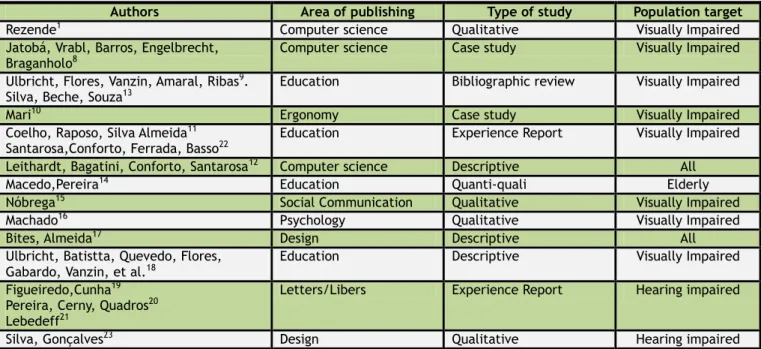
According to Figure 2, most documents were published by the Education field (06/17) and the predominant type of qualitative study
(5/17). Moreover, the main target audience was identified blind people (7/17).
Figure 2. Categorization of publications included in the review by Authors, Area of Publication, Type of study and Population Target. Fortaleza, 2012.
Authors Area of publishing Type of study Population target
Rezende1 Computer science Qualitative Visually Impaired
Jatobá, Vrabl, Barros, Engelbrecht, Braganholo8
Computer science Case study Visually Impaired
Ulbricht, Flores, Vanzin, Amaral, Ribas9.
Silva, Beche, Souza13 Education Bibliographic review Visually Impaired
Mari10 Ergonomy Case study Visually Impaired
Coelho, Raposo, Silva Almeida11 Santarosa,Conforto, Ferrada, Basso22
Education Experience Report Visually Impaired
Leithardt, Bagatini, Conforto, Santarosa12 Computer science Descriptive All
Macedo,Pereira14 Education Quanti-quali Elderly
Nóbrega15 Social Communication Qualitative Visually Impaired
Machado16 Psychology Qualitative Visually Impaired
Bites, Almeida17 Design Descriptive All
Ulbricht, Batistta, Quevedo, Flores,
Gabardo, Vanzin, et al.18 Education Descriptive Visually Impaired Figueiredo,Cunha19
Pereira, Cerny, Quadros20 Lebedeff21
Letters/Libers Experience Report Hearing impaired
Silva, Gonçalves23 Design Qualitative Hearing impaired
Regarding the accessibility of Moodle environment 13/17 publications considered it partially accessible, with occasional need for remodeling to facilitate access by the disabled or elderly. Only 04/17 considered it not widely available.
From this, we observed that the studies pointed barriers and specific suggestions according to disability or limitation of target (Figure 3).
Regarding the accessibility of Moodle environment 13/17 publications considered it partially accessible, with occasional need for remodeling to Facilitate access by the disabled or elderly. Only 04/17 considered it not widely available.
From this, we observed that the studies pointed barriers and specific suggestions according to disability or limitation of target (Figure 3).
Population Barriers Suggestions
Blind The absence of alternatives to the different media used
Obligatory insertion of alternate content for different media in the AVA by the authors and/or content.
Blind Difficulty in using synchronous tools-chats
Manual scrolling controlled by student use of spoken chat (Skype ® or MSN ®).
Blind Long courses More cohesive and content creation with minor routes
Blind Links within the text Links outside the Hierarchical shape text; The most important Links placed to the right and less important to the left of the page.
Blind Difficulty in using the text editor
Use text editor, open source, free and with availability of plug-ins for Assistive Technologies-TinyMCE ®
Blind Difficulty in reading pdf documents
To open documents in the browser
Deaf Difficulty in
understanding the Portuguese language
Videos and texts in Libbers; academic terms and glossary of the Portuguese language; online videos as a tool for communication student and tutor, option to download and upload videos in Libbers; make DVD with course content in Libbers.
Elderlies Difficulty in reading the texts on line
Contrast between font and background; Written with alternation between uppercase and lowercase letters.
Figure 3. Identification of accessibility barriers on the target population, and suggested solutions in the studies selected for this review. Fortaleza, 2012.
♦
The Moodle and accessibility in the
web
Using Moodle has become very popular among educators around the world as a tool for creating dynamic web sites for their students, with the provision for educators, tools for managing and promoting learning.24 However, the use of the environment for people with disabilities or limitations as the elderly still have barriers, damaging the accessibility and usability for these users.
For creating accessible web requires the observation of guidelines for the creation of sites, as the Web Content Accessibility Guidelines, created by the World Wide Web Consortium (W3C) and Web Accessibility Initiative (WAI)25, which are international communities that work focused to ensure web accessibility. We still have the Model Accessibility of Electronic Government (E-MAG), created by the Brazilian26 government
for the creation of federal websites accessible. Moreover, the assessment by automated tools for the development of the website or AVA, as the Assessor and Simulator Sites (ASES) is important and can point out the mistakes and how to correct them.
Despite all the technology for building web accessible, evaluation by the user is
necessary. For them, real barriers may be identified according to their limitations and their level of knowledge. Thus it becomes possible to build virtual learning environments in semantic formats, i.e. facing the user's own profile.
♦
Moodle and the person with visual
impairment
Regarding the studies that deal with the use of Moodle for people with visual impairments. There was identified as the main difficulty equivalent to the absence of the different media, such as images, videos, among others. For this, we proposed a set of mandatory insertion means of alternative content to existing media such as videos with audio description or text equivalents for images.
In a study evaluating websites with thirty blind users, found that most websites did not have text equivalents for images or graphics, with needs identified as the description of the location of the image on the page as well as short text alternative with audio options for those that want more information about them. 27 Barriers were mentioned in the use of
spoken with the use of software such as Skype® and MSN®.
Besides these, other obstacles are cited for using Moodle by people with visual impairment, including difficulty reading PDF documents and inserts links in the text. To overcome these difficulties were mentioned screen readers such as Jaws or Dosvox, which makes reading the source code of the pages and transfer to the voice synthesizer or a Braille display or both. 28 This way the content can be verbalized for the blind or transcribed into Braille characters, favoring the deaf-blind.29 For that there are no difficulties in understanding the content or even decrease the autonomy of users, it is necessary that developers know the different existing TAs and seek to adapt their material to them.
♦
Moodle and the person with hearing
impairment
All studies that dealt about using Moodle for people with hearing loss said about the difficulty that the deaf person has to understand the English language. This is due to the fact that the education of the deaf person is accomplished by use of sign language as natural language, which was made official in Brazil as LBS or Brazilian Sign Language.30
From this, the strategies aimed to solve the problem were: the creation of a glossary of Portuguese and academic terms, the availability of videos and download videos online for communication between student-tutor, and the creation of a DVD alternative with all the course content translated into LBS.
Currently, the LBS is scientifically recognized as a language in gesture-visual communication with grammatical structure itself, independent of the Portuguese language. This means that the deaf person may not be literate in Portuguese or do not understand all the vocabulary texts or even more convoluted. However, the creation of an accessible AVA implies developing an environment where everyone can access with the same ease and speed. Thus, it is antagonistic the option of creating other means of access to the educational material outside the learning environment, for example, a DVD, when it should choose the universal design.
♦
Moodle and the elderly
The document that dealt about using Moodle for older people reported as the main obstacle to the difficulty of reading the text on the computer screen. As alternatives given
were given to creating pages with increased font size, and contrast between the font color and background screen. Another option was favorable writing texts alternating uppercase and lowercase letters.
Moreover, it was observed that some users have had good knowledge about the use of computers and the internet, giving up as an option to create AVAS facing a standard usability median, i.e. for people with average knowledge about the use internet or online education environments.
Aging causes decreased organ functions, including vision and reflexes or even logical reasoning and preparedness. Thus, in the cyber world many people aged over 60 still shirk in using communication technologies for fear of failing to meet the requirements or physical limitations such as decreased visual acuity. However, with the aging population, the country opens up to new ways of democratization of knowledge that are provided by the use of information technologies and communication, including the Internet and online education courses.31
The internet becomes therefore an infrastructure of community and a space for the expression of citizenship for everyone, including the elderly.32
Older people now have a better educated than those of the last century and have better scientific knowledge with systematic titles undergraduate and postgraduate. Thus their concerns and perspectives are different and need to be properly satisfied. 33
Thus, education focused on elder ceases to be of assistance, in order to fill the idle time for a transformative education as a means of liberation and changes in the elderly, as it allows the reevaluation of the characteristics, and provide a process of reflection and analysis for these people.33
Digital inclusion is currently one of the parameters of development of a society. It is closely related to universal design, i.e., a society made for everyone, including their spaces, products, media and education.
Faced with the prospects of inclusion in education, the creation of virtual learning environments through the use of Moodle has been expanded and encouraged, and this is favorable to digital inclusion, as it is a tool that offers more features than accessibility barriers.
It is noteworthy that accessibility goes beyond the physical and communicational and
faced with behavioral barriers. This is important, since the creators, developers, tutors and contents of virtual learning environments must take into account the limitations in existing population as well as the ability of these people have to learn and interact through online education. This means that everyone should work towards creating digital learning objects accessible.
1. Instituto Brasileiro de Geografia e Estatística [Internet]. Síntese de Indicadores. Pesquisa Nacional por Amostras de Domicílio (PNAD). 2008 [cited 20 Jan 2012]. Available from:
http://www.ibge.gov.br/home/estatistica/po pulacao/trabalhoerendimento/pnad2008/defa ult.shtm.
2. Brasil. Decreto n.º 6949, de 25 de agosto de 2009. Promulga a Convenção Internacional sobre os Direitos das Pessoas com Deficiência e seu Protocolo Facultativo, assinados em Nova York, em 30 de março de 2007. Diário Oficial da União 2009 Aug. 26;1(163):3-9. 3. Silva RA, Luckman AP, Wilbert JW. Acessibilidade de AVAS para o usuário PNEE: uma visão introdutória. Rev ACB Bibliotec Santa Catarina [Internet]. 2011 Jan-June [cited 2012 Apr 14];16(1):217-33. Available from:
http://www.sumarios.org/sites/default/files/ pdfs/65963_7462.PDF.
4. Silva ASR. Estudo da relação entre domínio tecnológico, interação e aprendizagem "colaborativa" na EaD on-line pelo uso de um modelo de equações estruturais. Fortaleza (CE). Tese [Doutorado em Educação] - Universidade Federal do Ceará; 2009.
5. Romanowski JP, Ens RT. As pesquisas
denominadas do tipo “estado da arte” em
educação. Diálogo Educ [Internet]. 2006 Sept-Dec [cited 2012 Mar 12];6(19):37-50. Available from:
http://www2.pucpr.br/reol/index.php/DIALO GO?dd1=237&dd99=view.
6. Ursi ES, Gavão CM. Prevenção de lesões de pele no perioperatório: revisão integrativa da literatura. Rev latinoam enferm [Internet]. 2006 Feb [cited 2012 Oct 22];14(1):124-31.
Available from:
http://www.scielo.br/scielo.php?script=sci_ar ttext&pid=S0104-11692006000100017&lng=es.
7. Rezende ALA. EASY: Mediando as Interações dos Deficientes Visuais com o Ambiente Virtual de Aprendizagem Moodle. Rev RESI [Internet]. 2007 [cited 2012 May 23]. Available from:
http://www.unime.com.br/2006/modulos/co ordenacao/arquivos/resi_2_artigo_3.pdf.
8. Jatobá A, Vrabl S, Barros DR, Engelbrecht A, Braganholo V. Ampliando Horizontes de Aprendizagem: Ensaios sobre o Uso do Moodle por Deficientes Visuais. Anais do 13º Congreso Internacional de Educación a Distancia CREAD UDEC; 2009 Nov 30-Dec 4. Santiago (CL): UDEC; 2009.
9. Ulbricht V, Flores ARB, Vanzin T, Amaral MA, Ribas A. Os Deficientes Visuais e a Educação a Distância. Rev Educ online [internet]. 2011 Sept-Dec [cited 2012 May 23]; 5(3):[about 5 sreens]. Available from:
http://www.latec.ufrj.br/revistas/index.php? journal=educaonline&page=article&op=view& path%5B%5D=187.
10. Mari CMM. Avaliação de Acessibilidade e da Usabilidade de um Modelo de Ambiente Virtual de Aprendizagem para a Inclusão de Deficientes Visuais. São Carlos (SP). Dissertação [Mestrado em Engenharia de Produção] - Universidade Federal de São Carlos; 2011.
11. Coelho CM, Raposo PN, Silva EX, Almeida ACF. Acessibilidade para pessoas com deficiência visual no Moodle. Rev Lin Crític. [Internet]. 2011 May-Aug [cited 2012 June 13];17(33):327-48. Available from:
http://seer.bce.unb.br/index.php/linhascritic as/article/viewFile/5697/4709
12. Leithardt VRQ, Bagatini D, Conforto D, Santarosa LMC. Acessibilidade e Interatividade dos AVAS: dependentes dos navegadores Web. Rev Perspect Conhec [Internet]. 2010 [cited 2012 June 13];3(1):80-92. Available from:
http://www.facensa.com.br/files/revista _2010/acessibilidade
13. Silva SC, Beche RCE, Souza MV. A Acessibilidade na Educação à Distância. Anais do 8º Congresso Brasileiro de Ensino Superior a Distância; 2011 Oct 3-5. Ouro Preto (MG): UNIREDE; 2011.
14. Macedo MKB, Pereira ATC. Desenvolvimento de recomendações de acessibilidade e usabilidade para ambientes virtuais de aprendizagem voltados para o usuário idoso. Rev Renote [Internet]. 2009 July [cited 2012 June 13];7(1):14-24.
Available from:
http://seer.ufrgs.br/renote/article/viewFile/ 14035/7927
15. Nóbrega GC. Acessibilidade aos conteúdos visuais em ambientes virtuais de aprendizagem. Rev Rev Bras Trad Visual [Internet]. 2011 [cited 2012 June 13];9(9).
Available from:
http://www.rbtv.associadosdainclusao.com.b r/index.php/principal/article/view/114/184
16. Mari CMM. Avaliação de Acessibilidade e da Usabilidade de um Modelo de Ambiente Virtual de Aprendizagem para a Inclusão de Deficientes Visuais. São Carlos (SP). Dissertação [Mestrado em Engenharia de Produção] - Universidade Federal de São Carlos; 2011.
17. Machado DS. Inclusão e Acessibilidade: A mediação pedagógica de uma professora com Deficiência Visual em Ambientes Virtuais de Aprendizagem. Brasília (DF). Monografia [Especialização em Desenvolvimento Humano, Educação e Inclusão Escolar] - Universidade Aberta do Brasil/Universidade de Brasília; 2011.
18. Bites PG, Almeida OCS. Design de Interação para WEB com ênfase em Pessoas com Deficiência. Anais do 15º Congresso Internacional de Educação à Distância; 2009 Sept 27-30; Fortaleza (CE); 2009.
19. Ulbricht VR, Batistta CMS, Quevedo SRP, Flores AB, Gabardo P, Vanzin T, et al. Educação a Distância Inclusiva. Anais do 11º Encuentro Internacional Virtual Educa; 2010 June 21-25; Santo Domingo; 2010.
20. Figueiredo LM, Cunha M. O uso da educação a distância para o ensino de libras nos cursos de licenciatura. Anais do 8º Congresso Brasileiro de Ensino Superior a Distância; 2011 Oct 3 – 5. Ouro Preto (MG): UNIREDE; 2011.
21. Pereira ATC, Cerny RZ, Quadros RM. O Ambiente Virtual de Ensino-Aprendizagem do curso LetrasLIBRAS. Rev Tec Cient [Internet]. 2009 [cited 2012 June 13];1(1):52-60.
Available from:
https://periodicos.ifsc.edu.br/index.php/rtc/ article/view/209/152
22. Lebedeff TB, Rosa F. Ensino de libras a distância: uma discussão sobre desafios e superações didáticas. Anais do 8º Congresso Brasileiro de Ensino Superior a Distância; 2011 Oct 3 – 5. Ouro Preto (MG): UNIREDE; 2011. 23. Santarosa LMC, Conforto D, Ferrada RBH, Basso LO. Formação de Professores: Construindo Cenários Inclusivos na América Latina. In: Sánchez CJ. Congreso Iberoamericano de Informática Educativa [Internet]. 2010 [cited 2012 June 13].
Available from:
http://www.niee.ufrgs.br/eventos/TISE/2010 /libro_ie_2010.pdf
24. Silva MR, Gonçalves MM. Um processo de projeto para interfaces de objetos de aprendizagem: o caso do hiperlivro do ambiente virtual de Letras/LIBRAS. Rev Des
Hiperm Proces Conex [Internet]. 2010 [cited 2012 June 13]. Available from:
http://designdehipermidia.ufsc.br/vol1/cap3 /cap3.pdf
25. Moodle [Internet]. Bem-vindo a comunidade Moodle! [cited 2012 June 13]. Available from: http://moodle.org/.
26. Web Accessibility Initiative Guidelines and Techniques [Internet]. 2012 [Updated 2011 Mar 15; cited 2012 Mar 10]. Available from:
http://www.w3.org/WAI/guid-tech.html.
27. Brasil. e-MAG Modelo de Acessibilidade em Governo Eletrônico. Ministério do Planejamento, Orçamento e Gestão. Brasília: MP, SLTI, 2011 [cited 2012 Mar 10]. Available from:
http://www.governoeletronico.gov.br/acoes-e-projetos/e-MAG/.
28. Murphy E, Kuber R, McAllister G, Strain P, Yu W. An empirical investigation into the difficulties experienced by visually impaired Internet users. Univ Access Inf Soc [Internet]. 2008 [cited 2012 Aug 23];7(1):79–91. Available from:
http://link.springer.com/article/10.1007%2Fs 10209-007-0098-4?LI=true#page-1
29. Shimomura Y, Hvannberg ET , Hafsteinsson H. Accessibility of audio and tactile interfaces for young blind people performing everyday tasks. Univ Access Inf Soc [Internet]. 2010 Nov [cited 2012 Aug 23];9(4):297-310. Available from:
http://www.deepdyve.com/lp/springer- journals/accessibility-of-audio-and-tactile-interfaces-for-young-blind-people-pQyl5QzDgK
30. Web Accessibility in Mind (WEBAIM). [Internet]. Utah: Center for Persons with Disabilities; c1999-2012. Introduction to web accessibility. Available from:
http://webaim.org/intro/.
31. Freitag PLM, Fiúza NLG, Rebouças CBA. Aspectos da comunicação da enfermeira com o deficiente auditivo. Rev Esc Enferm USP [Internet]. 2007 Sept [cited 2012 Aug 23];41(3):411-8. Available from:
http://www.scielo.br/scielo.php?script=sci_ar ttext&pid=S0080-62342007000300010&lng=en.
32. Alves VP, Lopes C. Idosos, Inserção social e envelhecimento saudável no contexto da Educação a Distância nas UnATIS: Um relato de experiência. Pesqui Prat Psicossociais [Internet]. 2008 Aug [cited 2012 Aug 20];3(1):125-32. Available from:
http://www.ufsj.edu.br/portal2-repositorio/File/revistalapip/volume3_n1/pdf /Alves_Lopes.pdf.
Legislation, Ethics and Practice of Nursing. J Nurs UFPE on line [Internet]. 2009 Apr-June [cited 2012 Aug 20];3(2):399-404. Available from:
http://www.ufpe.br/revistaenfermagem/inde x.php/revista/article/view/308/pdf_882.
34. Oliveira RC, Oliveira FS, Scortegagna PA. Pedagogia Social: possibilidade de empoderamento para o idoso. Rev Latino-Am Enfermagem [Internet]. 2010 Mar [cited 2012 Aug 23];1-15:[about 5 p.]. Available from:
http://www.proceedings.scielo.br/scielo.php? script=sci_arttext&pid=MSC0000000092010000
100022&lng=en&nrm=iso.
Submission: 03/10/2012 Accepted: 13/01/2013 Published: 15/03/2013
Correspondence
Aline Tomaz de Carvalho Rua Cícero Alves de Souza, 93 Bairro Cidade dos Funcionários