Analysis of the trajectory of the Brazilian Nursing Association –
Ceará
Section
Análise da trajetória da Associação Brasileira de Enfermagem – Seção Ceará
André Ribeiro de Castro Júnior1, Silvia Maria Nobrega-Therrien1, Maria Irismar de Almeida1, Daniele Vasconcelos
Fernandes Vieira1, Francisca Gomes Montesuma1
Objective: to describe the trajectory of the Brazilian Nursing Association.Methods: documental research with data obtained mainly from minutes of meetings of the Brazilian Nursing Association - Ceará Section. A book report was produced, with quantitative and qualitative surveys of recurrent terms and issues in the minutes. Data were triangulated and interpreted into categories. Results: information concerning the association
were divided into five categories, which exposed the profile of the boards and their priorities in the nursing
discussion in Ceará, highlighting challenges, struggles and positions about nursing education, and encouraging
the production and scientific dissemination, contextualized in the social and political conditions. Conclusion:
the Brazilian Nursing Association - Ceará Section is emblematic in building the history of the profession in
Ceará, because it brings reflections about the importance of associations to strengthen and bring visibility to the class struggles, the qualification of education and the expansion of scientific production.
Descriptors: Nursing; History of Nursing; Education, Nursing.
Objetivo: descrever a trajetória da Associação Brasileira de Enfermagem.Métodos: pesquisa documental com
dados obtidos principalmente das atas de reuniões da Associação Brasileira de Enfermagem − Seção Ceará. Produziu-se fichamento, com levantamento quantitativo e qualitativo de termos e assuntos recorrentes nas atas.
Os dados foram triangulados e interpretados em categorias. Resultados: as informações referentes à associação
foram divididas em cinco categorias, que expuseram o perfil das diretorias e suas prioridades na discussão da enfermagem cearense, destacando desafios quanto a lutas e posicionamentos sobre o ensino da enfermagem, e
ao estímulo à produção e divulgação científica, contextualizadas nas condições sociais e políticas. Conclusão:
a Associação Brasileira de Enfermagem − Seção Ceará é emblemática na construção da história da profissão no Ceará, ao ativar reflexões sobre a importância do associativismo no fortalecimento e na visibilidade das lutas de classe, a qualificação do ensino e a ampliação da produção científica.
Introduction
The Brazilian Nursing Association has its
im-portance in scientific production, through conferen -ces, symposia, seminars and conferen-ces, as well as other social events, which provide to its members, besides socio-cultural and political empowerment,
benefits such as the expansion of dialogues about edu -cation and work in nursing(1-2).
In its history of struggles for democracy, ethics and commitment to Brazilian nursing, the association levers actions in defense of life and training of profes-sionals committed to the population’s quality of life, social justice and the guarantee of citizenship(3-4).
Over time, there is growing broader participa-tion of the Brazilian Nursing Associaparticipa-tion in promoting
scientific and professional development, making it
increasingly known and recognized by national and international government, social control and nursing authorities(5).
The conditions and the impacts of associations in social life can be analyzed in several ways, following different objectives and analytical approaches in
or-der to evaluate the influence of groups and associa
-tions in the socialization process of individuals; the potential to promote reproduction, integration and social transformation; their ability to leverage econo-mic development; fostering belonging structures and
cultural identity, among others. Inserted in the field of
political sociology, this article is justified because it in -vestigatesthe relationship between associations and democracy, having as a background the contemporary
societies marked by a high degree of complexity and
plurality of social life(6).
Among other contributions, associations allow larger areas of democratic practices in various sphe-res of social life, providing an alternative way to give greater visibility to a group of disadvantaged individu-als in society or who still struggle for unreached
inte-rests. In the case of nursing, the moviment promoted by the association becomes clearly an instrument of struggle for its recognition as a profession not only in the state of Ceará, but also in Brazil and in the world(7).
The Brazilian Nursing Association - Ceará Sec-tion is an instituSec-tion that, since its creaSec-tion, through this partnership model, seeks to strengthen the
rela-tionship in a professional class that can be defined as
a social practice that promotes certain management group involved by large and particular objectives grounded in a common focus. In parts, the main focus the association movement succeeded in promoting interventions that establish a link among members,
encouraging discussions and reflections on the futu
-re of nursing, which we-re made possible by the union established between those professionals because of
the historical difficulties experienced by the nursing
staff(8-9).
The professional status is defined as social
prestige, derived from the belief that society has that the occupation has such attributes, and the belief in the dignity and importance of their job. This
recog-nition is also expressed by the organized political
power and recognized in society, when designing the association as representative of the category. This combination should be perceived by its members as a common variable to these members, but considered particular in relation to the social whole and to the go-vernment(10-11).
social field and, thus, it provides own values of a ci -vic culture. This factor tends to strengthen democracy and social ties.
The relevance of research documenting the his-tory and the memory of this association in the state of Ceará, given the lack of research on the topic, hi-ghlights the need to give visibility to its historical na-ture of work. The study of association movements in the Brazilian Nursing Association - Ceará section can show nurses’ political and social relevance in this par-tnership model, as well as contribute to the unders-tanding of the bonding process in the institution and strengthening of this institution, to strengthen ties be-tween professionals and society.
Even though it has an important representa-tion, it seems that the Brazilian Nursing Association - Section Ceará has silenced its history due to the lack of publications and reports of its history. So, this is a pioneering research regarding the preservation of the
institution’s history, finding as a difficulty in the ou -tline of the research the lack of publications about the institution, having to resort to less recent materials such as the intention to rescue data from the Brazilian Nursing Association - Ceará Section and its associa-tion model.
This research aims to describe the trajectory of
the Brazilian Nursing Association Ceará Section.
Methods
A documental type study was conducted. In the positivist conception of history, the document is something objective, neutral, and that serves to che-ck facts and events in a linear perspective. The idea of document as a monument, which appeared in the New History, is opposed to this understanding, postulating
that every historical source expresses the power of
a past society about memory and future. Thus it re-quires another focus of analysis of the document that
takes into account the reconstruction of a fact into a problematical and, above all, understanding point of
view - not only informative and explanatory. With this
view, original documents were dealt with, belonging to the Brazilian Nursing Association - Ceará Section still free from analytic treatment, as well as the minu-tes of the association’s board meetings(12).
Data collection occurred in the institution he-adquarters from June 2015 to May 2016. One sought the history of the institution in the 2003-2013 period, setting a decade of records for analysis. The time
fra-me is justified because it represents the longest term
of a president of the Brazilian Nursing Association - Ceará Section.
In the documental sources, one collected pri-marily information about the boards, their accom-plishments, milestones, challenges, struggles and achievements, characterizing the types of records
made during meetings. There was, at first, the reading
of ten minutes and thereafter ledgers were consulted
and also sent and received official documents. In the
second step, one produced a book report, with quanti-tative and qualiquanti-tative terms and subjects recurrent in the minutes. In a third step, the data were triangula-ted and interpretriangula-ted into categories and subcategories
in order to systematize the textual content of the mi
-nutes, ledgers and official documents of the Brazilian
Nursing Association - Ceará Section.
Results
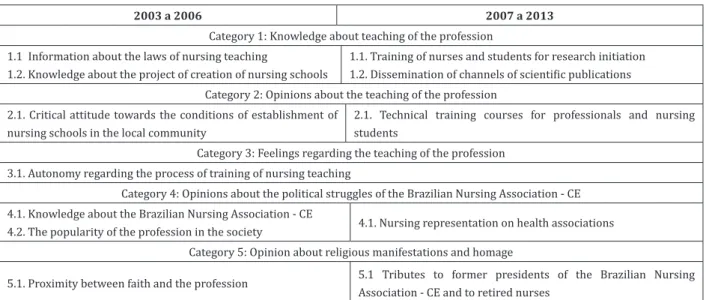
The content of the minutes showed what mem-bers of the association thought or what they did about the teaching of the profession. One found names that represented nursing in Ceará, emphasizing, as the construction of associative practice, the joints made in the name of better social and political conditions for nursing in that period (Figure 1).
2003 a 2006 2007 a 2013
Category 1: Knowledge about teaching of the profession
1.1 Information about the laws of nursing teaching
1.2. Knowledge about the project of creation of nursing schools
1.1. Training of nurses and students for research initiation
1.2. Dissemination of channels of scientific publications
Category 2: Opinions about the teaching of the profession
2.1. Critical attitude towards the conditions of establishment of nursing schools in the local community
2.1. Technical training courses for professionals and nursing students
Category 3: Feelings regarding the teaching of the profession
3.1. Autonomy regarding the process of training of nursing teaching
Category 4: Opinions about the political struggles of the Brazilian Nursing Association - CE
4.1. Knowledge about the Brazilian Nursing Association - CE
4.2. The popularity of the profession in the society 4.1. Nursing representation on health associations
Category 5: Opinion about religious manifestations and homage
5.1. Proximity between faith and the profession 5.1 Tributes to former presidents of the Brazilian Nursing
Association - CE and to retired nurses
Figure 1 -Systematization of the textual content of the minutes of the Brazilian Nursing Association - Ceará Section
Discussion
The ownership of the Brazilian Nursing Asso-ciation, from the point of view of the historical cons-truction of nursing in Ceará shows the important role of associations, highlighting the institution as a representative of the interests of the profession, and bringing together nurses, technicians, assistants and nursing students. The historical design enables the knowledge of its achievements as well as challenges
to be overcome. The designed profile brings, however,
limitations such as the scarcity of material about the institution, presenting gaps in primary sources, as to
the specific decisions and outstanding shares in the
temporal clippings, as well as in relation to the detai-led analysis of the impacts of these moments in cur-rent situation of nursing in the state of Ceará.
Category one: Knowledge about the teaching of the profession shows the knowledge of the members of the Brazilian Nursing Association - Ceará Section about the teaching of the profession. In the minutes of the period from 2003 to 2006, two sub categories were systematized, “information about the nursing
Based on the most frequent context units of the first group of minutes, it was inferred that the
contents of this category reveal, by the speaches of its board members, reports about the representations of association members in relation to the teaching of the profession, both concerning information about the laws of high school, as well as the knowledge about the project to create a nursing college in the reality of Ceará.
Concerning the years between the period 2007 to 2013, there is the division of minutes with focus on “training of nurses and students to start research” and
“dissemination of scientific publications channels.” The theme “research” was identified as part of the
struggles of the Brazilian Nursing Association - Ceará Section. Its members were concerned about the rele-vance of this issue, as this issue was addressed by the board of directors. The focus was on events to publi-cize the characteristic of nursing knowledge by the association, to promote events, disseminate nursing knowledge and allow initiation and training for rese-arch through training courses.
sing profession, there is the exchange of the teaching
model, which has a more informative characteristic. The seek for a researcher nursing highlights the need for education to appropriate itself of nursing
scienti-fic knowledge. Interest in research therefore becomes an influencer for the dissemination of this knowledge,
not only for the self-knowledge of the category, but also for the recognition of society that it attends - it is worth mentioning the Brazilian Nursing Association - Ceará Section as a vehicle in the propagation of nur-sing science(6,13-14).
Regarding Category 2: Opinions about the tea-ching of the profession, the discussions are organized into two subcategories: “critical attitude towards the conditions of creation of nursing schools in the local community” (2003-2006) and “courses of techni-cal training for professionals and nursing students” (2007-2013).
The first subcategory reveals an opinion rela
-ted to compliance with the legal aspects of training of nursing professionals, dedicated to undergraduate education. The creation of the course project at this level was under the responsibility of the nursing ca-tegory; back in the day this education was a medical liability. Then, there was the empowerment of nursing due to its teaching and its autonomy as a profession.
Wits positive positions, responsibilities are shared
among professional nurses.
The second category gathers context units that
refer to the concerns and opinions of nurses about technical training courses for professionals. There is an adaptation of members and institutions to the “te-chnical model” currently required, as the search for
scientific knowledge requires the improvement of the
knowledge acquired in the profession. Such evidence strengthens the claim that the social representations of the members of the Brazilian Nursing Association - Ceará Section guided their behaviors for the training responsibilities of professionals of the area and of its own members.
Association - Ceará Section indicate that there is a unit in the process of nursing education in the state of
Ceará, emerging, from this analysis of the feeling ex -pressed, the subcategory that deals with “autonomy regarding the process of nursing education.”
The partners, together with the institution, ha-ving a wish to change the nursing education situation, which has its base side founded in the biomedical kno-wledge, promote events, courses and meetings to pro-mote cultural capital, develop the feeling of belonging
to the institution and create zones of influence. Thus,
they are the associative life catalysts, so that nurses’ professional training start to have its autonomy de-dicated to nursing knowledge - different from the ol-der teaching model, in which various nursing schools
emerged with a knowledge field limited to the biome
-dical model, often having most of its faculty formed by doctors.
The need for changes in the education of nurses and nursing technicians, also in the processes of recognition of the profession, is a banner of struggle with which the Brazilian Nursing Association - Ceará Section consolidates in this study period, having achievements recognized by peers. Since the late
1980s until now, this fight has been strengthened by a number of events in the context of the Brazilian society and in health education - specifically nursing. Teaching is influenced by changes in the social
perspective (as in the case of the Health Reform and
the implementation of the Unified Health System) and it aims at fitting to less technical models, more
human-centered and focused on individuals. Nursing, beyond this biomedical model, needs visibility and its
own scientific knowledge(6-14).
a more participative association in movements that
fight for ideals in favor of nursing, becoming more vi -sible to society and stronger as a political represen-tative. Although with a reduced number of partners, these struggles and the spread of nursing guided by
scientific knowledge have always been the goal of the
Brazilian Nursing Association - Ceará Section.
Regarding the subcategory “representation of nursing in health associations”, one found out that even though it was silenced, regarding its number of members, the institution has large participation in movements and struggles that defend the category .
It is exactly through these autonomous, diffu
-se and formal characteristics that are grounded the
foundations for its influence on democracy, denoun
-cing injustice and questioning the traditional relations of social power and representation. This freedom of association is fundamental, from the democratic point of view, because it establishes that a diversity of interests, opinions and perspectives should have its aspects represented in the public sphere. In general, such perspectives defend that associations contribu-te to the promotion of good citizens; strengthen col-lective bonds based on trust, cooperation and public
spirit; They represent groups and vulnerable and ex
-cluded sectors; publicize demands and social proble-ms; and promote co-management and occupy spaces of public policies, enriching the foundation of partici-pation and political representation in contemporary democracies(15).
However, it is necessary to advance in the un-derstanding of the relationship between the
asso-ciative practices and the health field, particularly in
nursing. One must analyze the current democratic effectiveness of these practices in subjects, either in the individual level, or in the political and/or social le-vel, taking into account the numerical representation, regard the members of the institution.
Category 5: Opinion about religious
manifesta-tions and homages gathers the context units referring
to the attitudes of the group of nurses from the Brazi-lian Nursing Association - Ceará Section related to the cult of the Catholic religion in the period from 2003 to 2006. Although in this period, there was not so much
religious influence, it existed, even because of the ori -gin with Sister Cecília Fernandes Pequena, revealing a connection with the sisters of charity from Escola São Vicente de Paulo in its origin.
In the second period of grouping of the minu-tes, one systematized the opinions of the members of the Brazilian Nursing Association - Ceará Section in relation to the homages paid to former presidents. There was the inauguration of the photographic panel of former presidents, an action that represents a valu-ation of the history of the institution and recognition of the work of renowned professionals that worked in the association.
The identity of social subjects, which were once built on cultural factors of class, gender and even of religious aspect, underwent transformations. This change is more visible after the late 20th century, and it
opens new possibilities of social representation. This change is characterized by a high level of search for
social support. It can be identified the loss of a cultural trait, but also the gain of a more rational and scientific
professional bond. Such decoupling is presented since the very notion of need for professional growth(6-15).
Conclusion
The history of the Brazilian Nursing Association - Ceará Section showed concerns, struggles and achievements, considering the political and social
conjuncture of the time, triggering reflections on the
importance of associations and triggering a discussion about how this profession is seen today. The class struggles have been recognized as essential for the
qualification of education, the expansion of scientific
production and the appreciation of the profession, in the social dimension and in the construction of policies.
Collaborations
Castro Júnior AR and Nobrega-Therrien SM contributed to the project design, organization and
in-terpretation of data, article writing and final approval
of the version to be published. Almeida MI, Vieira DVF and Montezuma FG contributed to the critical review of the intellectual content.
References
1. Moreira MC. Dimensões do associativismo
voluntário no cenário das relações entre saúde, pobreza e doença. Ciênc Saúde Coletiva [Internet]. 2010 [citado 2017 mai. 8]; 15(3):917-24. Disponível em: http://www.scielo.br/scielo.php?script=sci_
arttext&pid=S1413-81232010000300035
2. Silva FV. Caminhos percorridos pela ABEn no período de 2004 a 2007 [editorial]. Rev Bras Enferm [Internet]. 2007 [citado 2017 mai. 8]; 60(6):617. Disponível em: http://www.scielo.br/ pdf/reben/v50n3/v50n3a01.pdf
3. Silva KL, Sena RR, Grillo MJ, Horta NC. Formação do
enfermeiro: desafios para a promoção da saúde.
Esc Anna Nery [Internet]. 2010 [citado 2017 mai. 8]; 14(2):368-76. Disponível em: http://www. scielo.br/pdf/ean/v14n2/21.pdf
4. Santana MN. O desafio de representar a ABEn
no Conselho Nacional de Saúde [editorial]. Rev Bras Enferm [Internet]. 2004 [citado 2017 mai. 8]; 57(4):393. Disponível em: http://www.scielo.br/scielo.php?script=sci_
arttext&pid=S0034-71672004000400001
5. Vale EG, Fernandes JD. Ensino de Graduação em Enfermagem: a contribuição da Associação Brasileira de Enfermagem. Rev Bras Enferm [Internet]. 2006 [citado 2017 mai. 8]; 59(esp):417-22. Disponível em: http://www.scielo.br/pdf/ reben/v59nspe/v59nspea06.pdf
6. Associação Brasileira de Enfermagem (ABEn). Centro de Estudos e Pesquisa em Enfermagem. Histórico. Apresentação [Internet]. 2015 [citado 2017 mai. 8]. Disponível em: http://www. abennacional.org.br/home/historico.htm
7. Leal S, Vargas ER. Entre associativismo e regimes
de engajamento: reflexões acerca do conceito de
inovação social para pensar políticas públicas de inovação. Estud Sociol [Internet]. 2014 [citado 2017 mai. 8]; 19(37):349-69. Disponível e m : h t t p : / / w w w. c o p p e a d . u f r j . b r / u p l o a d / publicacoes/lealevargas.pdf
8. Cabral IE, Almeida Filho AJ. 85 anos de ABEn® e 80 de REBEn® promovendo o desenvolvimento
científico e profissional da Enfermagem brasilei
-ra. Rev Bras Enferm [Internet]. 2013 [citado 2017 mai. 8]; 66(spe):13-23. Disponível em: http:// www.scielo.br/pdf/reben/v66nspe/v66nspea02. pdf
9. Tesser Júnior ZC, Ribeiro J, Domingos FL, Bett JV, Lopes VF, Manenti FM, et al. O papel do associativismo político na promoção de saúde. Saude Transf Soc. 2015; 6(3):1-8.
10. Bellaguarda ML, Padilha MI, Peres MA, Paim L.
Enfermagem profissão: seu status, eis a questão.
Rev Enferm UERJ [Internet]. 2016 [citado 2017 mai. 8]; 24(2):91-5. Disponível em: http://www. facenf.uerj.br/v24n2/v24n2a08.pdf
12. Associação Brasileira de Enfermagem – Seção Ceará. Histórico [Internet]. 2014 [citado 2017 mai. 8]. Disponível em: http://aben-ce.com.br/ historico
13. Perez D. Análise das matrizes sobre associa-tivismo civil norteadoras da formação de tra-balhadores para Ongs. Publ UEPG Ci Soc Apl [In-ternet]. 2013 [citado 2017 mai. 8]; 21(1):53-71. Disponível em: https://repositorio.unesp.br/han-dle/11449/127048.
14. Tesser Júnior ZC, Ribeiro J, Domingos FL, Bett JV, Lopes VF, Manenti FM, et al. O associativismo civil e a política de saúde no Brasil. Saúde Transf Soc. 2016; 6(3):1-8.
15. Gleriano JS, Marca NC, Justi J. Perfil e significados