www.elsevier.com/locate/precamres
Tectonic implications of Precambrian Sm–Nd dates from
the southern Sa˜o Francisco craton and adjacent Arac¸uaı´
and Ribeira belts, Brazil
Hannes K. Brueckner
a,b,
*, Dickson Cunningham
c
, Fernando F. Alkmin
d
,
Stephen Marshak
e
aSchool of Earth and Environmental Sciences, Queens College and the Graduate Center of CUNY, Queens College, Flushing, NY 11367, USA
bLamont–Doherty Earth Observatory of Columbia University, Palisades, NY 10964, USA
cOrogenic Processes Group, Department of Geology, University of Leicester, Leicester LE1 7RH, UK
dDepto. de Geologia, Univ. Federal de Ouro Preto, Ouro Preto M.G. 35.400, Brazil
eDepartment of Geology, University of Illinois, Urbana, IL 61801, USA
Received 17 November 1998; accepted 14 September 1999
Abstract
The Archean and Paleoproterozoic Sa˜o Francisco craton of eastern Brazil is surrounded on all sides by Brasiliano (=Pan African) orogens. The N–NE trending orogen that separates the eastern edge of the southern Sa˜o Francisco craton from the Atlantic coast can be divided into the largely greenschist and amphibolite facies Arac¸uaı´ belt on the west and the largely granulite facies Ribeira belt on the east. A pronounced linear gravity and magnetic anomaly, the Abre Campo discontinuity, defines the boundary between these two belts. We obtained Sm–Nd mineral ages and whole-rock Sm–Nd model ages for garnet-bearing metamorphic rocks along an E–W transect across the southern Sa˜o Francisco craton, the southern Arac¸uaı´ belt, and the Ribeira belt at about latitude 20°S. A recrystallization age of 2.1 Ga from metasediments recrystallized during the development of the classic dome-and-keel province of the southern Sa˜o Francisco craton (the ‘Quadrila´tero Ferrı´fero’) indicates that dome emplacement occurred during the waning stages (extensional collapse) of the Transamazonian collisional orogeny. Seven mineral ages from the southern Arac¸uaı´ and Ribeira belts date the thermal peak of metamorphism at between 538 and 589 Ma, confirming that these belts were pervasively remobilized during the Brasiliano event. Samples from the Arac¸uaı´ belt yield either Archean (>2.6 Ga) or Transamazonian (2.1–2.3 Ga) T
DMmodel ages, indicating that the protoliths were either fragments of
the Sa˜o Francisco craton crust or were sediments derived from that craton, which presumably had been stretched to form a thinned continental margin during Meso- and Neo-Proterozoic rifting events. Notably, a mixed meta-pelite and metabasite sequence in the southern Arac¸uaı´ belt, the Dom Silve´rio Group, has Transamazonian ancestry and thus may represent oceanic sediments deposited on or east of this stretched margin and then thrust back onto the continent to mark a collisional suture between the Sa˜o Francisco block and an Archean (?) crustal sliver to the east. The rocks of the Ribeira belt (i.e. the region east of the Abre Campo discontinuity) have younger model ages (T
DM=1.6–2.0 Ga), indicating that this belt was not originally part of the Sa˜o Francisco craton — it may represent
an accreted Transamazonian terrane. Therefore, the Abre Campo discontinuity marks an important crustal boundary, possibly a suture. Brasiliano shear zones appear to steepen and root into the Abre Campo discontinuity, suggesting that it formed in Brasiliano time. © 2000 Elsevier Science B.V. All rights reserved.
Keywords:Arac¸uaı´ belt; Brasiliano event; Brazil geology; Ribeira belt; Sa˜o Francisco craton; Sm–Nd geochronology
* Corresponding author. Fax:+1-914-365-8150.
E-mail address:[email protected] (H.K. Brueckner)
1. Introduction prior to the Cretaceous opening of the South Atlantic (e.g. Trompette, 1994). The crust between
South America today consists of a Precambrian the Sa˜o Francisco craton and the Atlantic coast
core bordered by active orogens to the north and was mobilized and/or remobilized by Brasiliano
west, and by a Mesozoic–Cenozoic passive margin tectonism and metamorphism (e.g. Almeida, 1977;
to the east. The Precambrian core is divided into Almeida and Hasui, 1984) to form an orogen that
four Archean to late Proterozoic ‘cratons’ was continuous with the West Congo fold belt of
(Almeida et al., 1981; Brito Neves and Cordani, western Africa prior to the opening of the South
1991) by a network of ‘Brasiliano’ (=Pan African) Atlantic (Porada, 1989; Brito Neves and Cordani,
orogens that developed during the final assembly 1991; Pedrosa-Soares et al., 1992; Maurin, 1993;
of Gondwana near the end of the Proterozoic. Trompette, 1994; Fig. 1). Despite considerable
pre-One of these cratons, the Sa˜o Francisco craton vious work concerning the petrological evolution
(Almeida, 1977), lies within the eastern part of of the region between the Sa˜o Francisco craton
the Brazilian Highlands (Fig. 1). The northeastern and the Atlantic coast (e.g. So¨llner et al., 1991;
lobe of this craton was continuous with the Congo Figueiredo and Campos Neto, 1993; Wiedemann,
craton of western sub-Saharan Africa ( Fig. 1), 1993; Costa et al., 1995) there is no unified and
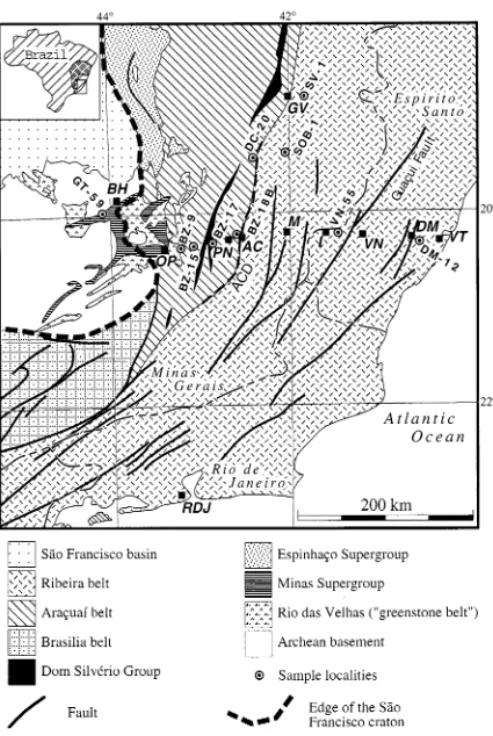
generally accepted geological subdivision for this region. Recent work (e.g. Costa et al.; 1995; Cunningham et al., 1998; Alkmim and Marshak, 1998; Fischel et al., 1998) suggests that it can be
divided into two distinct~N–S-trending tectonic
belts ( Fig. 2): the largely amphibolite-facies
Arac¸uaı´ belt on the west, and the largely granulite-facies Ribeira belt [also referred to as the ‘Coastal Mobile belt’ or ‘Atlantic belt’; see Cunningham et al. (1996, 1998) for discussion of nomenclature] on the east. These belts are separated by a
pronounced gravity and magnetic anomaly
(Haralyi and Hasui, 1982): the Abre Campo discontinuity.
Previous dates on metamorphic and igneous rocks from the Arac¸uaı´ and Ribeira belts indicate that Brasiliano tectonism in this region occurred around 0.6–0.5 Ga ( Teixeira, 1982; So¨llner et al.,
1991; Campos Neto and Figueiredo; 1995;
Machado et al., 1996b). However, many questions remain concerning the precise timing of tectonism
and the ancestry of the crust affected by this
tectonism. For example, did the Ribeira and Arac¸uaı´ belts form separately or simultaneously? Is there any Brasiliano juvenile crust in either belt or are both belts composed of remobilized Archean
and/or Proterozoic crust? Is there a Brasiliano
Fig. 1. West Africa–eastern Brazil Gondwana reconstruction suture in the region, or are there any older sutures? showing location of cratons and Brasiliano/Pan African belts.
How much of the Archean crust of the Sa˜o
Adapted from Porada (1989) and Cunningham et al. (1996).
Francisco craton was affected by the 2.1 Ga
AS: Angola Shield; CC: Congo Craton; SFC: Sa˜o Francisco
elsewhere (Marshak et al., 1996; Cunningham et al., 1996, 1998; Alkmim and Marshak, 1998). Here we report Sm–Nd mineral and whole-rock geochronologic results on garnet-bearing meta-morphic rocks. These results confirm that the rocks of the Arac¸uaı´ and Ribeira Belt were intensely recrystallized and deformed between 550 and
600 Ma ago. They provide evidence for
Transamazonian tectonism in the southern Sa˜o Francisco craton, and suggest that the basement of the Arac¸uaı´ belt contains relics of the Transamazonian orogen. Finally, the results sug-gest that most of the Arac¸uaı´ belt consists of remobilized Archean rocks of the Sa˜o Francisco craton whereas the Ribeira belt appears to consist of remobilized post-Archean crust, implying that the boundary between these two belts may be a suture.
2. Geologic setting
The southern Sa˜o Francisco craton and its margins initially formed during the Archean in several discrete events between 3.2 and 2.7 Ga (Carneiro et al., 1998). Between 2.1 and 1.9 Ga, the Transamazonian orogeny left its imprint on the southern and eastern parts of the craton (Machado
Fig. 2. Simplified regional map of southeastern Brazil showing
et al., 1992, 1996b), creating a NNW-verging
fold-sample localities and the southern Sa˜o Francisco craton, the
Quadrila´tero Ferrı´fero, and the Arac¸uaı´ and Ribeira belts sepa- and-thrust belt that was later incorporated in a rated by the Abre Campo discontinuity (ACD). BH: Belo dome-and-keel province (Alkmim and Marshak, Horizonte; GV: Governador Valladares; OP: Ouro Preto; PN:
1998). The eastern margin underwent rifting at
Ponta Nova; AC: Abre Campo; M: Manhuac¸u; I: Ibatiba; DM:
1.75 Ga (Machado and Abreu-Bentivi, 1989) to
Domingo Martins; VN: Venda Nova; VT: Vito´ria; RDJ: Rio
form a deep basin that filled with the largely
de Janeiro.
quartzitic Espinhac¸o Supergroup (Dussin and Dussin, 1995; Brito Neves et al., 1996). Another rifting event occurred along the eastern margin Arac¸uaı´ and Ribeira belts form during the
Transamazonian event, and, if so, is there a bound- between 1050 and 900 Ma, resulting in the
depos-ition of the Macau´bas Group, and the generation ary between Transamazonian juvenile crust and
Archean crust? of mafic dike swarms (Machado and
Abreu-Bentivi, 1989; Pedrosa-Soares et al., 1992, 1998; We undertook a combined structural and
geo-chronological study of the southern Sa˜o Francisco Correa-Gomes and Oliveira, 1996). All margins of
the craton were subjected to Brasiliano deforma-craton and the Brasiliano belts along its eastern
margin in order to address these questions. We tion during the Neoproterozoic and earliest
Phanerozoic (Cambrian), creating fold-thrust belts concentrated our efforts in the region between Belo
Horizonte and Vito´ria, at about 20°S, in the states that generally verge towards the interior of the
craton (Fig. 1). of Minas Gerais and Espirito Santo ( Fig. 2). The
southern Sa˜o Francisco craton in the region Herbert et al., 1991; Mu¨ller et al., 1991). There is also a structural contrast between the eastern and around Belo Horizonte (Fig. 2): Archean
base-ment [granitoid intrusives, gneisses, and migmat- western halves of the southern Arac¸uaı´ belt. The
eastern half is characterized by moderate to steep ites that range in age from 3.2 to 2.7 Ga (Machado
et al., 1992; Carneiro et al., 1998)]; an Archean foliations and is cut by numerous shear zones that
consistently verge west and, therefore, can reason-(ca. 2.7 Ga) supracrustal assemblage (the Rio das
Velhas ‘greenstone’ and associated sedimentary ably be attributed to Brasiliano tectonism. In
contrast, much of the western half of this belt sequences); two Paleoproterozoic supracrustal
assemblages, the Minas Supergroup [platformal contains a shallow east-dipping foliation
(Cunningham et al., 1998) that gradually steepens and deep marine strata including quartzite,
phyl-lite, carbonate, and Lake Superior type banded eastwards towards a structural root zone near
Abre Campo. The southern Arac¸uaı´ belt contains iron formations, deposited between 2.1 and 2.4 Ga
(Babinski et al., 1991; Machado et al., 1992, numerous mappable lithologic units (Costa et al.,
1995; Cunningham et al., 1996, 1998). One of the 1996b)] and the Itacolomi Group (quartzite and
conglomerate). The basement occurs in dome- most distinct units is the Dom Silve´rio Group, a
sequence of pelitic metasedimentary and metabasic shaped bodies separated by deep keels (troughs)
containing deformed supracrustal rocks — i.e. the rocks that occurs just west of the town of Ponte
Nova (Fig. 2). This unit contains pelitic schists, region is a dome-and-keel province (Marshak
et al., 1992). This dome-and-keel province is talc schists, serpentinites, manganese-rich
metased-iments (gondites) and other metabasites including known as the Quadrila´tero Ferrı´fero (QF ), or ‘iron
quadrangle’, because of the abundant iron ores of rare ultramafic units (Brandalise, 1991;
Jordt-Evangelista, 1992). Cunningham et al. (1996, the Minas Supergroup (Dorr, 1969). Alkmim and
Marshak (1998) postulated that the last dome 1998) suggested that the Dom Silve´rio Group may
represent a former subduction complex that marks emplacement event occurred after the
NNW-verg-ing deformation attributed to the Transamazonian a collisional suture between a Paleoproterozoic
continent to the west (which encompasses the Sa˜o orogeny, but before Brasiliano west-vergent
thrust-ing. Typically, a metamorphic ‘aureole’, where Francisco craton and the basement to the southern
Arac¸uai belt) and Transamazonian basement
ter-temperatures reached 625°C at 3 kbar
(Jordt-Evangelista et al., 1992; Marshak et al., 1992), rane to the east.
The Arac¸uaı´ belt terminates to the east at a occurs in supracrustal strata at the contact between
supracrustal strata and basement along the mar- pronounced gravity and magnetic anomaly called
the Abre Campo discontinuity ( Haralyi and Hasui, gins of the domes (Marshak et al., 1996). We
collected material from this aureole to date the 1982; Fischel et al., 1998). A narrow,
discontinu-ous belt of amphibolite, the Santo Antoˆnio do dome-emplacement event.
The eastern two-thirds of the QF is overprinted Grama amphibolite, is exposed along the
disconti-nuity (Brandalise, 1991) and a band of migmatite by west-verging structures attributed to the
Brasiliano orogeny (Chemale et al., 1994; Alkmim lies just east of it (Jordt-Evangelista and Mu¨ller,
1986). The Ribeira Belt occupies the region east and Marshak, 1998). The intensity of deformation
and the degree of associated metamorphism of the Abre Campo discontinuity and extends to
the Atlantic coast. Previously, this region has been increases eastward, culminating in the intensely
deformed, dominantly amphibolite-facies schists divided into the Juiz to Fora Gneiss Complex on
the west, the Paraı´ba do Sul Complex in the center, and gneisses of the southern Arac¸uaı´ belt. The
rocks in the eastern part of the southern Arac¸uaı´ and the Costeiro Gneiss Complex on the east
(Almeida and Hasui, 1984; So¨llner et al., 1991). belt are dominantly biotite–amphibole
ortho-gneisses and migmatites of felsic-intermediate com- The Ribeira belt consists of dominantly
granulite-facies gneisses and charnockites that contrast position of the Mantiqueira gneiss and Piedade
Gneiss complexes (Jordt-Evangelista and Mu¨ller, markedly in metamorphic grade with the
are separated by numerous narrow, highly the Belo Horizonte ‘dome’ (Fig. 2). Therefore, a mineral age from this rock dates the time of deformed, quartz mylonite and metasedimentary
belts and are cut by an array of steep NNE- contact metamorphism, and hence the time of
dome emplacement in the dome-and-keel province. striking shear zones along which there has been
dextral strike-slip and transpressive movement The whole-rock model age provides constraints on
the provenance of the metasediment. Further infor-(Costa et al., 1995; Cunningham et al., 1998). In
addition, the Ribeira belt is intruded by calk- mation on the petrography of this zoned contact
aureole is given by Herz (1978) and Jordt-alkaline granitoids that may define a Brasiliano
magmatic arc ( Wiedemann, 1993; Pedrosa-Soares Evangelista et al. (1992).
et al., 1998).
4.2. Sample BZ-9
This sample is a garnet–chlorite–muscovite 3. Sm–Nd geochronology
schist from the Nova Lima Group (Dorr, 1969), within the southern Arac¸uaı´ belt, from a railroad
Garnets generally develop much higher Sm/Nd
ratios than most other metamorphic minerals in cut 15 km east of Ouro Preto at the southeastern
corner of the QF. The unit lies at the west edge of high-grade metamorphic rocks and can be used to
define mineral isochron ages (Griffin and the southern Arac¸uaı´ belt and is thought to be
an Archean greenstone recrystallized during
Brueckner, 1980). These ages usually approach the
time of the thermal peak of metamorphism more Brasiliano metamorphism. The outcrop displays a
strong E-dipping foliation with top-to-the-west closely than do K–Ar, Ar–Ar and Rb–Sr mineral
ages. In addition, the tendency for the REEs to be kinematic indicators suggesting Brasiliano
defor-mation. Snowball-like inclusion trails within gar-relatively immobile during metamorphism means
that Sm–Nd model ages calculated from whole- nets indicate syntectonic metamorphism.
rock samples reasonably constrain the time the
protoliths of the metamorphic rocks were extracted 4.3. Sample BZ-15
from the mantle (DePaolo and Wasserburg, 1976).
Garnet-bearing metamorphic rocks were collected This garnet–biotite gneiss was collected from a
roadcut on MG262 where it crosses the Gualaxo from nine localities with the goal of obtaining Sm–
Nd recrystallization ages and whole-rock model River about 32 km east of Ouro Preto. The gneiss
is traditionally mapped as the Mantiqueira
ages.
Complex and corresponds to the basement of the Dom Silve´rio Group, a metasedimentary unit
dis-cussed below. The foliation dips 60°E. The sample
4. Sample collection localities
was analyzed for whole-rock model age. Here, we describe the sample localities (shown
in Fig. 2), in sequence from west to east, and 4.4. Sample BZ-17
provide the reasons for collecting the samples.
This biotite–garnet–muscovite–kyanite schist is mapped as part of the Dom Silve´rio Group within 4.1. Sample GT-59
the Arac¸uaı´ belt, and was collected from a roadcut 12 km west of the town of Ponte Nova. In addition This garnet–sillimanite–muscovite schist is from
the Sabara´ Formation (Dorr, 1969) exposed in a to metasedimentary schists, the Dom Silve´rio
Group contains metabasalts, ultramafites, gon-roadcut near the town of Ibirite´, 10 km west of
Belo Horizonte, in a portion of the QF that dites, and marble (Jordt-Evangelista, 1992) along
strike to the north, suggesting deposition in an escaped subsequent Brasiliano overprinting. The
collection locality lies within the contact aureole oceanic environment. Also, the unit may correlate
Arac¸uaı´ belt that has been interpreted as the 4.7. Sample SOB-1 remnant of an ophiolite (Pedrosa-Soares et al.,
1992, 1998). Thus, the Dom Silve´rio Group may This sample comes from strongly deformed
biotite-garnet gneiss exposed in a roadcut on BR mark a Transamazonian or Brasiliano suture.
However, the unit may be allochthonous; if so, its 116 about 8 km southeast of the town of Sobralia
(i.e. 30 km south of Governador Valadares), in the present position does not necessarily define the
position of a suture. We collected the sample to westernmost Ribeira belt. The sample comes from
outcrops that expose large (hundreds of meters determine its metamorphic age and possibly to
constrain the age of the provenance source. across) west-vergent sheath folds and mylonitic
shear zones. We collected this sample to determine its history of metamorphism and to try to constrain the timing of west-directed deformation.
4.5. Sample BZ-18B
A sample of garnet–biotite gneiss was collected 4.8. Sample SV-1
from a narrow slot-like roadcut along highway
MG262 12 km east of the town of Ponte Nova, in This rock is from a roadcut 25 km east of the
city of Governador Valadares within the Ribeira the Arac¸uaı´ belt. Garnet-bearing gneisses of the
Mantiqueira Complex are exposed as lenses with belt. The sample is a foliated granodiorite, and is
from a metamorphosed intrusive suite of tonalite, a relict steeply dipping foliation, surrounded by
garnet-free, biotite-rich gneiss that developed in granodiorite, and diorite called collectively the
Galile´ia Batholith. da Silva et al. (1987) deter-association with an anastamosing shallow-dipping
foliation. If the shallow-dipping foliation is a mined an Rb–Sr whole-rock isochron age of
650 Ma from a diorite within this complex and Brasiliano fabric, the relict garnet-bearing gneiss
lenses may record pre-Brasiliano metamorphism. interpreted this date as the time of crystallization
of a Brasiliano intrusive complex. Nalini et al. This sample comes from one of these lenses. The
sample also contains abundant magnetite and (1998) obtained a somewhat younger U–Pb
crys-tallization age of 595 Ma from zircons in a grano-amphibole that may be of secondary origin, related
to the shallow dipping foliation. diorite. However, Sm–Nd model ages (T
DM) for
these rock range between 2.26 and 1.80 Ga (Nalini
et al., 1998), with e
ND values ranging between
−8.9 and −9.3. These values suggest that the
4.6. Sample DC-20
complex is Brasiliano in age and was generated by melting older Precambrian crustal rocks. The col-This sample is a garnet-bearing charnockitic
gneiss from a roadcut along BR 458 where it lected sample is foliated and contains a
metamor-phic mineral assemblage, including garnet. We crosses the Santo Esteva˜o River, 15 km southwest
of the town of Dom Cavati. The largely massive collected this sample to determine the time of
metamorphism and associated deformation. outcrop displays an east-dipping foliation. The
sample was taken about 100 km northeast of
sample BZ-18B near the boundary between the 4.9. Sample VN-55
Arac¸uaı´ belt and Ribeira belt where granulite and
amphibolite-grade lithologies are intermixed [the This garnet-bearing migmatite was collected
from a roadcut along BR 262, 14 km northwest of boundary is not well defined in this region
(Cunningham et al., 1996)]. It was collected to the town of Venda Nova (120 km west of Vitoria)
in the central Ribeira belt. The rock is part of a determine whether it contains a record of
pre-Brasiliano metamorphism. This gneiss is believed wide migmatite belt associated with small granite
bodies included in the Juiz de Fora complex, to be a thrust slice that correlates with charnockitic
rocks of the Juiz de Fora complex further to that lies just to the west of the Guac¸ui fault. A
(Signorelli, 1993) was obtained from migmatites average143Nd/144Nd ratio of 0.511 857±42 for the La Jolla Nd standard (2s, standard deviations) at within this unit. We collected this sample to
deter-mine the age of recrystallization, and to deterdeter-mine the time most of the samples were being analyzed.
The143Nd/144Nd ratios were corrected for machine from the model age whether this rock had an
earlier crustal history. fractionation by normalizing to 146Nd/144Nd of
0.721 90.
The data are shown in Table 1. Isochrons were 4.10. Sample DM-12
calculated by applying York-fit regressions to the data from each sample using the ISOPLOT pro-This sample comes from a roadcut along BR
262, 5 km east of the town of Domingos Martins, gram of Ludwig (1988). The 147Sm/144Nd errors
were taken to be 0.5%, the errors in143Nd/144Nd not far from Vitoria, in the eastern Ribeira belt.
The rock consists of kinzingite, part of a 20 km were estimated using the relationship (X2+Y2)1/2
whereXis the standard deviation (2s) of replicate
wide belt of biotite–garnet–sillimanite–cordierite
gneiss that is variably migmatized. The belt is analyses of the standards (i.e. 0.000 042, see above)
andYis the standard deviation of the mean (2s)
involved in a very large west-vergent nappe. We
collected this sample to determine its metamor- of each individual run (shown on Table 1). The
calculated ages are Model 1 (Ludwig, 1988) unless phic history.
otherwise noted. T
CHUR and TDM model ages are
calculated from the whole-rock analyses and repre-sent extraction ages from the mantle assuming the 5. Methodology
rocks had been derived from an undepleted and depleted mantle respectively.
We collected approximately 5 kg of each sample, making sure that the sample was unweathered. Initial processing was carried out at the Federal
University of Ouro Preto. Samples were crushed 6. Results and interpretation
in a jaw crusher. A fraction of the resulting
frag-ments was further pulverized in a disk mill to 6.1. Sa˜o Francisco craton
provide material for whole rock analysis. A second
fraction was passed through a jaw crusher to yield The date for sample GT-59 [Fig. 3(A)]
indi-cates that metamorphism at a dome/keel (i.e.
fragments less than 1 mm in diameter. We obtained
concentrates of heavy minerals (garnet, biotite, basement/supracrustal ) contact in the western QF
occurred at 2098±33 Ma — i.e. during late stages
amphibole) and light minerals (primarily feldspars
and quartz) using a shaker table. The concentrates of the Transamazonian event. As discussed in
earlier papers (Marshak et al., 1996; Alkmim and and whole-rock powders were sent to the isotope
geochemistry lab at Lamont–Doherty Earth Marshak, 1998), this date constrains the timing
of final dome emplacement. Pomerene (1964) Observatory for further processing. There, the
concentrates were further processed into pure min- mapped the sampled unit as the Sabara´ Formation,
the youngest unit of the Minas Supergroup. U–Pb eral separates using standard heavy liquid,
mag-netic separation and hand-picking techniques. studies by Machado et al. (1992) indicate that
the Sabara´ contains Transamazonian zircons
Garnet, biotite, muscovite, amphibole and
quartz/feldspar mixtures (QF ) and whole-rock (2125±4 Ma), leading them to interpret the
Sabara´ as a Transamazonian foreland basin powders were prepared for Sm–Nd analyses using
laboratory methods described by Brueckner et al. deposit. Alkmim and Marshak (1998) argue that
the unit was deformed shortly after deposition by (1991). Procedural blanks for Nd are 30–140 pg.
Sm and Nd analyses were performed on a VG incorporation in NW-verging folds, part of the
foreland fold-thrust belt of the Transamazonian 54-30 mass spectrometer at Lamont–Doherty
Earth Observatory using a dynamic, multicollector orogen, and that immediately following thrusting
Table 1
Sm–Nd whole-rock and mineral results from garnet-bearing metamorphic rocks form the Sa˜o Francisco craton, the Arac¸uaı´ belt, and the Ribeira belt, eastern Brazil
Sm (ppm) Nd (ppm) 147Sm/144Nd 143Nd/144Nd Error 2s e
Nd TCHUR(Ga) TDM(Ga) today @575
Sa˜o Francisco craton
GT-59 WR 7.20 40.0 0.110 0.511 368 0.000 014 −24.8 – 2.22 2.37
Ms 4.60 26.1 0.107 0.511 319 0.000 012 Ms 4.07 23.0 0.107 0.511 320 0.000 016 Grt 2.19 4.22 0.313 0.514 171 0.000 012 Grt 2.43 4.89 0.301 0.513 999 0.000 017
Arac¸uaı´ belt
BZ-9 WR 8.84 33.5 0.160 0.511 452 0.000 045 −23.1 −20.4 4.8 4.0 QF
1 1.28 6.30 0.123 0.511 229 0.000 007 QF
2 0.98 16.63 0.0897 0.511 205 0.000 011 Chl 5.57 30.5 0.110 0.511 273 0.000 008 Grt 1.11 4.28 0.157 0.511 479 0.000 008
BZ-15 WR 7.89 43.7 0.109 0.510 999 0.000 005 −32 −25.6 2.83 2.83 BZ-17 WR 6.08 35.6 0.103 0.511 323 0.000 003 −25.7 −18.8 2.14 2.29
Grt 1.55 2.22 0.422 0.512 467 0.000 014
BZ-18B WR 58.9 356 0.100 0.510 879 0.000 008 −34.3 −27.3 2.76 2.78 Amp
1 68.4 198 0.209 0.512 236 0.000 009 Amp
2 65.7 194 0.205 0.512 200 0.000 006 Mag 17.2 71.6 0.145 0.511 602 0.000 015 QF 8.50 28.8 0.178 0.512 048 0.000 010 Grt
1 12.3 44.8 0.166 0.511 902 0.000 009 Grt
2 10.4 36.3 0.173 0.511 913 0.000 009
Ribeira belt
SOB-1 WR 6.51 40.9 0.09601 0.511 548 0.000 015 −21.3 −13.9 1.65 1.89 Bi 1.30 6.19 0.127 0.511 635 0.000 012
QF 0.631 3.82 0.0999 0.511 561 0.000 009 Grt 4.19 2.44 1.04 0.515 183 0.000 014
SV-1 WR 3.11 17.6 0.106 0.511 901 0.000 009 −14.4 −7.74 1.24 1.60 QF 0.301 0.705 0.258 0.512 449 0.000 014
Grt 2.07 0.631 1.98 0.518 804 0.000 020
DM-12 WR 15.7 82.6 0.115 0.511 916 0.000 006 −14.1 −8.08 1.34 1.70 QF 2.89 16.8 0.104 0.511 874 0.000 010
Grt 3.78 13.6 0.168 0.512 101 0.000 012
DC-20 WR 8.04 46.4 0.105 0.511 598 0.000 007 −20.3 −13.5 1.72 1.96 QF 0.642 3.97 0.0977 0.511 545 0.000 019
Grt 7.03 7.69 0.553 0.513 239 0.000 013
VN-55 WR 2.08 11.8 0.106 0.511 607 0.000 010 −20.1 −13.4 1.72 1.97 QF 2.19 15.9 0.0833 0.511 492 0.000 010
Grt 1.82 1.85 0.591 0.513 417 0.000 016
domes during orogenic collapse. The 2098 Ma date small negative e
Nd value (−1.0) at the time of
recrystallization indicate that the source rock had reported here is consistent with that interpretation.
The model ages of 2.2 Ga (T
CHUR) to 2.3 Ga a short residence time in the crust before it waseroded and re-deposited as the Sabara´ formation,
(T
DM) are consistent with the U–Pb zircon data
(Machado et al., 1996b) and indicate that the as would be expected if the source terrain
contained a major Transamazonian igneous
Sabara´ Formation could not have been derived
Fig. 3. Sm–Nd mineral isochrons from the Sa˜o Francisco Craton and the Arac¸uaı´ belt, eastern Brazil. Best-fit line for sample BZ-9 (B) excludes QF1.
6.2. Arac¸uaı´ belt mineral assemblage attributable to the Brasiliano orogeny and would suggest that the west-verging fabric found throughout the eastern part of the The data for Sample BZ-9, the metamorphosed
chlorite–garnet schist from the Nova Lima Group QF, particularly in the western Arac¸uaı´ belt,
formed during the Brasiliano. The unrealistically [Fig. 3(B)], yield a very poorly defined
scatter-chron of ca. 575 Ma. The minerals in this relatively old model age for the whole rock (T
DM=4.0 Ga!)
is based on a whole rock with an unusually high low-grade (greenschist) metamorphic rock do not
appear to have equilibrated for Sm, Nd and Nd Sm/Nd ratio, but is nevertheless consistent with
the interpretation of the Nova Lima as an Archean isotopes. The snowball-like inclusions in the garnet
suggest it formed under changingP–Tconditions, Greenstone Belt.
The biotite–muscovite–garnet–kyanite schist so a lack of equilibration is not surprising. The
crude best-fit age of ca. 580 Ma (QF 1 is arbitrarily from the Dom Silve´rio Group (BZ-17) defines a
garnet–whole-rock mineral age of 547 Ma
deleted from the age calculation) suggests that the
rock was metamorphosed during the Brasiliano [Fig. 3(C )], demonstrating that this unit was
meta-morphosed during the Brasiliano event. In addi-event. If confirmed, this date would be significant
because it would mark the westernmost dated tion, the model ages of ca. 2.1 Ga (T
2.3 Ga (T
DM) indicate that the unit was derived in the craton known as the Rio das Velhas event(Carneiro et al., 1998). However, sample BZ-18B
from a Paleoproterozoic ( Transamazonian) source
terrane. The apparent large negativee
Nd ratio for comes from east of the Dom Silve´rio Group,suggesting that if the Dom Silve´rio Group
repre-this rock (−16.6) at the time of the metamorphism
indicates that the source rock and/or the detritus sents a Transamazonian or Brasiliano suture then
there is Archean basement on either side of it. The from the source rock comprising the sediments
had a long residence time in the crust before model age is consistent with other Sm–Nd
whole-rock model ages determined for whole-rocks in the region Brasiliano metamorphism, as would be expected if
the rock was derived from a Paleoproterozoic ( Fischel et al., 1998), although these ages tend to
cluster at Early Archean (3.02–3.06 Ga) and Late source.
As previously mentioned, the protoliths of the Archean (2.53–2.64 Ga) and thus bracket the
model age determined for BZ-18B. Dom Silve´rio Group were probably deep oceanic
sediments and possibly ophiolitic rocks. The model The primary minerals of sample BZ-18B, garnet
and the quartz–feldspar mixture (QF ), and the ages suggest that this oceanic setting existed to
the east of the Sa˜o Francisco craton and that whole rock, define a linear array with an age that
implies the rock was subjected to Transamazonian the protolith sediments were either derived from
a Paleoproterozoic terrane to the east metamorphism at about 2.2 Ga [Fig. 3(D)]. The
e
Nd value of −6.8 for this rock during
recrystal-(arc/subduction complex?) or from rocks affected
by the Transamazonian (Paleoproterozoic) defor- lization is consistent with the notion that
Transamazonian metamorphism remobilized older mation to the west in the Sa˜o Francisco craton.
In other words, the Dom Silve´rio Group could (Archean) crystalline rocks. The secondary
miner-als of sample BZ-18B, amphibole and magnetite, represent rocks caught between a colliding terrane
to the east and the Sa˜o Francisco craton thus which may have formed later, appear to define a
younger age of about 1.5 Ga. This young age representing a suture. Because Archean rocks lie
immediately east of the Dom Silve´rio outcrop belt matches model ages of about 1.5 Ga for rocks
nearby to the east, in the Ribeira belt, as discussed
(see results for sample BZ-18B), this offshore
terrane is probably a continental basement frag- below. Thus one interpretation of the data is that
sample BZ-18B represents Archean basement
ment that rifted off of the eastern margin of the
Sa˜o Francisco craton. The present position of the rocks that were recrystallized during the
Transamazonian orogeny and then later during a Dom Silve´rio group within the Arac¸uaı´ belt
(Fig. 2) does not necessarily constrain the original ca. 1.5 Ga event. However, other Sm–Nd mineral
isochrons in the same general region as sample position of this possible suture, because the degree
of allochthoneity of the unit has not been deter- BZ-18B (i.e. the area immediately west of the Abre
Campo discontinuity) range from 528 to 672 Ma mined. However, structural data of Cunningham
et al. (1998) suggest that the Dom Silve´rio Group ( Fischel et al., 1998), clearly reflecting Brasiliano
recrystallization but showing no evidence of a is not derived from the boundary between the
Arac¸uaı´ and the Ribeira Belts some tens of kilome- 1.5 Ga event. Therefore, another interpretation of
the data is that sample BZ-18B represents Archean ters to the east of the present outcrop belt ( Fig. 2).
The scattered mineral data for sample BZ-18B basement rocks that were recrystallized during the
Brasiliano event, but either recrystallization did [Fig. 3(D)], a high-grade gneiss that occurs in
lenses surrounded by shallowly dipping lower- not result in complete equilibration between
miner-als for the Sm–Nd system, or shearing or some grade shear zones, provide a complex and
interes-ting story. The model ages for the whole rock other event subsequent to recrystallization caused
open system behavior for the Sm–Nd system, suggest that the protolith of this rock formed in
the Archean, between 2.7 and 2.8 Ga. This age resulting in the scattered data array in Fig. 3(D).
In either case, the unit sampled by BZ-18B appears range is typical of the basement rocks in the
southern Sa˜o Francisco craton region and has to differ from the other dated units of the region.
that escaped pervasive Brasiliano recrystallization garnet-bearing metamorphic rocks (528–600 Ma) determined by Fischel et al. (1998) for the area and therefore records important pre-Brasiliano
events. east of Abre Campo ( Fig. 2), U–Pb zircon ages of
570–580 Ma for rocks of the Juiz de Fora complex, in the western Ribeira belt (So¨llner et al., 1991), 6.3. Ribeira belt
U–Pb zircon, monazite and titanite ages between 565 and 590 Ma for different lithotectonic domains All five samples analyzed from the Ribeira belt,
the region east of the Abre Campo discontinuity, within the Ribeira belt (Machado et al., 1996a),
an Rb–Sr whole-rock isochron age of 580–590 Ma define Brasiliano Sm–Nd recrystallization ages
(Fig. 4) between 538 and 589 Ma. These (Signorelli, 1993) from migmatites collected near
our sample VN-55 ( Fig. 2), and a U–Pb crystal-ages confirm previous K–Ar and Rb–Sr mineral
ages ( Teixeira, 1982; da Silva et al., 1987). They lization age of 595 Ma from zircons from the
Galile´ia batholith (Nalini et al., 1998). Taken also agree with other Sm–Nd mineral ages from
together, these ages suggest that Brasiliano granu- T
DM and TCHUR ages from the remaining
sam-ples analyzed from the Ribeira belt (SOB-1, SV1 lite-facies metamorphism accompanied by
large-and DM-12) are significantly younger than scale migmatization and anatectic melting occurred
Transamazonian [Fig. 4(A)–(C )] and many of
at about 575±20 Ma.
them approach the younger (1.4–1.5 Ga)T
DMages
The whole-rock model ages for samples from
obtained by Fischel et al. (1998) for rocks of the the Ribeira belt are between 1.2 and 1.7 Ga if it is
Ribeira belt just east of Abre Campo. These youn-assumed the rock protoliths were derived from
ger model ages hint at episodes of crust formation
non-depleted mantle (i.e. T
CHUR) and 1.6–2.0 Ga during the very long interval (ca. 1500 m.y.)
if it is assumed the protoliths were derived from a
between the Transamazonian and Brasiliano
depleted mantle source (i.e.T
DM). Our results are events. Among these possible events is the 1.75 Ga
in broad accordance with model ages determined
Espinhac¸o rifting event that occurred along the by Fischel et al. (1998) from rocks from the
eastern margin of the Sa˜o Francisco craton
western Ribeira belt, although their T
DM values (Machado et al., 1992; Brito Neves et al., 1996)
tend to fall into two groups: Paleoproterozoic
and the 0.9 Ga rifting and mafic extrusive event (2.2–2.1 Ga) and Mesoproterozoic (1.5–1.4 Ga).
documented by Pedrosa-Soares et al. (1992) They also agree with those of So¨llner et al. (1991),
200 km to the north. The only evidence for either who carried out a U–Pb study of zircons from the
rifting event at the latitude of our study is the Juiz de Fora complex (i.e. the western Ribeira
model age (T
DM) of 897 Ma from the Santo
belt) and found all ages were 2.1 Ga or younger.
Antoˆnio do Grama amphibolite (Fischel et al., Similarly, an Rb–Sr whole-rock isochron from the
1998) noted above. We suggest that the model Piedade Gneiss yielded an age of 2.16 Ga ( Teixeira,
ages may point towards post-Amazonian anoro-1982). The lack of Archean model ages from the
genic magmatism at ca. 1.6±0.2 Ga (Cunningham
Ribeira belt distinguishes it from the Arac¸uaı´ belt
et al., 1998). However, this possible interpretation and implies that it is not remobilized unmodified
must be judged with caution, as samples SOB-1, Sa˜o Francisco cratonic material, but rather a
sepa-SV-1 and DM-12 are from penetratively sheared rate terrane. The Abre Campo discontinuity is,
and locally migmatized gneisses that may not have therefore, a reasonable candidate for a major
remained closed Sm–Nd systems during peak terrane boundary. Fischel et al. (1998) determined
Brasiliano metamorphism. a model age (T
DM) of 897 Ma from an amphibolite
(the Santo Antoˆnio do Grama amphibolite) that lies along the Abre Campo discontinuity near our
transect. This age and the basaltic nature of the 7. Conclusions
amphibolite protolith suggest the Abre Campo
discontinuity may represent a Brasiliano suture. Our dates indicate the following.
The ca. 1.95 Ga (T
DM) model ages for samples (1) Transamazonian (~2.1 Ga) metamorphism
DC-20 and VN-55 [Fig. 4(D) and ( E)] and the accompanied juxtaposition of basement domes
2.1–2.2 GaT
DMmodel ages determined by Fischel with supracrustal keels in the southern tip of the
et al. (1998) and 2.26–1.80 Ga T
DM model ages Sa˜o Francisco craton, confirming structural
evi-determined by Nalini et al. (1998) may indicate dence that a Transamazonian event occurred
that portions of the Ribeira belt were generated within the southern margin of the craton at this
initially during the Transamazonian event. It time.
should be remembered that T
DM ages are model (2) The region between the eastern edge of the
ages that give the oldest possible time of extraction southern Sa˜o Francisco craton and the east coast
from the mantle. If the rocks of the Ribeira terrane of Brazil was metamorphosed to amphibolite and
had been extracted from a less depleted, or even granulite facies, migmatized and anatectically
undepleted mantle, the model ages would be sig- melted during the Brasiliano orogeny between 589
and 538 Ma.
nificantly younger and approach the T
(3) The protoliths of the largely amphibolite to Acknowledgements greenschist facies metamorphic rocks of the
south-ern Arac¸uaı´ belt either formed during the Archean This work was funded by NSF Grant INT
93-01292 to W.D. Cunningham and S. Marshak or were derived as sediments from an Archean
terrane. Thus, the southern Arac¸uaı´ belt represents and EAR 90-04219 to S. Marshak with a
sub-contract to H.K. Brueckner. F. Alkmin received the stretched eastern margin of the Sa˜o Francisco
craton that was closed and thrust westward during support from CNPq project 915 153/90-6. We
thank Marcio Martins Pimentel and Nuno
the Brasiliano orogeny and possibly previously
during the Transamazonian orogeny. Machado for very helpful reviews of an earlier
version of this manuscript. Lamont–Doherty (4) The Dom Silve´rio Group, an oceanic
met-asedimentary and metaigneous unit exposed near Earth Observatory contribution number 6010.
the east edge of the southern Arac¸uaı´ belt, was derived from a Transamazonian source and was metamorphosed during Brasiliano deformation.
This unit could represent ocean crust and marine References
sediments that formed between an offshore
Transamazonian terrane (e.g. a magmatic arc con- Alkmim, F.F., Marshak, S., 1998. Transamazonian orogeny in
the southern Sa˜o Francisco craton region, Minas Gerais,
structed on an Archean continental basement
Brazil: evidence for Paleoproterozoic collision and collapse
sliver — perhaps similar to modern-day Japan) to
in the Quadrila´tero Ferrifero. Precamb. Res. 90, 29–58.
the east and the Sa˜o Francisco craton to the west.
Almeida, F.F.M., 1977. O craton do Sa˜o Francisco. Rev. Bras.
(5) Model ages for the largely granulite-facies Geocienc. 7, 349–364.
rocks of the Ribeira belt are late- to post- Almeida, F.F.M., Hasui, Y., 1984. O Precambriano do Brasil.
Edgard Blu¨cher, Sa˜o Paulo. 378 pp.
Transamazonian to Mesoproterozoic. The older
Almeida, F.F.M, Hasui, Y., Brito Neves, B.B., Fuck, R.A.,
protoliths may represent remobilized
Trans-1981. Brazilian structural provinces: an introduction. Earth
amazonian crust; the Mesoproterozoic protoliths
Sci. Rev. 17, 1–29.
in this belt may have formed during one or more Babinski, M., Chemale Jr, F., Van Schmus, W.R., 1991.
post-Transamazonian/pre-Brasiliano orogenic/ Geocronologia Pb/Pb em rochas carbona´ticas do
Supergrupo Minas, Quadrila´tero Ferrı´fero, Minas Gerais,
magmatic events.
Brasil. III Congresso Brasileiro de Geoquı´mica. Soc. Bras.
(6) The Abre Campo discontinuity separates
Geoquı´m. Resumos 2, 628–631.
the southern Arac¸uaı´ belt of Sa˜o Francisco craton
Brandalise, L.A., 1991. Text accompanying ‘Folha Ponte Nova
derivation to the west from the Ribeira Belt of (SF.23-X-B-II ), Estado de Minas Gerais, 1:100,000’.
Pro-Transamazonian and younger affinity to the east grama Levantamentos Geolo´gicos Ba´sicos do Brasil.
Depar-tamento Nacional da Produc¸a˜o Mineral, Companhia de
and thus also appears to be a major boundary
Pesquisas e Recursos Minerais — CPRM, Brasilia. 162 pp.
between terranes of different ages. Thus the strong
Brito Neves, B.B., Cordani, U.G., 1991. Tectonic evolution of
possibility exists that there are two separate
South America during the Late Proterozoic. Precamb. Res.
Precambrian sutures within the Arac¸uaı´ and the 53, 23–40.
Ribeira Belts: the Dom Silve´rio Group and the Brito Neves, B.B., Sa´, J.M., Nilson, A.A., Botelho, N.F., 1996.
A tafrogeˆnese estateriana nos blocos paleoproterozo´icos da
Abre Campo anomaly. Unfortunately,
determin-Ame´rica do Sul e processos subsequ¨entes. Geonomos 3,
ing whether one suture is Brasiliano and the other
1–21.
Transamazonian is difficult because of the strong
Brueckner, H.K., Medaris, L.G., Bakun-Czubarow, N., 1991.
Brasiliano amphibolite–granulite-grade recrystal- Nd and Sr age and isotope patterns from Variscan eclogites
lization and structural overprint. Cunningham of the eastern Bohemian Massif. N. Jb. Miner. Abh. 163,
169–196.
et al. (1998) suggested that the Abre Campo
discon-Campos Neto, M.C., Figueiredo, M.C.H., 1995. The Rio Doce
tinuity represents a Brasiliano suture because
Orogeny, Southeastern Brazil. J. S. Am. Earth Sci. 8,
Brasiliano thrust faults appear to steepen towards
143–162.
and root into that zone. However, the structural Carneiro, M.A., Teixeira, W., Carvalho, I.M., Fernandes, R.A.,
significance of the Dom Silve´rio Belt is uncertain 1998. Ensialic tectonic setting of the Archaean Rio das
Velhas Greenstone belt: Nd and Pb isotopic evidence from
the Bonfim Metamorphic complex, Quadrila´tero Ferrı´fero, ero, Minas Gerais, Brazil, US Geological Survey Prof. Paper USA, C1–C81.
Brazil. Rev. Bras. Geocien. 28 (2), 189–200.
Chemale Jr, F., Rosie`re, C.A., Endo, I., 1994. The tectonic Jordt-Evangelista, H., 1992. O Grupo Dom Silve´rio a SE de Minas Gerais: Petrografia, metamorfismo e geologia eco-evolution of the Quadrila´tero Ferrı´fero, Minas Gerais,
Brazil. Precamb. Res. 65, 25–54. noˆmica. Rev. Esc. Minas Ouro Preto 45, 1–2, 140–142. Jordt-Evangelista, H., Mu¨ller, G., 1986. Petrography of a trans-Correa-Gomes, L.C., Oliveira, E.P., 1996. O exame radial
gigante de diques ma´ficos da provı´ncia Bahia–Congo. Impli- ition zone between the Archean craton and the coast belt SE of the Iron Quadrangle, Brazil. Chem. Erde 46, 145–160. cac¸o˜es reolo´gicas e tectoˆnicas da presenc¸a de uma pluma
mante´lica na interface Ame´rica do Sul/Africa, 1,0 Ga atra´s, Jordt-Evangelista, H., Alkmin, F.F., Marshak, S., 1992. Meta-morfismo progressivo e a ocorreˆncia dos treˆs polimorfos de V Simpo´sio Nacional de Estudos Tectoˆnicos. SNET,
Pireno´-polis, pp. 52–55. abstracts. Al2SiO5 (Cianita, Andaluzita, e Silimanita) na Formac¸a˜o Sabara´ em Ibirite´, Quadrilatero Ferrı´fero, M.G.. Rev. Esc. Costa, A.G., Rosie`re, C.A., Moreira, L.M., Fischel, D.P., 1995.
Caracterizac¸a˜o geotectoˆnica do setor setentrional do Cint- Minas Ouro Preto 45, 157–160.
Ludwig, K.R., 1988. ISOPLOT for MS-DOS. A plotting and ura˜o Ribeira: Evideˆncia de acrec¸a˜o Neoproterozo´ica no leste
de Minas Gerais, Brasil. Geonomos 3 (2), 51–68. regression program for radiogenic-isotope date for IBM-PC compatible computers, version 1.00. US Geol. Surv. Open Cunningham, W.D., Marshak, S., Alkmim, F.F., 1996.
Struc-tural style of basin inversion at mid-crustal levels: two tran- File Rep. 88-577.
Machado, N., Abreu-Bentivi, F.R., 1989. Preliminary U–Pb sects in the internal zone of the Brasiliano Arac¸uaı´ belt,
Minas Gerais, Brazil. Precamb. Res. 77, 1–15. data on the evolution of the Proterozoic Espinhaco Orogen in Minas Gerais, Brazil, Program with Abstracts — Geologi-Cunningham, D., Alkmim, F.F., Marshak, S., 1998. A
structural transect across the Ribeira belt in the Brazilian cal Association of Canada Mineralogical Association of Canada, Canadian Geophysical Union, Joint Annual Meet-Highlands ( latitude 20°S ): roots of a Precambrian
trans-pressional orogen. Precamb. Res. 92, 251–275. ing vol. 14, 110.
Machado, N., Noce, C.M., Ladeira, E.A., Belo de Oliveira, O., da Silva, J.M.R., de Lima, M.I.C., Veronese, V.F., Ribeiro Jr,
R.N., Rocha, R.M., Siga Jr, O., 1987. Text accompanying 1992. U–Pb geochronology of Archean magmatism and Pro-terozoic metamorphism in the Quadrila´tero Ferrı´fero, ‘Carta Geologica Rio Doce, Folha SE.24, 1:1,000,000’:
Pro-grama Levantamento de Recursos Naturais vol. 34. Insti- southern Sa˜o Francisco craton, Brazil. Geol. Soc. Am. Bull. 104, 1221–1223.
tuto Brasileiro de Geographia e Estatistica, Rio de Janeiro.
DePaolo, D.J., Wasserburg, G.J., 1976. Nd isotopic variations Machado, N., Valladares, C., Heilbron, M., Valeriano, C., 1996a. U–Pb geochronology of the central Ribeira belt and petrogenetic models. Geophys. Res. Lett. 3, 249–252.
Dorr II, J.V.N., 1969. Physiographic, stratigraphic and struc- (Brazil ) and implications for the evolution of the Brazilian orogeny. Precamb. Res. 79, 347–361.
tural development of the Quadrila´tero Ferrı´fero Minas
Gerais Brazil, US Geological Survey Prof. Paper 641-A, Machado, N., Schrank, A., Noce, C.M., Gauthier, G., 1996b. Ages of detrital zircon from Archean–Paleoproterozoic 1–110.
Dussin, I.A., Dussin, T.M., 1995. Supergrupo Espinhac¸o: sequences, implications for greenstone belt setting and evo-lution of a Transamazonian foreland basin in Quadrilatero modelo de evoluc¸a˜o geodinaˆmica. Geonomos 3 (1), 19–26.
Figueiredo, M.H., Campos Neto, M.C., 1993. Geochemistry of Ferrifero, southeast Brazil. Earth Planet. Sci. Lett. 141, 1–4, 259–276.
the Rio Doce magmatic arc, Southeastern Brazil. An. Acad.
Bras. Cienc. 65, suppl. 1, 63–81. Marshak, S., Alkmim, F.F., Jordt-Evangelista, H., 1992. Pro-terozoic crustal extension and the generation of dome-and-Fischel, D.P., Pimentel, M.M., Fuck, R.A., Costa, A.G.,
Rosiere, C.A., 1998. Geology and Sm–Nd isotopic data for keel structure in an Archean granite–greenstone terrane. Nature 357, 491–493.
the Mantiqueira and Juiz de Fora complexes (Coastal
Mobile Belt) in the Abre Campo–Manhuay¨u region, Minas Marshak, S., Tinkham, D., Alkmim, F., Brueckner, H., Bornh-orst, T., 1996. Dome-and-keel provinces formed during Gerais, Brazil, Abstracts, International Conference on
Pre-cambrian and Craton Tectonics, Univ. Federal de Ouro Paleoproterozoic orogenic collapse — core complexes, dia-pirs, or neither? Examples from the Quadrila´tero Ferrı´fero Preto, Ouro Preto (Brazil ), 21–23.
Griffin, W.L., Brueckner, H.K., 1980. Caledonian Sm–Nd ages and the Penokean orogen. Geology 25, 415–418.
Maurin, J.C., 1993. La chaine panafricaine ouest-congolienne: and a crustal origin for Norwegian eclogites. Nature 285,
319–321. corre´lation avec le domaine est-bre´silien et hypothe´se ge´ody-namique. Bull. Soc. Geol. Fr. 164 (1), 51–60.
Haralyi, N.L.E., Hasui, Y., 1982. The gravimetric information
and Archean–Proterozoic structural framework of eastern Mu¨ller, H.J., Roeser, H., Schulz-Kuhnt, D., Tobschall, H.J., 1991. Comparison of geochemical data from gneiss– Brazil. Rev. Bras. Geocien. 112, 160–166.
Herbert, H.J., Mu¨ller, G., Roeser, H., Schulz-Kuhnt, D., migmatite and granulite facies terrains, eastern Minas Gerais, Brazil. Chem. Erde 51, 187–200.
Tobschall, H.J., 1991. Comparison of geochemical data
from gneiss–migmatite and granulite facies terrains, eastern Nalini Jr, H.A., Bilal, E., Correia Neves, J.M., 1998. Mineralog-ical, geochemMineralog-ical, and isotopic constraints of Neoprotero-Minas Gerais, Brazil. Chem. Erde 51, 187–200.
Gerais State, Brazil, Abstracts, International Conference on Jequeri Quadrangle, eastern Minas Gerais, Brazil. Chem. Erde 50, 225–245.
Precambrian and Craton Tectonics (14th International
Con-ference on Basement Tectonics), Ouro Preto (Brazil ), 44–46. Signorelli, N., 1993. Text accompanying ‘Carta Geologica Folha Alfonso Cla´udio (SF.24-V-A-II ), Estado Espı´rito Santo e Pedrosa-Soares, A.C., Noce, C.M., Vidal, P.H., Monteiro,
R.L.B.P., Leonardos, O.H., 1992. Toward a new tectonic Minas Gerais, 1:100,000’: Programa Levantamentos Geo-lo´gicos Ba´sicos do Brasil. Departamento Nacional da Pro-model for the Late Proterozoic Arac¸uaı´ (SE Brazil )–West
Congolian (SW Africa) belt. J. S. Am. Earth Sci. 6, 33–47. duc¸a˜o Mineral, Companhia de Pesquisas e Recursos Minerais — CPRM, Brasilia. 176 pp.
Pedrosa-Soares, A.C., Vidal, P., Leonardos, O.H., Brito Neves,
B.B., 1998. Neoproterozoic oceanic remnants in eastern So¨llner, F., Lammerer, B., Weber-Diefenbach, K., 1991. Die Krustenentwicklung in der Ku¨stenregion No¨rdlich von Rio Brazil: further evidence and refutation of an exclusively
ensi-alic evolution for the Arac¸uaı´–West Congo orogen. Geology de Janeiro/Brasilien. Mu¨nchner Geologishe Hefte 4. 100 pp. Teixeira, W., 1982. Geochronology of the southern part of the 26 (6), 519–522.
Pomerene, J.B., 1964. The geology and ore deposits of the Belo Sa˜o Francisco craton. Rev. Bras. Geocien. 12, 268–277. Trompette, R., 1994. Geology of Western Gondwana Horizonte, Ibirite´ and Macacos quadrangles, Minas Gerais,
Brazil, US Geological Survey Prof. Paper US Geol. Survey (2000–500Ma). Pan-African–Brasiliano Aggregation of South America and Africa,. A.A. Balkema, Rotterdam. 341-D, 1–84.
Porada, H., 1989. Pan-African rifting and orogenesis in south- 350 pp.
Wiedemann, C.M., 1993. The evolution of the Early Paleozoic, ern to equatorial Africa and Eastern Brazil. Precamb. Res.
44, 103–136. late- to post-collisional magmatic arc of the Ribeira belt, in the state of Espı´rito Santo, eastern Brazil. An. Acad. Bras. Schulz-Kuhnt, D., Mu¨ller, G., Hoefs, J., 1990. Petrology of