regional committee
PAN AMERICAN
HEALTH
ORGANIZATION
XVII Meeting
ORGAN
Port-of-Spain Trinidad and Tobago
October 1967- : '
WORLD
HEALTH
IZATION
XIX Meeting
POLIOMYELITIS IN THE AMERICAS, 1951-1966
CD17/29 (Eng.) 3 October 1967 ORIGINAL: ENGLISH
In the last ten years immunization against poliomyelitis has been available, producing dramatic reductions in morbidity and mortality from
the disease in several countries. An analysis of the situation in each country over the past fifteen years shows the extent to which the benefits from extensive use of 'accines against poliomyelitis have been attained in the Americas.
In 1951, almost 35,000 cases of poliomyelitis were reported in the Region and of these over 31,000 were in the United States and Canada and only 4,000 in the remainder of the Region. By 1965, only 2,988 cases were reported, of which 2,913 were in Latin America. The total numbers(l) of
cases reported from 1951 through 1966 are shown for three divisions of the Americas with rates per 100,000 population (Table 1). The change in
Northern America is dramatic from a high of 62,876 cases in 1952 to a low of 75 cases in 1965. In both Middle and South America the annual numbers of cases show considerable variation ranging in Middle America from a high of 3,110 cases in 1954 to a low of 769 cases in 1964, and in South America from a high of 8,204 cases in 1956, to a low of 1,646 cases in 1965.
Overall a decline in the period is evident in the two regional divisions. However, decreases have not been observed in all countries and epidemics continue to occur.
In 1967, localized epidemics in Colombia, Ecuador and Nicaragua. been reported for similar periods in
Colombia Ecuador Nicaragua
of poliomyelitis have been reported The following numbers of cases have 1966 and 1967 for these countries:
through April 16' through August 26 through August 19
1967 254
358
458
1966
45
104 2
The outbreak in Cali, Department of Valle del Cauca', Colombia, began in October 1966 and ended in early. March 1967. Of the total of 151 cases, 55 occurred in 1966. In the first 12 weeks of 1967, 136
cases were reported in Valle del Cauca.
Reported cases of poliomyelitis began to-increase in Nicaragua during April and May and reached a high level in June; a decline occurred in July. Of the total of 458 cases for Nicaragua through 19 August 1967, 208 were in the Department of'Managua and 166 in f'our neighboring depart-ments; 43 deaths were recorded.
CD17/29 (Eng.) Page 2
Table 1
Reported Cases of Poliomyelitis with Rates per 100,000 Population in the Three Regions of the Americas,
1951-1966
Northern America Middle America South America (a) Year
N-Number te Number Rate Number Rate 1951 31,006 18.4 2,239 4.8 1,7301 3-5 1952 62,876 36.8 1,547 3.2 1,814 3.7 1953 44,595 25.6 2,429 4.9 3,849 7.4 1954 41,448 23.4 3,110 5.7 2,189 4.0 1955 30,248 16.7 2,911 5.2 2,230 4.1 1956 15,820 8.6 1,396 2.3 8,204 14.3 1957 5,773 3.1 2,820 4.6 2,261 3.9 1958 6,190 3.2 1,973 3.1 2,470t 4.1 1959 I 10,314 5.3 3,005 4.6 2,762 4.4
1960 4,102 2.1 2,640 3.9 2,759 4.3
1961 1,501 0.7 1,532 2.2 2,950 4.5
1962 1,001 0.5 933 1.3 3,407 5.1
1963 ~ 572 0.3 1,451 2.0 2,954 4.4
1964 141 0.1 769 1.O 2,614 3.6
1965 i 75 0.0 1,267 1.6 1,646 2.2 1966(b) 102 0.0 i 1,267 1.6 1,680j 2.2
(a) Excluding Brazil.
(b) Including provisional data.
In Guayaquil, Ecuador, 262 cases with 21 deaths were reported by the end of August. No information regarding cases in September has been received. Other parts of the coastal region are reported to have increased incidence; specifically, there has been an outbreak of 21 cases in
Porto-viejo, Province of Manabi.
All three epidemics reported have affected principally preschool children. The percentage of cases under 6 years of age was given as 85 in Cali and 94 in Guayaquil; in Nicaragua 93 per cent were of children under
5 years and 79 per cent under 3 years of age. Type I virus was identified in all three outbreaks.
A smaller outbreak of 31 cases in the Jepartment of Piura, Peru, in 1967, also affected principally young children with 95 per cent of the cases in persons under 4 years of age.
In Tables 2 and 3 and in the figure presented, data regarding reported cases and rates per 100,000 population are given by country and year, for the period 1952-1966. The marked declines in case rates in the United States and Canada are clear. In Middle America reductions in
reported case rates.are observed for Costa Rica, Cuba, Mexico and Trinidad and Tobago. In Mexico an increase was noted in 1966. In Haiti, cases in 1958 numbered 238 and in other years only a few cases were reported.
,4
4
w
w---Table 2. Reported Cases of Acute Poliomyelitis, by Country, 1952-1966 Country Argentina Barbados Bolivia Brazil Canada Chile
Colombia (c) Costa Rica Cuba
Dominican Republic Ecuador
El Salvador (d) Guatemala
Guyana Haiti
Honduras (f) Jamaica Mexico Nicaragua Panama Paraguay Peru
Trinidad and Tbbago United States Uruguay Venezuela I 1952 695
7
4,755
575
29 13 492 47 10 112 2 2 771 24 2640
127 6 j57,879 1 26 ! 26619531 1954
2,579 871
3 1
2
8,878 2,390
554
589
154 110
9 1,081
68 56
7
37 62 151 40 140 139
2 3
...
7
4 759 1,787 609 191 45
15 15 59 70 79 73
jt
189
35,592i38,476 56, 86 327 325
1955 ' 1956
i i
435 1 1,021 416 155
45
26740
9
86
2 71 1,824 1139
37
20316
28,985551
3906,496
18
607
71908
17056
18
30
54
1464
15
1714
594
48
144
115 294 9 15,14071
34o 1957760
1 14 273333
16951
96
4
42
68
107 10045
20 395 1,56268
8
35
291 3005,485
149
468
1958 842 3 323 328 230 63 1035
37 4385
23887
92 904 255 1118
491 275,787
162 359i . . .. ^.x
-i * e q l ; q i- I
1959 1 1960 1961 1962 1963 1964 i 1965
I I I ! I I
1,030
6
5
1,886
456
234
41
288
32143
60
159 2 12213
18
1,877 20 24 27 43515
8,428
55
475
1,097 905546
23366
330
2936
48
78
139
27 132 1,125 211 2943
453
14
3,19015
333
1,1973
189
648
170
34
348
17
97
58
147 2 2548
16
740
70
2739
3,73
3 1,31251
370 1,0827
389
441
581
50
46
2949
37
111 182 12 10 25483
13
65
25598
12 91050
393
955
79
1 123 115397
18
1357
16995
176 3115
27 15486
151 1367
581
15
449
2 316557
1019
363
755
10 1 1789
207/4
2338
57
404
47 2040
553
4
122 22 226 26041
3
206
33015
46
21781
2105
265 53477
105
9
18
444 72 12 118196a)
574 b) 14 ... 3 130 489 o10 17 148 36 118e) 4
38
6 1,O24 34
14 138 1 99 23 150(a) Provisional data for Thile, Guatemala, Guyana, Haiti, Nicaragua, Unlcea States, Uruguay and Venezuela. (b) Reporting area. (c) Reporting area until 1963 inclusive. (d) Report-ing area, except in 1963 and 1964. (e) Incomplete data. (f) -(.oting area beginning 1962.
(g) Reporting area except in 1966.
0
Lej tj
6L-I ! t1
I
_ -j,
W 14
. .
. . . o
_-4
Table 3. Reported Cases of Acute Poliomyelitis per 100,000 Population, by Country, 1952-1966
Country
19_52
1953 1 1954
11955 1956 11957 1958 1959 1960 1961 1962 1963 1964 1965 1966(a)
N,,,4 Argentina Barbados Bolivia Brazil Canada Chile
Colombia (c) Costa Rica Cuba
Dominican Republic Ecuador
E1l Salvador (d) Guatemala
Guyana Haiti
Honduras (f) Jamaica Mexico Nicaragua Panama
Paraguay (b) Peru (b)
Trinidad and Tobago United States
Uruguay
Venezuela (g)
(a) Provisional data (b) Reporting area. (e) Incomplete data.
3.9 0.2 32.8 9.1 0.4
1.5
8.5 1.4 1.1 3.8 0.4 0.1 2.8 2.2 3.1 3.13.7
0.9 37.0 1.1 8.9 14.2 1.4 0.,159.6
8.6
1.6
1.0 1.2 0.3 1.0 16.9 4.6 0.4 0.3 6.2 16.6 1.7 4.5 2.1 Oo1 22,4 2.4 10.8 4.7 0.1 15.6 8.9 1.0 118.0 0.9 1.7 4.4 4.4 0.6 0.2 51.5 2.1 3.8 1.7 5.2 1.8 27.1 23.8 3.7 10.1 2.3 0.0 6.5 6.1 1.4 4.7 4.3 1.1 0.9 2.6 0.4 4.7 6.0 9.3 1.0 5,2 4.9 2.2 17.6 23.3 11.7 -33.7 0.6 3.8 10.3 0.9 17.2 0.9 0.7 0.8 4.9 4.3 0,8 0.4 1.0 0.9 1.9 3.8 15.2 12,3 6.7 1.2 9.0 3.09.8
__9 .
3.9 0.4 0.4
1.6
4.7 1.4 4.9 1.5 0.1 1.1 5.9 3.1 19.4 1.2 1.1 25.7 4.8 5.3 0.8 3.4 6.1 39.2 3.2 2.0 13.07.4 5.7
-- I I I I I I
4.2 0.1 1.9 4.5 1.9 5.9 1.6 0.2 0.9 3.4 2.4 6.2 4.8 5.9 2.7 19.2 1.1 1.6 10.1 3.4 3.3 6.6 9.6 5.1 2.6 0.1
10.8
6.1
1.9 3.6 4.3 11.0 1.0 4.5 4.3 0.4 3.1 0.7 1.1 5.4 1.5 2.3 1.6 8.11.8
4.8 2.212.3
I I 7 I I
5.3 5.1 7.1 1.7 5.6 4.8 1.0 0.8 3.3 2.0 0.2 1:.0 1.4 8.1 3.1 15.0 2.7 2.5 8.1
1.7
1.8 0.68.3
5.7 0.1 1.0 8.2 1.2 2.8 5.0 0.5 2.2 3.9 3.7 0.3 0.6 2.4 1.0 2.0 4.8 2.5 3.3 7.6 0.30.7
2.07.3
5.1 3.0 0.10.5
5.5 4.3 3.9 0.7 0.9 1.1 2.4 2.7 30.6 0.3 1.1 1.5 1.3 0.9 5.8 2.0 11.6 1.3 0.5 1.97.4
4.4 33.30.0
0.6 1.4 2.8 1.3 0.0 10.6 3.5 3.5 4.2 50.8 0.1 2.7 0.9 1.2 9.8 1.1 6.1 12.1 1.6 0.2 0.15.7
2.5 0.30.1
4.3 4.3 0.7 0.0 0.5 1.8 0.7 1.7 0.5 3.0 3.3 1.0 2.9 1.7 3.6 10.2 0.4 0.1 0.83.9
3.9 .0 1.7 1.2 1.1
0.0
2.4 1.8 1.0 1.3 4.2 3.7 4.7 0.1 23.2 3.0 1.1 6.30.7
1.7
7.3
0.0 0.42.0
2.5b)0.8
0.0 1.5 2.6 0.7 0.5 2.8 0.7 2.6 )0O.1 2.8 0.3 2.3 0.2 0.3 1.3 2.3 0.1 0.1 0.81.7 A) Q m F
0
REPORTED CASES OF ACUTE POLIOMYELITIS PER 100,000 POPULATION IN SELECTED COUNTRIES OF THE AMERICAS, 1952-1966
MIDDLE AMERICA SOUTH AMERICA NORTHERN AMERICA
100.0 COSTA RICA CUBA DOMINICAN REPUBLIC EL SALVAOOR ARGENTINA CHILE COLOMBIA CANADA _ 100.0
50.0 0- 50.0
~~~~~~~~~~~~~~~~~10.~~~~~~~~~~~0
-~~~~~~~~~~~
- 10.01.0 I 1 0
o 00.5 , II , It III , I , II I,,IIIIIIIII IIIIIIIIIIII IIIIII 0 0.
~IY Y Y YJ LUL0L±LL - 0
CD17/29 (Eng.)
Page 6
In Panama 65 cases were reported in 1962 and in the following years only small numbers. No definite decline appears in the other countries. In South America the number of reported cases of the disease per 100,000 population has decreased in Argentina, Chile, Uruguay and Venezuela. In Peru the case rate was low (2.3 per 100,000 population) in 1966 as com-pared to those for the previous years; in 1963, 12.1 cases per 100,000 population were reported. In several of the countries in this region increases are apparent, perhaps resulting from improved reporting of the disease.
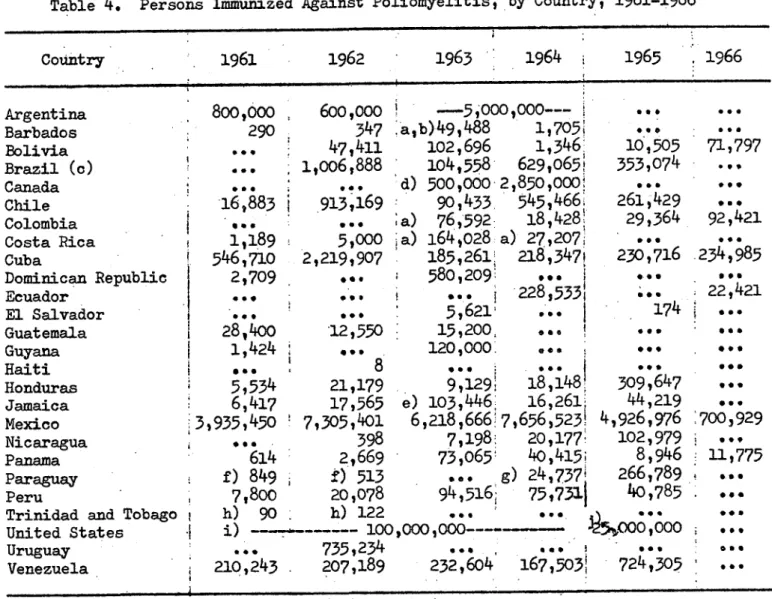
In most of the countries where the decline has been marked, exten-sive vaccination programs have been carried out in recent years (Table 4). In the United States widespread application of inactivated poliovaccine began in 1955, followed by extensive use of oral poliovaccine, commencing in 1961. By the end of 1965, based on a sample survey (2) over 80 per
cent of the population under 20 years of age had received either inacti-vated polio vaccine or oral poliovaccine. The poliovaccine status for four age groups (per cent of population with completed series of inacti-vated or oral poliovaccine) was as follows:
1-4 Years 73.9 per cent 5-9 Years 89.9 per cent 10-14 Years 92.1 per cent 15-19 Years 88.3 per cent
Similarly extensive use of both inactivated vaccine and of oral vaccine was made in Canada. In Argentina, Cuba, Mexico, Chile, Uruguay and Venezuela large numbers of children had also been vaccinated.
Following the mass vaccination programs in Cuba, no cases of poliomyelitis were reported in 1965 or 1966. In several of the other countries the decreases have not been as marked. The coverage by immuni-zation may not have been sufficient or vaccination may not have been routinely carried out for children born after the mass vaccination programs.
CD17/29 (Eng.)
Page 7
Table 4. Persons Immunized Against Poliomyelitis, by Country, 1961-1966
Country
1961
1962
1963 '
1964
1965
1966
Argentina 800,000 600,000 l - 5,000,000--- ...
Barbados
290
347 Ia,b)49,48
81,705, ..
Bolivia ... 47,411 102,696 1,346! 10,505 71,797 Brazil (c) ! ... 1,006,888 104,558 629,065* 353,074
Canada . .:. d) 500,000 2,850,000 ..
Chile
-16,883
X913,169
90,433
545,466
261429
...Colombia . .. . a) 76,592: 18,428 29,364 92,421
Costa Rica 1,189 5,000 ia) 164,028 a) 27,207: ...
Cuba 546,710 2,219,907 185,261: 218,347! 230,716 234,985
Dominican Republic 2,709 ... 580209 ... ...
Ecuador ... ... 228533 . 22,421
El Salvador ... 5,621' ... 174
Guatemala i 28,400 '12,550 15,200, . ! * .
Guyana 1,424 ... 120,000. .4 · ,
Haiti 8
"
Honduras
5,534
21,179
9,129i
18,148
309 647
Jamaica 6,417 17,565 e) 103,446. 16,261, 44,219 ... Mexico :3,935,450 7,305,401 6,218,666:7,656,523' 4,926,976 :700,929 Nicaragua ... 398 7,198& 20,1771 102,979 ...
Panama 614 2,669 73,065' 40,415; 8,946 11,775
Paraguay ' f) 849 f) 513 .. g) 24,737' 266,789 ,.
Peru 7,800 20,078 94,516, 75,7311 40,785 .
Trinidad and Tobago h) 90 h) 122 ... ... ...
United States
l
i) 100,000,000----
-
00 00...
Uruguay ... 735,234 ... ..
Venezuela 210,243 207,189 232,604 167,503! 724,305 ·
(a) Number of doses administered. (b) Incomplete data. (c) Interior of State of Sao Paulo. (d)'Minimum estimate. (e) In addition 44,382 doses administered.
(f) Data for capital. (g) Provisional data. (h) Excluding data from school program. (i) Approximate number of doses of each type of monovalent oral vaccine administered. (j) Approximate number of doses of all types of vaccine sold or distributed.
I
I
CD17/29 (Eng.) Page 8
Table 5
Number of Reported Cases of Poliomyelitis by Age Group for Three Periods by Regions of the Americas
Northern America Total Under 1 1-4 5-9 10-14
15 and over Not stated
19,623 795 5,259 4,215 2,503 6,737 114 100 4.1 27.0 21.6 12.8 34.5 5,547 250 1,801 1,345 597 1,490 64 100 4.6 32.8 24.5 10.9 27.2
174 100
117 .19 10 27 1 67.6 11.0 5.8 15.6 Middle America Total Under 1 1-4 5-9 10-14
15 and over Not stated
1,906 287 1,137 174 102 194 12 100 15.2 60.0 9.2 5.4 10.2 989 185 596 119 32 48 9 100 18.9 60.8 12.1 3.3 4.9 445 86 268 32
7
7
45 100 21.5 67.0 8.0 1.8 1.8 South America Total Under 1 1-4 5-9 10-1415 and over Not stated
9,574 1,788 5,520 1,128 443 653 42 100 18.8 57.9 11.8 4.6 6.9 3,151 793 1,827 243 113 140 35 100 25.4 58.6 7.8 3.6 4.5 1,292 367 786 79 29 19 12 100 28.7 61.4 6.2 2.3 1.5
· ·
~~~~~~~~~~~~~I
CD17/29 (Eng.) Page 9
Interpretation of these findings is complicated. In the United States the highest incidence was in Texas in Pre-school
children. This age group was not adequately vaccinated. Serological studies in various countries of the Hemisphere have' shown that there is great activity of poliomyelitis viruses, even in areas where the disease was clinically unknown. At the same time, however, improved environmental sanitation and rising living standards in various regions have reduced the spread of the enteric viruses. Population groups formerly subject to poliomyelitis infection in the first months of life are no longer.exposed, which means:that increasingly larger groups remain susceptible. There is considerable variation by country indicating the need of data by age for evaluation of the changes in each country.
The lower proportions of cases of adults in the three regions may r.esult from a higher level of immunity whether through vaccination or a broader.contact with the virus in the community.
The actual situation of poliomyelitis vaccination programs was considered at the XII Meeting of the Ministers of Health of Central America and Panama (3) with the following conclusion: "It is recom-mended that the countries of Central America reorient the programs of vaccination against .poliomyelitis on the basis of definite knowledge of the problem .establishing useful levels of protection in the most susceptible age group, without neglecting the new susceptibles added to the population."
Sabin (4) has commented on the problem that even when mass vaccina-tion programs reached as much as 90 per cent of the susceptible age groups as in the Brazilian States of Guanabara and Sao Paulo, continuous migration of unvaccinated children as well as insufficient coverage in localized regions contribute to the continued occurrence of cases.
-The important role of health services should be emphasized, both in providing preventive services and in ensuring the adequate diagnosis and control of the disease. The effects of vaccination programs initiated
during epidemics have proven to be limited when compared with those of large- scale mass programs followed by continuing vaccination activities.
.REFERENCES
1. Reported Cases of Notifiable Diseases in the Americas, PAHO, Sc. Pub. Nos. 48, 58, 86, 102, 114, 135 and 149.
2. Poliomyelitis Surveillance, Annual Summary for 1965, Communicable Disease Center, No. 288, 1966, U.S.P.H.S.
3.
"Situacion Actual de la Poliomielitis, Programa de. Vacinacion,"Documento de Trabajo, Tema 10, XII Reuni6n de Ministros de Salud Publica de Centroamerica y Panama, 1967.
regional committee
PAN AMERICAN
WORLD
HEALTH
HEALTH
*44*
ORGANIZATION
ORGANIZATION
.. XVII Meeting . XIX Meeting
Port-of-Spain Trinidad and Tobago
October 1967
Agenda Item '33 CD17/32 (Eng.)
7 October 1967 ORIGINAL: SPANISH
STATEMENT ON THE ITEM PREPARED BY THE GOVERNMENT OF NICARAGUA AT THE XVII MEETING OF THE DIRECTING COUNCIL OF THE PAN AMERICAN
* HEALTH ORGANIZATION, XIX MEETING OF THE REGIONAL COMMITTEE OF. THE WORLD HEALTH ORGANIZATION FOR THE AMERICAS
ONE DAY MASS VACCINATION AGAINST POLIOMYELITIS
Mr. Chairman:
Fellow Representatives:
it: is a pleasure for me to speak to the XVII Meeting of the Directing Council of the Pan American Health Organization, XIX Meeting of the Regional Committee of the World Health Organization, on the item entitled "One-day mass vaccination against poliomyeli-t is, based on electoral districts' which.was included in the agen-da at the suggestion of my Government and through:the kindness of the Director of the Pan AmericanSanitary Bureau, Dr. Abraham Horwitz. 'It is even a 'greater pleasure for me to. be able to put before this important Pan American Meeting the idea of his Excellency the President of the.Republic of Nicaragua, General of Division,. Anastasio Somoza Debayle, of basing the vaccination campaign on the
electoral districts and using the voting lists as vaccination lists.
. .. .in
On 1 May 1967, I took office-as Minister of Public Health, in resp'onse to the wishes of the President. Confronted with a terrible and widespread epidemic that afflicted the children of Nicaragua, I began faithfully to discharge my civic duties and to deal firmly and
decisively with it. The first measure I ordered against thi: terri-ble'scourge was for intensive vaccination to be carried out in all 'health centers in the country and I requested the Connaught
Labora-tories of Canada through the Emergency'Fund of the Pan American Sanitary Bureau, for the estimated'amount of vaccine for immunizing all children under 6 years of age who had not been vaccinated in the 'routine programs carried out under the national health plan.
CD17/32 (Eng.) Page 2
At that point we requested PASB for assistance and they imme-diately sent us an epidemiologist. At the same time I asked the USPHS Communicable Disease Center in Atlanta, Georgia, to send us two other epidemiologists, and they quickly arrived in Managua. In response to the alarm our cables caused in international circles, friendly governments provided us with assistance in one form or an-other. Their worthy representatives in our country expressed to us their solidarity in the painful hour we were going through. Among these governments, special mention should be made of the USAt Mexico, El Salvador, Honduras, Great Britain, France, Japan, Israel and Egypt. I should like also to mention a number of international institutions including the First Baptist Church of Cleveland, the Catholic Relief Services, Brother's and Brother Foundation and various laboratories and equipment and manufacturing houses that sent us assistance. Since it was impossible to moderate the epidemic case rate, which was stead-ily increasing with a growing number of cases in the age-group up to 15 years, the epidemiologists suggested that arrangements be made for the mass vaccination of the population between the ages of 3 months and 15 years. At that moment it crossed my mind to put into effect the suggestion of the President of my country, namely, that we use the electoral districts of the Republic which cover the entire extent of the national territory.
To give you some idea of these districts and of the personnel that aelped to bring the one-day mass immunization campaign to a suc-cessful conclusion, I must tell you that an electoral district covers a geographical area the average population of which is 400 voters of both sexes over 18 years of age, representing a population of 1,000 in all age groups. The total population of Nicaragua is covered by 1,572 electoral districts, plus 493 additional polling booths. Each electoral district has a Board of Directors consisting of a Chairman and a representative of each of the political parties, and the whole electoral system comes under one of the State Authorities known as the Electoral Authority. The mass poliomyelitis vaccination campaign based
on electoral districts was carried out as follows:
1. Policy-Making Stage:
1.1 In view of the seriousness of the epidemic, the Technical -- Health Council, under my authority, declared a state of
national emergency in agreement with the Pediatric Society. 1.2 The Technical Council met with the Electoral Authority,
CD17/32 (Eng.) Page 3
1.3 All the community leaders represented at the above-mentioned meeting turned to the Government and voluntary personnel and members of associations, under their jurisdiction, so as to coordinate their efforts with the National Health Author-ities at the various levels.
1.4 An Executive Committee for the Plan of the National Polio-myelitis Vaccination Campaign was organized, as were sub-sidiary committees at the departmental, municipal and dis-trict level.
1.5 The departmental health educators were brought to the capi-tal to receive instructions on putting the plan into effect in each department, municipality and district.
1.6 The population to be vaccinated was defined: that under 15 years of age.
1.7 The vaccine to be administered was distributed by depart-ment, municipality, and canton.
1.8 Leaflets were distributed containing instructions on indi-cations, doses, contra-indiindi-cations, storage of vaccine, siting of vaccination stations, vaccinators, vaccination lists, vaccination booklets and the dispatch of vaccination reports to the municipal, departmental and district
author-ities.
1.9 Intensive health education activities through the Press, Radio, and Television with the view to motivating the popu-lation to take part in the program.
1.10 A meeting of the health authorities with community leaders at all levels in order to coordinate efforts or to instruct them on standards for the implementation of the plan.
1.11 Medical supervisors, nurses, and teachers were organized at the central level to cover the various areas of the country.
2, Operational Stage:
2.1 The vaccination stations opened their doors at 7 a.m. and were instructed not to close them until vaccine had been administered to the last person who asked for it that day.
CD17/32 (Eng.) Page 4
2.3 The vaccine was administered by a person previously trained for that purpose, generally the district Chairman or a schoolmaster;
2.4 The national radio station was installed in the office of the Minister and, on their own initiative, all the other radio stations in the country were hooked up with it so that
the citizens were kept constantly informed of the develop-ment of the campaign; bulletins were issued on the adminis-tration and maintenance of the vaccine.
2.5 Vaccine and personnel requirements were taken care of by national communication services. Valuable cooperation was also received from the National Guards whose airplanes made special parachute drops of the thermos flasks containing the
vaccine in difficult or inaccesible places. In addition, full collaboration was received from the Automobile Club of Nicaragua in ensuring safe and efficient land transportation.
2.6 Vaccinations were performed-on-9 July and, in the same way, six weeks later, on the 20th of August, when the second dose was given. However, the second time many of the difficulties that had occurred on the first day were overcome.
-2.7 On both days the lists of vaccinees began to arrive in the evening and were then tabulated by the Division of
Bio-statistics. These data are to be found in the document which has been distributed.
During the course of those tragic three months, 458 cases occurred. Fifty four children died while battling death in an iron lung. Bulbar poliomyelitis destroyed their small organisms in the cruel and hopeless struggle. Nine Emerson pulmotors moved their diaphragms replacing the diaphragms that did not move while seven Bird positive pressure ventilators were simultaneously at work. The physiological blood gas analyzer was of vital importance in evaluating respiratory capacity and, in that bitter and obstinate struggle, all community leaders were at one, forming a solid front with the medical practitioners and the health authorities of the country to stem the deadly advance of that terrible scourge. As an aftermath of that implacable disease many homes are sunk in sadness and many children are broken in body.
When the epidemic broke and the number of cases fell to zero, we then began the long, intensely sad, intensely painful process
- which we are corageusly facing¥ of rehabiliting our children
crippled by infantile paralysis. Both the President of my country and the First Lady of the Nation, Dame Hope Portocarrero de Somoza,
President of the National Medical Care and Social Welfare Board, as well as the Ministry of Public Health, under my authority, and the com-munity at large are constantly working to restore those children to health.
CD17/32 (Eng.) Page 5
We, Nicaraguans, cannot let this occasion pass without ex-pressing out thanks to the scientists who came to our help and put their scientific knowledge at our disposal. I should like here to express our sincere thanks to the Government and the people of the United States who at all times gave us support and generous assis-tance. I should also like to express our thanks to that great President of the United States of America, Lyndon B. Johnson who gave us such magnificent help and cooperation; I should like to say the same to the medical personnel of the United States and from in-ternational agencies who shared our responsibilities towards the children of Nicaragua.
In the document which has been distributed to you, you will find the details of the history of poliomyelitis in Nicaragua; the history of the most recent epidemic; and the method used on the one-day mass vaccination of the population, in which voting district were used as vaccination areas.
Mr. President,
Fellow Representatives:
regional committee
/--
:
\PAN AMERICAN
WORLD
p6l-jvt
>
)WHEALTH
HEALTH
L
ORGANIZATION
ORGANIZATION
XVII Meeting XIX Meeting
Port-of-Spain Trinidad and Tobago
October 1967
CD17/34 (Eng.) 10 October 1967 ORIGINAL: SPANISH
POLIOMYELITIS IN CUBA
(Document submitted by the Government of Cuba)
1962 - 1st Campaign with Sabin trivalent oral vaccine (TI, TIi, TIII)
(1 million TCD-50). III
Two doses were administered at an-interval of 4-6 weeks to children between the ages of 1 month and 14 years.
A serological survey was carried out before and after vaccination. 2,187,855 children were immunized or 87.5 per cent of the popu-lation in that age-group.
1963 - The 2nd Campaign was launched: the first dose consisted of bi-valent Sabin vaccine (T1 1, Tv1 *,) and 4--6 weeks later a second dose of monovalent (TI)vaccinc- was administered.
Two doses were given to the population between the ages of 1 month and 14 years.
88.1 per cent of this age-group received the first dose and 89.8 per cent (2,293,256 children) the second.
This method of immunization was used since the serological sur-vey made after the first campaign showed that the Virus type I antibody levels were rather low and the question arose of possible interference when the trivalent vaccine was administered. A first dose of TII, T IIwas administered in order to prevent possible interference o other viruses with the TI that was administered later.
CD17/34 (Eng.) Page 2
1964 - In the 3rd Campaign two doses of trivalent vaccine were given to the population between the ages of 1 month and 5 years. Children between the ages-of 6 and 14 years were given only one dose of trivalent vaccine, since the serological test showed that a good level had been achieved with earlier immunizations.
2,452,438 children between the ages of 1 month and 14 years were immunized or 94.6 per cent of the population in this age-group.
1965 - In the 4th Campaign two doses of trivalent vaccine were ad-ministered to children between the ages of 1 month and 4 years, and one dose of the same vaccine to those between the ages of 5 and 6. This was done because serological studies demonstrated
optimum levels in children over those ages.
1,019,461 children between the ages of 1 month and 4 years or 97.4 per cent of the population in this age-group were given 2 doses and 375,255 children between the ages of 5 and 6, or 111.2 per cent of the population in this age-group were given
1 dose.
1966 - In the 5th Campaign two doses of trivalent vaccine were ad-ministered to children between the ages of 1 month and 2 years and one dose to those between 3 and 4 years of age. The ages were decided in the light of the findings of serological-studies.
652,739 children between 1 month and 2 years were immunized or 100.4 per cent of the population in that age-group; 490,474
children between 3 and 4 years or 115.6 per cent of the population.
1967 - In the 6th Campaign only 2 doses of trivalent vaccine were given to children under 2 years of age.
It is planned to continue vaccinating up to the age of two years to ensure that the child receives two doses before it reaches the age of 1 year, and 2 doses before it reaches the end of its second year of life.
A booster dose is given on entering school.
CD17/34 (Eng.) Page 3
In 1965, 1966, and 1967 no cases of poliomyelitis occurred.
Between 1962 and 1965 only 2 cases were reported.