485
EXERCISE EFFECT ON PLACENTAL COMPONENTS:
SYSTEMATIC REVIEW AND META-ANALYSIS
EFEITO DO EXERCÍCIO NOS COMPONENTES PLACENTÁRIOS: REVISÃO SISTEMÁTICA E META-ANÁLISE
EFECTO DEL EJERCICIO EN COMPONENTES PLACENTARIOS: REVISIÓN SISTEMÁTICA Y META-ANÁLISIS
Walter Krause Neto1 (Educador Físico) Eliane Florencio Gama1 (Fisioterapeuta)
1. Universidade São Judas Tadeu, Departamento de Educação Física, Laboratório de Estudos Morfoquantitativos e Imunohistoquímica, São Paulo, SP, Brasil.
Correspondência:
Rua Taquari, 546, Mooca, São Paulo, SP, Brasil. 03166-000.
ABSTRACT
Physical exercise has been demonstrated a positive effect on many pregnancy outcomes. Placental com-ponents are important for exchanging oxygen and nutrients between mother and fetus. This study aimed to systematic review and meta-analysis whether physical exercise could induce a morphological adjustment on placenta components. We systematically searched PubMed database until October 30th, 2014. We included
randomized and non-randomized studies with control group, which aimed to investigate the effect of the physical exercise (water, aerobic and resistance) on placental components (placental weight and volume, villous volume and vascular volume, intervillous space and stem villi). Initially, we identified 222 articles, of which 9 articles were used for full text analysis. Finally, four articles were included in the systematic review and meta-analysis. Meta-analysis demonstrated that exercise appeared to affect placental weight (95% CI, 39.73g [4.66-74.80]), placental volume (95% CI, 47.11 cm3 [37.99-56.23]), intervillous space (95% CI, 16.76 cm3
[12.66-20.68]), villous volume (95% CI, 46.01 cm3 [40.21-51.81]), villous vascular volume (95% CI, 15.95 cm3
[7.83-24.07]) and stem villi (95% CI, 6.00 cm3 [4.25-7.75]). Apparently, physical exercise has a positive effect on
placental components. However, this conclusion is based on a limited number of studies. Clearly, it stands the necessity of larger samples and better methodology quality.
Keywords: placenta, chorionic villi, physical exertion, pregnancy.
RESUMO
O exercício físico tem demonstrado efeito positivo nos muitos desfechos da gravidez. Componentes da placenta são importantes para a troca de oxigênio e nutrientes entre mãe e feto. O objetivo deste estudo foi revisar de forma sistemática e realizar uma meta-análise para verificar se o exercício físico pode induzir um ajuste morfológico nos componentes da pla-centa. A pesquisa foi feita sistematicamente no banco de dados PubMed até 30 de outubro de 2014. Foram incluídos estudos randomizados e não-randomizados com grupo controle, que tiveram como objetivo investigar o efeito do exercício físico (água, aeróbico e resistência) em componentes da placenta (peso e volume placentário, volume vascular e volume viloso, espaço interviloso e troncos vilosos). Inicialmente, identificamos 222 artigos, dos quais nove artigos foram utilizados para a análise de texto completo. Por último, quatro artigos foram incluídos na revisão sistemática e meta-análise. A meta-análise demostrou que o exercício parece afetar o peso da placenta (95% IC, 39,73g [4,66-74,80]), o volume placentário (IC 95%, 47,11 cm3 [37,99-56,23]), o espaço interviloso (IC 95%, 16,76 cm3 [12,66-20,68]), o volume viloso (IC 95%, 46,01 cm3 [40,21-51,81]),
o volume vascular viloso (95% IC, 15,95 cm3 [7,83-24,07]) e o tronco viloso (95% IC, 6,00 cm3 [4,25-7,75]). Aparentemente, o
exercício físico tem efeito positivo sobre os componentes da placenta. No entanto, esta conclusão é baseada em um número limitado de estudos. Claramente, destaca-se a necessidade de amostras maiores e melhor qualidade de metodologia.
Palavras-chave: placenta, vilosidades coriônicas, esforço físico, gravidez.
RESUMEN
El ejercicio físico ha demostrado efecto positivo en los muchos resultados del embarazo. Los componentes de la placenta son importantes para el intercambio de oxígeno y nutrientes entre la madre y el feto. El objetivo de este estudio fue revisar de forma sistemática y realizar un meta-análisis para comprobar si el ejercicio físico puede inducir la adaptación morfológica en los componentes de la placenta. La encuesta se realizó sistemáticamente en la base de datos PubMed hasta 30 de octubre de 2014. Se incluyeron ensayos aleatorios y no aleatorizados con grupo control, que tenían como objetivo investigar el efecto del ejercicio físico (agua, aeróbico y de resistencia) en los componentes de la placenta (peso y volumen de la placenta, el volumen vascular y volumen velloso, espacio intervelloso y troncos vellosos). Inicialmente, se identificaron 222 artículos, de los cuales nueve artículos fueron utilizados para el análisis de texto completo. Finalmente, cuatro artículos fueron incluidos en la revisión sistemática y análisis. El meta--análisis mostró que el ejercicio parece afectar el peso de la placenta (IC del 95%, 39,73g [4,66-74,80]), el volumen de la placenta (IC del 95%, 47,11 cm3 [37,99-56,23]), el espacio intervelloso (IC del 95%, 16,76 cm3 [12,66-20,68]), el
volumen velloso (IC del 95%, 46,01 cm3 [40,21-51,81]), el volumen vascular velloso (95 IC%, 15,95 cm3 [7,83-24,07])
y el tronco velloso (IC 95%, 6,00 cm3 [4,25-7,75]). Aparentemente, el ejercicio físico tiene un efecto positivo sobre los
componentes de la placenta. Sin embargo, esta conclusión se basa en un número limitado de estudios. Claramente, hay una necesidad para mayores tamaños de muestra y una mejor calidad de la metodología.
Palabras clave: placenta, vellosidades coriónicas, esfuerzo físico, embarazo.
SYSTEMATIC REVIEW ARTICLE
ARTIGO DE REVISÃO SISTEMÁTICO
ARTÍCULODE REVISIÓN SISTEMÁTICO
486
INTRODUCTION
Placenta serves as a selective barrier tissue between mother and child. During physical exertion, cardiac output is driven away from splenic organs and might lead to decrease oxygen and nutrients delivery. By means, maternal metabolism might adapt and activate several cellular and/or molecular mechanisms to counterbalance this gas rate reduction1,2.
Many data have been published regarding placenta morphological adaptation during maternal physical training. Jackson and colleagues3
showed villi, steam villi and total peripheral villi increase among women who continued moderate exercise training through pregnancy. Others also showed interesting placental morphology adjustments both trai-ned and sedentary pregnant women4-6. However, many
methodologi-cal issues such as few patients’ number, gestational age at beginning and others might influence outcomes.
Therefore, the aim of this systematic review with meta-analysis was to determine whether physical exercise could induce a morphological adjustment on placenta components.
METHODS
This systematic review was developed based on the PRISMA guideli-ne [preferred reporting items for systematic reviews and meta-analysis]7.
On October 30th, 2014, we did a systematic review search in the
Pub-Med database, using the following Mesh and Entry terms: (((Randomized controlled trial[pt] OR controlled clinical trial[pt] OR randomized controlled trials[mh] OR random allocation[mh] OR double-blind method[mh] OR single-blind method[mh] OR clinical trial[pt] OR clinical trials[mh] OR (“cli-nical trial”[tw]) OR ((singl*[tw] OR doubl*[tw] OR trebl*[tw] OR tripl*[tw]) AND (mask*[tw] OR blind*[tw])) OR (“latin square”[tw]) OR placebos[mh] OR placebo*[tw] OR random*[tw] OR research design[mh:noexp] OR follow-up studies[mh] OR prospective studies[mh] OR cross-over studies[mh] OR control*[tw] OR prospectiv*[tw] OR volunteer*[tw] OR non-randomized clinical trials OR non-randomized trials OR non ran-dom OR non ranran-domized clinical trials OR non ranran-domized trials)) AND (exercises OR exercise physical OR exercises physical OR physical exercise OR physical exercises OR exercise isometric OR exercises isometric OR isometric exercises OR isometric exercise OR exercise aerobic OR aero-bic exercises OR exercises aeroaero-bic OR aeroaero-bic exercise OR exertion OR physical fitness OR exercise therapy OR physical endurance OR physical exertion OR exertion physical OR exertions physical OR physical exer-tion OR physical effort OR effort physical OR efforts physical OR phy-sical efforts OR resistance training OR training resistance OR strength training OR training, strength OR weight lifting strengthening progra-ms strengthening program, weight-lifting OR strengthening prograprogra-ms, weight-lifting OR weight lifting strengthening program OR weight-lifting strengthening programs OR weight-lifting exercise program OR exercise program, weight-lifting OR exercise programs, weight-lifting OR weight lifting exercise program OR lifting exercise programs OR -bearing strengthening program OR strengthening program, weight--bearing OR strengthening programs, weightweight--bearing OR weight bearing strengthening program OR weight-bearing strengthening programs OR weight-bearing exercise program OR exercise program, weight-bearing OR exercise programs, weight-bearing OR weight bearing exercise pro-gram OR weight bearing exercise propro-grams OR running OR jogging OR swimming OR walking)) AND (placenta OR placentas OR placentome OR placentomes OR placentome, normal OR normal placenta OR nor-mal placentas OR placentomes, nornor-mal OR maternal-fetal exchange OR exchange, maternal-fetal OR maternal fetal exchange OR transplacental exposure OR exposure, transplacental OR placental circulation OR cir-culation, placental OR uteroplacental circulation OR circir-culation, utero-placental OR fetoutero-placental circulation OR circulations, fetoutero-placental OR
fetoplacental circulations OR circulation, fetoplacental OR fetal-placental circulation OR circulation, fetal-placental OR circulations, fetal-placental OR fetal placental circulation OR fetal-placental circulations OR chorionic villi OR chorionic villus OR villi, chorionic OR villus, chorionic OR placental villi OR placental villus OR villi, placental OR villus, placental OR decidua OR deciduas OR deciduous OR deciduoma OR trophoblasts OR tropho-blast OR cytotrophotropho-blasts OR cytotrophotropho-blast OR syncytiotrophotropho-blasts OR syncytiotrophoblast).
Studies Selection
First, we searched for randomized controlled trials. However, very few evidence appeared. Therefore, we decided to include randomi-zed and non-randomirandomi-zed control trials, which aimed to investigate the effect of physical exercise (water, aerobic and resistance) on placenta components at delivery day.
The primary outcome was placenta weight and volume. The se-condary outcomes analyzed were intervillous space, villous volume and vascular volume, and stem villi.
We extracted total patients number, randomization, age, gestational age during study recruitment, physical activity level prior protocol in-tervention, final gestational age prior to birth time, exercise and control protocols and research primary results. After complete data extraction, authors independently assessed the methodological quality of each article using the Jadad, Oxford and Delphi quality scales8-10.
Data synthesis and analysis
Review manager software 5.2 was used to calculate heterogeneity by the I2, Chi2 and Tau2 values. We used I2 to assess heterogeneity between
trials, using fixed effect models where there was high heterogeneity. We also used inverse variance method and 95% total confidence interval.
This study is an analysis of published data, which did not require ethics committee approval.
RESULTS
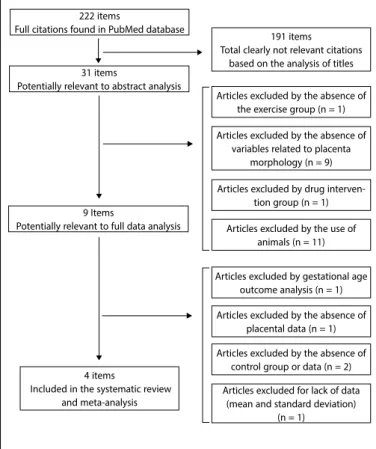
The initial search identified 222 articles titles, of which 31 articles were used for initial abstract analysis. From this, nine articles were in-cluded for full text analysis, leaving four papers to systematic review and meta-analysis3,5,11,12. The selection process is shown in figure 1.
Participants
A total of 170 patients were included in the systematic review analy-sis (84 and 86 patients in exercising and control group, respectively). Table 1 described the information extracted from each selected trial.
Exercise Interventions
At all interventions considered, predominantly, aerobic exercise training was applied 3,5,11. Only one studied used a multiple exercise
type intervention12.
We applied Jadad, Oxford and Delphi quality scale as tools to verify the quality assessment of randomized and non-randomized trials. These scales were developed with the objective to help the researchers to rapidly identify if these studies contain enough internal and statistical information, and further quality. Our results demonstrated Jadad scores that ranged from 0 to 3, which did not demonstrated enough internal and statistical information presented by the trials. Oxford scale showed a wider score (ranged from 0 to 4).Delphi list scored from 3 to 7 (table 2).
Meta-analysis
Meta-analysis was applied for placenta weight (g) and volume (cm3), intervillous space (cm3), villous volume (cm3) and vascular
487
Data Synthesis
Placenta weight: Data are presented by the analysis of three articles and 124 patients studied. Forest plot demonstrated homogeneity (p=0.69, I2= 0%)
between studies and exercise appeared to affect placental weight by incre-asing it (95% CI, 39.73g [4.66-74.80]). Table 3 presented data and forest plot. Placenta Volume: Data are presented by the analysis of 108 patients from three articles. Meta-analysis showed also homogeneity (p= 0.69, I2=0%) between studies and exercise increased placental volume by
47.11 cm3 (95% CI, 37.99-56.23). Table 4 presented data and forest plot.
Intervillous space
A total of 108 patients were evaluated from three studies. Exercise demonstrated to affect intervillous space. The forest plot showed a low heterogeneity level (p= 0.34, I2= 8%). Effect estimated was 16.67 cm3 (95%
CI, 12.66-20.68). In addition, physical training demonstrated a significant overall effect (Z=8.14 [p<0.00001]). Table 5 presented data and forest plot.
Villous volume
Forest plot demonstrated that exercise induced increase in villous vo-lume. This analysis showed a high level of homogeneity (p= 0.97, I2=0%).
Placenta from 68 patients were evaluated. Data is presented are table 6.
Villous vascular volume
Exercise effective altered villous vascular volume. However, it showed a high level of heterogeneity (p= 0.04, I2=75%). Effect estimated was 15.95
cm3 (95% IC, 7.83-24.07) from 62 patients. Data are presented in table 7.
Stem villi
Exercise altered stem villi. This analysis showed high homogeneity level between studies (p= 1.00, I2= 0%). Effect estimated was 6.00 cm3
(95% IC, 4.25-7.75) Data are presented in table 8.
Study Patients (num-ber) Rando-mization Age (years) Gestational age during Study Recruitment Physical Activity prior protocol Gestational Age that Stopped Intervention
Exercise protocol Control Results
Price
et al.12 62 Yes
Exercise group: 30.5±5 Control group:
27.6±7.3
12-14 weeks No
36 week gestation or
delivery
45-60 minutes duration, 4x/week, 12-14 Borg scale intensity (Day 1: step aerobics; Day 2: walking over adjacent hilly
terrain; Day 3: circuit resistance training [1-10 minutes
aerobics on treadmill or eliptical trainers or stationary bicycles,
alter-nated with weight training that included upper, lower and core
exercises]; Day 4: walking)
Every day tasks
Placenta weight did not significant differ between groups (Exercise: 691±178g/
Control: 625±103g)
Bergmann
et al.11 22 No
Ranged between 29
and 35
Not mensioned Yes Delivery
Running ≥4x/week, 40-60 minutes duration, intensity fixed at 55-65% maximal aerobic
capacity Stopped running through gestation and did every day tasks
Placenta weight did not significant differ be-tween groups (Exercise: 440±80g/ Control: 400±80g)
Villous vascular volume and indices of cell proliferation were increased significantly in Exercise group compared
to control.
Clapp 3rd
et al.5 46 Yes 31±1 8 weeks No Delivery
20 minutes of aerobic exercise (treadmill, step aerobics or stair stepper), 3-5x/week and intensity
fixed about 55-60% of the maximal aerobic capacity
Every day tasks
Midtrimester placenta growth rate, volume, functional and nonfunctional volume, villous volume and terminal villi were
statistically increased in exercise group
Jackson
et al.3 40 Yes
Ranged between 21
and 40
6 months prior
pregnancy Yes Delivery
30 minutes of aerobic exercise, ≥3x/week, ≥50% maximal
capacity
Every day tasks
Placenta weight did not di-ferred significantly between
groups (Exercise: 499±96g/ Control: 472±62g) Placenta and Villous composition were increased in exercising group
Table 1. Information description of sample characteristics, training protocol and primary results.
Figure 1. Flux gram of the articles selection process and exclusion criteria. NOTE: All meta-analysis data was managed in Review manager software 5.2.
222 items
Full citations found in PubMed database
191 items
Total clearly not relevant citations based on the analysis of titles
Articles excluded by the absence of the exercise group (n = 1)
Articles excluded by drug interven-tion group (n = 1)
Articles excluded by the use of animals (n = 11)
Articles excluded by gestational age outcome analysis (n = 1)
Articles excluded by the absence of placental data (n = 1)
Articles excluded by the absence of control group or data (n = 2)
Articles excluded for lack of data (mean and standard deviation)
(n = 1)
Articles excluded by the absence of variables related to placenta
morphology (n = 9) 31 items
Potentially relevant to abstract analysis
9 Items
Potentially relevant to full data analysis
4 items
488
DISCUSSION
This systematic review with meta-analysis analyzed four studies of varying designs evaluating, predominantly, aerobic exercise training as a stimulus to increase placental components. Thus, low number of articles and patients included in this meta-analysis, we could indica-te that aerobic training might increase placenta weight and volume, villous volume and vascular volume, intervillous space and steam villi. However, it is clear the necessity of better quality studies and higher number of participants (as showed in table 2). In addition, it´s necessary
Table 2. Description of data quality assessment.
Study Quality assessment Jadad (0-5) Quality assessment Oxford (0-7) Quality assessment Delphi (0-10)
Price et al.12 1a. Yes, 1b. Yes, 2a. No,
2b. No, 3. Yes 3
Described and adequated, no, no, described and adequated 4
1a. Yes, 1b. No, 2. Yes, 3. Yes, 4. Yes, 5. No,
6. No, 7. Yes, 8. Yes, 9. Yes 7
Bergmann et al.11 1a. No, 1b. No, 2a. No,
2b. No, 3. No 0 No, no, no, no 0
1a. Not described, 1b. Not described, 2. Yes, 3. No, 4. Not described, 5. Not described, 6. Not described, 7. Yes, 8. Yes, 9. Not described
3
Clapp 3rd et al.5 1a. Yes, 1b. Yes, 2a. No,
2b. No, 3. Yes 3
Described, no, no, described
and adequated 3
1a. Yes, 1b. No, 2. Yes, 3. Yes, 4. No,
5. Not described, 6. No, 7. Yes, 8. Yes, 9. Yes 6
Jackson et al.3 1a. Yes, 1b. No, 2a. No,
2b. No, 3. No 1
Described, no, no, described
however incomplete 2
1a. Yes, 1b. Not described, 2. Yes, 3. Not described, 4. Not described, 5. Not described, 6. Not described, 7. Yes, 8. Yes, 9. Not described
4
apply for future research several training parameters that might inter-fere in the results, such as: total training volume, total training loading and load evolution graphics by gestational age, time under tension, higher vs low time exertion, and others.
Several mechanisms could explain these findings. Bergmann et al.11
published the first paper to show that exercise training can increase cell proliferation indexes. Increased and decreased oxygen delivery during physical effort might stimulate cell proliferation. This acute change leads to a Hypoxia Induced Growth Factor (HIF) action. Following, Vascular Table 4. Forest plot presented information about aerobic exercise effect on placenta volume (cm3).
Exercise Control Mean difference Mean difference
Study or subgroup Mean SD Total Mean SD Total Weight IV, Fixed, 95% CI IV, Fixed, 95% CI
Bergmann et al.11 431 76 11 391 80 11 2.0% 40.00 (-25.21, 105.21)
Clapp 3rd et al.5 462 18 22 414 14 24 94.6% 48.00 (38.62, 57.38)
Jackson et al.3 481 94 20 454 60 20 3.5% 27.00 (-21.87, 75.87)
Total (95% CI) 53 55 100.0% 47.11 (37.99, 56.23)
Heterogeneity: Chi2 = 0.73, df = 2 (p = 0.69): I2 = 0%
Test for overall effect: Z = 10.13 (P < 0.00001) Control Exercise
-100 -50 0 50 100 Table 3. Forest plot presented information about overall aerobic exercise effect on placenta weight (g).
Exercise Control Mean difference Mean difference
Study or subgroup Mean SD Total Mean SD Total Weight IV, Fixed, 95% CI IV, Fixed, 95% CI
Bergmann et al.11 440 80 11 400 80 11 27.5% 40.00 (-26.86, 106.86)
Jackson et al.3 499 96 20 472 62 20 49.0% 27.00 (-23.08, 77.08)
Price et al.12 691 178 31 625 103 31 23.5% 66.00 (-6.39, 138.39)
Total (95% CI) 62 62 100.0% 39.73 (4.66, 74.80)
Heterogeneity: Chi2 = 0.75, df = 2 (p = 0.69): I2 = 0%
Test for overall effect: Z = 2.22 (p = 0.03) Control Exercise
-100 -50 0 50 100
Table 5. Forest plot presented information about aerobic exercise effect on intervillous space (cm3).
Exercise Control Mean difference Mean difference
Study or subgroup Mean SD Total Mean SD Total Weight IV, Fixed, 95% CI IV, Fixed, 95% CI
Bergmann et al.11 136 26 11 136 31 11 2.8% 0.00 (-23.91, 23.91)
Clapp 3rd et al.5 166 8 22 149 6 24 95.0% 17.00 (12.88, 21.12)
Jackson et al.3 188 53 20 164 33 20 2.1% 24.00 (-3.36, 51.36)
Total (95% CI) 53 55 100.0% 16.67 (12.66, 20.68)
Heterogeneity: Chi2 = 2.17, df = 2 (P = 0.34): I2 = 8%
Test for overall effect: Z = 8.14 (P < 0.00001) Control Exercise
-100 -50 0 50 100
Table 6. Forest plot presented information about aerobic exercise effect on villous volume (cm3).
Exercise Control Mean difference Mean difference
Study or subgroup Mean SD Total Mean SD Total Weight IV, Fixed, 95% CI IV, Fixed, 95% CI
Bergmann et al.11 284 65 11 237 56 11 1.3% 47.00 (-3.70, 97.70)
Clapp 3rd et al.5 268 11 22 222 9 24 98.7% 46.00 (40.16, 51.84)
Total (95% CI) 33 35 100.0% 46.01 (40.21, 51.81)
Heterogeneity: Chi2 = 0.00, df = 1 (p = 0.97): I2 = 0%
Test for overall effect: Z = 15.55 (p < 0.00001) Control Exercise
489
REFERENCES
1. Clapp JF. Influence of endurance exercise and diet on human placental development and fetal growth. Placenta. 2006;27(6-7):527-34.
2. De Marco CS, Caniggia I. Mechanisms of oxygen sensing in human trophoblast cells. Placenta. 2002;23(Suppl A):S58-68.
3. Jackson MR, Gott P, Lye SJ, Ritchie JW, Clapp JF 3rd. The effects of maternal aerobic exercise on human placental development: placental volumetric composition and surface areas. Placenta. 1995;16(2):179-91. 4. Clapp JF 3rd, Rizk KH. Effect of recreational exercise on midtrimester placental growth. Am J Obstet
Gynecol. 1992;167(6):1518-21.
5. Clapp JF 3rd, Kim H, Burciu B, Lopez B. Beginning regular exercise in early pregnancy: effect on feto-placental growth. Am J Obstet Gynecol. 2000;183(6):1484-8.
6. Clapp JF 3rd, Kim H, Burciu B, Schmidt S, Petry K, Lopez B. Continuing regular exercise during preg-nancy: effect of exercise volume on fetoplacental growth. Am J Obstet Gynecol. 2002;186(1):142-7. 7. Liberati A, Altman DG, Tetzlaff J, Mulrow C, Gøtzsche PC, Ioannidis JP, et al. The PRISMA statement for
reporting systematic reviews and meta-analyses of studies that evaluate healthcare interventions: explanation and elaboration. BMJ. 2009;339:b2700.
8. Jadad AR, Moore RA, Carroll D, Jenkinson C, Reynolds DJ, Gavaghan DJ, et al. Assessing the quality of
reports of randomized clinical trials: is blinding necessary? Control Clin Trials. 1996;17(1):1-12. 9. Verhagen AP, de Vet HC, de Bie RA, Kessels AG, Boers M, Bouter LM, et al. The Delphi list: a criteria list
for quality assessment of randomized clinical trials for conducting systematic reviews developed by Delphi consensus. J Clin Epidemiol. 1998;51(12):1235-41.
10. Zhang J, Ho KY, Wang Y. Efficacy of pregabalin in acute postoperative pain: a meta-analysis. Br J Anaesth. 2011;106(4):454-62.
11. Bergmann A, Zygmunt M, Clapp JF 3rd. Running throughout pregnancy: effect on placental villous vascular volume and cell proliferation. Placenta. 2004;25(8-9):694-8.
12. Price BB, Amini SB, Kappeler K. Exercise in pregnancy: effect on fitness and obstetric outcomes-a randomized trial. Med Sci Sports Exerc. 2012;44(12):2263-9.
13. Clapp JF 3rd, Schmidt S, Paranjape A, Lopez B. Maternal insulin-like growth factor-I levels (IGF-I) reflect placental mass and neonatal fat mass. Am J Obstet Gynecol. 2004;190(3):730-6.
14. Weissgerber TL, Davies GA, Roberts JM. Modification of angiogenic factors by regular and acute exercise during pregnancy. J Appl Physiol (1985). 2010;108(5):1217-23.
15. Ferland S, Bujold E, Giguère Y, Girard M, Demers S, Forest JC. Association between physical activity in ear-ly pregnancy and markers of placental growth and function. J Obstet Gynaecol Can. 2013;35(9):787-92. Endothelial Growth Factor (VEGF) induces a cascade downstream,
stimu-lating the formation of new blood vessels. This cellular cascade might explain the increased villous vascular volume. Others growth factors such as Insulin Growth factor (IGFs), Placental growth factor (PGF) and
Pregnancy-associated plasma protein- A (PAPP-A) might also be involved in placenta adaptation to training stimulus13-15.
Gestational age might influence morphological adaptation to exercise5,6. Beginning exercise prior the half of the first trimester
could induce a significant increase in placental function in previous sedentary women5. However, reducing training volume during the
first trimester might be detrimental for placental adaptation induced by physical training6.
Finally, exercise type is known to induce several different physiologi-cal adaptations. Perhaps, time under exertion is a factor to contribute for placental adaptation6. However, it is necessary to study the differences
of resistance training and endurance training on placental components adaptation. Price et al.12 combined endurance and resistance training
through 36 weeks of gestation. The results showed improved aerobic fitness, muscular strength, fewer cesarean delivery rates and recovered faster postpartum. However, placental weights did not differ between groups. These result was computed in our meta-analysis and overall effect was significant (p=0.03) which indicate a positive effect on larger placental weights over training stimulus. Clearly, it is needed more high quality studies for a more precise result.
FINAL CONSIDERATIONS
This study revealed a clear positive effect of exercise training on pla-cental components. However, number of patients and studies identified were low and the study quality analysis showed a necessity of higher quality studies with a more well conducted methodology.
All authors have declared there is not any potential conflict of interests concerning this article.
Table 7. Forest plot presented information about aerobic exercise effect on villous vascular volume (cm3).
Exercise Control Mean difference Mean difference
Study or subgroup Mean SD Total Mean SD Total Weight IV, Fixed, 95% CI IV, Fixed, 95% CI
Bergmann et al.11 77 20 11 47 18 11 26.1% 30.00 (14.10, 45.90)
Clapp 3rd et al.5 62 20 20 51 8 20 73.9% 11.00 (1.56, 20.44)
Total (95% CI) 31 31 100.0% 15.95 (7.83, 24.07)
Heterogeneity: Chi2 = 4.06, df = 1 (p = 0.04): I2 = 75%
Test for overall effect: Z = 3.85 (p = 0.0001) Control Exercise
-100 -50 0 50 100
Table 8. Forest plot presented information about aerobic exercise effect on stem villi (cm3).
Exercise Control Mean difference Mean difference
Study or subgroup Mean SD Total Mean SD Total Weight IV, Fixed, 95% CI IV, Fixed, 95% CI
Jackson et al.3 20 11 20 14 5 20 10.9% 6.00 (0.70, 11.30)
Clapp 3rd et al.5 29 4 22 23 2 24 89.1% 6.00 (4.15, 7.85)
Total (95% CI) 42 44 100.0% 6.00 (4.25, 7.75)
Heterogeneity: Chi2 = 0.00, df = 1 (P = 1.00): I2 = 0%
Test for overall effect: Z = 6.72 (P < 0.00001) Control Exercise