Álvaro Francisco Lopes de Sousa
I, Artur Acelino Francisco Luz Nunes Queiroz
I, Layze Braz de Oliveira
I,
Maria Eliete Batista Moura
II, Odinéa Maria Amorim Batista
II, Denise de Andrade
II Universidade de São Paulo, Ribeirão Preto College of Nursing, Postgraduate Program in Fundamental Nursing. Ribeirão Preto, São Paulo, Brazil.
II Universidade Federal do Piauí, Health Sciences Center, Postgraduate Program in Nursing. Teresina, Piauí, Brazil.
How to cite this article:
Sousa AFL, Queiroz AAFLN, Oliveira LB, Moura MEB, Batista OMA, Andrade D. Social representations of biosecurity in nursing: occupational health and preventive care. Rev Bras Enferm [Internet]. 2016;69(5):810-7. DOI: http://dx.doi.org/10.1590/0034-7167-2015-0114
Submission: 11-20-2015 Approval: 04-27-2016
ABSTRACT
Objective: to understand the biosecurity social representations by primary care nursing professionals and analyze how they articulate with quality of care. Methods: exploratory and qualitative research based on social representation theory. The study participants were 36 nursing workers from primary health care in a state capital in the Northeast region of Brazil. The data were analyzed by descending hierarchical classifi cation. Results: fi ve classes were obtained: occupational accidents suffered by professionals; occupational exposure to biological agents; biosecurity management in primary health care; the importance of personal protective equipment; and infection control and biosecurity. Conclusion: the different positions taken by the professionals seem to be based on a fi eld of social representations related to the concept of biosecurity, namely exposure to accidents and risks to which they are exposed. However, occupational accidents are reported as inherent to the practice. Descriptors: Occupational Risks; Biosecurity; Primary Health Care; Nursing; Social Psychology.
RESUMO
Objetivo: apreender as representações sociais da biossegurança por profi ssionais de Enfermagem na Atenção Primária e analisar como elas se articulam com a qualidade da assistência prestada. Métodos: pesquisa exploratória, qualitativa, fundamentada na Teoria das Representações Sociais. Os participantes da pesquisa foram 36 trabalhadores de Enfermagem de Unidades Básicas de Saúde de uma capital da Região Nordeste do Brasil. Os dados foram analisados pela Classifi cação Hierárquica Descendente. Resultados: foram obtidas cinco classes: acidentes ocupacionais sofridos pelos profi ssionais; exposição ocupacional a agentes biológicos; gestão da biossegurança em Atenção Primária; importância do equipamento de proteção individual, e biossegurança e controle de infecção. Conclusão: as diferentes tomadas de posições dos profi ssionais parecem se ancorar em um campo das representações sociais ligado a questões relacionadas ao conceito de biossegurança, à exposição a acidentes e riscos aos quais estão expostos. No entanto, o acidente ocupacional é reportado como inerente à prática.
Descritores: Riscos Ocupacionais; Biossegurança; Atenção Primária; Enfermagem; Psicologia Social.
RESUMEN
Objetivo: comprender las representaciones sociales de bioseguridad en profesionales de Enfermería en Atención Primaria y analizar cómo se articulan con la calidad de la atención brindada. Métodos: investigación exploratoria, cualitativa, fundamentada en Teoría de las Representaciones Sociales. Participaron del estudio 36 trabajadores de Enfermería de Unidades Básicas de Salud de una capital del Noreste brasileño. Datos analizados por Clasifi cación Jerárquica Descendente. Resultados: se obtuvieron cinco clases: accidentes laborales sufridos por profesionales; exposición laboral a agentes biológicos; gestión de bioseguridad en Atención Primaria; importancia de equipos de protección individual; y bioseguridad y control de infecciones. Conclusión: las diferentes tomas de posición de los profesionales parecen anclarse en un campo de las representaciones sociales vinculado
Social representations of biosecurity in nursing:
occupational health and preventive care
Álvaro Francisco Lopes de Sousa E-mail: [email protected] CORRESPONDING AUTHOR
INTRODUCTION
Healthcare professionals, specifically the nursing team (i.e., nurses, technicians, and aides), are exposed to several risks of occupational accidents, whether in the hospital environment, in community health care, or at home. A risk is deemed to be one or more conditions of a variable with potential to cause harm. Risks of accidents can be classified as physical (heat, lighting, and sharp items, for instance), chemical (chemical solutions, airborne contaminants), biological (represented by bodily fluids carrying viruses, bacteria, or fungi), and ergonomics. Among these, bio-logical risk stands out as one of the most frequent for profession-als engaging in nursing activities, especially during manipulation of material contaminated with blood and bodily fluids(1-2).
Nursing professionals exercise precautions that involve the risk of contamination with biological material, such as the use of sharp objects (needles, needled and over-the-needle cath-eters, and scalpel blades), gauzes contaminated with blood and/or bodily fluids, surgical instruments, bed sheets, and oth-er hospital matoth-erials that are also contaminated. Consequent-ly, it is necessary to apply biosecurity regulations to prevent the occurrence of health hazards to workers(3-4).
In Brazil, biosecurity is regulated by Law 11.105 of March 25, 2005, which addresses National Safety on Biosecurity that, in addition to issues related to labor and the health area, also covers those related to the environment and biotechnol-ogy(5). The study of occupational exposure to biological risks among healthcare workers can be considered recent and goes back to the outbreak of acquired immunodeficiency syn-drome (AIDS), especially after the advent of the first case of occupational transmission by this virus(6).
Therefore, biosecurity, also aimed at worker health, covers the study of those risks and is a relatively new and emerging area for several professional categories with high exposure, especially the healthcare field(7). Given the importance of maintaining the health of professionals, biosecurity emerges as a mandatory subject area in training courses and requires constant professional qualification(8).
Biosecurity involves several professions, and nursing is of exceptional importance, considering that the activities car-ried out by a nursing professional and the team require them to be in direct contact with the patient while providing care, thus exposing them to higher occupational risk(4). The provi-sion of quality nursing care is extremely important to guar-antee the safety of these professionals, as well as the team and the patients(9).
There are a large number of studies conducted on bios-ecurity of nursing professionals in the hospital setting, which are justifiable because it is a hazardous environment crowd-ed with patients with infectious and contagious diseases, in
addition to the hazards of dealing regularly with death and work overload(10-12). Primary healthcare professionals are also exposed to high risk from their work activity in community health and home care, especially the risks involving biologi-cal materials, for instance, handling contaminated bandages and/or administering intravenous medications. Therefore, to ignore the topic is to turn a blind eye to the several risks that professionals are exposed to, a scenario greatly represented in the current health environment(13).
Facing this issue, the aim of this study was to examine the social representations of biosecurity by primary care nursing professionals. The national and international scientific pro-duction on the subject was considered insufficient, and the authors also wanted to take into account the magnitude of occupational accidents involving healthcare professionals(2-3,5).
What has also been observed is an increased use of the theoretical framework of social representations in studies that address healthcare professionals, especially involving topics related to diseases and forms of prevention and care(14).
Social representations are symbolic, practical, and dynami-cal settings in which status is linked to production, and not to reproduction or reaction, as well as external stimuli based on the use and selection of information resulting from an existent and current repertoire in society. It is not a mere “opinion about,” or “images of,” but real sui generis collective theories aiming to interpret and expound on the real. Thus, to rep-resent an object, person, or thing does not consist solely of unfolding it, repeating it, or reproducing it, but rather of re-constructing it, retouching it, and changing it(15).
With its relationship with nature, humankind, based on social-historical context, has its actions and attitudes constant-ly permeated by social relations established in the context in which humans are inserted. Taking into account that nursing professionals are exposed to risks of cross-infection in the healthcare environment, it is essential to know the position taken by the social actors involved in order to investigate the psychological aspects that influence the attitudes of profes-sionals when carrying out the activities related to the imple-mentation of biosecurity measures.
The objective of this study was to learn the social representa-tions of biosecurity by primary care nursing professionals and analyze how it relates to the quality of care provided by the team.
METHOD
This is an exploratory study with a qualitative approach based on the theory of social representations developed by Serge Moscovici in the 1950s, built on the basis of concepts, claims, and experiences of the participants through a socially elaborated and shared knowledge(15).
a asuntos relacionados al concepto de bioseguridad, a la exposición al accidente y riesgos a los cuales están expuestos. No obstante, el accidente laboral es considerado inherente a la práctica.
Participants, place, and sample
This study was carried out with nursing professionals from a family health strategy team, working in 18 primary health care units in the city of Teresina (PI) that belong to two health care regions (East/Southeast and South). These two regions include 63 primary healthcare units, with 36 located in the East/Southeast and 27 in the South. The regions and the healthcare units were chosen by lot. The sample consisted of 36 nursing professionals, where 18 were technicians and 18 nurses, selected through a proportional stratified random sampling method.
For inclusion in the study, the professional should be a per-manent worker in the primary healthcare unit who performed activities as part of the family health strategy for at least one year. Professionals who were on leave or on vacation and those who refused the invitation were excluded.
The data were collected from January to February 2015, in a room reserved at the institution, guided by a semi-structured script that was previously tested in a pilot study, with three open-ended questions that explored the knowledge and prac-tices of professionals in their daily routines. The interview was recorded and had an average duration of 25 minutes, totaling more than seven hours of dialogue, which were transcribed later. At the end, the participants were asked if they wanted to quit the study or change their answers, but there were neither dropouts nor changes.
Data analysis
For data processing and analysis, the IRAMUTEQ (Interface de R pour les Analyses Multidimensionnelles de Texteset de Ques-tionnaires) software was used. The data were analyzed based on the descending hierarchical classification, where the texts were classified according to their respective vocabularies, and the whole set of texts was then divided by the frequency of the reduced forms. Based on the matrices, which crossed segments of texts and words (repeated X2 tests), the descending hierarchical classification was applied to obtain a stable and definitive classi-fication. This classification allowed obtaining text segments with similar vocabulary among them, but that were at the same time different from the text segments of the other classes(16).
Ethical considerations
After approval by the Research Ethics Committee, contact was sought with the units and, later, with the nurses and nursing techni-cians. During each data collection, the objectives, risks, and bene-fits of the study were presented so that the participants could auton-omously manifest their willingness to participate. No one refused, and all of the participants signed the Informed Consent Form.
To preserve the identity of nursing professionals, an alpha-numerical system was used, with aliases “ENF” for nurses and “TEC” for nursing technicians, followed by Arabic numerals.
RESULTS
Of the 36 participants, 24 were women, the mean age was 26 years, the mean time of service was five years, and the level of education was more than five years.
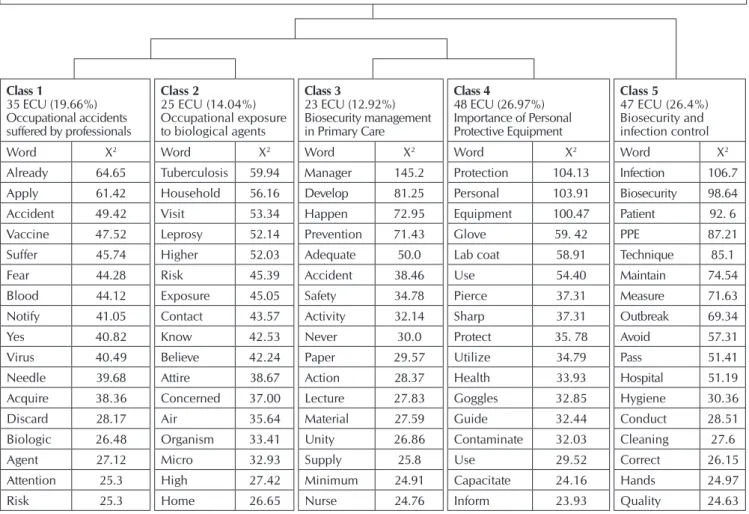
The IRAMUTEQ software recognized the division of the corpus into 178 elementary text units from 208 text segments. There were 7,356 recorded occurrences, with the use of 93.97% of the total corpus, a value considered high. Based on the descending hierarchical classification, it was possible to identify and analyze the textual domains, as well as to in-terpret the meanings, giving them names with their respective significance in classes, as illustrated in Figure 1.
The corpus analyzed in its entirety contained elements that addressed the knowledge and the practice of professionals re-lated to biosecurity. Initially, this corpus was submitted to the first partition into two subgroups, related to the combination exposure-accident and adherence-management, covering four classes (classes 1 to 4). Class 5 came from the second parti-tion, encompassing the others and related to prevention and control of infection during the services.
Class 1: Occupational accidents suffered by professionals This class showed the occupational accidents most expe-rienced by professionals. It involved biological accidents and seemed to have adopted the concept of “accidents” as elabo-rated by these individuals, as can be seen in expressions such as “Already, with blood, isn’t it?”; “Yes, there is always blood”; “I had an accident, but there was no blood”; “The needle had blood, that is why I panicked.”
The relationships between material and accident-exposure were present in all discourses, almost always associ-ated with fear and precaution. The concern with exposure to bodily fluids as well as sharp materials and their handling was substantiated with the dialectics of acting preventively when not aware of the possibility of contamination/infection. Atten-tion was drawn to the account made by the individuals that elected the vaccination room as the setting with the highest probability for accidents to happen.
I was handling a box with needle stick, and did not notice when I was sealing the box and the needles were pointing
upwards overloading… (TEC01)
Yes, I already suffered some accidents. And most of us here in this primary care unit had more than once, all my
col-leagues at least… (ENF08)
These professionals felt more vulnerable when providing care to the patient at home, because the integration of the cor-rect knowledge about the standards did not necessarily align with their use. Furthermore, the relation between personal protective equipment (PPE) and its use was compromised by the investment in the primary care units, which was consid-ered to be far from reality and lacking incentives.
... Oh, this is very common when dealing with people with tuberculosis, for instance… including the bandages and gy-necological procedures, besides small sutures and draining
some types of abscesses that we end up doing. (ENF10)
... What really scares us the most is to get exposed to nee-dles and needle sticks, and get infected with HIV and hepa-titis B... (ENF11)
... Exposure is always a constant, especially when caring for patients with tuberculosis, leprosy, and is a form of
expo-sure... (TEC 04)
Class 3: Biosecurity management in primary health care The content learned in this class evidenced that the profes-sionals perceived biosecurity as safety measures and standards,
and subsidies that would be provided for their daily practices. The most significant word, “manager,” showed the importance of acting educationally, which led to precaution-prevention. In ad-dition, the achievement of precaution-prevention had to do with the manager-dependent type and, in short, involved the provision of materials that, according to these individuals, was independent from their will and knowledge.
The manager must provide a structure at least adequate to
the job […], supply the materials so we can carry out our
work in an appropriate manner, but this manager does not
do that. (ENF 10)
There is no educational activity going on here, […]; they
simply drop off the materials and it is up to us to learn by
ourselves. (TEC 10)
When we have it, we use it... If we don’t... we will do the
procedure no matter what. (TEC 18)
Class 4: Importance of using personal protective equipment This class is closely related to the previous one (Class 3), in the sense that its content expressed the interdependence condition between provision of materials and the guaranteed use of the Note: ECU: Elementary Context Unit; PPE: Personal Protective Equipment.
Figure 1 – Thematic structure of the social representations of biosecurity by primary care nursing professionals
Class 1
35 ECU (19.66%) Occupational accidents suffered by professionals
Class 2
25 ECU (14.04%) Occupational exposure to biological agents
Class 3
23 ECU (12.92%) Biosecurity management in Primary Care
Class 4
48 ECU (26.97%) Importance of Personal Protective Equipment
Class 5
47 ECU (26.4%) Biosecurity and infection control
Word X2 Word X2 Word X2 Word X2 Word X2
Already 64.65 Tuberculosis 59.94 Manager 145.2 Protection 104.13 Infection 106.7
Apply 61.42 Household 56.16 Develop 81.25 Personal 103.91 Biosecurity 98.64
Accident 49.42 Visit 53.34 Happen 72.95 Equipment 100.47 Patient 92. 6
Vaccine 47.52 Leprosy 52.14 Prevention 71.43 Glove 59. 42 PPE 87.21
Suffer 45.74 Higher 52.03 Adequate 50.0 Lab coat 58.91 Technique 85.1
Fear 44.28 Risk 45.39 Accident 38.46 Use 54.40 Maintain 74.54
Blood 44.12 Exposure 45.05 Safety 34.78 Pierce 37.31 Measure 71.63
Notify 41.05 Contact 43.57 Activity 32.14 Sharp 37.31 Outbreak 69.34
Yes 40.82 Know 42.53 Never 30.0 Protect 35. 78 Avoid 57.31
Virus 40.49 Believe 42.24 Paper 29.57 Utilize 34.79 Pass 51.41
Needle 39.68 Attire 38.67 Action 28.37 Health 33.93 Hospital 51.19
Acquire 38.36 Concerned 37.00 Lecture 27.83 Goggles 32.85 Hygiene 30.36
Discard 28.17 Air 35.64 Material 27.59 Guide 32.44 Conduct 28.51
Biologic 26.48 Organism 33.41 Unity 26.86 Contaminate 32.03 Cleaning 27.6
Agent 27.12 Micro 32.93 Supply 25.8 Use 29.52 Correct 26.15
Attention 25.3 High 27.42 Minimum 24.91 Capacitate 24.16 Hands 24.97
Risk 25.3 Home 26.65 Nurse 24.76 Inform 23.93 Quality 24.63
PPE, with the goal of acting preventively. Thus, biosecurity was represented as PPE, which was considered an important mea-sure for preventing occupational accidents and maintaining occupational health. However, the discourses evidenced that its use was insufficient. Professionals reported the routine use of gloves and lab coats only, even when there were other materials to be used, revealing a contradiction between talk-ing, thinktalk-ing, and acting.
This equipment is important to professionals, but here in
our sector we don’t use PPE. (TEC 01)
You use everything available while carrying out a proce-dure, for protection against a risk to your health; it can be
gloves, coats, facemasks, boots, caps. (ENF 07)
Gloves, NR-95 facemasks; I wear glasses so I don’t think it
is necessary to wear protective goggles. (ENF 01)
To learn how to use personal protective equipment and
practice the knowledge. (ENF 05)
Class 5: Biosecurity and infection control
The concept of biosecurity was elaborated based on infec-tion preveninfec-tion and control, and a cause-effect relainfec-tionship. The interpretation of the representations expressed by the interviewees, regardless of their professional category, was anchored in the adequacy of conduct and techniques, with a great impact on professional practice. It was clear that these representations, in some cases, changed the very way of pro-viding care, requiring a physical distancing by the profes-sional in relation to the client, making the dialectics of acting with precaution concrete.
When I use the material, in other words, when I protect myself, I avoid infection contamination, not only for me,
but for the patient as well... (ENF 04)
Sometimes the condition of the patient indicates tubercu-losis; in other words, he was supposed to be in isolation! Then we really have to avoid him, right?… Because I was
supposed to be using N95. (ENF 15)
Those very poor houses, with those filthy people... the kid with an exposed wound… sometimes we pick them up,
check them out, but very cautiously, right? (TEC 14)
According to the descending hierarchical classification, expressed by the relationship among classes (Figure 1), the representations of biosecurity, from the perspective of the primary care nursing team, showed that the risk of accidents while carrying out their activities is constant. This risk, related to the exposure these professionals face to biological agents, can be minimized by providing adequate working conditions. This must be guaranteed by the healthcare manager, whose duty is to provide the materials, especially the PPE. In the end, the professionals recognized the importance of biosecurity in infection control, once subsidies are provided for them to carry out a safer care. When biosecurity was not guaranteed,
the quality of the practice was affected, because these profes-sionals ended up engaging in a more cautious care, which sometimes translated into physical distancing.
DISCUSSION
Healthcare professionals all over the world have a higher risk of acquiring pathogens, such as hepatitis B and C and the HIV virus, when compared to any other occupational group(11). For nursing, the biological risks are even higher and mostly related to accidents with sharp materials, needle sticks contaminated with blood, tissues, and other bodily fluids that are potentially infected(1). This justifies the discussion focused on these topics, drawn from the accounts of professionals.
Despite recognizing the magnitude of this problem, the implementation of strategies worldwide would be very com-plex. There are, currently, in the world approximately 35 mil-lion healthcare workers, of which three milmil-lion have already had some kind of percutaneous exposure to viruses trans-mitted by blood. This high level of exposure occurs mostly because of lack of public policy guidelines, personal quali-fication, motivation, and work overload(17). With regard to this, the study revealed that 70% of the global population is somewhat covered by primary health care. However, when the issue is occupational health in primary care, only 10% to 15% of these workers had access(1).
The knowledge and recognition by professionals regard-ing the norms and risks that they are exposed to are important for reducing the rates of occupational infections, because they demonstrate an understanding of what the practice has taught them, associated with the scientific framework. In pri-mary care, healthcare professionals are exposed to microor-ganisms by the very characteristics of the healthcare model. Many patients are assisted without diagnosis, especially in home visits. In not being aware of the diagnosis, many nurs-es neglect the use of PPE(18).
The professionals have difficulty conveying education and performance or discourse and practice, as represented by their not using PPE when necessary. It becomes clear in their discourses that the use of PPE is a mere theoretical activity, which has no room in their working routine, although it is widely indicated for standard precautions. The use of gloves, for instance, is recommended in case of exposure to biologi-cal fluids, which is common in primary care practice(19).
When explaining the perception of professional practice as risk-free, the team considers the use of such protections unnecessary and ends up being exposed during activities that are beyond the working routine or in emergency situations. This setting, which discourages the use of PPE, reveals the importance of acting educationally, especially on the part of the managers, who should reinforce its use through educa-tional activities with the aim of minimizing this deadlock. This would take into account the fact that professionals are aware of its importance for a healthier professional practice, but they see it with distance(20).
or lower risk, expressing more concern mostly with airborne diseases, such as tuberculosis and leprosy. Yearly, more than 200,000 new cases of leprosy and more than nine million new cases of tuberculosis are reported worldwide. Both of these diseases are highly prominent in Brazil, especially in the North, Northeast, and Central-West regions, with ap-proximately 30 thousand and 700 new cases of leprosy and tuberculosis, respectively, reported yearly in the country(21).
As a result of airborne diseases, the use of facemasks with respirators (N95), the key PPE in the context of respiratory dis-eases, such as tuberculosis, becomes necessary(22-23). In Brazil, the regulatory standard NR-6 requires companies to provide their workers with adequate PPEs free of charge and in good condition whenever collective measures do not provide total protection against the risk of accidents or work-related illness-es. However, in context of this study, this did not occurred and the professionals ended up suffering great exposure(24).
The capacitation was identified as a sine qua non action, incisive, and efficient at preventing accidents, capable of providing the educated behavior and allowing the profes-sionals to act preventively. In this respect, simulation prac-tices are extremely effective compared to traditional training methods. They provide opportunities for rehearsing already known activities, as well as unexpected events and new techniques(2).
There are also educational proposals taking into account the practices and dispositions of the agents involved within health care when they are offered courses and training on biosecurity, so they can become part of the learning-teaching process and, consequently, take into their professional lives what they have learned(2,25).
Among the areas that cover biosecurity, infection control is the most similar and most influences the practice of profes-sionals. Although they lack specific theoretical knowledge, especially on prevention and control of infections related to health care, such as the correct use of PPE, techniques for washing hands, and aseptic performance for invasive pro-cedures, it is notable that professionals base their attitudes — or try to — on infection prevention.
Biosecurity still presents a major challenge to quality management in health care, laboratories, and other health-care units, especially because of the one-way accountability, as this study showed. When questioned about their responsi-bilities, the representations turned to the manager as the pro-vider of the necessary working conditions to act preventively. It is known that the manager plays an important role in ac-tions to control health risks, being responsible for providing capacitation, infrastructure adaptation including PPE and col-lective protection equipment, monitoring, planning, and risk management resulting from professional activities. However, a co-accountability scenario can provide changes in attitudes that could contribute to a practice focused on the collective. In addition, it is important to note that Brazil lacks a nation-wide policy on biosecurity for effective care, especially relat-ed to the area of workers’ health care, which makes it difficult to list the responsibilities and duties at the managerial level(26).
Study limitations and contributions for the nursing In the study, it was not possible to specify the risk man-agement measures used by the professionals, when it was not possible to assure the adequate biosecurity. The study re-vealed only that professional conduct is strongly influenced by these representations, with repercussions in practice. This limitation points to a need to carry out further studies to ad-dress this issue.
The topic is relevant for addressing the issue of the current healthcare system associated with professional health prac-tices, risk situations, and imposed vulnerability, especially re-garding nursing. The social representations elaborated show, simultaneously, the behaviors of the group and the very sce-nario where they act, allowing the adoption of measures con-textualized with the studied reality.
FINAL CONSIDERATIONS
The social representations of nursing professionals regard-ing biosecurity in primary health care allowed for an increase in elaborated and shared knowledge by this group, rooted as a result of its professional practice.
The method of analysis enabled the authors to imply that the representations were based on the routine of the profes-sional, in which those professionals correlate the concept of biosecurity with exposure and accidents. Therefore, the par-ticipants recognized the risks they were exposed to. However, they related occupational accidents as inherent to the practice and expressed difficulties in recognizing their own insecurity within the practice. When this insecurity embodies the pres-ence of diagnosis, diagnostic assumption, blood, or visible filthiness, the professionals use protection more frequently or, in the absence of such protection, they avoid physical contact or approach.
In this context, to raise this discussion, based on the the-ory of social representations, allowed a better understanding regarding the cognitive, symbolic, and affective activities re-lated to biosecurity in this environment, which is of great im-portance to health care, but hardly discernible when the issue is risk management, which mostly associated with the health of professionals.
Concerning the social representations of biosecurity by nursing professionals, modalities with positive content were considered when the need for adopting biosecurity measures in the health care environment was recognized. However, neutrality became visible; these measures were only partially adopted when nurses were carrying out their activities, be-cause of the difficulties they faced in their daily work.
Drawn from this learned knowledge, it is possible to pro-pose intervention strategies that could raise issues of biosecu-rity in primary health care.
FUNDING
REFERENCES
1. Vasiliki B, Antonaki E. Health and safety risks, implications and training in hospitals. Ind Comm Train [Internet]. 2013[cit-ed 2015 Nov 07];45(7):420-7. Available from: http://www. emeraldinsight.com/doi/abs/10.1108/ICT-04-2013-0025
2. Bakanidze L, Imnadze P, Perkins D. Biosafety and biosecurity as essential pillars of international health security and cross-cutting elements of biological nonproliferation. BMC Public Health [Internet]. 2010[cited 2015 Nov 07];10(Suppl 1):S12. Available from: http://www.biomedcentral.com/1471-245 8/10/S1/S12
3. Gyawali S, Rathore DS, Bhuvan KC, Shankar PR. Study of status of safe injection practice and knowledge regarding injection safety among primary health care workers in Ba-glung district, western Nepal. BMC Int Health Hum Rights [Internet]. 2013[cited 2015 Nov 07];13:3. Available from: http://bmcinthealthhumrights.biomedcentral.com/articl es/10.1186/1472-698X-13-3
4. Gyawali S, Rathore DS, Shankar PR, Kumar KV. Strategies and challenges for safe injection practice in developing countries. J Pharmacol Pharmacother [Internet]. 2013[cit-ed 2015 Nov 07];4(1):8-12. Available from: http://www. ncbi.nlm.nih.gov/pmc/articles/PMC3643353/.
5. Laura H. Can biosecurity be embedded into the culture of the life sciences? Biosecur Bioterror [Internet]. 2012[cited 2015 Nov 07];10(2):241-6. Available from: http://online. liebertpub.com/doi/abs/10.1089/bsp.2012.0023
6. Markkanen P, Galligan C, Laramie A, Fisher J, Sama S, Quinn M. Understanding sharps injuries in home healthcare: The Safe Home Care qualitative methods study to identify path ways for injury prevention. BMC Public Health [Internet]. 2015[cited 2015 Nov 07];15(1):359. Available from: http:// bmcpublichealth.biomedcentral.com/articles/10.1186/ s12889-015-1673-x
7. Garbaccio JL, Oliveira AC. Adherence to and knowledge of best practices and occupational biohazards among manicur-ists/pedicurists. Am J Infect Control [Internet]. 2014[cited 2015 Nov 07];42:791-5. Available from: http://www.ajicjourn al.org/article/S0196-6553(14)00212-0/abstract
8. Carvalho NP, Nogueira PC, Godoy S, Mendes IA. Measures of knowledge about standard precautions: a literature review in nursing. Nurse Educ Pract [Internet]. 2013[cited 2015 Nov 07];13(4):244-9. Available from: http://www.nurseeducationi npractice.com/article/S1471-5953(13)00039-5/abstract
9. Efstathiou G, Papastavrou E, Raftopoulos V, Merkouris A. Factors influencing nurses compliance with standard precau-tions in order to avoid occupational exposure to microorgan-isms: a focus group study. BMC Nursing. 2011;10(1). Avail-able from: http://bmcnurs.biomedcentral.com/articles/10.1 186/1472-6955-10-1
10. Kumar A, Khuwaja AK, Khuwaja AM. Knowledge practice gaps about needle stick injuries among healthcare workers at tertiary care hospitals of Pakistan. J Ayub Med Coll Ab-bottabad [Internet]. 2012[cited 2015 Nov 07];24(3-4):50-2. Available from: http://www.ayubmed.edu.pk/JAMC/24-3/Am eet.pdf
11. Gorar ZA, Butt ZA, Aziz I. Risk factors for bloodborne viral hepatitis in healthcare workers of Pakistan: a popu-lation based case-control study. BMJ Open [Internet]. 2014[cited 2015 Nov 07];4(7):e004767. Available from: http://bmjopen.bmj.com/content/4/7/e004767.abstract
12. Khurram M, Ijaz K, Bushra HT, Khan NY, Bushra N, Hussain W. Needlestick injuries: A survey of doctors working at ter-tiary care hospitals of Rawalpindi. J Pak Med Assoc[Internet]. 2011[cited 2015 Nov 07];61(1):63-5. Available from: http:// jpma.org.pk/full_article_text.php?article_id=2537
13. Chowdhury AK, Roy T, Faroque AB, Bachar SC, Asaduzza-man M, Nasrin N, et al. A comprehensive situation assess-ment of injection practices in primary health care hospitals in Bangladesh. BMC Public Health [Internet]. 2011[cited 2015 Nov 07];11:779. Available from: http://bmcpublichealth. biomedcentral.com/articles/10.1186/1471-2458-11-779
14. Dantas MS, Abrão FMS, Costa SFG, Oliveira DC. HIV/ AIDS: meanings given by male health professionals. Esc Anna Nery Rev Enferm [Internet]. 2015[cited 2015 Nov 07];19(2):323-30. Available from: http://www.scielo.br/pdf/ ean/v19n2/1414-8145-ean-19-02-0323.pdf
15. Moscovici S. Representações sociais na psicanálise.Rio de Janeiro: Zahar; 1978.
16. Sousa AFL, Queiroz AAFLN, Oliveira LB, Valle ARMC, Moura MEB. Representações sociais da infecção comu-nitária por profissionais da Atenção Primária. Acta Paul Enferm [Internet]. 2015[cited 2015 Nov 07];28(5):454-9. Available from: http://www.scielo.br/pdf/ape/v28n5/1982-01 94-ape-28-05-0454.pdf
17. Akinboro AA, Adejumo OP, Onibokun CA, Olowokere EA. Community healthcare workers’ risk perception of oc-cupational exposure to HIV in Ibadan, south-west Nigeria: original research. African J Primary Health Care Family Med [Internet]. 2012[cited 2015 Nov 07];4(1):1-9. Available from: http://www.ncbi.nlm.nih.gov/pmc/articles/PMC4565413/ pdf/PHCFM-4-338.pdf
18. vanBijnen EM, Paget J, den Heijer CD, Stobberingh EE, Brug-geman CA, Schellevis FG; APRES study team. Evidence-based primary care treatment guidelines for skin infections in Europe: a comparative analysis. Eur J Gen Pract [Internet]. 2014[cited 2015 Nov 07];20(4):294-300. Available from: http://www.ncbi.nlm.nih.gov/pubmed/24456348
19. New Zealand. Best Practice Advocacy Centre. Exposure to body fluids: keeping the primary health care team safe. Best tests [Internet]; 2014[cited 2015 Nov 07]. Available from: http://www.bpac.org.nz/BT/2014/November/docs/BT25-e xposure.pdf
20. Farsi D, Zare MA, Hassani SA, Abbasi S, Emaminaini A, Hafezimoghadam P, et al. Prevalence of occupational ex-posure to blood and body secretions and its related effec-tive factors among health care workers of three Emergency Departments in Tehran. J Res Med Sci [Internet]. 2012[cited 2015 Nov 07];17(7):656-61. Available from: http://www. ncbi.nlm.nih.gov/pmc/articles/PMC3685782/.
Vasconcelos DM, Naafs B. Leprosy and tuberculosis co-infection: clinical and immunological report of two cases and review of the literature. Am J Trop Med Hyg [Internet]. 2013[cited 2015 Nov 07];88(2):236-40. Available from: http://www.ajtmh.org/content/88/2/236.long
22. Sasaki K, Kotake K. Practices of Japanese nurses for the prepa-ration of N95 respirators. Southeast Asian J Trop Med Public Health [Internet]. 2014[cited 2015 Nov 07];45(5):1221-7. Available from: http://www.ncbi.nlm.nih.gov/pubmed/2541 7526
23. Naidoo S, Seevnarain K, Nordstrom DL. Tuberculosis infection control in primary health clinics in eThekwini, KwaZulu-Natal, South Africa. Int J Tuberc Lung Dis [Inter-net]. 2012[cited 2015 Nov 07];16(12):1600-4. Available from: http://www.ncbi.nlm.nih.gov/pubmed/23032106
24. Esteves RJ. The quest for equity in Latin America: a com-parative analysis of the health care reforms in Brazil and Colombia. Int J Equity Health [Internet]. 2012[cited 2015 Nov 07];11:6. Available from: https://equityhealthj. biomedcentral.com/articles/10.1186/1475-9276-11-6
25. Luo Y, He GP, Zhou JW, Luo Y. Factors impacting compliance with standard precautions in nursing, China. Int J Infect Dis [Internet]. 2010[cited 2015 Nov 07];14(12):e1106-14. Avail-able from: http://www.ijidonline.com/article/S1201-9712(10) 02501-4/fulltext