Characterization of NiCrAlC PTA Coatings
Marjorie Benegraa, Giuseppe Pintaudeb*,
Ana Sofia Clímaco Monteiro D’Oliveirac, Helio Goldensteind
aFAE Centro Universitário, Rua 24 de Maio, 135, Centro, CEP 80230-080, Curitiba, PR, Brazil bUniversidade Tecnológica Federal do Paraná – UTFPR, Av. Sete de Setembro,
3165, Rebouças, CEP 80230-901, Curitiba, PR, Brazil cDepartamento de Engenharia Mecânica, Setor de Tecnologia, Universidade Federal do Paraná – UFPR, Campus Centro Politécnico, Rua Francisco H. Santos, s/n, Jardim das Américas, CEP 81531-980, Curitiba, PR, Brazil
dDepartamento de Engenharia Metalúrgica e Materiais, Escola Politécnica, Universidade de São Paulo – USP, Av. Professor Mello Moraes, 2463, Cidade Universitária, CEP 05508-900, São Paulo, SP, Brazil
Received: August 12, 2011; Revised: June 4, 2012
Surface tailoring with plasma transferred arc (PTA) hardfacing involves the deposition of powder mixtures to produce coatings with an almost unlimited chemical composition. PTA hardfacing is particularly important for processing low weldability alloys, such as those for high-temperature applications, of which NiCrAlC is an example. This study analyzed NiCrAlC coatings processed by PTA using a mixture of elemental powders. Deposition on AISI316L plates was carried out with currents of 100 A and 130 A to induce variations in the chemical composition of the coatings, which were also subjected to isothermal exposure at temperatures of up to 1000 °C for up to 72 hours in an air furnace. The results show that the aluminide compounds were stable, the coatings that solidified more slowly having the highest hardness after temperature exposure and potentially being suitable for use in high-temperature abrasion environments.
Keywords: nickel aluminides, plasma transferred arc, high-temperature
1. Introduction
Intermetallic compounds have been extensively used to manufacture components operating at high service temperatures1. Goldenstein et al.2 developed a new class of
cast intermetallic alloys known as NICRALC®. The alloy
was designed to offer good abrasion resistance at high temperature, a characteristic that is as a consequence of the intermetallic matrix of Ni3Al with a dispersion of hard chromium carbides.
As-cast NiCrAlC alloy3 and high velocity oxygen
fuel (HVOF) thermal spray coatings4 were tested for wear
resistance and showed good wear performance at room temperature. Plasma transferred arc (PTA) hardfacing produces coatings that have a metallurgical bond with the substrate, and the processing parameters allow solidification rates to be controlled and defects typically found in thermal spray coatings and casting materials to be minimized.
This study investigates the characterization of NiCrAlC coatings processed by PTA hardfacing before and after exposure to temperatures of up to 1000 °C and seeks to optimize the chemical composition of the deposited powder mixtures to achieve higher, more stable coating hardness after temperature exposure.
2. Experimental Methods
Mixtures of nickel, aluminum, chromium carbide and iron boride powders were used to deposit in situ NiCrAlC coatings using the PTA process. Powders with a grain size within the range 90-180 micrometers were mixed for 1 hour in a Y-mixer and dried at 100 °C for 48 hours to avoid agglutination. The nominal composition of the deposited powder mixture was 10% Cr, 15% Al, 8% chromium carbide and 0.1% iron boride (Ni balance), which was based on the composition of the atomized alloy used by Benegra et al.4.
PTA hardfacing on 316 L stainless steel substrate plates (100 × 80 × 7 mm3) was carried out with two deposition
currents (100 and 130 A). All other processing parameters were kept constant: scanning speed - 100 mm/min; stand-off distance - 10 mm; plasma gas flow rate - 2 L/min; protective gas flow rate - 15 L/min; and carrier gas flow rate - 2 L/min. No preheating before deposition or torch oscillations were used. Argon with a purity of 99.995% was used for the plasma, protective and carrier gases. The quality of the surfaces was analyzed by visual inspection for the presence of cracks. The dilution level (d) was determined at the cross section of the coatings using two different procedures: (i) quantitative metallography5, to
determine the area ratio darea = (substrate melted area/total melted area), and (ii) iron content6, determined by the ratio
*e-mail: [email protected]
OI:
D 10.1590/S1516-14392012005000098
Benegra et al.
d%Fe = (%Fefinal – %Feinicial)/%Fesubstrate, where %Feinitial was taken as zero. %Fefinal was determined by energy dispersive X-ray spectroscopy (EDS) in a central area of the coating. The upper surfaces of the samples were polished for X-ray diffraction (XRD) analysis in a Shimadzu XRD6000 diffractometer with CuKα radiation. The diffractograms were refined using the Rietveld method and TOPAS Academic software.
The microstructures were analyzed using scanning electron microscopy (SEM). Temperature stability tests were carried out at 600, 800 and 1000 °C in an air furnace for 1, 6, 24 and 72 hours.
3. Results and Discussion
3.1.
As-deposited coatings
Sound coatings were obtained with a 130 A deposition current, but processing with a 100 A current resulted in a compromised coating with transverse cracks. These may be associated with the steeper temperature gradient between the coatings and substrate, causing the coatings to solidify faster and therefore preventing them accommodating the thermal expansion cycling experienced by the substrate during heating and cooling7.
The interaction between the deposited material and substrate is an important factor in hardfacing procedures. Two different approaches were therefore used to assess this: quantitative metallography and the iron content method, which takes into account the additional diffusion that can occur during the cooling cycle. The dilution levels thus obtained – approximately 15% and 40% for coatings deposited with a 100 A and 130 A current, respectively - were similar for both methods.
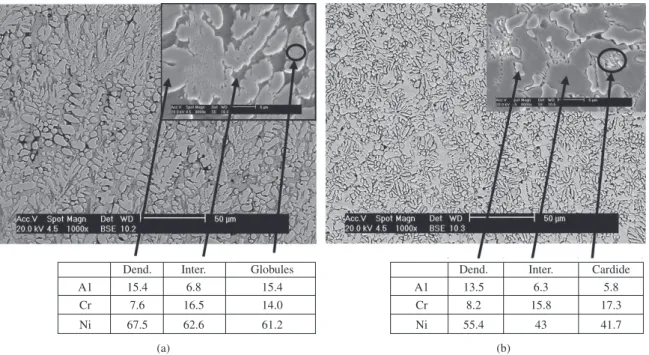
Dendritic structures were observed in all coatings (Figure 1). The variation in the deposition current led to differences in the solidification rate, and the steeper temperature gradient imposed by the 100 A current moved the system further away from equilibrium than the slower solidification and cooling for coatings processed with a 130 A current. The precipitates observed in the coatings processed with the lower current may be associated with the formation of a saturated solid solution during solidification followed by aging during further cooling to room temperature. Coatings processed with the higher current did not contain these precipitates, suggesting that the solid solution did not become saturated during solidification, so that precipitates failed to form on cooling to room temperature.
EDS analysis showed that the dendritic region was rich in aluminum and was associated with the richer aluminum compound identified by XRD, NiAl-β, which is also the phase with the highest melting point. This constituent was found in large fractions in the coatings processed with a 100 A current. An interdendritic region with a small amount of aluminum and high chromium content, which was either a solid solution (γ) or the Ni3Al-γ’ intermetallic phase, was observed. A dendritic precipitate dispersion rich in aluminum and chromium and observed as “globules” was identified as the sigma phase8 (Figure 1a). Coatings processed with a
130 A current, which imposes a slower solidification rate, contained chromium carbides but no evidence of “globules” in the as-deposited condition (Figure 1b)
3.2.
Variation in microstructure with exposure to
temperature
Exposure of coatings to temperature should change the structure so that it moves towards equilibrium. The magnitude of any change is strongly dependent on the rate
Figure 1. Microstructures and chemical analysis of NiCrAlC coatings: a) NiCrAlC deposited with a fast solidification rate (100 A); b) NiCrAlC deposited with a slow solidification rate (130 A).
Characterization of NiCrAlC PTA Coatings
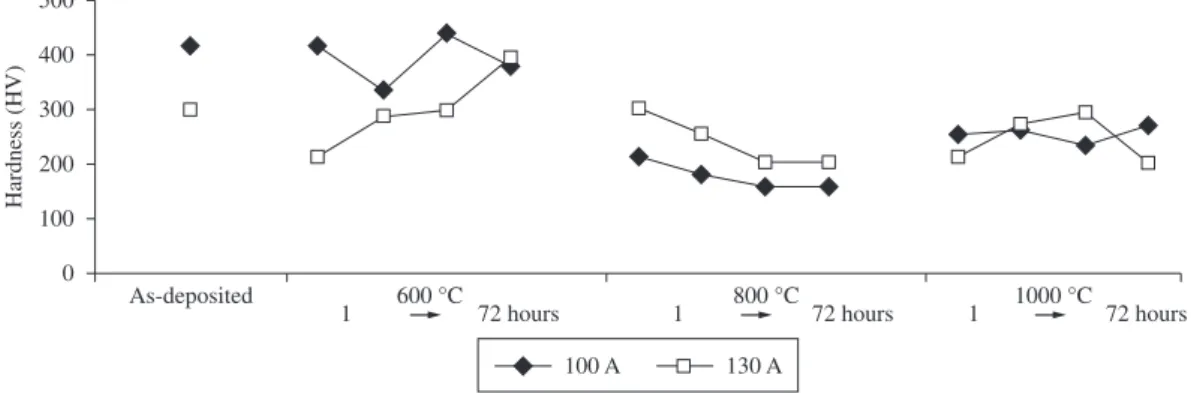
at which each coating solidifies. The variations in hardness resulting from exposure of NiCrAlC coatings to temperature are shown in Figure 2. Coatings deposited with a 100 A current maintained their original hardness of approximately 400 HV following exposure to 600 °C. Despite the faster solidification rate with a 100 A current, the lower dilution of these coatings preserves the chemical composition of the powder mixtures better and ensures the formation of a larger fraction of intermetallic compounds. However, a significant decrease in hardness was observed following exposure to 800 °C.
Processing with a 130 A current resulted in coatings with a lower hardness (300 HV). The hardness value fell further after exposure to 800 °C for 1 hour and increased to 400 HV when coatings were exposed for 72 hours.
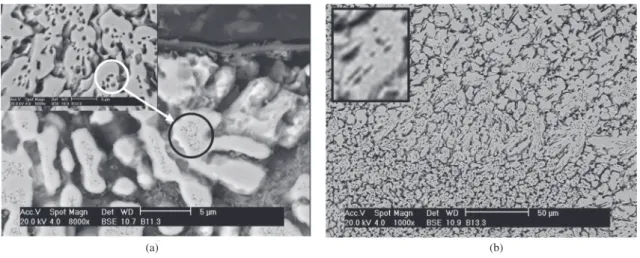
The variations in hardness observed here are associated with microstructural changes. Analysis of the microstructures of the coatings processed with a 100 A current (i.e., coatings with a fast solidification rate) after temperature exposure revealed changes in the globular phase. As the exposure time increased, this phase was observed as needle-like particles (Figure 3a). Although it formed preferentially in the dendritic region, this phase was also found in the interdendritic region. After 1 hour at 1000 °C, H-shaped precipitates were identified (Figure 3b). Yang et al.8 studied
the microstructural features of a polycrystalline nickel-base superalloy K465 after exposure to temperature and suggested that some of the needle-like particles were M6C carbides because of their higher carbon, W and Mo content. These needle-like particles can also be the sigma phase if there is no carbon present and an abundance of Ni and Cr. Given that the C content in the powder mixtures used here was much lower than that reported by Yang et al.8 for superalloy
K465 and that the particles were completely removed by the chemical reagent used to reveal the microstructure, it is plausible to assume that they were the sigma phase.
Precipitation of the globular phase began at 600 °C and became more intense with temperature, as shown in Figures 4a, b. At 1000 °C precipitates are coarser and have a needle-like or “H” morphology. The increase in hardness can be attributed to the formation of the sigma phase, which is a hard constituent even at 600 °C. Westbrook9
reported that the hardness of the sigma phase is similar to that of M23C6 carbide at 800 °C. Both the sigma phase and M23C6 carbide are typical constituents of stainless steels.
When the coatings were exposed to higher temperatures, precipitates were observed irrespective of the deposition current used. The coarsening of these precipitates at higher temperatures may account for the corresponding decrease in hardness.
Figure 2. Vickers hardness tests for coatings deposited with currents of 100 and 130 A and exposed to 600, 800 and 1000 °C for 1, 6, 24 and 72 hours.
Figure 3. a) NiCrAlC deposited with a 100 A current and exposed to 600 °C for 1 hour and 72 hours. b) NiCrAlC deposited with a 100 A current and exposed to 1000 °C for 1 hour.
Benegra et al.
reason for the hardness variations observed after temperature exposure. For coatings processed with a low current, a large amount of NiAl (β phase) was observed, and the precipitates coarsened after temperature exposure, causing the hardness to decrease. Furthermore, the hot hardness of this phase is the lowest of all the phases.
Coatings processed with a lower deposition current and which consequently had a slower solidification rate exhibited a delay in the onset of precipitate coarsening. Also, the large amount of Ni3Al (γ’ phase) and chromium carbides explains the increase in hardness measured after temperature exposure.
These results show that NiCrAlC PTA coatings can be used in a range of applications, especially high-temperature abrasion, which requires that coating hardness be maintained at elevated temperatures. For such applications, the coating with a high dilution level tested here could offer better wear performance together with a good metallurgical bond between coating and substrate, thereby avoiding brittle failures.
Of all the constituents detected in NiCrAlC alloy, the softest when subjected to a temperature of 800 °C is NiAl (beta phase), which has a hardness of 60 HV[9]. This may
be a further reason for the low hardness value observed, as the Ni3Al phase tends to keep its original hardness (approximately 200 HV at ambient temperature for the isolated phase9).
4. Conclusions
This investigation analyzed the microstructures of NiCrAlC alloys processed by PTA and changes in them following temperature exposure. The solidification rates imposed by the deposition current resulted in a solid solution with different saturations. When supersaturation was reached during solidification, precipitation occurred during the subsequent cooling, as observed for coatings processed with a 100 A current.
The volume fraction of microstructural constituents in the as-deposited condition can be considered the main
Figure 4. a) NiCrAlC deposited with a 130 A current and exposed to 800 °C for 72 hour. b) NiCrAlC deposited with a 130 A current and exposed to 1000 °C for 24 hours.
References
1. Meier GH. A review of advances in high-temperature corrosion.
Materials Science and Engineering A. 1989; 120:1-11. http:// dx.doi.org/10.1016/0921-5093(89)90712-0
2. Goldenstein H, Silva YN and Yoshimura HN. Designing a new family of high temperature wear resistant alloys based on Ni3Al IC: experimental results and thermodynamic modeling.
Intermetallics. 2004; 12:963-8. http://dx.doi.org/10.1016/j. intermet.2004.02.027
3. Silva WS, Souza RM, Mello JDB and Goldenstein H. Room temperature mechanical properties and tribology of NICRALC and Stellite casting alloys. Wear. 2011; 271:1819-27. http:// dx.doi.org/10.1016/j.wear.2011.02.030
4. Benegra M, Magnani M, Goldenstein H, Maranho O and Pintaude G. Abrasion and corrosion resistance of new Ni-based coating deposited by HVOF thermal spray process. Surface
Engineering. 2010; 26:463-8. http://dx.doi.org/10.1179/0267 08410X12550773058144
5. Donachie MJ and Donachie SJ. Superalloys – A Technical Guide. Materials Park: ASM International; 2002. 409 p.
6. Yaedu AE and D’Oliveira ASCM. Co based alloy PTA hardfacing with different dilution levels. Materials Science and Technology. 2005; 21(4):459-66. http://dx.doi. org/10.1179/174328405X36511
7. Kou S. Welding Metallurgy. New Jersey: John Wiley & Sons; 2003. 460 p.
8. Yang JX, Zheng Q, Sun XF, Guan HR and Hu ZQ. Topologically close-packed phase precipitation in nickel-base superalloy during thermal exposure. Materials and Science Engineering A. 2007; 465:100-8. http://dx.doi.org/10.1016/j. msea.2007.01.152
9. Westbrook JH. Temperature dependence of the hardness of secondary phases common in turbine bucket alloys. Journal of Metals. 1957; 209:898-904.