31
Faculdade de Saúde Pública
N Ú M ERO 2
ABRIL 1997
Revista de Saúde Pública
J O
U
R
N
A
L
O
F
P
U
B
L
I
C
H
E
A
L
T
H
© Copyright Faculdade de Saúde Pública da USP. Proibida a reprodução mesmo que parcial sem a devida autorização do Editor Científico. Proibida a utilização de matérias para fins comerciais. All rights reserved.
MAGALHÃES, Luiz Augusto, Observations on the miraxonal attraction exercised by sexually immature or adult Biomphalaria glabrata infected or not by Schistosoma mansoni. Rev. Saúde Pública, 31 (2): 121-4, 1997.
p. 121-4
O bservations on the miraxonal attraction
exercised by sexually immature or adult
Biomphalaria glabrata infected or not by
Schistosoma mansoni
O bservações sobre a atração miraxonal exercida por
Biomphalaria glabrata
infantil e adulta, infectada ou não
por
Schistosoma mansoni
Luiz Augusto M agalhães, Eliana M aria Zanotti-M agalhães e José Ferreira de Carvalho
* Supported by “Conselho Nacional de Desenvolvimento Científico e Tecnológico/CNPq”. Process nº 301798/88-5.
Correspondence to: Luiz Augusto Magalhães Departamento de Parasitologia do Instituto de Biologia da Universidade Estadual de Campinas
-Cidade Universitária Barão Geraldo - Caixa Postal 6109 - 13083-970 Campinas, SP - Brasil. E-mail: luiz @ correionet.com.br Edição subvencionada pela FAPESP. Processo 96/5999-9.
Recebido em 18.1.1996. Reapresentado em 22.9.1996. Aprovado em 28.2.1997.
O bservations on the miraxonal attraction exercised
by sexually immature or adult
Biomphalaria
glabrata infected or not by Schistosoma mansoni*
O bservações sobre a atração miraxonal exercida por
Biomphalaria glabrata
infantil e adulta, infectada ou não
por Schistosoma mansoni
Luiz Augusto M agalhães, Eliana M aria Zanotti-M agalhães e José Ferreira de Carvalho
Departamento de Parasitologia do Instituto de Biologia da Universidade Estadual de Campinas. Campinas, SP - Brasil (L.A.M ., E.M .Z.M .), Departamento de Estatística do Instituto de
M atemática, Estatística e Ciência da Computação da Universidade Estadual de Campinas. Campinas, SP - Brasil (J.F.C.)
Abstract
Objective The influence of age and the presence of secondary sporocysts in the miraxonal attraction exercised by Biomphalaria glabrata on miracidia of Schistosoma
mansoni of the BH strain were studied.
Material and Method A glass apparatus containing two compartments joined by a tube and previ-ously tested in other experiments, was used. Specimens of B. glabrata or its snail conditioned water (SCW) selected before the first oviposition (sexually immature), after the first oviposition (adult), with or without secondary sporo-cysts, were used to attract the miracidia.
Results It was noted that snails or their SCW containing secondary sporocysts lost the ability to attract miracidia. The sexual maturity of the snail did not influence miraxonal attraction.
Biomphalaria, parasitology. Schistosoma mansoni, physiology. Host-parasite relations.
Resumo
Objetivo Estudou-se a influência da idade e da presença de esporocistos secundários na atração miraxonal exercida por Biomphalaria glabrata sobre miracídios de
Schistosoma mansoni da linhagem BH.
Resultados Verificou-se que os moluscos (ou sua SCW) que continham esporocistos secun-dários perderam o poder de atrair miracídios. A condição dos moluscos serem infantis ou adultos não interferiu na atração miraxonal.
Biomphalaria, parasitologia. Schistosoma mansoni, fisiologia. Relações hospedeiro-parasita.
The factors to be studied were thus: – sexual maturity ( immature, mature)
– infection (no: no secondary sporocysts; yes: presence of secondary sporocysts)
– source (mollusk, SCW)
Every combination of the levels of the three factors, comprising eight experimental settings, were tested in a completely randomized experiment. Ten replications were performed. The resulting eighty uses of the artifact described below were performed in random order. An additional setting, with only dechlorinated water, was tested for the sole purpose of checking the experimental device.
A previously tested glass artifact was used for the study of miraxonal attraction. The artifact is composed of two circular chambers, with 30 mm diameter and 20 mm depth, joined by a channel of 40 mm lenght, 11 mm width and 10 mm depth (Brasio et al.2, 1985).
Each run of the experiment was carried out by allocating a mollusk or SCW in a randomly chosen chamber of the artifact and depositing ten BH strain miracidia in the channel. The result of the run was the frequencies of miracidia in each compartment of the artifact - chamber with mollusk or SCW, empty chamber or channel, after fifteen minutes. A stereoscopic micros-cope with 0.5 reductor frontal glass was used for the observation and counting of miracidia.
Standard categorical data statistical techniques were employed to analyze the results: Grizzle et al.7 (1969)
model and derivations thereof for the evaluation of statistical significance of main effects and interactions; and correspondence analysis (Benzécri1, 1973), for the
visualization of these effects.
RESU LTS
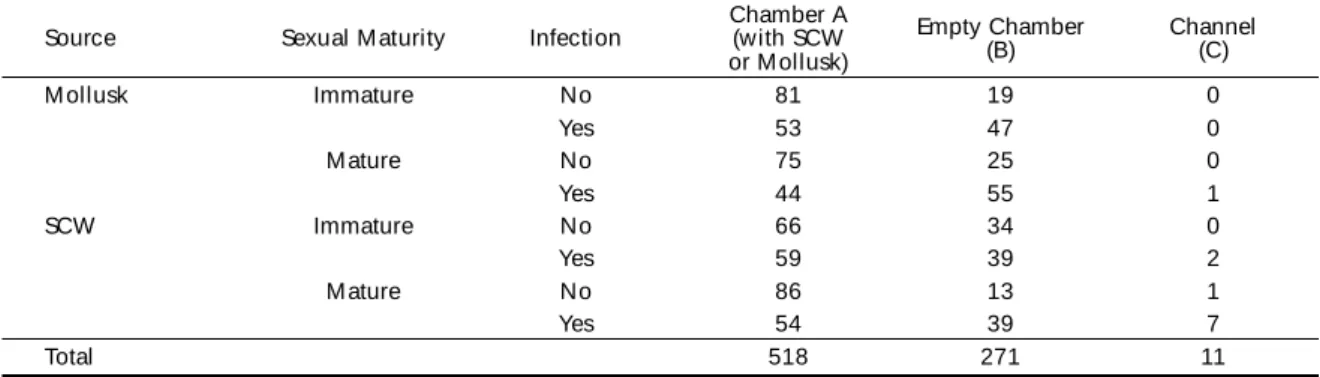
A summary of the experimental results are in Table 1.
The statistical analysis (Table 2) evidenced that: a) infection had a definite effect, in those snails with secondary sporocysts showed no attraction to mira-cidia; b) sexual maturity was immaterial to attraction. The results of the correspondence analysis also show clearly the importance of infection on the mira-cidia attraction. The graphic (Figure) should be read by evaluating the angles between the vectors corre-sponding to the compartments (labeled A, B and C, respectively) and the vectors corresponding to the factors levels combination (labeled zero to 7, in the order of Table 1) (Table 3, Figure).
IN TRO D U CTIO N
Miraxonal attraction caused by vectors snails of
Schistosoma mansoni was demonstrated by
Kloet-zel8, 9 (1958, 1960), Etges et al.6 (1985).
The miracidia attraction to intermediate hosts re-sults from substances emanated by the snail in water. The water containing these substances is named SCW (snail conditioned water) (Chernin4, 1970).
The hemolymph and the SCW of the vector mol-lusks were analysed by Brasio et al.2, 3 (1985) where
they appointed some cations and aminoacids as probable substances responsible for miraxonal at-traction.
Magalhães11 (1987) deemed the miraxonal
attrac-tion as one of the biological events essential in the study of epidemiology of mansonic schistosomiasis. Niemann et al.14 (1990) observed that the
suscep-tibility to the infection of B. glabrata caused by S.
mansoni was inversely related to the size of the snail
and not necessarily to its age.
Zanotti-Magalhães et al.17 (1991) verified that the
intensity of miraxonal attraction is directly related to the degree of susceptibility of the snail to the schis-tosome infection. To get to this conclusion the au-thors utilized populations genetically selected by self-fecundation. The authors also concluded that the de-gree of miraxonal attraction depends exclusively on snail population, not interfering the fact that the mira-cidium had been originated of trematode population maintained by several generations in snails partially resistant or highly susceptible.
In the present work it is consider the possible re-lationships of snail sexual maturity (before and after first oviposition) and infection (present, absent) with miraxonal attraction.
M ATERIAL AN D M ETH O D
Attractants were B. glabrata selected before the first oviposition (sexually immature) or after the first ovipositon (adults), having or not secondary sporocysts (infected or not). SCW (Chernin5, 1972) obtained from the snail pools,
The vectors labeled A and B are close to axis 1 and contrary to each other. This axis represents 73% of the total variation in the correspondence analysis. One sees, then, that axis 1 is associated with the chambers. Now the vectors corresponding to the fac-tors settings show that the even numbered ones are in the same direction as A; those numbered with odd numbers, associated with B. This shows clearly that chamber A receives more miracidia in the presence of non-infected mollusk or SCW of non-infected mollusks.
There is one vector7, which is aligned with C.
This corresponds to the situation: SCW, mature, in-fected. It is apparent that this situation is the one situ-ation that leaves some of the miracidia left in the channel.
D ISCU SSIO N AN D CO N CLU SIO N S
It is well know that mollusks infected by dige-netic larvae suffer deep physiological transformation altering, for example, their reproductive ability and the susceptibility to infection (Minchella et al.13,
1983; Machado et al.10, 1988).
Seta et al.16 (1993) verified that B. glabrata
(and also the SCW) newly infected (having pri-mary sporocysts) repulsed miracidia of S.
man-Table 1 - Total frequencies of miracidia in compartments, after a 15 minutes period: results of ten replicates per experimental setting.
Chamber A Empty Chamber Channel
Source Sexual M aturity Infection (with SCW (B) (C)
or M ollusk)
M ollusk Immature No 81 19 0
Yes 53 47 0
M ature No 75 25 0
Yes 44 55 1
SCW Immature No 66 34 0
Yes 59 39 2
M ature No 86 13 1
Yes 54 39 7
Total 518 271 11
SCW - Snail conditioned w ater.
Table 2 - Generalized Least Squares (GLS) analysis of variance tabl e.
Source DF Chi-Square Probabil ity
Intercept 2 171.20 0.0000
M ollusk 2 3.23 0.1987
Ovipositi on 2 1.23 0.5402
M ollusk Oviposition 2 8.19 0.0167
Infection 2 49.18 0.0000
M ollusk Infection 2 2.27 0.3219
Ovipositi on Infecti on 2 4.23 0.1205
M ollusk Oviposition Infection 2 4.18 0.1236
Likelihood rati o 0 – –
D F - degree freedom
Table 3 - M iracidi a distri bution.
Compartments Dimension 1 Dimension 2
Chamber A 0.994827 0.005173
Chamber B 0.947816 0.052184
Channel C 0.171922 0.828078
soni. For the B. tenagophila these authors
ob-tained contrary results.
It was noted by us in the present work that B.
glabrata having secondary sporocysts, sexually
im-mature, as well as adults, lost attraction to miracidia. It seems, however, that the power to repel observed by Seta et al.16 (1993) is attenuated during the
infec-tion of the snail.
The repellence to miracidia of S. mansoni had already been described by Magalhães et al.12 (1991)
in a sample of Biomphalaria straminea. These au-thors concluded that snails can have the ability to emanate substances repulsive to the miracidia.
The fact that infected snails do not attract mira-cidia or even repulse these larvae, results in a better
profit of the larvae in water, because that they are only attracted by non-infected snails.
Richards et al.15 (1972) verified that the sexual
maturity of snails affects the susceptibility of the in-fection caused by S. mansoni.
The present results show that the mollusks matu-rity does not influence the miraxonal attraction.
During the miracidia observation, it was verified in all experiments that the larvae were more active in the chambers where the attractants (snails or SCW) were. This fact demonstrates that miraxonal sub-stances act not only attracting miracidia but also in-creasing their vitality. The increased of vitality was evidenced by a more active movement of the larvae and also, by their increased lenght.
REFEREN CES
1. BENZÉCRI, J. P. L’Analyse des Données: T. 2, l’analyse des correspondences. Paris, Dunod, 1973.
2. BRASIO, B. C.; MAGALHÃES, L. A.; MILLER, J., CARVALHO, J. F. Atração de miracídios de Schistosoma
mansoni por hospedeiros invertebrados. Comportamento de
miracídios frente a girinos de Hyla fuscovaria. Rev. Saúde
Pública, 19:18-27, 1985.
3. BRASIO, B. C.; MAGALHÃES, L. A.; MILLER, J.; CARVALHO, J. F. Verificação da resposta de miracídios de
Schistosoma mansoni a substâncias provenientes de
moluscos planorbídeos. Pesquisa de substâncias quimiotáxicas. Rev. Saúde Pública, 19:154-70, 1985.
4. CHERNIN, E. Behavioral responses of miracidia of
Schistosoma mansoni and other trematodes to substances
emitted by snails. J. Parasitol., 56:287-96, 1970.
5. CHERNIN, E. Penetrative activity of Schistosoma mansoni miracidia stimulated by exposure to snail conditioned water. J. Parasitol., 58:209-12, 1972.
6. ETGES, F. J.; CARTER, O. S.; WEBBE, G. Behavioral and developmental physiology of schistosoma larvae as related to their molluscan hosts. Ann. N.Y. Acad. Sci.,
266:480-96, 1985.
7. GRIZZLE, J. E.; STARMER, C. F.; KOCH, G. G. Analysis of categorical data by linear models. Biometrics, 25:489-504, 1969.
8. KLOETZEL, K. Observações sobre o tropismo do miracídio do Schistosoma mansoni pelo molusco
Australorbis glabratus. Rev. Bras. Biol., 18:223-32, 1958.
9. KLOETZEL, K. Novas observações sobre o tropismo do miracídio do Schistosoma mansoni pelo molusco
Australorbis glabratus. Rev. Inst. Med. Trop. S. Paulo,
2:341-6, 1960.
10. MACHADO, S. M. P.; MAGALHÃES, L. A.; ARTIGAS, P. T.; CORDEIRO, N. S.; CARVALHO, J. F. Verificação de antagonismo entre larvas de Schistosoma mansoni e larvas de outros Digenea em Biomphalaria tenagophila molusco planorbídeo de criadouro natural situado na região de Campinas, SP, Brasil. Rev. Saúde Pública, 22:484-8, 1988.
11. MAGALHÃES, L. A. Relevant problems to the epidemiology of mansonic schistosomiasis. Mem. Inst.
Oswaldo Cruz, 82:341, 1987.
12. MAGALHÃES, L. A. & ZANOTTI-MAGALHÃES, E. M.; CARVALHO, J. F.; FARAONE, M. Atração miraxonal exercida por Biomphalaria straminea, Lymnaea columella e
Physa sp., sobre miracídios de Schistosoma mansoni da
linhagem BH. Rev. Saúde Pública, 25:23-7, 1991.
13. MINCHELLA, D. J. & LOVERDE, P. T. Laboratory comparison of the relative success of Biomphalaria glabrata stocks which are susceptible and insusceptible to infection with Schistosoma mansoni. Parasitology, 86:335-44, 1983.
14. NIEMANN, G. M. & LEWIS, F. A. Schistosoma mansoni: influence of Biomphalaria glabrata size on susceptibility to infection and resultant cercarial production. Exp.
Parasitol., 70:286-92, 1990.
15. RICHARDS, C. S. & MERRITT, J. W. Genetic factors in the susceptibility to juvenile Biomphalaria glabrata to
Schistosoma mansoni infection. Am. J. Trop. Med. Hyg.,
21:45-434, 1972.
16. SETA, L.; MAGALHÃES, L. A.; ZANOTTI-MAGALHÃES, E. M.; OLIVEIRA FILHO, B.; MARANGONI, S.;
CARVALHO, J.F. ; REIS, E.R. Estudo da atração miraxonal em Biomphalaria glabrata e Biomphalaria tenagophila livres de infecção ou infectados por Schistosoma mansoni. Rev.
Bras. Parasitol. Vet., 2:51, 1993.
17. ZANOTTI-MAGALHÃES, E. M.; MAGALHÃES, L. A.; CARVALHO, J. F. Atração miraxonal exercida por
Biomphalaria tenagophila selecionada geneticamente para o