Cop
yright
© ABE&M t
odos os dir
eit
os r
eser
vados
.
Organochlorine compound levels
in fertile and infertile women
from Rio de Janeiro, Brazil
Níveis de substâncias organocloradas em mulheres férteis e inférteis do Rio de Janeiro, Brasil
Ana Marcia Xavier Bastos¹, Maria do Carmo Borges de Souza², Gutemberg Leão de Almeida Filho², Thomas Manfred Krauss³, Thelma Pavesi³, Licínio Esmeraldo da Silva¹
ABSTRACT
Objective: The aim of the study was quantify organochlorine compounds in women seeking for infertility treatment (n = 15) and in spontaneously pregnant ones (n = 21). Materials and me-thods: A questionnaire was applied regarding lifestyle, occupational and reproductive history. Blood samples were collected from both groups. Results: From the pesticides studied, pp’DDE was detected in 100% of infertile women, at higher mean levels than in pregnant women (3.02 mcg/L vs. 0.88 mcg/L; p = 0.001; power of 69%), without correlation with the etiology of infer-tility. Levels of the polychlorinated biphenyls (PCBs) were low, with positive samples in 100% in the infertile women for PCBs 138, 153, 180, while in pregnant women, they were 85.7% for congeners 138 and 153. Only PCB180 showed signiicance, with frequency of 71.4% (p = 0.019). Conclusions: The risk factors for female infertility were: age, consumption of untreated water and of canned foods. Exposure to the most prevalent organochlorine compounds described in literature was conirmed in the study, indicating that pp’DDE may adversely inluence female fertility. Arq Bras Endocrinol Metab. 2013;57(5):346-53
Keywords
Organochlorine pesticides; polychlorinated biphenyls; female fertility; endocrine disruptors
RESUMO
Objetivo: O estudo teve como objetivo quantiicar as substâncias organocloradas em mulheres buscando tratamento para infertilidade (n = 15) e que espontaneamente engravidaram (n = 21). Materiais e métodos: Foi aplicado questionário considerando estilo de vida, história ocupacio-nal e reprodutiva. Amostras de sangue foram obtidas em ambos os grupos. Resultados: Dos pesticidas, pp’DDE foi detectado em 100% das inférteis, com níveis maiores que nas grávidas (3,02 mcg/L vs. 0,88 mcg/L; p = 0,001; poder 69%), sem correlação na etiologia da infertilidade. Os níveis de detecção das bifenilas policloradas (PCBs) foram baixos, com 100% de positivi-dade das amostras nas inférteis para os PCBs 138, 153, 180, e de 85,7% nas grávidas para os congêneres 138 e 153. Apenas PCB180 mostrou signiicância na frequência de 71,4% (p = 0,019). Conclusões: Os fatores de risco para infertilidade feminina foram: idade, consumo de água não tratada e alimentos enlatados. A exposição aos organoclorados mais prevalentes descritos na literatura foi conirmada no estudo, indicando que pp’DDE pode inluenciar adversamente a fertilidade feminina. Arq Bras Endocrinol Metab. 2013;57(5):346-53
Descritores
Pesticidas organoclorados; bifenilas policloradas; fertilidade feminina; desreguladores endócrinos
¹ Universidade Federal Fluminense (UFF), Niterói, RJ, Brazil
²Universidade Federal do Rio de Janeiro (UFRJ), Instituto de Ginecologia, Rio de Janeiro, RJ, Brazil
³ Centro de Estudos da Saúde do Trabalhador e Ecologia (CESTEH), Escola Nacional de Saúde Pública Sérgio Arouca (ESNP), Fundação Oswaldo Cruz (Fiocruz), Rio de Janeiro, RJ, Brazil
This study was developed at the Universidade Federal do Rio de Janeiro
Correspondence to:
Cop
yright
© ABE&M t
odos os dir
eit
os r
eser
vados
.
INTRODUCTION
T
he second half of the 20th century witnessed anincrease in population growth that has been ac companied by a decline in fertility rate (1), especially in developed countries. Social, economic, and cultural factors, such as better quality of life and, consequently, higher survival rates, may explain the present overpop ulation. In contrast, women entry into the job market, postponing maternity, as well as the availability of effec tive contraception methods may explain the low fecun dity rate in the modern world (2).
The Brazilian Census, published by the Brazilian Institute of Geography and Statistics, showed that the fecundity rate in Brazilian women decreased from 2.54 to 1.95 children per woman, on average, between 1997 and 2007, and the proportion of childless couples in creased from 12.9% to 16% during the same period (3,4).
With the advent of the industrial era, environmen tal pollution began to harm wildlife and human health; however, most of the studies have focused mainly on the mutagenic, teratogenic, and carcinogenic mani festations of environmental pollution. In general, the scientiic community supports the idea that pollution is causing a negative impact on health, but very little is known about its impact on reproductive capacity. Se veral epidemiologic studies have observed deleterious effects of chemical agents following chronic exposure (5,6) in accidentally contaminated sites (711).
Numerous synthetic and natural environmental compounds known as endocrine disruptors (EDs) are found to modulate and alter endocrine functions, ef
fectively mimicking or blocking those functions, e.g.,
by means of estrogenic, antiestrogenic, and/or anti androgenic effects. They have potential to act as en dogenous hormones by binding to steroid hormone receptors. Among these compounds, organochlorines are a class of persistent bioaccumulative chemicals con sidered priority pollutants, which enter the food chain, and are also found in remote areas (12). About twelve toxic organic substances considered persistent organic pollutants (POPs) had their production and release in the environment reduced after the Stockholm Conven tion of the United Nations Environment Programme (13).
Among persistent chemicals are pesticides used in agriculture (DDT), which ight organisms that are harmful to men, such as diseasetransmitting vectors or
crop pests; despite the prohibition of largescale use,
they are still used in endemic areas, e.g., against malaria
mosquitoes in Brazil (14). Polychlorinated biphenyls (PCBs) are considered environmental pollutants, but are used in a variety of industrial applications, such as organic solvents, plastics, sealants, and adhesives on heat transfer luids for transformers and capacitors (15). Chemical products are also used in cosmetics, anabolic steroids for animal feeding, phytoestrogens in the diet, and are seen in residential, industrial, and urban sewer age system efluents, representing an important source of environmental contamination (16).
Exposure to these compounds during the devel opmental period causes reproductive abnormalities in adult life, and it has been suggested that they are trans generational. As female reproductive function depends upon ovarian steroidogenesis that enables folliculogen esis, ovulation, and pregnancy, the impact of altering ovarian development and function in female fertility may be the link between environmental exposure and reproductive failure (17).
Establishing risk factors for the general population is dificult and occasionally questioned by some au thors, as exposure, either at work or at home, cannot be easily characterized, and hence, cannot be proven. A number of adverse effects have been described in the literature, such as higher number of abnormalities in male genitalia, variation in birth sex rate, reduction in the quantity and quality of sperm, lower rate of fertil ity and fertilization, and higher rate of miscarriage and time to achieve pregnancy (18).
During the last decade, several clinical studies have attempted to validate the hypothesis that adverse effects on human health owing to environmental exposure, in cluding reproductive capacity, are often caused by en docrine disruption (19). Time to Pregnancy (TTP) is a tool for the retrospective study of fecundability (20). Evidence associating exposure to TTP increase deserve special attention and, as some geographic regions are more contaminated than others, differences should be analyzed in each speciic population (21). Berman and
cols. (22), reviewed studies regarding trends in repro
ductive health in Israeli population and found a de crease in the age of menarche from 1986 to 2000 and in the prevalence of male factor infertility. The authors supported the idea that endocrinedisrupting chemi cals must be regulated and public exposure reduced, especially in sensitive groups such as children and preg
Cop
yright
© ABE&M t
odos os dir
eit
os r
eser
vados
.
fects of pesticides on the development of precocious puberty in girls living in an agricultural region and, with exception of DDE, the pesticides studied were undetectable in serum and adipose tissue. Toshiba and
cols. (24),analyzed chemicals in urine of 42 Japanese
male partners of subfertile couples and suggested that pyrethroid exposing level and dietary habits (coffee and soy products) as signiicant contributors to poorer
semen quality.
In a systematic review (25) evaluating evidence of an association between EDs exposure and women re productive health, articles published until 2010 were not always consistent, in part due to limitations im posed by practical constraints. Reviewers recommen ded the development of appropriate biomarkers in or der to make progress in this ield.
Taking into consideration the diversity of clinical situations involved, the plausible association between environmental exposure and altered reproductive func tion is dificult to prove. The aim of the present study was to quantify organochlorine pesticides and poly chlorinated biphenyls, the most prevalent compounds described in the literature, in the serum of fertile and infertile women living in two urban areas of the state of Rio de Janeiro.
MATERIALS AND METHODS
The study and the related protocols were approved by the Ethics Committee for Research of the University Hospital of Universidade Federal do Rio de Janeiro. All participants signed an informed consent form.
The sample
The groups comprised women at reproductive age, between 18 and 38 years, that spontaneously achieved pregnancy in a period no longer than 12 months (fer tile group), and those seeking specialized treatment for infertility as they did not become pregnant in one year of unprotected sexual activity (infertile group). The following exclusion criteria for the latter group were: medical treatment in the previous 3 months, prema ture ovarian failure, male factor (oligoastenospermy or azoospermy) or surgical sterilization (tubal ligation or vasectomy). The fertile group was constituted of women randomly chosen at prenatal appointments, af ter twelve weeks of gestational age, as miscarriage was considered reproductive failure. The exclusion criteria
in this group were to be nursing or to have weaned the child less than 12 months before the study; to be un der medication or to have systemic disease; or women whose partners presented history of subfertility.
Data collection
A translated version of the Greenlee and cols. (6) ques
tionnaire was provided to both groups, between March and December 2006, taking into consideration the participants lifestyle, and occupational and reproduc tive history for epidemiological characterization and possible exposure to risk factors.
Analysis of organochlorine compounds
Samples were collected along with routine hormonal dosages during infertility investigation, as well as prena tal laboratory tests in the control group. Blood samples were drawn from the forearm vein and collected in a
Vacutainer® silicone tube without an anticlotting agent.
After spontaneous coagulation, serum was separated by centrifugation. Around 5 mL of the serum were kept frozen at 30ºC for the subsequent analysis of organo chlorine compounds.
The following substances were analyzed in the se rum samples: hexachlorobenzene (HCB); dichlorodi phenyltrichloroethane (DDT, pp’ and op’isomers), dichlorodiphenyldichloroethane (DDD, pp’ and op’ isomers), dichlorodiphenyldichloroethylene (DDE, pp’ and op’ isomers), and six marker PCBs (Nº 28, 52, 101, 138, 153, and 180). Instrumental analyses were conducted on Agilent 6890N gas chromatograph equipped with an Agilent 5973N mass selective detec tor, operated in the selected ion monitoring mode. Quantiication thresholds varied from 0.01 to 0.02 ng/ mL (= mcg/L) for the PCBs, and from 0.03 to 0.05 ng/mL (= mcg/L) for the DDT group and HCB. Re covery varied from 83 to 105% for the PCBs, and from 79 to 94% for the organochlorine pesticides.
Statistical analysis
Statistical data description was carried out using differ ent parameters (absolute frequency, proportion, aver age, standard deviation, minimum and maximum va lues, median, and interquartile deviation), tables, and graphs (box plots). Comparisons between the propor tion of independent samples were carried out with the
Cop
yright
© ABE&M t
odos os dir
eit
os r
eser
vados
.
Correlations among normal continuous variables were studied by means of Pearson’s correlation coef icient, and correlation among variables that did not show normal distribution were analyzed by means of Spearman’s correlation coeficient. The ShapiroWilk test checked normal data. Comparisons of two differ ent groups with independent data without normal dis tribution were carried out using MannWhitney test.
The level of signiicance was a = 0.05 (where p≤ 0.05
was signiicant). Power analysis was carried out after the signiicance test, using the observed difference to the null hypothesis as the effect size.
Statistical analysis was conducted using Microsoft Excel and SPSS statistical package version 10.0 from SPSS Inc.
RESULTS
From the 27 subjects who answered the questionnaire in each group, 21 pregnant and 15 infertile women completed blood sampling. No differences were found between the groups in relation to alcohol consumption, smoking, passive smoking, and body mass index, or in variables related to menstrual history (age of menarche, sexual initiation, and menstrual cycles.
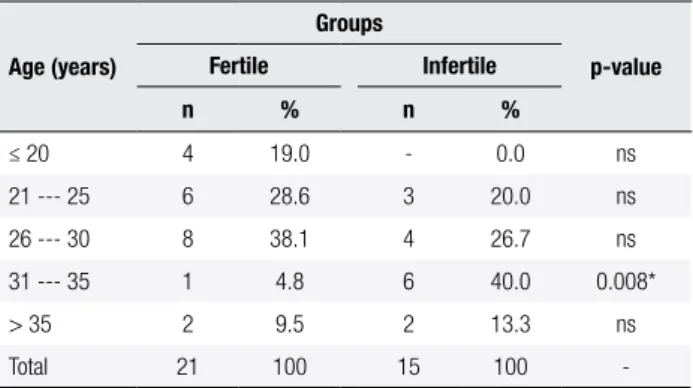
Both groups had the same social, demographic, and economic characteristics, and only differed in age. Me dian age of infertile patients was 30.9 years (S.D. ± 4.5), whereas it was 25.7 years in the fertile group (S.D. ± 5.4), demonstrating signiicant difference (Student’s t test: t = 2.996; df = 34; pvalue = 0.005). In the infertile group, 40% of the patients were between 31 and 35 years of age, whereas in the pregnant group, this age range represent
ed only 4.8% the sample (Chisquare test: χ2 = 6.937; df
= 1; pvalue = 0.008). These data are presented in table 1.
Gestational age ranged from 14 to 36 weeks, with a median of 23.8 weeks of pregnancy; 57.2% of the con trol group was in the second trimester, and 42.8% in the third trimester of pregnancy. Among the 21 preg nant women, 9 (42.8%) were in their irst pregnancy, and 12 (57.2%) had conceived before.
All the women lived in a metropolitan area with ap propriate water and sewage systems. However, inges tion of tap water was signiicantly different between the
groups (Chisquare test: χ2 = 4.573; df = 1; pvalue =
0.032), with 46.7% of the infertile patients, and 14.3% of the fertile ones consuming tap water. The other op
tions were: use of well water (only one infertile vs. three
pregnant women), iltered tap water and mineral wa ter, without signiicance in these variables. There was no signiicance in the consumption of meat or dairy products, either. On the other hand, there was signii
cant difference (Chisquare test: χ2 = 5.783; df = 1;
pvalue = 0.016) in the consumption of canned foods
once a week (86.7% case vs. 47.6% control). Exposure
to pesticides, such as insecticides, in the previous two years was similar in both the groups (73.3% for infertile
vs. 81% for fertile women), but the use of repellents
was reported by 20% of infertile patients against 0% of
pregnant woman (Chisquare test: χ2 = 4.582; df = 1;
pvalue = 0.032).
Regarding the DDT group, op’DDD and op’DDE isomers were not present in any of the analyzed sam ples, while op’DDT was observed in 13.3% patients in the experimental group and none in the control group. Among polychlorinated biphenyls, PCB 28 was nega tive in all samples, while PCB 52 was positive once in each group. Congener 101 was present in 33.3% of the infertile patients and in 28.5% of the controls, but it did not show any statistical difference.
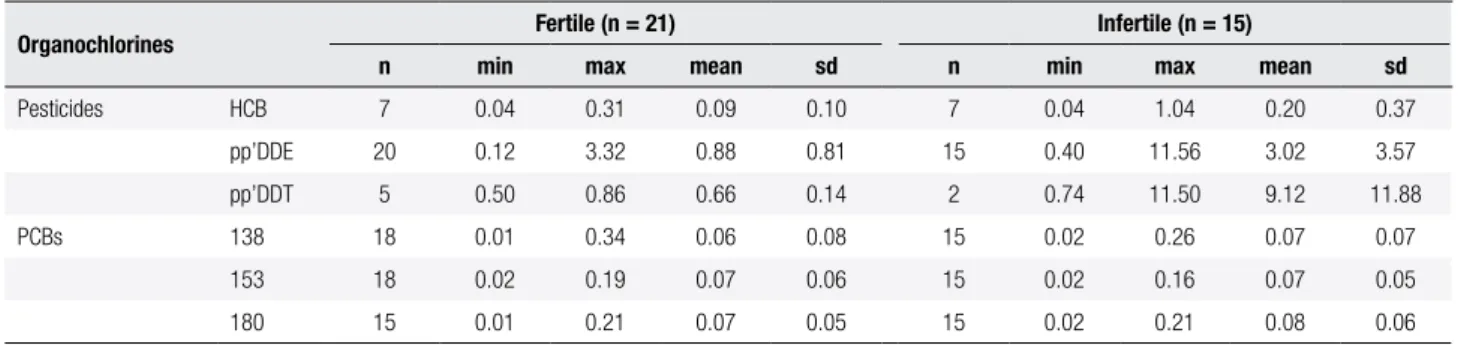
Table 2 shows the levels of the most prevalent organochlorine compounds (minimum, maximum, mean, and standard deviation) in both the groups. In the serum samples from both infertile and fertile pa tients, detectable levels of four kinds of organochlorine pesticides were found: HCB, pp’DDT, pp’DDD, and pp’DDE. The fungicide HCB was detected in seven samples from each group, with a mean of 0.21 mcg/L
vs. 0.09 mcg/L, for infertile and fertile patients, re
spectively, without any statistical signiicance. Samples were positive for pp’DDT in 5 out of 21 cases in the control group (23.8%), and 2 out of 15 patients in the experimental group (9.5%); pp’DDD was positive in only two patients of each group. It is worthy emphasi
Table 1. Comparison of the proportion of fertile and infertile women by age intervals
Age (years)
Groups
p-value Fertile Infertile
n % n %
≤ 20 4 19.0 - 0.0 ns
21 --- 25 6 28.6 3 20.0 ns
26 --- 30 8 38.1 4 26.7 ns
31 --- 35 1 4.8 6 40.0 0.008*
> 35 2 9.5 2 13.3 ns
Total 21 100 15 100
Cop
yright
© ABE&M t
odos os dir
eit
os r
eser
vados
.
zing that the main metabolite of DDT, pp’DDE, was the only isomer found in 100% of the infertile patients and in 95.3% of the pregnant women (except for one fertile woman who had undetectable levels). The levels in infertile women were higher than those detected in the control, with a signiicant difference between the groups (MannWhitney test: U = 56; pvalue = 0.001; power of 69%; Figure 1). Reviewing the analysis in three separate age groups for fertile and infertile wom en, pp’ DDE levels varied from 0332 mcg/L and 0.404.43 mcg/L, respectively, in fertile and infertile women, between 21 and 30 years old, without statisti cal difference. On the other hand, the subgroup over 30 years old showed difference between the groups (MannWhitney test: U = 0; p value = 0,012; Fi gure 2). The variation in this age group was 0.280.82 mcg/L for fertile women and 0.8711.56 mcg/L for infertile ones.
Polychlorinated biphenyls were detected only at low levels. However, the frequency of positive samples for congeners 138, 153, and 180 was 100% in infertile pa
Table 2. Statistical description of organochlorine compound levels in fertile and infertile groups
Organochlorines Fertile (n = 21) Infertile (n = 15)
n min max mean sd n min max mean sd
Pesticides HCB 7 0.04 0.31 0.09 0.10 7 0.04 1.04 0.20 0.37
pp’DDE 20 0.12 3.32 0.88 0.81 15 0.40 11.56 3.02 3.57
pp’DDT 5 0.50 0.86 0.66 0.14 2 0.74 11.50 9.12 11.88
PCBs 138 18 0.01 0.34 0.06 0.08 15 0.02 0.26 0.07 0.07
153 18 0.02 0.19 0.07 0.06 15 0.02 0.16 0.07 0.05
180 15 0.01 0.21 0.07 0.05 15 0.02 0.21 0.08 0.06
n: absolute frequency; min: minimum value; max: maximum value; mean: arithmetic mean; sd: standard deviation. All parameters values (except n) are expressed in mcg/L. HCB: hexachlorobenzene; pp’DDE: dichlorodiphenildichloroetilene; pp’DDT: dichlorodipheniltrichloetane; PCBs: polychlorinated biphenyls.
12
*
10
8
6
4
2
0
pp’DDE (mcg/L)
N 20
Fertile
15 Infertile Groups
12
pp’DDE (mcg/L)
N 3
Fertile 9
6
3
0
8 Infertile Groups
tients. Congeners 138 and 153 were detected in 85.7%, and PCB 180 in 71.4% of the patients in the control group; however, only PCB 180 frequency showed sig niicant difference between the groups (Chisquare test:
χ2 = 5.456; df = 1; pvalue = 0.019; Figure 3). There
was no signiicant difference in the levels of pp’DDE, PCB 138, PCB 153, and PCB 180 in the samples of the control group, when subgroups were compared, that is, when women in the irst pregnancy were compared with those who had achieved pregnancy before.
Etiologic diagnoses in infertile women were: 33.3% tubal factor (uni or bilateral obstruction), 20% ovu latory dysfunction (anovulation), and 20% both tubal and ovarian factors. There were two cases of uterine factors (uterine septum and unicornus), and in other two cases, the cause of infertility could not be found, and they were classiied as idiopathic. No cases of endo metriosis were found. There were no features or clinical suspicion of polycystic ovarian syndrome (PCOS), and hormonal assays excluded the possible involvement of hyperprolactinemia and hypothyroidism.
pp’DDE: dichlorodiphenildichloroetilene; mcg/L: microgram/liter. * Maximun value (11.56 mcg) for pp'DDE in the infertile group (p = 0.001; power 69%).
Figure 1. Box plots of pp’DDE levels observed in fertile and infertile groups.
pp’DDE: dichlorodiphenildichloroetilene; mcg/L: microgram/liter.
Cop
yright
© ABE&M t
odos os dir
eit
os r
eser
vados
.
Age is a determinant factor in fertility because ova rian reserve is reduced as women get older. In the pres ent study, mean age of infertile patients was signiicantly higher than of the fertile ones, but the average time of infertility in the experimental group was 52.4 months (varying from 1 to 12 years). When analyzing the sam ple with respect to age and time to pregnancy, infertile women were older and showed signiicant difference in TTP when compared with fertile ones, speciically in the subgroup over 31 years old. Also, in a casecontrol
study, Smith and cols. (21) found the duration of infer
tility lasting from 1 to 19 years, and similar mean value of 4 years. Both studies showed the long evolution of the disease and the dificulty in solving the cases, stat ing that age could be a risk factor for infertility.
In contrast, Greenlee and cols. (6) found similar
mean age in the fertile and infertile groups (29.7 vs.
29.9 years) showing no interference of age in female fertility. Age may also inluence organochlorine levels due to the longer period of exposure and, consequent ly, greater accumulation of these compounds. In the present study, the highest pp’DDE levels were found in two infertile women, aged 36 and 37 years, which emphasize the persistence in older people. The differ ence between pp’DDE levels found in the subgroup of infertile women over 30 years old may explain a nega tive impact in women fertility.
Another factor to be considered is the time of birth of the sample studied. These women were born be tween 1969 and 1988, when these chemicals had not
yet been banned in Brazil; therefore, the in utero ex
posure could have been possible. Although the ques tionnaire did not evaluate living conditions, work, and lifestyle of patients’ parents, there was no report of resi dences in rural, agricultural and/or cattleraising areas, or of the use of pesticides in childhood and adolescence in any of the groups.
There was a signiicant difference in the intake of drinking water between the groups, with the infertile pa tients consuming tap water more frequently than the fer tile ones. Greenlee and cols. (6) showed that the supply of private well water could present lower risk to infertility than water from the public water supply systems, which is considered to have higher concentration of chemical substances added for treatment. However, in 2004, Silva (26) reported the absence of HCB, DDT and its metab olites in the water supplied by the city of Rio de Janeiro. According to the World Health Organization, the population is primarily exposed to PCBs by means of
.4
N 18 15 15
*
*
18 Fertile .3
.2
.1
0.0
15 15 Infertile Groups
PCB level (mcg/L)
PCB 138 PCB 153 PCB 180
DISCUSSION
Infertility is deined as the incapacity to achieve preg nancy after one year of regular unprotected intercourse. The authors considered a major health problem in both developed and developing countries, affecting 10% of the population (2). This is the irst study in volving an urban population, comparing organochlo rine compounds in the serum of infertile and fertile women from the same area of Rio de Janeiro. Most of the published trials analyzed TTP retrospectively, as an epidemiological tool representing fecundity in exposed populations, such as in agricultural areas. On the other hand, samples consisted of women considered fertile, excluding the infertile ones, who did not achieve spon taneous pregnancy.
Greenlee and cols. (6) translated questionnaire was chosen as the instrument to evaluate exposure to risk factors, because it is the one that best approaches the study of female infertility considering the etiology and the possible variables involved. Although Greenlee's study was in agricultural population and the present re search was conducted with women living in an urban area, the questionnaire was useful. Demographic data, and information related to menstrual and reproductive history, as well as lifestyle proved to be of great value for the epidemiological characterization of the sample. A shorter and more objective questionnaire would con tribute to future studies on environmental issues affec ting human reproduction.
PCBs: polychlorinated biphenyls; mcg/L: microgram/liter. * Maximum values for PCB 138 in the fertile (0.34 mcg) and infertile (0.26 mcg) patients.
Cop
yright
© ABE&M t
odos os dir
eit
os r
eser
vados
.
ingestion of ish and other products of animal origin, such as meat, poultry, milk, cheese, and eggs (27). However, no conclusion about the differences in ex posure to organochlorines by food intake was visible, because only one infertile woman reported consump tion of ish, and in both the studied groups, food con sumption was exclusively based on chicken and beef
in similar proportions. Sarcinelli and cols. (28) inves
tigated organochlorine levels in the plasma and umbili cal cord blood of women and their newborns living in Rio de Janeiro. Out of the predictive variables analyzed (body mass index, menarche, maternal and gestational ages, parity, and eating habits), pp’DDE was the only chemical that showed signiicance, presenting a positive correlation with the consumption of ish and chicken.
In pregnant women, blood samples were collected in the second or third trimester of pregnancy in similar pro portions. Some factors may interfere with the levels of environmental chemical substances, such as body weight changes during pregnancy, as well as metabolism and en
ergy intake, but according to Longnecker and cols. (29),
the moment of serum sampling is not critical with regard to the organochlorine concentrations. In the present study, the authors found that the levels were greater than or equal to the detection threshold in all the samples of pregnant patients, for both DDE and PCBs, although DDE levels were higher than usually reported in the lit erature compared with PCBs level, which were similar. Although the limits of detection in the studied samples were low, PCBs 138, 153, and 180 were 100% posi tive in all the infertile patients, and pp’DDE levels were higher in the experimental group, conirming the data in literature. According to Safe and Hoivik (30), these are the most common organochlorine compounds found in humans. In addition, these compounds were also identi ied in the control group, but in lesser amounts, indicat ing that both the groups are exposed.
The inluence of breastfeeding on organochlorine levels was also excluded, because the levels of the four most frequent compounds (pp’DDE, PCB 138, PCB 153, and PCB180) were not altered when compared with the two subgroups of pregnant women. Almost half of the women were pregnant for the irst time, and hence, had never breastfed before, and those who had at least one child alive, had already weaned them for over
12 months. In contrast, Sarcinelli and cols. (28) reported
signiicant higher pp’DDE plasma levels in nulliparous women than in the multiparous ones; however, they did not provide any information regarding breastfeeding.
Younglai and cols. (31) studied the association be tween fertilization failure in 21 couples undergoing IVF and exposure of both partners to environmental contaminants. The isomer pp’ DDE was the most fre quent substance found in serum and follicular luid. Se rum levels of PCB 138, 153, and 180 were also found in more than 50% of the samples. The levels of the con gener 180 showed a signiicant difference between pa tients who achieved pregnancy and those who did not, and pp’DDE presented higher residual le vels and was associated with fertilization failure. In the present study, similar results were found, as PCB 180 showed signii cant difference in the frequency between the groups.
However, Buck and cols. (9) found that the values of
PCB 206 and HCB were 30% or more of their detec tion limits, and those of PCBs 138, 153, and 180 were below the detection limits. Nevertheless, PCB 205 was observed to be the only congener signiicant and posi tively associated with increased time to pregnancy.
The association of environmental exposure and ad verse effects in human health involves multiple factors. The dificulty in establishing the level of chemical expo sure in each geographic region, and the variety of com pounds existing simultaneously in the environment, the susceptibility and vulnerability of the host, and the long period of latency between exposure and characteriza tion of the individual responses are wellknown (32). Therefore, the limitations of this study, as in many oth ers, include the dificulty in proving causality, especially in an urban area without accidental or chronic popula tion exposure. Although the sample size limited statisti cal results, it was possible to show increased frequency of organochlorine compounds in the serum of infertile women living in an urban, compared with fertile ones.
CONCLUSIONS
Women living in a metropolitan area of Rio de Janei ro are exposed to the most prevalent organochlorine compounds described in the literature, even though detection levels are low. The comparison of organo chlorine levels in fertile and infertile women indicates that pp’DDE, may adversely inluence female fertility.
Cop
yright
© ABE&M t
odos os dir
eit
os r
eser
vados
.
Acknowledgements: we would like to thank Doctor Ruth Cla pauch for the contribution in the discussion of this paper from the endocrinologist standpoint, and for the incentive to publish the article.
Disclosure: no potential conlict of interest relevant to this article was reported.
REFERENCES
1. Global trends: population growth, but falling birth, fertility rates. Growth Strategies. June, 2001. Find Articles.com. Accessed on: July 26, 2009.
2. Crosignani PG, Rubin BL, Collins HJ. Social determinants of hu-man reproduction. The ESHRE Capri Workshop Group. Hum Re-prod. 2001;16(7):1518-26.
3. IBGE – Brazilian Institute of Geography and Statistics. National Research per Home Sampling. (PNAD 2006). Available at: >www. ibge.gov.br< Social Communication, September 28, 2007. Ac-cessed on: Feb 16, 2009.
4. IBGE – Brazilian Institute of Geography and Statistics Prospect of the Brazilian Population by Gender and Age-1980-2050. Revised Edition 2008. Social Communication, November 27, 2008. Avail-able at: <www.ibge.gov.br/presidencia/notícias> Accessed on: Feb 16, 2009.
5. Oliva A, Spira A, Multigner L. Contribution of environmental fac-tors to the risk of male infertility. Hum Reprod. 2001;16(8):1768-76. 6. Greenlee AR, Arbuckle TE, Chyou P. Risk factors for female
infertil-ity in an agricultural region. Epidemiology. 2003;14(4):429-36. 7. Yu M, Guo YL, Hsu CC, Rogan WJ. Menstruation and reproduction
in women with Polychlorinated Biphenyl (PCB) poisoning: long-term follow-up interviews of the women from Taiwan Yucheng cohort. Int J Epidemiol. 2000;29:672-7.
8. Buck GM, Vena JE, Schisterman EF, Dmochowski J, Mendola P, Sever LE, et al. Parental consumption of contaminated sport ish from Lake Ontario and predicted fecundability. Epidemiology. 2000;11(4):388-93.
9. Buck GM, Vena JE, Greizerstein HB, Weiner JM, McGuinness B, Mendola P, et al. PCB congeners and pesticides and female fe-cundity, New York State Angler Prospective Pregnancy Study. En-viron Toxicol Pharmac. 2002;12:83-92.
10. Axmon A, Rylander L, Stromberg U, Hagmar L. Time to pregnan-cy and infertility among women with a high intake of ish con-taminated with persistent organochlorine compounds. Scand J Work Environ Health. 2000;26(3):199-206.
11. Axmon A, Rylander L, Stromberg U, Hagmar L. Female fertility in relation to the consumption of ish contaminated with persis-tent organochlorine compounds. Scand J Work Environ Health. 2002;28:124-32.
12. Colborn T. Endocrine Disruption from Environmental Toxicants. In: Ron WN, ed. Environmental and Occupational Medicine, Phila-delphia: Lippincott; 1998. p. 807-1.
13. Stockholm Convention on Persistent Organic Pollutants (POPs): Text of the Convention. Available at: <http://chm.pops.int/Conven-tion/Compliance/DecisionsRecommendations/>. Accessed on: Sept 28, 2007.
14. Colborn T, Clement C. Chemically – induced alterations in sexual and functional development in the wildlike/human connection. Princeton. New Jersey: Princeton Scientiic Publishing; 1992.
15. Penteado JCP, Vaz JM. O legado das bifenilas policloradas (PCBs). Quím Nova. 2001;24(3):390-8.
16. Fontenele EGP, Martins MRA, Quidute APP, Montenegro RMJ. Contaminantes ambientais e os interferentes endócrinos. Arq Bras Endocrinol Metab. 2010;54(1):6-16.
17. Uzumcu M, Zachow R. Developmental exposure to environmen-tal endocrine disruptors: consequences within the ovary and on female reproductive function. Reprod Toxicol. 2007;23(3):337-52. 18. Damstra T, Barlow S, Bergman A, Kavlock R, Van Der Kraak G.
In-ternational Program on Chemical Safety (IPCS) – Global Assess-ment of the State-of-the-Science of Endocrine Disrupting Chemi-cals (EDCs). Chapter 5: Human Health; 2002. p. 57-87. Available at: < http://www.ehponline.org/who/ >. Accessed on: Feb, 2007. 19. Foster WG. Environmental toxicants and human fertility. Minerva
Ginecol. 2003;55(5):451-5.
20. Baird DD, Weinberg CR, Rowland AS. Reporting erros in time-to-pregnancy data collected with a short questionnaire. Impact on power and estimation of fecundability ratios. Am J Epidemiol. 1991;133:1282-90.
21. Smith EM, Hammonds-Ehlers M, Clark MK, Kirchner HL, Fuortes L. Occupational exposures and risk of female infertility. J Occup Environ Med. 1997;39(2):138-47.
22. Berman T, Levine H, Gamzu R, Grotto I. Trends in reproductive health in Israel: implications for environmental health policy. Isr J Health Policy Res. 2012;1(1):34.
23. Ozen S, Dauan S, Bayindir P, Karasulu E, Sinsek DG, Gürler T. Ef-fects of pesticides used in agriculture on the development of pre-cocious puberty. Environ Monit Assess. 2012;184(7):4223-32. 24. Toshiba H, Suzuki Y, Imai K, Yoshinaga J, Shiraishi H, Mizumoto Y,
et al. Endocrine disrupting chemicals in urine of Japanese male partners of subfertile couples: a pilot study on exposure and se-men quality. Int J Hyg Environ Health. 2012;215(5):502-6. 25. Caserta D, Mantovani A, Marci R, Fazi A, Ciardo F, La Rocca C, et
al. Environment and women’s reproductive health. Hum Reprod Update. 2011;17(3):418-33.
26. Silva SA. Contamination for composites organochlorine of the water of distribution of the region metropolitan of Rio de Janeiro: methodology validation. Master Thesis, National School of Public Health, Oswaldo Cruz Foundation, Rio de Janeiro; 2004. 27. Delgado IF, Barretto HHC, Kussumi TA, Alleluia IB, Baggio CA,
Paumgartten FJR. Serum levels of organochlorine pesticides and polychlorinated biphenyls among inhabitants of Greater Metropol-itan, Rio de Janeiro, Brazil. Cad Saude Publica. 2002;18(2):519-24. 28. Sarcinelli PN, Pereira ACS, Mesquita SA, Silva OJJ, Meyer A,
Menezes AAC, et al. Dietary and reproductive determinants of plasma organochlorine levels in pregnant women in Rio de Ja-neiro. Environ Res. 2003;91:143-50.
29. Longnecker MP, Klebanoff MA, Gladen BC, Berendes HZ. Serial levels of serum organochlorines during pregnancy and postpar-tum. Arch Environ Health. 1999;54(2):110-4.
30. Safe HS, Hoivik JD. Polychlorinated Biphenyls. Environmental and Occupational Medicine, Chapter 87: 1205-1214. In: Ron WN, ed. 3rd ed. Philadelphia: Lippincott - Raven Publishers; 1998. 31. Younglai EV, Foster WG, Hughes EG, Trim K, Jarrel JF. Levels of
environmental contaminants in human follicular luid, serum and plasma seminal of couples undergoing in vitro fertilization. Arch Environm Contam Toxicol. 2002;43:121-6.