Karine Amorim de Andrade1, Mariana Tâmara Teixeira de Toledo2, Mariana Souza Lopes3, Glaucilene Eliane Silva do Carmo4, Aline Cristine Souza Lopes5
Counseling regarding healthy lifestyles
in Primary Healthcare and the dietary
practices of clients
O
R
IG
IN
A
L
A
R
TI
C
LE
1 Nutritionist, Federal University of Minas Gerais. Supervisor of the Work for Health Education Program (Health-PET). Member of the Nutrition Interventions
Research Group. Belo Horizonte, MG, Brazil. [email protected] 2 Nutritionist. MS, Graduate Program in Nursing, Federal University of Minas Gerais.
Volunteer in the Health-PET. Member of the Nutrition Interventions Research Group. Belo Horizonte, MG, Brazil. [email protected] 3 Undergraduate
student, Federal University of Minas Gerais, Program in Nutrition. Supervisor of the Work for Health Education Program (Health-PET). Member of the Nutrition Interventions Research Group. Belo Horizonte, MG, Brazil. [email protected]; 4 RN, Family Health Strategy at the City Health Department of
Belo Horizonte. Tutor of PET-Health. Belo Horizonte, MG, Brazil. [email protected] 5 Adjunct Professor, Maternal Child Nursing and Public Health,
Graduate Program in Nursing at the Federal University of Minas Gerais. Tutor of Health-PET. Member of the Nutrition Interventions Research Group. Belo ACONSELHAMENTO SOBRE MODOS SAUDÁVEIS DE VIDA NA ATENÇÃO PRIMÁRIA E
PRÁTICAS ALIMENTARES DOS USUÁRIOS
CONSEJOS SOBRE HÁBITOS DE VIDA SALUDABLES EN LA ATENCIÓN BÁSICA Y PRÁCTICAS ALIMENTARIAS DE LOS PACIENTES
RESUMO
Trata-se de estudo seccional para verifi car a realização de aconselhamento sobre mo-dos saudáveis de vida por profi ssionais de saúde e sua associação com a adoção de prá cas alimentares saudáveis em Serviço de Atenção Primária à Saúde. Par ciparam 417 usuários, a maioria mulheres (78,9%), com mediana de idade de 39 anos, elevada prevalência de excesso de peso (59,1%) e inadequações alimentares importantes, contrastando com a baixa frequência de aconselhamento (40,8%). Mas, ainda as-sim, usuários aconselhados apresentaram maior adequação no consumo de balas/ goma de mascar (p=0,031), refrigerante comum (p=0,036), salgados (p=0,037), temperos industrializados (p=0,005) e ovos (p=0,010). A adoção de prá cas alimenta-res saudáveis foi mais frequente entre os mais velhos e mulheres (p<0,05). Apesar da importância em se aconselhar frente ao perfi l alimentar e de saúde iden fi cado, este foi pouco frequente, sugerindo a ne-cessidade de maior atuação dos profi ssio-nais de saúde, visando à prevenção ao con-trole de agravos e à promoção da saúde.
DESCRITORES Aconselhamento Hábitos alimentares Atenção Primária à Saúde Equipe de Assistência ao Paciente Programa Saúde da Família ABSTRACT
This cross-sec onal study examines a counseling program on healthy lifestyles run by health care professionals to es-tablish the adop on of healthy dietary prac ces by pa ents a ending a primary health care unit. Par cipants in the study included 417 clients of the unit, the major-ity of whom were women (78.9%), with an average age of 39 years, a high incidence of excessive weight, (59.1%), important dietary inadequacies, and with a contrast-ingly low frequency of receiving counsel-ing (40.8%). Clients receivcounsel-ing counselcounsel-ing displayed more appropriate
on of candy/gum (p=0.031), so drinks (p=0.036), salty foods (p=0.037), ar fi cial
fl avorings (p=0.005) and eggs (p=0.010). Adop on of healthy dietary prac ces was more common among older individuals and women (p <0.05). Despite the impor-tance of nutri onal counseling in dealing with such health problems, this was not prevalent, sugges ng the need for greater interven on by health care professionals aimed at preven ng and controlling dis-ease and promo ng good health.
DESCRIPTORS Counseling Food habits Primary Health Care Pa ent Care Team Family Health Program
RESUMEN
Estudio seccional que apunta a verifi car la efec vización de consejos sobre hábitos de vida saludables por profesionales de salud y su asociación con la adopción de
cas alimentarias saludables en Servicio de Atención Básica de Salud. Par ciparon 417 pacientes, mayoritariamente mujeres (78,9%), con mediana etaria de 39 años, alta prevalencia de exceso de peso (59,1%) y alimentación inadecuada, contrastándo-se con la baja frecuencia de aconcontrastándo-sejado (40,8%). Aún así, los pacientes aconseja-dos presentaron mayor adecuación en el consumo de caramelos/chicles (p=0,031), refrescos gasifi cados (p=0,036), pasteles fritos (p=0,037), condimentos industria-lizados (p=0,005) y huevos (p=0,010). La adopción de prác cas alimentarias saluda-bles fue más frecuente entre los de mayor edad y las mujeres (p<0,05). A pesar de la importancia de aconsejarse en función del perfi l alimentario y de salud iden fi cado, éste fue poco frecuente, sugiriéndose la necesidad de mayor actuación profesional, apuntando a prevenir y controlar proble-mas derivados y a la promoción de salud.
DESCRIPTORES Consejo
INTRODUCTION
In 2005, non-communicable diseases and injuries (NC-DI) such as cardiovascular disease, diabetes mellitus and obesity accounted for approximately 35 million deaths worldwide(1). In Brazil, non-communicable diseases and injuries have, in recent decades, become some of the main causes of death(2). Unhealthy diet and a sedentary lifestyle stand out as the main factors that have led to this growing problem(3).
The current food profi le of the Brazilian popula on is characterized by a high consump on of foods rich in fats, sugars and sodium. Furthermore, there has been a marked reduc on in the intake of foods such as cereals, legumes, fruits and vegetables in recent decades(1). This is despite evidence that adop ng a healthy diet could re-duce the risk of deaths due to non-communicable diseas-es and injuridiseas-es by 47% to 58%(3).
As for physical ac vity, es mates indicate that 26.3% of Brazilian adults are physically inac ve in
the four major areas of ac vity: work, com-mu ng, household du es and leisure (4).
Given this situa on, the Na onal Health Promo on Policy has become a vital compo-nent of the Primary Health Care System(3,5). The development and implanta on of cam-paigns emphasizing counseling to promote healthy ea ng and regular physical ac vity is consequently of fundamental importance(5).
Counseling within the health systems can range from generalized, informal ad-vice to specific, targeted actions that in-volve everything from guidance to inter-vention strategies carried out by health
professionals(6). Patients are not receiving adequate counseling on diet and lifestyle, despite the cost-ef-fectiveness of such advice. Benefits include reduced body weight, cholesterol and triglycerides, as well as increased levels of physical activity(7).
One study conducted in the South, North and North-east regions of Brazil looked into how much advice on physical ac vity was provided to adults and elderly
ents at Primary Health Care (PHC) units and results sug-gest that the amount of counseling was insuffi cient(8). A similar study found that nutri on counseling at PHC units was not mee ng the needs of individuals who would ben-efi t from interven ons(9).
Within this context, we conducted a study among us-ers of PHC services into how frequently health care profes-sionals and their associates provide counseling on healthy lifestyles and the eff ect this advice has on the adop on of healthy dietary prac ces.
METHOD
We developed a cross-sec onal study in a PHC unit in Belo Horizonte, MG, Brazil from October 2009 to Janu-ary 2010. We sampled pa ents of both genders, aged 20 years or over, who were wai ng treatment or elec ve pro-cedure and agreed to par cipate in the study. Incomplete ques onnaires and those applied to individuals under 20 years old or to pregnant women were excluded.
Data collec on was performed by fellows and vol-unteers under the Work for Health Educa on Program (Health-PET) at the Federal University of Minas Gerais, Brazil and the City Health Department of Belo Horizonte. These students came from a variety of degree courses, such as: Nursing, Physiotherapy, Speech Therapy, Medi-cine, Nutri on, Den stry and Occupa onal Therapy.
We applied a semi-structured and pretested ques on-naire, which addressed data on socio-demographic, di-etary and morbidity factors. We also took anthropometric
measurements based on a tool proposed by Lopes et al.(10). Par cipants were also asked about whether or not they had received advice on healthy lifestyle choices at a PHC unit through the ques on: During a consul-taƟ on at the health center, has a profession-al (doctor, nurse, nutriƟ onist ...) ever told you that you should improve/change your diet and/or do physical acƟ vity to improve your health? If so, we went on to ask who had given them this advice.
A two-day training session on data col-lection was held at the University. This was followed by two consecutive weeks of training in the field with a trained profes-sional. The training session was conducted in groups of four people per shift (morning and after-noon). Students who showed the greatest aptitude for applying the questionnaire remained in that role. Simi-larly, students whose anthropometric evaluation re-sults were closest to those obtained by the coach were selected as anthropometric reviewers. From all the students who underwent training, eight were selected to apply the questionnaire and four to conduct the anthropometric assessment. While the latter worked in pairs, the former worked individually in rotation throughout the week. The entire process of data col-lection was supervised by the aforementioned trainer together with health professionals who participated in the project. This supervision was also carried out on a rotating schedule.
We evaluated par cipants’ dietary intake by es mat-ing their monthly consump on of sugar, oil and salt, and by applying a Food Frequency Ques onnaire (FFQ). Thus, par cipants were asked about their frequency of con-sump on of 30 foods in the previous six months (daily,
Counseling within the health systems
can range from generalized, informal
advice to specifi c, targeted actions that
involve everything from guidance to intervention strategies
weekly, monthly, rarely or never). When the frequency was rarely or never, we considered it to be a non-con-sumed food. The frequencies of consump on were com-pared to those recommended by the ‘Food Guide for the Brazilian popula on’(11).
In order to evaluate the consump on of salt, sugar and oil, we used the recommenda ons of 840g of caster sugar, 240ml of oil and 150g of salt per month(11). We also recorded the par cipants’ number of daily meals; their consump on of animal fats; whether they had a habit of snacking between meals; and their fl uid intake during meals.
The anthropometric evalua on consisted in taking weight, height, waist circumference (WC) and hip cir-cumference (HC) measurements, in accordance with the World Health Organiza on (WHO) recommenda ons(12). Weight was measured on an electronic scale with a ca-pacity of 180 kilograms (kg) and accuracy of 100 grams. Height was recorded using a portable stadiometer with a 220cm tape measure. Waist and hip circumferences were measured three consecu ve mes using an inelas c tape measure and then the arithme c mean of the measure-ments was calculated.
From these measurements of weight and height, we calculated the Body Mass Index (BMI), and then used the WC and HC to fi nd the waist/hip ra o (WHR). We
used the following WHO guidelines to classify the BMI of adult par cipants(12): BMI <18.5 kg/m2 underweight, 18.5 to 24.9 kg/m2 normal weight, 25 to 29.9 kg/m2 overweight and 30 kg/m2 obese. For the BMI of elderly par cipants (60 years-old or above), we used the clas-sifi ca on proposed by Lipschitz(13): BMI 21.9 kg/m2 un-derweight, 22.0 to 26.9 kg/m2 normal weight and 27.0 kg/m2 overweight.
Men with WC 94 cm to 101.9 cm and women with WC 80 cm to 87.9 cm were classifi ed as being at high risk of metabolic complica ons associated with obesity, and men with WC 102 cm and women with WC 88 cm were considered to be at very high risk. For the waist/hip ra o (WHR), men whose ra o was> 1.00 and women with a value> 0.85 were classifi ed at risk for developing cardio-vascular diseases(12).
We used data from the Food Frequency Ques onnaire to analyze the adequacy of par cipants’ consump on of 20 foods, which have been related to the development of non-communicable diseases and condi ons. We went on to analyze the per capita consump on of oil, salt and sugar according to the ‘Food Guide for the Brazilian popu-la on’(11). Due to the subjec vity of some of the recom-menda ons in the Food Guide, addi onal criteria were proposed to determine the suitability of the consump on of some foods (Chart 1).
Chart 1 - Criteria for recommended consumption of various food types(11).
Food Recommendation Adopted criteria
Filled biscuits Reduce consumption - we used the recommended
in-take of sweets 2 times per week or less
Regular sodas Reduce consumption - we used the recommended
in-take of sweets 2 times per week or less
Artifi cial juices Reduce consumption - we used the recommended
in-take of sweets 2 times per week or less
Fried food Avoid or reduce consumption 2 times per week or less
Industrialized sauces Avoid consumption Rarely or never
Artifi cial fl avorings Avoid or reduce consumption Rarely or never
Cold cured meat (salami, etc.) Occasional consumption Up to twice a month
Eggs* Restrict consumption* Up to 2 per week*
Meat Daily consumption 5-7 times per week
Animal fat and chicken skin Remove all fat prior to preparation. Prepared without fat.
Lard Occasional consumption Up to twice a month
Instant noodles Avoid consumption Rarely or never
Savory, salty snacks and burgers Occasional consumption Up to twice a month
Note: *Recommendation of the Brazilian Guidelines on Dyslipidemias III and Guideline of Atherosclerosis Prevention - Department of Atherosclerosis of the Brazilian Society of Cardiology(14).
For the purposes of this study, we considered a healthy diet as one that, in general, contained adequate amounts of fruits and vegetables and was low in foods with high ca-loric density, rich in fats, sugars and salt and low in fi bers, such as industrialized foods(11).
We performed the sta s cal analyses with the aid of
The non-parametric variables were presented as median, minimum and maximum values, while those for parametric variables were given as mean and stan-dard deviation.
Regarding ethical aspects, this study was approved by both the Ethics and Research Commi ees of the City of Belo Horizonte, MG, Brazil (0037.0.410.000-09 CAAE) and the Federal University of Minas Gerais (ETIC 037.0.410.203-09). At the beginning of each interview, par cipants were given appropriate informa on and signed a free and informed consent form.
RESULTS
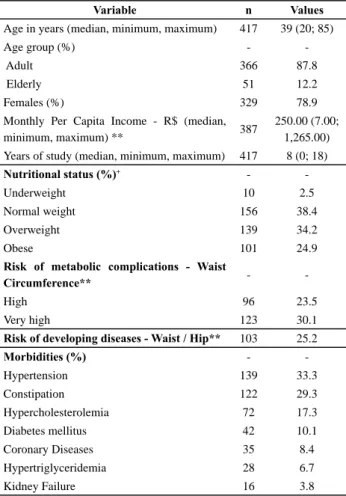
We interviewed 417 users, the majority of whom were adults (87.8%) and women (78.9%). We observed a high prevalence of overweight par cipants (59.1%). According to their WC measure, these par cipants were at signifi -cant risk of metabolic complica ons associated with obe-sity, and high WHR measurements also put them at risk of cardiovascular disease, hypertension, hypercholester-olemia and diabetes mellitus (Table 1).
When analyzing the par cipants’ dietary profi les, we can see that only 27.8% ate the recommended 5-6 daily ‘meals’, with 59.2% skipping the mid-morning ‘meal’ and 66.2% not ea ng mid-a ernoon. Furthermore, 46.6% had the habit of snacking between meals and 64.3% of par ci-pants liked to drink while they were ea ng.
Regarding the daily per capita consumption of salt, sugar and oil, we can see a median daily intake of 5.5 g (0.5 to 111.1 g), 55.5 g (0.0 to 333.3 g) and 24.0 mL (0.0 to 133.3 mL), respectively, with 80.4%, 62.7% and 94.6% of participants consuming quantities above those recommended(10).
On the whole, par cipants’ intake of healthy food was quite inadequate, especially the low consump on levels of fruits (40.5%), greens (52.9%), vegetables (61.6%), milk (42.2%) and deriva ves (23.5%), and they also presented a low weekly consump on of fi sh (10.3%). On the other hand, foods such as sweets/chocolate (13.4%), candy/ gum (13.9%), fried foods (13.0%), so drinks (22.3%), ar-fi cial juices (33.8%) and ar fi cial fl avorings (52.8%) had
high levels of daily intake.
We found that 40.8% (n = 170) of par cipants had re-ceived advice on healthy lifestyles at a PHC unit, of whom 81.2% women and 87.1% adults. Par cipants who had received counseling had a higher median age (45 vs. 36 years, p <0.001), however, the prevalence of advice was similar for adults and for the elderly ( 60 years).
Among the health professionals mentioned as re-sponsible for carrying out the counseling, the most frequent categories were doctors (87.6%), followed by nurses (10.0%), interns working with nutrition (7.6%), nutritionists at the Support for Family Health Center (1.8%), nursing assistants (0.6%) and dentists (0.6%). There was no reference to the Community Health Agents (CHA).
As can be seen in Table 2, par cipants who had re-ceived counseling showed a more adequate consump on of candy/gum (p = 0.031), regular soda (p = 0.036), ar -fi cial fl avorings (p = 0.005), eggs (p = 0.010) and savory
snacks (p = 0.037).
There were no signifi cant diff erences between the genders in either consump on pa erns or in whether or not par cipants had received counseling. However, wom-en who had received dietary advice showed a more ade-quate intake of sweets (p = 0.047), eggs (p = 0.027), savory snacks (p = 0.040), burgers (p = 0.044), lard (p = 0.029), ar fi cial fl avorings (p = 0.002) and salt (p = 0.034) than those who had not received advice (Table 3).
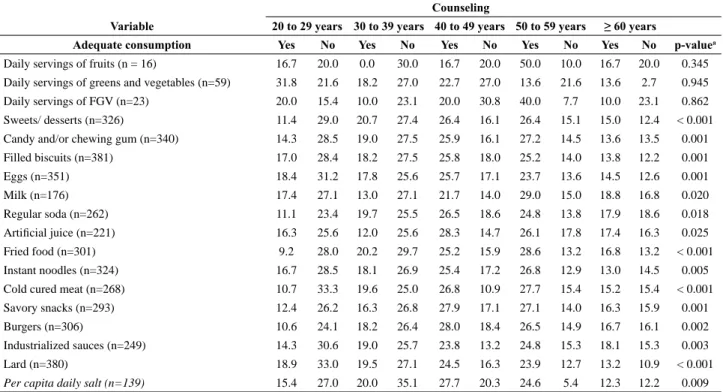
In general, diet became more adequate with age (p <0.05), with the excep on of fruit and vegetables in-take (Table 4).
Table 1 - Criteria for recommended consumption of various food types(11).
Variable n Values
Age in years (median, minimum, maximum) 417 39 (20; 85)
Age group (%) -
Adult 366 87.8
Elderly 51 12.2
Females (%) 329 78.9
Monthly Per Capita Income - R$ (median,
minimum, maximum) ** 387
250.00 (7.00; 1,265.00)
Years of study (median, minimum, maximum) 417 8 (0; 18)
Nutritional status (%)+ -
-Underweight 10 2.5
Normal weight 156 38.4
Overweight 139 34.2
Obese 101 24.9
Risk of metabolic complications - Waist
Circumference** -
-High 96 23.5
Very high 123 30.1
Risk of developing diseases - Waist / Hip** 103 25.2
Morbidities (%) -
-Hypertension 139 33.3
Constipation 122 29.3
Hypercholesterolemia 72 17.3
Diabetes mellitus 42 10.1
Coronary Diseases 35 8.4
Hypertriglyceridemia 28 6.7
Kidney Failure 16 3.8
Table 2 - Counseling on healthy lifestyles and participants’ adequacy of food consumption - Belo Horizonte, MG, Brazil - 2009/2010
Variable
Counseled (n=170) Not counseled (n=247)
p-value pa
Adeq Inadeq Adeq Inadeq
n % n % n % n %
Fruit 71 41.8 99 58.2 98 39.7 149 60.3 0.669
Greens 92 54.1 78 45.9 128 52.0 118 48.0 0.675
Vegetables 104 61.2 66 38.8 153 61.9 94 38.1 0.874
Sweets/ desserts 140 82.4 30 17.6 186 75.3 61 24.7 0.087
Candy /chewing gum 147 86.5 23 13.5 193 78.1 54 21.9 0.031
Filled biscuits 159 93.5 11 6.5 222 89.9 25 10.1 0.190
Milk 69 40.6 101 59.4 107 43.3 140 56.7 0.579
Regular soda 117 68.8 53 31.2 145 38.7 102 41.3 0.036
Artifi cial juice 92 54.1 78 45.9 129 52.2 118 47.8 0.704
Fried foods* 119 70.4 50 29.6 182 73.7 65 26.3 0.464
Savory snacks 129 75.9 41 24.1 164 66.4 83 33.6 0.037
Cold cured meat (salami, etc.) 112 65.9 58 34.1 156 63.2 91 36.8 0.568
Artifi cial fl avorings 52 36.6 118 69.4 46 18.6 201 81.4 0.005
Industrialized sauces 105 61.8 65 38.2 144 58.3 103 41.7 0.478
Burgers* 132 77.6 38 22.4 174 70.7 72 29.3 0.116
Eggs* 152 89.9 17 10.1 199 80.6 48 19.4 0.010
Meat* 128 75.3 42 24.7 190 77.2 56 22.8 0.646
Fish* 4 2.4 166 97.6 14 5.7 232 94.3 0.141b
Remove skin from chicken+ 16 51.6 151 39.7 15 48.4 229 60.3 0.195
Remove fat from meat*++ 15 41.7 148 40.1 21 58.3 221 59.9 0.856
Note: * Individuals with no information = 1 + Individuals who do not eat chicken = 6 + + Individuals who do not eat meat = 12
a Chi Squared test bExact Fisher test.
Table 3 - Adequate consumption of various food groups according to gender and whether respondent received counseling - Belo Horizonte, MG, Brazil - 2009/2010
Consumption
Women (n=329) Men (n=88)
Counseled Not counseled Counseled Not counseled
Adeq Inadeq Adeq Inadeq Adeq Inadeq Adeq Inadeq
% % % % p-value pa % % % % p-value pa
Fruits 47.8 52.2 44.0 56.0 0.489 15.6 84.4 25.0 75.0 0.304
Greens* 59.4 40.6 56.0 44.0 0.538 31.3 68.8 38.2 61.8 0.515
Vegetables 65.2 34.8 67.0 33.0 0.734 43.8 56.3 44.6 55.4 0.935
Sweets/desserts 82.6 17.4 73.3 26.7 0.047 81.3 18.8 82.1 17.9 0.917
Candy /chewing gum 84.8 15.2 77.5 22.5 0.099 93.8 6.3 80.4 19.6 0.122b
Filled biscuits 93.5 6.5 90.6 9.4 0.344 93.8 6.2 87.5 12.5 0.294b
Milk 41.3 24.6 45.5 54.5 0.444 37.5 62.5 35.7 64.3 0.867
Regular soda 72.5 27.5 63.9 36.1 0.101 53.1 46.9 41.1 54.5 0.275
Artifi cial juice 55.1 44.9 50.3 49.7 0.389 50.0 50.0 58.9 41.1 0.417
Eggs 92.0 8.0 83.8 16.2 0.027 80.6 19.4 69.6 30.4 0.265
Fried foods 73.9 26.1 75.9 24.1 0.679 54.8 45.2 66.1 33.9 0.301
Savory snacks 79.7 20.3 69.6 30.4 0.040 59.4 40.6 55.4 44.6 0.714
Cold cured meat 68.1 35.3 62.3 37.7 0.276 62.5 37.5 66.1 33.9 0.360
Lard 96.4 3.6 90.1 9.9 0.029 81.3 18.8 87.5 12.5 0.427
Sauces 63.0 37.0 59.2 40.8 0.477 56.3 43.8 55.4 44.6 0.935
Burgers 80.4 19.6 70.7 29.3 0.044 65.6 34.4 70.9 29.1 0.607
Artifi cial fl avorings 30.4 69.6 16.2 83.8 0.002 31.3 68.8 26.8 73.2 0.655
Per capita daily salt 46.1 53.9 34.1 65.9 0.034 25.0 75.0 31.1 68.9 0.594
Meat 77.5 22.5 75.9 24.1 0.732 65.6 34.4 81.8 18.2 0.089
Fish 2.2 97.8 6.8 93.2 0.053 3.1 96.9 1.8 98.2 0.598b
DISCUSSION
We observed a high prevalence of overweight par pants and high levels of morbidity. The majority of par ci-pants were shown to have unhealthy ea ng habits. Even though results showed that li le counseling was being provided by health professionals, were it did take place we saw a posi ve impact on the par cipants’ diet.
The percentages of both overweight and obese par ci-pants were higher than the na onal average(4). In par cu-lar, we observed a high prevalence of abdominal obesity, which is an important risk factor for non-communicable diseases and injuries(15).
This could be explained by some aspects of par ci-pants’ dietary profi le such as: skipping meals, the habit of
snacking and a high daily intake of sugar and oil. A poor distribu on of daily food intake, caused by the habit of skipping meals, has been linked to weight gain(16). Like-wise, ea ng at sporadic mes can raise the daily calorie intake, causing a predisposi on to weight gain(17). Finally, the high intake of sugar and oil observed amongst the par cipants, with a median consump on of the la er three mes higher than those recommended by the ‘Food Guide for the Brazilian popula on’ (11) is also related to be-ing overweight or obese.
Although the median per capita intake of salt was close to that recommended for a healthy population, the high prevalence of hypertension among the
partici-pants meant that their consumption was excessive. In addition, foods high in sodium such as cold cured meats and industrialized sauces and artificial flavoring were consumed in excess, as were foods rich in saturated fats (red meat with fat and chicken with skin). We also observed an inadequate consumption of fruits, greens, vegetables and fish. This study highlighted a pattern of poor diet and excessive intake of sugar(18), which may contribute to increased risk or aggravation of non-com-municable diseases and injuries, already very prevalent within the group(11,16).
Given this situa on, providing counseling on healthy lifestyles should be a priority for Primary Health Care Ser-vices, where current prac ce has been shown to be insuf-fi cient. Similar fi ndings were reported in Chicago, United
States(19) where it was found that 40% or less of pa ents had received advice about diet, according to the reports of the doctors interviewed. In Brazil, a study showed that 28.9% of adult par cipants and 38.9% of elderly par ci-pants received counseling on physical ac vity(8).
It has been suggested that health professionals, mainly physicians and nurses, choose not to give advice on healthy lifestyles as a consequence of the diffi culty on how best to approach issues of diet and physical ac vity. These diffi
es are possibly due to limited knowledge on the subject acquired at the undergraduate, residency, or specializa on stages; short consulta on mes and possible diffi cul es in implemen ng changes in ea ng behavior itself(9).
Table 4 - Adequate consumption of various food groups according to age and whether respondent received counseling - Belo Horizonte. MG, Brazil – Brazil - 2009/2010
Counseling
Variable 20 to 29 years 30 to 39 years 40 to 49 years 50 to 59 years ≥ 60 years
Adequate consumption Yes No Yes No Yes No Yes No Yes No p-valuea
Daily servings of fruits (n = 16) 16.7 20.0 0.0 30.0 16.7 20.0 50.0 10.0 16.7 20.0 0.345
Daily servings of greens and vegetables (n=59) 31.8 21.6 18.2 27.0 22.7 27.0 13.6 21.6 13.6 2.7 0.945
Daily servings of FGV (n=23) 20.0 15.4 10.0 23.1 20.0 30.8 40.0 7.7 10.0 23.1 0.862
Sweets/ desserts (n=326) 11.4 29.0 20.7 27.4 26.4 16.1 26.4 15.1 15.0 12.4 < 0.001
Candy and/or chewing gum (n=340) 14.3 28.5 19.0 27.5 25.9 16.1 27.2 14.5 13.6 13.5 0.001
Filled biscuits (n=381) 17.0 28.4 18.2 27.5 25.8 18.0 25.2 14.0 13.8 12.2 0.001
Eggs (n=351) 18.4 31.2 17.8 25.6 25.7 17.1 23.7 13.6 14.5 12.6 0.001
Milk (n=176) 17.4 27.1 13.0 27.1 21.7 14.0 29.0 15.0 18.8 16.8 0.020
Regular soda (n=262) 11.1 23.4 19.7 25.5 26.5 18.6 24.8 13.8 17.9 18.6 0.018
Artifi cial juice (n=221) 16.3 25.6 12.0 25.6 28.3 14.7 26.1 17.8 17.4 16.3 0.025
Fried food (n=301) 9.2 28.0 20.2 29.7 25.2 15.9 28.6 13.2 16.8 13.2 < 0.001
Instant noodles (n=324) 16.7 28.5 18.1 26.9 25.4 17.2 26.8 12.9 13.0 14.5 0.005
Cold cured meat (n=268) 10.7 33.3 19.6 25.0 26.8 10.9 27.7 15.4 15.2 15.4 < 0.001
Savory snacks (n=293) 12.4 26.2 16.3 26.8 27.9 17.1 27.1 14.0 16.3 15.9 0.001
Burgers (n=306) 10.6 24.1 18.2 26.4 28.0 18.4 26.5 14.9 16.7 16.1 0.002
Industrialized sauces (n=249) 14.3 30.6 19.0 25.7 23.8 13.2 24.8 15.3 18.1 15.3 0.003
Lard (n=380) 18.9 33.0 19.5 27.1 24.5 16.3 23.9 12.7 13.2 10.9 < 0.001
Per capita daily salt (n=139) 15.4 27.0 20.0 35.1 27.7 20.3 24.6 5.4 12.3 12.2 0.009
It should be noted that guidance on ea ng habits is the responsibility of all health workers(11). However, in this study, the Community Health Agents had not been responsible for any of the counseling the par cipants re-ceived, even though off ering guidance on self-care and health protec on measures cons tutes the central role of their professional prac ce(20).
Results from our study suggest the urgent need for the training of health professionals in order to ensure that providing counseling on healthy lifestyles is part of their daily prac ce(11). This is of great importance, as this type of counseling can promote weight reduc on and increased daily consump on of fruits and vegetables, with a con-sequent reduc on of the risk of developing or worsening non-communicable diseases or injuries(7).
Despite the infrequent counseling provided by health professionals, we observed its benefi cial eff ect on the eat-ing habits of users. Individuals who had received advice had more adequate intake of sweets/chewing gum, ar fi cial fl a-vorings, regular sodas, savory snacks and eggs when com-pared to those who had not received advice. This on in consump on of high calorie and high sodium foods can contribute to disease preven on and weight control, refl ec ng posi vely on health. This serves to reinforce the importance of counseling for professional prac ce.
As for dietary diff erences between the genders a er receiving counseling, it can be said that women respond-ed more posi vely to counseling. They were shown to pay greater a en on to their health(21), as refl ected in their healthier ea ng pa erns. Furthermore, counseling on diet and physical ac vity was more frequent among
ents with a higher than median age, probably due the occurrence of non-communicable diseases and injuries
increasing with age(22). In this regard, the fact that the cipants in the 40 year-old age bracket showed the most adequate intake of food is signifi cant.
In addi on to a be er control of non-communicable diseases and injuries among the elderly, we would like to highlight the need to carry out preven ve ac ons in the younger age groups and among men. Such ac ons become par cularly relevant when we consider that these diseases have long latency periods and therefore originate in earlier phases of life(2). It is therefore essen al to strengthen and equalize the prac ce of counseling at all ages.
Cross-sec onal studies have certain limita ons, which prevent us from establishing temporal rela onships of cause and eff ect between the studied variables. In
on, some data were lost due to invalid ques onnaires. As the sampling process was performed in only one Primary Health Care unit, the results cannot be extrapolated to the general popula on. Despite these issues, we believe our fi ndings are important in that they indicate the need to rethink the way in which health professionals within the Primary Health Care System promote healthy living.
CONCLUSION
Counseling was seldom observed despite the impor-tant role it would play given the ea ng and health profi les iden fi ed, which suggests health professionals should be more proac ve in providing such guidance with a view to prevent and control diseases and promote health. Coun-seling healthy life habits is essen al, especially among men and young individuals, considering its healthy infl u-ence on the popula on’s ea ng habits, and consequently on its health and quality of life.
REFERENCES
1. World Health Organiza on (WHO). Preven ng chronic diseases: a vital investments [Internet]. Geneva; 2005 [cited 2010 Dec 17]. Available from: h p://www.who.int/chp/ chronic_disease_report/contents/foreword.pdf
2. Brasil. Ministério da Saúde; Secretaria de Vigilância em Saúde; Secretaria de Atenção à Saúde. Diretrizes e Recomendações para o Cuidado Integral de Doenças Crônicas não Transmissíveis: promoção da saúde, vigilância, prevenção e assistência [Internet]. Brasília; 2008 [citado 2010 dez. 17]. Disponível em: h p://portal.saude.gov.br/ portal/arquivos/pdf/volume8livro.pdf.
3. Brasil. Ministério da Saúde; Secretaria de Atenção à Saúde, Departamento de Atenção Básica, Coordenação-Geral da Polí ca de Alimentação e Nutrição. Indicadores de Vigilância Alimentar e Nutricional: Brasil 2006. Brasília; 2009.
4. Brasil. Ministério da Saúde; Secretaria de Vigilância em Saúde; Secretaria de Gestão Estratégica e Par cipa va. VIGITEL Brasil 2008: Vigilância de Fatores de Risco e Proteção para Doenças Crônicas por Inquérito Telefônico. Brasília; 2009.
5. Brasil. Ministério da Saúde; Secretaria de Vigilância em Saúde; Secretaria de Atenção à Saúde, Departamento de Atenção Básica. Polí ca Nacional de Promoção da Saúde. Brasília; 2006.
6. Rodrigues EM, Soares FPTP, Boog MCF. Resgate do conceito de aconselhamento no contexto do atendimento nutricional. Rev Nutr. 2005;18(1):119-28.
8. Siqueira FV, Nahas MV, Facchini LA, Silveira DS, Piccini RX, Tomasi E, et al. Aconselhamento para a prá ca de a vidade sica como estratégia de educação à saúde. Cad Saúde Pública. 2009;25(1):203-313.
9. Wynn K, Trudeau JD, Taunton K, Gowans M. Nutri on in primary care: current prac ces, a tudes, and barriers. Can Fam Physician. 2010;56(3):109-6.
10. Lopes ACS, Santos LC, Ferreira AD. Atendimento nutricional na Atenção Primária à Saúde: proposição de protocolos. Nutr Pauta. 2010;18(101):40-4.
11. Brasil. Ministério da Saúde; Secretaria de Atenção à Saúde, Departamento de Atenção Básica, Coordenação-Geral da Polí ca de Alimentação e Nutrição. Guia alimentar para a população brasileira: promovendo a alimentação saudável. Brasília; 2006.
12. World Health Organiza on (WHO). Obesity: preven ng and managing the global epidemic. Report of a WHO consulta on. Geneva; 2000. (Technical Report Series, 894).
13. Lipschtz DA.Screening for nutri onal status in the elderly. Nutr Old Age.1994;21(1):55-67.
14. Santos RD, Giannini SD, Fonseca FH, Moriguchi EH, Maranhão RC, Luz PL, et al. III Diretrizes Brasileiras sobre Dislipidemias e Diretriz de Prevenção da Aterosclerose do Departamento de Aterosclerose da Sociedade Brasileira de Cardiologia. Arq Bras Cardiol. 2001;77(3):1-48.
15. Ferreira MG, Valente JG, Silva RMVG, Sichieri R. Acurácia da circunferência da cintura e da relação cintura/quadril como preditores de dislipidemias em estudo transversal de doadores de sangue de Cuiabá, Mato Grosso, Brasil. Cad Saúde Pública. 2006;22(2):307-14.
16. World Health Organiza on (WHO). Diet nutri on and the preven on of chronic diseases: report of a joint WHO/ FAO expert consulta on. Geneva; 2003. (Technical Report Series, 916).
17. Francis LA, Lee Y, Birch LL. Parental weight status and girls’ television viewing, snacking, and body mass indexes. Obes Res. 2003;11(1):143-51.
18. Levy-Costa RB, Sichieri R, Pontes NS, Monteiro CA. Disponibilidade domiciliar de alimentos no Brasil: distribuição e evolução (1974-2003). Rev Saúde Pública.
2005;39(4):530-40.
19. Kusnher RF. Barriers to providing nutri on counseling by physicians: a survey of primary care prac oners. Prev Med.
1995;24(6):546-52.
20. Santos LPGS, Fracolli LA. Community Health Aides: possibili es and limits to healthpromo on. Rev Esc Enferm
USP [Internet]. 2010 [cited 2010 Dec 17];44(1):76-83. Available from: h p://www.scielo.br/pdf/reeusp/v44n1/ en_a11v44n1.pdf
21. Co a RMM, Ba sta KCS, Reis RS, Souza GA, Dias G, Castro FAF, et al. Perfi l sociossanitário e es lo de vida de hipertensos e/ou diabé cos, usuários do Programa de Saúde da Família no município de Teixeiras, MG. Ciênc Saúde Cole va. 2009;14(4):1251-60.
22. Pinheiro ARO, Freitas SFT, Corso ACT. Uma abordagem epidemiológica da obesidade. Rev Nutr. 2004;17(4):523-33.