Nursing history research groups:
a Brazilian reality
O
r
i
g
i
n
a
l
a
r
ti
c
le
1 RN. Ph.D. in Nursing, Escola de Enfermagem Anna Nery, Universidade Federal do Rio de Janeiro. Post-Doctoral degree, Lawrence Bloomberg Faculty of Nursing at University of Toronto, Canada. Faculty, Nursing Department, Universidade Federal de Santa Catarina. Coordinator of the Study Group on the History of Knowledge in Nursing and Health. CNPq Researcher. Florianópolis, SC, Brazil. [email protected] 2 RN. Ph.D. in Nursing, Graduate Nursing Program, Universidade Federal de Santa Catarina. Associate Professor, Nursing Department, Universidade Federal de Santa Catarina. Deputy Leader of the Study Group on the History of Knowledge in Nursing and Health. CNPq Researcher. Florianópolis, SC, Brazil. [email protected] 3 RN, Universidade Federal de Santa Catarina. Florianópolis Municipal Government Nurse. Member of the Study Group on the History of Knowledge in Nursing and Health. Florianópolis, SC, Brazil. [email protected] 4 Undergraduate Nursing Student, Universidade Federal de Santa Catarina. CNPq Scientiic Initiation Grantee. Member
RESUmo
Este estudo tem por objeivo analisar as aividades dos grupos de pesquisa em história da enfermagem existentes no Brasil e sua ariculação com os cursos de graduação e pós-graduação em enferma-gem. É um estudo exploratório qualitaivo descriivo documental, realizado no pe-ríodo de julho de 2008 a março de 2010. Foram ideniicados 34 grupos de pesqui-sa com pelo menos uma de suas linhas de pesquisa em história da enfermagem. Os resultados indicaram que os grupos têm produzido um vasto material bibliográico, linhas de pesquisa e ampla paricipação de estudantes de graduação e pós-graduação. Veriica-se também que ainda não há uma rede de comunicação entre os grupos da mesma linha de pesquisa. Conclui-se que é necessário trabalhar na interdisciplinarida-de e no fortalecimento interdisciplinarida-de algumas linhas de pesquisa que sustentem o conhecimen-to em história da enfermagem brasileira.
dEScRitoRES
Grupos de Pesquisa História da enfermagem Educação em enfermagem
ABStRAct
The objecive of this study is to examine the aciviies of Nursing History research groups in Brazil and their relaionships with the nursing undergraduate and graduate courses. This exploratory, descripive, qual-itaive documental study was performed from July 2008 to March 2010. We ideni-ied 34 research groups that had Nursing History as the focus of at least one of the lines of research. Results showed that the groups have produced a great amount of bibliographical material, research lines and broad paricipaion of undergraduate and graduate students. It was also found that there is a communicaion network among groups working within the same line of research. In conclusion, there is a need to increase interdisciplinarity and also strengthen some lines of research in order to support knowledge of the history of Bra-zilian nursing.
dEScRiPtoRS
Research Groups Nursing history Educaion, nursing
RESUmEN
Este estudio objeiva analizar las acividades de los grupos de invesigación en Historia de la Enfermería existentes en Brasil y su ariculación con los cursos de graduación y posgraduación en Enfermería. Es un es-tudio exploratorio, cualitaivo, descripivo, documental, realizado en el período de julio 2008 a marzo 2010. Fueron ideniicados 34 grupos de invesigación con al menos una de sus líneas invesigaivas focalizada en Histo-ria de la Enfermería. Los resultados indicaron que los grupos han venido produciendo una vasta canidad de material bibliográico, lí-neas invesigaivas y amplia paricipación de estudiantes de graduación y posgraduación. Se veriica también que aún no hay una red de comunicación de la misma línea de inves-igación. Se concluye en que es necesario una mejora en la interdisciplinaridad, así como el fortalecimiento de algunas líneas de invesi-gación que sustentan el conocimiento histó-rico de la enfermería brasileña.
dEScRiPtoRES
Grupos de Invesigación História de la enfermería Educación em enfermería
maria itayra Padilha1, miriam Susskind Borenstein2, maria Aline Lima carvalho3, Aline coelho Ferreira4
NUrSING hIStory reSearCh GroUPS: a BrazIlIaN realIty
iNtRodUctioN
History serves to clarify the context experienced and to provide the meanings of this context. Knowledge about the socioeconomic, cultural and poliical currents that inluenced the long course of history about care pracice allow nurses to break free from past heritag-es. In fact, to the extent that one knows the history of a profession, like in our case that of nursing, it is per-ceived how much and how nursing can be disinguished from other aciviies in life, from the health world and its social commitments. With this look, history adheres to the possibility of outlining and idenifying who nurses are, what they think, what they feel, how they act and, also, what lies ahead for them as a contextualized pro-fessional group(1). In its history, nursing necessarily ap-propriates itself of and approaches interdisciplinary ter-ritories, not only of historians, but also anthropologists, sociologists, psychologists, philosophers, to menion but a few, because there is no way to understand the pro-cesses through which the history of the profession was constructed without them. This was
in-deed inluenced by the New History, which broadened the historian’s look to other subject areas, establishing good-neighbor
relaions between them. Each discipline
comes with its pariculariies and recovers the past through interdisciplinary bridges, as a kaleidoscope with countless facets(2-4).
The development of graduate programs in Brazil as from the 1980’s was undeniable accompanied by the expansion of scieniic producion in nursing, including theses, dis-sertaions and books as well as papers pub-lished in indexed journals, among others. Stricto sensu graduate programs represent
a consolidated segment in the Brazilian and internaional educaional context and have decisively contributed to qualiied human resource training and to naional scienif-ic-technological development, clearly revealing their stra-tegic role in the country(1,5).
The analysis of knowledge producion in Nursing His-tory in Brazil, resuling from dissertaions and theses, re-vealed only 126 studies between 1972 and 2004 about themes like professional idenity, insituionalizaion of Nursing in Brazil, organizaional eniies, nursing special-ies and studspecial-ies about the creaion of Brazilian nursing schools(1). In these studies, as from the 1980’s, nursing experts’ concerns with nursing studies in a historiograic perspecive were enhanced, especially to understand nursing as part of a historical, social, cultural, poliical, educaional and gender perspecive(6). As there are sill few documentaion centers in Brazil, Nursing has moved on without adequately preserving its history, both due to its recogniion and the limitaion and non-organizaion of iles used for research, besides the non-importance of
recovering and preserving writen, oral and iconographic sources of exising and future iles(7).
The Brazilian Nursing Associaion’s (ABEn) Nursing Study and Research Center – CEPEn plays a relevant role in changing this paradigm, as well as the papers published in Brazilian journals like Revista da Escola Anna Nery,
Re-vista Brasileira de Enfermagem and Revista Texto & Con
-texto Enfermagem, whose policy is to publish nursing his-tory papers. Internaionally, the journal Nursing Hishis-tory Review can be menioned, issued by the American Asso-ciaion for the History of Nursing and especially created to disseminate research about Nursing History; and the Nursing Inquiry, whose inal issue of the year exclusively publishes Nursing History texts(8).
In this sense, in the atempt to deepen discussions about the theme and contribute for Brazilian nursing to preserve its memory and idenity, to support faculty, students, research-ers and anyone interested in Nursing History, we believe it is extremely important to study exising Nursing History re-search groups and centers and their ariculaion with
under-graduate and under-graduate Nursing programs.
mEtHod
An exploratory, descripive and qualitaive documentary research(9) was developed be-tween July 2008 and March 2010. To construct the panorama of research groups on Nursing History, two databases were used: (1) The Bra-zilian Council for Scieniic and Technological Development – CNPq’s Directory of Research Groups in Brazil, version 5.0(10), updated in March 2010; (2) researchers’ individual curric-ulum as available on the Lates Plaform. De-paring from the directory database, there are various ways of outlining the installed research capacity in Nursing History. To give an example, a database search that used the keyword nursing history in the ields group name, i
-tle of the line and key words of the line resulted in 40 groups. When adding the main area of the group as health sciences, this dropped to 37 groups, and further to 34 when select-ing the nursing area. As the presentaion of these research results aims to give visibility tothe research groups whose research lines include Nursing History, in the irst phase,we chose to analyze the following items: speciicity of the group area; year of creaion; iniials; ideniicaion of leaders and baseline educaion; CNPq researchers; other researchers; students at all levels and technicians. In addiion, we ideni-ied the insituions they belong to, the region of the country where the group is located; the number and characterisics of each group’s research lines. To facilitate data organizaion, we elaborated worksheets in Microsot Excel® 2007 sot-ware, containing all data for analysis.
The second research phase, related to the research group paricipants, involved individual consultaions of As there are still few
documentation centers in Brazil, Nursing has
moved on without adequately preserving
each paricipant’s curriculum on the CNPq Lates Plat-form. With regard to educaion and degrees, data were collected and organized in tables, charts and graphs, also organized in Microsot Excel® 2007 sotware. We also con-sulted the site of the Coordinaion for the Improvement of Higher Educaion Personnel (CAPES), to search for and idenify graduate Nursing programs in Brazil. This study did not need Insituional Review Board approval from Universidade Federal de Santa Catarina, as this is a docu-mentary research that only used sources in the public do-main. The researchers, however, strictly followed ethical criteria in the search, analysis and discussion of results.
RESULtS ANd diScUSSioN
The Directory of Research Groups in Brazil is a project the CNPq has developed since 1992 and consists of da-tabases with informaion about acive research groups in the country. The directory maintains a current database,
whose informaion group leaders, students and research managers at paricipaing insituions update coninu-ously. CNPq also accomplishes biannual census, which are photographs of this current database. Thus, to situate this research in the general context of health research in Bra-zil, we detected, since the irst census in 1993 and unil 2008, the number of registered Health Science Research Groups grew exponenially, from 4,402 to 22,797(9). The number of research lines in human health also increased from 13,841 lines in 2002 to 21,862 in 2008. Speciically considering the group distribuion per predominant area, we selected the Nursing area and found a rise from 59 to 373 groups in 2008, with 1059 research lines.
The data revealed that the irst research group to de-velop studies from a historical perspecive was created in 1988 and called the Research Group on Health Poli-cies and Pracices (GRUPPS), at Universidade Federal do Ceará (UFC). The second group was created in 1989. In the 1990’s, nine groups were created, and 23 others as from the year 2000. Only ten out of these 34 groups include the word history in their itle. We consider Nursing History in teaching and research as a sedimentaion and expan-sion process. Its visible limitaions in Brazilian scieniic producion in Nursing should be acknowledged, which is going through an accelerated development process of so-ciohistorical research, creaing possibiliies to reconstruct the knowledge that consitutes speciic historical and cul-tural contexts(8,11).
A comparaive analysis with other Brazilian research groups reveals that, in a study on the scieniic develop-ment of epidemiology in Brazil, the authors found that, in the 1990’s, collecive health research groups increased by 4.09% in comparison with the irst decade of the 20th century(12). This increase in the number of research groups was also veriied in another study, which analyzed the growth in educaion and nursing research groups in the South of Brazil, idenifying that, out of 18 exising groups
in 2006, ive got structured in the 1990’s(13). The main re-search for the enhanced knowledge producion in all ar-eas is deinitely due to the incrar-ease in graduate programs in Brazil and, consequently, to the establishment of re-search groups(14).
The visibility of the knowledge produced in graduate programs and research groups is evidenced when parici-paing researchers, faculty and students’ research results are published. The graduate system needs to expand to respond to new needs. This means greater investment in inancial resources at graduate levels, paricularly to prepare teaching staf the universiies will absorb, where health research needs support(7). Stricto sensu graduate programs in Nursing in Brazil started in 1972, at the Fed-eral University of Rio de Janeiro Anny Nery School of Nurs-ing, which founded the Master’s Program in Fundamental Nursing. In 1973, the University of São Paulo School of Nursing (EEUSP) started the Master’s Program in Nurs-ing Fundamentals(7-8). There were 14 graduate Nursing programs in 1998, which increased to 39 in 2010, which corresponds to a 278.57% growth, which is extremely rel-evant for the development of the nursing profession in terms of professional qualiicaion(15). Besides, when com-paring the number of Nursing History group with the 433 Nursing groups registered in the CNPq Current Database, these represent only 7.8% of the total number(9). However, taking into account that this is an expanding area and that a large number of groups guarantees neither consolida-ion nor research quality, we consider that the producconsolida-ion of nursing history research groups in terms of projects and publicaions is what can guarantee their maintenance and strengthening(16). According to CAPES data, in Brazil, today, 39 stricto sensu graduate Nursing programs exist. Thirty-ive of these ofer a Master’s program, three professional Master’s programs and 20 Ph.D. programs. The programs are distributed as follows: 19 in the Southeast, three in the Central-West, nine in the Northeast and eight in the
South(15). It can be inferred that graduate programs and
re-search groups are closely related, as greater consolidaion and simuli for research groups’ work exist where gradu-ate programs are locgradu-ated, and these groups, as a coun-terpart, strengthen graduate programs, as they represent spaces that comprise researchers’ scieniic core. In this sense, 60.70% of groups are concentrated in the South-east, which is related with the number of graduate Nurs-ing programs in this region. It is also interesNurs-ing to observe that approximately 17.64% belongs to the Northeast, 11.76% to the South and only 5.88% to the North, which clearly demonstrates a disequilibrium in group distribu-ion and, consequently, in Brazilian scieniic producdistribu-ion.
groups(12). The same informaion is present in a study on human aging research in Brazil, when the authors iden-iied that the geographical distribuion shows a larger number of research groups - about 59.7% of groups in the human aging area – in the Southeast. Next comes the South with 21.5%, the Northeast with 13.9%, the Central-West with 4.9 % and the North with 0%(17).
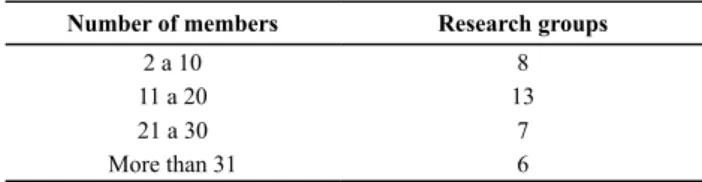
Another important data when assessing the expansion of scieniic producion about the History of Nursing and Health is the number of Research Group paricipants (Table 1).
a study developed to assess Brazilian Nursing research group characterisics between 2005 and 2007, in which the authors ideniied that most groups comprised be-tween one and 17 members(18).
One important aspect to be taken into account is the research groups’ infrastructure, with a view to guarantee-ing a space for integraion, collecive producion and ac-ivity organizaion, in this sense, the more paricipants a group contains, the greater will be the need for adequate infrastructure to guarantee afecive and knowledge shar-ing, besides enhancing the visibility of the groups’ integra-ive aciviies(13).
According to CNPq Research Directory informaion,
the Research Line (RL) represents binding themes of
scien-iic studies that are based on a research tradiion, which give rise to projects whose results display mutual aini-ies(9). All of the researchers, students and technicians’ intellectual producion in research groups joins around the research lines, which the group has established based on ongoing projects. According to CNPq, research project (RP) is a research with a deined start and end, based on speciic aims, aiming to achieve cause-and-efect results or to evidence new facts(9). Researchers with a Ph.D. de-gree are responsible for creaing and maintaining the re-search lines. In the assessment of the rere-search groups’ RL, the below list shows the distribuion of the number of RL among the 34 ideniied groups that develop research on the History of Nursing and Health, according to their itle, research lines or projects.
Number of members Research groups
2 a 10 8 11 a 20 13 21 a 30 7 More than 31 6
Table 1 – Number of research group members – 2006 Census – Directory of Research Groups in Brazil/CNPq – 1988-2010
The large majority of the groups (13) contain between 11 and 20 paricipants, comprising researchers, students and technicians. Although there is no deiniion for the ideal number of research group members, we consider that extremes are undesirable. In other words, a group with few paricipants can, but does not necessarily imply hardly signiicant producion. A very large group, on the other hand, like more than 25 members for example, can imply diiculies to organize the group, the studies devel-oped and to plan group aciviies. This data is in line with
Chart 1 – Distribution of Research Groups and Lines on the History of Nursing and Health – 2006 Census – Directory of Research Groups in Brazil/CNPq – 1988-2010
GROUP NAME RESEARCH LINES
Professional Practice and the Identity Establishment of Brazilian Nurses/ UFRJ
1. he construction of Nursing History knowledge 2. Preprofessional nursing
3. Sources for Nursing History 4. he primordials of nursing in Brazil 5. Trajectory of public health nursing practice
he trajectory of nursing care in specialized areas/UFRJ 1. he historical trajectory of nursing care in specialized areas Systematic Analysis of Care Delivery to HIV/Aids patients/UFRJ 1. Nursing Care Models, Paradigms, Knowledge and History
Development of Nursing and Nursing organizations/UFRJ 1. Nursing and social movements
2. Nursing organizations in social and political dynamics
Development of Nursing and Citizenship/UFRJ 1. Nursing and social movements 2. Nursing schools in Brazilian society
Symbolic power in nursing institutions/UFRJ 1. he reconiguration of nursing in hospital institutions 2. Gender and Care History
Child health – hospital context/UFRJ
1. Clinical and surgical pediatric nursing 2. History of Brazilian pediatric nursing 3. Nursing paradigm, knowledge and history
Health education and historical-social development/UERJ 1. Professional Health Education and Historical-Social Development of Nursing
Research Group on Nursing History/UFF
1. Care culture 2. Nursing history 3. History of institutions 4. Professional identity 5. Memory of nursing
Research Group on Nursing Fundamentals/UFF 1. heoretical-philosophical foundations of nursing care
Research Group on Nursing History in Brazilian Society/UNIGRANRIO 1. Historical evolution of the nursing profession 2. History of nursing in transmissible diseases
In Chart 1, we decided to analyze only those 31 groups with one or more RL on the History of Nursing and Health. In the three groups excluded from the igure, Nursing His-tory is not the central focus of their studies. We veriied that only eight groups present speciic lines on the His-tory of Nursing and Health. This means that the remaining 25 groups do not explicitly include the word history in the descripion of their research groups or lines. Seven groups present two research lines and the remainder (23) three to ive research lines, which represents signiicant knowl-edge producion in the area in a diversiied way.
A great victory Brazilian Nursing History research-ers achieved was the fact that the Research Line was ac-knowledged at the Naional Forum of Nursing Graduate Program coordinators, which CAPES organized in the year 2000 during the 52nd Brazilian Nursing Congress in Belém, PA. This legiimizes the line as an important research area and also permits increased funding for Nursing History re-search and rere-searchers. The acceptance of this line sill is not unanymous in Brazil though, as illustrated by the lim-ited number of funding for historical research in compari-son with other areas. That is the case because research
GROUP NAME RESEARCH LINES
Laboratory on Scientiic Approach in Nursing History LACENF/UNIRIO
1. Health policies in the historical-social context and their implications for public health nursing in Brazil
2. Imagetic Construction of Nursing 3. History of nursing care technology Research Laboratory on Nursing History/LAPHE/UNIRIO 1. he Development of Nursing in Brazil
Gender, Health and Nursing/USP 1. he knowing-how-to-be and professional practice of nursing 2. Nursing work
Bioethics and Administration: Health Teaching and Care/USP 1. Ethics, History and Legislation
Nursing History and Legislation/USP 1. Management of health and nursing actions and services Study and Research Group on Health Service Aministration and Nursing
Management/GEPAG/UNIFESP
1.History of Management and Administration in Health and Nursing
Nursing Knowledge and Practices/UNITAU 1. Social representations about being a nurse 2. he trajectory of nursing and its historical evolution
Study and Research Group on Nursing and Health GEPES/PUC/MG 1. Nursing, health and society: living, human illness and care. 2. Nursing, health: knowledge and practices
Study Group on the History of Knowledge in Nursing and Health GEHCES/ UFSC
1. he History of Nursing Education in Brazil 2. he History of nursing in Brazil – a prospective study 3. he History of Health and Nursing specialties 4. Professional identity in Health and Nursing 5. History in Nursing and Health
Study Group on Collective Health/UFRGS
1. Science and Collective Health
2. Construction of knowledge, images and meanings in health care production 3. Policies and practices in health and nursing
Study, Research, Care and Support Center for the Family/ NEPAAF/UEM 1. Family life and the interface with health and illness Research and Teaching Center on Human Resource Training in Health/
NEFORHUS/UEM
1. History of Nursing
Growing/UFBA 1. History of Child Health
heoretical, practical, historical and cultural studies in health/UFS 1. History and health
Study Group D. Isabel Macintyre/UFAL 1. History of Brazilian/Alagoan Nursing Study and Research Group on Epistemology and Fundamentals of Health
and Nursing Care/UPE
1. Professional Identity and Nursing History
Interdisciplinary Research Group on Collective Health Nursing and Epidemiology/UFAM
1. Human development: health and education
History of Health and Nursing in Amazonia/UFAM 1. Historicity of Health and Nursing in Amazonia
Health Research, Policies and Practices Group/GRUPPS/UFC 1. Nursing and Health Policies and Practices
...Continuation.
funding eniies privilege studies with more pragmaic problems, which threatens Nursing History as a domain area, as it is at the heart of the scieniic community that these spaces are consituted(19). Thus, one of the posiive strategies to be used is the strengthening of this research line in graduate Nursing programs.
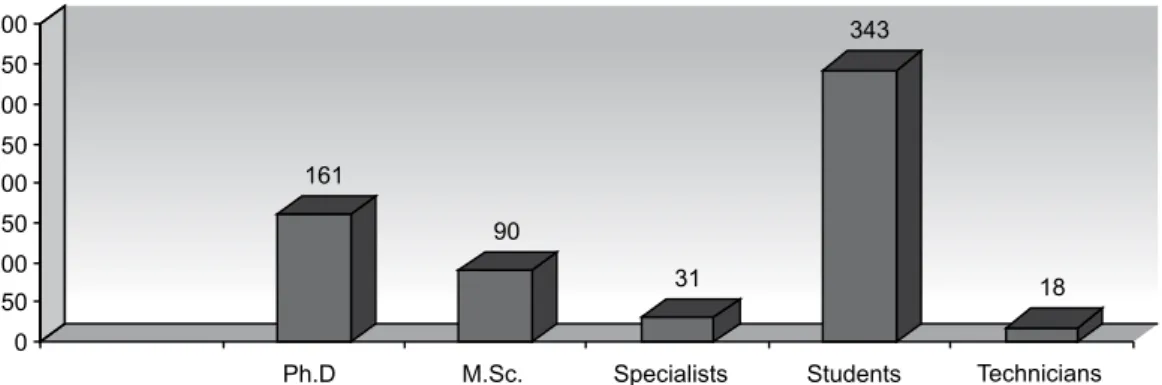
To idenify the research group members’ qualiicaion, we analyzed both the CNPq Research Directory and the Lates Plaform, which raised several challenges, includ-ing registraion diferences between data in the Directory of the CNPq Current Database and group members’ Lates Curriculum, i.e. in the Group Directory, one person was ideniied as a Ph.D. student, while the same person was
registered as a Ph.D. graduate on the Lates plaform. An-other problem was the group members’ distribuion in the categories of researcher and technician. Some groups iden-iied Ph.D.’s, M.Sc.’s and Specialists as researchers; others only the Ph.D.’s and so forth. In this sense, with a view to homogenizing our assessment, we considered the qualii-caion informed in the CNPq Research Directory, as follows:
161
90
31
343
18
0 50 100 150 200 250 300 350 400
Ph.D M.Sc. Specialists Students Technicians
Figure 1 – Distribution of Research Group participants per qualiication – 2006 Census – CNPq Directory of Research Groups in
Brazil – 1988-2010
In total, 643 research group members were ideniied, 161 of whom were Ph.D.’s, 90 M.Sc.’s, 31 held a Specialist degree and 18 were technicians. Besides, 343 were stu-dents: 151 undergraduates, 105 Master’s, 51 Ph.D. and 36 Specializaion students. Out of 161 Ph.D. graduates in the groups, only 26 are CNPq producivity grantees, 12 PQ 1 and 14 PQ 2, represening 16.14% of all Ph.D. graduates. The CNPq Research Directory considers researchers as
re-search team members with an undergraduate or graduate degree, directly and creaively involved in the accomplish
-ment of the group’s projects and scieniic, technological and arisic producion(9). In this sense, the following were considered as researchers: Ph.D.’s (135), Ph.D.-graduated CNPq researchers (26), M.Sc.’s (90), specialists (31) and graduates (6), totaling 288 members. As observed, 87.45% of the researchers are included in the Ph.D. or M.Sc. cat-egory, which guarantees an important qualiicaiton level, especially in group research. This informaion is compared with the study about Nursing Educaion research groups in the South of Brazil, where 86% of researchers with M.Sc. and Ph.D. degrees were ideniied (35% Ph.D. and 49.7% M.Sc.)(13). One important piece of informaion ideniied in this study is the number of Ph.D., M.Sc., specializaion and undergraduate students with support scholarships in research development. The proporion of Ph.D.-graduated researchers in all knowledge areas present in the CNPq Directory is 56.7%. When related with Nursing History re-search groups, this proporion is high, as the number of Ph.D.-graduated researchers in this sub-area is 27.65%. This can be considered a very posiive aspect for Nursing History knowledge producion.
Out of 343 students, 83 (24.19%) receive scholarships, 33 at the scieniic iniiaion, 10 at Ph.D. and 32 at M.Sc. level. This relaively small number of grantees in compari-son with the total number indicates that most students
paricipate in research groups as volunteers, but demon-strates the importance of research groups in student edu-caion at all levels. The predominant funding agencies that ofer student scholarships are Brazilian, state and some in-ternaional funding agencies. Since the mid-20th century, these have strongly inluenced the insituionalizaion and direcions of Brazilian scieniic producion and the estab-lishment of relaions among researchers(14).
Research groups can expand the producion possibiliies of researchers ailiated with Graduate Programs, because they have devices at their disposal that facilitate this process, including producivity and scieniic iniiaion grants to pre-pare students for research(20). It is fundamental for inclusion in the research area to start at the undergraduate level, as this educaion strategy not only permits learning the steps of the research process, but enhances the educaion of a new generaion of nurses, who not only accomplish their irst re
-search experiments, but also adopt a posture of incorporat
-ing the scieniic methods to elaborate concepts, ideas and formulate inquiries(13). One of the goals of students’ parici-paion at diferent training levels is to support the research group leaders and researchers; hence, they are considered the criical mass that is being prepared. This concidence of viewpoints among researchers and students with a view to research development is a simulus the group ofers for stu-dents to develop and grow in this area(8,18).
historical research, the students develop insights and a beter understanding of the nursing profession, and also expand the curriculum’s muliple educaional needs(4,8,21). History enhances the development of students’ criical skills towards events and historical issues and explores how these events may have changed the profession. His-tory ofers not only contextual perspecives, but also
clari-icaions, and feeds pride and self-esteem in a profession that is frequently subject to social devaluaion(22).
coNcLUSioN
The data presented here entail the possibility of know-ing and analyzknow-ing the aciviies of exisknow-ing Nursknow-ing History research groups in Brazil in qualitaive terms, which in-dicates a developing knowledge area. Various important aspects in this research should be taken into account. These include the clear intent and importance of Research Groups’ ariculaion with undergraduate and graduate
nursing programs, in view of the number of students who paricipate in these groups.
This study permited reconstrucing and strengthen-ing the historical knowledge of Nursstrengthen-ing by enhancstrengthen-ing new relecions and furthering the analysis of the evoluion in the Nursing History research line, especially ariculated with stricto sensu graduate Nursing programs in Brazil. We believe that one of the aspects that has also strengthened concerns with the development and expansion of histori-cal studies was the increase in Nursing History research groups, considering Nursing History as a research area un-der development. Producion was enhanced as from the 1990’s, culminaing in its CAPES acknowledgement as a research line in the year 2000. We consider that, in teach-ing and research, Nursteach-ing History is sill goteach-ing through a sedimentaion and expansion process. Its visible limita-ions in sociohistorical research should be acknowledged, creaing possibiliies to reconstruct the knowledge that consitutes speciic historical and cultural contexts.
REFERENcES
1. Padilha MICS. O ensino de história da enfermagem em cur-sos de Graduação de Santa Catarina. Trab Educ Saúde. 2006;4(2):325-36.
2. Cardoso CF, Brignoli HP. Os métodos da história. 6ª ed. Rio de Janeiro: Graal; 2002.
3. Borenstein MS, Padilha MICS. Por quê conhecer a história da enfermagem? In: Borenstein MS, organizadora. Fragmentos de memórias coleivas: a história da saúde nos hospitais da Grande Florianópolis (1940 - 1960). Florianópolis: Ed. Assem-bléia Legislaiva; 2004. p. 11-9.
4. American Associaion for the History of Nursing (AAHN).
Posi-ion paper on history in curriculum: preparing nurses for the 21 st Century [Internet]. Wheat Ridge (CO); 2007 [cited 2010 Mar 1]. Available from: htp://aahn.org/posiion.html
5. Marziale MHP. Scieniic producion in Brazilian nursing: the search for internaional impact. Rev Laino Am Enferm. 2005;13(3):285-6.
6. Padilha MICS, Kletemberg DF, Gregório VRP, Borges LM, Bo-renstein MS. Historical research vinculated to nursing gradu-ate programs in Brazil from 1972 to 2004. Texto Contexto En-ferm. 2007;16(4): 671-9.
7. Barreira IA, Bapista SS. La invesigación y la documentación em la história de la enfermería em Brasil. Esc Anna Nery Rev Enferm. 2000;4(3):396-403.
8. Padilha MI, Nelson S. Teaching nursing history: the Santa Ca-tarina, Brazil experience. Nurs Inq. 2009;16(1):171-80.
9. Poupart J, Deslauriers JP, Groulx LH, Laperriére A, Mayer R, Pires AP. A pesquisa qualitaiva: enfoques epistemológicos e metodológicos. Petrópolis: Vozes; 2008.
10. Brasil. Ministério de Ciências e Tecnologia. Diretório dos Grupos de Pesquisa no Brasil: censos [Internet]. Brasília: CNPq; 2010 [citado 2010 mar. 22]. Disponível em: htp:// dgp.cnpq.br/censos/
11. Erdmann AL, Marziale MHP, Pedreira MLG, Lana FCF, Pa-gliuca LMF, Padilha MI, et al. Evaluaion of scieniic peri-odicals and the brazilian producion of nursing aricles. Rev Laino Am Enferm. 2009;17(3):403-9.
12. Guimarães R, Lourenço R, Cosac S. A pesquisa em epidemio-logia no Brasil. Rev Saúde Pública. 2001;35(4):321-40.
13. Backes VMS, Canever BP, Ferraz F, Lino MM, Prado ML, Reib-nitz KS. Grupos de pesquisa de educação em enfermagem da Região Sul do Brasil. Rev Gaucha Enferm. 2009; 30(2):249-56.
14. Mocelin DG. Concorrência e alianças entre pesquisadores: relexões acerca da expansão de grupos de pesquisa dos anos 1990 aos 2000 no Brasil. RBPG Rev Bras Pós-Gradua-ção. 2009;6(11):35-64.
15. Brasil. Ministerio da Educação; Coordenação de Aperfeiçoa-mento de Pessoal de Nível Superior. Estaísicas [Internet]. Brasília; 2010 [citado 2010 mar. 22]. Disponivel em: htp:// www.capes.gov.br/estaisicas.
17. Prado SD, Sayd JD. A pesquisa sobre envelhecimento hu-mano no Brasil: grupos e linhas de pesquisa. Ciênc Saúde Coleiva. 2004; 9(3):763-72.
18. Erdmann AL, Lanzoni GMM. Caracterísicas dos grupos de pesquisa da enfermagem brasileira ceriicados pelo CNPq de 2005 a 2007. Esc Anna Nery Rev Enferm. 2008;12(2): 316-22.
19. Barreira I, Bapista S. O movimento de reconsideração do ensino e da pesquisa em história da enfermagem. Rev Bras Enferm. 2003;56(6):702-6.
20. Moreira A, Porto F, Freitas GF, Campos PFS. Simpósio Ibero-Americano de História da Enfermagem: novas perspecivas da produção intelectual em história da enfermagem. Rev Esc Enferm USP. 2009;43(n.esp 2):1358-63.
21. Lewenson SB. Integraing nursing history into the curricu-lum. J Prof Nurs. 2004;20(6):374-80.
22. Nelson S. The fork in the road: nursing history versus the his-tory of nursing. Nurs Hist Rev. 2002;10(1):175-88.
Acknowledgements
Acknowledgements to the Brazilian Naional Council for Scieniic and Technological Development - CNPq for supporing the research that originated this paper, as well as for the Scieniic Iniiaion Grant (PIBIC/UFSC),