DECIDING THE ROUTE OF DELIVERY IN BRAZIL: THEMES AND TRENDS
IN PUBLIC HEALTH PRODUCTION
Liana Carvalho Riscado1, Claudia Bonan Jannotti2, Regina Helena Simões Barbosa3
1 Doctoral student at the Programa de Pós-Graduação em Saúde da Criança e da Mulher, Instituto Fernandes Figueira (IFF), Fundação Oswaldo Cruz (Fiocruz). Rio de Janeiro, Rio de Janeiro, Brazil. E-mail: [email protected]
2 Ph.D. in Human Sciences. Professor at the Programa de Pós-Graduação em Saúde da Criança e da Mulher, IFF/Fiocruz. Rio de Janeiro, Rio de Janeiro, Brazil. E-mail: [email protected]
3 Ph.D. in Public Health. Professor at Instituto de Estudos em Saúde Coletiva, Universidade Federal do Rio de Janeiro. Rio de Janeiro, Rio de Janeiro, Brazil. E-mail: [email protected]
ABSTRACT: This study addresses the production of knowledge in the public health ield regarding the “decision” on the route of delivery. This is an integrative literature review that discusses uses, potentials and limits of this category in analyses of the practice of cesarean sections in Brazil. We used a combination of thematic and discourse analysis techniques. The literature on cesarean sections in Brazil has advanced from the narrow focus on the individual choice to a deeper contextualization. However, literature still needs to progress, since there are few discussions on socio-cultural, political, and economic issues, and on the role of medical and non-medical technologies. DESCRIPTORS: Parturition. Cesarean section. Choice behavior.
A DECISÃO PELA VIA DE PARTO NO BRASIL: TEMAS E TENDÊNCIAS NA
PRODUÇÃO DA SAÚDE COLETIVA
RESUMO: O artigo estuda a produção de conhecimento no campo da saúde coletiva sobre a “decisão” relacionada à via de parto. Trata-se de um estudo de revisão integrativa da literatura que discute usos, potencialidades e limites dessa categoria nas análises sobre a prática da cesariana no Brasil. Utilizou-se uma combinação de técnicas de análise temática e de discurso. Considera-se que a literatura sobre cesariana no Brasil tem avançado ao sair do foco estreito de escolha individual para uma contextualização mais profunda. Acredita-se, porém, que a literatura ainda precisa progredir, pois há poucas discussões de questões socioculturais, políticas, econômicas e sobre o papel das tecnologias médicas e não médicas.
DESCRITORES: Parto. Cesárea. Comportamento de escolha.
LA DECISIÓN POR EL TIPO DE PARTO EN BRASIL: TEMAS Y TENDENCIAS
EN LA PRODUCCIÓN DE SALUD COLECTIVA
RESUMEN: El artículo estudia la producción de conocimiento en el ámbito de la salud colectiva sobre la “decisión” en relación al tipo de parto. Se trata de un estudio de la revisión integradora de la literatura que trata sobre los usos, las posibilidades y límites de esta categoría en los análisis sobre la práctica de la cesárea en Brasil. Utilizamos una combinación de técnicas de análisis temática y del discurso. Se considera que la literatura sobre la cesárea en Brasil ha avanzado de la limitada visión de la elección individual a una contextualización más profunda. Se cree, sin embargo, que la literatura aún tiene que progresar, porque hay pocas discusiones de temas socio-culturales, políticos, económicos y acerca del papel de las tecnologías médicas y no médicas.
DESCRIPTORES: Parto. Cesárea. Conducta de elección.
INTRODUCTION
With the rise of biomedicine, labor and deliv-ery practices suffered deep changes during the 20th
century. From private events assisted by traditional midwives, these practices were gradually trans-ferred to the hospital environment and centered in the physician’s image, becoming progressively de-pendent on technological interventions, spreading a technocratic birthing model.1 The growing use of
cesarean sections is part of this process.
Brazil was not immune to these changes. Labor care has been increasingly marked by technical and technological interventions as well as by a broad use of cesarean sections as a mode of delivery.2 For
nearly two decades, the Brazilian Ministry of Health (MH) has intervened with policies to humanize labor and delivery, and to reduce the number of cesarean sections, based on recommendations of the World Health Organization (WHO) and following
scientiic evidences that point to the disadvantages
of surgery compared to vaginal delivery, in terms of maternal and perinatal morbidity and mortality as well as expenses for the healthcaresystem.3-5 Social
movements involving women and health
profes-sionals have also raised the lag of labor and delivery
practices transformation under the perspective of humanization and reproductive rights. Neverthe-less, the country still stands out in the world scenario for having over half of all deliveries being surgical, mostly elective.6
Due to the prevalence and controversies around their meaning and consequences, cesarean deliveries are considered a public health issue, and, thus, have also been the object of interest of academic studies. In search of understanding this phenomenon, recent studies have scrutinized factors associated with cesarean deliveries, such as, type of institution (public or private), geographical region, socioeconomic level of women or characteristics of professionals and medical care.7-13 A part of the
lit-erature analyzes maternal and perinatal outcomes, comparing cesarean with vaginal deliveries, and demonstrated worse results for the surgery, in terms of morbidity and mortality, mainly among women living in less privileged social and health-conditions.14-16 Some studies used a clinical and/or
surgical approach and address the use of
medica-tion, evaluation of the pelvic loor, postpartum
depression, among other clinical issues.17-19
Another set of studies, discuss more socio-logical and anthroposocio-logical concerns, such as the
“decision”, “choice”, “preference” or “opinion” of
women and professionals regarding the route of delivery.20-35 Most studies point to the preference of
women for the vaginal delivery in the initial phases of pregnancy, which contrasts with the growing number of cesarean deliveries in Brazil. In contrast, studies with professionals reveal their belief in the female preference for cesarean delivery and in the safety of the surgery.31,36 Women who make use of
the private health sector, and who hypothetically would have better access to information and qual-ity services, are those who mostly undergo surger-ies. These are some of the issues that suggest that knowledge on the cesarean practice and on the issue
of “decision”, “choice” or “preference” for the mode
of delivery in Brazil still has many gaps.
The object of analysis of the present study is the production of knowledge and academic debate
in the ield of collective health on the “decision” – and its variants “choice” and “preference” – related
to the route of delivery. The purpose is to discuss uses, potentialities and limits of these categories in analyses about cesarean section practices in the Brazilian reality.
METHODOLOGY
This is an integrative literature review.37 Stud-ies published in scientiic journals and indexed in
LILACS and MEDLINE data bases on the subject of cesarean delivery in Brazil, between 2000 and 2013, were gathered from the Virtual Health Library (VHL) portal. First, the following keywords were
used separately: “cesarean”, “route of delivery”, and “delivery”. With the keyword “delivery”, the criterion “main subject” of publication was ap
-plied, to select only studies that had “cesarean”, “delivery”, “natural delivery”, “obstetric delivery”, and “humanized labor” as central subject. Then,
the following combinations of keywords were
used:“cesarean” and “choice”, “cesarean” and “de
-cision”, “route of delivery” and “choice”, “route of delivery” and “decision”, “delivery” and “choice”, “delivery” and “decision”. With the aid of speciic ilters available at the VHL search tools, we opted
to include only publications in the form of articles in the study, whose full texts were available, and
which had Brazil as the “country/region” of subject.
studies were gathered. This collection was carried out between February 4thand 6thof 2014.
The treatment of this material started with organization of the studies according to the year of publication and reading of abstracts. After ex-amination of the problems and objectives, the 239 studies were rearranged according to the following
thematic ields: 1) “decision”, “choice”, or “prefer
-ence” related to route of delivery (28 studies); 2) factors associated with route of delivery (30 studies);
3) perinatal and maternal outcomes related to route
of delivery (24 studies); 4) care practices, indica
-tors and policies related to delivery (79 studies); 5)
clinical and/or surgical studies related to delivery
(22 studies); 6) cesarean delivery and labor as pe
-ripheral subjects (52 studies); 7) veterinary studies
(four studies).
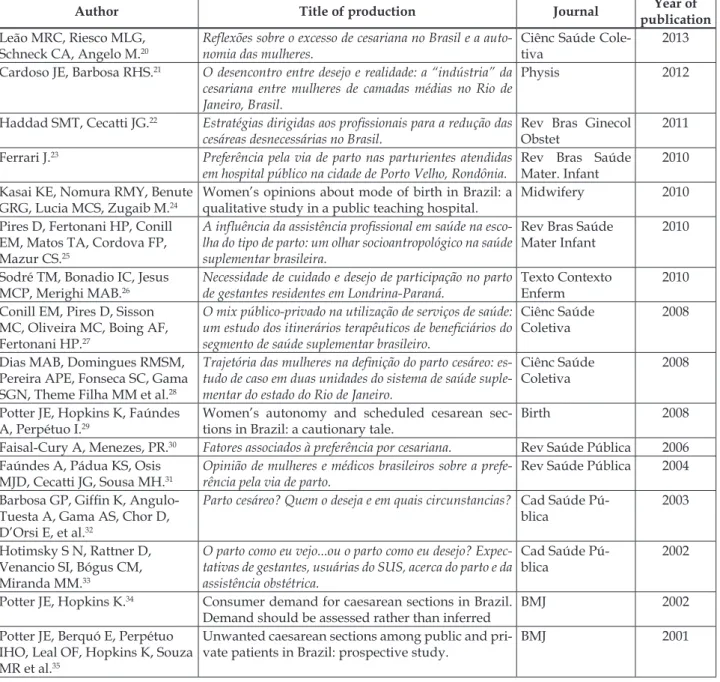
The 28 publications20-36,38-48 having“decision”,
“choice”, or “preference” for the route of delivery
as central category were selected for analysis, as presented in Table 1, and used as written sources.
Although one of the iltered studies was not an
article, but an editorial,34 it was included in the
analysis, since it belongs to important authors in
this ield who have other publications on the subject
being analyzed in the present review.29,35
Table 1 – Analyzed publications
Author Title of production Journal Year of
publication Leão MRC, Riesco MLG,
Schneck CA, Angelo M.20
Relexões sobre o excesso de cesariana no Brasil e a auto -nomia das mulheres.
Ciênc Saúde Cole-tiva
2013
Cardoso JE, Barbosa RHS.21 O desencontro entre desejo e realidade: a “indústria” da cesariana entre mulheres de camadas médias no Rio de Janeiro, Brasil.
Physis 2012
Haddad SMT, Cecatti JG.22 Estratégias dirigidas aos proissionais para a redução das cesáreas desnecessárias no Brasil.
Rev Bras Ginecol Obstet
2011
Ferrari J.23 Preferência pela via de parto nas parturientes atendidas em hospital público na cidade de Porto Velho, Rondônia.
Rev Bras Saúde Mater. Infant
2010
Kasai KE, Nomura RMY, Benute GRG, Lucia MCS, Zugaib M.24
Women’s opinions about mode of birth in Brazil: a qualitative study in a public teaching hospital.
Midwifery 2010
Pires D, Fertonani HP, Conill EM, Matos TA, Cordova FP, Mazur CS.25
A inluência da assistência proissional em saúde na esco -lha do tipo de parto: um o-lhar socioantropológico na saúde suplementar brasileira.
Rev Bras Saúde Mater Infant
2010
Sodré TM, Bonadio IC, Jesus MCP, Merighi MAB.26
Necessidade de cuidado e desejo de participação no parto de gestantes residentes em Londrina-Paraná.
Texto Contexto Enferm
2010
Conill EM, Pires D, Sisson MC, Oliveira MC, Boing AF, Fertonani HP.27
O mix público-privado na utilização de serviços de saúde: um estudo dos itinerários terapêuticos de beneiciários do
segmento de saúde suplementar brasileiro.
Ciênc Saúde Coletiva
2008
Dias MAB, Domingues RMSM, Pereira APE, Fonseca SC, Gama SGN, Theme Filha MM et al.28
Trajetória das mulheres na deinição do parto cesáreo: es -tudo de caso em duas unidades do sistema de saúde suple-mentar do estado do Rio de Janeiro.
Ciênc Saúde Coletiva
2008
Potter JE, Hopkins K, Faúndes A, Perpétuo I.29
Women’s autonomy and scheduled cesarean sec-tions in Brazil: a cautionary tale.
Birth 2008
Faisal-Cury A, Menezes, PR.30 Fatores associados à preferência por cesariana. Rev Saúde Pública 2006 Faúndes A, Pádua KS, Osis
MJD, Cecatti JG, Sousa MH.31
Opinião de mulheres e médicos brasileiros sobre a prefe-rência pela via de parto.
Rev Saúde Pública 2004
Barbosa GP, Gifin K, Angulo-Tuesta A, Gama AS, Chor D, D’Orsi E, et al.32
Parto cesáreo? Quem o deseja e em quais circunstancias? Cad Saúde Pú-blica
2003
Hotimsky S N, Rattner D, Venancio SI, Bógus CM, Miranda MM.33
O parto como eu vejo...ou o parto como eu desejo? Expec -tativas de gestantes, usuárias do SUS, acerca do parto e da assistência obstétrica.
Cad Saúde Pú-blica
2002
Potter JE, Hopkins K.34 Consumer demand for caesarean sections in Brazil. Demand should be assessed rather than inferred
BMJ 2002
Potter JE, Berquó E, Perpétuo IHO, Leal OF, Hopkins K, Souza MR et al.35
Unwanted caesarean sections among public and pri-vate patients in Brazil: prospective study.
Author Title of production Journal Year of publication Dias MAB, Deslandes S F.36 Cesarianas: percepção de risco e a sua indicação pelo
obs-tetra em uma maternidade pública no município do Rio de Janeiro.
Cad Saúde Pú-blica
2004
Teixeira C, Correia S, Victora CG, Barros H.38
The Brazilian Preference: Cesarean Delivery among Immigrants in Portugal.
PLoS One 2013
Mandarino NR, Chein MBC, Monteiro Júnior FC, Brito LMO, Lamy ZC, Nina VJS et al.39
Aspectos relacionados à escolha do tipo de parto: um es-tudo comparativo entre uma maternidade pública, outra privada, em São Luís Maranhão, Brasil.
Cad Saúde Pú-blica
2009
Osis MJD, Ceccati JG, Pádua KS, Faúndes A.40
Brazilian doctors’ perspective on the second opinion strategy before a C-section.
Rev Saúde Pública 2006
Ferrari J, Lima NM de.41 The obstetricians’ attitudes regarding the labor choice of delivery in Porto Velho, Rondonia, Brazil
Rev Bioét 2010
Watanabe T, Knobel R, Suchard G, Franco MJ, d’Orsi E,
Consonni EB et al.42
Medical students’ personal choice for mode of deliv-ery in Santa Catarina, Brazil: a cross-sectional, quan-titative study.
BMC Medical Education
2012
O’dougherty M.43 Plot and irony in childbirth narratives of middle-class.
Medical Anthro-pology Quarterly
2013
Ferreira LA, Silva JAJ, Zufi FB, Mauzalto ACM, Leite CP, Nunes JS.44
Expectativas de gestantes em relação ao parto. Rev Pesq: Cuid
Fundam Online
2013
Pimenta LF, Ressel LB, Stumm KE.45
The cultural construction of the birth process. J Res: Fundam Care Online
2013
Béhague DP, Victora CG, Barros FC.46
Consumer demand for caesarean sections in Brazil: informed decision making, patient choice or social inequality? A population based birth cohort study linking ethnographic and epidemiological methods.
BMJ 2002
Chiavegatto Filho ADP.47 Partos cesáreos e a escolha da data de nascimento no mu-nicípio de São Paulo.
Ciênc Saúde Coletiva
2013
Torloni MR, Daher S, Betrán AP, Widmer M, Montilla P, Souza JP, et al.48
Portrayal of caesarean section in Brazilian women’s magazines: 20 year review.
BMJ 2011
A combination of thematic and discourse analysis techniques was then used,49 both for
under-standing the thematic cores used in the construction of study problems, and for discursive articulation
of scientiic arguments. The analytical work was
performed in two stages. Firstly, multiple readings of the publications were carried out. Next, tables for analysis of the following aspects were built: method
of presentation and development of study problems; delineation of objects and purposes of study; used methodologies; results, discussions, and conclusions.
After these procedures, studies were categorized into
ive thematic cores, which subsidized the interpreta -tion and presenta-tion of results of this review.
RESULTS AND DISCUSSION
The “decision”, “choice”, or “preference”
for the route of delivery was an object of growing interest in the literature in the analyzed period. Between 2000 and 2004, production on the subject
included seven publications; between 2005 and
2009, six publications; and between 2010 and 2013, 15 publications were found. The authors are afili
-ated to different knowledge ields, such as medicine,
nursing, social sciences, and psychology. Most
publications (19) were found in Brazilian journals; however, there is signiicant production of studies
(nine) in foreign journals. Nearly all publications
(24) were found in journals classiied as A1, A2, B1, or B2 by the Qualis scientiic journal ranking system,
of the Coordination for the Improvement of Higher Education Personnel (CAPES, as per its acronym in Portuguese) of the Ministry of Education, in 2012. A total of 12 publications were found in journals
clas-siied as A1 and A2, and 12 in journals clasclas-siied as
B1 and B2, which indicates an acknowledgment of the production quality. As regards methodology, 12 productions were quantitative studies, 10 were qualitative studies, three combined quantitative and qualitative methods, two productions were reviews and one was an editorial.
The themes that stood out in this set of
issue”; the “medical factor” in the cesarean practice; the “women’s preference” question; “free choice” vs. “women empowerment”; inequalities in health provision, and the “commercialization” of labor care; the socio cultural context: status, safety and
planning ideals.
Cesarean sections as a “public health issue”
In the analyzed studies, with few excep-tions, the rates of cesareans in Brazil are presented
as “abusive”, “alarming”, and “worrying”, and conform a real “outbreak”, “a public health is
-sue”.32,36,38-40 Thedivergence of cesarean delivery
rates in the country with those considered accept-able by the WHO, which recommend from 10% to 15% surgeries in the total number of births, are frequently addressed.21-22,25-26,33,36,39-40
The generalization of surgery is seen as a sanitary issue for presenting higher morbidity and mortality risks for the mother and newborn, as well as foraffectingbreastfeeding.20,32-33,36,38-39 In defense of a more rational use of cesarean sections,
“scientiic evidences” are emphasized: good medi
-cal practices must be based on speciic parameters, balancing beneits and risks and trying to avoid
iatrogenies 20,28-29,32,40 the economic impact of the rise of caesarian deliveries on the health system must be considered, since indiscriminate use of surgery increasesexpenses.33,36,38
In contrast to the literature trend, two studies criticize the initiatives for reducing the number of cesarean deliveries, based on rates recommended by
the WHO, which were proposed in 1985, therefore
authors believe them to be outdated.23,41 The authors
argue that obstetric practices must accompany the changes in the dynamics of reproductive life, such as the increase of mother age, lower number of chil-dren, and greater weight gain during pregnancy. The authors also report that, over the last decades, there has been great advancement of medical tech-nologies, making cesarean sections safer. For them, the results of studies referring to risks inherent to each type of delivery - vaginal and surgical - are debatable, thus further studies are needed.
The “medical factor” in the cesarean delivery
practice
For many authors,35 the rise of cesarean rates
would be a consequence of factors such as the be-lief of physicians that the surgery is safer, lack of
professional skill to assist vaginal delivery, greater
convenience and proitability for these profession -als, as well as the fact that physicians assume women prefer surgery. It has been argued that physicians of the private sector believe that women are mistaken when they express their wish for a vaginal birth
and, with a paternalistic posture, they “convince”
their patients that surgical delivery provides more protection to the mother and the baby.29 It is ad-vocated that, in the private sector, the “option” of
women for cesarean delivery is a consequence of a type of dialog with the doctor in which there is little motivation towards the vaginal delivery and
“guidance” (explicit or not) towards the cesarean -delivery.21,25,27-28 In a study carried out in the
Brazil-ian Uniied Health System (SUS), the authors also
concluded that the high rates of cesarean deliveries
mainly relect convenience and lack of training of professionals who, to justify their practice, afirm
that women prefer surgery.31
A study carried out in a teaching hospital with medical students showed how university education and medical residence focus on training caesarian delivery and inculcating the idea of practicality, convenience and safety of the procedure.43 In line
with this, another study argues that, in public ma-ternity hospitals, rates of surgery are also increased, conveying a professional culture based on the belief of procedure safety and biases of obstetric medical training.36 The study calls attention to a generation
of obstetricians who are lacking familiarity with techniques and maneuvers of the vaginal delivery.
In face of any dificulty during labor, they go for
surgery, assuming that besides having more experi-ence with this type of birth, they feel less exposed to future lawsuits.
When asking doctors about the strategy of obtaining a second opinion before performing the cesarean section, a survey showed that professionals
did not ind it feasible in the private system, since
they assume that the obstetric practice should not be controlled in this sector.40 Another study advocates
that physicians and hospitals are mostly responsible for the growing rate of cesarean sections and that the main strategies to avoid unnecessary caesarians
should be directed to proissionals.22
The “women’s preference” issue
worked with the idea, or found it in their results, that most women initially prefer the vaginalbirth.20-35
Observing that a great number of these pregnan-cies ended in caesarian deliveries, many authors discuss women’s autonomy in decision making around birth and the asymmetries of power and knowledge of physicians. Many authors notice that, along the pregnancy, physicians create a scenario
of supposed rather than real risks which justiies intervention during prenatal care visits: “big baby”, “narrow hip”, “nuchal cord”, are said to women, who “choose” cesarean delivery in face of the fear
of being held responsible for any negative outcome, and their decision is jeopardized as a result of the
“power of persuasion” of physicians.21,25-29,35,40,43 A study found that in the private sector, ind -ing a physician will-ing to assist a vaginal delivery using the health plan is not always easy, and pay-ing directly to a physician is very costly, even for middle-classwomen.21The idea that middle- and
upper-class women prefer cesarean to vaginal birth and that they request surgery is criticized.29,34-35 For
these authors, a great number of these surgeries are
“unwanted cesarean deliveries”: women are “per
-suaded” at the end of pregnancy, especially by the
presentation of risk situations that are not in
agree-ment with scientiic evidences. It is emphasized that, with the “banalization” of surgery, women
are not surprised at the surgical indication and opt for the cesarean, resigning their initial wish for the vaginalbirth.28
Unlike most of the literature, preference for the cesarean was found among women in a private ma-ternity hospital.39 In contrast, in the public maternity
hospital studied, the authors found that the vaginal route was preferred. However, it was noticed that all women who wanted to have a cesarean delivery in the private sector had their wish met, something that did not occur among those who wanted vaginal birth in the same sector.
Women’s preference for a cesarean delivery,
the “cesarean delivery upon maternal request”, as
responsible for the increase of surgery, is questioned by authors who observed, in a study with pregnant women of low socio economic level, a demand for cesarean deliveries associated with the fear of the attitudes of professionals during the service and also with the wish for tubal ligation.33 In a study
with women using the SUS, it was advocated that
“cesarean deliveries upon maternal request” is more
of a consequence of a medical and institutional
culture than a “real preference” of women.32 The authors afirm that these are situations that involve
the obstetrician’s presence - absence of the partner, delay in admission time, bad previous experiences, absence of techniques for pain relief, which would be associated with the request for surgery.
In the reviewed literature, the preference for caesarian delivery - its authenticity, legitimacy, and even the ability of choice - is questioned or relativ-ized, differently from the preference for vaginal delivery, which does not appear as an object of study
itself. The causes for the “cesarean delivery upon maternal request” need further understanding, at
times, even to talk women out of this preference. Thus, the need for greater attention at psychological aspects, more dialog between women and profes-sionals, as well as more information during prenatal care are often discussed.24,26,44 In line with this, it is
argued that medical advising in favor of vaginal delivery may have a positive consequence, as well as educational studies directed to the population.28 A study pointed out the nurse as a strategic profes-sional for the humanization of childbirth and for supporting women in believing in their birthing ability.45 Thus, it states it is important that women
be informed and that other professionals participate to reduce the rates of cesarean deliveries.
It has been argued that women’s preference for a type of birth, both for cesarean and vaginal de-livery, seems to be associated with satisfaction with
a previous childbirth, inluenced by maternal and
especially neonatal outcomes.30 Another study also
emphasized the relevance of previous experiences, as well as of family relationships.25 In line with this,
a group of authors refer to the importance of the experience transmitted by close women regarding the preference for cesarean or vaginaldelivery.44-45
“Free choice”
versus
“women empowerment”
The discussion on autonomy, as regards the parturition process, follows two diverging views: when it is a matter of defending women’s preroga-tive of requesting a cesarean delivery, autonomy
seems to be associated with the idea of “free deci
-sions” and the right of” choice”;23,41 on the other
hand, autonomy seems to be associated with the
idea of “women empowerment” when vaginal
birth is advocated, which is seen as an emotionally
signiicant event for women.20-21,24-26,45 The last trend,
female body and childbirth.32 The rise of cesarean
deliveries means, thus, to disempower women and center the event of birth on the physician.
In the revised literature, there are discursive formulations stating that childbirth belonged to
women in the past; however it is not under women’s
power anymore, but under the physicians’ power. Studies discuss the medicalization of childbirth (as part of the social medicalization process), which made women incompetent in dealing with the event, due to its unpredictability and pain, transferring childbirth care from midwives to physicians.20-21,25
Childbirthis now surrounded by an interventionist practice in which women, by losing their leading
role, have also “[...]gradually lost their right of choice”.45:592 According to a previous study, the
de-velopment of women’s autonomy would be a
strat-egy to deal with “[...] an epidemic scenario of un
-necessary and unwanted cesarean deliveries”,20:2399
having social networks and social movements as the most important promoters of this autonomy.
On the other hand, it is argued that users of the Brazilian public healthcare system do not have the
“right of choice” on the route of delivery.23,41 The
au-thors question the authenticity of the preference for vaginal delivery in the public sector, since women receive prenatal care in health units where they are assisted by nurses who follow programs of the MH directed to vaginal delivery. For the authors, the
“non-right of choice” falls back on the most fragile women, belonging to suburban layers. Fulilling the
request of users for cesarean deliveries is advocated by these authors as an ethical question.
In general, the literature on the choice for the route of delivery criticizes the above mentioned. It
has been argued that, in fact, the rise of justiications
for cesarean delivery has increased the chance of women not having the desired vaginal delivery.29 It
has also been pointed that even middle-class women are not free from social and gender contradictions, in which the interests of physicians prevail, in a commercial, iatrogenic, and dehumanized biomedi-cal model that dismisses women from their central role.21
Inequalities in health care provision and the
“commercialization” of child birth care
Studies show that women with higher so-cioeconomic level, schooling and users of the private sector have more caesariandeliveries.22,40
In theory, these women would have greater access
to healthcare and lower gestational risk; thus, the
rates of cesarean deliveries in this group could not simply be explained by medical indication. Part of the analyzed texts associates the growth of sur-gery with the dynamics of the private system,25,27-28 considering that two studies, explicitly develop a criticism towards the commercialization of labor and delivery.21,46
Labor and delivery have become, thus, a “busi
-ness” in which economic interests prevail and are part of a “commercialized model” of healthcare.21 In
a capitalist society, cesarean delivery means greater productivity, since it can be performed in less time,
and higher proitability, due to higher hospital expenses for the patient. Scientiic and technical
knowledge has become a tool of the childbirth
“business”, as the medical discourse disguises the
commercial interests behind the cesarean delivery practice. A study that investigated the preference for cesarean delivery between groups of women of low socioeconomic level discussed the problematic of the excess of cesarean sections as part of a market of unnecessary interventions, created from inequali-ties in healthcareprovision.46 The authors advocate
that the request for cesarean delivery among women who feel marginalized from the access to medical technology is the form of avoiding poor and negligent service. It is not only a matter of lack of information, but a real and concrete situation of inequality in the service where requesting interven-tion means asking for quality service. Technology becomes, thus, a synonym of good care.
Socio-cultural context: status, safety and
planning ideals
Some authors discuss how personal and fam-ily values interfere in the decision making regarding the route of delivery, developed during prenatal care.25,27 For these authors, the expectations
the fear of pain of the vaginal delivery.28 Conversely, the decision at a later period of pregnancy and
dur-ing labor would be more inluenced by physicians
and assisting practices.
The cultural issue of childbirth planning is highlighted in a study that showed how the dif-fusion of the cesarean practice, while allowing the choice of the date, has altered the dynamics of many maternity hospitals.47 As demonstrated in the
study, scheduled cesarean deliveries have led to a reduction of births in some days and to an increase in others, for instance, rejection of some families for certain dates such as Christmas or day of the dead, and the increase of surgeries at more convenient times and days of the week for physicians.
In a study carried out in Portugal, it was
veri-ied that Brazilian immigrants presented signiicantly
higher prevalence of cesarean deliveries than Portu-guese women.38 It discussed how the cultural origin
of women inluences their perceptions of safety and
risks involving childbirth, as well as the decision of professionals regarding the route of delivery in Por-tuguese public facilities. The study concluded that cesarean delivery is a safer mode of delivery and a symbol of social status for Brazilian women.
Another study advocated that contemporary women are exposed to information on health - in-cluding childbirth - in the most varied forms of
media, and this exposure can inluence preferences
and decisions.48 The authors performed a review of articles published in the best-selling female
maga-zines in Brazil, between 1988 and 2008, and found
that the advantages of the cesarean delivery are more frequently mentioned than the risks, strength-ening the idea of safety of the surgical procedure, which may lead women to pay less attention to the possible ominous effects of the surgery.
A study with middle- and upper-class women in a private maternity hospital with high rates of cesarean deliveries proposed that, even when the
decision for the surgery suffers great inluence from the medical factor, women “negotiate” the birth of
theirchildren.43 This turns the event into a signiicant
celebration of the moment of transition into moth-erhood, with the family presence, photography,
ilming, among other things.
FINAL CONSIDERATIONS
Production of knowledge and academic
dis-cussion in the collective health ield on “decision”, “choice”, or “preference” related to the route of
delivery in Brazil present high rates of cesarean
delivery as a serious “public health issue” and a
situation that must be reverted. The idea that the responsibility for the increase of cesarean deliver-ies belongs to professionals and that most Brazilian women prefer vaginal delivery prevails. There is a strong discussion that associates vaginal delivery
and “women empowerment” afirming that, his -torically, childbirth was an event that belonged to
women; and that now, they have been expropriated
from the right of decision, and childbirth has become
a medical event, with many “unwanted cesarean deliveries” being performed.
In this literature, it is argued that there is no
“real preference” of women for cesarean deliveries. This expression – “real preference” is problematic, as there is no such thing as “free” choice or prefer
-ence; therefore it is assumed to be disconnected
from a macro-cultural and macro-social context. It is not our purpose to deny the advancements in the literature dedicated to the analysis of the cesarean delivery practice in Brazil, and there are studies at-tempting to leave behind the narrow focus on indi-vidual choice and go for a deeper contextualization of the route of delivery. However, it is believed that further understanding of the phenomenon is still necessary, since the discussion over the question
“who decides” on the route of delivery or whether women “prefer” the vaginal or caesarian route still
prevails.
There is a broad range of social processes that can be associated with the phenomenon of the growing number of cesareans and which are poorly discussed in the literature. Scheduled cesar-ean deliveries can be seen as a new type of birth in which unpredictability is removed, allowing for a rearrangement of the social dimension of the event, bringing together relatives and friends, besides bet-ter planning of the postpartum life routine. In ad-dition, body care and permeability to technological interventions, being cesarean delivery an exemplary case, characterize a society with a constant concern with health, esthetics, social and sexual perfor-mance, and productivity. Thus, cesarean deliveries may mean, in the view of many women, relatives, and professionals, an idea of body care associated with a naturalization of biomedical interventions.
REFERENCES
Sweden, and the United States. Long Grove (IL):
Waveland press, Inc; 1993.
2. Diniz SG. Women’s movement defends birth centres in
Brazil. Reprod Health Matters. 2009 Nov; 17(34):188-9.
3. Amorim MMR, Souza ASR, Porto AMF. Indicações de cesariana baseadas em evidências: parte I. Femina.
2010 Ago; 38(8):415-22.
4. Souza ASR, Amorim MMR, Porto AMF. Indicações de
cesariana baseadas em evidências cientíicas: parte II.
Femina. 2010 Set;38(9):459-68.
5. Faúndes A, Cecatti JG. A operação cesárea no Brasil. Incidência, tendências, causas, conseqüências e
propostas de ação. Cad Saúde Pública. 1991 Abr-Jun;
7(2):150-73.
6. Leal MC, Silva AAM, Dias MAB, Gama SGN, Rattner D, Moreira ME, et al. Birth in Brazil: national survey
into labour and birth. Reprod Health. 2012 Ago;
9(15):15.
7. Hofelmann DA. Tendência temporal de partos cesáreos no Brasil e suas Regiões: 1994 a 2009. Epidemiol Serv Saúde. 2012 Out-Dez; 21(4):561-8. 8. Mendoza-Sassi RA, Cesar JA, Silva PR, Denardin
G, Rodrigues MM. Fatores de risco para cesárea segundo tipo de serviço. Rev Saúde Pública. 2010
Fev; 44(1):80-9.
9. G u r g e l R Q , N e r y A M D G , A l m e i d a M L D . Características das gestações, partos e recém-nascidos da região metropolitana de Aracaju, Sergipe, Brasil. Rev Bras Saúde Mater. Infant. 2009 Abr-Jun;
9(2):167-77.
10. Almeida SD, Bettiol H, Barbiere MA, Silva AAM, Ribeiro VS. Diferença notável nas taxas de parto cesariano em hospital público e hospital privado no Brasil.Cad Saúde Pública. 2008 Dez; 24(12):2909-18. 11. Ribeiro VS, Figueiredo FP, Silva AA, Bettiol H, Batista
RF, Coimbra LC, et al. Why are the rates of cesarean section in Brazil higher in more developed cities than in less developed ones? Braz J Med Biol Res.2007Set; 40(9):1211-20.
12. Costa NDL, Paes NA, Ramos PCF, Formiga MCC. Desejo, intenção e comportamento na saúde reprodutiva: a prática da cesárea em cidade do Nordeste do Brasil. Rev Bras Ginecol Obstet. 2006
Jul; 28(7):388-96.
13. D’orsi E, Chor D, Gifin K, Angulo-Tuesta A, Barbosa
GP, Gama AS, et al. Qualidade da atenção ao parto em maternidades do Rio de Janeiro. Rev Saúde Pública.
2005 Ago; 39(4):646-54.
14. Freitas PF, Savi EP. Desigualdades sociais nas complicações da cesariana: uma análise hierarquizada. Cad Saúde Pública. 2011 Out; 27(10):2009-20.
15. Machado Junior LC, Sevrin CE, Oliveira E, Carvalho HB, Zamboni JW, Araújo JC, et al. Associação entre via de parto e complicações maternas em hospital público da Grande São Paulo, Brasil. Cad Saúde
Pública. 2009 Jan; 25(1):124-32.
16. Ramos JGL, Martins-Costa S, Vettorazzi-Stuczynski J, Brietzk E. Morte materna em hospital terciário do Rio Grande do Sul - Brasil: um estudo de 20 anos. Rev
Bras Ginecol Obstet. 2003 Jul; 25(6):431-6.
17. Araujo Júnior E, Freitas RCM, Di Bella Z I KJ, Alexandre SM, Nakamura MU, Nardozza LMM, et al. Avaliação do assoalho pélvico por meio da ultrassonografia tridimensional de mulheres primíparas de acordo com o tipo de parto: experiência inicial de um centro de referência do Brasil.Rev Bras
Ginecol Obstet. 2013 Mar; 35(3):117-22.
18. Cardoso MM, Leite AO, Santos EA, Gozzani JL, Mathias LA. Effect of dexamethasone on prevention of postoperative nausea, vomiting and pain after caesarean section: a randomised, placebo-controlled,
double-blind trial. Eur J Anaesthesiol. 2013 Mar;
30(3):102-5.
19. Zaconeta AM, Queiroz I FB de, Amato AA, Motta LDC, Casulari LA. Depressão com início após o parto: estudo de corte prospectivo em mulheres submetidas
à cesárea eletiva em Brasília, Brasil. Rev Bras Ginecol Obstet. 2013 Mar; 35(3):130-5.
20. Leão MRC, Riesco MLG, Schneck CA, Angelo M.
Relexões sobre o excesso de cesariana no Brasil e a autonomia das mulheres. Ciênc Saúde Coletiva. 2013; 18(8):2395-400.
21. Cardoso JE, Barbosa RHS. O desencontro entre desejo
e realidade: a “indústria” da cesariana entre mulheres
de camadas médias no Rio de Janeiro, Brasil. Physis.
2012; 22(1):35-52.
22. Haddad SMT, Cecatti JG. Estratégias dirigidas aos profissionais para a redução das cesáreas desnecessárias no Brasil. Rev Bras Ginecol Obstet.
2011 Mai; 33(5):252-62.
23. Ferrari J. Preferência pela via de parto nas parturientes atendidas em hospital público na cidade de Porto Velho, Rondônia. Rev Bras Saúde Mater. Infant. 2010
Dez; 10(2):409-17.
24. Kasai KE, Nomura RMY, Benute GRG, Lucia MCS, Zugaib M. Women’s opinions about mode of birth in Brazil: a qualitative study in a public teaching hospital.
Midwifery. 2010; 26(3):319-26.
25. Pires D, Fertonani HP, Conill EM, Matos TA, Cordova
FP, Mazur CS. A inluência da assistência proissional
em saúde na escolha do tipo de parto: um olhar socio-antropológico na saúde suplementar brasileira. Rev
Bras Saúde Mater Infant. 2010 Abr-Jun; 10(2):191-7.
26. Sodré TM, Bonadio IC, Jesus MCP, Merighi MAB. Necessidade de cuidado e desejo de participação no parto de gestantes residentes em Londrina-Paraná.
Texto Contexto Enferm. 2010 Jul-Set; 19(3):452-60.
27. Conill EM, Pires D, Sisson MC, Oliveira MC, Boing AF, Fertonani HP. O mix público-privado na utilização de serviços de saúde: um estudo dos itinerários
28. Dias MAB, Domingues RMSM, Pereira APE, Fonseca SC, Gama SGN, Theme Filha MM et al. Trajetória das
mulheres na deinição do parto cesáreo: estudo de caso
em duas unidades do sistema de saúde suplementar do estado do Rio de Janeiro.Ciênc. Saúde Coletiva.
2008 Set-Out; 13(5):1521-34.
29. Potter JE, Hopkins K, Faúndes A, Perpétuo I. Women’s autonomy and scheduled cesarean sections in Brazil:
a cautionary tale. Birth. 2008 Mar; 35(1):33-40.
30. Faisal-Cury A, Menezes, PR. Fatores associados à preferência por cesariana. Rev Saúde Pública. 2006
Abr; 40(2) 233-39.
31. Faúndes A, Pádua KS, Osis MJD, Cecatti JG, Sousa MH. Opinião de mulheres e médicos brasileiros sobre a preferência pela via de parto. Rev Saúde Pública.
2004 Ago; 38(4):488-94.
32. Barbosa GP, Gifin K, Angulo-Tuesta A, Gama AS,
Chor D, D’Orsi E, et al. Parto cesáreo? Quem o deseja e em quais circunstancias? Cad Saúde Pública. 2003
Nov-Dez; 19(6):1611-20.
33. Hotimsky S N, Rattner D, Venancio SI, Bógus CM, Miranda MM. O parto como eu vejo...ou o parto como eu desejo? Expectativas de gestantes, usuárias do SUS, acerca do parto e da assistência obstétrica. Cad Saúde
Pública. 2002 Set-Out; 18(5):1303-11.
34. Potter JE, Hopkins K. Consumer demand for caesarean sections in Brazil. Demand should be assessed rather
than inferred. BMJ. 2002 Ago; 325(7359):335.
35. Potter JE, Berquó E, Perpétuo IHO, Leal OF, Hopkins K, Souza MR et al. Unwanted caesarean sections among public and private patients in Brazil: prospective study. BMJ.2001Nov; 323(7322):1155-58.
36. Dias MAB, Deslandes S F. Cesarianas: percepção de risco e a sua indicação pelo obstetra em uma maternidade pública no município do Rio de Janeiro. Cad Saúde Pública. 2004 Jan-Fev; 20(1):109-16.
37. Mendes KDS, Silveira RCCP, Galvão CM. Revisão integrativa: método de pesquisa para a incorporação de evidências na saúde e na enfermagem. Texto
Contexto Enferm. 2008 Out-Dez; 17(4):758-64. 38. Teixeira C, Correia S, Victora CG, Barros H. The
brazi-lian preference: cesarean delivery among immigrants in Portugal. PLoS One. 2013 Mar;8(3) e60168: 1-7.
39. Mandarino NR, Chein MBC, Monteiro Júnior FC, Brito LMO, Lamy ZC, Nina VJS et al. Aspectos relacionados
à escolha do tipo de parto: um estudo comparativo
entre uma maternidade pública, outra privada, em São Luís Maranhão, Brasil. Cad Saúde Pública. 2009
Jul; 25(7):1587-96.
40. Osis MJD, Ceccati JG, Pádua KS, Faúndes A. Brazilian doctors’ perspective on the second opinion strategy
before a C-section. Rev Saúde Pública. 2006 Abr;
40(2):233-9.
41. Ferrari J, Lima NM. The obstetricians’ attitudes regar-ding the labor choice of delivery in Porto Velho,
Ron-donia, Brazil. Rev Bioét. 2010 Set-Dez; 18(3):645-58.
42. Watanabe T, Knobel R, Suchard G, Franco MJ, d’Orsi E, Consonni EB, et al. Medical students’ personal choice for mode of delivery in Santa Catarina, Brazil: a cross-sectional, quantitative study. BMC Medical
Education. 2012 Jul; 12(57):1-9.
43. O’dougherty M. Plot and irony in childbirth narratives of middle-class. Medical Anthropology Quarterly.
2013; 27(1):43-62.
44. Ferreira LA, Silva JAJ, Zufi FB, Mauzalto ACM, Leite CP, Nunes JS. Expectativas de gestantes em relação ao parto. Rev Pesq: Cuid Fundam Online. 2013
Abr-Maio [acesso 2014 Fev 4]; 5(2):3692-7. Disponível em:
http://saudepublica.bvs.br/pesquisa/resource/pt/ bde-24529
45. Pimenta LF, Ressel LB, Stumm KE. The cultural construction of the birth process. J Res: Fundam Care
Online. 2013 Out-Dez [acesso 2014 Fev. 4]; 5(4):591-8. Disponível em: http://pesquisa.bvs.br/brasil/
resource/pt/bde-24959
46. Béhague DP, Victora CG, Barros FC. Consumer demand for caesarean sections in Brazil: informed decision making, patient choice or social inequality? A population based birth cohort study linking ethnographic and epidemiological methods. BMJ.
2002Abr; 324(7343):942-45.
47. Chiavegatto Filho ADP. Partos cesáreos e a escolha da data de nascimento no município de São Paulo. Ciênc Saúde Coletiva. 2013 Ago;18(8):2413-20.
48. Torloni MR, Daher S, Betrán AP, Widmer M, Montilla P, Souza JP, et al. Portrayal of caesarean section in Brazilian women’s magazines: 20 year review. BMJ
[online]. 2011 Jan [acesso 2014 Fev. 4]; 342: d276:1-7.
Disponível em: http://pesquisa.bvsalud.org/portal/ resource/pt/mdl-21266421
49. Minayo MCS. O desaio do conhecimento: pesquisa
qualitativa em saúde. São Paulo (SP): Hucitec; 2010.
Correspondence: Liana Carvalho Riscado Rua Barão de São Francisco, 212 apt. 108 20560032 - Andaraí, Rio de Janeiro, RJ, Brazil E-mail: [email protected]