Effectiveness of Enteral Nutritional Therapy in the Healing Process of Pressure Ulcers: A Systematic Review
* Extracted from the thesis “ Efetividade da terapia nutricional enteral no processo de cicatrização das úlceras por pressão: revisão sistemática,” Universidade Federal do Paraná, 2013.
1 Master’s of Nursing, Graduate Program in
Nursing, Universidade Federal do Paraná, Curitiba, PR, Brazil.
2 Professor, Department of Nursing, Universidade
Federal do Paraná, Curitiba, PR, Brazil.
3 Doctoral Student, Graduate Nursing Program,
Universidade Federal do Paraná, Curitiba, PR, Brazil.
4 Professor, Department of Nursing, Universidade
Federal do Paraná, Curitiba, PR, Brazil.
5 Professor, Department of Nursing, Universidade
Federal do Paraná, Curitiba, PR, Brazil.
6 Associate Professor, Escola Paulista de
Enfermagem, Universidade Federal de São Paulo, São Paulo, SP, Brazil.
Received: 04/21/2014 Approved: 11/18/2014
REVISION ARTICLE DOI: 10.1590/S0080-623420150000100020
Correspondence Addressed to: Gisely Blanc
Rua João Dembinski, 1103 CEP: 81270-330 – Curitiba, PR, Brasil E-mail: [email protected]
Effectiveness of Enteral Nutritional Therapy in the Healing
Process of Pressure Ulcers: A Systematic Review*
Efetividade da terapia nutricional enteral no processo de cicatrização das úlceras por pressão: revisão sistemática Efectividad de la terapia de nutrición enteral en el proceso de cicatrización de las úlceras por presión: revisión sistemática
Gisely Blanc1, Marineli Joaquim Meier2, Janislei Giseli Dorociaki Stocco3, Hellen Roehrs4, Karla Crozeta5, Dulce Aparecida Barbosa6
ABSTRACT
Objective: To evaluate the efectiveness of enteral nutritional therapy (ENT) in the healing process of pressure ulcers (PU) in adults and the elderly. Method: A systematic review whose studies were identiied through the databases of Cochrane, MEDLINE/ PubMed, SciELO, LILACS, EMBASE, CINAHL, Web of Science, and manual searches.
It included randomized clinical trials (RCTs) without delimiting the period or language of publication, which addressed adults and elderly patients with pressure ulcers in a comparative treatment of enteral nutritional therapy and placebo or between enteral nutritional therapy with diferent compositions and dosages. Results: We included ten studies that considered diferent interventions. It resulted in more pressure ulcers healed in the groups that received the intervention. he included studies were heterogeneous with regard to patients, the type of intervention, the sample and the follow-up period, all of which made meta-analysis impossible. Conclusion: Although the enteral nutritional therapy demonstrates a promotion of pressure ulcer healing, suicient evidence to conirm the hypothesis was not found.
DESCRIPTORS
INTRODUCTION
A pressure ulcer (PU) is a public health problem that afects sick people, the family and society. It is deined as "a damaged area located on the skin and underlying tissue caused by pressure, shear, friction, or a combination of(1)". Its
etiology has other contributing factors that are intrinsic to the subject such as nutrition, age, and comorbidities, among others(2). Interventions imposed for its prevention and
treat-ment interfere in health care quality(3).
Age is considered a risk factor for PU, especially in pa-tients aged 65 years or more. Failure of wound healing af-fects three to six million people at that age, and represents 85% of this occurrence(4).
In Brazil, the concern with the PU became more evident with the publication of RDC Nº 36, from July 25th 2013,
which instituted actions to promote patient safety and qual-ity improvement in health services. Prevention of PU was included in the patient safety plan for which strategies and actions for risk management must be developed(5). A
pro-tocol was published for prevention that includes strategies for optimization of nutrition and hydration(6).
Regarding nutrition, studies show a relationship be-tween malnutrition and development of PU and delayed healing(7-8). A study that classiied patients as
malnour-ished, at nutritional risk and well-nourished according to the Body Mass Index, found extremely poor nutri-tional status in patients with PU (39.5% malnourished and 2.5% well-nourished), compared to patients without PU (16.6% malnourished and 23.6% well-nourished) (p <0.001)(9). A prospective study of high-risk and
hospital-ized patients identiied malnutrition in 29% of patients upon admission and after four weeks 17% of these de-veloped PU, however, the injury occurred in only 9% of patients who were not malnourished(10).
In this sense, nutritional triage contributes to identify-ing the need for Enteral Nutrition herapy (ENT) in or-der to provide calories, proteins, amino acids, vitamins and proper hydration for patients with PU. he nurse should be the one responsible for carrying out the nutritional triage and actions for implementing ENT(11-13).
ENT uses specially formulated food (industrialized or not), exclusively or partially employed to replace or supple-ment the alisupple-mentation for the nutritional needs of the pa-tient, and is engaged in the synthesis or maintenance of tissues, organs or systems(5,11).
In order to prevent and treat PUs, many supplements were commercially developed for ENT (oral nutritional supplement and via nasogastric, nasoenteral/nasojejunal or percutaneous tube). hese formulas are composed mainly of protein, arginine, glutamine, vitamin C, zinc, iron and vitamin E(14), and are classiied according to the complexity
of the nutrients in polymeric, oligomeric, and monomeric formulas, and also modular diets(15).
Regarding the importance of adequate nutritional status for PU healing, it is necessary to evaluate the efectiveness of Nutritional herapy (NT) as a treatment for PU. For both, research with the appropriate design on the theme
as well as systematic reviews for presenting the best level of evidence for clinical decision making is indispensable.
A systematic review (SR) published in 2003 aimed at evaluating the efectiveness of enteral and parenteral nu-trition for the prevention and treatment of PU included eight randomized controlled trials (RCTs), and noted that nutritional supplements reduced the number of new ulcers, but it was not possible to reach deinitive conclusions about the efect of enteral and parenteral nutrition due to the het-erogeneity of the studies(16).
In another SR published in 2005 to verify the impact of enteral nutritional support on the incidence and healing of PUs, 15 studies were included and ive were grouped into a meta-analysis of oral nutritional supplements or enteral tube feeding. he meta-analysis, n=1.224, of post-surgical chron-ically-hospitalized elderly patients showed that oral supple-ments were associated with a lower incidence of developing PU (odds ratio 0.75, 95% CI [62-89]). As for wound healing, meta-analysis was not possible, however individual studies have shown favorable results with the use of high doses of protein supplements specialized for PU healing(17).
In 2008, an SR evaluating treatments available for PU nutritional interventions included seven RCTs and the au-thors found that the protein supplementation promoted the healing of ulcers compared with placebo (Scale Healing av-erage score 3.55 [4.66] vs. 3.22 [4:11], p <0.05), but there is little evidence to justify routine use of ENT compared to the standard treatment for PU healing(18).
While there have been SRs conducted involving nutrition in the prevention and treatment of PU, it was found that these were not restricted to ENT; extrapolating the research to other strategies and this does not achieve a wide search in the databases. herefore, considering the urgency of new studies with methodological quality and that the SR makes it possible to obtain answers to clinical questions and safely incorporate new procedures to professional practice with sci-entiic support(19), a SR aimed at evaluating the efectiveness
of Enteral Nutrition herapy (ENT) in the healing process of Pressure Ulcers (PU) in adults and the elderly was proposed.
METHOD
It is a Systematic Review (SR), based on the Cochrane Handbook for Systematic Reviews of the recommendations of In-terventions proposed by the Cochrane Collaboration(20). he SR
difers from other review methods because it uses explicit pro-cedures of systematic search and critical analysis to synthesize the literature on a particular issue, aiming to minimize biases and random error present in individual analyzes(19).
To elaborate the research question, the acronym PI-CO(20) was employed (P - population and problem; I -
Effectiveness of Enteral Nutritional Therapy in the Healing Process of Pressure Ulcers: A Systematic Review
Manager version 5.1.0 program, in which the studies were judged as 'low risk of bias,' 'high risk bias' and 'uncertain/ unclear risk of bias' to six domains/areas: random sequence generation, allocation concealment, blinding of participants and personnel, blinding of outcome assessment, incomplete outcome data and selective outcome (20).
Due to the heterogeneity of the studies, the data were descriptively grouped and analyzed for outcomes.
here was no conlict of interest in conducting this re-view, nor was any funding provided for the study.
RESULTS
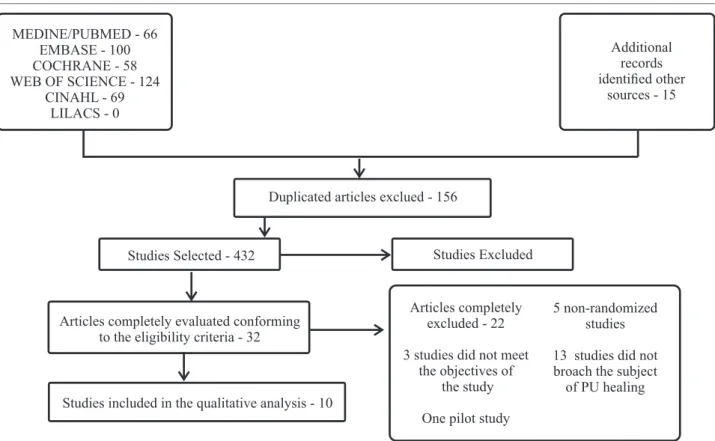
432 studies were identiied, of which 66 were in MED-LINE/PUBMED, 100 in EMBASE, 58 in CENTRAL, 124 in Web of Science, 69 in CINAHL, zero/none in Sci-ELO or LILACS, and 15 in the manual search. Of these, 156 were duplicates and 244 did not meet the inclusion criteria. hus, we evaluated 32 studies in full, and after an independent review by two reviewers, ten studies were in-cluded in this review, as shown in Figure 2. he opinion of the third reviewer for consensus of the included studies was requested. he Kappa index showed signiicant agreement 0.939 (p <0.001 and 95% CI).
In the assessment of methodological quality of the stud-ies, only two had low risk of bias for all assessed areas (E32, E90) and one for ive areas (E5). Two classiied with two areas as high risk of bias (E419, E424) and two with one (E420, E10). In eight studies there were at least one clas-siied area in uncertain risk of bias (E5, E10, E412, E418: E419, E424, E425, E426), which shows a lack of detail in the description of the methodology of these studies and prevents a proper analysis as to quality. Figure 2 gives a review of studies for each area individually.
healing process in adults and the elderly?”
Inclusion criteria were randomized controlled trials without language restriction or publication date which eval-uated the efect of ENT in the PU healing process in adults and elderly, hospitalized or at home, comparing treatment with ENT and placebo; ENT or of diferent compositions; or ENT with diferent dosages.
We excluded studies that involved other causes of wounds; were not limited to their ENT intervention (ad-opted another route of administration); or did not describe the formula used in ENT.
he primary endpoint was the overall healing of PU, and the secondary endpoints were partial healing of PU; stability of the area; reduction of exudate and devitalized tissue. he search took place from May to August 2013. he studies were identiied through the following databases: Cochrane Central Register of Controlled Trials (CENTRAL) in he Cochrane Library, National Library of Medicine/NLM (MEDLINE)/PubMed, Scientiic Electronic Library online (SciELO), Latin American and Caribbean Health Sciences (LILACS), Biomedical Database (EMBASE), Cumulative Index to Nursing and Allied Health Literature (CINAHL) and Web of Science. he procedure also included a manual search through consulting summaries of papers presented at conferences, reference articles and systematic reviews of identiied RCTs, ECR registration databases and contact with researchers active in wound treatment area.
he search strategies were formulated according to the criteria and documentation for each database. We used Medical Subject Heading (MeSH) descriptors, descriptors in Health Sciences (MeSH), and terms related to the re-search problem (pressure ulcers), intervention (enteral nu-trition therapy) and study design (randomized controlled trial), combined with boolean operators (AND and OR) and truncation symbols.
Chart 1 shows the search strategy adopted in the MEDLINE via PubMed, which was adapted for the other analyzed databases.
For inclusion, the abstracts of the identiied studies were blindly and independently assessed by two reviewers who applied the eligibility criteria and selected the relevant studies; in case of disagreement, a third reviewer was re-quested. In the irst consensus meeting the selected studies were evaluated in full with application of eligibility criteria; and then in the second consensus meeting, the studies to be included and excluded from the review were deined. he degree of agreement between reviewers was assessed by measuring Kappa(20) using the STATA® 9.7 software. he
Kappa assesses the interobserver agreement and ranges from 1 (complete agreement) to -1 (complete disagreement)(21).
For data extraction, a form(22) was adopted which
in-cluded: identiication of the study (title, journal, year of publication, volume and number), method, characteristics of participants and intervention, outcome, ethical aspects, inancing and opinion of the reviewer.
he methodological quality of the studies was per-formed using the Cochrane Collaboration tool for assessing the risk of bias in randomized clinical trials available in Review
Chart 1 - Search strategy in MEDLINE/PubMed database - Curi-tiba, PR, 2013.
#1 (((((((((“Pressure Ulcer”[MeSH Terms] OR Pressure Ulcers[Title/
Abstract]) OR Ulcers, Pressure[Title/Abstract]) OR Bedsore[Title/ Abstract]) OR Bedsores[Title/Abstract]) OR Pressure Sore[Title/ Abstract]) OR Pressure Sores[Title/Abstract]) OR Bed Sores[Title/ Abstract]) OR Bed Sore[Title/Abstract]) OR Decubitus Ulcer[Title/ Abstract]) OR Decubitus Ulcers[Title/Abstract]
#2 “Diet Therapy”[MeSH Terms] OR Diet
Therapies[Title/Ab-stract] OR “dietary supplements”[MeSH Terms] OR Dietary Supplement[Title/Abstract] OR Food Supplementation[Title/ Abstract] OR Dietary Supplementation[Title/Abstract] OR Di-etary Supplementations[Title/Abstract] OR Supplemented Food[Title/Abstract] OR Supplemented Foods[Title/Abstract] OR Food Supplements[Title/Abstract] OR Food Supplement[Title/ Abstract] OR “enteral nutrition”[MeSH Terms] OR Enteral Feeding[Title/Abstract] OR Tube Feeding[Title/Abstract] OR “food, formulated”[MeSH Terms] OR Formulated Food[Title/Abstract] OR Formulated Foods[Title/Abstract] OR Synthetic Diet[Title/ Abstract] OR Dietary Formulations[Title/Abstract] OR Dietary Formulation[Title/Abstract] OR Chemically Deined Diet[Title/ Abstract] OR Chemically Deined Diets[Title/Abstract] OR Ele-mental Diet[Title/Abstract] OR EleEle-mental Diets[Title/Abstract] OR (“nutritional support”[MeSH Terms] OR “nutrition therapy”[MeSH Terms]) OR Medical Nutrition Therapy[Title/Abstract] OR “nutri-tional support”[MeSH Terms] OR Artiicial Feeding[Title/Abstract]
#3 (((((((Clinical Trial[Publication Type]) OR
Randomized[Title/Ab-stract]) OR Placebo[Title/AbRandomized[Title/Ab-stract]) OR Clinical Trial as Topic[MeSH Terms]) OR Randomly[Title/Abstract]) OR Trial[Title/Abstract]) OR Groups[Title/Abstract])
MEDINE/PUBMED - 66 EMBASE - 100 COCHRANE - 58 WEB OF SCIENCE - 124
CINAHL - 69 LILACS - 0
Additional records identified other
sources - 15
Duplicated articles exclued - 156
Studies Selected - 432 Studies Excluded
Articles completely excluded - 22 3 studies did not meet
the objectives of the study One pilot study Articles completely evaluated conforming
to the eligibility criteria - 32
Studies included in the qualitative analysis - 10
5 non-randomized studies 13 studies did not broach the subject of PU healing
Legend: + 'low risk of bias' (low risk of bias); - High risk of bias' (high risk of bias); ? 'uncertain risk of bias' (unclear risk of bias).
Figure 2 – Individual assessment of the methodological quality of the studies included in the systematic review - Curitiba, PR, 2013.
Figure 1 - Flowchart of identification, selection and inclusion of studies - Curitiba, 2013.
+ + + + + +
+ -
-+ + +
+ + + +
+ + + + + + +
+ + + + + +
+ + + + + + + + +
-?
?
?
?
?
?
?
?
?
?
?
?
?
?
?
?
?
?
Random sequence generation (selection bias)
Alocation concealment (selection bias)
Blinding of participants and personnel (performance bias)
Blinding of outcome assessment (detection bias)
Incomplete outcome data (attrition bias)
Selective outcome (report bias)
E05
E10
E32
E412
E418
E419
E424
E425
E426
E90
Chart 2 presents selected studies and related references, year of publication, country, design and number of patients. Chart 3 presents the list of studies as the intervention and the number of participants in the experimental group and control, valuation and follow-up. It is noted that the
opera-tions contemplated supplements such as arginine, vitamin C, collagen, ornithine alpha-ketoglutarate (OKG), zinc sulfate, hydrolyzed collagen and mixed nutritional supple-ments. Only two studies (E412, E419) had the same inter-vention (vitamin C).
continued... Chart 2 – Selected studies according to the reference year, country, design and number of patients - Curitiba, 2013.
Study Reference Year/Country Design/number of patients
E5 The effect of different doses of an arginine-containing supplement on the Leigh B, Desneves K, Rafferty J, Pearce L, King S, Woodward MC, et al.
healing of Pressure ulcers. J Wound Care. 2012; 21(3):150-6.
2012
Australia Randomized Clinical Trial /n=23
E10 Ohura T, Nakajo T, Okada S, Omura K, Adachi K. Evaluation of effects of nutrition intervention on healing of pressure ulcers and nutritional states
(randomized controlled trial). Wound Repair Regen. 2011;9(3):330-6.
2011
Effectiveness of Enteral Nutritional Therapy in the Healing Process of Pressure Ulcers: A Systematic Review
...continuation
Study Reference Year/Country Design/number of patients
E32
Lee SK, Posthauer ME, Dorner B, Redovian V, Maloney MJ. Pressure ulcer healing with a concentrated, fortiied, collagen protein hydroly-sate supplement: a randomized controlled trial. Adv Skin Wound Care.
2006;19(2):92-6.
2006 United States of
America
Multicenter, Controlled, Randomized Clinical Trial/n=89
E90
Meaume S, Kerihuel JC, Constans T, Teot L, Lerebours E, Kern J, et al. Ef-icacy and safety of ornithine alpha-ketoglutarate in heel pressure ulcers in elderly patients: results of a randomized controlled trial. J Nutr Health
Aging. 2009; 13(7):623-30.
2009 Bulgaria, France,
Germany, Italy, Romania, Spain
Multicenter, Randomized Clinical Trial/n=160
E412 Riet GT, Kessels AG, Knipschild P. Randomised clinical trial of ultrasound treatment for pressure ulcers. BMJ. 1995; 310(6986):1040-1. Holland1995 Multicenter, Blind, Randomized Clinical Trial/n=88
E418 Norris JR, Reynolds RE. The effect of oral zinc sulfate therapy on decubi-tus ulcers. J Am Geriatr Soc. 1971; 19(9):793-7. United States of 1971
America
Randomized Clinical Trial Crossover/n=14
E419 acid supplementation in the treatment of pressure-sores. Lancet. Taylor TV, Rimmer S, Day B, Butcher J, Dymock IW. Ascorbic
1974;304(7880):544-6.
1974 United States of
America
Double-Blind, Controlled, Randomized Clinical Trial /n=20
E424 Desneves KJ, Todorovic BE, Cassar A, Crowe TC. Treatment with supple-mentary arginine, vitamin C and zinc in patients with pressure ulcers: a
randomised controlled trial. Clin Nutr. 2005; 24(6):979-87.
2005
Australia Randomized Clinical Trial /n=16
E425
Van Anholt RD, Sobotka L, Meijer EP, Heyman H, Groen HW, Topinková E, Van Leen M, et al. Speciic nutritional support accelerates pressure ulcer healing and reduces wound care intensity in non-malnourished
pa-tients. Nutrition. 2010; 26(9):867-72.
2010 Czech Republic,
Belgium, Holland, Curacao
Multicenter, Randomized Clinical Trial/n=43
E426
Cereda E, Gini A, Pedrolli C, Vanotti A. Disease-Speciic, Versus Standard, Nutritional Support for the Treatment of Pressure Ulcers in Institutional-ized Older Adults: a randomInstitutional-ized controlled trial. Am Geriatr Soc. 2009;
57(8):1395-402.
2009
Italy Controlled, Randomized Clinical Trial/n=38
Chart 3 -Selected studies according to the intervention in the experimental and control groups, number of participants in the experi-mental group and control, evaluation and follow-up - Curitiba, 2013.
Study Intervention Experiment (N) Control (N) Evaluation Method Follow-up time
E10
Mixed nutritional supplements
Specialized formula containing protein, carbohydrates, fats and micronutrients in calculated amount based on energy expendi-ture and stress factor vs specialized formula containing protein,
carbohydrates, fats and micronutrients maintaining normal caloric intake;
21 29 DESIGN scale; 12 weeks
E424
Standard hospital diet (diet A) vs standard hospital diet and specialized formula with high protein content (diet B) vs
stan-dard hospital diet and specialized formula with high protein, arginine, zinc and vitamin C (diet C);
Diet B – 5
Diet C – 5 Diet A – 6 PUSH tool; 3 weeks
E425 Specialized formula with high energy content and enriched with arginine, vitamin C, vitamin A, vitamin E, carotenoids,
zinc, selenium, copper, and folic acid vs placebo; 22 21 PUSH tool; 8 weeks
E426 Specialized formula enriched with arginine, zinc and vitamin C vs standard hospital diet or standard enteral formula; 13 15 PUSH tool; 12 weeks
E5 4.5 g of arginine vs 9 g of arginine;Arginine 12 11 PUSH tool; 3 weeks
E32 Hydrolyzed collagen vs Placebo;Hydrolyzed collagen 44 27 PUSH tool; 8 weeks
E90 Ornithine alpha-ketoglutarate (OKG) vs Placebo;Ornithine alpha-ketoglutarate 85 75 Veriication of the area; 6 weeks
E412 Vitamin C (500 mg two times per day) vs Vitamin C (10 mg two Vitamin C
times per day); 38 29
Veriication of the area; and
photography; 12 weeks
E419 Vitamin C (500 mg two times per day) vs Placebo (two times per day); 10 10
Subjective evaluation of a researcher; Veriication of
the area; and photography;
4 weeks
Study Intervention Experiment (N) Control (N) Evaluation Method Follow-up time
E418 Zinc sulfate vs Placebo;Zinc Sulfate 10 10
Veriication of the volume
of the lesion through alginate (jeltrate);
24 weeks (permutation with
12)
Four studies (E10, E424, E425, E426) evaluated the use of mixed nutritional supplements. In the study E10,
interaction between the two groups (intervention and con-trol) as the size of the PU and the intervention period was signiicant (p <0.001). here was a signiicant reduction in wound size from the irst day of the intervention period (p = 0.05). he E424 study that evaluated the diets A, B and C, obtained that: Diet C showed a signiicant improvement of
the initial PUSH tool score (9.4 ± 1.2); and the PUSH tool score in the third week was signiicantly lower compared to diets A and B (7.0 ± 1.5 and 6.0 ± 1.2, p <0.05). he patients showed an approximate 2.5 times greater improve-ment in healing of the PU after three weeks in comparison with the other two groups. Diet A (control) showed a slight improvement in the healing of PU in the third week (8.7 ± 1.0 vs. 7.0 ± 1.5; Week 0 and 3, respectively; p <0.05), and
for Diet B there were no signiicant changes in PUSH tool
score in the three weeks.
In the study E425, reduction in the size of the PU in the experimental group difered signiicantly from the control group during the eight-week period (p=0.006, treatment by time, p=0.016, treatment by time2, repeated-measures mixed
models [RMMM]). PU in the experimental group were signiicantly lower compared with the initial assessment from the third week (p=0.019) and in the following weeks (p=0.012). In the control group, the PU were signiicantly lower compared with the initial assessment from the ifth week (p=0.019), and in subsequent weeks (p=0.008). he PUSH tool score improved signiicantly in the experimen-tal group compared with the control group (p=0.011, treat-ment by time, p=0.033, treattreat-ment by time2, RMMM). he
types of tissues difered signiicantly between treatments after four weeks, there were fewer PU identiied with 'gran-ulation tissue' or 'necrotic tissue' and more PU identiied as 'closed' or 'epithelial tissue' in the experimental group compared to the control group (p=0.037), demonstrating good progress of healing and the presence of complete heal-ing of the lesions. he PUSH tool instrument subscores related to the size of the PU and amount of exudate did not difer signiicantly between groups. However, the decrease in the number of dressings (experimental group) difered signiicantly from the control group throughout the period of eight weeks (p = 0.003, treatment by time; p=0.045, treat-ment by time2, RMMM, post hoc). hus, it is inferred that
the general health condition of the PU improved; for in-stance the exudate and presence of devitalized tissues.
he diferences between the interventions in E426 study became statistically signiicant in the PUSH tool score in week 12 (p <0.05) and PU area in week 8 (p<0.05). he
...continuation
experimental group showed a signiicantly greater reduc-tion in average with regard to the area of PU (57% vs. 33% at 8 weeks, p<0.02; 72% vs 45% at 12 weeks, p<0.005). he provision of adequate amounts of energy and protein was shown to be efective in improving the healing of PU (p<0.001) for both groups.
he E5 study evaluated the use of arginine in the
heal-ing of PU and obtained a signiicant diference in PUSH tool score declining over time (p<0.001). here was no dif-ference in healing rates between the groups (p=0.991).
he E32 study evaluated the hydrolyzed collagen and
identiied that changing the PUSH tool score in eight weeks was 3.22 ± 4.11 in the control group and 3.55 ± 4.66 (p<0.05) in the experimental group. he PUSH tool scores decreased in all patients during the intervention period, however the experimental group had approximately twice the healing rate compared to the control group. he experi-mental group had greater reduction in PUSH tool scores compared to the control group (60% vs 48%, p<0.05).
he ornithine alpha-ketoglutarate was evaluated by
E90 studies and the PU subgroup with area ≤ 8 cm2 showed an absolute decrease in PU area in the sixth week signii-cantly higher in the experimental group compared with the control group (-2.3 ± 4.2 cm2 vs.-1.7 ± 1.7 cm2, p=0.006).
here was a tendency to a higher proportion of wounds that reached a higher regression to 90% in six weeks in the experimental group (23.4% vs 13.0%) (OR = 0.49; 95% CI [0.16 to 1.46]. he healing rate was higher in the experi-mental group compared to the control group (-0.07 ± 0.11 cm2/day vs. 0.04 ± 0.08 cm2/day; p=0.007). In subgroup
area > 8 cm2 there were no diferences between the groups
regarding the absolute decrease in the area, proportion of regression and PU healing rate. here was no diference in healing rates.
Two studies assessed vitamin C (E412, E419). he
E412 study in the analysis by intention to treat (ITT), the absolute healing rate in the experimental group was 0.21 and 0.27 cm2/week in the control group (90% CI). he
average reduction in the volume of PU was 0 ml/week in the experimental group and 0.20 ml/week in the control group (90% CI). he average 'clinical change' (healing rate, reduced surface and volume) was scored on a scale from -100 to + 100%, and the experimental group showed im-provements of 17.89% per week and 26.08% per week in the control group. In the per-protocol analysis, 67 patients were included; the absolute healing rate in the experimental group (n=35) was 0.23 and was 0.27 cm2/week in the
Effectiveness of Enteral Nutritional Therapy in the Healing Process of Pressure Ulcers: A Systematic Review and 0.11 ml/week in the control group (90% CI). he
aver-age 'clinical change' in the experimental group was 18.79% per week and 29.50% per week in the control group.
In the E419 study, the experimental group showed a signiicant reduction in the PU area of 84% (p<0.005), com-pared to 42.7% (p<0.001) in the control group. he mean healing rates were 2.47 cm2 and 1.45 cm2 per week in the
treated and untreated groups, respectively.
Zinc sulfate was assessed in the E418 study. For the
ten participants who received the intervention, there was a change in the PU with regard to the average volume of 10 ml (± 9 ml), the ten patients who had received placebo had a change in average volume of 6.0 mL (17.5 ml ±), the results were not statistically signiicant.
DISCUSSION
Considering that proper nutrition is related to the healing process, the objective of this SR was to evaluate the efectiveness of ENT as a treatment in the PU healing process for adults and the elderly. For this outcome, the results of the included studies show that ENT helps the healing of PU, but suicient evidence was not found to conirm this inding.
553 patients were randomized from selected studies, and of these 488 were included in the analyzes of the data.
Regarding the ‘complete healing of PU’, ive studies reported that 39 PU achieved this outcome (E10, E90, E425, E426, E419). A greater proportion of PU healed in the experimental groups (61.5%). For the subgroup 'mixed nutritional supplements' (E10; E425; E426) there were 16 PU healed in experimental groups (28.5%; N=56) and 9 in control (13%, N=65), tracking time of 8 to 12 weeks.
his agrees with the inding of this study(23), an open
multicenter trial which included 245 patients and evalu-ated the efects of mixed nutritional supplements (protein, arginine, vitamin C, vitamin E, and other micronutrients - Cubitan®), and obtained 65 PU (27%) healed in nine weeks. he systematic review(24) used the following terms
for limiting the use of outcomes: ‘reduction in wound size’ and ‘healing rate’ as a substitute for ‘complete healing' for the included studies, and the lack of homogeneity in the outcomes made it diicult to compare studies.
As for the outcome ‘partial healing’ for the subgroup ‘mixed nutritional supplements’, the groups that received the intervention showed a decrease in depth and area of the lesion, as well as improved healing rates compared to the control groups. It is inferred that ENT enriched with pro-teins and micronutrients favor the PU healing process (E10, E424, E425, E426). In line with this inding, a study(23)
found a signiicant reduction in the area of ulcers (1580 ± 3743 mm2 to 743 mm2 ± 1809), representing 53% reduction
in nine weeks (p<0.0001). A prospective study(25) conducted
with 39 patients which used a mixed nutritional supple-ment (supplesupple-ment rich in protein, enriched with arginine, vitamin C and zinc), and after three weeks of intervention showed signiicant reduction in the area of PU (23.6 cm2
to 19.2 cm2) (p<0.001), representing a reduction of 29%.
Still, national guideline recommends nutrition therapy for
PU patients using nutrient immune-modulating formulas and higher protein content in the treating patients with PU, with a high degree of recommendation and strength of evidence (A)(26).
For the ‘arginine’ subgroup, only one study evaluated this nutrient alone. here were no signiicant diferences in the healing rate between the experimental and control groups, so it is suggested that a dose of 4.5g of arginine per day can promote efective similar healing compared to a dose of 9g (E5). It is noteworthy that of the included studies, three had arginine in the formula compositions (E424, E425, E426). An observational study(27) evaluated the rate and the time
for PU healing in 18 participants who received nutritional therapy with 9g of arginine (Arginaid®, Nestlé Nutrition®) compared to a historical control with 17 participants. We identiied a total of 26 PU healed in the historical control group and 30 PU in the 18 patients in the experimental group. In the experimental group, the healing time was found to be twice as fast compared to the control (10.5 ± 1.3 weeks vs 21 ± 3.7 weeks; p=0.006). herefore, this study suggests the beneit of supplementation with 9g of arginine for PU healing.
he results deviated for the ‘vitamin C’ subgroup. Given the heterogeneity of the included studies, it is concluded that there is no evidence on the beneits of vitamin C sup-plementation in the healing of PU (E412, E419). To con-irm these indings, four other SRs that evaluated the efects of vitamin C supplementation in PU healing were included in the same studies of this review and concluded that due to the scarcity of scientiic production and methodological rigor, the role of vitamin C remains uncertain in the heal-ing of PU (16,18,24,). It is noteworthy that four other studies
included in this review had vitamin C in the compositions of formulas (E10; E424: E425, E426).
he patients who received the ‘zinc sulfate’ interven-tion showed a reducinterven-tion in the volume of the lesion, how-ever there was no statistical signiicance and only three patients completed the study (E418). Corroborating this data, six RCTs were included in a SR(28) in order to
de-termine the efectiveness of zinc sulfate supplementation promote the healing of venous and arterial ulcers, noting that there is no evidence to say that zinc sulfate supple-mentation promotes healing.
A critical review(29) on the efects of zinc
supplemen-tation in wound healing was conducted in the scientiic literature and found that zinc signiicantly participates in the healing process, however there is evidence to support the indication of supplementation. he included studies were considered old, with small samples, short follow-up, high rate of follow-up losses, and low methodological quality. hus, we highlight the need for studies with rig-orous methodology.
Regarding the use of ‘mixed nutritional supplements’, al-though there is no evidence that supplementation with vita-mins and minerals assist in the healing of PU, supplementa-tion is recommended when there is suspicion of deiciencies(3).
experimental group showed greater reduction in total area compared to the control. he study suggests that supple-mentation with OKG has beneits in reducing the PU area with an area less than or equal to 8 cm2, accelerating the
healing process (E90). his data corroborates the RCT with 47 participants which examined the efectiveness of OKG compared with isonitrogenous control in the healing of se-verely burned patients. It was found that the healing time of wounds in patients receiving OKG was lower compared to the control (60 ± 7 vs 90 ± 12 days; p <0.05)(30).
For ‘hydrolyzed collagen’, the experimental group had ap-proximately twice the healing rate compared to the control group and obtained greater reduction in PUSH tool score in eight weeks (60% vs 48%, p<0.05). he study suggests that supplementation with hydrolyzed collagen promotes PU healing (E32). Other studies that have evaluated the efects of ENT with hydrolyzed collagen in PU and other types of wounds were not identiied; the authors of the study have proposed to ignore studies that address this issue (E32).
Regarding the ‘reduction of devitalized tissue’, only one study in the ‘mixed nutritional supplements’ subgroup (E425) evaluated this outcome. here was a signiicant de-crease in the number of bandages in the experimental group compared to the control group, so it is inferred that it im-proves the general health of the PU with regards to exudate and presence of devitalized tissues. Also, two studies(23,25)
have analyzed the outcome “reduction of exudate” and found a signiicant reduction in the amount of exudate in three to nine weeks, respectively (p=0.012; p<0.0001). One study(25)
found a signiicant reduction of necrotic tissue (p=0.001). Prior to the preparation of this review, searches were conducted in order to identify other SR that addressed the ENT as a treatment for PU. hree were found, however these were not restricted to ENT, and/or did not perform extensive searches in databases, and/or had not been prop-erly updated. he irst review(16) included eight studies that
dated from 1971 to 1995, the second(17) had four from 1990
to 2002, and the third(18) had seven studies from 1971 to
2006. In this review ten studies published between 1971 to 2012 were included, of which ive had more recent publica-tion years to the other reviews.
In this review, the included studies were heterogeneous in relation to patients (surgical, residents of long term care facilities for the elderly - ILPIs, eligibility criteria), the type of intervention, sample and follow-up. It is inferred that the interpretation of the results of the studies should be done with caution given the sample size and follow-up losses. he heterogeneity between the studies prevented the combina-tion and comparison of the results, and thus were consid-ered inadequate to perform meta-analysis and to detect the efects of nutritional interventions.
Among the limitations of SR, RCT showed no adequate description of the methodology with relevant and clear in-formation, meaning a detailed description of the methods of allocation concealment, random sequence generation, and use of a double-blind method. Similar to this review, a SR(25) that evaluated the eicacy and safety of treatment
strategies for adults with pressure ulcers published in 2013
included 11 RCTs, three of which were considered of good quality, two moderate quality and six of poor quality. To meet with the present review, limitations were reported as: low methodological quality; small samples, which limits the detection of statistically signiicant diferences; diferences in the population of patients according to the characteristics of ulcers (location and stage), and comparison interventions (placebo or standard treatment)(25).
Another limitation was the risk of bias assessment, only two studies (E32, E90) had low risk of bias for all areas evaluated in the "Cochrane Collaboration tool for assess-ing the risk of bias in randomized clinical trials". he other RCT did not show adequate description of the methodol-ogy, such as a detailed description of the methods of al-location concealment, random sequence generation, and using double-blind method. However, it is not possible to precisely state that the absence of such data indicates that the study was not conducted properly; considering that sometimes data is omitted due to the rules of publication required by magazines such as a page limit for the study. RCTs included were conducted with small samples, a fact that complicates detecting the efects of interventions and signiicant diferences between the groups.
he diferent components included in ENT: arginine (E5), vitamin C (E412, E419), hydrolyzed collagen (E32), OKG (E90), zinc sulfate (E418) and mixed nutritional supplements (E10; E424; E425; E426). Most of the stud-ies had mixed nutritional supplements as an intervention which makes it impossible to check the efects of the com-ponents alone, or as a group for statistical analysis in the SR. he studies difered with regard to data analysis, there were only graphs/charts and a lack of absolute data, ob-structing the critical analysis and grouping of studies.
hus, there is no way to conirm that ENT favors PU healing in adults and the elderly, but this review shows ad-vances with a higher conidence index and less bias risk because only RCT were included, an extensive search in various database data was conducted, there was a strict and predeined methodology, relevant research was selected and critically-assessed, data was collected and analyzed from studies, providing important information for clinical decision-making.
CONCLUSION
Effectiveness of Enteral Nutritional Therapy in the Healing Process of Pressure Ulcers: A Systematic Review hrough this study, two gaps present in scientiic
produc-tion were found. he irst was observed regarding the efec-tiveness of ENT with only vitamin C in the PU healing pro-cess, considering that the last RCT identiied concerning this subject was from 1995. A second gap investigated concerns hydrolyzed collagen that although has shown favorable re-sults and indicates that its action promotes PU healing, other studies that evaluated the efectiveness of supplementation for PU and other types of wounds were not found. herefore, research that addresses the action of these two nutrients needs to be performed. Further research with a larger number of patients and with adequate methodology are necessary to
obtain evidence to assess the impact of nutrition on ulcers. Given the scarcity of data from quality RCTs to indicate the use of ENT and the composition of the formulas, it is appropriate to conduct new studies to be incorporated into this review in order to establish the safety, beneits and greater certainty regarding the use of ENT for treatment of PU. It is suggested to conduct randomized clinical tri-als with rigorous methodological description and sustained in concrete recommendations in the literature. hey also need to be conducted with larger samples, an assessment of isolated nutritional components, with results described in detail and providing absolute data.
RESUMO
Objetivo: Avaliar a efetividade da terapia nutricional enteral no processo de cicatrização das úlceras por pressão em adultos e idosos. Método: Revisão sistemática cujos estudos foram identiicados por meio das bases de dados Cochrane, MEDLINE/PubMed, SciELO,
LILACS, EMBASE, CINAHL, Web of Science, e por busca manual. Incluíram-se ensaios clínicos randomizados, sem delimitação de
período e idioma da publicação, que abordaram pacientes adultos e idosos portadores de úlceras por pressão, em tratamento comparativo entre terapia nutricional enteral e placebo ou entre terapia nutricional enteral com diferentes composições e dosagens. Resultados: Foram incluídos dez estudos, que contemplaram diferentes intervenções. Apontaram maior número de úlceras por pressão cicatrizadas nos grupos que receberam a intervenção. Os estudos incluídos foram heterogêneos em relação aos pacientes, ao tipo de intervenção, à amostra e ao tempo de seguimento, aspectos que inviabilizaram a metanálise. Conclusão: Embora a terapia nutricional enteral demonstre favorecer a cicatrização de úlcera por pressão, não foram encontradas evidências suicientes para conirmar essa hipótese.
DESCRITORES
Úlcera por Pressão; Terapia Nutricional; Cicatrização; Revisão.
RESUMEN
Objetivo: Evaluar la efectividad de la terapia de nutrición enteral en el proceso de cicatrización de las úlceras por presión en adultos y ancianos. Método: Revisión sistemática cuyos estudios fueron identiicados por medio de las bases de datos Cochrane, MEDLINE/
PubMed, SciELO, LILACS, EMBASE, CINAHL, Web of Science, y por búsqueda manual. Se incluyeron ensayos clínicos randomizados,
sin delimitación de período e idioma de la publicación, que abordaron a pacientes adultos y ancianos portadores de úlceras por presión, en tratamiento comparativo entre terapia de nutrición enteral y placebo o entre terapia de nutrición enteral con distintas composiciones y dosiicaciones. Resultados: Fueron incluidos diez estudios, que contemplaron diferentes intervenciones. Señalaron mayor cantidad de úlceras por presión cicatrizadas en los grupos que recibieron la intervención. Los estudios incluidos fueron heterogéneos con relación a los pacientes, la clase de intervención, la muestra y el tiempo de seguimiento, y los aspectos que hicieron inviable el metanálisis. Conclusión: Aunque la terapia de nutrición enteral demuestre favorecer la cicatrización de la úlcera por presión, no se encontraron evidencias suicientes para conirmar dicha hipótesis.
DESCRIPTORES
Úlcera por Presión; Terapia Nutricional; Cicatrización de Heridas; Revisión.
REFERENCES
1. European Pressure Ulcer Advisory Panel (EPUAP). National Pressure Ulcer Advisory Panel (NPUAP). Treatment of pressure ulcers: quick reference guide. Washington: National Pressure Ulcer Advisory Panel; 2009.
2. Dealey C. Cuidando de feridas: um guia para as enfermeiras. 3ª ed. São Paulo: Atheneu; 2008.
3. Silva AJ, Pereira SM, Rodrigues A, Rocha AP, Varela J, Gomes LM, et al. Economic cost of treating pressure ulcers: a theoretical approach. Rev Esc Enferm USP [Internet]. 2013 [cited 2014 Jan 31];47(4):971-976. Available from: http://www.scielo.br/pdf/reeusp/v47n4/en_0080-6234-reeusp-47-4-0971.pdf
4. Guo S, Dipietro LA. Factors affecting wound healing. J Dent Res. 2010;89(3):219-29.
5. Brasil. Ministério da Saúde; Agência Nacional de Vigilância Sanitária. Resolução RDC n. 36, de 25 de Julho de 2013. Institui ações para a segurança do paciente em serviços de saúde e dá outras providências [Internet]. Brasília; 2013 [citado 2014 jan. 31]. Disponível em: http://bvsms.saude.gov.br/bvs/saudelegis/anvisa/2013/rdc0036_25_07_2013.html
6. Brasil. Ministério da Saúde; Agência Nacional de Vigilância Sanitária. Anexo 02: Protocolo para prevenção de úlcera por pressão [Internet]. 2010 [citado 2013 nov. 25]. Disponível em: http://www20.anvisa.gov.br/segurancadopaciente/
7. Shahin ES, Meijers JMM, Schols JMGA, Tannen A, Halfens RJ, Dassen T. The relationship between malnutrition parameters and pressure ulcers in hospitals and nursing homes. Nutrition. 2010;26(9):886-9.
9. Hengstermann S, Fischer A, Steinhagen-Thiessen E,Schulz RJ. Nutrition status and pressure ulcer: what we need for nutrition screening. JPEN J Parenter Enteral Nutr. 2007;31(4):288-94.
10. Thomas DR, Goode PS, Tarquine PH, Allman RM. Hospital acquired pressure ulcers and risk of death. J Am Geriatr Soc. 1996;44(12):1435-40.
11. Brasil. Ministério da Saúde; Agência Nacional de Vigilância Sanitária. Resolução RDC n. 63, de 6 de julho de 2000. Aprova regulamento técnico que ixa os requisitos mínimos exigidos para a terapia de nutrição enteral [Internet]. Brasília; 2000 [citado 2013 nov. 25]. http:// www.saude.mg.gov.br/images/documentos/RDC%2063%20NUTRICaO%20ENTERAL.pdf
12. Brasil. Conselho Federal de Enfermagem (COFEN). Resolução n. 277, de 16 de junho 2003. Dispõe sobre o regulamento da terapia nutricional [Internet]. Brasília; 2003 [citado 2013 nov. 25]. Disponível em: http://www.cofen.gov.br/resoluo-cofen-2772003_4313.html 13. DiMaria-Ghalili RA, Bankhead R, Fisher AA, Kovacevich D, Resler R, Peggi A; American Society for Parenteral and Enteral. Nutrition
Stan-dards of Practice for Nutrition Support Nurses. Nutr Clin Pract. 2007;22(4):458-65. 14. Sherman AR, Barkley M. Nutrition and wound healing. J Wound Care. 2011;20(8):357-67.
15. Baxter YC. Critérios de decisão na seleção de dietas enterais. In: Waitzberg DL. Nutrição oral, enteral e parenteral na prática clínica. São Paulo: Atheneu, 2006. p. 659-76.
16. Langer G, Schloemer G, Knerr A, Kuss O, Behrens J. Nutritional interventions for preventing and treating pressure ulcers. Cochrane Data-base Syst Rev. 2003;(4):CD003216.
17. Stratton RJ, Ek AC, Engfer M, Moore Z, Rigby P, Wolfe R, et al. Enteral nutritional support in prevention and treatment of pressure ulcers: a systematic review and meta-analysis. Ageing Res Rev. 2005;4(3):422-450.
18. Reddy M, Gill SS, Rochon P.A. Treatment of pressure ulcers: a systematic review. JAMA. 2008;300(22):2647-62.
19. Sackett DL, Straus SE, Richardson WS, Rosenberg W, Haynes RB. Medicina baseada em evidências: prática e ensino. 2ª ed. Porto Alegre: Artmed, 2003.
20. Higgins JPT, Green S, editors. Cochrane Handbook for Systematic Review of Interventions: version 5.1.0 [Internet]. Oxford: The Cochrane Library; 2011 [cited 2012 May 01]. Available from: http://www.cochrane-handbook.org/
21. Hulley SB, Cumming SR, Browner WS, Grady DG, Newman TB. Delineando a pesquisa clínica: uma abordagem epidemiológica. 3ª ed. Porto Alegre: Artmed; 2008.
22. Stocco JGD, Crozeta K, Taminato M, Danski MTR, Meier MJ. Evaluation of the mortality of neonates and children related to the use of central venous catheters: a systematic review. Acta Paul Enferm [Internet]. 2012 [cited 2014 Feb 18];25(1):90-5. Available from: http:// www.scielo.br/pdf/ape/v25n1/en_v25n1a16.pdf
23. Heyman H, Van De Looverbosch DEJ, Meijer EP, Schols JM. Beneits of an oral nutritional supplement on pressure ulcer healing in long-term care. J Wound Care. 2008;17(11):476-80.
24. Smith ME, Totten A, Hickam DH, Fu R, Wasson N, Rahman B, et al. Pressure ulcer treatment strategies: a systematic comparative effective-ness review. Ann Intern Med. 2013;159(1):39-50.
25. Frias Soriano LF, Vázquez ML, Maristany CPP, Xandri Graupera JM, Wouters-Wesseling W, Wagenaar L. The effectiveness of oral nutritional supplementation in the healing of pressure ulcers. J Wound Care. 2004;13(8):319-22.
26. Sociedade Brasileira de Nutrição Parenteral e Enteral; Associação Brasileira de Nutrologia; Sociedade Brasileira de Clínica Médica. Projeto Diretrizes. Terapia Nutricional para Portadores de Úlceras por Pressão. São Paulo: AMB; 2011.
27. Brewer S, Desneves K, Pearce L, Mills K, Dunn L, Brown D, et al. Effect of an arginine-containing nutritional supplement on pressure ulcer
healing in community spinal patients. J Wound Care. 2010;19(7):311-6.
28. Wilkinson EAJ, Hawke C. Oral zinc for arterial and venous leg ulcers. Cochrane Database Syst Rev. 2012;(8):CD001273. 29. Bradbury S. Wound healing: is oral zinc supplementation beneicial? Wounds UK. 2006;2(1):54-61.