on the Brazilian northeastern coast
Cristina de Oliveira Dias & Sérgio Luiz Costa Bonecker
Biota Neotropica v7 (n2)
http://www.biotaneotropica.org.br/v7n2/pt/abstract?short-communication+bn00407022007
Recebido em 24/10/06 Versão reformulada recebida em 18/02/07
Publicado em 01/05/07
Laboratório Integrado de Zooplâncton e Ictioplâncton, Departamento de Zoologia, Instituto de Biologia, Universidade Federal do Rio de Janeiro – UFRJ,
CCS, Bloco A, Ilha do Fundão, CEP 21941-590, Rio de Janeiro, RJ, Brasil Corresponding author: Cristina de Oliveira Dias, e-mail: [email protected],
Sérgio Luiz Costa Bonecker, e-mail [email protected]
Abstract
Dias, C. O. & Bonecker S. L. C. New records of Monstrilloida Sars, 1901 (Crustacea, Copepoda) On The Brazilian Northeastern Coast.Biota Neotrop. May/Aug 2007 vol. 7, no. 2 http://www.biotaneotropica. org.br/v7n2/pt/abstract?short-communication+bn00407022007. ISSN 1676-0603.
During a series of zooplankton surveys carried out from 2001 through 2005 off the coast of the state of Bahia, Brazil, 98 individuals of monstrilloid copepods were collected. These belong to five species (Monstrilla grandis, Cymbasoma cf. longispinosum, Cymbasoma cf. rigidum, Cymbasoma gracilis, and Cymbasoma quadridens). The first three are recorded for the first time in the Bahia coastal region. The geographical range of C. quadridens is expanded to the Brazilian northeastern coast. The results presented herein increase to nine the number of nominal species of Monstrilloida known from off Bahia; the environmental diversity of Caravelas Channel with highly productive areas and coral reef zones harbor an abundant and diverse monstrilloid fauna that should be surveyed in more detail.
Keywords: new occurrence, zooplankton, Southwest Atlantic, Brazilian coast, Bahia, taxonomy.
Resumo
Dias, C. O. & Bonecker S. L. C. Novas ocorrências para Monstrilloida Sars, 1901 (Crustacea, Copepoda) na costa Nordeste do Brasil.Biota Neotrop. May/Aug 2007 vol. 7, no. 2 http://www.biotaneotropica.org.br/ v7n2/pt/abstract?short-communication+bn00407022007. ISSN 1676-0603.
Durante uma série de amostragens de zooplâncton, realizadas de 2001 a 2005, na costa do estado de Bahia, Brasil, 98 exemplares de copépodes Monstrilloida foram coletados. Os exemplares pertencem a cinco espécies (Monstrilla grandis, Cymbasoma cf. longispinosum,Cymbasoma cf. rigidum, Cymbasoma gracilis and Cymbasoma quadridens). As primeiras três espécies foram coletadas pela primeira vez na região costeira do estado da Bahia. A distribuição geográfica de C. quadridens foi expandida para a costa nordeste brasileira. Os resultados apresentados aumentam a nove o número de espécies Monstrilloida conhecidas para a costa da Bahia. A diversidade ambiental do Canal de Caravelas, com áreas altamente produtivas e a proximidade de uma região de recifes de coral, abriga uma abundante e diversa fauna de Monstrilloida, que deve ser examinada mais detalhadamente.
Introduction
Monstrilloid copepods are protelean parasites of benthic macroinvertebrates such as polychaetes and mollusks (Caullery & Mesnil 1914, Davis 1984); most postnaupliar and preadult stages are endoparasitic. Adults are the most conspicuous stage, because they are free-living (Suárez-Morales & Ivanenko 2004), and are captured by plankton nets in zooplankton surveys of coastal-neritic systems at all latitudes (Suárez-Morales & Dias 2001a).
The zooplankton communities of the continental shelf off the state of Bahia, on the northeast coast of Brazil, are still poorly known (Bonecker 1995, Neumann-Leitão 1994/1995). A previous survey of the monstrilloid copepod fauna off northeastern Brazil yielded records ofMonstrilla grandis Giesbrecht, 1891, Monstrilla rugosa Davis, 1947, Cymbasoma cf. rigidum Thompson, 1888, Cymbasoma cf. longispinosum Bourne, 1890, and Cymbasoms gracilis Gurney, 1927. Four new species were described: Monstrilla careli Suárez-Morales & Dias, 2000, Monstrilla brasiliensis Suárez-Morales & Dias, 2000, Monstrilla satchmoi Suárez-Morales & Dias, 2001b and Monstrilla bahiana Suárez-Morales & Dias, 2001b (Dias 2005). Of these spe-cies,Monstrilla careli,M. brasiliensis, M. bahiana, M. satchmoi andCymbasoma gracilis were collected in the oceanic region off Bahia.
As part of serial surveys of the marine fauna off the coast of Bahia, zooplankton samples were collected from 2001 through 2005. Several specimens of monstrilloid copepods were collected and sorted for identification. The aim of this study was to expand the knowledge of the composition and distribution of the monstrilloid species in the region.
Material and Methods
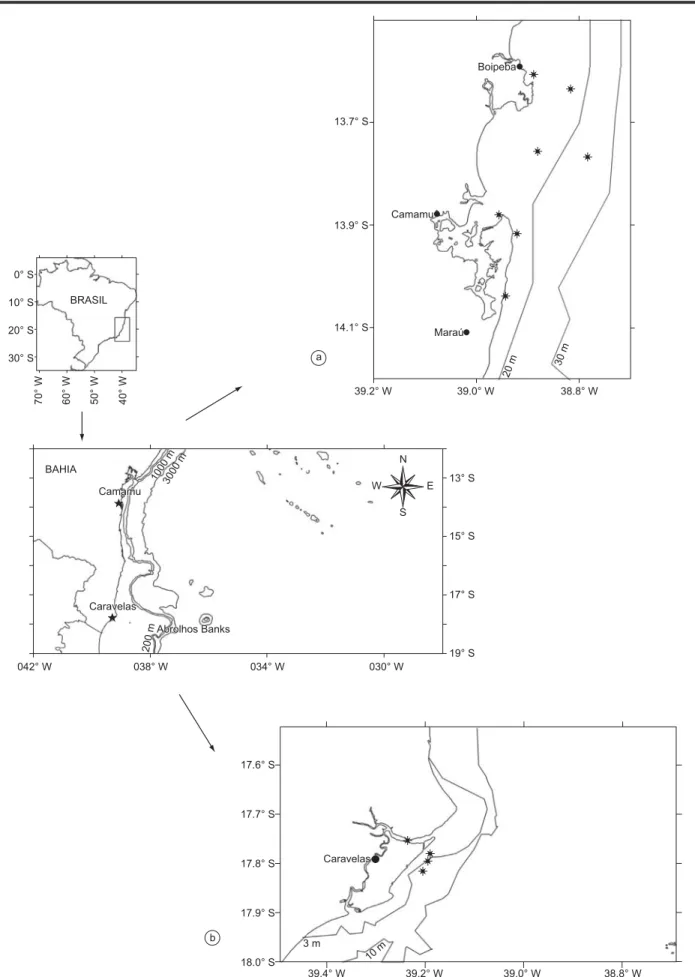
The biological material examined was obtained as part of a project to study the copepod fauna off northeastern Brazil. The program was carried out from October 2001 to February 2005, at two sites along the coast of Bahia. The sites with the occurrence of monstrilloids were located between Boipeba (13° 35’ 27” S and 38° 54’ 56” W) and the Maraú peninsula (14° 06’ 32” S and 39° 01’ 08” W), on the adjacent inner continental shelf near Camamu Bay (sta. 1-7) at stations as far as the 30-m isobath, and in the estuarine area of the Caravelas Channel (17° 44’ 47” and 17° 48’ 56” S and 39° 10’ 51 and 39° 14’ 11” W) and the adjacent coastal region (sta. 1-4) out to the 10-m isobath (Figure 1).
The samples were collected during the day, by subsurface hori-zontal and vertical hauls, with a conical net of mesh size 200 Pm and mouth diameter 60 cm, fitted with a calibrated flowmeter. Samples were fixed and preserved in 4% buffered formalin. Monstrilloid copepods were sorted out from the original samples.
All the specimens found were deposited in the zooplankton col-lection of the Integrated Zooplankton and Ichthyoplankton Laboratory of the Federal University of Rio de Janeiro (MONSTRILLOIDA DZUFRJ 175 to 191). The individuals were measured from the anterior end of the cephalic somite to the posterior margin of the anal somite.
Results and Discussion
A total of 98 individual monstrilloid copepods, belonging to the species Monstrilla grandis, Cymbasoma gracilis, C. cf. longispinosum, C. rigidum and C. quadridens Davis, were found in the surveyed area.
Two males of C. quadridens (1.19 and 1.26 mm, respectively) were collected. This species had a total length similar to that found by Dias (2005) in the Brazilian coast, and by Davis (1947) in the
northwestern Atlantic Ocean (Biscayne Bay, Florida). Hitherto, this species has been reported from the Atlantic Ocean (Davis 1947, Dias 1996, Johnsson 1998), including southeastern Brazil. This is the first record of the species off the Brazilian northeastern coast. The occurrence of C. quadridens in the area expands the distribution of this species northwards.
A single male of Monstrilla grandis, with a total body length of 1.06 mm was collected. The distribution of M. grandis is very wide (Suárez-Morales 2000a); this is the first record from the Bahia coastal region. The length of this specimen is similar to that found by Dias (2005) on the northeastern (state of Pernambuco), central and south coast of Brazil, and shorter than those found by Scott (1904) off Scotland, by Rose (1933) off France and by Ramírez (1971) off Argentina, which ranged from 1.6 to 2.0 mm. Suárez-Morales (2000a) reported total lengths of 0.61-0.65 mm (France). The size of copepods increases with decreasing temperature and with depth into oceanic waters. The warm-water communities contain smaller copepods than temperate waters, with cold polar waters containing large species (Hopcroft et al. 2001).
Four specimens of Cymbasoma cf. longispinosum (two males, one damaged; and two females) with total body lengths of 1.45 mm (male) and 1.96 and 2.06 mm (females), and two males of Cymbasoma cf. rigidum, each with total body length of 0.93 mm, were also recorded. The length of Cymbasoma cf. longispinosum is similar to that reported by Dias (2005) and Duarte (1999) for other Brazilian specimens. Rose (1933), from France, and Sars (1921), from Norway, reported larger lengths (F: 2.3 to 3.16 mm, M: 1.8 to 2.3 mm). The length of the males of C. cf. rigidum is similar to that found by Dias (2005) on the Brazilian coast, but differs from values reported by Wilson (1950) in the Philippines and Rose (1933) in France (1.5 to 1.8 mm).
In the present study, these nominal species are reported for the first time from the Bahia coastal region. Cymbasoma cf. longispinosum andC. cf. rigidum were found from off northeastern (state of Rio Grande do Norte) to southern Brazil (Dias 1996, 2005, Johnsson 1998, Duarte 1999, Dias 2005). Comparing the specimens found in different areas along the Brazilian coast, there are not morphological differences between the specimens found in the present study with the specimens designated as Cymbasoma cf. longispinosum and C.cf. rigidum by Dias (1996).
13.7° S
13.9° S
14.1° S
39.2° W 39.0° W 38.8° W
N
S
W E 13° S
15° S
17° S
19° S 0° S
10° S
20° S
30° S
70° W 60° W 50° W 40° W
BRASIL
a
b
Boipeba
Camamu
Maraú
20 m
30 m
Camamu Camamu
Caravelas Caravelas
Abrolhos Banks Abrolhos Banks BAHIA
042° W 038° W 034° W 030° W
1000 m 1000 m3000 m
200 m 200 m
Caravelas Caravelas
3 m
10 m
17.6° S
17.7° S
17.8° S
17.9° S
18.0° S
39.4° W 39.2° W 39.0° W 38.8° W
Figure 1.Map of the study area indicating the sampling stations with the occurrence of monstrilloids: a) inner continental shelf off Camamu; and b) estuarine area of Caravelas Channel and adjacent coastal region.
host (Suárez-Morales 2000a), the lengths of the specimens are pro-vided in order to contribute to studies and revisions of the specimens belonging to these species-complexes.
Eighty-nine females (3 damaged) of Cymbasoma gracilis (1.28-1.86 mm) were collected. The total length range is similar to that found by Dias (2005). This species has been found in tropical waters of the Atlantic and Indian oceans and in the Mediterranean and Red seas (Gurney 1927, Isaac 1975). Dias (2005) gave the local distribution of this species as from the northeastern (states of Bahia and Rio Grande do Norte) to the southern Brazilian coast.
The occurrence of these species expanded the distribution pro-posed by Dias (2005) in the tropical species associations in Brazilian coast, characterized by the presence of Tropical Water in the area.
Comparing the two sampling areas, Camamu Bay and Caravelas Channel, most of the monstrilloids (95%) were found in the area of the Caravelas Channel and the adjacent coastal region (with highest values of salinity up to an average of 37), in shallow waters down to the 10 m isobath. The coastal zone of Caravelas, off southern Bahia, contains diverse and productive ecological systems, including the Abrolhos coral reefs, considered the most important coral-reef sys-tem of the South Atlantic Ocean. Suárez-Morales (2001) suggested that monstrilloids are particularly rich and abundant in coastal and reef areas because their hosts are aggregated and abundant in these environments. The coastal zone and the oceanic region adjacent to Caravelas is the most productive of the Bahia coast (Andrade & Dominguez 2002). This is an area of high diversity and productivity, related to the coral reefs, and the large number of monstrilloids can be attributed to a local mass liberation of adults from aggregated ben-thic hosts (polychaetes and mollusks). The biotic community of the coral reefs off southern Bahia is still poorly known. In the Abrolhos region, it is composed mainly of cnidarians. The other components of the benthic fauna are the sponges, mollusks, polychaete annelids and echinoderms (Castro 1994).
Because of their scarcity in the zooplankton samples, the value of the occurrence of each specimen is high. Previous reports have shown that this area harbors a rich variety of species, several of which are undescribed (Suárez-Morales & Dias 2001a). This report increases to nine the number of species of Monstrilloida known from the Bahia region and emphasizes the relevance of coastal and reef-related areas as harboring an abundant and diverse array of monstrilloid copepods.
Acknowledgments
This study was conducted in the Integrated Laboratory of Zoo-plankton and IchthyoZoo-plankton, Department of Zoology, Institute of Biology, Federal University of Rio de Janeiro (UFRJ). It is part of a monitoring program of the Caravelas region developed by CEPE-MAR Ltda., and of Camamu Bay developed by ENSR International do Brasil Ltda. and KRITERIA Consultores Associados Ltda. We thank the ARACRUZ Celulose S.A., El Paso Óleo and Gás do Brasil Ltda. for placing some of their zooplankton material at our disposal. We thank Janet W. Reid for improving the English text.
References
ANDRADE, A.C. DA S. & DOMINGUEZ, J.M.L. 2002. Geologic-Geomor-phological Informations As Subsidies For Environmental Analysis: The Example of Caravelas Coastal Plain, Bahia. Bol. Par. Geoc. 51:9-17. BONECKER, S.L.C. 1995. Dinâmica do zooplâncton no sistema estuarino
do rio Mucuri-BA. Tese de Doutorado, Ciências Biológicas (Zoologia), Universidade de São Paulo, São Paulo, 194pp.
BOURNE, G.C. 1890. Notes on the genus Monstrilla Dana. Quekett J.
Microsc. Sci. 30(4):565-578, pl. 37.
CASTRO, C.B. 1994. Corals of Southern Bahia. In: Corals of Southern Bahia (B. Hetzel & C.B. Castro, eds.). Editora Nova Fronteira, Rio de Janeiro, p.161-176.
CAULLERY, M. & MESNIL, F. 1914. Sur deux Monstrillides parasites d’Annelides (Polydora giardi Mesn. et Syllis gracilis Gr.). Bull. Sci.
Fran. Bel. (7)48(1):15-29.
DAVIS, C.C. 1947. Two monstrilloids from Biscayne Bay, Florida. Trans. Am. Microsc. Soc. 66(4):390-395.
DAVIS, C.C. 1984. Planktonic Copepoda (including Monstrilloida). In: Marine plankton life cycle strategies (K.A. Steidinger & L.M. Walter, eds.). CRC Press, Boca Raton, Florida, p.67-91.
DIAS, C.O. 1996. Monstrilloida (Copepoda) off the Brazilian coast. Hydro-biologia 324(3):253-256.
DIAS, C.O. 2005. Taxonomy and geographic distribution of the Monstrilloida (Copepoda Crustacea) from the South Occidental Atlantic. Biota Neotrop. 5(2):http://www.biotaneotropica.org.br/v5n2/pt/fullpaper?bn020050220 05+en (last accessed on 07/06/07).
DUARTE, A.K. 1999. Ocorrência de Monstrilloida (Copepoda) em águas costeiras do Sul do Brasil. Nauplius 7:201-202.
GIESBRECHT, W. 1891. Elenco dei Copepodi pelagici raccolti dal Tenente di vascello Gaetano Chierchia durante il viaggio della R. Corvetta ‘Vettor Pisani’ negli anni 1882-1885 e dal Tenente di vascello Francesco Orsini nel Mar Rosso, nel 1884. Rendiconti delle Sedute della Real Accademia dei Lincei 7(1):474-481,
GRYGIER, M.J. 1994. Nomenclature, redescription, and new record from Okinawa of Cymbasoma morii Sekiguchi, 1982 (Monstrilloida). Hyd-robiologia 292/293: 23-29.
GURNEY, R. 1927. VIII. Report on the Crustacea Copepoda and Cladocera of the plankton. Trans. Zool. Soc. Lond. 22(2):139-171.
HOPCROFT, R. R., ROFF, J. C. & CHAVEZ, F. P. 20001. Size paradigms in copepod communities: a re-examination. Hydrobiologia 453-454: 133-141.
ISAAC, M.J. 1975. Copepoda. Sub-order Monstrilloida. Fiches d’Identification du Zooplancton, Conseil International pour l’Exploration de la Mer 144/145:1-10, figs.
JOHNSSON, R. 1998. Maxillopoda – Copepoda, Monstrilloida. In: Catalogue of Crustacea of Brazil (P.S. Young, ed.). Museu Nacional, Série Livros, Rio de Janeiro, 6:261-262.
NEUMANN-LEITÃO, S. 1994/1995. Resenha literária sobre zooplâncton estuarino no Brasil. Trab. Oceanogr. Univ. Fed. 23:25-53.
RAMÍREZ, F.C. 1971. Nuevas localidades para Monstrilla grandis
Giesbrech-ti, 1892 y Monstrilla helgolandica Claus, 1863 (Copepoda: Monstrilloida) hallados en aguas de la plataforma Argentina. Physis 30(81):377-383. ROSE, M. 1933. Copépodes pelagiques. Faune de France, Paris, 26:1-374,
figs. 1-456.
SARS, G.O. 1901. An account of the Crustacea of Norway with short descrip-tions and figures of all the species. Vol. IV. Copepoda Calanoida. The Bergen Museum, Bergen, p.1-28, figs. 1-16.
SARS, G.O. 1921. An account of the Crustacea of Norway with short descrip-tions and figures of all the species. Vol. VII. Copepoda Monstrilloida & Notodelphyoida. The Bergen Museum, Bergen, 91pp., figs. 1-37. SCOTT, T. 1904. Notes of some rare and interesting marine Crustacea.
Twenty-second Annual Report of the Fishery Board for Scotland, Being for the Year 1903. Part III. Scientific Investigations,22(3):242-261, Pls. 13-15. SEKIGUCHI, H. 1982. Monstrilloid copepods from Ago Bay, central Japan.
Proc. Jpn Soc. Syst. Zool. 22: 24-34, figs. 1-6 (Japanese summary). SUÁREZ-MORALES, E. 2000a. Taxonomic report on some monstrilloids
(Copepoda, Monstrilloida) from Toulon Bay, France. Bull. Inst. R. Sci. Nat. Belg. 70:107-118.
SUÁREZ-MORALES, E. 2000b. A new species and new geographic records ofMonstrilla (Copepoda: Monstrilloida) from the Philippines. J. Crust. Biol. 20(4):680-686.
with description of a new species. An. Inst. Biol. Univ. Nac. Autón. Mex. Zool. 72(1):9-28.
SUÁREZ-MORALES, E. 2006. Validation and redescription of Cymbasoma germanicum (Timm) (Crustacea: Copepoda: Monstrilloida) from
Helgo-land with comments on Cymbasoma rigidum Thompson. Helgol. Mar.
Res. 60(3):171-179.
SUÁREZ-MORALES, E. & DIAS, C.O. 2000. Two new species of Monstrillo-ida (Copepoda) from Brazil. J. Mar. Biol. Ass. U.K. 80(3670):1-9. SUÁREZ-MORALES, E. & DIAS, C.O. 2001a. A new species of Monstrilla
(Copepoda: Monstrilloida) from Brazil with notes on M. brevicornis Isaac. Proc. Biol. Soc. Wash. 114(1):219-228.
SUÁREZ-MORALES, E. & DIAS, C.O. 2001b. Taxonomic report of some monstrilloids (Copepoda: Monstrilloida) from Brazil with description of four new species. Bull. Inst. R. Sci. Nat. Belg. 71:65-81.
SUÁREZ-MORALES, E. & ESCAMILLA, J.B. 2001. Taxonomic report on some monstrilloids (Copepoda, Monstrilloida) from southeast Mexico with the description of a new species of Monstrilla. J. Nat. Hist. 35(10): 1433-1445.
SUÁREZ-MORALES, E. & IVANENKO, V.N. 2004. Two new species of
Monstrillopsis Sars (Crustacea: Copepoda: Monstrilloida) from the
White Sea and Norway, with comments on M. dubia Scott. Arctic 57(1):
37-46.
SUAREZ-MORALES, E., PALOMARES-GARCIA, R. 1999. Cymbasoma californiense, a new Monstrilloid (Crustacea: Copepoda: Monstrilloida) from Baja California, Mexico. Proc. Biol. Soc. Wash. 112(1):189-198. THOMPSON, I.C. 1888. Copepoda of Madeira and the Canary Islands, with
descriptions of new genera and species. J. Linn. Soc. London (Zool.) 20:145-156, pls.10-13.
TIMM, R. 1893. Monstrilla grandis Giesbr. M. helgolandica Claus, Thaumaleus germanicus n. sp. Zool. Anz. 16(432):418-420.