M. Faella, A. Murano (Eds.): Games, Automata, Logics and Formal Verification (GandALF 2012)
EPTCS 96, 2012, pp. 169–182, doi:10.4204/EPTCS.96.13
c
D. Neider, R. Rabinovich & M. Zimmermann This work is licensed under the
Creative Commons Attribution License.
Solving Muller Games via Safety Games
Daniel Neider Lehrstuhl f¨ur Informatik 7 RWTH Aachen University, Germany [email protected]
Roman Rabinovich Mathematische Grundlagen der Informatik
RWTH Aachen University, Germany [email protected]
Martin Zimmermann
RWTH Aachen University, Germany & University of Warsaw, Poland [email protected]
We transform a Muller game withnvertices into a safety game with(n!)3vertices whose solution allows to determine the winning regions of the Muller game and to compute a finite-state winning strategy for one player. This yields a novel antichain-based memory structure and a natural notion of permissive strategies for Muller games. Moreover, we generalize our construction by presenting a new type of game reduction from infinite games to safety games and show its applicability to several other winning conditions.
1
Introduction
Muller games are a source of interesting and challenging questions in the theory of infinite games. They are expressive enough to describe all ω-regular properties. Also, all winning conditions that depend only on the set of vertices visited infinitely often can trivially be reduced to Muller games. Hence, they subsume B ¨uchi, co-B ¨uchi, parity, Rabin, and Streett conditions. Furthermore, Muller games are not positionally determined, i.e., both players need memory to implement their winning strategies. In this work, we consider three aspects of Muller games: solution algorithms, memory structures, and quality measures for strategies.
To date, there are two main approaches to solve Muller games: direct algorithms and reductions. Examples for the first approach are Zielonka’s recursive polynomial space algorithm [22], which is based on earlier work by McNaughton [17], and Horn’s polynomial time algorithm for explicit Muller games [12]. The second approach is to reduce a Muller game to a parity game using Zielonka trees [7] or latest appearance records (LAR) [11].
In general, the number of memory states needed to win a Muller game is prohibitively large [7]. Hence, a natural task is to reduce this number (if possible) and to find new memory structures which may implement small winning strategies in subclasses of Muller games.
As for the third aspect, to the best of our knowledge there is no previous work on quality measures for strategies in Muller games. This is in contrast to other winning conditions. Recently, much attention is being paid to not just synthesize some winning strategy, but to find an optimal one according to a certain quality measure, e.g., waiting times in request-response games [13] and their extensions [23], permissiveness in parity games [1, 3], and the use of weighted automata in quantitative synthesis [2, 5].
∗This work was supported by the projectsGames for Analysis and Synthesis of Interactive Computational Systems (GASICS)
Inspired by work of McNaughton [18], we present a framework to deal with all three issues. Our main contributions are a novel algorithm and a novel type of memory structure for Muller games. We also obtain a natural quality measure for strategies in Muller games and are able to extend the definition of permissiveness to Muller games.
While investigating the interest of Muller games for “casual living-room recreation” [18], Mc-Naughton introduced scoring functions which describe the progress a player is making towards winning a play: consider a Muller game(A,F0,F1), whereA is the arena and(F0,F1)is a partition of the set of loops inA used to determine the winner. Then, the score of a setF of vertices measures how often Fhas been visited completely since the last visit of a vertex not inF. Playeriwins a play if and only if there is anF∈Fi such that the score ofFtends to infinity while being reset only finitely often (a reset occurs whenever a vertex outsideFis visited).
McNaughton proved the existence of strategies for the winning player that bound her opponent’s scores by|A|! [18], provided the play starts in her winning region. The characterization above implies that such a strategy is necessarily winning. The bound|A|! was subsequently improved to 2 (and shown to be tight) [9]. Since some score eventually reaches value 3, the winning regions of a Muller game can be determined by solving the reachability game in which a player wins if she is the first to reach a score of 31. However, it is cumbersome to obtain a winning strategy for the infinite-duration Muller game from a winning strategy for the finite-duration reachability game. The reason is that one has to carefully concatenate finite plays of the reachability game to an infinite play of the Muller game: reaching a score of 3 infinitely often does not prevent the opponent from visiting other vertices infinitely often.
The ability to bound the losing player’s scores can be seen as a safety condition as well. This allows us to devise an algorithm to solve Muller games that computes both winning regions and a winning strategy for one player. However, we do not obtain a winning strategy for the other player. In general, it is impossible to reduce a Muller game to a safety game whose solution yields winning strategies for both players, since safety conditions are on a lower level of the Borel hierarchy than Muller conditions.
Given a Muller game, we construct a safety game in which the scores of Player 1 are tracked (up to score 3). Player 0 wins the safety game, if she can prevent Player 1 from ever reaching a score of 3. This allows to compute the winning region of the Muller game by solving a safety game. Furthermore, by exploiting the intrinsic structure of the safety game’s arena we present an antichain-based memory structure for Muller games. Unlike the memory structures induced by Zielonka trees, which disregard the structure of the arena, and the ones induced by LARs, which disregard the structure of the winning condition (F0,F1), our memory structure takes both directly into account: a simple arena or a simple winning condition should directly lead to a small memory. The other two structures only take one source of simplicity into account, the other one can only be exploited when the game is solved. Furthermore, our memory also implements the most general non-deterministic winning strategy among those that prevent the opponent from reaching a certain score in a Muller game. Thus, our framework allows to extend the notion of permissiveness from positionally determined games to games that require memory.
Our idea of turning a Muller game into a safety game can be generalized to other types of winning conditions as well. We define a weaker notion of reduction from infinite games to safety games which not only subsumes our construction but generalizes several constructions found in the literature. Based on work on small progress measures for parity games [14], Bernet, Janin, and Walukiewicz showed how to determine the winning regions in a parity game and a winning strategy for one player by reducing it to a safety game [1]. Furthermore, Schewe and Finkbeiner [20] as well as Filiot, Jin, and Raskin [10]
1 This reachability game was the object of study in McNaughton’s investigation of humanly playable games, which, for
used a translation from co-B ¨uchi games to safety games in their work on bounded synthesis and LTL realizability, respectively. We present further examples and show that our reduction allows to determine the winning region and a winning strategy for one player by solving a safety game. Thus, all these games can be solved by a new type of reduction and an algorithm for safety games. Our approach simplifies the winning condition of the game – even down the Borel hierarchy. However, this is offset by an increase in the size of the arena. Nevertheless, in the case of Muller games, our arena is only cubically larger than the arena constructed in the reduction to parity games. Furthermore, a safety game can be solved in linear time, while the question whether there is a polynomial time algorithm for parity games is open.
2
Definitions
The power set of a setS is denoted by 2S and Ndenotes the set of non-negative integers. The prefix relation on words is denoted by⊑. Forρ∈Vω andL⊆Vω we define Pref(ρ) ={w∈V∗|w⊑ρ}and Pref(L) =S
ρ∈LPref(ρ). Forw=w1· · ·wn, let Last(w) =wn.
An arena A = (V,V0,V1,E) consists of a finite, directed graph (V,E) without terminal vertices, V0⊆V andV1=V\V0, whereVi denotes the positions of Playeri. We require every vertex to have an outgoing edge to avoid the nuisance of dealing with finite plays. The size|A|ofA is the cardinality of V. A loopC⊆V inA is a strongly connected subset ofV, i.e., for everyv,v′∈Cthere is a path fromvto v′that only visits vertices inC. A play inA starting inv∈V is an infinite sequenceρ=ρ0ρ1ρ2. . .such thatρ0=vand(ρn,ρn+1)∈Efor alln∈N. The occurrence set Occ(ρ)and infinity set Inf(ρ)ofρ are
given by Occ(ρ) ={v∈V | ∃n∈Nsuch thatρn=v}and Inf(ρ) ={v∈V | ∃ωn∈Nsuch thatρn=v}. We also use the occurrence set of a finite play infixw, which is defined in the same way. The infinity set of a play is always a loop in the arena. A gameG = (A,Win)consists of an arenaA and a set Win⊆Vω of winning plays for Player 0. The set of winning plays for Player 1 isVω\Win.
A strategy for Player iis a mapping σ:V∗Vi→V such that (v,σ(wv))∈E for allwv∈V∗Vi. We say thatσ is positional ifσ(wv) =σ(v)for everywv∈V∗Vi. A playρ0ρ1ρ2. . .is consistent withσ if
ρn+1=σ(ρ0· · ·ρn)for everynwithρn∈Vi. Forv∈V and a strategyσ for one of the players, we define the behavior of σ from v by Beh(v,σ) ={ρ ∈Vω |ρplay starting invthat is consistent withσ}. A strategyσfor Playeriis a winning strategy from a set of verticesW⊆Vif everyρ∈Beh(v,σ)forv∈W is won by Playeri. The winning regionWi(G)of PlayeriinG contains all vertices from which Playeri has a winning strategy. We always haveW0(G)∩W1(G) =/0 andG is determined ifW0(G)∪W1(G) =V. A winning strategy for Playeriis uniform, if it is winning from allv∈Wi(G).
A memory structure M = (M,Init,Upd) for an arena (V,V0,V1,E) consists of a finite set M of
memory states, an initialization function Init :V →M, and an update function Upd : M×V → M. The update function can be extended to Upd∗:V+ →M in the usual way: Upd∗(ρ0) =Init(ρ0) and Upd∗(ρ0. . .ρnρn+1) =Upd(Upd∗(ρ0. . .ρn),ρn+1). A next-move function (for Playeri) Nxt :Vi×M→V has to satisfy (v,Nxt(v,m))∈E for allv∈Vi and all m∈M. It induces a strategy σ for Playeriwith memoryMviaσ(ρ0. . .ρn) =Nxt(ρn,Upd∗(ρ0. . .ρn)). A strategy is called finite-state if it can be
im-plemented with a memory structure. The size ofM(and, slightly abusive,σ) is|M|.
3
Scoring Functions for Muller Games
In this section, we introduce scores and accumulators for Muller games. These concepts describe the progress of a player throughout a play. Intuitively, for each setF⊆V, the score ofF of a play prefixw measures how oftenF has been visited completely since the last visit of a vertex that is not inFor since the beginning ofw. The accumulator of the set F measures the progress made towards the next score increase: AccF(w)contains the vertices ofFseen since the last increase of the score ofFor the last visit of a vertexv∈/F, depending on which occurred later. For a more detailed treatment we refer to [9, 18].
Definition 1. Let w∈V+, v∈V , and F⊆V .
• DefineSc{v}(v) =1andAcc{v}(v) =/0, and for F6={v}defineScF(v) =0andAccF(v) =F∩ {v}.
• If v∈/F, thenScF(wv) =0andAccF(wv) =/0.
• If v∈F andAccF(w) =F\ {v}, thenScF(wv) =ScF(w) +1andAccF(wv) =/0.
• If v∈F andAccF(w)=6 F\ {v}, thenScF(wv) =ScF(w)andAccF(wv) =AccF(w)∪ {v}. Also, forF ⊆2V defineMaxSc
F:V+∪Vω→N∪ {∞}byMaxScF(ρ) =maxF∈Fmaxw⊑ρScF(w).
Example 1. Let V={0,1,2}and F={0,1}. We haveScF(10012100) =1andAccF(10012100) ={0}, butMaxSc{F}(10012100) =2, due to the prefix1001. The score for F is reset to0by the occurrence of 2, i.e.,ScF(10012) =0andAccF(10012) = /0.
If wis a play prefix with ScF(w)≥2, thenF is a loop of the arena. In an infinite playρ, Inf(ρ)
is the unique set F such that ScF tends to infinity while being reset to 0 only finitely often. Hence, MaxScF1−i(ρ)<∞implies Inf(ρ)∈Fi. Also, we always have AccF(w)(F.
Next, we give a score-based preorder and an induced equivalence relation on play prefixes.
Definition 2. LetF⊆2V and w,w′∈V+.
1. w isF-smaller than w′, denoted by w≤F w′, ifLast(w) =Last(w′)and for all F∈F:
• ScF(w)<ScF(w′), or
• ScF(w) =ScF(w′)andAccF(w)⊆AccF(w′).
2. w and w′areF-equivalent, denoted by w=F w′, if w≤F w′and w′≤F w.
The condition w=F w′ is equivalent to Last(w) =Last(w′) and for every F ∈F the equalities ScF(w) =ScF(w′)and AccF(w) =AccF(w′)hold. Thus,=F is an equivalence relation. Both≤F and
=F are preserved under concatenation, i.e.,=F is a congruence.
Lemma 1. LetF ⊆2V and w,w′∈V+.
1. If w≤F w′, then wu≤Fw′u for all u∈V∗.
2. If w=F w′, then wu=Fw′u for all u∈V∗.
4
Solving Muller Games by Solving Safety Games
In this section, we show how to solve a Muller game by solving a safety game. Our approach is based on the existence of winning strategies for Muller games that bound the losing player’s scores by 2.
The following example shows that the bound 2 is tight.
Example 2. Consider the Muller game G = (A,F0,F1), where A is depicted in Figure 1, F0=
{{0},{2},{0,1,2}} andF1={{0,1},{1,2}}. By alternatingly moving from1to0and to2, Player0 wins from every vertex, i.e., we have W0(G) ={0,1,2}, and she bounds Player1’s scores by2. However,
he is able to achieve a score of two: consider a play starting at1and suppose (w.l.o.g.) that Player0 moves to vertex0. Then, Player1uses the self-loop once before moving back to1, thereby reaching a score of2for the loop{0,1} ∈F1.
1
0 2
Figure 1: The arenaA for Example 2
A simple consequence of Lemma 2 is that a vertex vis in Player 0’s winning region of the Muller game G if and only if she can prevent her opponent from ever reaching a score of 3 for a set in F1. This is a safety condition which only talks about small scores of one player. To determine the winner ofG, we construct an arena which keeps track of the scores of Player 1 up to threshold 3. The winning conditionFof the safety game requires Player 0 to prevent a score of 3 for her opponent.
Theorem 1. LetG be a Muller game with vertex set V . One can effectively construct a safety gameGS with vertex set VSand a mapping f:V →VSwith the following properties:
1. For every v∈V : v∈Wi(G)if and only if f(v)∈Wi(GS).
2. Player0has a finite-state winning strategy from W0(G)with memory M⊆W0(GS). 3. |VS| ≤∑|Vk=|1 |Vk|
·k!·2k·k!+1≤(|V|!)3.
Note that the first statement speaks about both players while the second one only speaks about Player 0. This is due to the fact that the safety game keeps track of Player 1’s scores only, which al-lows Player 0 to prove that she can prevent him from reaching a score of 3. But as soon as a score of 3 is reached, the play is stopped. To obtain a winning strategy for Player 1, we have to swap the roles of the players and construct a safety game which keeps track of the scores of Player 0. Alternatively, we could construct the arena which keeps track of both player’s scores. However, that would require to define two safety games in this arena: one in which Player 0 has to avoid a score of 3 for Player 1 and vice versa. This arena is larger than the ones in which only the scores of one player are tracked (but still smaller than(|V|!)3). It is well-known that it is impossible to reduce a Muller game to a single safety game and
thereby obtain winning strategies for both players. We come back to this in Section 6.
We begin the proof of Theorem 1 by defining the safety gameGS. LetG = (A,F0,F1)with arena A = (V,V0,V1,E). We define
Plays<3={w|wplay prefix inG and MaxScF
1(w)<3}
to be the set of play prefixes inG in which the scores of Player 1 are at most 2 and we define
Plays=3={w0· · ·wn+1|w0· · ·wn+1play prefix inG, MaxScF1(w0· · ·wn)≤2, and MaxScF1(w0· · ·wnwn+1) =3}
to be the set of play prefixes in which Player 1 just reached a score of 3. Furthermore, let Plays≤3=
[1] [0]
[2]
[01]
[10]
[12]
[21]
[101]
[100]
[122]
[121]
[1010]
[1001]
[1221]
[1212]
[10101]
[10010]
[12212]
[12121]
[101010]
[100101]
[122121]
[121212]
W0(GS) W1(GS)
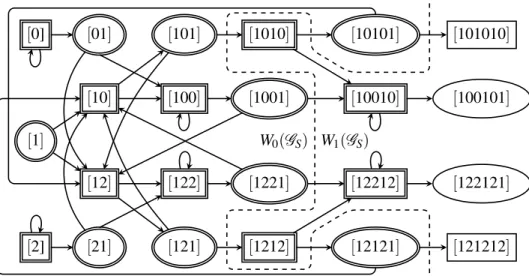
Figure 2: The safety gameGS forG from Example 2 (vertices drawn with double lines are in F); the dashed line separates the winning regions.
Formally, we defineGS= ((VS,VS
0,V1S,ES),F)where
• VS=Plays≤3/=F1,
• ViS={[w]=F1 |[w]=F1 ∈V
Sand Last(w)∈V
i}fori∈ {0,1},
• ([w]=F1,[wv]=F1)∈E
Sfor allw∈Plays
<3and allvwith(Last(w),v)∈E2, and
• F=Plays<3/=F1.
The definitions ofV0S andV1S are independent of representatives, as w=F1 w′ implies Last(w) = Last(w′), we haveVS=V0S∪V1Sdue toV =V0∪V1, andFis well-defined, since every equivalence class
in Plays<3/=F
1 is also one in Plays≤3/=F1. Finally, let f(v) = [v]=F1 for everyv∈V. Remark 1. If([w]=F1,[w
′]
=F1)∈E
S, then we have(Last(w),Last(w′))∈E.
For the sake of readability, we denote=F1-equivalence classes by[w]from now on. All definitions and statements below are independent of representatives and we refrain from mentioning it from now on.
Example 3. To illustrate these definitions, Figure 2 depicts the safety gameGS for the Muller gameG from Example 2. One can verify easily that the vertices[v]for v∈V are in the winning region of Player0. This corresponds to the fact that Player0’s winning region in the Muller game contains every vertex.
The proof of Theorem 1 is split into several lemmata. Due to determinacy of both games, it suffices to consider only one Player (we picki=0) to prove Theorem 1.1.
To win the safety game, we simulate a winning strategy for the Muller game that bounds Player 1’s scores by 2, which suffices to avoid the vertices inVS\F, which encode that a score of three is reached.
Lemma 3. For every v∈V : if v∈W0(G)then[v]∈W0(GS). 2Hence, every vertex in Plays
=3is terminal, contrary to our requirements on an arena. However, every play visiting these
For the other direction of Theorem 1.1 we show that a subset ofW0(GS)can be turned into a memory structure for Player 0 in the Muller game that induces a winning strategy. We use the=F1-equivalence class ofwas memory state to keep track of Player 1’s scores inG. But instead of using all equivalence classes in the winning region of Player 0, it suffices to consider the maximal ones with respect to≤F1 that are reachable via a fixed positional winning strategy for her in the safety game. Formally, we have to lift≤F1 to equivalence classes by defining[w]≤F1 [w′]if and only ifw≤F1 w′.
The following proof is similar to the reductions from co-B ¨uchi [10, 16, 20] and parity games [1] to safety games, but for the more general case of Muller games. We come back to the similarities to the latter reduction when we want to determine permissive strategies in the next section.
Lemma 4. For all v∈V : if[v]∈W0(GS)then v∈W0(G).
Proof. Letσ be a uniform positional winning strategy for Player 0 in GS and letR⊆VSbe the set of vertices which are reachable fromW0(GS)∩ {[v]|v∈V}by plays consistent withσ. Every[w]∈R∩VS
0
has exactly one successor inR(which is of the form[wv]for somev∈V) and dually, every successor of
[w]∈R∩V1S (which are exactly the classes[wv]with(Last(w),v)∈E) is inR. Now, letRmaxbe the set
of≤F1-maximal elements ofR. Applying the facts about successors of vertices inRstated above, we obtain the following remark.
Remark 2. Let Rmaxbe defined as above.
1. For every[w]∈Rmax∩V0S, there is a v∈V with(Last(w),v)∈E and there is a[w′]∈Rmaxsuch
that[wv]≤F1[w′].
2. For every[w]∈Rmax∩V1Sand each of its successors[wv], there is a[w′]∈Rmaxsuch that[wv]≤F1
[w′].
Thus, instead of updating the memory from [w] to [wv] (and thereby keeping track of the exact scores) when processing a vertexv, we can directly update it to a maximal element that isF1-larger than[wv](and thereby over-approximate the exact scores). Formally, we defineM= (M,Init,Upd)by
M=Rmax∪ {⊥}3,
Init(v) =
(
[w] if[v]∈W0(GS)and there exists[w]∈Rmaxwith[v]≤F1[w],
⊥ otherwise,
Upd([w],v) =
(
[w′] if there is some[w′]∈Rmaxsuch that[wv]≤F1[w′],
⊥ otherwise.
This implies[w]≤F1Upd∗(w)for everyw∈V+ with Upd∗(w)6=⊥. Thus, Last(w) =Last(w′), where
[w′] =Upd∗(w). Using Remark 2, we define the next-move function
Nxt(v,[w]) =
v′ if Last(w) =v,(v,v′)∈E, and there exists[w′]∈Rmaxsuch that[wv′]≤F1[w′],
v′′ otherwise (wherev′′is some vertex with(v,v′′)∈E),
and Nxt(v,⊥) =v′′for somev′′with(v,v′′)∈E. The second case in the case distinction above is just to match the formal definition of a next-move function; it is never invoked due to Last(w) =Last(w′)for Upd∗(w) = [w′]or Upd∗(w) =⊥.
3We use the memory state⊥to simplify our proof. It is not reachable via plays that are consistent with the implemented
It remains to show that the strategyσ implemented byMand Nxt is a winning strategy for Player 0
fromW ={v|[v]∈W0(GS)}. An inductive application of Remark 2 shows that every playwthat starts inW and is consistent with σ satisfies Upd∗(w)6=⊥. This bounds the scores of Player 1 by 2, as we have[w]≤F1 Upd∗(w)∈Rmax⊆Plays<3for every such play. Hence,σ is indeed a winning strategy for
Player 0 fromW.
Using Lemma 3 and the construction in the proof of Lemma 4 proves Theorem 1.2.
Corollary 1. Player 0 has a finite-state winning strategy from W0(G) whose memory states form an
≤F1-antichain in W0(GS).
To finish the proof of Theorem 1, we determine the size ofGS to prove the third statement. To this end, we use the concept of alatest appearance record(LAR) [11, 17]. Note that we do not need a hit position for our purposes. A wordℓ∈V+ is an LAR if every vertexv∈V appears at most once inℓ. Next, we map eachw∈V+ to a unique LAR, denoted by LAR(w), as follows: LAR(v) =vfor every v∈V and forw∈V+andv∈V we define LAR(wv) =LAR(w)vifv∈/Occ(w)and LAR(wv) =p1p2v
if LAR(w) =p1vp2. A simple induction shows that LAR(w)is indeed an LAR, which also ensures that
the decomposition ofwin the second case of the inductive definition is unique. We continue by showing that LAR(w)determines all but|LAR(w)|many ofw’s scores and accumulators.
Lemma 5. Let w∈V+andLAR(w) =vkvk−1· · ·v1.
1. w=xkvkxk−1vk−1· · ·x2v2x1v1for some xi∈V∗withOcc(xi)⊆ {v1, . . . ,vi}for every i. 2. ScF(w)>0if and only if F={v1, . . . ,vi}for some i.
3. If ScF(w) =0, then AccF(w) ={v1, . . . ,vi} for the maximal i such that {v1, . . . ,vi} ⊆ F and AccF(w) =/0if no such i exists.
4. LetScF(w)>0and F={v1, . . . ,vi}. Then,AccF(w)∈ {/0} ∪ {{v1, . . . ,vj} | j<i}. This characterization allows us to bound the size ofGSand to prove Theorem 1.3.
Lemma 6. We have|VS| ≤∑k|V=|1 |Vk|
·k!·2k·k!+1≤(|V|!)3.
Proof. In every safety game, we can merge the vertices inV\F to a single vertex without changing W0(G). Since[v]∈F, we also retain the equivalencev∈Wi(G)⇔[v]∈Wi(GS).
Hence, it remains to bound the index of Plays<3/=F1. Lemma 5 shows that a play prefix w∈V +
has|LAR(w)|many sets with non-zero score. Furthermore, the accumulator of the sets with score 0 is determined by LAR(w). Now, consider a playw∈Plays<3 and a setF ∈F1 with non-zero score. We have ScF(w)∈ {1,2} and there are exactly|F| possible values for AccF(w) due to Lemma 5.4. Finally, LAR(w) =LAR(w′)implies Last(w) =Last(w′). Hence, the index of Plays<3/=F1 is bounded
by the number of LARs, which is ∑nk=1 nk
·k!, times the number of possible score and accumulator combinations for each LARℓof lengthk, which is bounded by 2k·k!.
In the proof of Theorem 1.2, we used the maximal elements of Player 0’s winning region of the safety game that are reachable via a fixed winning strategy. It is the choice of this strategy that determines the size of our memory structure. However, finding a winning strategy that visits at mostk∈Nvertices in an arena (from a fixed initial vertex) for a givenkis NP-complete. This can be shown by a reduction from the vertex cover problem (compare, e.g., [8] where a more general result is shown). Moreover, it is not even clear that a small strategy also yields few maximal elements.
In general, a player cannot prevent her opponent from reaching a score of 2, but there are arenas in which she can do so. By first constructing the subgameG′
5
Permissive Strategies for Muller Games
Bernet et al. introduced the concept of permissive strategies for parity games4[1], a non-deterministic winning strategy that subsumes the behavior of every positional (non-deterministic) winning strategy. To compute such a strategy, they reduce a parity game to a safety game. The main observation underlying their reduction is the following: if we denote the number of vertices of priorityc by nc, then a (non-deterministic) positional winning strategy for Player 0 does not allow a play in which an odd prioritycis visitednc+1 times without visiting a smaller priority in between. This property can be formulated using scoring functions for parity games as well. The scoring function for a priorityccounts the occurrences ofcsince the last occurrence of a smaller priority (such an occurrence resets the score forcto 0). Hence, our work on Muller games can be seen as a generalization of Bernet et al.’s work. While the boundncon the scores in a parity game is straightforward, the bound 2 for Muller games is far from obvious.
Since both constructions are very similar, it is natural to ask whether we can use the concept of permissive strategies for Muller games. In parity games, we ask for a non-deterministic strategy that subsumes the behavior of everypositionalstrategy. As positional strategies do not suffice to win Muller games, we have to give a new definition of permissiveness for such games. In other words, we need to specify the strategies whose behaviors a permissive strategies for a Muller game should subsume. One way to do this is to fix a sufficiently large boundMand to require that a permissive strategy for a Muller games subsumes the behavior of every finite-state winning strategy of size at mostM(this was already proposed by Bernet et al. for parity games [1]).
However, we prefer to take a different approach. By closely inspecting the reduction of parity to safety games, it becomes apparent that the induced strategy does not only subsume the behavior of every positional winning strategy, but rather the behavior of every strategy that prevents the opponent from reaching a score ofnc+1 for some odd priorityc(in terms of scoring functions for parity games). It is this formulation that we extend to Muller games: a (non-deterministic) winning strategy for a Muller game is permissive, if it subsumes the behavior of every (non-deterministic) winning strategy that prevents the losing player from reaching a score of 3. We formalize this notion in the following and show how to compute such strategies from the safety game constructed in the previous section.
A multi-strategy for Player iin an arena (V,V0,V1,E)is a mapping σ:V∗Vi →2V\ {/0}such that v′∈σ(wv)implies(v,v′)∈E. A playρis consistent withσ ifρn
+1∈σ(ρ0· · ·ρn)for everynsuch that
ρn∈Vi. We still denote the plays starting in a vertexv that are consistent with a multi-strategy σ by BehA(v,σ)and define BehA(W,σ) =Sv∈WBehA(v,σ)for every subsetW⊆V. A multi-strategyσ is winning for Player 0 from a set of verticesW in a game(A,Win)if BehA(W,σ)⊆Win, and a multi-strategyτis winning for Player 1 fromW, if BehA(W,σ)⊆Vω\Win. It is clear that the winning regions of a game do not change when we allow multi-strategies instead of standard strategies.
To define finite-state multi-strategies we have to allow a next-move function to return more than one vertex, i.e., we have Nxt :Vi×M→2V\ {/0}such that v′ ∈Nxt(v,m) implies (v,v′)∈E. A memory structureMand Nxt implement a multi-strategyσ viaσ(wv) =Nxt(v,Upd∗(wv)).
Definition 3. A multi-strategyσ′for a Muller gameG is permissive, if
1. σ′is a winning strategy from every vertex in W0(G), and
2. BehA(v,σ)⊆BehA(v,σ′)for every multi-strategyσand every vertex v withMaxScF1(ρ)≤2for
everyρ∈BehA(v,σ).
4A parity game(A,Ω)consists of an arenaA and a priority functionΩ:V →N. A playρis winning for Player 0 if the
The original definition for parity games replaces the second condition by the following requirement: BehA(v,σ)⊆BehA(v,σ′)for every positional multi-strategyσand everyvfrom whichσ is winning.
Example 4. Once again consider the Muller game of Example 2. Starting at vertex1, moving to0is consistent with a winning strategy for Player0that bounds Player1’s scores by2. Similarly, moving to 2is also consistent with a winning strategy for Player0that bounds Player1’s scores. Hence, we have σ′(1) ={0,2}for every permissive strategyσ′. Now consider the play prefix10. Here it is Player1’s turn and he can use the self-loop either infinitely often (which yields a play that is winning for Player0) or only finitely often (say n times) before moving back to vertex1. In this situation, i.e., with play prefix 10n+11, a strategy that bounds Player 1’s scores by 2has to move to vertex 2. Hence, we must have σ′(10n+11)⊇ {2}. However, it is possible that we also have1∈σ′(10n+11), since a permissive strategy
may allow more plays than the ones of strategies that bound Player1’s scores by2. However, at some point,σ′has to disallow the move back to vertex0, otherwise it would allow a play that is losing for her.
Using the safety gameGS defined in the previous section, we are able to show that Player 0 always has a finite-state permissive strategy and how to compute one.
Theorem 2. LetG be a Muller game andGS the corresponding safety game as above. Then, Player0 has a finite-state permissive strategy forG with memory states W0(GS).
The proof is very similar to the one for Theorem 1.2 (cf. the construction in the proof of Lemma 4), but we have to use all vertices inW0(GS)as memory states to implement a permissive strategy, only using the maximal ones (restricted to those reachable by some fixed winning strategy for the safety games) does not suffice. Furthermore, the next-move function does not return one successor that guarantees a memory update to a state fromW0(GS), but it returns all such states.
Proof. We defineM= (M,Init,Upd)whereM=W0(GS)∪ {⊥}5,
Init(v) =
(
[v] if[v]∈W0(GS),
⊥ otherwise,
Upd([w],v) =
(
[wv] if[wv]∈W0(GS),
⊥ otherwise.
Hence, we have Upd∗(w) = [w]∈W0(GS) as long as every prefix x of w satisfies [x]∈W0(GS), and Upd∗(w) =⊥otherwise. We define Nxt by Nxt(v,⊥) ={v′}for some successorv′ofvand
Nxt(v,[w]) =
(
{v′|[wv′]∈W0(GS)} if[w]∈W0(GS)and Last(w) =v,
{v′′} otherwise, wherev′′is some successor ofv.
Since every vertex inW0(GS)∩VS
0 has at least one successor inW0(GS), the next-move function always returns non-empty set of successors ofvinG.
It remains to show that the strategy σ′ implemented by M and Nxt is permissive. We begin by
showing thatσ is winning from every vertexv∈W(G): due to Lemma 3, we have[v]∈W0(GS). Hence, the memory is initialized with[v]∈W0(GS). A simple induction shows Upd∗(w) = [w]∈W0(GS) for every play prefix that starts in[v]is consistent withσ′. This bounds Player 1’s scores by 2. Hence,σ′is indeed winning fromv.
5Again, we use the memory state⊥to simplify our proof. It is not reachable via plays that are consistent with the strategy
Finally, consider a multi-strategy σ and a vertex v such that MaxScF1(ρ)≤2 for every playρ ∈ BehA(v,σ). We have to show that every playρ∈BehA(v,σ)is consistent withσ′. Sinceσ is winning fromv(as it bounds Player 1’s scores), we havev∈W0(G). Now, assumeρ is not consistent withσ′
and letρ0· · ·ρnρn+1be the shortest prefix such thatρn+1∈/σ′(ρ0· · ·ρn). Then, we have[ρ0· · ·ρnρn+1]∈/ W0(GS). Hence, Player 1 has a strategy to enforce a visit toVS\F in G
S starting in [ρ0· · ·ρnρn+1]. Player 1 can mimic this strategy inG to enforce a score of 3 against every strategy of Player 0 when starting with the play prefixρ0· · ·ρnρn+1. Since this prefix is consistent withσ, which we have assumed
to bound Player 1’s scores by 2, we have derived the desired contradiction.
6
Safety Reductions for Infinite Games
It is well-known that classical game reductions are not able to reduce Muller games to safety games, since they induce continuous functions mapping (winning) plays of the original game to (winning) plays of the reduced game. The existence of such functions is tied to topological properties of the sets of winning plays in both games. However, we transformed a Muller game to a safety game which allowed us to determine the winning regions and a winning strategy for one player. This is possible, since our reduction does not induce a continuous function: a play is stopped as soon as Player 1 reaches a score of 3, but it can (in general) be extended to be winning for Player 0.
In this section, we briefly discuss the reason why Muller games can not be reduced to safety games in the classical sense, and then we present a novel type of game reduction that allows us to reduce many games known from the literature to safety games. The advantage of this safety reduction is that the reduced game is always a safety game. Hence, we can determine the winning regions of various games from different levels of the Borel hierarchy using the same technique. However, we only obtain a winning strategy for one player, and to give such a reduction, we need to have some information on the type of winning strategies a player has in such a game. Let us begin by discussing classical game reductions.
An arenaA = (V,V0,V1,E)and a memory structureM= (M,Init,Upd)forA induce the expanded arenaA ×M= (V×M,V0×M,V1×M,E′)where((s,m),(v′,m′))∈E′ if and only if(v,v′)∈E and
Upd(m,v′) =m′. Every playρ in A has a unique extended play ρ′= (ρ0,m0)(ρ1,m1)(ρ2,m2). . . in A ×Mdefined bym0=Init(ρ0)andmn+1=Upd(mn,ρn+1), i.e., mn=Upd∗(ρ0· · ·ρn). A gameG =
(A,Win)is reducible toG′= (A′,Win′)viaM, writtenG ≤MG′, ifA′=A ×Mand every playρin
G is won by the player who wins the extended playρ′inG′, i.e.,ρ∈Win if and only ifρ′∈Win′.
Lemma 7. LetG be a game with vertex set V and W ⊆V . IfG ≤MG′ and Player i has a positional winning strategy forG′from{(v,Init(v))|v∈W}, then she also has a finite-state winning strategy with memoryMforG from W .
The set WinM⊆Vω of winning plays of a Muller game is in general on a higher level of the Borel hierarchy than the set WinS⊆Uω of winning plays of a safety game. Hence, in general, there exists no continuous (in the Cantor topology) function f:Vω →Uω such thatρ ∈WinM if and only if f(ρ)∈
WinS(see, e.g., [15]). Since the mapping from a play inA to its extended play inA ×Mis continuous, we obtain the following negative result (which holds for other pairs of games as well).
Corollary 2. In general, Muller games cannot be reduced to safety games.
Definition 4. A gameG= (A,Win)with vertex set V is (finite-state) safety reducible, if there is a regular language L⊆V∗of finite words such that:
• For every playρ∈Vω: ifPref(ρ)⊆L, thenρ∈Win.
• If v∈W0(G), then Player0has a strategyσ such thatPref(Beh(v,σ))⊆L.
Note that a strategy σ satisfying Pref(Beh(v,σ))⊆Lis winning for Player 0 from v. Many games appearing in the literature on infinite games are safety reducible, although these reductions do neither yield fast solution algorithms nor optimal memory structures.
• In a B ¨uchi gameG, Player 0 has a positional winning strategy such that every consistent play visits a vertex inF at least every k=|V\F|steps. Hence,G is safety reducible withL=Pref(((V\ F)≤k·F)ω).
• In a co-B ¨uchi gameG, Player 0 has a positional winning strategy such that every consistent play stays in F after visiting each vertex in V\F at most once. Hence, G is safety reducible with L=Pref({w·Fω | eachv∈V\F appears at most once inw}).
• In a request-response gameG, Player 0 has a finite-state winning strategy such that in every con-sistent play every request is answered within k =|V| ·r·2r+1 steps, where r is the number of request-response pairs [21]. Hence,G is safety reducible to the language of prefixes of plays in which every request is answered withinksteps.
• In a parity game, Player 0 has a positional winning strategy such that every consistent play does not visitnc+1 vertices with an odd prioritycwithout visiting a smaller even priority in between, wherencis the number of vertices with priority c. Hence,G is safety reducible to the language of prefixes of plays satisfying this condition for every odd priorityc.
• Lemma 2 shows that a Muller game is safety reducible to the language of prefixes of plays that never reach a score of 3 for Player 1.
Let A = (V,V0,V1,E) be an arena and let A= (Q,V,q0,δ,F) be a deterministic finite automaton
recognizing a language overV. We define the arena A ×A= (V×Q,V0×Q,V1×Q,E◦δ) where
((v,q),(v′,q′))∈E◦δ if and only(v,v′)∈Eandδ(q,v′) =q′.
Theorem 3. LetG be a game with vertex set V that is safety reducible with language L(A) for some
DFAA= (Q,V,q0,δ,F). Define the safety gameG′= (A ×A,V×F).
1. v∈W0(G)if and only if(v,δ(q0,v))∈W0(G′).
2. Player0has a finite-state winning strategy from W0(G)with memory states Q.
It is easy to show that every game in which Player 0 has a finite-state winning strategy is safety-reducible to the prefixes of plays consistent with this strategy, which is a regular language. However, for this construction, we need a finite-state winning strategy, i.e., there is no need for a safety reduction.
IfG is determined, then Theorem 3.1 is equivalent tov∈Wi(G)if and only if(v,δ(q0,v))∈Wi(G′). Hence, all games discussed above can be solved by solving safety games. We conclude by mentioning that safety reducibility of parity games was used implicitly to construct an algorithm for parity games [14] and to compute permissive strategies for parity games [1]. Furthermore, the safety reducibility of co-B ¨uchi games is used implicitly in work on bounded synthesis [20] and LTL realizability [10], so-called “Safraless” constructions [16] which the do not rely on determinization of automata on infinite words.
7
Conclusion
We have shown how to translate a Muller game into a safety game to determine both winning regions and a finite-state winning strategy for one player. Then, we generalized this construction to a new type of reduction from infinite games to safety games with the same properties. We exhibited several implicit applications of this reduction in the literature as well as several new ones. Our reduction from Muller games to safety games is implemented in the toolGAVS+6 [6]. In the future, we want to compare the
performance of our solution to classical reductions to parity games as well as to direct algorithms. Our construction is based on the notion of scoring functions for Muller games. Considering the maximal score the opponent can achieve against a strategy leads to a hierarchy of all finite-state strategies for a given game. Previous work has shown that the third level of this hierarchy is always non-empty, and there are games in which the second level is empty. Currently, there is no non-trivial characterization of the games whose first or second level of the hierarchy is non-empty, respectively.
The quality of a strategy can be measured by its level in the hierarchy. We conjecture that there is always a finite-state winning strategy of minimal size in the least non-empty level of this hierarchy, i.e., there is no tradeoff between size and quality of a strategy. This tradeoff may arise in many other games for which a quality measure is defined. Also, a positive resolution of the conjecture would decrease the search space for a smallest finite-state strategy.
We used scores to construct a novel antichain-based memory structure for Muller games. The an-tichain is induced by a winning strategy for the safety game. It is open how the choice of such a strategy influences the size of the memory structure and how heuristic approaches to computing winning strate-gies that only visit a small part of the arena [19] influence the performance of our reduction.
Finally, there is a tight connection between permissive strategies, progress measure algorithms, and safety reductions for parity games: the progress measure algorithm due to Jurdzi´nski [14] and the re-duction from parity games to safety game due to Bernet et al. [1] to compute permissive strategies are essentially the same. Whether the safety reducibility of Muller games can be turned into a progress measure algorithm is subject to ongoing research.
AcknowledgmentsThe authors want to thank Wolfgang Thomas for bringing McNaughton’s work to their attention, Wladimir Fridman for fruitful discussions, and Chih-Hong Cheng for his implementation of the algorithm.
References
[1] Julien Bernet, David Janin & Igor Walukiewicz (2002): Permissive strategies: from parity games to safety games.ITA36(3), pp. 261–275, doi:10.1051/ita:2002013.
[2] Roderick Bloem, Krishnendu Chatterjee, Thomas A. Henzinger & Barbara Jobstmann (2009):Better Quality in Synthesis through Quantitative Objectives. In Ahmed Bouajjani & Oded Maler, editors: CAV,LNCS
5643, Springer, pp. 140–156, doi:10.1007/978-3-642-02658-4_14.
[3] Patricia Bouyer, Nicolas Markey, J¨org Olschewski & Michael Ummels (2011):Measuring Permissiveness in Parity Games: Mean-Payoff Parity Games Revisited. In Bultan & Hsiung [4], pp. 135–149, doi:10.1007/ 978-3-642-24372-1_11.
[4] Tevfik Bultan & Pao-Ann Hsiung, editors (2011): Automated Technology for Verification and Analysis, 9th International Symposium, ATVA 2011, Taipei, Taiwan, October 11-14, 2011. Proceedings.Lecture Notes in Computer Science6996, Springer, doi:10.1007/978-3-642-24372-1.
6See
[5] Pavol ˘Cern´y, Krishnendu Chatterjee, Thomas A. Henzinger, Arjun Radhakrishna & Rohit Singh (2011): Quantitative Synthesis for Concurrent Programs. In Ganesh Gopalakrishnan & Shaz Qadeer, editors:CAV,
LNCS6806, Springer, pp. 243–259, doi:10.1007/978-3-642-22110-1_20.
[6] Chih-Hong Cheng, Alois Knoll, Michael Luttenberger & Christian Buckl (2011):GAVS+: An Open Platform for the Research of Algorithmic Game Solving. In Parosh Aziz Abdulla & K. Rustan M. Leino, editors:
TACAS,LNCS6605, Springer, pp. 258–261, doi:10.1007/978-3-642-19835-9_22.
[7] Stefan Dziembowski, Marcin Jurdzi´nski & Igor Walukiewicz (1997):How Much Memory is Needed to Win Infinite Games? In:LICS, IEEE Computer Society, pp. 99–110, doi:10.1109/LICS.1997.614939. [8] Ruediger Ehlers (2011): Small witnesses, accepting lassos and winning strategies in omega-automata and
games.CoRRabs/1108.0315. Available athttp://arxiv.org/abs/1108.0315.
[9] John Fearnley & Martin Zimmermann (2012): Playing Muller Games in a Hurry. Int. J. Found. Comput. Sci.23(3), pp. 649–668, doi:10.1142/S0129054112400321.
[10] Emmanuel Filiot, Naiyong Jin & Jean-Franc¸ois Raskin (2011):Antichains and compositional algorithms for LTL synthesis.Formal Methods in System Design39(3), pp. 261–296, doi:10.1007/s10703-011-0115-3. [11] Yuri Gurevich & Leo Harrington (1982):Trees, Automata, and Games. In:STOC, ACM, pp. 60–65. [12] Florian Horn (2008): Explicit Muller Games are PTIME. In Ramesh Hariharan, Madhavan Mukund &
V. Vinay, editors: FSTTCS,LIPIcs 2, Schloss Dagstuhl – Leibniz-Zentrum f¨ur Informatik, pp. 235–243, doi:10.4230/LIPIcs.FSTTCS.2008.1756.
[13] Florian Horn, Wolfgang Thomas & Nico Wallmeier (2008):Optimal Strategy Synthesis in Request-Response Games. In Sung Deok Cha, Jin-Young Choi, Moonzoo Kim, Insup Ldoi & Mahesh Viswanathan, editors:
ATVA,LNCS5311, Springer, pp. 361–373, doi:10.1007/978-3-540-88387-6_31.
[14] Marcin Jurdzi´nski (2000):Small Progress Measures for Solving Parity Games. In Horst Reichel & Sophie Tison, editors:STACS,LNCS1770, Springer, pp. 290–301, doi:10.1007/3-540-46541-3_24.
[15] Alexander Kechris (1995):Classical Descriptive Set Theory.Graduate Texts in Mathematics156, Springer. [16] Orna Kupferman & Moshe Y. Vardi (2005): Safraless Decision Procedures. In: FOCS, IEEE Computer
Society, pp. 531–542, doi:10.1109/SFCS.2005.66.
[17] Robert McNaughton (1993): Infinite Games Played on Finite Graphs. Ann. Pure Appl. Logic65(2), pp. 149–184, doi:10.1016/0168-0072(93)90036-D.
[18] Robert McNaughton (2000):Playing Infinite Games in Finite Time. In Arto Salomaa, Derick Wood & Sheng Yu, editors:A Half-Century of Automata Theory, World Scientific, pp. 73–91.
[19] Daniel Neider (2011): Small Strategies for Safety Games. In Bultan & Hsiung [4], pp. 306–320, doi:10. 1007/978-3-642-24372-1_22.
[20] Sven Schewe & Bernd Finkbeiner (2007): Bounded Synthesis. In Kedar S. Namjoshi, Tomohiro Yoneda, Teruo Higashino & Yoshio Okamura, editors: ATVA,LNCS 4762, Springer, pp. 474–488, doi:10.1007/ 978-3-540-75596-8_33.
[21] Nico Wallmeier, Patrick H¨utten & Wolfgang Thomas (2003):Symbolic Synthesis of Finite-State Controllers for Request-Response Specifications. In Oscar H. Ibarra & Zhe Dang, editors:CIAA,LNCS2759, Springer, pp. 11–22, doi:10.1007/3-540-45089-0_3.
[22] Wiesław Zielonka (1998): Infinite Games on Finitely Coloured Graphs with Applications to Automata on Infinite Trees.Theor. Comput. Sci.200(1-2), pp. 135–183, doi:10.1016/S0304-3975(98)00009-7. [23] Martin Zimmermann (2009):Time-Optimal Winning Strategies for Poset Games. In Sebastian Maneth, editor: