International Journal of Engineering and Technology Volume 2 No. 10, October, 2012
ISSN: 2049-3444 © 2012 – IJET Publications UK. All rights reserved.
1780
Achieving Access to Knowledge through E-Learning: A Case Study
Christian A. Bolu*, Ikechukwu C. Ifeanacho**
*Department of Mechanical Engineering, University of Nigeria, 410101, Enugu State, Nigeria **Department of Architecture, University of Nigeria, Enugu Campus, Enugu State, Nigeria
ABSTRACT
More and more scholars are turning to the Internet to find scientific information and academic institutions are devoting more and more resources to improving their presence on the web.
E-learning programs and open access initiatives allow knowledge of these institutions to spread beyond physical boundaries. The Web can hence be used as a way to attract students, scholars and funding from other places, spreading the prestige of these educational institutions all over the world. This has provoked competition between universities to achieve an advantageous visibility on the Web and to improve their position in search engine results.
This paper examines ongoing e-learning effort globally to enhance access to knowledge. In particular the role of University of Nigeria is playing in the promotion of access to knowledge is discussed. In line with their Information and Communication Technology Programme, the University has created an Internet repository of over 20,000 documents such as theses, journals articles and academic publications as well as a vibrant e-learning portal.
1.
WHY THE WEB?
More and more scholars are turning to the Internet to find scientific information and academic institutions are devoting more and more resources to improving their presence on the web. The web is probably already the main showcase for universities, but in the near future the virtual institution might be as important and representative as a real one. In a world where every day we become more interconnected, the global visibility of academia is clearly linked to their commitment to the worldwide web [3]
E-learning programs and open access initiatives allow knowledge of these institutions to spread beyond physical boundaries. The Web can hence be used as a way to attract students, scholars and funding from other places, spreading the prestige of these educational institutions all over the world. This has provoked competition between universities to achieve an advantageous visibility on the Web and to improve their position in search engine results.
2.
WHAT IS E-LEARNING?
E-Learning is the use of technology to enable people to learn anytime and anywhere. E-Learning can include training, the delivery of just-in-time information and guidance from experts
E-learning involves the use of a computer or electronic device (e.g. a mobile phone) in some way to provide
training, educational or learning material. It can involve a greater variety of equipment than online training or education, for as the name implies, "online" involves using the Internet or an Intranet. CD-ROM and DVD can be used to provide learning materials.
Distance education provided the base for e-learning's development. E-learning can be "on demand". It overcomes timing, attendance and travel difficulties. An e-journey is one type of e-learning or online training. Blended learning is e-learning combined with other training methods.
3.
FEATURES,
BENEFITS
AND
ADVANTAGES OF E-LEARNING
"Good teaching is good teaching, no matter how it's done." The old adage still rings true, and e-Learning brings with it new dimensions in education. Some of the unique features of e-Learning are listed below.
3.1
Features of E-Learning
Learning is self-paced and gives students a chance to speed up or slow down as necessary
Learning is self-directed, allowing students to choose content and tools appropriate to their differing interests, needs, and skill levels
ISSN: 2049-3444 © 2012 – IJET Publications UK. All rights reserved.
1781
Designed around the learner Geographical barriers are eliminated, opening up broader education options
24/7 accessibility makes scheduling easy and allows a greater number of people to attend classes
On-demand access means learning can happen precisely when needed
Travel time and associated costs (parking, fuel, vehicle maintenance) are reduced or eliminated.
Overall student costs are frequently less (tuition, residence, food, child care)
Potentially lower costs for companies needing training, and for the providers
Fosters greater student interaction and collaboration
Fosters greater student/instructor contact
Enhances computer and Internet skills
Draws upon hundreds of years of established pedagogical principles
Has the attention of every major university in the world, most with their own online degrees, certificates, and individual courses
3.2
Benefits of e-Learning
There are many significant benefits for the student who learns online. Some of them are listed below:
3.2.1
Convenience and Portability
Courses are accessible on your schedule
Online learning does not require physical attendance
Learning is self-paced (not too slow, not too fast)
You're unbound by time - courses are available 24/7
You're unbound by place - study at home, work, or on the road
Read materials online or download them for reading later
3.2.2
Cost and Selection
Choose from a wide range of courses to meet your needs
Degree, Vocational, and Certificate programs
Continuing Education
Individual courses
Wide range of prices to fit your budget
Go back to school to get a degree, learn a new skill, learn a new craft, or just have fun!
From art to zoology you can do it all online in a price range to fit your budget.
Flexibility
Online learning accommodates your preferences and needs - it's student-centered
Choose instructor-led or self-study courses
Skip over material you already know and focus on topics you'd like to learn
Use the tools best suited to your learning styles
Higher Retention
Online learning will draw you to topics you like and enjoy. Studies show that because of this and the variety of delivery methods used to reach different types of learners, retention is frequently better than in a traditional classroom.
Greater Collaboration
Technology tools make collaboration among students much easier. Since many projects involve collaborative learning, the online environment is far easier (and often more comfortable) to work in since learners don't have to be face-to-face.
Global Opportunities
The global learning community is at your fingertips with online learning. The technologies used give online instructional designers the ability to build in tools that take you to resources you may never see in a traditional classroom.
3.3
Challenges of E-learning
3.3.1
Disadvantages to the Trainer or
Organization
ISSN: 2049-3444 © 2012 – IJET Publications UK. All rights reserved.
1782
Up-front investment required of an e-learning
solution is larger due to development costs. Budgets and cash flows will need to be negotiated.
Technology issues that play a factor include whether
the existing technology infrastructure can accomplish the training goals, whether additional tech expenditures can be justified, and whether compatibility of all software and hardware can be achieved.
Inappropriate content for e-learning may exist
according to some experts, though are limited in number. Even the acquisition of skills that involve complex physical/motor or emotional components (for example, juggling or mediation) can be augmented with e-learning.
Cultural acceptance is an issue in organizations
where student demographics and psychographics may predispose them against using computers at all, let alone for e-learning.
3.3.2
Disadvantages to the Learner
The ways in which e-learning may not excel over other training include:
Technology issues of the learners are most
commonly technophobia and unavailability of required technologies.
Portability of training has become strength of
e-learning with the proliferation of network linking points, notebook computers, PDAs, and mobile phones, but still does not rival that of printed workbooks or reference material.
Reduced social and cultural interaction can be a
drawback. The impersonality, suppression of communication mechanisms such as body language, and elimination of peer-to-peer learning that are part of this potential disadvantage are lessening with advances in communications technologies.
3.3.3
Disadvantages of e-Learning
Unmotivated learners or those with poor study habits may fall behind
Lack of familiar structure and routine may take getting used to
Students may feel isolated or miss social interaction
Instructor may not always be available on demand
Slow or unreliable Internet connections can be frustrating
Managing learning software can involve a learning curve
Some courses such as traditional hands-on courses can be difficult to simulate
4.
GLOBAL
EXAMPLES
TOWARDS
ACCESS TO KNOWLEDGE
4.1
Google’s Book Project
"Google's mission is to organize the world's information and make it universally accessible and useful. Today, together with the authors, publishers, and libraries, we have been able to make a great leap in this endeavour," said Sergey Brin, cofounder & president of technology at Google. "While this agreement is a real win-win for all of us, the real victors are all the readers. The tremendous wealth of knowledge that lies within the books of the world will now be at their fingertips." [Google, 4]
4.1.1
Quantity
Right now, one can search over the full text of some seven million books through Google Books. Whenever you do a Google web search, you are also searching Google book index; any relevant hits will appear in your search results, and clicking on a result will take you to the relevant page in the book, where you can browse a few more pages and learn where to borrow or buy it.
4.1.2
Sources
The books in Google Books come from two sources.
i. The Library Project
Google has partnered with renowned libraries around the world to include their collections in Book Search. For Library Project books that are still in copyright, the results are like a card catalogue; it shows information about the book and, generally, a few snippets of text showing ones search term in context. For Library Project books that are out of copyright, however, can be read and the entire book downloaded.
ii. The Partner Program
ISSN: 2049-3444 © 2012 – IJET Publications UK. All rights reserved.
1783
4.1.3
Future Offering
i. Out of print books
Out-of-print books will be available for preview, reading and purchase in the U.S.; thus helping to ensure the ongoing accessibility of out-of-print books.
ii. Accessing books
The project will create new options for reading entire books by the following routes:
a. Online access
One will be able to purchase full online access to millions of books. This means that one can read an entire book from any Internet-connected computer, simply by logging in to your Book Search account, and it will remain on your electronic bookshelf, so you can come back and access it whenever you want in the future.
b. Library and university access
Libraries, universities and other organizations will have the ability to purchase institutional subscriptions, which will give users access to the complete text of millions of titles while compensating authors and publishers for the service. Students and researchers will have access to an electronic library that combines the collections from many of the top universities across the country. Public and university libraries in the U.S. will also be able to offer terminals where readers can access the full text of millions of out-of-print books for free.
c. Buying or borrowing actual books
If the book one wants is available in a bookstore or nearby library, one will continue to be pointed to those resources.
iii. International users
Google Book project directly affects only those users who access Book Search in the U.S.; anywhere else, the Book Search experience will not change. Going forward, Google hopes to work with international industry groups and individual rights holders to expand the benefits of this agreement to users around the world.
iv. Types of books
There are three categories of books on Google Books.
a.In-copyright and in-print books
In-print books are books that publishers are still actively selling, the ones you see at most bookstores. This agreement expands the online marketplace for in-print books by letting authors and publishers turn on the "preview" and "purchase" models that make their titles more easily available through Book Search.
b.In-copyright but out-of-print books
Out-of-print books aren’t actively being published or sold, so the only way to procure one is to track it down in a library or used bookstore. Every out-of-print book that Google digitizes will become available online for preview and purchase, unless its author or publisher chooses to "turn off" that title.
c.Out-of-copyright books
Google Books will display out-of-copyright books and will continue to allow Book Search users to read, download and print these titles, just as we do today.
4.2
The University of Nigeria Effort on
Achieving Access to Knowledge
The University of Nigeria ICT Strategy Programme has the following Objectives:
The provision of ICT infrastructure, including support and standards by raising the quantity of Internet Bandwidth to a level that makes the use of Internet for research and communication comparable to what obtains in some of the best universities in the world.
The delivery of high quality and cost effective ICT services and training by making Internet accessible from the staff research desks, student workplaces and laboratories in the shortest possible time
The fostering of innovation, best practice, and value for money in the use of ICT in teaching, learning and research across the University.
ISSN: 2049-3444 © 2012 – IJET Publications UK. All rights reserved.
1784
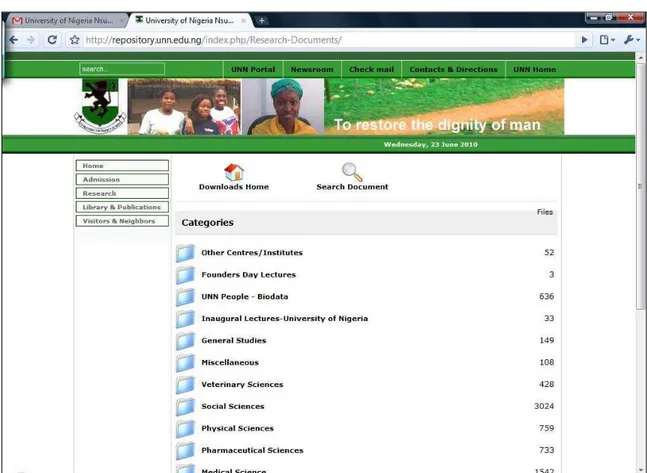
Fig 1: The University of Nigeria Document Repository
http://repository.unn.edu.ng They are as follows:
Category Number of
Documents
Arts 1,208
Agriculture 1,669
Biological Sciences 941
Business Administration 2,236
Dentistry 0
Education 4,877
Engineering 755
Environmental Studies 555
Health Sciences and Technology 261
Law 19
Medicine 1,542
Pharmaceutical Sciences 733
Physical Sciences 759
Social Sciences 3,024
Veterinary Medicine 428
Inaugural Lectures 33
Others 1,057
ISSN: 2049-3444 © 2012 – IJET Publications UK. All rights reserved.
1785
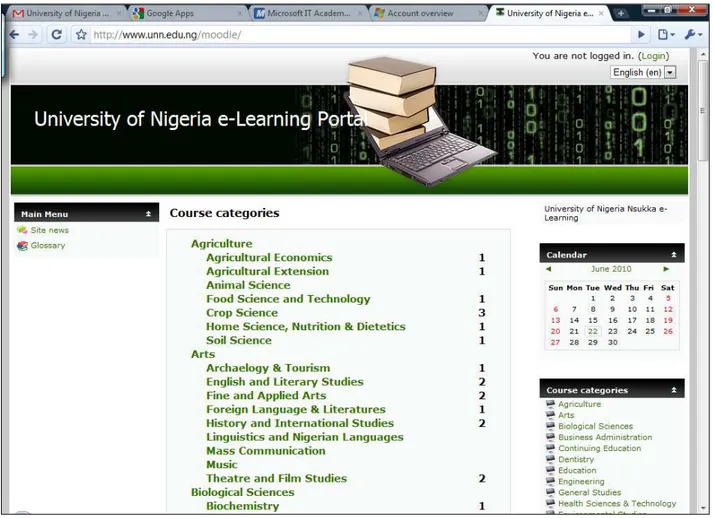
The University has an e-learning Portal for her studentsand soon will be providing access to the proposed
Distance Learning programme and some continuing Education Programmes for the public.
http://learn.unn.edu.ng
Fig 2: The University of Nigeria e-Learning Portal
Presently, the university e-learning portal, as at Tuesday, 22 June 2010, has the following statistics:
Areas Quantity
Courses: 207
Users: 3861
Role assignments: 2034 Teachers: 109
Posts: 529
Questions: 1123 Resources: 302
5.
CONCLUSION
There is quite considerable effort being made by various organisations and universities to promote free access to knowledge. The effort by Google Inc through their Book project, the controversies notwithstanding, is of note. The University of Nigeria is playing her role in the promotion
of access to knowledge in Nigeria. The University has an Internet repository of over 20,000 publications such as theses, journals articles and academic publications as well as a vibrant e-learning portal.
REFERENCES
[1] University of Nigeria Repository: <http://repository.unn.edu.ng>, accessed June 23, 2010
[2] University of Nigeria e-Learning Portal: <http://learn.unn.edu.ng>, accessed June 22, 2010
[3] Ortega, J. L. & Aguillo, Mapping world-class universities on the web, Information Processing and Management, Elsevier, 45 (2009) 272–279.