Revista Brasileira de Geof´ısica (2008) 26(3): 327-330 © 2008 Sociedade Brasileira de Geof´ısica ISSN 0102-261X
www.scielo.br/rbg
TIME-LAPSE CRITICAL REFLECTION: DOES IT REALLY WORK IN SEISMIC MONITORING
OF LOW POROSITY AND HIGH EFFECTIVE STRESS CONDITIONS?
Fredy Alex Villaordu˜na Artola
1, Vladimir Alvarado Bastante
2and Wilson Mouzer Figueir´o
3Recebido em 30 abril, 2007 / Aceito em 31 julho, 2008 Received on April 30, 2007 / Accepted on July 31, 2008
ABSTRACT.We present an evaluation of the time lapse critical reflection method from the point of view of sensitivity and uncertainty analysis. The purpose of this analysis is to establish the link between changes in the p-wave velocity in the reservoir, due to fluid substitution, and the critical distance (XC), a dynamic parameter.
Two static parameters of the overburden are considered in the analysis: its thickness and its effective or equivalent P-wave velocity. Stochastic uncertainty analysis by means of Monte Carlo simulations was carried out to determine the sensitivity ofXCto velocity contrast between that of the reservoir and the corresponding one to the
overburden (incident medium). Results show that the effect of the velocity values in each medium, overburden and reservoir (reflecting medium), on estimates ofXC
depends on the velocity contrast between the two media. It turns out that the greater the velocity difference between the two media, the greater the effects associated with the reservoir P-wave velocity. On the other hand, the dependence ofXCon overburden velocity (Vrms of the incident medium) is just the opposite. From the inversion
viewpoint, predicting changes of the reservoir P-wave velocity from changes in critical distance is strongly dependent of the uncertainty in the initial estimate of the reservoir P-wave velocity, followed by degree of importance by the uncertainty in the overburden velocity. Other sources of uncertainty in this analysis turned out to be negligible. Geomechanical effects have not been accounted for in this analysis.
Keywords: critical reflection, time-lapse seismic, reservoir monitoring, sensitivity analysis.
RESUMO.Apresentamos uma avaliac¸˜ao do m´etodo da reflex˜ao cr´ıticatime-lapsedo ponto de vista da an´alise de sensibilidade e de incertezas. O prop´osito desta an´alise ´e estabelecer um v´ınculo entre variac¸˜oes da velocidade ondulat´oria compressional (P) num reservat´orio, devido `a substituic¸˜ao de fluidos, e a distˆancia cr´ıtica (XC), um parˆametro dinˆamico. Dois parˆametros est´aticos da sobrecarga (overburden) s˜ao considerados na an´alise: sua espessura e sua velocidade ondulat´oria efetiva
(ouPequivalente). An´alise estoc´asticas de incertezas, usando simulac¸˜oes atrav´es do m´etodo de Monte Carlo, foram realizadas para determinar a sensibilidade deXC
relativamente ao contraste de velocidade entre o reservat´orio e sua correspondente sobrecarga. Resultados mostram que o efeito do valor da velocidade em cada meio, reservat´orio e sua sobrecarga, na estimativa deXCdepende do contraste de velocidade entre os dois meios. Eles revelam que quanto maior for a diferenc¸a de velocidade
entre os dois meios, maiores ser˜ao os efeitos associados com a velocidadePno reservat´orio. Por outro lado, a dependˆencia com relac¸˜ao `a velocidade (Vrms do meio incidente) ´e, exatamente, oposta. Do ponto de vista da invers˜ao, a previs˜ao das variac¸˜oes da velocidadePno reservat´orio atrav´es de variac¸˜oes da distˆancia cr´ıtica, ´e fortemente dependente de incertezas na estimativa inicial da velocidadePno reservat´orio, seguido, pelo seu grau de importˆancia, pela velocidade associada ao meio incidente. Outras fontes de incertezas revelaram-se desprez´ıveis nesta an´alise. Efeitos geomecˆanicos n˜ao foram aqui considerados.
Palavras-chave: reflex˜ao cr´ıtica, s´ısmicatime-lapse, monitoramento de reservat´orio, an´alise de sensibilidade.
1Schlumberger-Venezuela, Data and Consulting Services, DCS, Av. Intercomunal, Torre BVC PH, Barcelona, Anzoategui, 4019A, Venezuela. Phone: +58 (281) 500-5719 (office), +58 (412) 188-2706 (cel.); Fax: +58 (281) 286-8355 – E-mail: [email protected]
2University of Wyoming, College of Engineering and Applied Science, Department of Chemical and Petroleum Engineering, Dept. 3295, 1000 E. University Avenue, Laramie, WY, 82071, USA. Phone: +1 (307) 766-6464; Fax: +1 (307) 766-6777 – E-mail: [email protected]
328
TIME-LAPSE CRITICAL REFLECTION: DOES IT WORK IN SEISMIC MONITORING?INTRODUCTION
Landro et al. (2004) proposed an intriguing idea to indirectly determine subtle changes in the P-wave velocity in a reservoir by
using variations of the critical distance,XC, associated with the
critical reflection, due to fluid substitution, e.g. oil by water during
production events. This idea is attractive because XCturns out
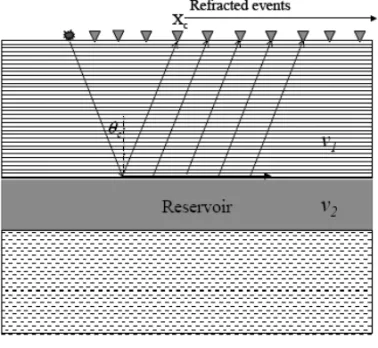
to be very sensitivity to modest variations of the reservoir P-wave velocity. The existence of a critical angle in seismic refraction le-ading to critical reflection is only possible for reflecting medium (reservoir) that offers a positive contrast in velocity with respect to the incident medium, i.e. the reservoir exhibits higher wave velo-city than the overburden. Under this condition, a critical reflection can be registered at its corresponding critical distance, as shown in Figure 1.
Figure 1– Refracted rays.
Considerable effort has been dedicated for a number of
ye-ars to find out under what circumstances4Dseismic would
pro-vide useful information on reservoir dynamics. There is a general
consensus among practitioners and researchers that4Dseismic
monitoring is particularly effective in high-porosity sandstone reservoirs. This condition is usually encountered in poorly con-solidated or unconcon-solidated reservoirs with a low degree of dia-genesis or under conditions of low effective stress.
Reservoirs subject to high effective stresses, due to low rock compliance, would exhibit very small changes in the propaga-tion velocity, even if reservoir pressure were severely altered by production events or fluid injection. Highly accurate techniques would be required to detect the expected subtle changes in the propagation velocity in this type of reservoir setting. This might not even be possible in practice.
In the case of non-clastic reservoirs, production-induced changes in density or velocity are also generally small, requiring
the development of new techniques to enable the record of such small changes (Landro et al., 2004).
All of the aforementioned ideas have been confirmed in con-ventional seismic monitoring studies for the passed 2 years. Ex-perience shows that in an overwhelming majority of the
succes-sful field cases,4Dseismic monitoring was carried out in
high-porosity sandstone reservoirs (Landro et al., 1999; Koster et al., 2000).
Critical reflection based methods can be offered as an alter-native to detecting effectively subtle changes in the propagation velocity due to fluid substitution or production events, hardly at-tainable by conventional techniques, once the hurdles are over-come and the appropriate conditions for its applicability have been identified. One important aspect of this seismic refraction
techni-que is to establish a clear understanding of how sensitive XC
is to small variations (perturbations) of depth and velocity
con-trast1V(1V = V2−V1), so that variations of the
propa-gation velocity in the reservoir can be quantitatively determined
from changes inXC. The latter heads in the direction of inverse
analysis, so rather than looking at howXCdepends on changes
in the reservoir properties, we would like to use changes inXC
to estimate reservoir properties, which would be one of the pur-pose of any time lapse seismic technique. To accomplish this
task, it is necessary to see how sensitive1V2is to changes in
XC, reservoir depth,Z, and the effective overlaying or incident
medium velocity, usually taken as the value ofVR M S.
METHOD
A minimum condition for critical reflection is a positive velo-city contrast between the incident (overburden) and the refracted
(reservoir) media, Snell law allows us to calculateXCas a
func-tion ofV1,V2, andZ. As previously stated,V1is approximated
by replacing it by the root mean square velocity value,VR M S.
Snell law yields:
XC =
2Z
r
V2 2
V2
R M S
−1
(1)
For instance, if a reservoir (reflecting medium), initially satu-rated with oil, suffers a velocity change due to fluid substitution (total oil replacement by water), Eq. (1) can be rewritten as:
XC′ =
2Z
r (V2
+1V2)2
V2
R M S
−1
(2)
where1V2represents a variation in P-wave velocity due to fluid
substitution, as indicated previously.
Landro et al. (2004) went further and subtracted Eq. (2) from Eq. (1), and then carried on with a series expansion to first order
FREDY ARTOLA, VLADIMIR ALVARADO and WILSON FIGUEIR ´O
329
in 1V2/VR M S to yield:
1XC =XC−XC′ ≈ −2
V2∙1V2 VR M S2
Z
V2 2
V2
R M S
−1
3/2 (3)
Sensitivity and uncertainty analysis
In functional terms, and direct sense,XCcan be represented as:
XC = f V2,VR M S,Z. (4)
In this context, perturbation inVR M SandZ are associated
with estimation errors (but disregarding geomechanical effects),
and perturbations inV2(1V2), linked to fluid substitution events
in the reservoir. A stochastic analysis of uncertainty propaga-tion was completed by means of Monte Carlo simulapropaga-tions. This
way, the variance ofXC was obtained in the direct formulation
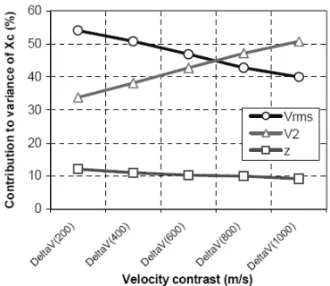
of the problem. Perturbations of input parameters were modeled as Gaussian probability density functions (PDFs). The particular choice of perturbation models was not considered too relevant, because the interest here was focused on the relative impact of the different uncertainty (sensitivity) sources. Gaussian PDFs are naturally centered, with well-defined variance values. Figure 2 shows the relative contributions of perturbations in the input pa-rameters to the variance of the critical distance as a function of the contrast between the overburden and the reservoir velocities. V2and VR M S clearly contribute dominantly to the variances,
with increasing contributions fromV2and decreasing
contribu-tions fromVR M S, with minor contributions coming from
per-turbations inZ. Analytical perturbation analysis results via
tor-nado diagrams (not shown) yielded a similar trend as those found through Monte Carlo analysis.
Figure 2– Variance components ofXCas a function of the velocity contrast.
Other simulations were carried out to evaluate the effect of
depth(Z). Figure 3 shows the increasing variance of XC as
a function of depth. This variance is larger for lower velocity contrast,(V2−V1).
Figure 3– Variance components ofXCas a function of thickness of the
over-burden.
In terms of inverse analysis, the objective is the indirect quantification of the P-wave velocity in the reservoir, due to fluid
substitution or changes in pressure. 1V2can be calculated by
rearranging Eq. (3), as follows:
1V2= −
1XC∙VR M S2
2Z∙V2
V22 VR M S2
!3/2
(5)
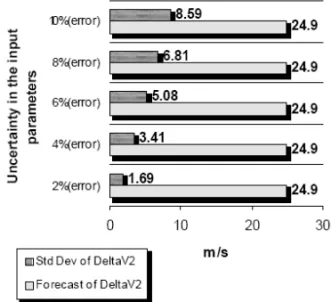
Monte Carlo simulations with total of 100,000 realizations were carried out. Each of the input parameters was considered as independent (parameters can be considered dependents) and was represented with a Gaussian PDF. The error was
calcula-ted as twice the standard deviation(ε = 2). Figure 4 shows
that1V2is more sensitivity to uncertainties inV2(for instance,
P-wave velocity in the reservoir prior to fluid substitution), fol-lowed by a significant contribution originated in uncertainties of VR M S. 1V2is relatively insensitive to errors in the remaining two parameters. Sensitivity results using examples from
Lan-dro et al. (2004), corresponding to a model withZ =2000 m,
V2 =2500 m/s,VR M S =1800 m/s, and1XC =85 m; are
shown in Figure 5.
Figure 4– Sensitivity of1V2to uncertainty in the input parameters.
330
TIME-LAPSE CRITICAL REFLECTION: DOES IT WORK IN SEISMIC MONITORING?
Figure 5–1V2uncertainties induced by uncertainties in the input parameters.
CONCLUSIONS
The results presented here show that there is a strong link between the critical distance and velocity values of both the re-servoir and the overburden. This link is a strong function of the
velocity contrast. XC grows with increasing values of the
velo-city difference, but the dependence onVR M Sor velocity in the
overburden diminishes with increasing velocity contrast instead. On the other hand, the sensitivity with respect to uncertainties in depth is a function of the overburden thickness, generally increa-sing in sensitivity with depth.
In terms of inverse analysis, results show a strong depen-dence of the reservoir velocity variations due, for instance, to
fluid substitution with respect to the estimation of the initial ve-locity. Although not negligible, there is a less significant influ-ence of overburden P-wave velocity. Therefore, even if we as-sume an undisturbed overburden (neglecting geomechanical ef-fects), changes in the P-wave velocity of the reservoir estimated by methods of critical reflection can contain significant
associ-ated uncertainty, due to uncertainties in the estimate ofVR M S.
Geomechanical effects can compromise even more the estimate
of1V2. Finally, uncertainties sources fromZand1XCcan be
neglected.
To summarize the concluding remarks, it can be stated that the method analyzed in this article can be effective if a signifi-cant contrast in elastic properties between the incident medium and the reflector exists; this turns out to be an ideal condition in carbonates. On the other hand, the greater the contrast in elastic properties, the lower the influence of errors associated to incident medium velocity (Vrms).
REFERENCES
KOSTER K, GABRIELS P, HARTUNG M, VERBEEK J, DEINUM G & STAPLES R. 2000. Time-lapse seismic surveys in the North Sea and their business impact. The Leading Edge, 19: 286–293.
LANDRO M, SOLHEIM OA, HILDE E, EKREN BO & STRONEN LK. 1999. The Gullfaks 4D Seismic Study. Petroleum Geoscience, 5: 213–226.
LANDRO M, NGUYEN AK & MEHDIZADEH H. 2004. Time lapse refrac-tion seismic – a tool for monitoring carbonate fields? In: 74th Annual International Meeting, SEG, Expanded Abstract, 2295–2298.
NOTES ABOUT THE AUTHORS
Fredy Alex Villaordu˜na Artola. B.Sc. Geological Engineering (UNI-Peru); M.Sc. Applied Geophysics, 1997 (UNB); Ph.D. Applied Geophysics, 2000 (UNB). He visited CPGG-UFBA as a postdoc researcher in 2001 and developed research projects at PUC-Rio during the period 2002-2006. Areas of interest are: Seismic Modeling, Seismic Anisotropy, Ray Theory, Multicomponent Seismology, Rock Physics, Time-Lapse Seismic Reservoir Monitoring, Geomechanics, Theoretical aspects of the Seismic Data Processing and Seismic Interpretation. He worked as Exploration Geophysicist with Gra ˜na y Montero Petrolera (1992-1995), as Processing Geophy-sicist with Petroleum Geo-Services PGS (2007). He is currently a Senior Geomechanics Specialist and Reservoir GeophyGeophy-sicist (International Mobile) with Schlumberger, Venezuela (Data and Consulting Services, DCS).
Vladimir Alvarado Bastante. Ph.D. from the Department of Chemical Engineering and Materials Science, University of Minnesota, Minneapolis, MN (1996). He received a Masters in Exploration and Production from the Institut Franc¸ais du P´etrole, Paris, France (2002). He has more than 17 years of experience in Petrophysics, Reservoir Engineering and Enhanced-Oil Recovery. He developed collaborative work on Time-lapse seismic during his stay at PUC-Rio, Brazil, between 2003 and 2005. He is currently an Assistant Professor with the Department of Chemical and Petroleum Engineering at The University of Wyoming, Laramie, WY; and a Senior Consultant with Norwest-Questa Engineering, Golden, CO.
Wilson Mouzer Figueir´o.B.Sc. (1983) in Mathematics from the Federal University of Rio de Janeiro (UFRJ). Since 1992, he has been Geophysics Professor with the Geophysics Department of the Geoscience Institute at the Federal University of Bahia (UFBA), where he teaches Mathematical Geophysics. He obtained his Ph.D. in Geophysics (1994) from UFBA. From 1997 to 1999, Figueir´o did post-doctoral studies at the Earth-Atmosphere-Ocean Department of the Superior Normal School of Paris (DTAO-ENS), France. Now, he is researcher at the Geophysics and Geology Research Center (CPGG) of the UFBA. His main areas of interest are: Geophysical Inversion and Applied Mathematics to Geophysics.