Impactos das políticas públicas ambientais em Campo Grande, MS: o caso da
área de proteção ambiental do córrego Lajeado
Impacts des politiques publiques de l’environnement en Campo Grande, MS: le
cas de Lajeado volet zone de protection de l’environnement
Impactos de las políticas públicas del medio ambiente em Campo Grande, MS: el caso
del área de protección ambiental de Lajeado corriente
Helder Pereira de Figueiredo*
Michel Ângelo Constantino**
Cristiane Camargo Sanches**
Reginaldo Brito da Costa**
Recebido em 18/05/2016; revisado e aprovado em 12/08/2016; aceito em 12/09/2016 DOI: http://dx.doi.org/10.20435/1984-042X-2016-v.17-n.4(13)
Abstract: The post-agenda 2015 of the United Nations has focused on the environment based on the defi nition of Sustainable Development Goals (SDGs). This study aims to analyse which were the positive and negative externalities generated by public policies in the environmental scope between 2000 and 2015 in the Environmental Protection Area (EPA) of the Lageado area in Campo Grande, MS, from photographic records, satellite images and direct survey with benefi ciaries. Key words: EPA; public perception; sustainability; ineffi ciency government.
Resumo: A agenda pós-2015 da ONU tem como foco o meio ambiente na defi nição dos Objetivos de Desenvolvimento Sustentável (ODS). Este estudo tem como objetivo analisar quais as exter-nalidades positivas e negativas geradas pelas políticas públicas de âmbito ambiental entre 2000 a 2015 na Área de Proteção Ambiental (APA) da região do Lajeado em Campo Grande, MS, a partir de registros fotográfi cos e imagens de satélite e pesquisa direta com benefi ciários.
Palavras-chave: APA; percepção pública; sustentabilidade; inefi ciência governamental.
Résumé: L’agenda post-2015 des Nations Unies met l’accent sur l’environnement dans la défi ni-tion des Objectifs de Développement Durable (ODD). Cette étude vise à analyser les externalités positives et négatives attendues générées par les politiques publiques pour cadre environnemental entre 2000-2015 dans la Zone de Protection de l’Environnement (ZPE) de la région Lajeado à Campo Grande, MS, à partir de documents photographiques et des images satellite et enquête directe auprès des bénéfi ciaires.
Mots clés: ZPE; perception publique; developpment durable; ineffi cacite gouvernement.
Resumen: La agenda post-2015 de las Naciones Unidas se centra en el medio ambiente en la defi nición de los Objetivos de Desarrollo Sostenible (ODS). Este estudio tiene como objetivo analizar los factores externos positivos y negativos previstos generados por las políticas públicas de marco ambiental entre 2000 a 2015 en el Área de Protección Ambiental de la región Lajeado en Campo Grande, MS, a partir de los registros fotográfi cos y las imágenes de satélite y la encuesta directa de los benefi ciarios. Palabras-clave: APA; percepción pública; sostenibilidad; gobierno inefi ciencia.
* Instituto de Perícias Científi cas, Campo Grande, Mato Grosso do Sul, Brasil. ** Universidade Católica Dom Bosco, Campo Grande, Mato Grosso do Sul, Brasil.
1 INTRODUCTION
The public policies permeate
human actions which somehow impact
on public goods. In order to ensure
One of the fundamental aspects
of the legacy of public policies are their
achieved results. Each policy or program
hasits economical and social purpose
qualitatively and quantitatively de
fi
ned,
having the community and the city as its
main bene
fi
ciaries.
In literature, there are several ways
of measuring range, impact or results of a
governmental program or public policy,
based on its goals and bene
fi
ciaries. One
of the most used methods to know the
externalities caused by governmental
intervention is to analyze data over time,
in time series showing the before and after
implementation.
In the case of preservation areas, one
exhaustedly used way by speci
fi
c studies is
the georeferenced comparison of the area,
before implementation and the results
over time, also researching how the direct
bene
fi
ciaries understand the externalities
caused by governmental intervention.
Ferreira’s (2006) studies were
fi
xed
in the Permanent Preservation Area
and in public policies in relation to their
essential ecological functions whereas
Rosa (2011) dealt with legal analysis and
their context in governmental policies.
The liability and public policies in the
environmental area of Amazonas state
were discussed by Braz (2006).
This article aimed to analyze
which were the positive and negative
externalities generated by public policies
in the environmental scope between 2000
and 2015 in the contribution basin region
of the Lajeado Stream in Campo Grande,
MS, from photographic records and direct
survey with bene
fi
ciaries of the region.
As speci
fi
c complements, the study
also tries to identify the environmental
public policies which affected the same
region between 2000 and 2015, the main
goals of those public policies and evaluate
if the aims have been achieved.
In order to develop these
pur-poses, the paper has been divided into
this introduction, literature review,
methodology, results and final
consi-derations.
2 PUBLIC POLICY: DEFINITIONS
AND THEORY
The public policies and the
policy
makers’
decisions have been theoretical
and empirical
fi
elds of study and research
for decades. In theory, the public policy
or the action public program generated
by public policy is the tool by which the
governmental entity plans and meets the
needs of its citizens through de
fi
ned actions
by its constitution. Public policy establishes
the course of the development of a nation,
a region, a microregion, a state, a city and
re
fl
ects in the institututions generated by
this development determinants, namely,
the quality of life of the population.
Public policies outline their own
state planning aimed at achieving public
interest: therefore, it is not a matter of
simple governmental priorities election,
but the concretion of option already
carried out by the legislator (FERREIRA,
2006).
Before creating pubic policies,
one nation must meet the international
treaties and guidelines of the world
development. The United Nations
Organization (UN) have de
fi
ned the
high-priority challenges for the elimination
of poverty and hunger of the planet and
have organized eight Objectives of the
Millennium Development, associated
with implementation of health, sanitation,
education, housing, promotion of gender
equality and environment policies.
In the case of public policies
with environmental nature, it is the
legislator’s responsibility the elaboration
of environmental programs and laws
giving concreteness to the Standards of the
Socioenvironmental Order. It is certainly a
complex activity because they are actions
and goals to ensure the current and future
sustainability of speci
fi
c environmental
The environmental policies are
created from international guidelines that
have sustainability as their main goal. The
policy of creation of the Environmental
Protection Areas (EPAs) in Brazil is a
deployment of the Millennium goals
in a municipal level, mainly in areas
where there is effective relevance for the
population.
The challenge of sustainability is
in the population increase and in the
way urban areas affect the environment.
Following the MDG, which were outlined
in 2000 by the Millennium Cupula
promoted by UN, it was created in the
city of Campo Grande, state of Mato
Grosso do Sul, in 2001, the EPA of the
Lajeado Stream Springs (Lajeado EPA),
with the aim of protecting the water
resources which integrate one of the
sources that supply the city. A thorough
scienti
fi
c study was carried out in 2008,
depicting an inventory of the existing
situation in Lajeado EPA. Among these
fi
ndings, environmental liabilities have
been identi
fi
ed.
The analysis of the current situation
of each of the environmental liabilities
reported in that study was the object
of this research, aiming to evaluate if
interventions for the remediation and/
or recuperation of those liabilities would
have been performed. If so, if they
would have been ef
fi
cient in the effective
elimination of the found problems .
4 THE EPA OF THE LAJEADO
STREAM SPRINGS (LAJEADO EPA)
The Environmental Protection Area
of the Lajeado Stream Springs – Lajeado
EPA, located in Campo Grande, capital
of the state of Mato Grosso do Sul, was
created through the Municipal Decree n.
8265, 27th July, 2001. It is a conservation
unit belonging to the Sustainable Use group
whose aim is to basically reconcile the
sustainable use of natural resources with
the human presence in the protected area.
In regions and municipalities,
there are suitable programs for the
implementation of regional policies
through intermunicipal consortium tools,
covering several municipalities, starting
from economical- ecological zoning.
The municipalities are ordered by
the Master Plan and their
economical-ecological zoning defined as a tool
of Environmental National Policy,
also suitable for territorial ordering
with development and occupation
standards. It must not be forgotten the
importance of economical-ecological
zoning in the municipality internal
scope (where decision-makings will be
taken for its implementation) as a way
of delimitation of areas for de
fi
nitions of
uses, protections,which is the empirical
fi
eld of this study.
3 SUSTAINABILITY CHALLENGES
In 2000, the Cupula of Millennium,
which brings together leaders from 189
countries, promoted the Declaration of
Millennium, organized by UN and de
fi
ned
the guidelines for the world development.
To Feres and Reis (2014), these guidelines
do not address in an integrated manner
the conservation of natural resources. To
the authors, the environmental issue is
addressed in a limitated way. The goal 7,
which deals speci
fi
cally with environment,
does not mention the question of the
management of natural resources and the
targets associated with environmental
sustainability lack objectivity and scienti
fi
c
theories. The post-2015 development
agenda, which will succeed the Millennium
Development Goals (MDG) will have the
challenge to integrate the sustainability to
other development dimensions (FERES;
REIS, 2014).
In this region, there is a diversi
fi
ed
occupation which comprehends local
public roads, gatherers, arterial fast
traf
fi
c streets, commercial and industrial
establishments, farming activities and
recreation rural properties and also open
and closed residential settlements; the
latter is one type of occupation that has
happened more frequently lately, which
are large encampments in usually sparcely
occupied areas of easy acess (YOUSSEF;
MALTA, 2006).
Human occupation has been a cause
for great concern due to lack of adequate
management in implementation, not to
mention the stage of operation of open
urban settlements, closed residential
condominiums, comercial and industrial
establishments as well as rural activities
related to farming and leisure.
There are great possibilities for the
occupations and population density within
the limits of the Lajeado EPA to entail
damaging effects for the springs which
integrate the Lajeado contribution basin,
where there is capture of about 12% (twelve
per cent) of water which supplies the city
of Campo Grande, MS, according to data
from the Management Plan of Springs
Lajeado Stream Environmental Protection
Area – Lajeado EPA (PMCG; AGUAS
GUARIROBA S.A., 2012), hereafter only
referenced as Management Plan.
In this context, it is essential to
analyse the externalities resulting from
the creation of the EPA and over time and
also to check the perception of population
concerning the creation of public policy
and their results.
5 METHODOLOGY
5.1 Environmental liabilities analysis
5.1.1 Comparison from the Management
Plan data
The Management Plan conducted
in the Lajeado EPA was, amongst
other elements, aimed to identify the
environmental liabilities observed on
November 20, 2008 within its 5,235
hectares of surface area through
thirty-eight photographs, in which the
geographical location, the details of
each of the observed problems and then
proposed measures for their recuperation
or remediation are described.
From these data, which were
demonstrators of the
status quo
at the time
of the Management Plan (MP) surveys,
were carried out new visits in each one of
the places, in order to check the present
situation and above all, if there was no
reversal in the framework of previously
observed environmental agression. This
comparison was made on-site with direct
identification and photographic fixing
in each of the situations, that is, the one
described in the MP (november 20, 2008)
and the identification in the research,
whose surveys were carried out on
November 13 and 14, 2015.
5.1.2 Comparison from Satellite Images
In support of
in loco
observations,
were carried images of comparison
studies of years 2008 and 2015, extracting
data from forest cover on both dates. The
2008 data are those contained in the MP,
especially in pictures 4.2.1.c (Vegetal
Cover) and 4.3.1.a (Use of Soil). The 2015
data were supported by technical work
developed by Folhes (2015).
5.2 Perception of Public Policies
Externalities with the bene
fi
ciaries
Aiming to research how the direct
bene
fi
ciaries understand the externalities
caused by governmental intervention linked
to the creation of Lajeado EPA, a survey was
held with closed questions (Likert Scale,
wide gradation levels), targeted to speci
fi
c
publics, among them government of
fi
cials
activities (Public Ministry, Law Enforcement
Agencies and Judicial Expertise), dwellers in
one of the Campo Grande Environmental
Protection Areas, (besides the Lajeado
EPA, there are the Guariroba and Ceroula
EPAs), people connected to universities,
class entities (CREA, OAB and CAU), social
organizations and also business entities with
activities in the area of in
fl
uence of EPA.
The survey was sent to 1248 people
in one of the segments above, by using
the plataform of Google Drive Forms®.
There was no need of the respondent’s
identi
fi
cation. The
fi
rst aspects covered
by the survey were the ones related
to socio-economic parameters. They
were then presented questions about the
National System of Conservation Units
(SNUC, in portuguese) were presented,
with the objective of identify the level
of absorption level of the same by the
respondentes. Covered also the analysis
of the effectiveness of the legislation (Law
9985/2000). The third stage achieved
speci
fi
c questions about the Environmental
Protection Areas (EPAs) as a whole, that
is, trying to prospect if there perception
of ef
fi
cacy due of the Law 6902/1981. The
last stage was based on questions related
to the Municipal Decree of Campo Grande,
MS, 8265/2001, which came to speci
fi
cally
establish the Lajeado EPA.
The systemic analysis of the
responses provided allowed to identiy
lhe level os awareness of the population
regarding environmental issues in general
and also as to the Lajeado EPA speci
fi
cally.
6 RESULTS AND DISCUSSION
6.1 Environmental liabilities results
6.1.1 Comparison from Management
Plan data
For identi
fi
cation of the situation
of environmental liabilities which were
detected in the research and compared to
the ones observed in the surveys which
supported the Lajeado Epa Management
Plan, the same locations, listed in annex
11 of that environmental inventory, were
covered, obtaining the following results:
6.1.1.1 Silting of the riverbed by decanters
material of the Guariroba EPA
The comparison of the pictures
below reveals that: a) there was some
natural regeneration (silting reduction),
without full success (liability not totally
reversed) ; b) the physical structure of the
dissipation box needs maintainance; c)
there were not interventions of closing in
the Permanent Preservation Area (PPA),
which was necessary to avoid cattle
trampling in the protected area.
Figure 1
– Picture on November 20, 2008.
Source: Manegement Plan. Type of liability: silting of watercourse/ silting and vegetation burial of PPA. Generated cause: service activity
Source: Research data. The liability continues as well as its deterioration by activity or generated cause of services.
Figure 3
– Picture on November 20, 2008
Source: Management Plan Type of liability: contamination by effl uents and residues / release of sewage in spring area/ watercourses. Generated cause: urban occupation.
Figure 4
– Picture on November 14, 2015,
in the same location, at the point of
coor-dinates UTM 755,293 x 7.734.581
Source: Research data.
The comparison of the above pictures
reveals that: a) There were not interventions
intended to the environmental liability
elimination although without maximizing
the preexistent problem; b) It is veri
fi
ed
a small vegetal regeneration in the PPA,
not being enough for the recuperation of
water quality; c) The release of sanitary
sewage in the spring remains and it was
also observed that urban waste is loaded
to river-bed.
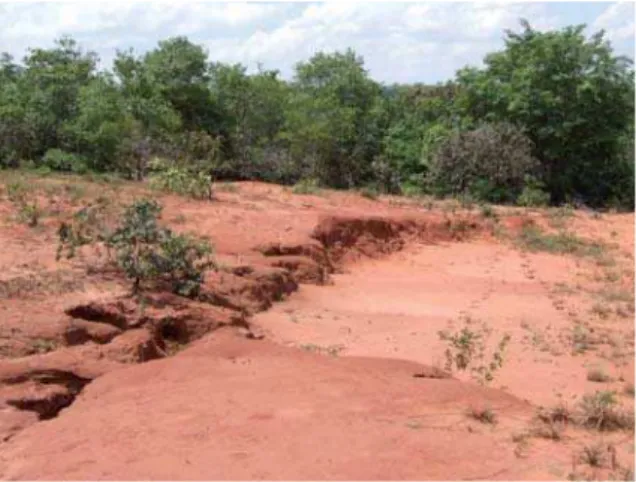
6.1.1.3 Abandoned loan area with sheet
rosion processes and in low density grooves,
probably formed during the railway
building, long completed
The comparison of the pictures
below reveals that: a) There were no
interventions for the elimination of the
problem, although there was an apparent
increase of the preexisting problem; b)
It was observed sparse undergrowth
regeneration. The sandy terrain is very
susceptible to erosion processes. Leaching
process.
Figure 5
– Picture on november 20, 2008
Source: Manegement Plan The type of liability is the sheet erosion and in grooves, where there is a not recovered support unit. Generated cause: existing building site.
Figure 6
– Picture on November 13, 2015,
in the same location, at the points of
coor-dinates UTM 759,257 x 7,732,393
The presented visual comparisons,
which have merely sample nature, reveal
that very few were the interventions
intended to mitigation or remediation of
environmental liabilities.
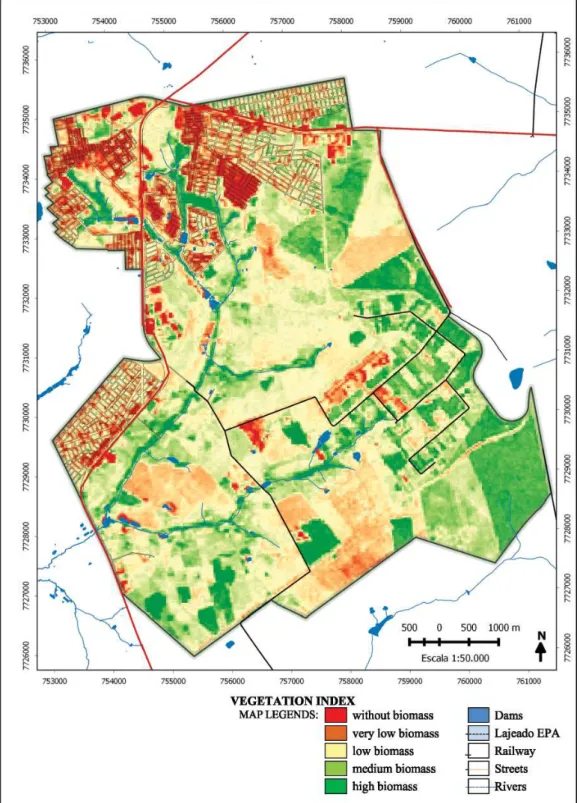
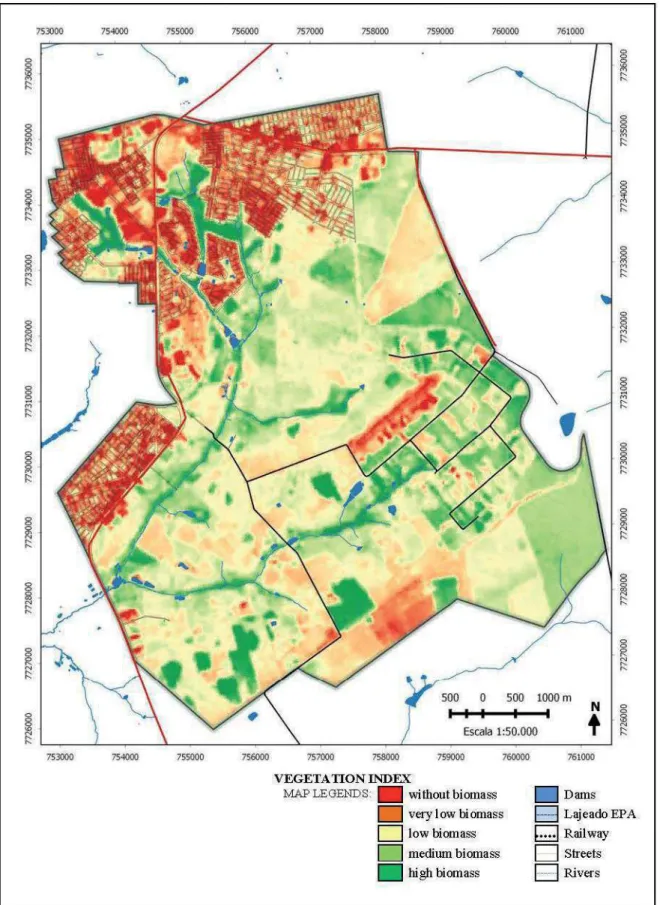
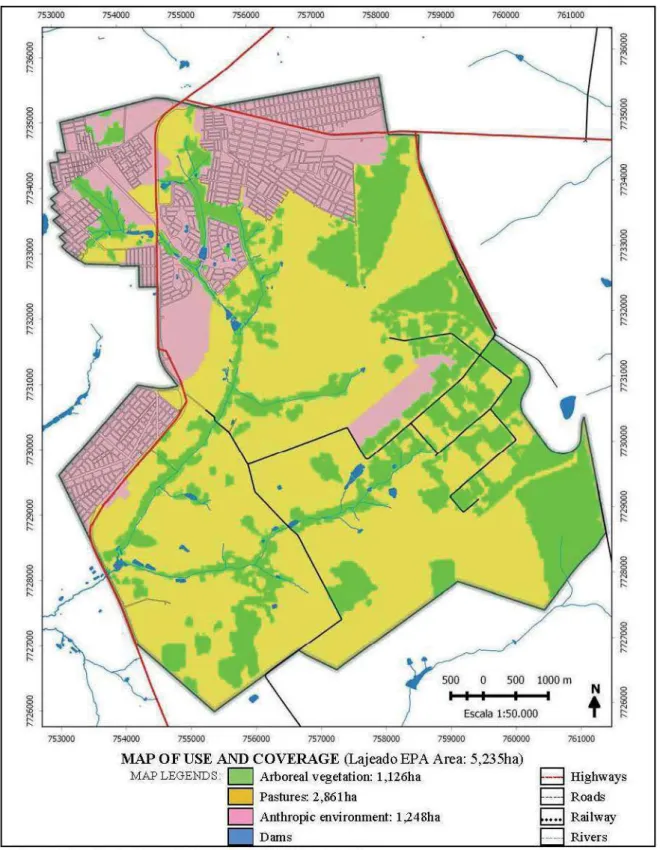
6.1.2 Comparison from satellite images
This subitem is aimed to compare
the situations of Use of the Soil and
Vegetation Index, from satellite images for
the years 2008 and 2015, according to the
calculation carried out by Folhes (2015).
Figure 7
– Vegetation Index Map on December 18, 2008 Recorded image from TM/
Landsat-5 sensor, covering the spectral bands 3, 4 and 5 in orbit/point 225/74.
Figure 8
– Vegetation Index Map on august 16, 2015. Recorded image from OLI/
Landsat-8 sensor, covering the spectral bands 2, 3, 4, 5, 6, 7 and 8 in orbit/point 225/74.
Figure 9
– Map of Soil Use on December 18, 2008. Recorded image from TM/Landsat-5
sensor, covering the spectral bands 3, 4 and 5 in orbit/point 225/74.
Figure 10
– Map of Soil Use on August 16, 2015. Recorded image from OLI/Landsat-8
sensor covering the specral bands 2, 3, 4, 5, 6, 7 and 8 in orbit/point 225/74.
The comparison of the satellite
images reveals us that: a) between 2008
and 2015 there was a reduction of 1,249ha
(23,85% of the EPA total area) to 1,126ha
(21,50% of the total area) in arboreal
vegetation existing within the limits
of EPA Lajeado; b) In 12/18/2008,
52,8% of EPA territory was occupied
by natural or planted pastures, raising
to 54,6% on 08/16/2015; c) Among
the dates, there has been a progress
of real state developments in areas
surrounding the headwaters Lajeado
stream contributors; d) The PPA, in both
analyzed passages, are not but narrow
strands of riparian vegetation along water
bodies; e) In both passages, it is observed
an important forest fragmentation, a
clearly inappropriate circumstance to
preservation of biodiversity of the region.
6.2 Analysis of Perception of
Individuals
For the analysis of perception
of individuals, the empirical research
included 118 stakes, 83,1% of the
respondents are over 31 years old and
58,55 of the total are male. Having high
schooling levels, 91,6% of the participants
have university degree, 57,65 were born
in the Middle-West region and 65,3%
have lived in Campo Grande for more
than ten years. The on-line surveys have
been sent to people directly involved in
environmental issues of the county and
of the state of Mato Grosso do Sul, where
65% of the total revealed that they know
the area and work with this theme.
6.2.1 National System of Conservation
Units (SNUC)
In relation to specific issues
concerning the SNUC – Law 9985/2000, it
was questioned if SNUC has considerably
contributed to the preservation and
restoration of the diversity of natural
ecosystems. The recorded data from
Graphic 1 show that 50,9% partially or
totally agree with the SNUC job for the
preservation and restoration of diversity
and approximately 11,8% disagree and
the others could not answer.
Graphic 1
– Perception about the SNUC contribution to the preservation
and restoration of diversity.
Being questioned about SNUC
efficiency, the interviewee have been
asked if only SNUC is enough for the
environment to be effectively protected,
due to the malpractice of fiscalization
carried out by the environmental control
organs.
Nearly 63% of the interviewed agree
that SNUC cannot provide protection
and natural preservation, according to
Graphic 2.
Graphic 2
– SNUC is not enough for the environment to be protected because
of insuf
fi
cient supervision by environmental agencies.
Source: research data.
Evaluating the perception in the
empirical field study about the Law
6902/1981 which regulates the EPA, it has
been questioned if the fact of the article
9th of the Law to establish rules to limit
or prohibit implementation and operation
of potentially polluting industries capable
of affecting water sources inside EPAs
6.2.2 PERCEPTIONS CONCERNING
LAJEADO EPA INSTITUTION
It hss been analysed in this item
the perception of the interviewed people
towards the objective of the decree of
EPA creation in Campo Grande and the
support of the supervision and execution
of protection process. As it happens in
several public policies, the inef
fi
ciency
and failure to comply with the aims and
purposes made in the creation scope, the
Lajeado EPA is one more unsuccessful item
of the list in the individuals’ perception.
The research results show that, as
the Lajeado EPA decree aims to restore,
protect and conserve the springs formed
by the Lajeado Stream Basin which
supply the city, is not fully full
fi
lling
their duty.
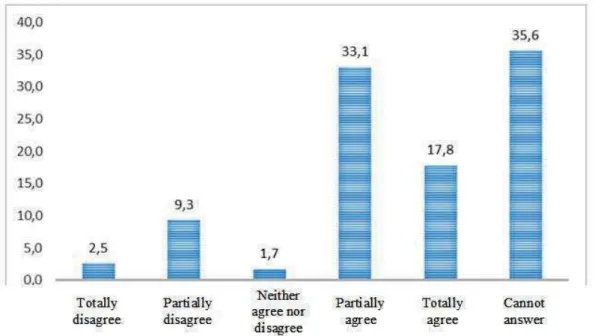
Graphic 4 shows that 36,4% of the
interviewee disagree that EPA protection
purpose is being achieves while 35,6%
agree that it is being partly achieved.
Graphic 3
:
Perception of the item “a” of article 9 of Law 6902/1981 to
esta-blish rules to limit or prohibit the operation of industries that affect water
resources within EPA.
6.2.3 Perceptions concerning Local
Supervision
Another kind of perception was to
analyse how the respondents evaluate
the environmental supervision at
Lajeado EPA carried out by Municipal
Secretaria of Sustainable Environment
and Development (SEMADUR) of Campo
Grande, MS.
Graphic 4
: The Lajeado EPA purpose of restoring, protecting and conserving
the springs formed by the Lajeado Stream Basin which supply the city.
Source: Research data.
Graphic 5
: Inef
fi
ciency due to lack of SEMADUR supervision agents
61,5% of the interviewee agree
that lack of supervision is a deterrent
factor to achieve better results while 6%
disagree. The predominant feeling is that
the supervision carried out by public
agents is not ef
fi
cient owing to lack of
human resources for its implementation.
The EPA environmental supervision
carried out by SEMADUR is not ef
fi
cient
resulting from the insuf
fi
cient material
resources, which prevents effective use
of technology in environmental control.
The combination of these data allows for
a systemic view that the inef
fi
ciency of the
public action supervision would be due to
lack of personnel associated with scarcity
of material resources for the implement.
7 FINAL CONSIDERATIONS
Since the creation of Lajeado EPA
constitutes a public policy designed to
protect the environment in general and
speci
fi
cally the springs which contribute
with approximately 12% of surface
water to the city of Campo Grande,
MS, in line with the Millennium Goals
and its efficiency would be evaluated
through positive actions, the objectives
have not been achieved, considering
that the liabilities which were evidenced
in 2008 were not reverted until 2015.
There was also reduction in the Arboreal
Vegetation Index within the protection
area, persisting faecal waste release in the
contributor streams springs. Furthermore,
not protected permanent protection areas
and intense forest fragmentation have
been evidenced.
It is observed that the feeling among
people who are directly or indirectly
connected with environmental issues is
that the simple creation of legal tools does
not entail any bene
fi
t in the institution
of public policies to be effective as
implementation institutes of life quality
of population in general.
Conclusively, there is little optimis
-tic prognosis of public policies in the
Lajeado EPA, which makes it
impera-tive to prescribe some pragmatic
ac-tions for implementation of good
envi-ronmental practices, among of which
stand out: a) need to enhance the public
agents’professionalization involved in
the environmental supervision and
man-agement in the city of Campo Grande,
MS, including better pay and autonomy
to perform their activities; b) the public
organs involved in the environmental
supervision and management must
have technological support
availabil-ity (satelitte images management with
high resolution and in real time, drones,
helicopters, etc.) and infrastructucture
for the development of their work; c) a
public policy must be implemented for
the pay of environmental services (PSA,
acronym in Portuguese), designed to
in-centive environmental interventions from
landowners, among which, the
imple-mentation of terracing and contour lines
in areas susceptible to erosion, closing of
the Permanent Preservation Areas and
the connection of forest fragmentation via
vegetation corridors which minimize the
carrying of solid and liquid waste harmful
to human health.
REFERENCES
BRAZ, Sebastião Ricardo Braga. Exigibilidade
e políticas públicas na área ambiental no estado do Amazonas. 2006. 174f. Dissertação (Mestrado em Direito Ambiental) - Programa de Pós-graduação em Direito Ambiental, Universidade do Estado do Amazonas, Manaus, AM, 2006.
FERES, José; REIS, Eustáquio. A agenda de desenvolvimento pós-2015: a questão ambiental no contexto do desenvolvimento sustentável. In: MONASTERIO, Leonardo Monteiro; NERI, Marcelo Côrtes; SOARES,
Sergei Suarez Dillon (Ed.). Brasil em
Desenvolvimento 2014: estado, planejamento e políticas públicas. Brasília: Ipea, 2014. v. 2.
a resolução CONAMA 369/2006. In: CONGRESSO DE DIREITO URBANO-AMBIENTAL, 18-20 out. 2006, Porto Alegre, RS. Anais... Porto Alegre: CORAG, 2006. p. 45.
FOLHES, Marcelo Theophilo. Resultados do
mapeamento de uso e cobertura da terra para os territórios das Áreas de Proteção Ambiental dos Mananciais do Córrego Lajeado (APA do Lajeado). Campo Grande, MS: IbiGeo – Geociência Aplicada, 2015. 7p.
PREFEITURA MUNICIPAL DE CAMPO GRANDE (PMCG); ÁGUAS GUARIROBA
S.A. Plano de Manejo da Área de Proteção
Ambiental dos Mananciais do Córrego Lajeado-APA do Lajeado. Campo Grande, MS: PMCG, 2012.
ROSA, M.D. A Relevância ambiental das áreas
de preservação permanente e sua fundamentação j u r í d i c a. P l a n e t a A m a z ô n i a . R e v i s t a Internacional de Direito Ambiental e Políticas Públicas, n. 3, p. 83-95, 2011.
YOUSSEF, L. R., MALTA, F. J. N. C. Área Residencial em Zona de Amortecimento na Apa da Serra da Mantiqueira – Região do
Vale do Paraíba, SP. Revista Ciências Humanas,
Taubaté, v. 12, n. 2, p. 75-89, jun./dez. 2006.