Intimate Partner Violence and Gender A/Symmetry: An Integrative Literature Review
Josiane Razera – Faculdade Meridional
Icaro Bonamigo Gaspodini – Faculdade Meridional (IMED)
Denise Falcke – Pontifícia Universidade Católica do Rio Grande do Sul, Porto Alegre, Brasil
Abstract
Gender stereotypes have largely been discussed in the occurrence of marital violence, mainly in international literature. The
objective was to map and analyze scientiic literature, published between 2010 and 2015, using the databases ISI Web of Science, Academic Search Complete, Medline Complete, PsycInfo e Scielo. Strings used were: a) irst search strategy – “intimate partner violence”
AND “gender symmetry”; b) second search strategy – “intimate partner violence” AND “gender asymmetry”. We analyzed 48
journal articles entirely available online. Most publications are from The United States (60.41%) and use quantitative research
designs (60.41%). The most frequently used instrument was the Revised Conlict Tactics Scales (CTS2), even though criticized
because of its checklist structure. Disagreement remains about gender a/symmetry in conjugal violence, however, an emerging
perspective afirms that these cases should not be generalized and each couple’s speciicities must be assessed. National studies
are necessary to contemplate different aspects of this phenomenon.
Keywords: symmetry; asymmetry; gender; conjugal relationships; intimate partner violence
Violência entre Parceiros Íntimos e As/simetria de Gênero: Revisão Integrativa da Literatura
Resumo
Estereótipos de gênero têm sido bastante discutidos na ocorrência de violência conjugal, principalmente na literatura
internacio-nal. Objetivou-se mapear e analisar a literatura cientíica, publicada entre os anos de 2010 e 2015, nas bases: ISI Web of Science,
Academic Search Complete, Medline Complete, PsycInfo e SciELO. Empregou-se os descritores: a) primeira estratégia de busca – “ inti-mate partner violence” AND “gender symmetry”; b) segunda estratégia de busca – “intimate partner violence” AND “gender asymmetry”.
Foram analisados 48 artigos disponíveis na íntegra. Predominaram as publicações realizadas nos Estados Unidos (60,41%),
preponderantemente de delineamento quantitativo (60,41%). O instrumento mais utilizado foi a Revised Conlict Tactics Scales (CTS2), embora criticada por se tratar de uma escala do tipo checklists. Ainda existem discórdias acerca da as/simetria de gênero
na violência conjugal, porém surge uma perspectiva que defende a não generalização desses casos e considera fundamental ava
-liar as particularidades de cada casal. Estudos nacionais são necessários para contemplar as diferentes facetas desse fenômeno.
Palavras-chave: simetria, assimetria, gênero, relações conjugais, violência entre parceiros íntimos
Violência Marital y As/simetría de Género: Una Revisión Integradora de la Literatura
Resumen
Los estereotipos de género han sido ampliamente discutidos en la ocurrencia de violencia conjugal, sobre todo en la literatura internacional. Se objetivó mapear y analizar la literatura cientíica publicada entre los años 2010 a 2015, en las bases: ISI Web of Science, Academic Search Complete, Medline Complete, PsycINFO y Scielo. Se emplearon los descriptores: a) primera estrate
-gia de búsqueda – “intimate partner violence” AND “gender symmetry”; b) segunda estrate-gia de búsqueda – “intimate partner violence” AND “gender asymmetry”. Fueron analizados 48 artículos disponibles en su totalidad. La mayoría de los publica
-ciones se realizaron en Estados Unidos (60,41%), principalmente de delineamiento cuantitativo (60,41%). El instrumento más utilizado fue la Revised Conlict Tactics Scales (CTS2), aunque fue criticado por tratarse de una escala de tipo checklists. Todavía existen desacuerdos sobre las as/simetría de género en violencia conjugal, sin embargo, en la actualidad surge una perspectiva que deiende la no generalización de esos casos y considera que es fundamental evaluar las particularidades de cada pareja. Se
necesitan estudios nacionales para contemplar las diferentes fases de este fenómeno. Palabras-clave: simetría; asimetría; género; relaciones conjugales; violencia de pareja.
Introduction
The concept of gender emerged in the late 1940s with the research of John Money, a psychologist who worked with surgery and hormone therapy for indi-viduals then called hermaphrodites (Cyrino, 2013). Although Money had considered the social construc-tion of gender (Butler, 2006), it is only since the 1970s that the movement and feminist theory embraced the
concept as a size analysis of the society and unequal relations between men and women (Mayorga, Coura, Miralles, & Cunha, 2013). This milestone allowed an understanding of the differences between male and female as no longer static and immutable (Santos & Izumino, 2005).
female phenotypes (APA, 2011). Gender, in turn, refers to the attitudes, feelings and behaviors that a particular culture associates with sex, that is, the normality of gen-der depends on the cultural expectations of male and female roles (APA, 2011). Thus, the notion of gender posits a construction of meanings made from psycho-logical, social and cultural characteristics, in addition to the biological dimension referred to as sex (Days & Machado, 2008).
The gender asymmetry, seen as inequality between men and women, reveals differences in the performance of social, cultural and family roles. To masculinity, are assigned the duties of manhood, strength and a posi-tion of power in relaposi-tionships. On the other side, on the female universe, is expected the practice of moth-erhood, care of children / household. It is expected that men and women engage in different tasks, which distance each other in terms of reason and emotion, respectively. However, even if one sees beneits in the social hierarchy of genres, it is often framed in certain social and cultural models that, if breached can cause pain (Guedes, Silva, & Coelho, 2007; Krishnan et al., 2012; Oliveira & Souza, 2006).
The sizeable impact of these differences motivates various studies in the genre issue, especially in regards to its combination with the occurrence of violence in marital relationships. Some cross-cultural studies show that the socially constructed differences between female and male put women at a disadvantage in rela-tion to men (Guedes et al., 2007, Lamoglia & Minayo, 2009), reinforcing feminist currents which understand that the fragility of a woman in relation to a man char-acterizes domestic violence mostly as gender violence, expressed in one way - offender man and victim woman (Gomes Diniz, Araújo & Coelho, 2007; Pazo & Aguiar, 2012). From this perspective, although men and women can commit acts of violence, there are signiicant dif -ferences in manner and intensity, being the woman the most debilitated (Lee, Stefani, & Park, 2014).
In contrast, another line of theory understands that blaming the men (and consequent victimization of women) may reinforce the distinction between genders (Falcke, Olive, Pink, & Bentancur, 2009; Straus, 2008). The need to look at the marital relationship, which is dynamic and not static, leads to perceive couples in vio-lent relationships as co-authors of the marital history. Thus, male or female, both can suffer or perpetrate any form of violence in the marital relationship. Studies have reported similar levels of perpetration and victim-ization of violence between men and women (Fortin,
Guay, Lavoie, Boisvert, & Beaudry, 2012; Gomez & Montesino, 2014), which leads to think that domestic violence can take on a bias that takes gender symme-try into consideration (Straus, 2008) and where marital violence is understood as an interactional phenomenon (Alvim & Souza, 2005; Falcke et al., 2009; Williams & Frieze, 2005).
There is controversy and lack of consensus in the scientiic literature regarding how the gender inluences the occurrence of intimate partner violence between spouses, which brings out the need to investigate the issue. The goal of this paper was to map and analyze the scientiic literature published between the years 2010-2015, about intimate partner violence and gender as/ symmetry, taking into consideration the goal, method, sample characteristics and the instruments used, as well as the main study results.
Method
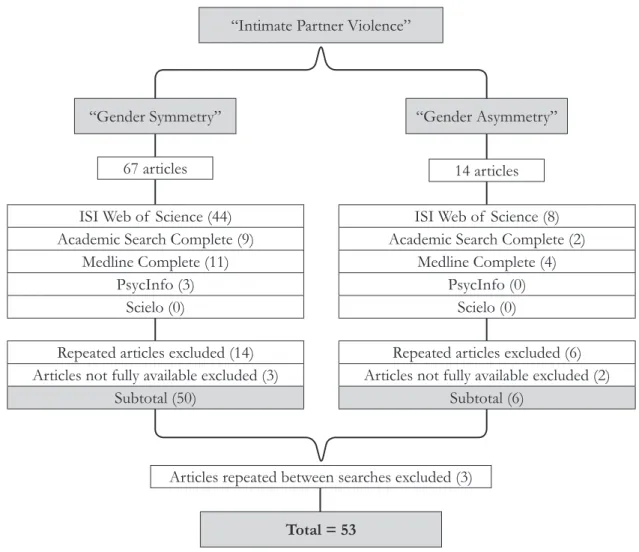
For this integrative literature review (Mendes Silveira, & Galvão, 2008), we carried out searches on articles indexed in ive databases: ISI Web of Science, Academic Search, Medline Complete, PsycInfo and Sci -elo. In order to locate articles that addressed the issues related to domestic violence and gender a/symmetry, two strategies have been carried out, with the follow-ing descriptors and Boolean operator: a) irst strategy - “intimate partner violence” AND “gender symme -try “; b) second strategy - “intimate partner violence” AND “gender asymmetry”. We opted to search for the descriptors in English language because the research in Portuguese had no results.
Total = 53
Articles repeated between searches excluded (3) “Intimate Partner Violence”
ISI Web of Science (44) Academic Search Complete (9)
Medline Complete (11) PsycInfo (3)
Scielo (0)
Repeated articles excluded (14) Articles not fully available excluded (3)
Subtotal (50) “Gender Symmetry”
67 articles
“Gender Asymmetry”
14 articles
ISI Web of Science (8) Academic Search Complete (2)
Medline Complete (4) PsycInfo (0)
Scielo (0)
Repeated articles excluded (6) Articles not fully available excluded (2)
Subtotal (6)
Figure 1. Flowchart
Results
Upon reading the articles, we found that, in regard to the country of origin of the study, the majority (58.49%) comes from the United States (31 articles). Following the distribution, the production came from the United Kingdom (5), Sweden (4), international studies (3), Australia (2), China (2), Canada (1), Ecua -dor (1), Israel (2) Slovenia (1) and Ireland (1). All were written in English and none were from Brazil.
Varied proposals were identiied in the objectives of the articles, however, all of them dealt with the dif-ferent manifestations of violence and its consequences on the health of those involved. For some, the pre-dominant was a theoretical research of controversies existent in the literature on gender a/symmetry (Chan, 2011; Enander, 2011; Hamby, 2015; Langhinrichsen-Rohling, 2010; Stark, 2010; Winstok, 2015). In other
cases, the inluence of male and female in different models of relationships was analyzed: in heterosexual individuals (Marshall, Jones, & Feinberg, 2011), homo -sexual couples (Messinger, 2011), married (Chan, 2012), separated (Johnson, Leone, & Xu, 2014) or dat -ing (Hamby & Turner, 2013; Volpe, Hardie, & Cerulli, 2012). Another highlight for the goals was the interest in validating (Lehmann, Simmons, & Pillai, 2012) or exploring (Nybergh, Taft, & Krantz, 2012) instruments, as well as to answer the questions made on the validity of the Conlict Tactics Scale (CTS) or the Revised Con -lict Tactics Scale (CTS2) (Straus, 2012).
Regarding the methodological outline, we found different results, as shown in Table 1.
2014; Chan, 2012; Jaquier & Sullivan, 2014; Johnson et al., 2014; Leonard, Winters, Kearns-Bodkin, Homish, & Kubiak, 2014; Lövestad & Krantz, 2012; Marshall et al., 2011; Renner, Habib, Stromquist, & Peek-Asa, 2014; Sillito, 2012; Sullivan et al., 2010; Volpe et al., 2012; Zanoni, Warburton, Bussey, & McMaugh, 2014). Other instruments used for the investigation of domestic vio-lence were: Relationship Behavior Rating Scale (RBRS); Ineffective Arguing Inventory; The Relationship Attri -bution Measure; Personal and Relationship Proile; Domestic Violence Screening Instrument Revised; Male Role Norms Inventory-Revised; Hostile Sexism scale; Dominance Scale; Richardson Conlict Response Questionnaire; WHO’s Violence Against Women. In cases where the objective was the investigation of domestic violence from the perspective of children and adolescents, the following instruments were used: Childhood Exposure to Domestic Violence Scale; Past Abusive Behavior Inventory; Juvenile Victimization Questionnaire; Conlict in Adolescent Dating Rela -tionships Inventory. For the investigation of coercive behaviors: Yllo’s Controlling Behavior Questions; CCB (Checklist of Controlling Behaviors); Coercive Con -trol Scale; Con-trolling Behavior Scale; Hostile Con-trol and Control; Sexual Relationship Power Scale. The authors also used other data collection techniques such as individual interviews, focus groups, life history and document analysis.
In regard to the characteristics of participants / samples of the studies, 22 empirical studies used women and men. Of the studies that used women and men, only ive conducted their research with couples (Chan, 2012; Leonard et al., 2014; Marshall et al., 2011; Renner et al., 2014; Tanha, Beck, Figueredo, & Ragha -vanet, 2010). Seven studies used a sample composed only of women (Goicolea, Öhman, Torres, Morras,
& Edin, 2012; Jaquier & Sullivan, 2014; Lehmann et al., 2012; Messinger, 2011; Simmons, Farrar, Frazer, & Thompson, 2011; Sullivan et al., 2010; Volpe et al., 2012). Finally, three studies used an exclusively male sample (Nybergh et al., 2012; Whitaker, 2013; Zanoni et al., 2014).
The results showed the different perceptions about the discussion of symmetry and asymmetry of gender and the controversies generated by this dilemma in the literature. An analysis revealed six distinct catego-ries of results, as shown in Table 2.
1) Studies show that both men and women can be perpetrators in situations of violence, however levels differ depending on the subtypes of vio-lence (Bates et al., 2014; Chan, 2012; Corbally, 2015; Hamby & Turner, 2013; Johnson et al., 2014; Lövestad & Krantz, 2012; Melander, Noel, & Tyler, 2010; Myhill, 2015; Post, Mezey, Max -well, & Rhodes, 2011; Tanha et al., 2010), which needs to be taken into account planning interven-tions (Allen, 2011; Brown, 2012; Langhinrichsen-Rohling, 2010; Stark, 2010). Also, violence tends to start asymmetrically and becomes symmetrical with time (Leonard et al., 2014).
2) Studies that emphasize the relevance of gender in domestic violence (Dragiewicz & DeKeseredy, 2012; Enander, 2011; Gerstenberger & Williams, 2013; Hamby, 2014; Johnson, 2010; Umubyeyi, Mogren, Ntaganira, & Krantz, 2014) and show that there are differences between genders in the understanding of the phenomenon. A quantitative study was conducted in the United States to check whether child custody evaluations are affected or not by the statements of judges and lawyers Table 1
Articles distributed by research outline
Outline Number of Articles Percentage
Literature Review/ Theorical 18 33.96%
Quantitative (explanatory) 14 26.41%
Quantitative (exploratory) 10 18.86%
Quantitative (descriptive) 06 11.32%
Qualitative 02 3.77%
Mixed 02 3.77%
on the occurrence of domestic violence. Clini-cal vignettes were presented to men and women and there was difference in the understanding of the data. Upon reading, men were 60% more likely to perceive mutual assault allegations, while
women demonstrated being up to 40% more likely to understand unidirectional aggression (Hans, Hardesty, Haselschwerdt, & Frey, 2014). Men tend to inhibit their aggressiveness when with their partners, not because they are their partners, but Table 2
Summary of the results of the analysed studies
Category Content Number
of Articles Articles
1 Men and women can be perpetrators in situations of violence, however, the levels vary according to the subtypes of violence
15 Allen, 2011; Bates, Graham-Kevan, & Archer, 2014; Brown, 2012; Chan, 2012; Corbally, 2015; Hamby & Turner, 2013; Johnson, Leone, & Xu, 2014; Langhinrichsen-Rohling, 2010; Leonard, Winters, Kearns-Bodkin, Homish, & Kubiak, 2014; Lövestad & Krantz, 2012; Melander, Noel, & Tyler, 2010; Myhill, 2015; Post, Mezey, Maxwell, & Rhodes, 2011; Stark, 2010; Tanha, Beck, Figueredo, & Raghavanet, 2010
2 Gender asymmetry and marital violence
8 Cross, Tee, & Campbell, 2011; Dragiewicz & DeKeseredy, 2012; Enander, 2011; Gerstenberger & Williams, 2013; Hamby, 2014; Hans, Hardesty, Haselschwerdt, & Frey, 2014; Johnson, 2010; Umubyeyi, Mogren, Ntaganira, & Krantz, 2014
3 Gender symmetry in marital violence
8 Carlyle, Scarduzio, & Slater, 2014; Chan, 2011;
Fincham, Cui, Gordon, & Ueno, 2013; Marshall, Jones, & Feinberg, 2011; Sullivan et al., 2010; Walsh et al., 2010; Winstok, 2013; Zanoni, Warburton, Bussey, & McMaugh, 2014
4 Explanation of differences in feminist studies and other approaches
2 Bumiller, 2010; Goicolea, Öhman, Torres, Morras, & Edin, 2012
5 Investigation of factors that predict marital violence
12 Ackerman, 2012; Caldwell, Swan, & Woodbrown, 2012; Jaquier & Sullivan, 2014; Melander et al., 2010; Messinger, 2011; Nybergh, Taft, & Krantzet, 2013; Nowinski & Bowen, 2011; Renner, Habib, Stromquist, & Peek-Asa, 2014; Selic, Svab, & Gucek, 2014; Sillito, 2012; Volpe, Hardie, & Cerulli, 2012; Whitaker, 2013
6 Various themes and instrument validation
because they are women, while women increase their aggressiveness with partners, not because they are men, but because they are their partners (Cross, Tee, & Campbell, 2011).
3) Studies that show similarity in female and male per -petration, revealing gender symmetry in domestic violence (Carlyle, Scarduzio, & Slater, 2014; Chan, 2011; Fincham Cui, Gordon, & Ueno, 2013; Mar -shall et al., 2011; Sullivan et al., 2010; Walsh et al., 2010; Winstok, 2013; Zanoni et al, 2014).
4) Articles that meditate on the differences in femi-nist and family studies (Goicolea et al., 2012), understanding that the feminist explanatory framework, failing to contribute to the theory and practice, made room for the triumph of “gender neutral” approaches (Bumiller, 2010).
5) Researches that investigated predictors of marital violence, such as education, depression and drug use (Melander et al., 2010), bisexuality (Messinger, 2011), social support, growing up with domestic violence and not being married (Nybergh, Taft, & Krantz, 2013); ethnicity and homosexuality (Nowinski & Bowen, 2011); power and control (Caldwell, Swan & Woodbrown, 2012; Volpe et al., 2012; Whitaker, 2013), education and unem -ployment rates (Selic, Svab, & Gucek, 2014) and post-traumatic stress disorder (Jaquier & Sullivan, 2014). In the same line, some investigated predic -tors of violence, such as depressive symptoms (Renner et al., 2014), marital dissatisfaction and divorce (Ackerman, 2012), worse physical health, depression and fear in female victims and not in male victims (Sillito, 2012).
6) Articles that addressed diverse topics associated with the gender a/symmetry and proved the validity of instruments for measuring violence (Lehmann et al., 2012; Straus, 2012), the inlu -ence of family origin (Miller, Cater, Howell, & Graham-Bermann, 2014), strategies to increase the search for help (Simmons et al., 2011), that violence in intimate relationships between ado-lescents differs from that seen in adults (Mess-inger, Fry, Rickert, Catallozzi, & Davidson, 2014) and that boundaries between acts of psychologi-cal, physical and sexual violence were indistinct among the men exposed to domestic violence (Nybergh et al., 2012).
Although there are different perspectives, researchers alert that the assumption that violence is symmetrical or asymmetrical can lead to the practice of dangerous interventions that instead of reducing the levels of violence would cause the opposite effect (Allen, 2011). Different types of violence require differ -ent types of interv-entions, and no single factor explains all sorts of intimate partner violence (Brown, 2012; Johnson, 2010; Keating, 2015; Langhinrichsen-Roh -ling, 2010; Stark, 2010; Straus, 2012). Criticizing this thought, Caldwell et al. (2012) report that the effects of violence are not equal and that women suffer more, especially in terms of injuries, fear and post-traumatic stress. With this in mind, studies suggest assessing the consequences of violence, and not only its manifesta-tions, when planning interventions (Renner et al., 2014; Sillito, 2012).
Discussion
The systematic review enabled the mapping of productions on gender a/symmetry in domestic violence, considering country of origin of the stud-ies, characteristics of sample and tools, outlines and results. It was found that, especially in the studies of quantitative design, most of the researches used the CTS and / or CTS2 to measure the perpetration and victimization of domestic violence. This instrument consists of 78 items that describe possible actions of the respondent and, reciprocally, of their partner. It has ive subscales that assess: 1) physical violence; 2) psychological aggression; 3) sexual coercion; 4) injury and 5) negotiating. Each dimension is divided into grave and minor, to assess the severity of the acts of violence. In Brazil, this instrument was validated by Moraes, Hasselmann, & Reichenheim (2002). The researches using the scale, mostly obtained results that showed a tendency to gender symmetry. Criticiz-ing this, Hamby (2014) points out that self-reported methods such as the CTS have very disparate results in comparison to other investigations. These instru-ments, or just checklists, do not represent the majority of data on intimate partner violence.
that this criticism of the results that show gender sym-metry comes from the theory that puts in check the values of “patriarchal domination.” Used worldwide, the CTS2 has high levels of validity and reliability, including in a national (Brazilian) study (Bolze, Crep-aldi, Schmidt & Vieira, 2013). The need for different instruments is evident for evaluation of violence in men and women, to include quantitative and qualita-tive paradigms.
The investigated population, men and / or women, also allows us to question the different results that were found. Some suggest that women are at a disadvantage and often suffer more violence than men (Caldwell et al., 2012), while others report that no signiicant differ -ences were found when distinguishing by gender (Bates et al., 2014), and others still, mention differences in the types of violence perpetrated by men and women (Johnson et al., 2014). Of the seven studies that evalu -ated only women, some bothered to perform analyzes that investigate potential predictors of victimization in domestic violence, noting that women who have suf-fered some form of abuse in the past were more likely to suffer domestic violence. In articles that had men as participants, the search for control of the relationship led to the physical violence perpetrated by them and partly to sexual coercion, but was not related to psy-chological violence (Whitaker, 2013). Only four articles (Leonard et al., 2014; Marshall et al., 2011; Renner et al., 2014; Tanha et al., 2010) looked to assess couples. The analysis of the marital set revealed that both men and women report victimization and perpetration of violence. Moreover, it was found that there was gen-der symmetry in the perpetration of violence, but differences in its frequency. In the same angle, a com -prehensive study presented by Razera, Mosmann and Falcke (2016) found that men committed signiicantly more sexual coercion, while women perpetrated more psychological violence, which could be linked to socio-cultural issues. While there may be differences between the types of violence committed, to separately examine the victims and perpetrators may be a bias that inlu -ences the results, so it is relevant to do further research and assess this duo.
There are studies that identify with the feminist perspective evaluation of violence, characterizing the asymmetry of gender (Gomes et al., 2007, Pazo & Aguiar, 2012), as well as others that show a relational perspective and symmetry in the relations (Fortin et al., 2012; & Gómez Montesino, 2014, Straus, 2008). Beside the two approaches mentioned, another trend brings
some controversy about this theoretical gap, seeking to relativize many aspects of asymmetry, such as that of gender symmetry (Langhinrichsen-Rohling, 2010). In this latter perspective, an extensive look at the phenom-enon is built up, understanding it from the different manifestations of violence in marriage and proposing to do less of general and more of individualized analy-sis (Casimiro, 2008). The central premise is to think of the mental health of these spouses and not to ind vic -tims and / or perpetrators.
Final Considerations
This systematic literature review identiied the lack of Brazilian studies that address gender symme-try or asymmesymme-try, within these search and inclusion criteria. In addition, it highlights the need for stud -ies that propose to carry out investigations with the marital duo, since most evaluate men or women, usually under the perspective of victims and perpetra-tors. Although this proposal is bold, the results could contribute to more effective intervention practices in which it would be possible to work together with the spouses on different ways of resolving conlict, improving communication of the couple, as well as training them to identify the main triggers of violence and how to anticipate them.
It is believed that a wide look could assist in understanding the phenomenon, which due to its com-plexity and various aspects that may be linked to the occurrence of violence. Extremist perspectives can strengthen the phenomenon of violence when blaming one or both spouses for what happened, without regard to the uniqueness of each case.
One possible limitation of this article is that the grouped descriptors may have restricted the search, although they were intended to bring the maximum results of the proposed theme. Further studies with dif-ferent methodological proposals can contribute to the scientiic development of this area, which still needs attention. Only so one can then think of proposals for effective interventions to reduce the suffering of the people involved in domestic violence contexts.
References
Allen, M. (2011). Is there gender symmetry in intimate partner violence? Child & Family Social Work, 16(3), 245-254. doi:10.1111/j.1365-2206.2010.00735.x Alvim, S. F., & Souza, L. (2005). Violência conjugal
em uma perspectiva relacional: homens e mul-heres agredidos/agressores. Psicologia: Teoria e Prática, 7(2), 171-206. Retrieved from: http://edi-torarevistas.mackenzie.br/index.php/ptp/article/ view/1041/759
American Psychological Association. (2011). Deinition
of terms: Sex, gender, gender identity, sexual orientation. Washington, DC: Author. Retrieved from: http:// www.apa.org/pi/lgbt/resources/sexuality-deini -tions.pdf
Bardin, L. (1977). Análise de conteúdo. Lisboa, Portu -gal: Edições 70.
Bates, E. A., Graham-Kevan, N., & Archer, J. (2014). Testing predictions from the male control theory of men’s partner violence. Aggressive Behavior, 40(1), 42-55. doi:10.1002/ab.21499
Bolze, S. D. A., Crepaldi, M. A., Schmidt, B., & Vieira, M. L. (2013). Relacionamento conjugal e táticas de resolução de conlito entre casais. Actualidades en Psicología, 27(114), 71-85. Retrieved from: http:// revistas.ucr.ac.cr/index.php/actualidades/article/ view/4828
Brown, J. (2012). Male perpetrators, the gender symmetry debate, and the rejection-abuse cycle implications for treatment. American Journal of Men’s Health, 6(4), 331-343. doi:10.1177/1557988312439404
Bumiller, K. (2010). The nexus of domestic violence reform and social science: From instrument of social change to institutionalized surveillance. An-nual Review of Law and Social Science, 6, 173-193. doi:10.1146/annurev-lawsocsci-102209-152813 Butler, J. (2006). Deshacer el género. Barcelona: Paidós. Caldwell, J. E., Swan, S. C., & Woodbrown, V. D.
(2012). Gender differences in intimate partner vio -lence outcomes. Psychology of Vio-lence, 2(1), 42-57. doi:10.1037/a0026296
Carlyle, K. E., Scarduzio, J. A., & Slater, M. D. (2014). Media portrayals of female perpe -trators of intimate partner violence. Journal of Interpersonal Violence, 29(13), 2394-2417. doi:10.1177/0886260513520231
Casimiro, C. (2008). Violências na conjugalidade: A questão da simetria do gênero. Análise Social, (188), 579-601. Retrieved from: http://analisesocial.ics. ul.pt/documentos/1222271301F5hRJ2yz1Oz55 WJ0.pdf
Chan, K. L. (2011). Gender differences in self-reports of intimate partner violence: A review. Aggression and Violent Behavior, 16(2), 167-175. doi:10.1016/j. avb.2011.02.008
Chan, K. L. (2012). Gender symmetry in the self-reporting of intimate partner violence. Journal of Interpersonal Violence, 27(2), 263-286. doi:10.1177/0886260511416463
Corbally, M. (2015). Accounting for intimate partner vio -lence: A biographical analysis of narrative strategies used by men experiencing IPV from their female partners. Journal of Interpersonal Violence, 30(17), 3112-3132. doi:10.1177/0886260514554429 Cross, C. P., Tee, W., & Campbell, A. (2011). Gender
symmetry in intimate aggression: An effect of intimacy or target sex? Aggressive Behavior, 37(3), 268-277. doi:10.1002/ab.20388
Cyrino, R. (2013). A produção discursiva e normativa em torno do transexualismo: Do verdadeiro sexo ao verdadeiro gênero. Crítica e Sociedade, 3(1), 92-108. Retrieved from: http://www.seer.ufu.br/ index.php/criticasociedade/article/view/19727 Dias, A. R. C., & Machado, C. (2008). Género e vio
-lência conjugal: Uma relação cultural. Análise Psicológica, 26(4), 571-586. Retrieved from: http:// www.scielo.mec.pt/pdf/aps/v26n4/v26n4a04.pdf Dragiewicz, M., & DeKeseredy, W. S. (2012). Claims
about women’s use of non-fatal force in intimate relationships: A contextual review of Canadian research. Violence against Women, 18(9), 1008-1026. doi:10.1177/1077801212460754
Enander, V. (2011). Violent women? The challenge of women’s violence in intimate heterosexual rela -tionships to feminist analyses of partner violence. NORA-Nordic Journal of Feminist and Gender Re-search, 19(2), 105-123. doi:10.1080/08038740.201 1.567999
Fincham, F. D., Cui, M., Gordon, M., & Ueno, K. (2013). What comes before why: Specifying the phenomenon of intimate partner violence. Journal of Marriage and Family, 75(2), 319-324. doi:10.1111/ jomf.12000
Fortin, I., Guay, S., Lavoie, V., Boisvert, J. M., & Be -audry, M. (2012). Intimate partner violence and psychological distress among young couples: Anal-ysis of the moderating effect of social support. Journal of Family Violence, 27(1), 63-73. doi:10.1007/ s10896-011-9402-4
Gerstenberger, C. B., & Williams, K. R. (2012). Gen -der and intimate partner violence: Does dual arrest reveal gender symmetry or asymmetry? Journal of Interpersonal Violence, 28(8) 1561-1578. doi:10.1177/0886260512468325
Goicolea, I., Öhman, A., Torres, M. S., Morras, I., & Edin, K. (2012). Condemning violence without rejecting sexism? Exploring how young men un-derstand intimate partner violence in Ecuador. Global Health Action, 5, 18049. doi:10.3402/gha. v5i0.18049
Gomes, N. P., Diniz, N. M. F., Araújo, A. J. de S., & Coelho, T. M. de F. (2007). Compreendendo a vio -lência doméstica a partir das categorias gênero e geração. Acta Paulista de Enfermagem, 20(4), 504-508. Retrieved from: http://www.scielo.br/pdf/ape/ v20n4/19.pdf
Gómez, J. L. G., & Montesino, M. L. C. (2014). Prev -alence of psychological and physical intimate partner aggression in Madrid (Spain): A dyadic analysis. Psicothema, 26(3), 343-348. doi:10.7334/ psioothema2013.262
Guedes, R. N., da Silva, A. T. M. C., & Coelho, E. D. A. C. (2009). Violência conjugal: Problematizando a opressão das mulheres vitimizadas sob olhar de gênero. Revista Eletrônica de Enfermagem, 9(2), 362-378. doi:10.1590/S1414-81452009000300024 Hamby, S. (2014). Intimate partner and sexual violence
research scientiic progress, scientiic challenges, and gender. Trauma, Violence, & Abuse, 15(3), 149-158. doi:10.1177/1524838014520723
Hamby, S. (2015). A scientiic answer to a scien -tiic question: The gender debate on intimate partner violence. Trauma, Violence, & Abuse, 1-10. doi:10.1177/1524838015596963
Hamby, S., & Turner, H. (2013). Measuring teen dating violence in males and females: Insights from the national survey of children’s exposure to violence. Psychology of Violence, 3(4), 323-339. doi:10.1037/ a0029706
Hans, J. D., Hardesty, J. L., Haselschwerdt, M. L., & Frey, L. M. (2014). The effects of domestic violence allegations on custody evaluators’ recommenda -tions. Journal of Family Psychology, 28(6), 957-966. doi:10.1037/fam0000025
Jaquier, V., & Sullivan, T. P. (2014). Fear of past abu -sive partner(s) impacts current posttraumatic stress among women experiencing partner vio-lence. Violence against Women, 20(2), 208-227. doi:10.1177/1077801214525802
Johnson, M. P. (2010). Langhinrichsen-Rohling’s conir -mation of the feminist analysis of intimate partner violence: Comment on “Controversies involving gender and intimate partner violence in the United States”. Sex Roles, 62(3-4), 212-219. doi:10.1007/ s11199-009-9697-2
Johnson, M. P., Leone, J. M., & Xu, Y. (2014). Intimate terrorism and situational couple violence in general surveys ex-spouses required. Violence against Women, 20(2), 186-207. doi:10.1177/1077801214521324 Keating, B. (2015). Violence against women: A disciplin
-ary debate and challenge. The Sociological Quarterly, 56(1), 108–124. doi:10.1111/tsq.12075
Krishnan, S., Vohra, D., De Walque, D., Medlin, C., Na -than, R., & Dow, W. H. (2012). Tanzanian couples’ perspectives on gender equity, relationship power, and intimate partner violence: Findings from the RESPECT study. AIDS Research and Treatment, 2012, 1-9. doi:10.1155/2012/187890
Lamoglia, C. V. A., & Minayo, M. C. de S. (2009). Violên -cia conjugal, um problema so-cial e de saúde pública: Estudo em uma delegacia do interior do Estado do Rio de Janeiro. Ciência & Saúde Coletiva, 14(2), 595-604. doi:10.1590/S1413-81232009000200028 Langhinrichsen-Rohling, J. (2010). Controversies in
-volving gender and intimate partner violence in the United States. Sex Roles, 62(3-4), 179-193. doi:10.1007/s11199-009-9628-2
violence in South Korea. BMC Public Health, 14(415), 1-10. doi:10.1186/1471-2458-14-415
Lehmann, P., Simmons, C. A., & Pillai, V. K. (2012). The validation of the Checklist of Controlling Behaviors (CCB): Assessing coercive control in abusive relationships. Violence against Women, 18(8), 913-933. doi:10.1177/1077801212456522
Leonard, K. E., Winters, J. J., Kearns-Bodkin, J. N., Homish, G. G., & Kubiak, A. J. (2014). Dyadic pat -terns of intimate partner violence in early marriage. Psychology of Violence, 4(4), 384-398. doi:10.1037/ a0037483
Lövestad, S., & Krantz, G. (2012). Men’s and women’s exposure and perpetration of partner violence: An epidemiological study from Sweden. BMC Public Health, 12(1), 945. doi:10.1186/1471-2458-12-945 Marshall, A. D., Jones, D. E., & Feinberg, M. E. (2011).
Enduring vulnerabilities, relationship attributions, and couple conlict: An integrative model of the occurrence and frequency of intimate partner vio-lence. Journal of Family Psychology, 25(5), 709-718. doi:10.1037/a0025279
Mayorga, C., Coura, A., Miralles, N., & Cunha, V. M. (2013). As críticas ao gênero e a pluralização do feminismo: Colonialismo, racismo e política het-erossexual. Estudos Feministas, 21(2), 463-484. doi:10.1590/S0104-026X2013000200003
Melander, L. A., Noel, H., & Tyler, K. A. (2010). Bi -directional, uni-directional, and nonviolence: A comparison of the predictors among partnered young adults. Violence and Victims, 25(5), 617-630. doi:10.1891/0886-6708.25.5.617
Mendes, K. D. S., Silveira, R. C. D. C. P., & Galvão, C. M. (2008). Revisão integrativa: Método de pesquisa para a incorporação de evidências na saúde e na enfermagem. Texto & Contexto Enfermagem, 17(4), 758-764. doi:10.1590/S0104-07072008000400018 Messinger, A. M. (2011). Invisible victims: Same-sex
IPV in the national violence against women survey. Journal of Interpersonal Violence, 26(11), 2228-2243. doi:10.1177/0886260510383023
Messinger, A. M., Fry, D. A., Rickert, V. I., Catallozzi, M., & Davidson, L. L. (2014). Extending Johnson’s intimate partner violence typology lessons from an adolescent sample. Violence against Women, 20(8), 948-971. doi:10.1177/1077801214546907
Miller, L. E., Cater, Å. K., Howell, K. H., & Graham-Bermann, S. A. (2014). Perpetration patterns and environmental contexts of IPV in Sweden: Relationships with adult mental health. Child Abuse & Neglect, 38(1), 147-158. doi:10.1016/j. chiabu.2013.10.023
Moraes, C. L., Hasselmann, M. H., & Reichenheim, M. E. (2002). Adaptação transcultural para o portu -guês do instrumento “Revised Conlict Tactics Scales (CTS2)” utilizado para identiicar violência entre casais. Cadernos de Saúde Pública, 18(1), 163-176. doi:10.1590/s0102-311x2002000100017 Myhill, A. (2015). Measuring coercive control: What
can we learn from national population sur-veys? Violence Against Women, 21(3), 355-375. doi:10.1177/1077801214568032
Nowinski, S. N., & Bowen, E. (2011). Partner violence against heterosexual and gay men: Prevalence and correlates. Aggression and Violent Behavior, 17(1), 36-52. doi:10.1016/j.avb.2011.09.005
Nybergh, L., Taft, C., & Krantz, G. (2012). Psychometric properties of the WHO Violence against Women instrument in a male population-based sample in Sweden. BMJ Open, 2(6), e002055. doi:10.1136/ bmjopen-2012-002055
Nybergh, L., Taft, C., & Krantz, G. (2013). Psychometric properties of the WHO Violence against Women instrument in a female population-based sample in Sweden: A cross-sectional survey. BMJ Open, 3(5), e002053. doi:10.1186/1471-2458-13-845
Oliveira, D. C. D., & Souza, L. D. (2006). Gênero e vio -lência conjugal: Concepções de psicólogos. Estudos e Pesquisas em Psicologia, 6(2), 34-50. Retrieved from: http://www.revispsi.uerj.br/v6n2/artigos/pdf/ v6n2a04.pdf
Pazo, C. G., & Aguiar, A. C. (2012). Sentidos da violência conjugal: Análise do banco de dados de um serviço telefônico anônimo. Revista de Saúde Coletiva, 22(1), 253-273. doi:10.1590/S0103-73312012000100014 Post, L. A., Mezey, N. J., Maxwell, C. D., & Rhodes,
Razera, J., Mosmann, C. P., & Falcke, D. (2016). The interface between quality and violence in mari-tal relationships. Paidéia, 26(63), 71-79. doi 10.1590/1982-43272663201609
Renner, L. M., Habib, L., Stromquist, A. M., & Peek-Asa, C. (2014). The association of intimate partner violence and depressive symptoms in a cohort of rural couples. The Journal of Rural Health, 30(1), 50-58. doi:10.1111/jrh.12026
Santos, C. M., & Izumino, W. P. (2005). Violência con -tra as mulheres e violência de gênero: Notas sobre estudos feministas no Brasil. Estudios Interdisciplin-arios de América Latina y El Caribe, 16(1), 148-164. Retrieved from: http://www.nevusp.org/down-loads/down083.pdf
Selic, P., Svab, I., & Gucek, N. K. (2014). A cross-sectional study identifying the pattern of factors related to psychological intimate partner violence exposure in Slovenian family practice attendees: What hurt them the most. BMC Public Health, 14(1), 223. doi:10.1186/1471-2458-14-223
Sillito, C. (2012). Gendered physical & emo -tional health consequences of situa-tional couple violence for heterosexual married & co-habiting couples. Feminist Criminology, 7(4) 255-281. doi:10.1177/1557085111431695
Simmons, C. A., Farrar, M., Frazer, K., & Thomp -son, M. J. (2011). From the voices of women: Facilitating survivor access to IPV ser -vices. Violence against Women, 17(10) 1226-1243. doi:10.1177/1077801211424476
Stark, E. (2010). Do violent acts equal abuse? Resolving the gender parity/asymmetry dilemma. Sex Roles, 62(3-4), 201-211. doi: 10.1007/s11199-009-9717-2 Straus, M. A. (2008). Dominance and symmetry in part -ner violence by male and female university in 32 nations. Children and Youth Services Review, 30, 252-275. doi:10.1016/j.childyouth.2007.10.004
Straus, M. A. (2012). Blaming the messenger for the bad news about partner violence by women: The methodological, theoretical, and value basis of the purported invalidity of the Conlict Tactics Scales.
Behavioral Sciences & The Law, 30(5), 538-556. doi:10.1002/bsl.2023
Sullivan, T. P., Titus, J. A., Holt, L. J., Swan, S. C., Fisher, B. S., & Snow, D. L. (2010). Does the
inclusion criterion of women’s aggression as op -posed to their victimization result in samples that differ on key dimensions of intimate part-ner violence? Violence against Women, 16(1), 84-98. doi:10.1177/1077801209353575
Tanha, M., Beck, C. J., Figueredo, A. J., & Raghavan, C. (2009). Sex differences in intimate partner violence and the use of coercive control as a mo-tivational factor for intimate partner violence. Journal of Interpersonal Violence, 25(10) 1836-1854. doi:10.1177/0886260509354501
Umubyeyi, A., Mogren, I., Ntaganira, J., & Krantz, G. (2014). Women are considerably more ex -posed to intimate partner violence than men in Rwanda: Results from a population-based, cross-sectional study. BMC Women’s Health, 14(1), 99. doi:10.1186/1472-6874-14-99
Volpe, E. M., Hardie, T. L., & Cerulli, C. (2012). Associations among depressive symp-toms, dating violence, and relationship power in urban, adolescent girls. Journal of Obstet-ric, Gynecologic, & Neonatal Nursing, 41(4), 506-518. doi:10.1111/j.1552-6909.2012.01384.x
Walsh, Z., Swogger, M. T., O’Connor, B. P., Chatav Schonbrun, Y., Shea, M. T., & Stuart, G. L. (2010). Subtypes of partner violence perpetrators among male and female psychiatric patients. Journal of Abnormal Psychology, 119(3), 563-574. doi:10.1037/ a0019858
Whitaker, M. P. (2013). Centrality of control-seeking in men’s intimate partner violence perpetration. Prevention Science, 14(5), 513-523. doi:10.1007/ s11121-012-0332-z
Williams, S. L., & Frieze, I. H. (2005). Patterns of violent relationships, psychological distress, and marital satisfaction in a national sample of men and wom-en. Sex Roles, 52(11-12), 771-784. doi:10.1007/ s11199-005-4198-4
Winstok, Z. (2013). From a static to a dynamic ap -proach to the study of partner violence. Sex Roles, 69(3-4), 193-204. doi:10.1007/s11199-013-0278-z Winstok, Z. (2015). Critical review of Hamby’s (2014)
Sobre os autores:
Josiane Razera is a psychologist and holds a Lato Sensu graduate Degree in Marriage and Family Dynamics from Faculdade Meridional (IMED). PhaD and MSc in Clinical Psychology (Universidade do Vale dos Sinos -UNISINOS), with a CAPES/ PROSUP Scholarship. Professor of Psychology at Faculdade Meridional (IMED).
E-mail: [email protected]
Icaro Bonamigo Gaspodini is a psychologist (Faculdade Meridional - IMED), PhD and MSc in Clinical Psychology
(Universidade do Vale dos Sinos - UNISINOS), with a CAPES/ PROSUP Scholarship. Professor of Psychology at Faculdade Meridional (IMED).
E-mail: [email protected]
Denise Falcke is a psychologist and holds a PhD from Pontifícia Universidade Católica do Rio Grande do Sul (PUCRS). Professor of Psychology at the Research Graduate Program in Clinical Psychology at Universidade do Vale do Rio dos Sinos (UNISINOS).
E-mail: [email protected]
Contato com os autores:
Faculdade Meridional – IMED
Rua Senador Pinheiro, 304 – Vila Rodrigues Passo Fundo-RS, Brasil
CEP: 99070-220
Zanoni, L., Warburton, W., Bussey, K., & McMaugh, A. (2014). Child protection fathers’ experiences of childhood, intimate partner violence and parent-ing. Children and Youth Services Review, 46, 91-102. doi:10.1016/j.childyouth.2014.08.009
Zoltowski, A. P. C., Costa, A. B., Teixeira, M. A. P., & Koller, S. H. (2014). Qualidade metodológica das
revisões sistemáticas em periódicos de psicologia brasileiros. Psicologia: Teoria e Pesquisa, 30(1), 97-104. doi:10.1590/S0102-37722014000100012