Qualidade dos alimentos: novas desafios
Braganc;:a, 2012 16-19 Setembro
The effects of e-beam radiation in the antioxidant potential of chestnuts
(
Castanea sativa
Mill.)
Márcio Carocho,1 Amilcar L. António1,2,3, Iwona Kaluska4, Albino Bento1,
Isabel C.F.R. Ferreira1,* 1
CIMO/Escola Superior Agrária, Instituto Politécnico de Bragança, Campus de Santa Apolónia, Apartado 1172, 5301-855 Bragança, Portugal.
2
IST/ITN, Instituto Superior Técnico, Instituto Tecnológico e Nuclear, Portugal
3
Departamento de Física Fundamental, Universidade de Salamanca, Spain
4
Institute of Nuclear Chemistry and Technology, Poland
Keywords: Chestnuts; e-beam; irradiation; antioxidant potential
Abstract: Chestnut fruits (Castanea sativa Mill.) are widely consumed all over the world, and have been studied in terms of nutritional value and also for their antioxidant potential. In Europe, Portugal is one of the leading producers of this nut, and its conservation is essential. Irradiation might be an alternative conservation method, since methyl bromide, a widely used fumigant, was prohibited as post-harvest technique by the European Union in 2010 due to its toxicity. The alternatives, hot water dip treatment among others, still present some disadvantages. Food treatment with radiation is environment friendly, poses no threat to consumers and is nutritionally adequate. The present study reports the effect of e-beam radiation (doses of 0, 0.5, 1 and 3 kGy, being 0 the control, non-irradiated) on the antioxidant potential of Portuguese chestnuts, as an ongoing project with previous results for gamma radiation. The antioxidant activity was evaluated through 2,2-diphenyl-1-pycryl-hydrazyl (DPPH) free radical scavenging activity assay, reducing power by the Ferricyanide/Prussian blue assay, and lipid peroxidation inhibition by β-carotene/linoleate and thiobarbituric acid reactive substances (TBARS) assays. Total phenolics and flavonoids were performed by spectrophotometric assays. Irradiated samples seemed to preserve total phenolics content (but not flavonoids) and revealed higher antioxidant activity (lower EC50 values) than the control samples. The most indicated dose to maintain antioxidants content, and to increase antioxidant activity was 1 kGy.
1. INTRODUCTION
still present some disadvantages [1,3,4]. Irradiation has been introduced as an alternative, seen as though it is environment friendly, reduces the amount of weight loss during post-harvest, doesn’t leave any residues on the fruits [4] and does not change the composition of chestnuts [5,6]. Although many studies should still be carried out, our team has already studied the effect of low doses of gamma irradiation (0.27 ± 0.04 kGy or 0.54 ± 0.04 kGy) on the antioxidant potential of chestnuts, being concluded that the application of gamma irradiation seemed to be advantageous for antioxidant activity, independently of the dose used [7]. Nevertheless, storage time altered the chestnuts antioxidant potential in a greater manner than radiation.
2. MATERIALS AND METHODS
2.1. Samples irradiation
Chestnuts samples were obtained from Bragança, Portugal, and divided into four groups: control (non-irradiated), sample 1 (0.5 kGy), sample 2 (1 kGy) and sample 3 (3kG). The irradiation with electrons was performed with an e-beam of 10 MeV of energy. A pulse duration of 5.5 µs, a pulse frequency of 440 Hz, an average beam current of 1.1 mA, and a scan width of 68 cm.
2.2. Antioxidant activity evaluation
After irradiation, all the samples were lyophilized, reduced to a fine dried powder and mixed to obtain homogenate samples. The lyophilized powder (1 g) was stirred with methanol (30 mL) and filtered through “Whatman” No. 4 paper. The combined methanolic extracts were evaporated under reduced pressure, re-dissolved in methanol at 10 mg/mL (stock solution), and successive dilutions were made from this solution and submitted to in vitro assays already described by the authors [7]. The sample concentrations providing 50% of antioxidant activity or 0.5 of absorbance (EC50) were calculated from the graphs of antioxidant activity percentages (DPPH, β-carotene/linoleate and TBARS assays) or absorbance at 690 nm (reducing power assay) against sample concentrations. Trolox was used as standard.
Total phenolics: The extract solution (1 mL) was mixed with Folin–Ciocalteu reagent (5 mL, previously diluted with water 1:10, v/v) and sodium carbonate (75 g/L, 4 mL). The tubes were vortex mixed for 15 s and allowed to stand for 30 min at 40 ºC for color development. Absorbance was then measured at 765 nm. The results were expressed as mg of gallic acid equivalents (GAE) per g of extract.
DPPH radical scavenging activity: This methodology was performed using an ELX800 Microplate Reader (Bio-Tek). The reaction mixture in each one of the 96-wells consisted of one of the different concentrations of the extracts (30 µL) and methanolic solution (270 µL) containing DPPH radicals (6×10⁻⁵ mol/L). The mixture was left to stand for 60 min in the dark and the absorption was measured at 515 nm.
Reducing power: The different concentrations of the extracts (0.5 mL) were mixed with sodium phosphate buffer (200 mmol/L, pH 6.6, 0.5 mL) and potassium ferricyanide (1% w/v, 0.5 mL). The mixture was incubated at 50 ºC for 20 min, and trichloroacetic acid (10% w/v, 0.5 mL) was added. The mixture (0.8 mL) was pipeted in the 48 wells with deionized water (0.8 mL) and ferric chloride (0.1% w/v, 0.16 mL), and the absorbance was measured at 690 nm in the microplate reader described above.
Inhibition of β-carotene bleaching: β-carotene (2 mg) was dissolved in chloroform (10 mL). After the chloroform was removed at 40 ºC under vacuum, linoleic acid (40 mg), Tween 80 emulsifier (400 mg), and distilled water (100 mL) were added to the flask with vigorous shaking. Aliquots (4.8 mL) of this emulsion were transferred into different test tubes containing different concentrations of the extracts (0.2 mL). The tubes were shaken and incubated at 50 ºC in a water bath. As soon as the emulsion was added to each tube, the zero time absorbance was measured at 470 nm. It was measured once again after 2 hours of heated bath, and the β-carotene bleaching was calculated.
TBARS assay: Porcine (Sus scrofa) brains, obtained from an official slaughter house, were homogenized in Tris–HCl buffer (20 mM, pH 7.4) to produce a 1:2 w/v brain tissue homogenate which was centrifuged at 3000g for 10 min. An aliquot (100 µL) of the supernatant was incubated with the different concentrations of the samples solutions (200 µL) in the presence of FeSO4 (10 mM; 100 µL) and ascorbic acid (0.1 mM; 100 µL) at 37 ºC for 1 h. The reaction was stopped by the addition of trichloroacetic acid (28% w/v, 500 µL), followed by thiobarbituric acid (TBA, 2%, w/v, 380 µL), and the mixture was then heated at 80 ºC for 20 min. After centrifugation at 3000g for 10 min, the color intensity of the MDA– TBA complex in the supernatant was measured by its absorbance at 532 nm.
2.3. Statistical analysis
Three replicates of each sample were used and all the assays were carried out in triplicate. The results are expressed as mean values and standard deviation (SD). The results were analyzed using one-way analysis of variance (ANOVA) followed by Tukey’s HSD Test with α = 0.05. This analysis was carried out using SPSS v. 18.0 program.
3. RESULTS AND DISCUSSION
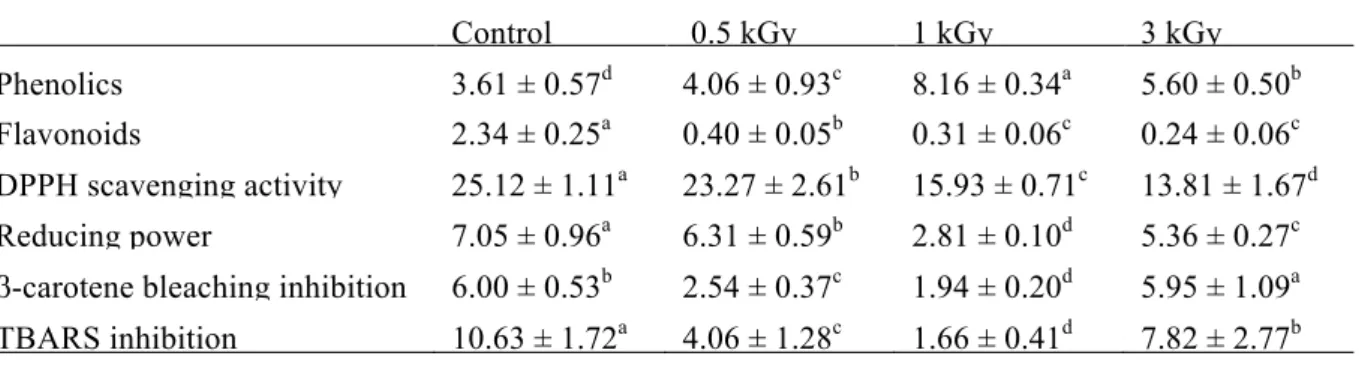
The results obtained for the samples are presented in Table 1. The best irradiation dose was 1 kGy, where the samples revealed the highest phenolic content (8.16 mg GAE/g extract) and the highest antioxidant activity (lowest EC50 values, 1.66 to 2.81 mg/mL), except for the DPPH scavenging
preserve phenolics since these samples present higher concentrations of the mentioned compounds than the control sample (non-irradiated) (Table 1). Moreover, all the irradiated samples (0.5, 1 and 3 kGy) revealed higher antioxidant activity than the control sample in all the assayed methods.
Table 1. Phenolics (mg GAE/g extract), flavonoids (mg CE/g extract) and antioxidant activity (EC50
values, mg/mL) of chestnuts submitted to electron beam irradiation. Mean±SD (n=9).
Control 0.5 kGy 1 kGy 3 kGy
Phenolics 3.61 ± 0.57d 4.06 ± 0.93c 8.16 ± 0.34a 5.60 ± 0.50b
Flavonoids 2.34 ± 0.25a 0.40 ± 0.05b 0.31 ± 0.06c 0.24 ± 0.06c
DPPH scavenging activity 25.12 ± 1.11a 23.27 ± 2.61b 15.93 ± 0.71c 13.81 ± 1.67d
Reducing power 7.05 ± 0.96a 6.31 ± 0.59b 2.81 ± 0.10d 5.36 ± 0.27c
β-carotene bleaching inhibition 6.00 ± 0.53b 2.54 ± 0.37c 1.94 ± 0.20d 5.95 ± 1.09a
TBARS inhibition 10.63 ± 1.72a 4.06 ± 1.28c 1.66 ± 0.41d 7.82 ± 2.77b
Irradiated samples showed higher DPPH scavenging activity, reducing power and β-carotene bleaching inhibition than control samples. The most indicated doses to maintain antioxidants content, and to increase antioxidant activity was 1 kGy followed by 3 kGy. Future studies should be performed in order to evaluate the effects of irradiation in individual phenolic compounds, using chromatographic techniques.
Acknowledgements
ON.2-QREN-EU Project nº 13198/2010 for financial support; M. Carocho and A. L. Antonio grant: ON.2/QREN/EU Project no. 13198/2010 and SFRH/PROTEC/67398/2010, respectively. Finally, we thank Prof. A. Chmielewski, General Director of the Institute of Nuclear Chemistry and Technology, Warsaw, Poland, for allowing e-beam irradiations.
References
[1] J.C.M. Barreira, S. Casal, I.C.F.R. Ferreira, M.B.P.P. Oliveira, J.A.Pereira - J. Agri. Food Chem. 57 (2009) 2836-2842.
[2] O. Borges, B. Gonçalves, J.L.S. Carvalho, P. Correira, A.P.Silva – Food Chem. 106 (2008) 976-984.
[3] J.C.M. Barreira, I.C.F.R. Ferreira, M.B.P.P. Oliveira, J.A.Pereira – Food Chem. 107 (2008) 1106 – 1113.
[4] UNEP, Montreal Protocol on substances that deplete the ozone layer, 2006. Report of the Methyl Bromide Technical Options Committee, 205–206, 310–313
[5] Â. Fernandes, J.C.M. Barreira, A.L. António, A. Bento, M.L. Botelho, I.C.F.R. Ferreira – Food Chem. Toxicol. 49 (2011) 2429 – 2432.
[6] M. Jeremini, M. Conedera, T.N. Sieber, A. Sassella, H. Schärer, G. Jelmini, E. Höhn - J. Sci. Food Agric. 86 (2006) 877 – 885.